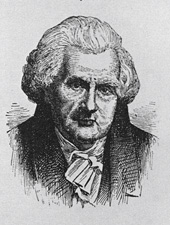
Stephen Mix Mitchell (1743–1835, shown here) was a lawyer in Wethersfield, Connecticut, having spent the 1760s as a student and then tutor at Yale College.
On 19 Sept 1774, Mitchell wrote to the merchant Peter Verstille in Boston. He first discussed his recent trip to the Rev. Eleazar Wheelock’s school, the challenges of collecting debts that season, and land that Gov. Francis Bernard might have been granted in Vermont.
Then Mitchell turned to the political turmoil in New England, addressing Verstille as representative of Boston and Massachusetts (which he wasn’t, but that’s another story):
We in the Country are more engaged for your Liberties (as I am told) than you are yourselves, you cannot conceive the Ardor of our people when the late Alarm happend. They flew to their Arms as readily as if they had been told their Wives & Children were captivated & carried of by a foreign foe,It took some effort to track down Mitchell’s allusion to the “brave Earl of Warren.” Tobias Smollett’s Complete History of England told the story of John de Warenne, 6th Earl of Surrey (1231–1304), this way:
I am fully convinced that the Country will never swallow these Acts of Parliament untill four fifths of the people are slain, the general say is “Tis a Country for which our fathers fought, bled & died with Savages, a Country for which we are not beholden to Great Britain, whose Liberties we will not give up but with our Lives——[”]
The Unanimity is beyond all Expectation. I have had Opportunity to enquire particularly in four or five Towns round about us which contain each about 4000 [sic] Inhabitants & not a Man whom the warmest Sons of Liberty do even suspect would not sacrifice his Life rather than submit....if this matter should come to blows, God only knows what would be the Event of it,
the Day is come when the friends of government at home can not say tis a Rabble who oppose them for tis now the land holders the freemen of our Towns those who have something to lose who are now ye. Zealous Patriots of the Day, & they will send their Sons to defend their Liberties; those who in the late warr would give 50 & 60 Dollars to hire a man to go into ye warr to get their Sons excused, are now determind. to trust the Defence of their Liberties in the hands of none but of their own families…
they say they chuse to live on their wonted good Terms with Great Britain, they chuse peace they chuse dependance on their mother Country, but if they must have warr or submit to these Duties & Marks of Slavery they have no Hesitancy in chusing the former;
they look up their old Deeds of patents from the Govt. & Company of the Colony when they read your Bill for regulating the Government of the Massachusetts Day, & then argue with themselves thus, “tis by this Deed I tho’t I held my land, this Deed is founded on our own Charter & what prevents our Charter from being taken from us, as that of our Neighbours has been? Then what security have I that I can hold my land by?”
Upon this the old Gray heads draw their old rusty Swords & order them to be cleand. & say like the brave Earl of Warren in another Case, “by this my father held & won his Land & by this I & my Children will defend it”—
This is no fiction but the cool deliberate Determination of the people, people who are friends to order & good government, & they are determind. this Time not to trust solely to the Virtue of the Merchants respecting non Importation, they will suffer no Mercht. To bring Goods.
the earl of Warenne, who being required by the judges to produce his charter, unsheathed an old rusty sword, as the instrument by which his ancestors had acquired their lands, and with which he resolved to preserve them to the last drop of his blood. This bold answer gave [King] Edward to understand, that his inquisition would be attended with very dangerous consequences…In the mid-1780s Mitchell represented Connecticut in the Confederation Congress. He was later appointed to the U.S. Senate to serve out Roger Sherman’s term, but his main government service was as a judge on Connecticut’s supreme court.
Mitchell’s letter is now at the American Philosophical Society and has been scanned as part of its Revolutionary City website. I haven’t found it transcribed anywhere before.
I would like to see more research into this issue — whether, and to what extent, New England residents feared that changes in their colonial charters would be a pretext for voiding their land titles. I think it may have been a bigger factor than most historians realize. As this letter points out, land ownership was practically sacred to rural New Englanders. Their ancestors had fought politically for those charters, and sometimes they had fought wars too; and in turn the charters guaranteed their property rights. They had made the land arable and productive, providing them food and revenue. Land ownership in turn gave them the right to vote and participate in government. Taxes in rural communities were also based on land values.
ReplyDeleteBy contrast, much of rural England was still essentially on a feudal system, where those who tilled the land were peasants, tenant farmers who paid rent to wealthy lords, and who had no voting or property rights.
When the first charter of the Massachusetts Bay Colony was revoked in the 1680s, to make way for the Dominion and Governor Andros, there were worries that land titles would be invalidated and that farmers would need to pay rent for land they had previously owned. The fight to oust Andros, and to gain the new Provincial charter, was still remembered in 1770s Massachusetts. In Vermont, disputes over validity of land titles led to the 1777 rebellion and the independent Vermont Republic. Now we see this letter from Connecticut, indicating that residents there feared loss of their land, and their rights, in 1774.
I wonder if further research might discover more examples of these worries, providing a greater rationale for New England's ardor against the Mother Country's policies in 1774 and '75.
And the converse was true on the other side of the Atlantic. The British governing class, including Members of Parliament, the King's Ministers, and officers of the military, simply could not envision farmers as anything but peasants, and thus were astonished when New Englanders dared to fight back against the greatest Army in the world.
In the early part of this letter Mitchell also refers to how certain land to the north was thought to be part of New Hampshire but was then ruled to be in New York. He wasn’t taking sides in that dispute, though. He seems to have simply looking for a potential profit in a claim Sir Francis Bernard might be willing to give up. But another example of how a person might lose his claim on land because of a decision made on the other side of the ocean.
ReplyDelete