J. L. BELL is a Massachusetts writer who specializes in (among other things) the start of the American Revolution in and around Boston. He is particularly interested in the experiences of children in 1765-75. He has published scholarly papers and popular articles for both children and adults. He was consultant for an episode of History Detectives, and contributed to a display at Minute Man National Historic Park.

Subscribe thru Follow.it


•••••••••••••••••


Showing posts with label Connecticut. Show all posts

Monday, September 07, 2026

“Ever afterwards, he was known as Dr. Bush”

David Bushnell’s pioneering submarine didn’t do much damage to the Royal Navy in 1776, but the next year he came back with another invention.

As Christian McBurney relates in this article, in August 1777 Bushnell oversaw an attack on H.M.S. Cerberus with explosive mines. They didn’t hit the warship, but they did destroy a schooner and kill three British sailors.

In August 1779 Bushnell became an officer in a new Continental corps of “Sappers and Miners.” Two years later, Capt. Bushnell led his specialized unit in the siege of Yorktown.

In 1787 Bushnell moved from Connecticut to France. There’s not much evidence of what he did there. Some people speculate that he crossed paths with Robert Fulton, who would design his own submarine as well as a steamboat. However, it looks to me like Fulton didn’t go to France until 1797, and by then Bushnell was back in the U.S. of A.

Not in Connecticut, however. Instead, Bushnell settled in Georgia “in 1795 or 96,” according to the Rev. George White’s Historical Collections of Georgia (1854). At first he was “a teacher in the County of Columbia.”
He was eminently distinguished for his classical and scientific learning. His chief enjoyments were found in the instruction of his classes, and an occasional visit to a few men of congenial spirit. . . .

His old fellow soldier, the Hon. Abraham Baldwin, received him into his family, under whose auspices he had no difficulty in placing himself at the head of one of the most respectable schools in Georgia. In this vocation he spent several years, and under his guidance and tuition many of our most useful citizens received valuable instructions in learning and morals.
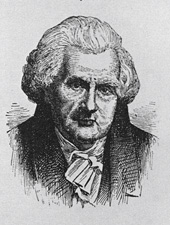
Bushnell and Baldwin (1754–1807, shown above) had met at Yale in the early 1770s. Baldwin was barely a “fellow soldier,” though; he had been a chaplain for Connecticut troops but spent most of the war preparing for the Congregationalist pulpit. Then in 1783 he suddenly changed direction, became a lawyer, and moved to Georgia.

Within a few years Baldwin was representing the state in the Confederation Congress, the Constitutional Convention, and the first federal House of Representatives. He also served as president of the nascent University of Georgia while it was organized.

As for the “family” that Baldwin welcomed Bushnell into, both men were lifelong bachelors. It looks like Bushnell shared Baldwin’s house for several years before the younger man died suddenly in 1807 while serving in the U.S. Senate.

The Historical Collections of Georgia profile of Bushnell continued:
Late in life, he settled in Warrenton as a practitioner of physic. Then, and ever afterwards, he was known as Dr. Bush. For reasons which have never been disclosed, he had some time before he settled in Georgia, dropped the last syllable of his name; and until the publication of his last will and testament, no person in this country, except his old friend Baldwin, was apprised of the fact that his family name was Bushnell.
The name of “David Bush, Phicion [physician]” does appear on Georgia tax records for 1805, owning “Stock in trade & House adjoining Warrenton.” Three years later, he bought more real estate. In 1810 David Bush was one of the commissioners to incorporate the town of Warrenton, named for Dr. Joseph Warren.

At least one other local did know Dr. Bush’s real name, however. In 1814 George Hargraves, a notary in Warren County, wrote a letter to Thomas Jefferson enclosing a “description and drawing of a Torpedo” that might be useful to the U.S. in the current war. He said the inventor was “a man of science” mentioned in David Ramsay’s history of the Revolution, hinting: “you will readily conjecture who the Inventor is.” Bushnell must therefore have entrusted Hargraves with his secret, just as he trusted the man to be an executor of his will.

Dr. Bush probably died in early 1826. Hargraves started advertising for his debtors to come pay what they owed the estate on 15 March of that year.

On 9 August an item appeared in the Middlesex Gazette of Middletown, Connecticut, reminding readers about Bushnell and his “destructive machine.” It reported:
About 30 years since, Mr. Bushnell left his native town, and from that period no information was received respecting him, until very recently, when a gentleman arrived in Saybrook from Georgia, with the intelligence that Mr. Bushnell had lately died in that State, leaving about 9,000 dollars in cash; accumulated principally by the practice of Medicine; which Mr. B. had given to him, he being a particular friend, provided that if he should, upon inquiry, discover that Mr. B’s connexions in Saybrook, were from their character, worthy of the property, such connexions were to receive the whole amount.

The gentleman with whom it was entrusted, ascertained, on reaching Saybrook, that Mr. Bushnell’s nearest relatives were four nephews, and those all men of worth and integrity, and faithfully divided the property among them.
Those were the sons of David Bushnell’s brother Ezra. In addition to the money, this article said, he bequeathed them an “unfinished a piece of mechanism, upon which he had bestowed much pains”—but what it was, the newspaper didn’t, or couldn’t, say.

The Middlesex Gazette stated: “Mr. Bushnell…bore a very high reputation as a mechanical genius, and was esteemed an exemplary member of society, although possessing many eccentricities of character.” Again, the paper didn’t say what those eccentricities were.

Sunday, September 06, 2026

“Came under the bottom of the ship”

After his brother Ezra Bushnell fell ill, the inventor David Bushnell asked Gen. Samuel Holden Parsons to send three men who might be able to operate his submarine against the Royal Navy in New York harbor.

Parsons already had a list of volunteers ready to sail a fireship toward the fleet, another risky venture. One of them was his brother-in-law, Sgt. Ezra Lee (1749–1821, shown here).

Bushnell brought the machine back to Saybrook, Connecticut, for the three men to practice. Eventually Lee got the assignment. His mission: Screw a timed explosive charge (Bushnell’s other invention, called the “magazine”) to the hull of H.M.S. Asia.

Lee went into action on 6 Sept 1776, 250 years ago today. Decades later, in 1815, he wrote an account of his mission for David Humphreys:
We set off from the City—the Whale boats towed me as nigh the ships, as they dared to go, and then cast me off—I soon found that it was too early in the tide, as it carried me down by the ships—I however hove about, and rowed for 5 glasses, by the ships’ bells, before the tide slacked so that I could get along side of the man of war, which lay above the transports—

The Moon was about 2 hours high, and the daylight about one—when I rowed under the stern of the ship, could see the men on deck, & hear them talk—I then shut down all the doors, sunk down, and came under the bottom of the ship, up with the screw against the bottom but found that it would not enter—

I pulled along to try another place, but deviated a little one side, and immediately rode with great velocity, and come above the surface 2 or 3 feet between the ship and the daylight—then sunk again like a porpoise I hove partly about to try again, but on further thought I gave out, knowing that as soon as it was light the ships boats would be rowing in all directions, and I thought the best generalship, was to retreat, as fast as I could as I had 4 miles to go, before passing Governor’s Island.—

So I jogg’d on as fast as I could, and my compass being then of no use to me, I was obliged to rise up every few minutes to see that I sailed in the right direction, and for this purpose keeping the machine on the surface of the water, and the doors open—

I was much afraid of getting aground on the island as the Tide of the flood set on the north point While on my passage up to the City, my course owing to the above circumstances, was very crooked & zig zag, and the enemy’s attention was drawn towards me, from Governors Island—

When I was abreast of the fort on the island 3 or 400 men got upon the parapet to observe me,—at leangth a number came down to the shore, shoved off a 12 oar’d barge, with 5 or 6 sitters, and pulled for me—I eyed them, and when they had got within 50 or 60 yards of me, I let loose the magazine, in hopes, that if they should take me, they would likewise pick up the magazine, and then we should all be blown up together, but as kind Providence would have it, they took fright, and returned to the island, to my infinite joy.—

I then weathered the Island, and our people seeing me, came off with a whaleboat, and towed me in—

The Magazine after getting a little past the Island, went off with a tremendous explosion, throwing up large bodies of water to an immense height.
On seeing that explosion, Humphreys wrote, Gen. Israel Putnam shouted, “God’s curse ’em, that’ll do it for ’em.” But the bomb merely startled the enemy, not doing any physical damage.

Why hadn’t Sgt. Lee been able to attach that bomb to H.M.S. Asia as planned? Humphreys explained:
The reason why the screw would not enter, was that the ship’s bottom being coppered it would have been difficult under any circumstances to have peirced through it—but on attempting to bore with the auger, the force necessary to be used in pressing against the ships bottom, caused the machine to rebound off
In this series about David Bushnell and his submarine, I’ve cut down long letters that the U.S. Navy has collected on this website. Though the submarine was a top-secret operation in 1776, men like Humphreys and Thomas Jefferson made a concerted effort after the war to gather information about the machine and its operation.

Authors have written several books about the submarine. I’m linking to Arthur S. Lefkowitz’s The American Turtle Submarine because he gave me a nifty cap.

TOMORROW: Bushnell’s secrets.

Saturday, September 05, 2026

“The first essays with the submarine Vessel”

On 2 Feb 1776, David Bushnell journeyed from his workshop in Saybrook, Connecticut, to Lebanon to meet with Gov. Jonathan Trumbull and his Council, telling those gentlemen about his “machine contrived to blow ships.”

After Bushnell left the room, the officials voted to keep the conversation secret and to send Matthew Griswold, the deputy governor, to Bushnell with £60 to encourage his work.

Back home, Bushnell resumed work on his machine—the first submarine to be deployed in warfare.

Years later, Bushnell described his invention to a curious Thomas Jefferson:
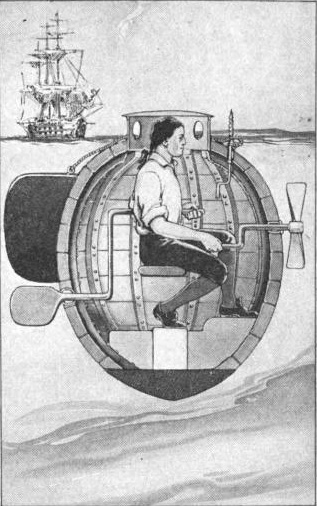
The external shape of the Submarine Vessel bore some resemblance to two upper tortoise shells of equal size, joined together: the place of entrance into the Vessel being represented by the opening, made by the swell of the shells, at the head of the animal. The inside was capable of containing the Operator, and air, sufficient to supply him, thirty minutes, without receiving fresh air.

At the bottom, opposite to the entrance, was fixed a quantity of lead for ballast. At one edge, which was directly before the operator, who sat upright, was an oar, for rowing forward or backward. At the other edge, was a rudder for steering. An aperture, at the bottom, with its valve, was designed to admit water for the purpose of descending; & two brass forcing pumps served to eject the water within, when necessary for ascending. At the top, there was likewise an oar, for ascending or descending, or continuing at any particular depth. A Watergage or Barometer, determined the depth of descent, a compass directed the course, & a ventilator within, supplied the Vessel with fresh air, when on the surface. . . .

The skilful operator could swim so low on the surface of the water, as to approach very near a Ship, in the Night, without fear of being discovered, and might if he chose, approach the stem or stern, above water, with very little danger. He could sink very quick, keep at any depth he pleased, and row a great distance, in any direction he desired, without coming to the surface; & when he rose to the surface, he would soon obtain a fresh supply of air, when, if necessary, he might descend again and pursue his course. . . .

In the first essays with the submarine Vessel, I took care to prove its strength to sustain the great pressures of the incumbent water when sunk deep, before I trusted any person to descend much below the surface: and I never suffered any person to go under water without having a strong piece of rigging made fast to it, until I found him well acquainted with the operations necessary for his safety. After that I made him descend and continue at particular depths, without rising or sinking, row by the compass, approach a Vessel, go under her, and fix the Woodscrew…into her Bottom, &c. until I thought him sufficiently expert to put my design into execution.

I found agreeably to my expectation, that it required many trials to make a person of common ingenuity, a skilful operator. The first I employed was very ingenious and made himself master of the business, but was taken sick in the campaign of 1776 at N.York, before he had an opportunity to make use of his skill, and never recovered his health sufficiently afterwards.
David Bushnell’s first operator was his own brother Ezra. They had inherited a farm together, and Ezra had bought out David’s interest to give him the capital to attend Yale College—an unusual course for a man in his late twenties.

Jefferson had Bushnell’s detailed description of his invention published by the American Philosophical Society in 1799. Those documents serve as the source for all attempts to depict and recreate the submarine, such as the 1916 illustration above.

TOMORROW: Into action.

Friday, September 04, 2026

“An account of the progress of our machine”

On 31 Aug 1775, the Rev. Benjamin Boardman, serving as a chaplain to Connecticut troops at the siege of Boston, wrote in his diary:
I collected this day in cash for the encouragt. of Mr. Bushnels Machine the sum of £13.4.4. in cash out of our regt.
Boardman was a graduate of Yale, and David Bushnell (1740–1826) had just graduated from that college.

On 24 September, Dr. Benjamin Church wrote to his British army contact:
The distroying the Ships in the manner I wrote you before they began to dispair of tho’ the former of the Machine is full of faith that he can do it, Works on hardly and so let him, I say.
This intel might have referred to the same machine, or to different technology designed to damage Royal Navy ships.

Bushnell’s invention was still in the works, but getting closer to completion, when the doctor and inventor Benjamin Gale (1715–1790) wrote from Killingworth to Silas Deane at the Continental Congress on 9 November:
In your last you requested I would give you an account of the progress of our machine, and whether anything may be expected of it. I now sit down to give you a succinct but imperfect account of its structure, which is so complicated that it is impossible to give a perfect idea of it. . . .

I conclude by the time this reaches you the machine will be in camp. Lately he has conducted matters and his designs with the greatest secrecy, both for the personal safety of the navigator as to produce the greatest astonishment to those against whom it is designed,—

if this projection succeeds, of which I make no doubt, as I well know the man and have seen the machine while in embryo, and every addition made to it fills me with fresh astonishment and surprize. And you may call me a visionary, an enthusiast, or what you please,—I do insist upon it, that I believe the inspiration of the Almighty has given him understanding for this very purpose and design.
But two weeks later, on 22 November, Gale had to report a delay:
I have to ask pardon for the wrong information I gave you. At the time of my last writing, I supposed the Machine was gone, but since find one proving the navigation of it in Connecticut River. The forcing pump made by Mr. [Isaac] Doolittle, not being made according to order given, did not answer; which has delayed him. The trials I mentioned to have been made since Dr. [Benjamin] Franklin’s being here, was the explosion, which prov’d beyond expectation.
The most famous American scientist of the day had stopped in Saybrook on his way back from Cambridge to Philadelphia in order to inspect this invention.

Gale sent another update and plea to Deane on 7 December:
…everything answers well, but still, he fails on one account. He proposes going in the night, on account of safety. He always depends on fox-wood, which gives light in the dark, to fix on the points of the needle of his compass, and in his barometer, by which he may know what course to steer and the depth he is under water, both which are absolute necessity for personal safety of the navigator; but he now finds that the frost wholly destroys that quality in that wood, of which he was before ignorant, and for that reason and that alone he is obliged to desist. He was detained near two months for want of money, and before he could obtain it the season was so far advanced he was, in the manner I have now related, frustrated. . . .

The person, the inventor of this machine, now makes all his affairs a secret even to his best friends, and I have liberty to communicate this much from him only with a view to know if Dr. Franklin knows of any kind of phosphorus that will answer his purpose; otherwise the execution must be omitted until next spring, after the frosts are past.
As of 1 February, Gale was still seeking some phosphorescent material for Bushnell. He wrote, “I have lately seen the man, and conversed freely with him. He is no enthusiast; a perfect philosopher, and by no means doubtful of succeeding.” But the siege of Boston would end before warm weather.

TOMORROW: A new campaign.

(Several replicas of the Bushnell’s machine have been built over the years based on the verbal descriptions. The one shown above was in Westbrook, Connecticut, as of last year.)

Wednesday, September 02, 2026

“Those who have something to lose who are now ye. Zealous Patriots of the Day”

Since this is the anniversary of the 1774 “Powder Alarm” in Cambridge, I’m quoting from a letter that discusses that event and the surrounding political environment.

Stephen Mix Mitchell (1743–1835, shown here) was a lawyer in Wethersfield, Connecticut, having spent the 1760s as a student and then tutor at Yale College.

On 19 Sept 1774, Mitchell wrote to the merchant Peter Verstille in Boston. He first discussed his recent trip to the Rev. Eleazar Wheelock’s school, the challenges of collecting debts that season, and land that Gov. Francis Bernard might have been granted in Vermont.

Then Mitchell turned to the political turmoil in New England, addressing Verstille as representative of Boston and Massachusetts (which he wasn’t, but that’s another story):
We in the Country are more engaged for your Liberties (as I am told) than you are yourselves, you cannot conceive the Ardor of our people when the late Alarm happend. They flew to their Arms as readily as if they had been told their Wives & Children were captivated & carried of by a foreign foe,

I am fully convinced that the Country will never swallow these Acts of Parliament untill four fifths of the people are slain, the general say is “Tis a Country for which our fathers fought, bled & died with Savages, a Country for which we are not beholden to Great Britain, whose Liberties we will not give up but with our Lives——[”]

The Unanimity is beyond all Expectation. I have had Opportunity to enquire particularly in four or five Towns round about us which contain each about 4000 [sic] Inhabitants & not a Man whom the warmest Sons of Liberty do even suspect would not sacrifice his Life rather than submit....if this matter should come to blows, God only knows what would be the Event of it,

the Day is come when the friends of government at home can not say tis a Rabble who oppose them for tis now the land holders the freemen of our Towns those who have something to lose who are now ye. Zealous Patriots of the Day, & they will send their Sons to defend their Liberties; those who in the late warr would give 50 & 60 Dollars to hire a man to go into ye warr to get their Sons excused, are now determind. to trust the Defence of their Liberties in the hands of none but of their own families…

they say they chuse to live on their wonted good Terms with Great Britain, they chuse peace they chuse dependance on their mother Country, but if they must have warr or submit to these Duties & Marks of Slavery they have no Hesitancy in chusing the former;

they look up their old Deeds of patents from the Govt. & Company of the Colony when they read your Bill for regulating the Government of the Massachusetts Day, & then argue with themselves thus, “tis by this Deed I tho’t I held my land, this Deed is founded on our own Charter & what prevents our Charter from being taken from us, as that of our Neighbours has been? Then what security have I that I can hold my land by?”

Upon this the old Gray heads draw their old rusty Swords & order them to be cleand. & say like the brave Earl of Warren in another Case, “by this my father held & won his Land & by this I & my Children will defend it”—

This is no fiction but the cool deliberate Determination of the people, people who are friends to order & good government, & they are determind. this Time not to trust solely to the Virtue of the Merchants respecting non Importation, they will suffer no Mercht. To bring Goods.
It took some effort to track down Mitchell’s allusion to the “brave Earl of Warren.” Tobias Smollett’s Complete History of England told the story of John de Warenne, 6th Earl of Surrey (1231–1304), this way:
the earl of Warenne, who being required by the judges to produce his charter, unsheathed an old rusty sword, as the instrument by which his ancestors had acquired their lands, and with which he resolved to preserve them to the last drop of his blood. This bold answer gave [King] Edward to understand, that his inquisition would be attended with very dangerous consequences…
In the mid-1780s Mitchell represented Connecticut in the Confederation Congress. He was later appointed to the U.S. Senate to serve out Roger Sherman’s term, but his main government service was as a judge on Connecticut’s supreme court.

Mitchell’s letter is now at the American Philosophical Society and has been scanned as part of its Revolutionary City website. I haven’t found it transcribed anywhere before.

Thursday, August 20, 2026

The Capture and Release of Capt. Samuel Richards

By 1777, both sides of the Revolutionary War held a significant number of prisoners.

Some of those people were soldiers or sailors captured in military operations while others had been detained as politically suspect.

American authorities were ready to arrange exchange prisoners as long as the British released someone of equal importance.

There were disputes about what that meant, of course. In July, a Boston crowd forcibly prevented Dr. Benjamin Church, suspected traitor and spy, from being traded for Dr. James McHenry, a young military surgeon who had already been paroled.

The Massachusetts government balked at releasing the Loyalist merchant Benjamin Davis, Sr., until a petition linked his case to Samuel Richards of Norwalk, Connecticut, as quoted yesterday.

Richards (1716–1777) lived in the village of Rowayton. He was a committee man clamping down on local Loyalism and captain of the militia company that guarded the shore.

Another Norwalk man, Stephen Hoyt (c. 1750–1809), had crossed to Long Island, New York, to work for the Crown. He cruised the coast in a sloop, picking up recruits for a Loyalist regiment called the Prince of Wales’s American Volunteers.

On the rainy night of 16 March, Capt. Hoyt led about twenty men into Rowayton to raid Richards’s farm. He captured fifteen armed men, including Capt. Richards, three Continental soldiers on leave, and eleven local guards.

Hoyt took those prisoners to New York, where they were locked up in the Provost jail. On 10 April the city’s Royal American Gazette praised the raid: “Such excursions as these will keep the Rebels in constant trepidation & give life & Spirit to our new made Soldiers & Officers.”

In May, Richards’s brother petitioned the Massachusetts General Court to exchange Benjamin Davis, Sr., for Capt. Richards. The legislature approved that plan on 2 June.

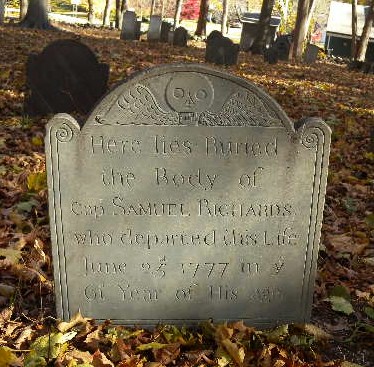
Davis traveled to New York. Samuel Richards returned to Norwalk but died very soon after, on 23 June. His gravestone appears above, courtesy of Find a Grave.

TOMORROW: Benjamin, Jr.

Wednesday, August 19, 2026

“Leave for his brother Benjamin, his son and servant, to depart this State”

As the year 1777 began, the Loyalist Benjamin Davis remained in the Boston jail along with his son and an enslaved servant.

Davis refused to petition the Massachusetts General Court for his release since he didn’t want to recognize the independent state government. But his religious scruples didn’t stop his brother Edward.

On 4 February, Massachusetts Council member Benjamin Austin came into the assembly chamber with
a petition of Edward Davis, of Boston, in behalf of his brother, Benjamin Davis, and son, prisoners in Boston Goal, praying that they may be permitted to go with a cartel to Newport
A “cartel” was the mechanism for a prisoner exchange.

The legislature named a joint committee of Austin and two House members to consider the request. The next day, that committee recommended “That the petitioner have leave to withdraw the same.” The General Court approved. That was a polite way of saying no.

On 18 February, jailer Joseph Otis listed his prisoners. Among the men noted as “being Enemical to the States” was Benjamin Davis but not his son. Benjamin, Jr., might have been paroled into the town, or at twenty years old he might still have been too young to merit his own listing.

On 6 March, the House noted
A petition of Edward Davis, praying leave for his brother Benjamin, his son and servant, to depart this State, in a cartel vessel bound for Halifax.
This time the response was “Read and dismissed.” That was a blunt way of saying no.

A newly elected legislature took their seats in May. Even as the House was getting itself in order
Nathan Cushing, Esq; brought down a Petition of James Richards, of Norwalk, praying that Mr. Benjamin Davis, a Prisoner in Boston, may be exchanged for his Brother Capt. Samuel Richards, a close Prisoner in New York Goal.
Again, the lawmakers referred this to a committee.

On 2 June, the Massachusetts House and Council reached this agreement:
Resolved that the prayer of the within petition be granted, & that Benjamin Davis now a Prisoner in the Goal in the town of Boston, be exchanged for Capt. Samuel Richards a prisoner in New York, provided that proper care be taken that sd Davis does not carry any papers with him & is cautiously sarched when deliver’d up. And it is also

Resolved that Benjamin Davis junr. Son of the aforesaid Davis, now a Prisoner in Boston Goal be exchanged for Mr John Callender a Prisoner in New York, provided due caution be taken that he does not carry any papers with him & is properly sarched when deliver’d up. But if said Callender or some person of equal rank should not be procured in Exchange for said Davis that said Davis be returned to this State.
Two days later, according to what Davis later told the British government, he was let out of the Boston jail. By the end of the year, it appears, the Davises were established in New York.

TOMORROW: The other side of those exchanges.

Saturday, August 15, 2026

Spreading the News of the Spread of a Fire

We can see the spread of news in the spring of 1775 through articles on the fire in Boston on the night of 17–18 May 1775.

The first printed report appeared in Samuel Hall’s Cambridge-based New-England Chronicle on 18 May, in the middle of other local news:
A terrible Fire broke out in Boston about 9 o’Clock last Evening, and raged a long Time. We hear it began just above the Draw Bridge, and burnt along the Town-Dock. A great Number of Buildings are doubtless consumed; but it is not possible to collect the Particulars for this Paper.
That same dire but vague paragraph was reprinted in Hartford on 22 May, Portsmouth on 26 May, and Philadelphia on 29 May.

Ebenezer Watson’s Connecticut Courant of Hartford confirmed that report in the 22 May issue by also quoting “a Letter from a Gentlemen in Cambridge…dated May 18”:
They had a great Fire in Boston last Night---it appeared to be between King-Street and the Market---it continued all night, and is not yet extinguished. What has really happened, is to us uncertain, as yet.
James Rivington chose to run the latter item in his 25 May New-York Gazetteer.

Meanwhile, on 22 May Solomon Southwick’s Newport Mercury offered an extract from “a manuscript account of the fire which happened in Boston last Wednesday night”:
The fire began in the barracks, under the arch formerly improved by Benjamin Davis, about half after eight o’clock, 17th May.—The soldiers were receiving some cartridges, by which means one took fire, and communicated to many more, which immediately set fire to the room.
That account then listed many property owners starting with John Hancock and including “a cooper’s shop, owned by Eliakim Hutchinson, adjoining the town dock, improved for barracks.” It concluded:
Instead of ringing the bells as usual, the soldiers beat to arms, by which means the people were in great confusion, not being used to such signals in time of fire.

N.B. The inhabitants took particular care to save the goods in Mr. Hancock’s store.
Curiously, in his 26 May New-Hampshire Gazette Daniel Fowle printed a version of that same detailed report on page 1 even as on page 3 he ran the New-England Chronicle’s first story saying it was “not possible to collect the Particulars for this Paper.”

John Holt put the “manuscript account” in his New-York Journal on 1 June with the dateline “CAMBRIDGE, May 12”—an obvious error since the fire hadn’t yet occurred then. Presumably Holt’s shop should have printed 19, 21, or 22 May, getting one digit wrong or transposing them.

No newspaper was published in Cambridge on those dates, suggesting Holt indeed took that text from a manuscript, not from a preceding newspaper. In addition, that text never appeared in the New-England Chronicle, the only newspaper then published out of Cambridge.

That strongly suggests that the Patriot authorities in Cambridge, perhaps Boston town officials in exile, sent their own quasi-official report on the fire out to newspapers in other colonies.

TOMORROW: A more pointed description.

Tuesday, July 28, 2026

“Praying for an Act of Assembly to hang the Memorialist”

At the end of August 1771, Richard Steele finished a very busy year.

Since the start of September 1770, the young man had been:
  • convicted of theft, whipped, cropped, and branded twice
  • locked up seven times, twice in irons
  • escaped three times
  • acquitted of theft twice
All those events were reported in Connecticut’s newspapers. And then we don’t hear about Steele’s activity for three years.

That said, on 15 October the Connecticut Courant in Hartford ran a long essay, filling most of a newspaper page and headed:
A MEMORIAL, praying for an Act of Assembly to hang the Memorialist.

To the Honorable the General Assembly of the Colony of Connecticut, to be conven’d at New-Haven, on the second Thursday of October, 1771.

The MEMORIAL of Richard Steele Burglarian, now confin’d in Fairfield Goal, in behalf of himself and the rest of the Housebreakers who now, or hereafter may, practice their calling and profession, within said colony
In this context the word “memorial” meant a memorandum, not a remembrance of the dead (yet).

The author was not Richard Steele but someone (ironically) stealing his persona to complain, for himself and fellow criminals, about the state of legal justice in the colony. The essay was dated September, and its writer was apparently unaware that in late August a court acquitted Steele of the charges that had landed him in the Fairfield jail. Not that such knowledge would have made the author happy.

The essay argued that under Connecticut’s legal system “the reformation of the punished—has…never been to any degree effected.” Yet “the confining of us to hard labour” was “utterly inconsistent with the privileges and liberties of Englishmen.”

That left only one course of action: “That your honors would order, decree and enact that the first offence be punished with death.”

It’s a weird use of sarcasm. I suspect that the real target was talk of establishing a prison to lock up convicted criminals for long terms. The essayist expressed hope
That the proposal for confining us to hard labour may (as we are confident it will) be treated with the contempt it deserves.
The Connecticut assembly didn’t approve converting the Simsbury copper mine into a prison until October 1773, but this looks like an attempt to quash that proposal early. It didn’t work.

Indeed, Richard Steele probably was the sort of criminal the New-Gate Prison was designed for. The traditional corporal punishments hadn’t deterred him, and by the end of 1770 he had no more ears to crop. Yet juries may have been reluctant to send the young man to the gallows for property crimes—hence the two acquittals in 1771.

An underground prison might have looked like the best way to keep Richard Steele off the streets.

COMING UP: Steele goes to New-Gate.

Monday, July 27, 2026

“Steel made a most vigorous Resistance”

The 7 May 1771 Connecticut Courant newspaper of Hartford repeated Sheriff Ezekiel Williams’s wanted notice for Richard Steele that I quoted yesterday.

Folks up in Hartford Country didn’t know that Steele was once again in jail.

Four days earlier, on 3 May, the Connecticut Journal of New Haven reported:
Last Monday [29 April], the notorious Burglar, Richard Steel, was taken up at Milford, and conveyed to Fairfield Goal, (charged with several Burglaries and Thefts, since his late Escape from Hartford Goal, the last of which was committed in Stratford) also one Evens, an occasional Landlord of Steel’s, and as whose House he was taken; Steel made a most vigorous Resistance, and wounded the Person in the Head, with a Cutlass who took him.
The same item was reprinted in the 18 May Providence Gazette with the landlord’s name spelled “Evans.”

As far as I can tell, this was the first time Steele was accused of a violent act, as opposed to stealing clothing, jewelry, or horses.

Steele had a record of breaking out of jails, but Fairfield County managed to hold onto him. On 30 July, the Connecticut Courant ran this item:
NEW-HAVEN, July 26.

A few Days ago a Letter from the notorious Richard Steel (now in Fairfield Goal, and who is to be tried for his Life for Burglary at the next Superior Court) directed to a Woman belonging to Milford, named Alling was intercepted, the Contents of which was to desire her to be out of the Way at the Time of his Tryal, she being the principal Witness against him;——but to prevent her escape she was last Evening committed to the Goal in this Town; not being able to procure Bail.
Steele thus stayed in custody until his case came up in August. Furthermore, Connecticut authorities had detained two possible accomplices or witnesses against him. Surely he wouldn’t get away with his crimes again!

On 27 August, the Connecticut Courant reported:
The notorious Richard Steel, so well known in this Town and County, and who was tried for his Life for Burglary last March Term, in this Place and acquitted, was again tried for his Life last Week at Fairfield for a like Offence, and again acquitted.
TOMORROW: The “Memorial of Richard Steele.”

Sunday, July 26, 2026

“The notorious Burglarian, that called himself Richard Steel”

Yesterday we left young Richard Steele back in the custody of Hartford County law enforcement in February 1771.

According to the 27 August Connecticut Courant, Steele “was tried for his Life for Burglary last March Term, in this Place and acquitted.”

Acquitted! The man was already being labeled “notorious.” But the evidence must not have been strong enough this time.

Nonetheless, the Connecticut authorities detained Steele on the grounds that he hadn’t paid the costs of his last case. That kept him off the streets for a few weeks, but the 2 April Connecticut Courant reported:
A few Days since the noted Richard Steel was dismissed from Goal in this Place, where he had been confined for Costs on his last Trial for Burglary——and on Tuesday Night last Week [26 March] he broke open the House of Mr. —— Kibbe, of Enfield, and rob’d it of sundry Articles and a small Sum in Money; from thence he went to the Barn of Mr. Terry of Enfield, and stole a Horse, and made off; but he was pursued and taken the next Day at Weston, and on Saturday returned to his former Lodgings in this Place, where it is hoped he will be confined till he shall receive a full Reward for all his past Offences.
Those hopes were soon dashed, though. This advertisement appeared in the 23 April Connecticut Courant and ran in that newspaper through early May:
Hartford, April 16, 1771

BROKE out of the county Gaol in this town, last Night and escaped, the following persons viz.

The notorious Burglarian, that called himself Richard Steel, that has been twice crop’d and branded, and was at March Court, in Hartford, again tried for the third Offence, but found not guilty, pursuing his old Trade, was again taken up and closely confined in Irons, but has found Means to get them off.

His appearance is that of a likely young Man of about 21 year of Age, about middling for Height somewha [sic] slender, has a lively, keen, dark colour’d Eye and is finely pitted with the Small Pox, wears his Hair, pretty dark Colour’d, but not unlikely he may soon get a wig to cover his Ears; he is pretty quick and lively in speaking, and has a little different Manner from persons born among us.
After descriptions of two other escapees, the same ad listed:
Also a woman called Rosanna Blanchard, who had been convicted of harbouring and entertaining the above named Steel and punished, and was held for the Cost.

Whoever shall take up either of the first mentioned notorious Criminals, and secure them that they may be brought to Justice, shall have a Reward of Forty Shillings; Lawful Money, and all necessary Charges paid;…and for the woman, Ten Shillings.

Ezekiel Williams, Sheriff.
The same newspaper carried this notice:
Ten Dollars Reward.

STOLEN from the Subscriber, out of his Stable in Hartford, on the Evening of the 17th Inst. a dark brown, or black colour’d MARE, with white on her near hind Foot, had on her Breast, the Mark or Print of a Collar, about fourteen Hands High, five years old; said Mare is well shaped, very high Liv’d, and good Carriage, both Paces and Trots. ALSO a plain Russett SADDLE, with a Saddle Cloth, and Bridle.—

Said Mare, &c. is supposed to be Stolen by that notorious Burglarian, who calls himself by the Name of Richard Steel, he hath been twice Crop’d and Branded within 12 Months past. Said Steel, broke out of Hartford Goal but two Nights before said Mare was Stolen, is about 21 Years old, of a middling Stature, somewhat slender, of a genteel Shape and Appearance, hath lively Dark coloured Eyes, and is very finely pitted with the Small Pox, Dark coloured Hair, European Born.

Whoever shall Apprehend and Secure said Thief, so that he may be brought to Justice, or shall secure said Mare, Saddle and Bridle, so that the Owner may have them again, shall have a Reward of TEN DOLLARS, Paid by me,
WILLIAM HOOKER.

Hartford, April 20th, 1771.
The description of Steele as “European Born” and the statement that “has a little different Manner from persons born among us” suggests that he had grown up somewhere in the British Isles.

By this time Steele was so infamous that people were assuming he was responsible for thefts simply because he was in the vicinity. Those accusations may well have been accurate, but the authorities would need better evidence if they wanted to convict him.

TOMORROW: A summer in jail.

Saturday, July 25, 2026

“When at liberty very sociable and familiar”

Yesterday’s posting left Richard Steele in New Haven, Connecticut, in December 1770, being branded and cropped on his ear the second time in a few months.

(I presume his right ear was cropped first, then his left, but the newspaper accounts don’t specify that.)

You might think that punishment would have taught Steele the error of his ways, or at least made it harder for him to keep committing crimes.

But no, Steele managed to get in one more theft before the end of the year, according to the Connecticut Journal of 4 Jan 1771:
----Stop the Felons!----

A Goldsmith’s Shop, belonging to the Subscriber in Waterbury, was broken up, on the Night of the 27th Instant, and sundry Pair of Stone Ear Rings, one Pair Stone Buttons, one Pair Gold ditto, and one Gold Ring, with some Shillings in Coppers, and some other Money, and likely some other Articles of Goldsmith’s Ware, was taken away, supposed by one Richard Steele, (and his Partner unknown) who was lately punished for breaking open Mr. Marks’s House in Derby.

Said Steele is of middling Stature, about 21 Years of Age, has dark brown Hair, not much curl’d, black Eyes, and beautiful Complection, but much Pockbroken, both Ears crop’d, branded twice in the Forehead, wears a brownish Coat, check’d woollen Shirt, old leather Breeches, and Hat slop’d.

Whoever will take up said Steele, or his Accomplice, and secure him or them, and notify me, shall have Three Dollars Reward, and necessary Charges paid, by
JOSEPH HOPKINS.
Dec. 31, 1770.
The 8 January Connecticut Courant, published in Steele’s usual haunt of Hartford, summarized the news about him for local readers.

Then on 5 February the Connecticut Courant had good news:
The Thief is Caught!

And was last thursday bro’t to this town and again committed to goal. He is perhaps the most notorious one that ever infested this colony, was last September before the hon. Superior Court, held in this place, convicted of Burglary by the name of Richard Steele, and in consequence thereof crop’d and branded, not long after which he broke goal, and escaped but pursuing his trade, was again taken for Burglary committed in Derby, and indicted at New-Haven before the adjourn’d Superior Court in December last, for the second offence, and again crop’d and branded, and very soon after escaped from that goal, and has since (perhaps) committed more Burglary’s than ever the notorious [Isaac] Frasier who was hanged at Fairfield ever did in so short a time.

He is now put in irons in very close confinement but least he should again escape, would that the world might know him, observe that he is a young man of about 20 years old, rather of a slender make, and about or little more than middling for stature, his facce [sic] finely pitted with the small pox, has a keen black eye, wears his own hair, of a very dark colour, pretty well down on his forehead in order no doubt to hide his scars, is a very lively active man and I believe when at liberty very sociable and familiar.

He had on him now when taken a light coloured surtout, of a cloth call’d bearskin or coating, most probably stolen from Mr. Ingersol of Westfield; a strait bodyed coat, stolen from Dr. Hooker of this town, trim’d with silver buttons, one each of which was wrote at large Sept. 2d, Daniel Hooker 1764; also 2 summer jackets stolen out of Mr. Mattock’s shop a barber in this place from whom also it is supposed, he took at the same time 2 wiggs, not yet found; had also with him, two silver watches; one of which stolen from Mr. Jonah Gillot of Wintonbury, the other with a China face, seems to answer the description of one advertized to be stolen from somebody in Stratford; also 5 pair silver shoe buckles; 2 gold necklaces; 2 pair stone jewels set in gold; 2 small Rings with 3 stones set in each; 3 watch seals set in silver; one pair gold sleeve buttons; one chain ditto, marked within side B W; one worsted purse with a mill’d dollar, marked G R and sundry other pieces of silver money; 4 very good black Barcelona handkerchiefs, with a paper pin’d on one of them marked 9s; a hatt crape; one brass inker with penknife and case, marked D, a scale for a womans finger; a bodkin, and a small gimblet; said to be owned by Jonathan Burney of Union, where he has disposed of a considerable quantity of valuable goods—

The foregoing articles are now lodged with the Sheriff of this County, and may be seen by any claimers this week at the Court House in Hartford, and any time afterwards before the setting of the superior court, in March next at his own house in Weathersfield.

If the Printers should generally insert the foregoing in their papers, it might perhaps be of public service.
This was, by my count, the fourth time Sheriff Ezekiel Williams had Steele in his custody.

And it looks like this time Steele stayed in jail for nearly two months.

TOMORROW: A busy April.

Friday, July 24, 2026

“Punished at Hartford, for Burglary, by the Name of Richard Steele”

On 17 Sept 1770, the Connecticut Courant of Hartford reported on recent cases from “the Superior Court of Assize and General Goal Delivery.”

After trials on bestiality (acquitted) and rape (acquitted), the newspaper told readers:
Also, Richard Steele and John Galloway, both transient Persons, were convicted of Burglary, and sentenced to be whip’d 15 Stripes each, and to be crop’d and branded with the Letter B on their Forehead, which Punishments they accordingly received on Friday last.
That corporal punishment took place on 14 September. Then the felons were set free.

Several weeks later, the Connecticut Courant for 6 November advertised Steele, Galloway, and Charles Livingston as wanted men. They had evidently been arrested again and escaped because the paper said:
The two first are shrewdly suspected to be the same that on the next evening, broke open a shoe makers shop, in said Hartford, and stole a greatcoat suit of cloaths, and two pair of shoes, and also last night Mr. [Peter] Verstille’s shop at Weathersfield, carried off considerable money, and sundry goods, were poorly clad when they went away, but probably by this time are well cloathed.

Whoever shall take up either of the two first mentioned persons, and convey the said Galloway to New-Haven Goal or to this, and the said Steel to this, shall have 20s. lawful money reward for each, and, for the said Livingston, a reward of 10s.

per Ezekiel Williams, Sheriff.

N.B. The Thief stole from Mr. Verstille two dollars, the one a Cobb, the other a Mill’d Dollar, which were both counterfeit, & about a Doz. black Barcelona handkerchiefs, several pieces of ribbon, &c.
That advertisement included a physical description of Steele, but unfortunately the page is ripped in the newspaper database I use, so I can’t offer a word picture of him yet.

On 4 December, the Connecticut Courant offered some good news, datelined New Haven on 30 November:
Last Tuesday was committed to the Goal in this Town, a Person Charged with breaking open and robbing the Shop of Mr. Marks of Derby: he says his Name is Richard James, but by the Mark on his Forehead, and some other Circumstances, it appears he is the Person who was lately punished at Hartford, for Burglary, by the Name of Richard Steele.
The authorities in New Haven sent the man back to Sheriff Williams in Hartford County. (The sheriff’s house in Wethersfield appears above, courtesy of Daniel Sterner’s Historic Buildings of Connecticut.)

On 24 December, the Boston Evening-Post ran this item from New London, dated 14 December:
Last Monday, one Richard Steele, was punished at Hartford, for the second offence of Burglary, by being whipt & branded, and having his left Ear cropt. He has since escaped from goal, but was yesterday taken and re-committed.
Thus, in the course of four months Richard Steele had been accused of burglary in Hartford, Wethersfield, and Derby; had been whipped, branded, and cropped on his ears twice; and had escaped jail twice—but was once again back in custody.

TOMORROW: On into 1771!

Thursday, July 23, 2026

Back to the Old New-Gate Prison

In January I broke off a series of postings about the first years of Connecticut’s New-Gate Prison because of the press of other matters.

As awful as we might think of being imprisoned underground in an old, dank copper mine, the colony actually opened that prison as a reform measure. It was an alternative to corporal and capital punishment. And enforced labor might even make that mine profitable.

From December 1773 to April 1774, Connecticut courts sent six convicted criminals to the prison in Simsbury, to be locked down under the eye of keeper John Viets.

By that April, all six had disappeared, either to parts unknown or under the rubble of a collapsed tunnel.

In a comment on my last posting Mike asked:
Did it occur to the people of Connecticut that Mr. Viet may have been a less than adequate overseer?
That’s a good question, and here are some thoughts grappling for an answer.

First, the official “overseers” of the prison were three members of the Connecticut legislature who supervised Viets. They had the responsibility to hire the keeper, but they were also responsible for securing him the resources necessary to do that job.

Second, long-term incarceration was still an experiment. If the Connecticut legislature wanted its prison to work (and the government had already sunk a fair amount of money into converting the old mine), it needed to get the budget and rules right. The legislators might have expected (or accepted) a period of adjustment.

Finally, the overseers had probably hired John Viets because he was convenient. He owned a tavern right next to the mine. That was the infrastructure for feeding the prisoners, housing the guards, and keeping someone on site watching for disturbances and escapes. Hiring a new keeper and setting him up in Simsbury would have been a big expense.

Viets knew that an unfortunate pattern was developing. His 26 April advertisement began “New Gate Prison was again broke open…” But he remained on the job.

TOMORROW: A hardened criminal appears.

Tuesday, July 14, 2026

Interrogating Elizabeth and Mary Hill at the Boston Jail

Back in April I wrote a series of postings about John Hill, his wife Elizabeth (?), and their daughter, captured on board the brig Elizabeth as they evacuated Boston in March 1776.

Recently I stumbled back across a source I may have seen before since I could have mentioned it in 2012. But I viewed it with new eyes.

As you recall, on 12 Oct 1776, Patriots in New London detected the two female Hills trying to carry secret letters onto British-occupied Long Island. They sent those women back to Boston, where John Hill was locked up, for questioning.

The records of the Boston committee, inspection, and safety, published by the New England Historical Genealogical Society in 1880, let us fill out that story.

On 21 October, the committee met at the house of Joseph Otis, the jailkeeper. The merchant William Davis chaired. They summoned “One Mrs. Hill Wife of one Hill now in the Jayl of this County examined together with her Daughter” about the incriminating papers they were carrying when detained.

The committee minutes say:
A Letter of recommendation given Mrs. Hill by Dr. [Benjamin] Church was read, together with the other Papers found upon her.

Mrs. Mary Hill the younger was brought in, and examined particularly with respect to Dr. Church, and one Ralph Cunningham mentioned in the Paper, the latter of whom appeared to be a Person who had made Courtship to the said Hill & supposed to be in the British Army at New York.
This source thus tells us that John Hill’s daughter was named Mary, and that she must have been the daughter of John Hill who married Lt. Cunningham of the Legion in 1779, as I guessed here.
Mrs. Hill the Mother was brought in & examined more particularly with respect to Mr. John Timmins of this Town Merchant, who was characterized by Hill the Husband, as a person who had been faithful to Government [i.e., Loyalist].

Mrs. Hill being asked who it was that delivered her the Paper wrote by her Husband answered. that she could not well recollect but thought it was one Richard Newton.
Well, of course we know what happened next: the authorities went on a hunt for Timmins and Newton.

TOMORROW: Further investigation.

Saturday, July 11, 2026

New Dramas at Old Places in Newport, Deerfield, and East Granby

This is a very busy summer for Plays in Place, which works with historic sites to create new plays built on their past, informed by their archives, and designed for their spaces.

At the Hunter House in Newport, Rhode Island, Newport Mansions presents Loyalty or Liberty, a trio of short plays set between 1778 and 1781 as control of that port changed hands.

“Dinah” by Ken Green follows an enslaved woman in a Loyalist household whose husband plans to enlist in the Continental Army, seeking freedom for the family. “For Love and Glory” by Patrick Gabridge dramatizes the conference between Axel von Fersen, aide-de-camp to Gen. Rochambeau, and Adm. de Barras, who has to be convinced to sail his fleet to Yorktown. “Where We Once” by Lily Mathews picks up the story of Dinah’s enslaver, Sarah Wanton, as she faces life in an independent republic. These plays are directed by Rachel Walshe and produced by Jessica Chace.

Loyalty or Liberty will run Tuesday and Saturday evenings through 1 September. Normally the plays will be staged outdoors, overlooking Narragansett Bay, but in bad weather the production will move into the Guild Hall at St. John’s Church. Buy tickets here.

Historic Deerfield is hosting A Stake in the Ground: 1774, three short plays about conflicts in that Loyalist-leaning town as Massachusetts slid out of royal control.

In the summer of 1774, Patriots brought a Liberty Pole into Deerfield. “The Liberty Lark” by Talya Kingston, “Jinny and Cato” by Valyn Lyric Turner, and “Sparks on Dry Tinder” by Patrick Gabridge explore the political divisions, tangled family relations, and complexities of enslavement stirred up by that political act and the protest against it. These dramas are directed by Brianna Sloane and produced by Talya Kingston.

Performances will take place on Friday and Saturday evenings and Sunday afternoons through 16 August. A Stake in the Ground will be staged outside, with the audience walking to each location and sitting on folding chairs. On 31 July–2 August, and in very bad weather, the same plays will be performed inside the Deerfield Community Center for a more traditional and accessible theatrical experience. Tickets available here.

At the Old New-Gate Prison & Copper Mine in East Granby, Connecticut, visitors can take in The Slippery Truth: Prisonbreak at New Gate by Patrick Gabridge, directed by Zoë Golub-Sass and produced by Nicole Young-Martin.

On 18 May 1781, a group of captive Loyalists rushed up a 35-foot ladder and overpowered their guards, killing one man before escaping into the night. Was this brave resistance by political prisoners or a desperate blow by criminals? Did they have inside help? Prison trustee John Forward interrogates guards and recaptured prisoners to find the truth.

The Slippery Truth will be produced indoors—to be precise, inside the mine. The audience will enter via 33 steps and a 100-yard loop starting at 35 feet below ground and descending to 75 feet below. The shortest tunnel is 4 feet. The mine is always 52 degrees and wet. Strollers, wheelchairs, walkers, and similar devices are not permitted, and visitors should consider their medical history and physical limitations before attending.

Performances will happen on Friday, Saturday, and Sunday evenings through 30 August. Tickets at this page.

Friday, June 19, 2026

“Intrenched on the southerly part of Charlestown Hill”

In his History of the Siege of Boston, Richard Frothingham published a letter about the Battle of Bunker Hill written by Samuel Gray in Roxbury on 12 July 1775.

That letter was addressed to a “Mr. Dyer.” I agree with Bernard Knollenberg’s guess that Samuel Gray was from Windham, Connecticut, probably the man born in 1751 who served as a Continental Army commissary, and “Mr. Dyer” was his uncle Eliphalet Dyer, or another maternal relation.

Gray provided an account of the battle that gives us a different name for where the provincials dug their redoubt:
Friday night, after the 16th of June, a large part of the Continental army intrenched on the southerly part of Charlestown Hill, on the height toward Charles River. North of this hill lies Bunker Hill, adjoining East or Mystic River. Between these two is a valley. North of Bunker Hill is a low, flat, narrow neck of land, the only avenue to the hill and town. The low neck and the valley (both which must be passed in advancing to or retreating from the intrenchment) are exposed to a cross fire from the ships and floating batteries on each side, and the valley to the fire of the battery on Copps Hill, in Boston.

About sunrise, the 17th, our intrenchment was discovered, and a heavy fire immediately began from the ships and batteries, which continued with very little cessation till about one o’clock, when a large party of the ministerial troops landed on a point of land S. E. from the intrenchment, about 4 o’clock. The savages set fire to the town, beginning with the meeting-house. A heavy fire from the cannon and musketry was kept up on both sides till about five o’clock, when our men retreated:…
Gray thus referred the high spot above the Charlestown waterfront as “Charlestown Hill,” different from “Bunker Hill” to the north. And he apparently thought Dyer would recognize those designations.

I haven’t found “Charlestown Hill” in any newspaper, but some other eighteenth-century sources use the term:
  • Isaac Winslow, 10 July: “We were alarmed by the firing of guns the morning of the seventeenth of last month and found the country people had erected a work on Charlestown Hill.”
  • James Jeffry, 7 July, in Québec: “This day four or five topsail vessels arrived, a transport or two from Boston. The report off the Capt. of one of the transports is that the battle was at Charlestown hill; that a party of Provincials were on the evg. of the 17th. entrenching themselves there & a party of the Regulars were sent out to dislodge them.”
  • William Cooper, 3 Jan 1776 letter: “an attested Copy of the account of the Battle on Charlestown Hill”
But of course that nomenclature isn’t entirely clear for us. Decades earlier, Judge Samuel Sewall wrote in his diary on 5 Oct 1709, “As came homeward went over Charlestown Hill on the Neck of Land; and came into the Rode again by Mr Emerson’s.” That appears to use the same term to refer to Bunker’s Hill.

And in a 26 Jan 1776 letter from Boston, Lt. William Carter twice used “Charles-Town Hill” to mean Bunker’s Hill since he was writing about the promontory that the British army had fortified against the Continentals.

At the very least, these sources offer more evidence that “Breed’s Hill” hadn’t yet solidified as the name of the place where the provincials built their redoubt.

TOMORROW: The choice.

Friday, June 12, 2026

Did Sybil Ludington’s Ride Really Happen?

Last month I talked with Ryan Chatelain of Spectrum News about the tale of Sybil Ludington.

His story, headlined “Sybil Ludington is called the ‘female Paul Revere.’ But did her ride really happen?” is a good primer on the historical debate.

On the one hand, Vincent Dacquino has succeeded in pushing back the documented mentions of Sybil Ludington’s ride, as shown in the most recent edition of his book Patriot Hero of the Hudson Valley:
Through his research, Dacquino uncovered that the earliest evidence of her ride actually came in 1854, when Charles Ludington — Henry’s grandson and Sybil’s nephew — argued in a letter to a group of Masons planning a statue for Gen. David Wooster, who was killed in the Battle of Ridgefield, that Henry and Sybil Ludington should also be included in their tribute.
On the other hand, as I state in the article, we still lack contemporaneous evidence about the Ludingtons’ effect on the Battle of Ridgefield or anything else to support the family lore. Knowing that Charles Ludington believed the story seventy years later isn’t proof that it actually happened.

On such lore, Chatelain quotes me on my theory of “grandmothers’ tales”:
Women, sometimes men, involved in raising children would tell stories of the family’s involvement in historical events, presenting those stories simply as educational, as inspirational, as entertaining, not expecting them to be put into the public realm,” Bell said. “…But the children who are hearing those stories grow up — and because these are the earliest stories they’ve heard, because they have to do with their family, because they hear them maybe many times — they really stick with them. And so as they become older, they want these stories, which they believe to be gospel truth, out for everyone to hear.”
The legend of Sybil Ludington’s ride is one of many that fit that model. We know that in other ways the Ludington family lore exaggerates how central their ancestors were to events—just as most family traditions and many personal memoirs do. All the more reason to look for solid evidence.

As I said to Chatelain, the Sybil Ludington story may have some basis in fact. But we have to acknowledge how that account was massaged and enlarged over the years. In the early 1900s an author published a conjectural map of her ride, based on what he acknowledged was supposition. That’s became the basis of more maps, measurements, and highway markers, as well as the repeated claim that Sybil rode farther than Revere—without any additional evidence being offered.

Friday, June 05, 2026

“I know that our way will bring us there”

Yesterday’s posting mentioned the Rev. Samuel Ashbow, a Baptist minister from the Mohegan community in Connecticut.

A lot of information about Ashbow comes from Samson Occom and the Christian Indians of New England by W. DeLoss Love (1899). Both Ashbow and Occom studied with the Rev. Eleazer Wheelock and worked on his conversion missions before breaking with him theologically and organizationally.

The Rev. David McClure (1748–1820, shown here) also left a glimpse of Ashbow in his diary. This passage comes from the summer of 1768 when McClure was an undergraduate at Yale College. He “took a ride to the Sea Shore & in company with Mr. Chester Bingham tarried a few days at Narraganset,” the Native community in what’s now Charlestown, Rhode Island.
Sabbath, attended the Indian meeting, at their meeting house, which was small & about the size of a common school house. About 50 Indians were present. They were mostly elderly people. They sung, prayed & exhorted. There were 4 or 5 who exhorted. The principal speaker was called Sam’l Ashpo.

They were all very earnest in voice & gesture, so much so that some of them foamed at the mouth & seemed transported with a kind of enthusiasm. When they prayed, all spake audibly, some in english & some in Indian. It was indeed a confused noise. . . .

I stood near to Ashpo, and noticed the following expressions in his prayer er in confession of sins. We must allow for grossness of the style, from his imperfect knowledge. “Lord, thou knowest what a poor vile sinner I have been; how I have been a vile drunkard, and like a beast have lain drunk in my own spue, all night at taverns and on the road; but O Lord, thou has forgiven me my sins, for the sake of our blessed Saviour Jesus Christ, who can save the vilest sinner” &c.— . . .

As a sample of their ready wit even in serious things, among other instances, after meeting passing the house of one of the speakers, standing in his door, He said to me, “How do you like our way of worship?[”] I replied some things are very good; but would it not be more edifying, in prayer for one to pray & the congregation to join?—He replied “that will never do. Must make ’em all pray. Plaguy apt to cheat.”

When in the Meeting, one of the Exhorters addressed me & my companion, & said “this is the way that we Indians have to get to Heaven. You white people have another way. I don't know but your way will bring you there, but I know that our way will bring us there.”
Though McClure was contemptuous about the worshippers’ “simple and vulgar” way of expressing their understanding, I thought the metaphors he recorded them using were actually quite evocative.
One of the exhorters said, “I have been up the North ward in the french war, and when cold weather come on orders come—Go into winter quarters. This was dreadful news, to stay there all winter in cold & hunger; but soon word come again, strike your tents & home boys home. Then was all glad, and so it is with a christian going to Heaven.”

Another said, “I have been to New Port & down the wharf, & seen a ship just going to sea. There friends shake hands, and cry farewell, soon the sails are up & the wind comes & she goes, & all hands huzza, (hurraw) so it is with a christian going to Heaven.”
Three or four of Ashbow’s sons died fighting for the Continental cause, starting with Samuel, Jr., at Bunker Hill. He remained in Connecticut after the war while many other Christian Natives in the northeast, including Occom, were pushed to the Brotherton community in upstate New York and then on to Wisconsin. 

Thursday, June 04, 2026

Up and Down the River Screening and Discussion in Charlestown, 11 June


On Thursday, 11 June, the National Parks of Boston and Bunker Hill Community College will host a screening and discussion of the new short film Up and Down the River, dramatizing the choices of Mohegan people during the American Revolution.

This movie was directed by Madeline Sayet and co-written by her and her mother, Melissa Tantaquidgeon Zobel, vice chair of the Mohegan Council of Elders. It stars several Native actors from the Mohegan and other communities.

The film description says:
Spanning the colonial and American Revolutionary eras, Up and Down the River delves into the difficult decisions made by members of the Mohegan Tribe at these pivotal periods in both tribal and U.S. history. Featured in this film is the Ashbow family, including Hannah and her son Samuel Ashbow, Jr. Choosing to fight alongside the American colonists, Samuel Ashbow, Jr., died at the Battle of Bunker Hill in 1775, becoming one of the first Indigenous soldiers to die in the American Revolution.
Ashbow’s father was the Rev. Samuel Ashbow (1718–1795) of New London, Connecticut.

After the film showing, there will be a reflective conversation between Zobel and endawnis Spears, Practitioner in Residence for Tribal Engagement at Brown University and Co-Founder and Director of Programming and Outreach at the Akomawt Educational Initiative.

This program will begin at 6 P.M., with doors open half an hour before. It’s scheduled to last ninety minutes. The showing and discussion are free to the public, but registration is required.