J. L. BELL is a Massachusetts writer who specializes in (among other things) the start of the American Revolution in and around Boston. He is particularly interested in the experiences of children in 1765-75. He has published scholarly papers and popular articles for both children and adults. He was consultant for an episode of History Detectives, and contributed to a display at Minute Man National Historic Park.

Subscribe thru Follow.it


•••••••••••••••••


Showing posts with label Solomon Southwick. Show all posts

Wednesday, October 25, 2023

Jacob Bates Finds New Pastures in Newport

On 25 Oct 1773, two and half centuries ago, the Newport Mercury reported:
Last week Mr. Bates, the famous horseman, arrived in town, from Boston, and ’tis supposed he will perform this week.
Jacob Bates may have planted this item with printer Solomon Southwick, but it’s more tentative than his usual style.

When Bates arrived in New York and then Boston, he took out long advertisements proclaiming his skills, his triumphs in Europe, and exactly when locals would have the fortunate opportunity to see him perform.

But no such advertisements appeared in the Newport newspapers, not even little ones. Was he out of money? Or did he not need to advertise in Rhode Island because there was already plenty of interest in horsemanship—as reflected in this newspaper item?

Southern New England was known for producing horses. Since the late 1600s, Rhode Island’s governors usually listed horses first on their lists of the colony’s exports. The principal market was the sugar islands in the Caribbean, where the animals provided power for planting and refining as well as transportation.

In 1715 the governor of Barbados complained about how French and Dutch colonies had come to rival his island in producing sugar “owing to the great Supplies of Horses they receive from New England.” In 1729 a British merchant claimed that New England captains had told him they didn’t have to pay fees on French islands as long as they arrived with sixty horses. Two years later, British Caribbean planters asked Parliament to forbid the sale of horses outside the empire, but the mainland traders managed to head off that legislation.

Rhode Island was also a center of horse racing. The Rev. James MacSparran wrote in America Dissected (1753) that Rhode Island’s “fine horses…are exported to all parts of English America. They are remarkable for their fleetness and swift pacing, and I have seen some of them pace a mile in little more than two minutes, a good deal less than three.” Eventually these horses would be recognized as Narragansett pacers.

Thus, in moving his equestrian exhibitions from Boston to Newport, Jacob Bates was shifting to a smaller town but perhaps finding more appreciative audiences.

Saturday, May 21, 2022

“Whether our inalienable rights and privileges are any longer worth contending for”

Before the Revolution, messages between the British secretary of state in London and royal governors were deemed confidential.

Govs. Francis Bernard and Thomas Hutchinson spent a lot of time telling the Massachusetts General Court that no, they wouldn’t share the instructions they had received or their reports back to the ministry. The 1769 publication of Bernard’s letters, leaked by William Bollan, ended his effectiveness.

In Rhode Island, Gov. Joseph Wanton had a different understanding. Elected by the legislature, and he felt he should share the Earl of Dartmouth’s 4 Sept 1772 message about investigating the attack on H.M.S. Gaspee with those legislators and other top officials.

Wanton held those consultations sometime early in December. Details of Lord Dartmouth’s instructions quickly reached the newspapers.

As I wrote before, New England printers had reported on the Gaspee attack in June, but very plainly—a few select facts with minimal commentary. Once news of the royal commission arrived in December, printers started to editorialize.

Then on 21 December Solomon Southwick’s Newport Mercury published a long letter signed “Americanus.” I believe this was the first major newspaper essay addressing the Gaspee case. The writer pulled out all the rhetorical effects:
To be, or not to be, that’s the question: Whether our inalienable rights and privileges are any longer worth contending for, is now to be determined.——Permit me, my countrymen, to beseech you to attend to your alarming situation. . . .

A court of inquisition, more horrid than that of Spain and Portugal, is established within this colony, to inquire into the circumstances of destroying the Gaspee schooner, and the persons who are the commissioners of this new-fangled court are vested with most exorbitant and unconstitutional power.—

They are directed to summon witnesses, apprehend persons not only impeached, but even suspected! And them, and every of them to deliver to Admiral [John] Montagu, who is ordered to have a ship in readiness to carry them to England, where they are to be tried.— . . .

Upon the whole, it is more than probable, it is almost an absolute certainty, that, according to present appearances, the state of an American subject, instead of enjoying the privileges of an Englishman, will soon be infinitely worse than that of a subject of France, Spain, Portugal, or any other the most despotic power on earth: . . .

Ten thousand deaths, by the halter or the ax, are infinitely preferable to a miserable life of slavery, in chains, under a pack of worse than Egyptian tyrants, whose avarice nothing less than your whole substance and income will satisfy; and who, if they can’t extort that, will glory in making a sacrifice of you and your posterity, to gratify their master, the d––l, who is a tyrant, and the father of tyrants and of liars.
Who was “Americanus”? Some have assigned this essay to Samuel Adams, who had used a similar pseudonym in Boston. I doubt that, and not just because this essay started by quoting from [gasp!] the theater. Letters indicate that Adams didn’t know about the Gaspee commission until days after this essay appeared.

According to Neil L. York, the top candidate for Rhode Island’s “Americanus” is chief justice Stephen Hopkins (shown above).

TOMORROW: Dartmouth’s own words.

Saturday, January 08, 2022

What Ukawsaw Gronniosaw’s Book Had to Say

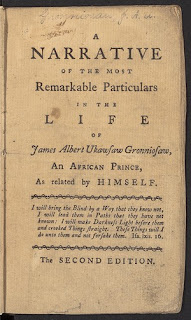
Among the digitized items in the Harvard Libraries’ Slavery, Abolition, Emancipation, and Freedom collection that I mentioned yesterday is A Narrative of the Most Remarkable Particulars in the Life of James Albert Ukawsaw Gronniosaw, an African Prince, as related by himself.

Published in Bath, England, in 1770, this was the first autobiography of a black former slave published in English, and one of the first handful of English books of any kind by a black author.

Interestingly, Gronniosaw was literate only in Dutch, having learned to read while enslaved in New York early in the century. His story was taken down by “a young lady of the town of Leominster.”

Gronniosaw dedicated his memoir to Selina Hastings, Countess of Huntingdon, the same evangelical noblewoman who financed the publication of Phillis Wheatley’s first book of poems. Gronniosaw also composed a letter to the countess thanking her for financial support a couple of years later—the only other known sample of his words.

Harvard’s copy of this book is labeled the second edition, but it doesn’t state where and when it was printed. (Sen. Charles Sumner, champion of abolition and civil rights, bequeathed this copy to the university.) The first American edition was published in Newport by Solomon Southwick in 1774. The Harvard library also owns a copy of a Welsh translation published in 1779, and there were several more editions in the decades that followed, showing the book’s popularity.

One notable aspect of Gronniosaw’s story is his description of how he first understood reading when he saw a white sea captain doing it—he thought that the book was talking to that man but wouldn’t talk to him as well. Henry Louis Gates traced this “Talking Book” trope through several more slave narratives in his study The Signifying Monkey. (Gates also included Gronniosaw’s text in Pioneers of the Black Atlantic, summarizing his earlier analysis in the introduction.)

Gronniosaw depicted himself as a prince in his birthplace, Bornu, at least by his maternal ancestry. He also said he was a dissenting monotheist among pagans. Gates therefore connects Gronniosaw’s description of himself to the idea of the Noble Savage, already established in British literature.

After being captured and sold into slavery in his teens, Gronniosaw recounted, he was shipped to Barbados, then New York, where he converted to Christianity and learned to read. Freed by his clerical master’s will, he signed onto a privateer and later into the 28th Regiment of Foot, but his goal was to reach England.

Once there, Gronniosaw struggled as a poor laborer. He married a widowed weaver, and they moved from one city to another during the 1760s and early 1770s, raising their children. In Kinderminster, Gronniosaw connected with a Dissenting minister who knew the Countess of Huntingdon, and that led to his life story being published.

Unlike other African-born memoirists of the late eighteenth and early nineteenth centuries, Gronniosaw did not condemn slavery. He did condemn racism, but seemed to feel that he deserved equal treatment in Britain because he was a Christian, not because he was a person. 

For many decades Gronniosaw’s book was the only evidence of his life. Then scholars discovered a death notice in the Chester Chronicle dated 2 Oct 1775 and a line in the burial register for that city’s church of St. Oswald. The newspaper repeated the book’s information about Gronniosaw, including both his Christian and original African names, and both sources said he had died at the age of seventy.

Saturday, May 06, 2017

“Trial, for the supposed Murther of Henry Sparker”

On 3 June 1768, three Royal Navy officers went on trial in Newport, Rhode Island, for stabbing a local shoemaker named Henry Sparker.

That killing the previous month had reportedly caused an angry crowd to threaten to lynch the officers. Later chroniclers tied that tension to the political turmoil in America since the Stamp Act, but ordinary friction between the navy and civilian sailors, particularly over impressment, might have played a bigger role.

Oliver Arnold, the colony’s attorney general, prosecuted the case. Joseph Russell presided as chief justice, and the other judges that year were Metcalf Bowler, William Greene, Nathaniel Searle, and Samuel Nightingale. (Unlike in the Massachusetts system, Rhode Island superior court judges were elected for short terms instead of appointed for life by the Crown.) I don’t know who represented the defendants.

On 6 June 1768, the Newport Mercury reported on the trial:

Last Friday, at the Superior Court, held here, Mr. Robert Young, Mr. Thomas Carless, and Mr. Charles John Marshall…had their Trial, for the supposed Murther of Henry Sparker. The Jury, consisting of Gentlemen of Capacity and undoubted Reputation, having heard the Case plead, with the Evidences and Circumstances attending the unhappy Affair, went out, and in a few Minutes returned to their Seats, and declared the Prisoners not Guilty, the Verdict being to the entire Satisfaction of the Court; and accordingly the Prisoners were immediately and honourably discharged.—

N.B. Mr. Dexter, the other Person wounded, is now almost recovered: His Evidence was greatly in Favour of the Prisoners.
The Mercury printer, Solomon Southwick, clearly tried to present that outcome as just, emphasizing the jurors’ respectability and speed. A month before, a report had suggested that Philip Dexter “could not long survive”; this story insisted he was “now almost recovered.” It’s not clear whether Dexter testified that he didn’t think the officers were really guilty or whether his description of his own actions that night revealed that he had been the aggressor—as a report in the Boston Chronicle certainly suggested.

Actual court records may say more about this case. The newspapers don’t even state which officer was accused of fatally wounding Sparker, but nineteenth-century historians said that was Midshipman Careless.

According to Capt. John Henry Duncan’s diary, published in The Naval Miscellany, in 1776 Midn. Thomas Careless was assigned to the Eagle. That ship carried Adm. Richard Howe to North America as he came to take over the war. Unlike most of his fellow midshipmen, Careless never rose to the rank of captain.

Careless’s captain back in 1768, Thomas Cookson, died in November 1775—not in the war but at age sixty-five in London. His son George, then fifteen years old, had already entered the Royal Navy, but Lord North sent him instead to the Royal Military Academy at Woolwich instead, and he became an officer in the Royal Artillery in 1778. He fought through the wars with Revolutionary and Napoleonic France and ended his military career as a general.

Thursday, May 04, 2017

“A supposed murder committed on the body of one Henry Sparker”

Yesterday I quoted from the 9 May 1768 Boston Chronicle about a fatal dispute in Newport, Rhode Island.

That same day, Solomon Southwick of the Newport Mercury (his house shown here) ran his first report about the same event:
On the Night following [another event], between 11 and 12 o’Clock, as Mr. Henry Sparker, Shoe-Maker, of this Town, and Mr. Philip Dexter of Providence, being in Company with some of the People belonging to his Majesty’s Sloop Senegal, now in this Harbour, commanded by Capt. [Thomas] Cookson, a Difference happened between them, which ended in a very tragical Manner; Sparker being run almost thro’ the Body, with a Sword, as ’tis supposed; by which he died in about an Hour after; and Dexter received a Stab in his right Side, and had his head very much cut and mangled, by which his Life is still in Danger.

The Senegal’s Men concerned in this unhappy Affair are Mr. Robert Young, Mate, Mr. Thomas Careless, and Mr. Charles John Marshall, Midship-men; who are now confined in his Majesty’s Jail in this Town, and are to have their Trial on the first Monday in June next. As yet it seems to be a little uncertain who were the first Aggressors in this melancholy Event, the Particulars must therefore be deferred till after the Trial.
The June trial date was notable in itself. Ordinarily the colony’s superior court wouldn’t have convened until September. But on 4 May, the day after the arrest of the three naval officers, the Rhode Island legislature convened and approved
An Act empowering the justices of the superior court of judicature, court of assize and general jail delivery, to meet and hold a special court, for the trial of Thomas Careless, Charles John Marshall and Robert Young, officers on board His Majesty’s ship of war, the Senegal, now lying at anchor in the harbor of Newport, who stand committed to His Majesty’s jail, in Newport, for a supposed murder committed on the body of one Henry Sparker, in the night time, on Tuesday, the 3d day of this instant May.
The stated reason for not waiting until September was that “His Majesty’s service, by their detention in jail until that time, may greatly suffer.”

The Newport Mercury report differs in some notable ways from what the Boston Chronicle stated the same day. Most significantly, the local newspaper identified the dead man as shoemaker Henry Sparker instead of a “Dutchman” (Dutch or German?) named Nichols. It said the other American in the fight, Philip Dexter, was from Providence rather than a Newport sailor. It said that Robert Young was a mate, not merely a midshipman, on H.M.S. Senegal. Presumably these details are more reliable than the report printed off in the neighboring colony.

On the other hand, the Newport Mercury said much less about the “melancholy Event” itself than the Massachusetts paper. There was no mention of the dispute starting at “a house of ill fame” or description of how the violence developed. Southwick left out Sheriff Joseph G. Wanton’s difficulty in securing the three officers from an angry, defiant crowd. Some of those omissions might be due to how the local readership had already heard a lot about the killing over the preceding week. But the Mercury was also making its home base look better.

On 3 June, exactly one month after the fatal fight, attorney general Oliver Arnold prosecuted Young, Careless, and Marshall on the charge of murder.

COMING UP: Well, of course I was going to break here, wasn’t I?