J. L. BELL is a Massachusetts writer who specializes in (among other things) the start of the American Revolution in and around Boston. He is particularly interested in the experiences of children in 1765-75. He has published scholarly papers and popular articles for both children and adults. He was consultant for an episode of History Detectives, and contributed to a display at Minute Man National Historic Park.

Subscribe thru Follow.it


•••••••••••••••••


Showing posts with label George Erving. Show all posts

Saturday, July 13, 2024

“Many among us, who are for compromising matters”

John Andrews was another merchant who left a lively record of the discussions in Boston in spring 1774 as the business community grappled with the impending effects of the Boston Port Bill.

Andrews was more aligned with the Whigs than John Rowe, but still didn’t always see eye-to-eye with the radicals.

Andrews’s account appears in a series of letters to an in-law in Philadelphia, now in the collections of the Massachusetts Historical Society. On 18 May he wrote in the most dire tone:
Imagine to yourself the horror painted in the faces of a string of slaves condemn’d by the Inquisition to perpetual drudgery at the oar! Such is the dejection imprinted on every countenance we meet in this once happy, but now totally ruin’d town.
Andrews urged his correspondent to sign on to “an entire stoppage of trade, both to England and the West Indies, throughout the continent.” Any alternative would be to “acknowledge the right of parliament to d—n us whenever they please.”

Later that day Andrews added the news that “we have had advice from Salem, Newbury, etc’a., that they will haul up all their vessels, and stop every trade, provided it becomes general through the continent.”

If accurate, that news must have after the day’s town meeting session, where a committee reported merely that the selectmen of Marblehead and Salem had sounded sympathetic and promised to call meetings in their towns, too.

Note how the promise from those smaller Massachusetts ports was contingent on all the other ports in North America signing on to a boycott as well. That’s often how collective action has to be organized: promising party A that party B is ready to act if party A will, and promising party B that party A is ready to act if party B will.

Yet Andrews also reported some Boston merchants calling for a different approach:
At the same time, we have many among us, who are for compromising matters, and put forward a subscription to pay for the Tea.

George Erving has declar’d this day. that if it should be promoted, he is ready to put down two thousand pounds sterling towards it, and will take it upon himself to wait on Governor [Thomas] Gage and know what his demands upon us are—which circumstance Jno. Amory mentioned at ye. town meeting this day, which was in general rejected, though he urged the matter much.
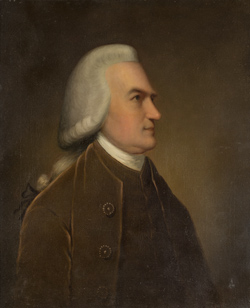
George Erving (1738–1806) and John Amory (1728-1803, shown above) were both Loyalists during the war. Amory ultimately returned to Massachusetts, and Erving’s son became a U.S. diplomat.

Though the Boston Tea Party had cost the East India Company over £9,000, five merchants pledging the amount Erving promised would have been enough to cover that sum. But the community “rejected” that idea.

At that point in late May 1774, Boston’s committee of correspondence may well have felt they had solid popular support for promoting a general boycott to protest the Port Bill. But when the committee drafted its “Solemn League and Covenant” and sent it to other towns and provinces, its members may have overplayed their hand.

TOMORROW: Going too far?

Friday, March 10, 2023

The Captain Who Hosted Gen. Washington in Boston

In looking for clues about the ship captain who told Gen. George Washington that the British military was preparing to leave in March 1776, I came across this line in an 18 March letter from Thomas Cushing to Robert Treat Paine:
A Detachment of our Troops have gone into Boston and this Day General Washington & his Suit dined with Captain Erving.
Was that the same captain as the Erving, Irvine, Irwin, Erwin, or Ervin who provided the general with useful information about two weeks before?

Did Washington choose to dine inside liberated Boston with the mariner who had first told him the British were preparing to leave?

It appears not.

Rather, the consensus is that Washington’s host was the Boston merchant captain and erstwhile Council member John Erving, Sr. However, as the editors of the R. T. Paine Papers commented:
John Erving (c. 1692–1786), a wealthy Boston merchant originally from the Orkneys, was an odd choice as Washington’s first dinner host. A member of the Council for some twenty years, Erving declined the offer of a seat on General [Thomas] Gage’s Mandamus Council, but his sons John and George accepted. All three of his surviving sons became Loyalists, and at least one of had just left Boston with the British troops.
I think the answer to that minor mystery goes back to James Bowdoin (shown above), the same man whose anecdote about Gen. William Howe sent me looking for Washington’s late informants in the first place.

Bowdoin was a senior member of the Massachusetts Council who had met several times with Gen. Washington in the preceding months. On good days he was the senior figure in the Massachusetts government. And John Erving, Sr., was his father-in-law.

Bowdoin couldn’t host Washington at his own house since he didn’t know what shape it was in after British occupation. But old Capt. Erving had stayed in Boston through the siege and could still host a genteel dinner.

True, most Erving men had shown themselves to be Loyalist, but perhaps that was all the more reason to reward a well-connected patriarch who had decided to remain in town as the British left.

Friday, August 30, 2019

“I am as Inocent of Destroying the Sloop as Either of you”

In 1933, the New London County Historical Society published the second volume of its collections, titled Connecticut’s Naval Office at New London During the War of the American Revolution.

The Continental agent in that port was Nathaniel Shaw, Jr. (1735-1782). As an addendum to the collection of public papers, the society’s editor and honorary president, Ernest E. Rogers, included a transcript of Shaw’s letterbox as a merchant in the years before the war.

That source from Shaw’s own hand confirms his connection to the ships involved in the Liberty riots in Newport, Rhode Island, and New London, Connecticut.

On 12 June 1769, Shaw wrote to a man he called Theopulas Backe: “Sir, Inclosed is a letter from Capt. Joseph Packwood which he desir’d might be forwarded to you. He is now in the West Indias, and when he will Return is Uncertain.” Packwood returned to Long Island Sound with Haitian sugar and molasses the next month.

Eight days later, Shaw wrote to his regular trading partners in Philadelphia, Thomas and Isaac Wharton:
I wrote you ye 16 Inst. by Capt. Edwd. Tinker ye Sloop Sally who had on Board 121 Casks of Melasses, who was to Proceed to N. York & in Case ye price of Melasses was not Equal to what you wrote [me?] by the Post, I gave him Orders to Proceed to Philadelphia & deliver his Cargoe to you.
The Customs sloop Liberty seized Tinker’s Sally and Packwood’s Thames in July. Shaw and Packwood went to Newport to get them back. And one riot later, they went home.

As I reported yesterday, in September the New London Customs office seized the Sally again.

Here’s what Nathaniel Shaw had to say about that situation in a 14 Sept 1769 letter to John and George Erving of Boston:
Gentlemen, I Received yours of the 28th Ulto. and am very much Oblig’d to you for your Advise in Regard to the Prosecution that is Intended Against me.

Att Present I Cant Conceive on what Accott. they Intend to trouble me, as I am as Inocent of Destroying the Sloop [Liberty] as Either of you, and can make it Appear so to the Sattisfaction of any Court or Jury in this Colony, and I am of the Opinion if I can do that, it will be Suffecient and In Case they are Determined to have the Matter try’d in Boston att a Court of Admiralty, should be glad you would Inform me in your next what method they are to take to Oblige Either Packwood or me to Appear their or if it goes Against us by Default what Plan they are to Persue to get the Money. Att Present we have no Judge of ye Admiralty in this Colony and I beleive no Person hear would att this time Except of it.

Mr. [Duncan] Stewart has Seiz’d a Sloop which he Suspects is the Sloop that was Carried of[f] att N Port the Night the Liberty was Destroy’d. It is now Seventeen days Since the Seizure was made and he has done nothing towards having her Libel’d. Neither can he git any advise from the Commisoners what steps to take with her, he has no Evidence hear to Prove this to be the Sloop, nor Cant have any, unless Capt. [William] Read or some of his People should come hear, & I beleive it will not be Convenient for them to make their appearence very Soon and haveing the Sloop detain’d so long must Consequently Create an Expense which must fall some where,

I Proposed to Mr. Stewart to have ye Sloop Appriz’d as she now is & give him Security for ye Vallue In Case she be Finally Condemn’d, that we might go on with her Repairs as she wants much before she is in a Condition for the Seas, I should be glad you would Consult some Person who can Advise me in this matter, what steps to take for I Suppose Mr. Stewart will not do any thing untill he has Orders from ye Commisoners.
Shaw’s letterbook doesn’t tell us directly whether Collector Stuart accepted his proposal. But he must have gotten his sloop back because on 17 May 1771 he wrote to the Wharton brothers again:
I have by the bearer Capt. Edwd. Tinker in the Sloop Sally, Shipt you seventy four hogsheads of Melasses, and thirteen hogsheads Sugar, which dispose of for my Accott.
Shaw insisted he was innocent of destroying the Liberty, that the Customs sloop hadn’t caught his Sally, and by extension that he wasn’t in the business of smuggling molasses.

TOMORROW: What Shaw’s other letters have to say about that.

[The photo above, courtesy of Historic Buildings of Connecticut, is Nathaniel Shaw’s house, now owned by the New London County Historical Society.]

Tuesday, September 11, 2018

The Barrel on the Beacon

On 11 Sept 1768, 250 years ago today, Bostonians awoke to see a barrel newly positioned in the iron platform atop the pole on Beacon Hill. Everyone knew that a flame from that beacon would signal for the countryside militia to assemble in arms. The barrel was clearly a response to the preceding week’s news that the London government had sent orders for army regiments to move into Boston.

How did the townspeople react? Most of them went to church. Because that 11 September was a Sunday. By law, no one was supposed to do business on Sunday—but two legal bodies met about the beacon.

Gov. Francis Bernard was spending the day at his country estate in Jamaica Plain. He later reported to Lord Hillsborough, the Secretary of State in London:
the Council sent to me on Sunday afternoon to desire I would order a Council, which I held at a Gentleman’s House halfway between me and Boston. Here It was debated what Means should be used to take the barrel down; & it was resolved that the Select men should be desired to take it down
The editor of the Bernard Papers published by the Colonial Society of Massachusetts says that the gentleman who hosted this impromptu Council meeting was George Erving (1738-1806), son of Council member John Erving. The Ervings were merchants who started as Whigs in the 1760s but gradually moved into the Loyalist camp.

Meanwhile, inside Boston selectman John Rowe noted in his diary: “After Church the Selectmen met about a Cask that was fix’d on the Saddle of the Beacon.” The record of that meeting states that only four of the seven selectmen attended. In addition to Rowe, they were Joseph Jackson, John Ruddock, and John Hancock, and they probably met at Faneuil Hall.

The discussion was recorded simply as: “Information was given the Selectmen that a Tar Barrel had been put in the Beacon.” Those elected officials made no move to take the barrel down.

That evening, the printers of the Boston Gazette, Boston Post-Boy, Boston Chronicle, and possibly even the Boston Evening-Post prepared the next day’s newspapers. As far as I can tell, none of those papers reported on the barrel perched high above the town, ready to be set on fire.

TOMORROW: Boston’s town meeting.

Sunday, December 06, 2015

How Isaac Royall Came to Endow a Harvard Law Professorship

As historical background for the current controversy over Harvard Law School’s adoption of the Royall family crest, the Harvard University Press recently published a long extract from On the Battlefield of Merit, Daniel R. Coquillette and Bruce A. Kimball’s recent institutional history of the school’s first century.

In April 1775, Isaac Royall (1719-1781, shown here) found himself in Boston and cut off by the siege lines from his estate in Medford. Of course, he could have left Boston and gone home if he wanted, but some of his neighbors accused him of leaning toward the Crown—which he did, though not fervently.

Royall evacuated to Halifax even before the British troops left in March 1776, then traveled to London. Yet he kept talking about going back to Medford, and he really didn’t want to lose control of his property in Massachusetts.

In 1778, as the war ground on, the Massachusetts legislature moved to confiscate the property of former royal officials, supporters, and “absentees” who had left with the British. The provincial army had already used some of that property during the siege, including the Royall house, and for the next couple of years the state administered those estates while maintaining their original legal ownership. But this new initiative would lead to permanent seizures. The state planned to sell the estates to finance the war effort.

Loyalists who had relatives, friends, or well-placed attorneys to lobby for them were more successful in fending off attempts to seize their property. In Royall’s case, his advocate was one of his neighbors, Dr. Simon Tufts.
It was only in 1778, long after Royall had “gone voluntarily to our enemies,” that his property was provisionally confiscated and reserved by the Committee of Medford for future heirs, under the watchful eye of Tufts. In contrast, the estates of his Tory sons-in-law, George Erving and William Pepperell, were taken under the “Act to Confiscate the Estates of Certain Notorious Conspirators,” passed April 30, 1779. Furthermore, Royall was not mentioned in the initial three lists of proscribed persons under the Acts of September 1778, April 30, 1779, and September 30, 1779.

To his death in 1781, Royall claimed that only ill health prevented his return and remained outraged at any slur on his loyalty. . . . exiled in Kensington, he made a will on May 26, 1778. It contained generous gifts to his friends, to the church and clergy in Medford, and to the Medford schools, together with a devise of land to the town of Worcester. But it also contained a gift to Harvard College that was to ensure Royall’s lasting fame. The provision reads, “All the remainder of said tract of land in said Granby containing eight or nine hundred acres more or less...I give, devise, and bequeath to the overseers and corporation of Harvard Colledge...to be appropriated towards the endowing a Professor of Laws in said Colledge, or a Professor of Physick and Anatomy, whichever the said overseers and Corporation shall judge to be best.”

The will only came to probate in 1786. This delay may not have been accidental. Due to his popularity in Medford, Royall was covered under the “Absentee Act” of April 30, 1779, which provided some procedural protection against confiscation, and it appears that Royall’s devoted friend Simon Tufts—essentially the trustee of Royall’s property—was waiting out events. It was a good strategy. The Treaty of Paris of September 3, 1783, contained provisions that at least promised recovery of loyalist property, and Jay’s Treaty of 1794 further raised hopes. In 1795 Harvard hired a lawyer to begin to locate the land in Royall’s bequest in preparation for sale.
Royall’s bequest to Harvard therefore got that influential institution behind his other heirs’ efforts to keep his property out of the state government’s hands.
In 1786 and 1787 Shays’s Rebellion had taken place in the region around Granby, and the ill feeling against loyalists, absentee landowners, and their well-to-do and politically connected friends persisted. The Harvard lawyer found Royall’s land stripped and occupied by squatters. In 1796, $2,000 was all that could be obtained from the Granby estate. . . . The college invested the money with remarkable success, despite economic adversity, and by 1815 there were a capital fund of $7,593 and interest on hand of $432. . . .

In retrospect, it was lucky for the Law School that the gift in Royall’s will could not be effected until thirty-three years after his death and eleven years after the receipt of the initial $2,000. It was not just about having enough money. In 1775 Harvard designated a bequest from Dr. Ezekiel Hersey of £1,000 to support “two Professors of Anatomy and Surgery, and of the Theory and Practice of Physic.” This was followed by further bequests of £1,000 in 1790 from Hersey’s widow and £500 in 1793 from his brother “for the encouragement and support of a Professor of Surgery and Physic.” After Royall’s death in 1781, the college was therefore occupied with appointing three medical professors and founding its medical school in 1782 and 1783.

Royall’s will gave Harvard the option of a “Professor of Law” or a “Professor of Physick and Anatomy.” In 1782 this would have played right into the development of the new Medical School. By 1815, the Medical School looked relatively secure…
The Boston Globe adds that the Harvard Law School didn’t adopt Royall’s crest as its own symbol until more than a century later, in 1936. Thus, while Royall’s bequest has been effective for two centuries, that school crest is less than eighty years old.