J. L. BELL is a Massachusetts writer who specializes in (among other things) the start of the American Revolution in and around Boston. He is particularly interested in the experiences of children in 1765-75. He has published scholarly papers and popular articles for both children and adults. He was consultant for an episode of History Detectives, and contributed to a display at Minute Man National Historic Park.

Subscribe thru Follow.it


•••••••••••••••••


Showing posts with label Francis Marion. Show all posts

Thursday, January 29, 2026

America’s History Conference in Glen Allen, Virginia, 27–29 Mar.

America’s History, L.L.C., will hold its thirteenth Annual Conference of the American Revolution in Glen Allen, Virginia, on 27–29 March.

Here’s the lineup of speakers:
  • Richard “Rick” Bell on “The American Revolution and the Fate of the World”
  • Todd W. Braisted on “‘You must expect to hear me talked of as a monster of cruelty’: Colonel Francis Lord Rawdon and the Revolutionary War”
  • Denver Brunsman on “Prisoners, Press Gangs, and the Battle for Sailors in the Revolutionary War”
  • Iris de Rode on “Something New to Think About: The Dutch in the American Revolution”
  • William “Larry” Kidder on “Defending Fort Stanwix: New York’s Frontier During the Revolutionary War”
  • Stephen L. Kling (the Lorna Hainesworth Sponsored Speaker) on “An Underappreciated Victory: Bernardo de Gálvez’s Mississippi River Campaign Against the British in 1779”
  • Mark Edward Lender on “War Without Mercy: Liberty or Death in the American Revolution”
  • Charles P. Neimeyer on “Revolutionary Riverine Warfare: The War for Independence on America’s Rivers and Lakes”
  • Gordon Blaine Steffey on “‘Trust Not Professions’: Feuding Founders and Diplomatic Disorder in the Arthur Lee–Silas Deane Affair”
  • Andrew Waters on “Backcountry War: The Rise of Francis Marion, Banastre Tarleton and Thomas Sumter”
In addition to the conference, attendees can sign up for a bus tour on Friday, 27 March, visiting Ferry Farm, Gunston Hall, and Historic St. John’s Church to learn about “More Virginia Founding Fathers: Essentially Important for Independence” from Edward G. Lengel and site staff.

For more information and registration, visit this page.

Monday, September 17, 2018

A Season of Talks at the David Library

Here’s the lineup of upcoming talks at the David Library of the American Revolution in Pennsylvania. That’s a striking venue with a loyal audience, and its offerings cover the entire war—note how many different people and events proved absolutely crucial to the Revolution.

Thursday, 20 September, 7:30
John Oller, “A Patriot (But Not THE Patriot)”
The author of The Swamp Fox: How Francis Marion Saved the American Revolution will explore the life and military campaigns of Francis Marion. Like Robin Hood of legend, Marion and his men attacked from secret hideaways before melting back into the forest or swamp, confounding the British. Although Marion bore little resemblance to the fictionalized portrayals in television and film, his exploits were no less heroic. He and his band of militia freedom fighters kept hope alive for the patriot cause in one of its darkest hours, and helped win the Revolution.

Thursday, 4 October, 7:30
Bob Drury, “The Existential Moment: How The Valley Forge Winter Saved the Revolution, Created the United States, and Changed the World”
Bob Drury is co-author (with Tom Clavin) of the new book Valley Forge. In his talk, he will outline how George Washington and his closest advisers spent six months on a barren plateau 23 miles from enemy-held Philadelphia fighting a war on two fronts—militarily against the British, and politically against a Continental faction attempting to depose him as Commander in Chief of the Continental Army. How he deftly prevailed on both of these fronts shaped the world as we know it today.

Sunday, 7 October, 3:00
Robert Selig, “The Washington-Rochambeau Revolutionary Route National Historic Trail in the State of Pennsylvania”
In 2008, President Obama signed legislation establishing the land and water routes that were traveled by the allied French and American armies to and from Yorktown in the summer of 1781 as a National Historic Trail. That trail stretches from Newport, Rhode Island, and Newburgh, New York, and includes Pennsylvania from Trenton south to Marcus Hook. Yet the very existence of this trail is still largely unknown. Robert Selig, Ph.D., serves as project historian to the National Park Service for the Washington-Rochambeau Revolutionary Route National Historic Trail Project. His lecture will introduce the trail and its historic significance, showing contemporary and modern maps, and important sites he has identified in his research, some of which was conducted at the David Library!

Wednesday, 17 October, 7:30
An Evening with Nathaniel Philbrick
This program comes in cooperation with nearby Washington Crossing Historic Park, which will host the event. The New York Times best-selling author, hailed by the Wall Street Journal as “one of America’s foremost practitioners of narrative nonfiction,” will give a talk about his newest book, In the Hurricane’s Eye: The Genius of George Washington and the Victory at Yorktown. Tickets are $50 for a single seat, and $80 for two. Each individual or couple admission price includes an autographed copy of In the Hurricane’s Eye. Proceeds benefit the David Library and the Friends of Washington Crossing Historic Park. Visit this site to buy tickets in advance.

Thursday, 25 October, 7:30
Stephen Fried, “Reclaiming Dr. Benjamin Rush, Our ‘Lost’ Founding Father”
Bestselling author Stephen Fried, whose latest book is Rush: Revolution, Madness, and Benjamin Rush, the Visionary Doctor Who Became a Founding Father, will help us see the American Revolution, the Federal Period and the human saga of the entire birth of our nation from the unique, fascinating perspective of founding father, physician, philosopher and confidant Benjamin Rush.

Thursday, 1 November, 7:30
Ricardo A. Herrera, “American Citizens, American Soldiers: Civic Identity and Military Service from the War of Independence to the Civil War”
From 1775 through 1861, American soldiers defined and demonstrated their beliefs about the nature of the American republic and how they, as citizens and soldiers, were part of the republican experiment. Despite uniquely martial customs, organizations, and behaviors, the United States Army, the states’ militias, and the war-time volunteers were the products of their parent society. Understanding American soldiers of all ranks, in war and in peace, helps us understand more about American society writ large and how that society shaped its armed forces in the years of the Early Republic. A former David Library Fellow, and currently Professor of Military History at the School of Advanced Military Studies in Kansas, Ricardo A. Herrera, Ph.D., is the author of For Liberty and the Republic: The American Citizen as Soldier, 1775-1861.

Thursday, 8 November, 7:30
Christopher S. Wren, “Vermont: The Most Rebellious Race”
Before Vermont was Vermont, it was a British territory fought over by such figures as Ethan Allen, who helped form the American Revolutionary War militia known as the Green Mountain Boys. This lecture, by the author of Those Turbulent Sons of Freedom: Ethan Allen's Green Mountain Boys and the American Revolution, will consider the story of the tough, brave, and wild crew of characters who faced some of the harshest combat in the American Revolution, and made their own rules to create an independent Vermont.

Sunday, 18 November, 3:00
Tilar J. Mazzeo, “The Private Lives and Loves of the Schuyler Sisters”
Mazzeo is the author of the new biography Eliza Hamilton: The Extraordinary Life and Times of the Wife of Alexander Hamilton. Her lecture will take a lively look into the lives of Eliza, Angelica and Peggy, the daughters of Philip Schuyler, and the context of colonial and early national women’s lives in the eighteenth and early nineteenth centuries. The lecture will draw on information from private family letters and documents, and will cover everything from Eliza Hamilton’s first crushes to the Schuyler family wedding cake recipe to how colonial women leveraged coterie networks to support spy rings in the Revolution.

Thursday, 6 December, 7:30
Christian di Spigna, “‘The Greatest Incendiary in all America’: The Rise and Fall of Dr. Joseph Warren”
Joseph Warren was the Boston physician who played a prominent role in the earliest days of the Revolution. As president of the revolutionary Massachusetts Provincial Congress, it was he who enlisted Paul Revere and William Dawes on April 18, 1775, to leave Boston and spread the alarm that the British garrison in Boston was setting out to raid the town of Concord. Christian di Spigna is the author of Founding Martyr: The Life and Death of Dr. Joseph Warren, the American Revolution's Lost Hero. His lecture will trace Warren’s rise from humble beginnings to his bloody death at Bunker Hill, and examine Warren’s postmortem journey over the years from Revolutionary hero to relative obscurity.

(My own talk at the David Library a couple of years back can be viewed here.)

Thursday, February 14, 2013

American Revolution Conference in Williamsburg, 22-24 Mar.

America’s History, L.L.C., is sponsoring its second annual Conference on the American Revolution in Williamsburg, Virginia, on 22-24 March. Although there are academics on the list of speakers, this conference is not designed for academic scholars and job-seekers but for independent researchers and history buffs.

The scheduled program is:

  • Edward G. Lengel: “Revolutionary Rivals: Horatio Gates and George Washington
  • Douglas Cubbison: “Man on a Mission: John Burgoyne and the Campaign of 1777”
  • Joshua Howard: “The Swamp Fox: Francis Marion, Revolutionary War Hero of South Carolina”
  • James Kirby Martin: “Benedict Arnold: Revolutionary America’s Heroic General”
  • Andrew O’Shaughnessy: “Fighting with Friends and Enemies Simultaneously: Sir Henry Clinton
  • Jim Piecuch: “Frustrated Ambitions: “Light Horse Harry Lee’s Conflicts On and Off the Battlefield”
  • John V. Quarstein: “Closing the Door on Cornwallis: The Battle of the Capes September 1781”
  • Glenn F. Williams: “Lord Dunmore’s War: Training Ground for Continental Officers”
As you see, there’s an emphasis on military commanders this year rather than, say, politics, battles or other events, ordinary soldiers, social movements, technology, &c.

There will also be two panel discussions: “The Best and Worst Military Commanders of the Revolutionary War” and “A Revolutionary War Bookshelf: What You Should Own and What Books Will Be Published Soon.”

The conference package costs $225 and includes lunch, two breakfasts, and refreshment breaks. There are rooms available at the Williamsburg Hospitality House, which I think is also the site of the sessions. On the Friday afternoon before the conference begins, there’s an optional bus tour of Petersburg and other sites led by William Welsch of the local American Revolution Round Table; that costs $95 extra. I hadn’t thought seriously about going to Virginia next month, but two feet of snow has a way of making me reconsider.

America’s History offers a range of other tours and events this year, including sessions on “Religion, Rebellion, and the Founding Fathers” in Pennsylvania with John Fea; "Defending the Highlands” in Newburgh, New York, with Bill Welsch and Bruce Venter; “Braddock's Campaign to Fort Duquesne” in Pennsylvania with Doug Cubbison; and “Burgoyne’s Campaign of 1777” in conjunction with the 10th annual American Revolution Seminar at Fort Ticonderoga.

Wednesday, June 01, 2011

Back to Brockington

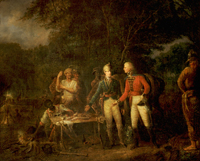
I started this series of sweet-potato postings with a descendant’s claim that the “British officer” in John Blake White’s painting of Francis Marion (shown here, courtesy of the U.S. Senate) actually showed Loyalist John Brockington, Jr., coming home after the war.

I still haven’t see the article that presents that claim, but context makes it seem very unlikely to me.

That scenario would mean that Samuel Weaver told of participating in a sweet-potato meal during the war, and the Rev. Mason Weems described such a meal, and many publications reprinted Weems’s description of the meal—yet White chose to paint a similar meal that no one else recorded for decades.

The painting shows Marion welcoming a red-coated gentleman to his table, but the descendant claimed that Brockington had invited Marion to share the food, which doesn’t fit the imagery.

Furthermore, White lived until 1859, long after engravings based on his painting appeared with captions identifying Marion’s guest as a British officer, and he didn’t correct that identification. When the painter’s son Octavius White donated the canvases to the U.S. Capitol in 1899, he described it as “the famous one representing General Marion inviting a British officer to share his meal of sweet potatoes.”

It seems more likely that Brockington’s descendants grew up in South Carolina surrounded by copies of White’s iconic image (it was even on some Confederate currency), and came to interpret it as showing their ancestor meeting Marion. I suspect that was a “Grandmother’s tale,” originally meant for the children in one family but told to the world after those children grew up.

Perhaps Brockington did meet Marion when he returned to South Carolina. But after the war there would have been no need for two gentlemen of considerable fortune (as measured by their human property) to eat sweet potatoes in the woods.

Tuesday, May 31, 2011

Slicing Open Marion’s Sweet Potatoes

If Jervais Henry Stevens and Samuel Weaver both said they saw Gen. Francis Marion share a meal of roasted sweet potatoes with a British officer, is that enough to validate the legend?

Unfortunately, both Stevens and Weaver were first set down a few years after the Rev. Mason Weems published the story in his biography of Marion. Newspapers and magazines reprinted the tale. Around 1820, apparently, John Blake White painted a picture of it. The sweet-potato dinner became a widely known detail in the story of a regional hero, with a patriotic moral. That meant there was probably value in putting oneself into that story, and little value in casting doubt on it.

I’m impressed, however, that Weaver swore that “He has been told by some, that this [meal] has been recorded in the life of Genrl as a dinner, but this was a breakfast.” Weaver indicated that he had not read the printed accounts, and furthermore that he was willing to contradict them in one detail.

Weaver also said Marion’s guest was “a British Officer as he was told [who] came into camp, but for what he does not know.” The veteran obviously wasn’t trying to present himself as important.

I suspect that Weaver had also not seen White’s painting since that shows a servile black man dishing up the potatoes. Weaver said he served the breakfast himself, and as a white in ante-bellum South Carolina would almost certainly not have enjoyed being represented as a black man.

Therefore, even though Weaver told his story about two decades after the tale first appeared in print, it seems to ring true.

In contrast, we don’t have Stevens’s story. Instead, author Alexander Garden appears to have read the Weems version, asked around, and found some old companions of Marion who said it—or something like it—was true. Even then Garden admitted some doubt by writing “It is said” before his final paragraph.

And that paragraph is, I suspect, all Weemsian mythmaking. The preacher may have come across the sweet-potato story from Weaver, or Stevens, or somebody else, and decided to add it to his Marion biography. Since he was writing a “romance,” Weems felt no compunction about making up dramatic dialogue between the American general and the British officer.

Most important, Weems added a moral to the story, which otherwise was just a little episode about American partisans living off the land and a British officer polite enough to share one meal with them. Weems’s version went on to say that Englishman went back to the Crown forces so impressed by Marion’s dedication that he told his commander they had no chance of subduing the Americans. By the time Garden wrote, “It is said,” that officer even resigned his commission.

But how was an American author privy to a private conversation between British officers in British-occupied Georgetown? How could an American author know why a British officer resigned when he clearly doesn’t know that officer’s name or the date of the event? Weems’s ending to the story is a big part of its power, but it’s not nearly as convincing as Samuel Weaver’s simple tale of how he “wiped the ashes off with a dirty handkerchief.”

TOMORROW: Back to the Brockington claim (and away from increasingly strained metaphors about sweet potatoes).

Monday, May 30, 2011

Digging for Marion’s Sweet Potatoes

As quoted back here, in his biography of Gen. Francis Marion, the Rev. Mason Weems described the general treating a British officer to a dinner of roasted sweet potatoes during the Revolutionary War. Weems presented that tale as coming from Marion’s subordinate officer Peter Horry, but Horry repudiated the first edition of the book, and never saw later editions that contained the tale.

So is there any solid basis for this story?

In fact, at least two men stated that they had witnessed or participated in such an event. In Anecdotes of the Revolutionary War in America, published in Charleston in 1822, Alexander Garden introduced the story like this:
An anecdote is related of him, of the authenticity of which, many of his followers can still give testimony. I name one of them, Lieut. J[ervais]. H[enry]. Stevens, of [Hezekiah] Mayham’s regiment, who was an eye witness of the occurrence.

A British officer was sent from the garrison at Georgetown, to negotiate a business interesting to both armies; when this was concluded, and the officer about to return, the general said, “If it suits your convenience sir, to remain for a short period, I shall be glad of your company to dinner.” The mild and dignified simplicity of Marion’s manners, had already produced their effect; and, to prolong so interesting an interview, the invitation was accepted.

The entertainment was served upon pieces of bark, and consisted entirely of roasted potatoes, of which the general eat heartily, requesting his guest to profit by his example, repeating the old adage, that “hunger was an excellent sauce.”

“But surely general,” said the officer, “this cannot be your ordinary fare.”

“Indeed it is sir,” he replied, “and we are fortunate on this occasion, entertaining
company, to have more than than our usual allowance.”

It is said, that on his return to Georgetown, this officer immediately declared his conviction, that men who could without a murmur endure the difficulties and dangers of the field, and contentedly relish such simple and scanty fare, were not to be subdued; and, resigning his commission, immediately retired from the service.
In addition, a veteran named Samuel Weaver (1755-1852), applying for a pension in 1836, swore under oath:
During the time he was with Gen’l Marion, a British Officer as he was told, came to Camp but for what reason he does not know & he was roasting and baking sweet potatoes on the coles—

Gen’l Marion steped up with the British Officer and remarked he believed he would take Breakfast; he felt proud of the request, puled out his potatoes, wiped the ashes off with a dirty handkerchief, placed them on a pine log (which was all the provision they had) and Gen’l Marion and the Brittish Officer partook of them.

He had been told by some that this had been recorded in the log of the Gen’l as dinner but this was breakfast.
There’s a transcription of Weaver’s pension application memoir here.

TOMORROW: Slicing open the evidence.

Sunday, May 29, 2011

“Most certainly ’tis not MY history, but YOUR romance.”

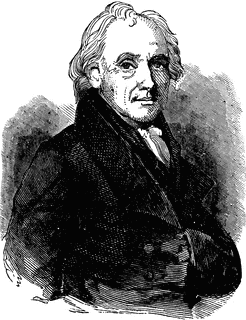
The first edition of The Life of Gen. Francis Marion appeared at the end of 1809. As I described yesterday, it was brought to press by the Rev. Mason Weems (shown here), but written in the voice of Peter Horry, one of Marion’s officers.

It took until 4 Feb 1811, over a year after publication, before Horry told Weems what he thought of the book, in a fun-to-read letter later printed in William Gilmore Simms’s Views and Reviews in American Literature:
I requested you would, (if necessary,) so far alter the work as to make it read grammatically, and I gave you leave to embellish the work,—but entertained not the least idea of what has happened—though several of my friends were under such apprehensions, which caused my being urgent on you not to alter as above mentioned.

Do you not recollect my sitting on the ground with you near the Georgetown Printing Office,
and urging you again on the subject of no alterations to the work—That you replied, (seemingly out of humour,) that, “When the work came out, you engaged I would be satisfied.” I replied, “That is enough;”—and, I recollect nothing farther passed between us afterwards on the subject.

How great was my surprise on reading these words in your letter: “Knowing the passion of the times for novels, I have endeavoured to throw your ideas and facts about General Marion into the garb and dress of a military romance.” A history of realities turned into a romance! The idea alone, militates against the work. The one as a history of real performance, would be always read with pleasure. The other as a fictitious invention of the brain, once read would suffice. Therefore, I think you injured yourself, notwithstanding the quick sales of your book.

Nor have the public received the real history of General Marion. You have carved and mutilated it with so many erroneous statements, your embellishments, observations and remarks, must necessarily be erroneous as proceeding from false grounds. Most certainly ’tis not MY history, but YOUR romance.

You say the book sells better than [Weems’s book on George] Washington! The price of the one is much less than the other—[that] is the reason. Besides, persons unacquainted with the real history, buy and read your book as authentic. When known to be otherwise, [it] will lie mouldering on the shelves, and no more purchasers [will] be obtained. You have my work; compare [it] with yours, and the difference will appear. Yours is greatly abridged, and the letters contained in mine (which I thought much of,) are excluded from yours.

You say, “you are surprised to hear that I am displeased with your book, particularly as it places Marion and myself in so conspicuous and exalted a light.” Can you suppose I can be pleased with reading particulars (though ever so elevated, by you) of Marion and myself, when I know such never existed.

Your book is out. My dissatisfaction of it is no ways material. You say you want to see me to procure some additional anecdotes for your 2d edition—and that, if I can point out any errors or places where improvement may be made, that you will cheerfully attend to any instructions. Could such improvement be really made, I fear for its fate—to be disregarded as my first performances were.
According to a sketch of Horry in the South Carolina Historical and Genealogical Magazine, “Horry’s annotated copy is extant and it shows many of Weems’ false statements, but not near all.”

That same article says, “The title page of the first edition credits the alleged biography to Weems, but after Horry’s death [in 1815] new editions falsely assigned it to Weems and Horry, despite Horry’s repeated repudiation of it during his lifetime.”

So it seems far less likely that Horry witnessed the sweet-potato dinner as his narrative voice described. In fact, if my supposition is right, Weems added the episode to the book only after Horry died, when he couldn’t object so vociferously.

TOMORROW: Other eyewitnesses to the sweet potato dinner?

Saturday, May 28, 2011

“O that mine enemy would write a book”

For most of the nineteenth century, editions of The Life of Gen. Francis Marion, a Celebrated Partisan Officer in the Revolutionary War, carried this author credit:
By Brig. Gen. P. Horry, of Marion’s Brigade:
and M. L. Weems
The book was written in the voice of Peter Horry (shown here, courtesy of the Horry County Historical Society). For a sample of that voice, the preface began:
“O that mine enemy would write a book.”—This, in former times, passed for as sore an evil as a good man could think of wishing to his worst enemy.—Whether any of my enemies ever wished me so great an evil, I know not. But certain it is, I never dreamed of such a thing as writing a book; and least of all a war book. What, I! a man here under the frozen zone and grand climacteric of my days, with one foot in the grave and the other hard by, to quit my prayer book and crutches, (an old man’s best companion,) and drawing my sword, nourish and fight over again the battles of my youth.

The Lord forbid me such madness! But what can one do when one’s friends are eternally teazing him, as they are me, and calling out at every whipstitch and corner of the streets, “Well, but, sir, where’s Marion? where’s the history of Marion, that we have so long been looking for?”

’Twas in vain that I told them I was no scholar; no historian. “God,” said I, “gentlemen, has made many men of many minds; one for this thing and another for that. But I am morally certain he never made me for a writer. I did indeed once understand something about the use of a broad sword; but as to a pen, gentlemen, that's quite another part of speech. The difference between a broad-sword and a pen, gentlemen, is prodigious; and it is not every officer, let me tell you, gentlemen, who can, like Caesar, fight you a great battle with his sword to-day, and fight it over again with his pen to-morrow.”
Of course, the reason those friends kept asking Horry about his Marion book is that he had collected information for a history of the brigade. But he had trouble getting it published. The Rev. Mason Weems—already a bestselling biographer of George Washington—convinced Horry to send him the manuscript so he could make it saleable.

TOMORROW: Big mistake.

Friday, May 27, 2011

Parson Weems Cooks Up a Dinner for Francis Marion

The Rev. Mason Weems published the first edition of his Life of Gen. Francis Marion in 1809. It followed the hortatory model of the parson’s book on George Washington, issued nine years earlier, but Weems wrote in the voice of Peter Horry, a South Carolina officer who had served under Marion (shown here, courtesy of NNDB.com) and loaned him documents as raw material.

I haven’t found an 1809 edition of Weems’s Marion online, but there are copies of the reprints from 1815-20 and later. That’s also when an incident from the book—the story of Marion and the sweet potatoes—was first reprinted in American periodicals, such as the 1817 volume of the Monthly Magazine, or British Register. That makes me suspect that Weems added the anecdote to his second edition and thus brought it into the public eye.

Weems’s text described Marion dining off sweet potatoes several times, but it highlighted a particular moment when an “Englishman” had brought “a flag from the enemy in George-town, S. C. the object of which was to make some arrangements about the exchange of prisoners.” After that gentleman had concluded that business with Marion:

The officer took up his hat to retire.

“Oh no!” said Marion, “it is now about our time of dining, and I hope, sir, you will give us the pleasure of your company to dinner.”

At the mention of the word dinner, the British officer looked around him, but to his great mortification, could see no sign of a pot, pan, or Dutch-oven, or any other cooking utensil that could raise the spirits of a hungry man.

“Well, Tom,” said the general to one of his men, “come, give us our dinner.”

The dinner to which he alluded was no other than a heap of sweet potatoes, that were very snugly roasting under the embers, and which Tom, with his pine-stick poker, soon liberated from their ashy confinement, pinching them every now and then with his fingers, especially the big ones, to see whether they were well done or not. Then, having cleansed them of the ashes, partly by blowing them with his breath, and partly by brushing them with the sleeve of his old cotton shirt, he piled some of the best on a large piece of bark, and placed them between the British officer and Marion, on the trunk of the fallen pine on which they sat.

“I fear sir,” said the general, “our dinner will not prove so palatable to you as I could wish; but it is the best we have.”

The officer, who was a well-bred man, took up one of the potatoes, and affected to feed as if he had found a great dainty; but it was very plain that he ate more from good manners than good appetite. . . .

The Englishman said, “he did not believe it would be an easy matter to reconcile his feelings to a soldier’s life on general Marion’s terms; all fighting, no pay, and no provisions but potatoes.

“Why, sir,” answered the general, “the heart is all; and when that is once interested, a man can do any thing. Many a youth would think hard to indent himself a slave for fourteen years. But let him be over head and ears in love, and with such a beauteous sweetheart as Rachel, and he will think no more of fourteen years’ servitude than young Jacob did. Well, now this is exactly my case. I am in love; and my sweetheart is LIBERTY.” . . .

I looked at Marion as he uttered these sentiments, and fancied I felt as when I heard the last words of the brave [Baron Johann] De Kalb. The Englishman hung his honest head, and looked, I thought, as if he had seen the upbraiding ghosts of his illustrious countrymen, [Algernon] Sydney and [John] Hampden.

On his return to George-town he was asked by Colonel [John Watson Tadwell] Watson why he looked so serious? “I have cause, sir,” said he, “to look so serious.”—

“What! has General Marion refused to treat [i.e., negotiate]?”

“No, sir.”—

“Well then, has old Washington defeated Sir Henry Clinton, and broke up our army?”

“No. sir, not that neither; but worse.”—

“Ah! what can be worse?”

“Why, sir, I have seen an American general and his officers, without pay, and almost without clothes, living on roots, and drinking water—and all for LIBERTY! What chance have we against such men!”
Weems always liked to draw a heroic little lesson out of his anecdotes, which helped make them popular with magazine and textbook editors. As I noted above, this story began to be reprinted in the late 1810s (punctuation and other small details differing from one publication to another).

When John Blake White painted Marion inviting a red-coated officer to share a meal of sweet potatoes about 1820, he surely had this episode in mind. It was becoming widely known, and it had a moral and patriotic message for the American public. No wonder a version is now hanging in the U.S. Capitol.

In contrast, no publication before 1999 appears to have reported that Marion also shared sweet potatoes with the Loyalist officer John Brockington as he returned home after the war. In fact, why would a planter like Marion be dining on vegetables in the woods once the war was over? And what message and value would that scene have held to the American public?

Of course, that doesn’t mean the scene Weems described ever happened.

TOMORROW: Hearing from Peter Horry.

Thursday, May 26, 2011

A Latter-Day Claim to Gen. Marion’s Sweet Potatoes

Last month at Blog, or Die, Michael Aubrecht wrote about John Blake White’s paintings of Francis Marion inviting a British officer to join him in a dinner of roasted sweet potatoes. Longtime Boston 1775 readers might recall that a ceremony about the version of that painting in the U.S. Capitol prompted some postings on the semi-legendary figure of Marion’s enslaved servant Oscar.

The Senate’s webpage on that painting and Aubrecht’s posting both cite an article about the underlying historic incident in the South Carolina Historical Society’s Carologue magazine for 1999. (Both webpages have typos that date the article to 1989, but the former also has the correct citation.) I haven’t found an online version of that article, Nell Weaver Davies’s “New Facts about an Old Story,” but Aubrecht describes its latter-day interpretation of the painting:
James P. Truluck, a descendant of the alleged British Officer,…[stated that] Captain John Brockington, Jr.—a landowner, slave-owner, and Tory sympathizer, who had fought against the “Swamp Fox”—was the legendary officer depicted in the piece. He added that his ancestor had been among the Tories that were banned to Nova Scotia after Continental forces assumed control of South Carolina.

In an effort to regain his land and reputation, Brockington returned to the colonies to refute his Loyalists ways and repay any claims that were made against him. After receiving a pardon, he and his slaves headed home and traveled through the swamps to avoid confrontation. It was while preparing their own camp meal that Truluck states Marion found them (resulting in the painted scene).
I’m baffled by Trulock’s claim, as best I understand it. It seems clear that White, painting around 1820, illustrated a specific episode described in Mason Weems’s Life of Gen. Francis Marion.

TOMORROW: Parson Weems and General Marion.

Monday, February 11, 2008

Oscar Marion: The Disney Version

To the left is yet another popular image of Gen. Francis Marion having a meal in the wilderness during the Revolutionary War. Except this time he’s being portrayed by Leslie Nielsen (on the left, before his hair turned white) in Walt Disney’s Swamp Fox adventures, first broadcast 1959-1961. This image comes UltimateDisney.com, where nostalgic folks can order a D.V.D. of those episodes.

Marion’s enslaved servant Oscar was a regular character in that series and sang its theme song, recounting Marion’s exploits. The actor who played that part was credited as “Smoki Whitfield,” though he appeared in other movies and TV shows as Robert or Jordan Whitfield. He had a long Hollywood career, but most of his roles were as porters or African sidekicks, such as Eli in the Bomba the Jungle Boy series.

Whitfield’s screen name “Smoki” fits into a pattern for African-American actors of the time. Many white Hollywood actors adopted professional names that hid or changed their ethnic background, as when Emmanuel Goldenberg became Edward G. Robinson. But many black Hollywood actors, particularly males, worked under names that emphasized or ironically played off their ethnicity and the stereotypes associated with it. The most famous was Lincoln Perry as Stepin Fetchit, but others included Willie Best as Sleep ’n’ Eat, Fred Toones as Snowflake, and Spencer Bell as G. Howe Black.

And at last I get to my point: American culture didn’t forget Gen. Marion’s enslaved servant Oscar. Rather, the culture fit that historical individual into reassuring molds that changed along with mainstream society’s values. First came the loyal, subservient servitor visible in nineteenth-century paintings and books. Then came the Disney Company’s friendly supporting character and quaint musical entertainer. Given that pattern, praising Marion’s “devoted and selfless consecration to the service of our country” in a Senate ceremony could simply shift the man into another reassuring mold—exemplary African-American patriot—without bringing us closer to understanding his real experiences.

Genealogist Tina C. Jones started to research Gen. Marion’s enslaved workers to find clues to such experiences; some of her ancestors were captive on that slave-labor plantation. Calling our attention to the black servants in paintings of Marion should help us think about what those figures represented. Reminding us that throughout the Revolution Gen. Marion was served by a real individual kept in bondage should spur us to consider what that man’s life might have been like. But we shouldn’t take the symbol for the man.

In its article on the Dec 2006 Senate ceremony about John Blake White’s painting of Marion, the Washington Post stated of the black cook, “He has had his name restored.” And indeed names are significant. Jones’s research seems to have spurred recent authors to refer to the man as “Oscar Marion” rather than “faithful servant Oscar.”

Of course, not all enslaved people shared a surname with their owners. Notable exceptions included:

In reading about Jones’s research, I still can’t tell if she’s found documents or direct descendants referring to “Oscar Marion.” It’s certainly possible that the man thought of himself that way. It’s also possible that we very much want to think of him that way.

Sunday, February 10, 2008

The Literature of Oscar Marion

The incident in the life of Gen. Francis Marion (shown here, courtesy of NNDB.com) that John Blake White depicted in his “General [Francis] Marion Inviting a British Officer to Share His Meal” was first reported in Mason Weems’s Life of General Francis Marion, published in 1805. Weems is best known for his biography of Gen. George Washington, which included such enduring but completely unconfirmable legends as Washington chopping at a cherry tree and praying in the snow at Valley Forge.

In the eighteenth chapter of his Marion biography, Weems included a long anecdote about a young British officer visiting Marion in his camp for a conference. The American general invites the officer to share his dinner, which turns out to be roasted sweet potatoes on platters of tree bark. Impressed by the partisans’ dedication to the cause of independence, the officer returns to his commander, Col. Watson; praises the enemy; and eventually resigns from the army. You can read the text in an 1852 edition through Google Books.

That anecdote did not name the British officer or explain how the author came by his information. Weems did not mention an enslaved man named Oscar accompanying Marion. Instead, as he described the scene, a soldier named Tom was roasting the potatoes.

The figure of Oscar Marion entered the literary record in A Sketch of the Life of Brig. Gen. Francis Marion, published in 1821 by William Dobein James (1764-1830). This book described a different dinner in Marion’s camp, not with a British officer but with the author himself:

At this place, the author had, (in the absence of his father,) the honour to be invited to dine with the general. The dinner was set before the company by the General’s servant, Oscar, partly on a pine log and partly on the ground; it was lean beef, without salt, and sweet potatoes. The author had left a small pot of boiled homminy in his camp, and requested leave of his host to send for it; and the proposal was gladly acquiesced in, gladly. The hominy had salt in it, and proved, although eaten out of the pot, a most acceptable repast. The general said but little, and that was chiefly what a son would be most likely to be gratified by, in the praise of his father. They had nothing to drink but bad water; and all the company appeared to be rather grave.
White produced his painting of Marion’s camp about the same time that James wrote his book. The artist may have combined the two published descriptions of Marion’s camp dinners to show Oscar making sweet potatoes for the British officer. He may have relied on his own unknown sources of information about Oscar. Or he may never have read about or met Oscar, and simply depicted a generic black servant for the general.

James mentioned Oscar one other time in his book, while describing Marion’s retirement to his slave-labor plantation at the end of the war: “His faithful servant Oscar, who had accompanied him through all his difficulties, always received high marks of his favour.” What marks those are James didn’t say. Unlike Washington’s bodyservant, William Lee, Oscar was never formally freed. By applying the term “faithful” to Oscar in one of two mentions, James’s book scores what I’ll call a “faithful quotient” (F.Q.) of 50%.

William Gilmore Simms’s The Life of Francis Marion (1844) also mentions Oscar twice. The first is an imperfect but basically accurate quotation of James’s anecdote. The second passage describes how Marion dealt with the property he had used during the war:
He had preserved carefully, as memorials of an eventful history, his marquee, camp bed, and cooking utensils, just as he had done while in the Brigade, during the last twelve months of his military life. These were carefully taken with him; and, with his faithful servant Oscar, and his two sumpter mules, were still the companions of his wanderings.
Like James, Simms had an F.Q. of 50%.

Subsequent biographies of Francis Marion drew heavily on those first three. In 1959, for example, Prof. Robert Duncan Bass published Swamp Fox: The Life and Campaigns of General Francis Marion. Bass was a literary scholar, not a historian, and his book had no footnotes. Reviewing a newer biography of Marion in The History Teacher in 1975, historian George Athan Billias criticized Bass and his predecessors for having “relied on dubious secondary sources, legends, and traditions.”

Nevertheless, Bass’s book found a large audience and became the principal source of Walt Disney’s Swamp Fox adventures, televised from 1959 to 1961. (I’ll discuss that adaptation tomorrow.) In the midst of America’s civil-rights movement, Bass mentioned Marion’s servant Oscar on five pages. Three describe the man as “faithful,” for an F.Q. of 60%.

Saturday, February 09, 2008

Collecting Possible Images of Oscar Marion

Yesterday I linked to an image of John Blake White’s painting of “General [Francis] Marion Inviting a British Officer to Share His Meal,” in a discussion of how best to acknowledge the place of the general’s enslaved servant Oscar in history.

It turns out that White made several copies of that scene, and one came into the collection of Boston’s Museum of Fine Arts. It’s not on display but can be viewed through the museum’s website—which includes a close-up feature.

White’s image was reproduced in other ways over the years:

Before photography, artwork was reproduced by other artists working by hand, and they introduced variations in the image. The images above differ in how, and how well, they depict the black serving man at the left of the composition—lately identified as Gen. Marion’s enslaved servant Oscar. His face appears more or less caricatured in different images. Some versions seem to emphasize the detail that he’s spilling liquid from his ladle onto the table; in others, that detail is hard to spot. Some pictures show the man picking up sweet potatoes, but in the Currier & Ives print he’s grabbing a piece of firewood.

Another figure who varies stands behind Marion’s left shoulder, one hand over a horse’s neck. In White’s painting he, too, in black. The Currier & Ives print makes him a generic black man while another print shows his skin tone not much different from the other men in the background. In the small bank note images, that figure is barely visible at all. It’s not clear why this figure could not be identified as Oscar Marion, except that he’s less prominent.

Another painter who depicted Francis Marion was William Ranney (1813-1857). He was born in Connecticut, spent his adolescence in North Carolina, studied in New York City, volunteered for the Texas War for Independence, and finally settled in New Jersey. His Marion paintings date from about 1850. Unlike White, he never claimed to have met Marion as a boy.

Ranney’s “Marion Crossing the Pedee” is now at the Amon Carter Museum in Fort Worth. It, too, has been reproduced in engravings and lithographs, such as these from the Library of Congress collection. There’s also a small study for the painting at the Greenville County Museum of Art.

Like White, Ranney depicted Marion with black servants. There are two black men in this boat. One is easy to pick out: he’s the only man who’s rowing. (Let me say that again. He’s the only man who’s rowing.) The other stands near the front of the boat holding the horses, looking ahead somewhat vacantly while all the other men in that area are turned toward their mounted commanders.

Finally, Ranney produced a painting now titled “Marion and His Men” (thumbnail above), which shows a mounted black man near the front of the column might cement that assignment. This is the most vigorous, least subservient depiction of an African-American in all these paintings. He’s not stooping, relegated to the background, or shown as incompetent. Still, of all the figures in the image, he alone has his sleeves rolled up, indicating that he’s from a laboring class.

Friday, February 08, 2008

Further Thoughts on the Figure of Oscar Marion

Back in December 2006, I linked to a news report about a U.S. Senate ceremony about John Blake White’s painting “General Marion Inviting a British Officer to Share His Meal,” and specifically about the identification of a black serving man in that painting as Oscar Marion.

I took issue with the ceremony’s description of that man’s “devoted and selfless consecration to the service of our country,” on the grounds that we don’t know his real desires and motivations because he was enslaved. He was forced to serve Gen. Francis Marion, and thus forced to serve the U.S. of A. While Oscar Marion might have supported the American cause if he’d been free, to imply that he made a free choice to do so seems to erase his individuality rather than reclaim it.

My next few posts will follow up on some historical questions surrounding the figure of Oscar Marion. First, I’ll note that other writers reacted to the 2006 ceremony with questions similar to mine. On his blog entitled Acting White, James C. Collier wrote:

It pings odd that a black slave, with no rights as the property of another, should be posthumously elevated to the distinction of patriot. A patriot is someone who gives of themselves, freely and clearly, for a cause they believe in. Could Oscar Marion, slave of General Francis Marion, freely decided to support a regime that kept him in bondage? Jose would probably say no-way.

This is not to declare that Mr. Marion’s family should not either be proud of him or want his face, on a painting in the Capitol building, to have a name, for all to see.

But what is really going on here? We are equating being an exemplary slave with being a patriot worthy of presidential honor, and in doing so we ignore that undermining their masters was the highest, and perhaps most noble, form of battle slaves could undertake in their quest for freedom.
I don’t think that “undermining their masters” was necessarily the quickest or most successful route to freedom for enslaved people; I think that choice depended on the circumstances. It seems clear, however, that for Oscar Marion there was no such route. He died in slavery.

Jabari Asim, senior editor of Washington Post Book World and a syndicated columnist for the Washington Post Writers Group, stated:
Experts believe White created the painting between 1815 and 1825, a period when the portrayal of African-Americans began to decline almost completely into caricature. Oscar Marion, by comparison, received a very dignified treatment. Although his facial features were not deliberately exaggerated—as was typical of the time—his kneeling posture makes his lowly stature clear.

In that regard, White’s painting is part of a well-established tradition: He is shown kneeling while everyone else is shown standing. . . .

We know little of Oscar Marion’s life other than what Jones has unearthed, and we certainly don’t know what he was thinking on days like the one preserved in White’s painting.

But I suspect [Ralph] Ellison’s words probably aren’t far off: “When they approach me they see only my surroundings, themselves, or figments of their imagination—indeed, everything and anything except me.”
Of course, rejecting reassuring assumptions about Oscar Marion doesn’t negate the value of genealogist Tina C. Jones’s work in seeking all the information that survives about the real man. A year ago, the Association for the Study of African American Life and History at Howard University made her the first non-academic recipient of a “people’s award” for her research.

TOMORROW: Boston’s own image of Oscar Marion.

Wednesday, December 20, 2006

Rediscovering Oscar Marion?

A posting at A Student of History, by John Maass, alerted me to a recent ceremony in Washington, D.C., respecting Oscar Marion, enslaved servant of Revolutionary War general Francis Marion (1732-1795).

As the Washington Post reported, many nineteenth-century images of Gen. Marion include a black servant in the background. The best known of these is "General Marion Inviting a British Officer to Share His Meal," now hanging on the Senate's side of the U.S. Capitol. The black man is never identified in those paintings, but genealogist Tina Jones recovered the knowledge that Marion was served throughout the war by an enslaved man named Oscar.

The Post quotes Jones as saying of Oscar Marion, "He is not just some obscure figure in the background. This person had a name. He had a life and a separate contribution." Which is true, but it's very hard to tell what his individual life and thoughts were since (a) he was trapped within the American slavery system, and (b) our sources seem to be all generated by his master's family. Presiding over the recent ceremony, George W. Bush praised Oscar Marion's "devoted and selfless consecration to the service of our country," but of course the man didn't have a free choice. He was "selfless" first because American law assigned his self to another man.

John Blake White (1781-1859) created the painting at the Senate in the 1820s, after Francis Marion's death. The artist said he had met the general when he was a boy, and painted the man's face from memory. But White made no such claim of accuracy about the other men in the painting. There thus seems to be no evidence that White tried to paint the individual Oscar Marion, or met the enslaved man at the same time he met the general.

Instead, I think the painting shows little more than a symbol of a helpful enslaved servant. The black man's features aren't distinctive, and even his pose reflects the notion of servitude: kneeling to prepare food for the white men who stand above him. The individual whom Gen. Marion called Oscar is still probably faceless.

Similarly, a black servant stands in the background of a couple of paintings of George Washington: John Trumbull's 1780 portrait and Edward Savage's 1796 picture of the Washington family. In recent years people have rushed to identify those figures as William Lee, the enslaved bodyservant who accompanied the Washington throughout the Revolutionary War.

Both Trumbull and Savage painted from life. Trumbull probably encountered Lee many times when he served as an aide at the general's headquarters in Cambridge, so he could have indeed painted the individual Lee. But the face in Trumbull's painting looks like a caricature. As for Savage, when he described his painting, he didn't even mention the black man in the background, just as he didn't mention the table at the center. I think we might be wishful to interpret these paintings as containing portraits of individual black men.

(We have more evidence about Will Lee as an individual and his relationship to George Washington; see the Boston 1775 posting on Margaret Thomas.)