J. L. BELL is a Massachusetts writer who specializes in (among other things) the start of the American Revolution in and around Boston. He is particularly interested in the experiences of children in 1765-75. He has published scholarly papers and popular articles for both children and adults. He was consultant for an episode of History Detectives, and contributed to a display at Minute Man National Historic Park.

Subscribe thru Follow.it


•••••••••••••••••


Showing posts with label Christopher Seider/Christopher Snider. Show all posts

Monday, February 28, 2022

“Boston’s Revolutionary Martyrs” Panel in the Back Bay, 5 Mar.

Here’s the second panel discussion about the Boston Massacre that I’ll participate in this week, on the exact anniversary of the event (and of most of the memorial orations that followed).

Saturday, 5 March, 2:00–3:30 P.M.
Boston’s Revolutionary Martyrs
American Ancestors Research Center, 99-101 Newbury Street, Boston

The lineup of topics:
“Young Martyr: The Short Life of Christopher Seider” presented by J. L. Bell — On February 22, 1770, a protest by Boston boys spiraled into a violent confrontation that ended with a customs officer killing a child named Christopher Seider. This young son of immigrants from Germany was thus the first person killed in Boston’s confrontation with the Crown. The town’s political organizers organized a grand funeral for the boy, raising public passions that fed into the Boston Massacre one week later. What does genealogical research reveal about the Seider family, their young son, and the man who killed him?

“Women Witnessing a Massacre” presented by Katie Turner Getty — On the night of March 5, 1770, a crowd, variously described as “a motley rabble of saucy boys,” “mostly boys and youngsters,” “near 200 boys and men,” and “a parcel of Rude boys,” gathered in King Street and famously hurled oyster shells and chunks of snow and ice at British troops. When the soldiers fired on the crowd, five of these boys and men were shot and killed. In the aftermath of the shooting, dozens of male eyewitnesses gave depositions and testified at the ensuing trials. But did any women or girls witness the Boston Massacre? If so, what did they see and how have their voices reached us today?

“The Martyr & the Massacre: The Story of Dr. Joseph Warren” presented by Christian Di Spigna — The Boston Massacre stands as one of the most memorable events in American History. Yet often overlooked is the man who helped immortalize the event—Dr. Joseph Warren. Discover Warren's pivotal role in the Massacre's aftermath as we highlight new discoveries and deconstruct why he remains a forgotten figure even though his fingerprints left an indelible mark on the Massacre’s enduring legacy.
The presentations will be followed by questions from the audience.

This event at the New England Historic Genealogical Society was organized by the Dr. Joseph Warren Foundation in partnership with Massachusetts Freemasons, Revolution 250, and the Massachusetts Society Sons of the American Revolution.

Artifacts from the life of Dr. Joseph Warren will be on display as part of a discussion of what martyrdom means in political organizing and historical memory. We’ll have books available for sale and signing as well.

Admission to this event is $15 to benefit the N.E.H.G.S. Register through this site.

Monday, November 22, 2021

New Movies about Arnold and Adams

A couple of films about the Revolutionary War debuted this month. I haven’t seen them, but I know and respect historians involved in these projects, so I’m passing on the news for folks who like to take in historical stories that way.

Benedict Arnold: Hero Betrayed is a docudrama available to rent or buy on YouTube, AppleTV, Amazon, and other platforms. It was directed by Chris Stearns and produced by Thomas Mercer and Anthony Vertucci, with co-producers Steve Letteri and Michael Camoin.

The main source was James Kirby Martin’s biography of Arnold. Martin was involved in the film as both an executive producer and an actor.

The trailer shows battle reenactments, enhanced with C.G.I., and dramatizations of important moments featuring Peter O’Meara as Arnold. The press release says the movie also “features insightful interviews with leading experts.” Martin Sheen supplied the narration.

The press material emphasizes how this movie gets beyond the caricature of Arnold as a treacherous villain. We probably haven’t seen authors offer such a one-sided portrayal in over a century, though. Dramas like the 2003 television movie Benedict Arnold: A Question of Honor with Aidan Quinn and the later seasons of Turn: Washington’s Spies with Owain Yeoman also tried to depict why an American battlefield hero came to plot with the enemy and defect.

That said, phrases in the press release like “self-serving political and military leaders” and “an arbitrary system of personal favoritism and cronyism” make me suspect this movie goes further in portraying the situation as Arnold himself saw it.

Folks can watch the trailer for Benedict Arnold: Hero Betrayed on YouTube or I.M.D.B.

Quincy 400 just celebrated the local premiere of a feature-length documentary titled Beyond the Bloody Massacre. It features interviews with several historians who have written on that event: Hiller B. Zobel, Serena Zabin, Robert Allison, Kerima Lewis, and Daniel Coquillette.

The announcement of this movie says:
Beyond the Bloody Massacre presents the intersecting histories of the Boston Massacre Trials through the words and experiences of John Adams, and Josiah Quincy Jr., the two Quincy (formerly Braintree) born lawyers who defended a British Captain and seven [eight] soldiers in two murder trials in the late fall of 1770.
In addition, another local boy, Josiah’s older brother Samuel Quincy, was one of the prosecutors. And Christopher Seider, the young boy killed in Boston eleven days before the confrontation on King Street, was also born in the part of Braintree that became Quincy after the war.

This documentary was filmed last fall during the 250th anniversary of the Rex v. Preston and Rex v. Wemms et al. trials. The pandemic made it impossible to reenact those trials as we’d hoped. But this film promises to explore some of the legal, political, and moral issues they raised.

Quincy 400 appears to be an initiative of the city of Quincy, and particularly of longtime mayor Thomas P. Koch. The name refers to the 400th anniversary of British settlement of the area that includes Quincy in 2025.

I can’t find any information on who made Beyond the Bloody Massacre or how people can see it now. It’s not yet viewable online, but the Quincy 400 Facebook page promises “age appropriate school curriculum materials, live roundtable discussions, collaborative programs and future public viewings.” Plenty to come in three more years before that quadricentennial.

Monday, November 01, 2021

Reading “The 1619 Project”

Two years ago the New York Times published a special issue of its Sunday magazine called “The 1619 Project.” And the historiographical disputes it kicked up are still going on.

Not only is there an expanded and revised form of that essay collection coming out as a book this season, but so are multiple books that seek to refute its argument.

Most of the negative attention has focused on project leader Nikole Hannah-Jones’s introductory essay, which begins, “My dad always flew an American flag in our front yard…” More particularly, on her take on the American Revolution.

I’ll quote the portions of Hannah-Jones’s original text that relate directly to the Revolution and the founding of the U.S. of A.:
Before the abolishment of the international slave trade, 400,000 enslaved Africans would be sold into America. . . . They built the plantations of George Washington, Thomas Jefferson and James Madison, sprawling properties that today attract thousands of visitors from across the globe captivated by the history of the world’s greatest democracy. They laid the foundations of the White House and the Capitol, even placing with their unfree hands the Statue of Freedom atop the Capitol dome. . . .

The United States is a nation founded on both an ideal and a lie. Our Declaration of Independence, signed on July 4, 1776, proclaims that “all men are created equal” and “endowed by their Creator with certain unalienable rights.” But the white men who drafted those words did not believe them to be true for the hundreds of thousands of black people in their midst. “Life, Liberty and the pursuit of Happiness” did not apply to fully one-fifth of the country. . . .

The very first person to die for this country in the American Revolution was a black man who himself was not free. Crispus Attucks was a fugitive from slavery, yet he gave his life for a new nation in which his own people would not enjoy the liberties laid out in the Declaration for another century. . . .

In June 1776, Thomas Jefferson sat at his portable writing desk in a rented room in Philadelphia and penned these words: “We hold these truths to be self-evident, that all men are created equal, that they are endowed by their Creator with certain unalienable Rights, that among these are Life, Liberty and the pursuit of Happiness.” For the last 243 years, this fierce assertion of the fundamental and natural rights of humankind to freedom and self-governance has defined our global reputation as a land of liberty. As Jefferson composed his inspiring words, however, a teenage boy who would enjoy none of those rights and liberties waited nearby to serve at his master’s beck and call. His name was Robert Hemings, and he was the half brother of Jefferson’s wife, born to Martha Jefferson’s father and a woman he owned. It was common for white enslavers to keep their half-black children in slavery. Jefferson had chosen Hemings, from among about 130 enslaved people that worked on the forced-labor camp he called Monticello, to accompany him to Philadelphia and ensure his every comfort as he drafted the text making the case for a new democratic republic based on the individual rights of men.

At the time, one-fifth of the population within the 13 colonies struggled under a brutal system of slavery unlike anything that had existed in the world before. Chattel slavery was not conditional but racial. It was heritable and permanent, not temporary, meaning generations of black people were born into it and passed their enslaved status onto their children. Enslaved people were not recognized as human beings but as property that could be mortgaged, traded, bought, sold, used as collateral, given as a gift and disposed of violently. Jefferson’s fellow white colonists knew that black people were human beings, but they created a network of laws and customs, astounding for both their precision and cruelty, that ensured that enslaved people would never be treated as such. . . .

Yet in making the argument against Britain’s tyranny, one of the colonists’ favorite rhetorical devices was to claim that they were the slaves — to Britain. For this duplicity, they faced burning criticism both at home and abroad. As Samuel Johnson, an English writer and Tory opposed to American independence, quipped, “How is it that we hear the loudest yelps for liberty among the drivers of Negroes?”

Conveniently left out of our founding mythology is the fact that one of the primary reasons the colonists decided to declare their independence from Britain was because they wanted to protect the institution of slavery. By 1776, Britain had grown deeply conflicted over its role in the barbaric institution that had reshaped the Western Hemisphere. In London, there were growing calls to abolish the slave trade. This would have upended the economy of the colonies, in both the North and the South. The wealth and prominence that allowed Jefferson, at just 33, and the other founding fathers to believe they could successfully break off from one of the mightiest empires in the world came from the dizzying profits generated by chattel slavery. In other words, we may never have revolted against Britain if some of the founders had not understood that slavery empowered them to do so; nor if they had not believed that independence was required in order to ensure that slavery would continue. It is not incidental that 10 of this nation’s first 12 presidents were enslavers, and some might argue that this nation was founded not as a democracy but as a slavocracy.

Jefferson and the other founders were keenly aware of this hypocrisy. And so in Jefferson’s original draft of the Declaration of Independence, he tried to argue that it wasn’t the colonists’ fault. Instead, he blamed the king of England for forcing the institution of slavery on the unwilling colonists and called the trafficking in human beings a crime. Yet neither Jefferson nor most of the founders intended to abolish slavery, and in the end, they struck the passage.

There is no mention of slavery in the final Declaration of Independence. Similarly, 11 years later, when it came time to draft the Constitution, the framers carefully constructed a document that preserved and protected slavery without ever using the word. In the texts in which they were making the case for freedom to the world, they did not want to explicitly enshrine their hypocrisy, so they sought to hide it. The Constitution contains 84 clauses. Six deal directly with the enslaved and their enslavement, as the historian David Waldstreicher has written, and five more hold implications for slavery. The Constitution protected the “property” of those who enslaved black people, prohibited the federal government from intervening to end the importation of enslaved Africans for a term of 20 years, allowed Congress to mobilize the militia to put down insurrections by the enslaved and forced states that had outlawed slavery to turn over enslaved people who had run away seeking refuge.
The essay, having already discussed the arrival of enslaved Africans at Jamestown in 1619, then went on to address the ante-bellum period, the Civil War, the backlash against Reconstruction, Jim Crow segregation, and finally the civil rights movement. The extracts I’ve quoted total more than 1,000 words, and they’re just one part of this essay, which in turn was just one essay in “The 1619 Project.”

Almost immediately, in August 2019, the magazine noted that this essay had made a common error in saying the Declaration of Independence was “signed” on 4 July 1776. Well, the text was signed that day, but only by Continental Congress chairman John Hancock and secretary Charles Thomson to signify that the body had approved it.

When we talk about the Declaration signing, we usually mean when dozens of delegates put their names on the handsome, widely reproduced handwritten copy. That process started on 2 August. So the Times scrupulously changed “signed on July 4” to “approved on July 4” and noted the correction, as good news outlets do.

I would also change the statement “The very first person to die for this country in the American Revolution was a black man,…Crispus Attucks.” Young Christopher Seider was killed eleven days earlier in violence arising directly from Boston’s effort to resist the Townshend duties. Forgetting him is another very common error.

In addition, while Attucks surely had African ancestry, eyewitnesses saw as much or more Native ancestry in his appearance; they referred to him as “the mulatto” or even “the Indian.” Attucks might well be considered “black” today. Nonetheless, I think we shouldn’t omit his full heritage nor forget the European conquest of the Americas began well before the establishment of chattel slavery on those continents.

Neither of those details was what in these thousand words kicked up so much controversy, however.

TOMORROW: Primary reasons.

Friday, March 26, 2021

The Sources for Revere’s Window Art

My second thought on the art that followed the fatal events of early 1770 is perforce not as developed as yesterday’s.

Of the three images that Paul Revere illuminated in his windows on the first anniversary of the Boston Massacre in 1771, we can connect two of them to other images he produced.

One window showed:
the Soldiers drawn up, firing at the People assembled before them—the Dead on the Ground—and the Wounded falling, with the Blood running in Streams from their Wounds: Over which was wrote FOUL PLAY.
The caption was new, but otherwise that description matches the picture that Revere copied from Henry Pelham to make a famous engraving and later carved as a woodcut as well.

In another window was:
the Figure of a Woman, representing AMERICA, sitting on the Stump of a Tree, with a Staff in her Hand, and the Cap of Liberty on the Top thereof,—one Foot on the Head of a Grenadier lying prostrate grasping a Serpent.—Her Finger pointing to the Tragedy.
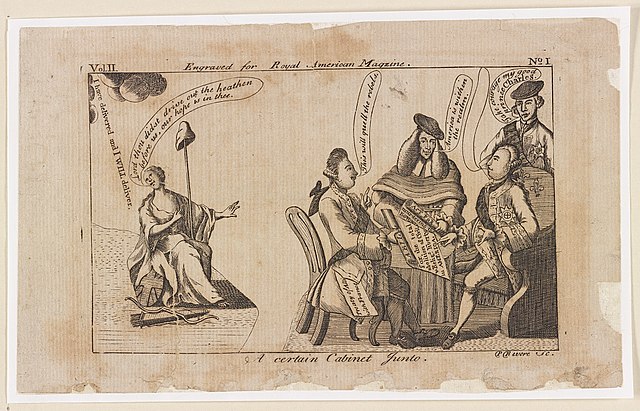
Revere engraved America, grenadier, and serpent beside his picture of John Hancock for the Royal American Magazine in March 1774. That America was standing, but Revere included a similar America, sitting this time, in his illustration “A certain Cabinet Junto” in January 1775, as shown above. The same female figure appeared in mirror image in “America in Distress” two months later.

Revere clearly copied that figure of America, and most of the “America in Distress” composition, from “Britannia in Distress,” a print that appeared in the Oxford Magazine in 1770. (The rest of his “Cabinet Junto” came from “A retrospective View of a certain Cabinet Junto” published in 1773.) Thus, Revere probably had access to his source for “a Woman, representing AMERICA,” by early 1771.

That leaves this image:
the Ghost of the unfortunate young [Christopher] Seider, with one of his Fingers in the Wound, endeavouring to stop the Blood issuing therefrom: Near him his Friends weeping: And at a small distance a monumental Obelisk, with his Bust in Front
To be frank, this picture seems a bit busy—an obelilsk and a bust and a bleeding ghost?

Revere hardly made any engravings without copying from someone else’s engraving or drawing. And when he tried, the results were poor. Though Revere was skilled at engraving decorations on metal, drawing human faces, figures, and landscapes in perspective was not among his talents.

Therefore, I suspect there must be some model or models for Revere’s Seider picture—a picture of a youth with a finger in a bleeding wound and perhaps a separate picture of a memorial obelisk and bust. One or the other of those images would include some weeping mourners.

I’ve kept my eye open for possible models in looking at Revere’s other work and at British engravings. Occasionally I’ve run keyword searches on the British Museum website, source of the original prints I’ve linked to above. But so far I’ve come up empty.

Tuesday, March 09, 2021

Three New Interviews

A couple of weeks ago I wore collared shirts and shaved almost every day of the week.

That’s because I was scheduled to participate a series of online conversations that were recorded for viewing.

First, I spoke with Bob Allison and Jonathan Lane of the Revolution 250 coalition about young Christopher Seider, his killer Ebenezer Richardson, and what date was really George Washington’s birthday. Here’s the link to the video and the audio.

The next day I connected with Christian Di Spigna of the Dr. Joseph Warren Historical Society to interview Mitch Kachun about the place of Crispus Attucks in American history and culture. Kachun’s book is First Martyr of Liberty. Here’s the video.

Finally, on Friday Christian and I linked up again to talk with Nina Sankovitch about her story of three intertwined families from north Braintree (now Quincy), Amerian Rebels: How the Hancock, Adams, and Quincy Families Fanned the Flames of Revolution. Here’s that video link.

Behind me in the videos are the shelves I set up last month in an attempt to get my books more organized. I’ve already assembled three more bookcases, with another two to follow. And I’m not close to caught up yet.

Wednesday, March 03, 2021

The Boston Massacre’s Political Resonance

The Boston Massacre was a political event, of course.

It arose from conflicts between sources of authority—the imperial government and the town government, the British army and the local community, two groups of people feeling threatened and in the right.

In the immediate aftermath, the Whigs memorialized that event as part of that larger political campaign. Then in 1783, when independence had been won and the U.S. of A. was no longer part of internal British politics, Boston stopped commissioning orations every March.

The Massacre gained new political meaning in the mid-1800s as William Cooper Nell and other abolitionists used the figure of Crispus Attucks to argue that Americans of African descent had long been central to the nation and deserved equal rights.

As Mitch Kachun traces in First Martyr of Liberty, Attucks became an emblem of African-American patriotism in the late nineteenth and early twentieth centuries. When Boston erected a monument to the Massacre victims on the Common in 1889, black civil rights campaigners had been among its strongest proponents, and it was informally called “the Crispus Attucks monument.” (Not to be left out, Irish-Americans pointed to Patrick Carr and German-Americans to Christopher Seider as important martyrs.)

Other African-American heroes and models became prominent in the twentieth century, and Attucks’s name lost some of its resonance. In Boston, Melnea Cass revived the tradition of Crispus Attucks Day, shown in this photograph from 1970. His inspiration and her legacy will be discussed at Revolutionary Spaces’s ”Grief, Remembrance, Justice” online panel discussion on 5 March at 5:00 P.M.

Two months after that 1970 anniversary, National Guardsmen shot and killed four student protesters at Kent State University. Within days, Eric Hinderarker reports in Boston’s Massacre, someone published the poster shown above, paralleling the shooting on King Street and the shooting in Ohio. At almost the same time, Mississippi police officers killed two more students at Jackson State University.

Blacks were not the only Americans seeing their cause reflected in the Massacre of 1770. In Boston, the Bicentennial coincided with a federal court instituting busing to integrate schools. One of the more militant white groups resisting that order, R.O.A.R., attended the 1775 Massacre reenactment in force. When the muskets fired, as J. Anthony Lukas recounted here, scores of those protesters fell down, too—assuming the role of victims of an oppressive government.

The 1999 reenactment was the first I attended in a long time. It came a month after New York detectives had killed an African immigrant named Amadou Diallo, shooting 41 rounds at the unarmed man sitting on his front stoop. The current issue of the New Yorker, dated 8 March, showed a white policeman at a fairground shooting booth with a sign that read “41 Shots 10¢.” At the reenactment, I recall hearing a couple of spectators shout, “Forty-one shots for a dime!”

Last May after a peaceful Black Lives Matter protest on Boston Common, Boston police forcefully went after straggling groups of protesters, resulting in arrests, looting, and vandalism. There was slight damage to some historic sites and statuary. In subsequent days the governor called out the state militia, and Jake Sconyers caught a resonant image of a military vehicle parked in front of the Old State House on a spot where some of the crowd had stood on 5 March 1770.

As long as we have conflicting sources of authority, as long as groups feel threatened, rightly or wrongly—in other words, for the foreseeable future—the Massacre will continue to have contemporary political resonance.

Monday, April 20, 2020

The Trial of Ebenezer Richardson

On 20 Apr 1770, 250 years ago today, Ebenezer Richardson went on trial for the killing of young Christopher Seider.

This was just short of two months after the fatal confrontation at Richardson’s house in the North End, but for the Boston Whigs that was too long.

They suspected that the judges and attorneys who leaned toward the Crown had delayed the trial to cool the passions aroused by the violent death of a child. The Crown was definitely trying to delay the Boston Massacre trials.

At various times the provincial Attorney General, the appointed defense attorney, and some judges didn’t show up for procedures in Rex v. Richardson and Wilmot. But at last on 20 April everyone was present.

Justice Benjamin Lynde presided, with Edmund Trowbridge, Peter Oliver, and William Cushing on the bench with him. The prosecutors were Massachusetts solicitor general Samuel Quincy and Robert Treat Paine, hired by the town of Boston. The newly appointed defense attorney was Josiah Quincy, Jr.

The two sides agreed on the basic facts of the case. After Richardson had tried to break up a boys’ protest outside of importer Theophilus Lillie’s shop, the boys attacked his house. The violence and damage escalated. Eventually Richardson fired a musket full of birdshot out of his window. Christopher Seider fell, mortally wounded.

The question was whether Richardson was rightfully defending his home and family from attack. Did the boys’ actions justify a lethal response? Was Christopher participating in illegal activity? Did Richardson aim at the child? Possible verdicts included guilty of murder, guilty of manslaughter, and not guilty entirely.

(Of course there was also the sailor George Wilmot, who had gone into Richardson’s house to help but hadn’t fired a gun.)

Samuel Quincy opened by questioning the prosecution witnesses, as his partner’s notes show. They played down the danger from the riotous boys and talked about Richardson’s anger. Among those witnesses were the Whig activists Edward Procter, David Bradlee, and Dr. Thomas Young.

Josiah Quincy’s notes preserve his strategy to win over the jurors:
1st. To open the Defence with a proper Address to the Jury to remove all popular Prejudices and Passions and engage them to make a fair, candid and impartial Enquiry and to give their Verdict agreeable to Law and the Evidence, uninfluenc’d by any other Motive; to mention the manner of my becoming engaged as Council for the Prisoners, explain my Duty and the Part I ought and am determin’d to act.

2d. The Witnesses for the Crown having been carefully and thoroughly cross-examined, to produce those for the Prisoners, and endeavour to find out what the Nature and Degree of Provocation offered; how far the Attack upon the house was carried; Whether and to what Degree the Windows were demolished before the firing, and whether the Door was broke open, and any Attempt made upon it; whether any actual Attempt was made to enter; or any Evidence of such Design from threatning Words; Whether Men as well as Boys were not concerned in that Attack; What Weapons were used or thrown into the house; and whether any One within was wounded; and upon the whole whether this is not to be consider’d as an Attack upon the Persons of the Prisoners.

3d. To sum up the Evidence and state the Facts as they shall appear upon Evidence.

4thly. To explain the Nature of the Crime of Murder and the different Kinds of Homicide, as justifiable, excusable (as se defendendo) and felonious: and to shew the Distinction between felonious Homicide of Malice prepense, which is properly Murder, and without such Malice, which is Manslaughter.
The defense witnesses included Richardson’s daughters Sarah and Kezia, possibly Harvard student William Eustis, schoolmaster Elias Dupee, and one of the Dr. Perkins. The witness testimony and then the legal arguments of Paine and Josiah Quincy lasted well past dark.

An unofficial factor in the courtroom were the many people who had come to see the trial. So many, in fact, that there were complaints of pickpocketing afterward. Judge Oliver called this audience “a vast Concourse of Rabble.”

Today we expect a judge to sum up legal issues and options for the jury but to leave the decisions to them. At this time, however, the multiple judges also advised on guilt and innocence. A report sent to Gov. Francis Bernard said that all those gentlemen felt the facts favored Richardson’s case:
They said it appeared by the Evidence that the prisoner was attacked in his own house by a number of tumultuous people. That what he had done was in his own defence. That self-defence was a right inherent in every man. . . . they were convinced the jury could find him guilty of nothing more than manslaughter.
According to acting governor Thomas Hutchinson, his friend and relation on the bench went even further:
Mr. Just. Oliver doubted whether it could amount to that and with great spirit charged the death of the Boy upon the Promoters of the Effigies and the Exhibitions which had drawn the people together and caused unlawful and tumultuous assemblies and he did not excuse such as had neglected suppressing these Assemblies as the Civil Magistrate had done.
At that, Oliver heard someone in the audience shout, “Damn that Judge, if I was nigh him, I would give it to him!” Other Crown informants said they heard people call, “Remember, jury, you are upon Oath”; “Blood requires blood!” and “Damn him, hang him! Murder, no manslaughter!”

At 11:00 P.M. the jurors went into a private room to deliberate. The defendants were supposed to be taken back to the jail, but the judges had heard that some spectators had brought “an Halter, ready at the Door of the Court Room,” to hang Richardson. (People had nearly lynched him on the day of the shooting.) Sheriff Stephen Greenleaf locked the defendants inside the courthouse instead.

The judges also waited in the building for most of the crowd to disperse. They finally ventured out at midnight. Even so, one Crown informant said, “The judges were hissed and abused in a most shameful manner in passing from the bench to their carriages.”

Meanwhile, the jury was still deliberating.

TOMORROW: The verdicts.

Thursday, February 27, 2020

“My Eyes never beheld such a funeral”

Yesterday I described how the Boston Whigs prepared for young Christopher Seider’s funeral procession on Monday, 26 Feb 1770.

The first newspaper published after that date was the 1 March Boston News-Letter, and it reported on the event this way:
a great Multitude of People assembled in the Houses and Streets to see the Funeral Procession;—it began about 3 o’clock from Liberty-Tree, (the Dwelling-House of the Parents of the deceased being but at a little distance from thence) the Boys from the several Schools, supposed to be between 4 and 500, preceded the Corps in Couples;—after the sorrowful Relatives and particular Friends of the Youth, followed many of the principal Gentlemen and a great Number of other respectable Inhabitants of this Town, by Computation exceeding 1300; about 30 Chariots, Chaises, &c. closed the Procession:

Throughout the Whole there appeared the greatest Solemnity and good Order, and by as numerous a Train as was ever known here.
Richard Draper at the News-Letter had evidently received complaints about his first report on the shooting, composed as the event unfolded, not condemning Ebenezer Richardson as much as people wanted. So this issue had more criticism of Richardson and mourning for his victim.

The Whigs supplied a longer, even more slanted report on the funeral to two Monday newspapers, the Boston Gazette and Boston Evening-Post. (The Boston Post-Boy printers, Green and Russell, had already stated, “We are extremely cautious of publishing any thing which may raise a Prejudice in the Minds of People” while a trial was in the offing.)

The Boston Whigs insisted that “About Five Hundred School boys” led the procession of, “in the Estimation of good Judges, at least Two Thousand of all Ranks, amidst a Crowd of Spectators.” Merchant John Rowe agreed with the latter number, which would be the equivalent of one of every eight people in Boston.

John Adams, having ridden to Boston from legal business in Weymouth, wrote in his diary:
When I came into Town, I saw a vast Collection of People, near Liberty Tree—enquired and found the funeral of the Child, lately kill’d by Richardson was to be attended. Went into Mr. Rowes, and warmed me, and then went out with him to the Funeral, a vast Number of Boys walked before the Coffin, a vast Number of Women and Men after it, and a Number of Carriages. My Eyes never beheld such a funeral. The Procession extended further than can be well imagined.

This Shewes, there are many more Lives to spend if wanted in the Service of their Country. It Shews, too that the Faction is not yet expiring—that the Ardor of the People is not to be quelled by the Slaughter of one Child and the Wounding of another.
The Rev. William Gordon later wrote that the procession was a quarter-mile long. It ended at what is now called the Granary Burying-Ground, and the small coffin was placed in a tomb owned by the town of Boston.

In the newspapers, the Whigs declared of Christopher Seider:
His tragical Death and the peculiar Circumstances attending had touched the Breasts of all with the tenderest Sympathy, a few only excepted, who have long shown themselves void of the Feelings of Humanity.
Tributes continued. Phillis Wheatley wrote a poem, “On the Death of Mr. Snider Murder’d by Richardson.” The Boston Gazette assured the public that
a Monument will be erected over the Grave of young Snider, with an Inscription, to perpetuate his Memory; A Number of patriotic Gentlemen having generously subscrib’d for that Purpose…the Overplus Money, if any, will be given to the Parents.
No such monument was built. Over a year later, in the 21 Mar 1771 Massachusetts Spy, a writer asked what happened to “the Money so collected.” That letter said the man who had collected the cash was “a Gentleman who had a considerable share in the popular transactions of the year past”—which sounds like William Molineux. By then he was developing money troubles.

The Whigs’ report on the Seider funeral appeared in the Boston Gazette and Boston Evening-Post on Monday, the 5th of March. The passionate description no doubt shaped the public mood that day and evening, which culminated in the Boston Massacre. Those deaths overshadowed Christopher Seider’s, and soon there were five more bodies in the tomb where his coffin lay.

[Photo from the Granary Burying Ground in winter courtesy of Boston Ghosts tours.]

Wednesday, February 26, 2020

“A grand funeral” for Christopher Seider

Young Christopher Seider was shot and killed on Thursday, 22 Feb 1770. His funeral was held the following Monday, 26 February—250 years ago today.

Monday was also when the Whig newspapers published, so they ran their detailed, almost incendiary accounts of the killing over announcements of the funeral. The Boston Evening-Post and other papers told the public:
The general Sympathy and Concern for the Murder of the Lad by the base and infamous Richardson on the 22d Instant, will be a sufficient Reason for your Notifying the Publick that he was be buried from his Father’s House in Frogg-Lane, opposite Liberty-Tree, on Monday next, when all the Friends of Liberty may have an Opportunity of paying their last Respects to the Remains of this little Hero and first Martyr to the noble Cause.
The Boston Gazette offered further advance spin on the event:
It is said that the Funeral of the young Victim THIS AFTERNOON at Four o’Clock, will be attended by as numerous a Train as ever was known here.—It is hoped that none will be in the Procession but the Friends of Liberty, and then undoubtedly all will be hearty Mourners.
Acting governor Thomas Hutchinson thought the Whigs’ preparations were a little much. In the continuation of his history of Massachusetts, never published in his lifetime, he wrote: “The boy that was killed was the son of a poor German. A grand funeral was, however, judged very proper for him.”

There was a ceremony in King’s Chapel, the Anglican church where Christopher’s younger sister had been baptized and his employer owned a good pew. Ironically, that was also where the boy’s killer, Ebenezer Richardson, had married his second wife in 1754.

Then came the procession. The Boston Gazette stated, “The little Corpse was set down under the Tree of Liberty, whence the Procession began.” The Whigs published detailed descriptions of some aspects of the event and nothing about others, probably because readers were already familiar with standard funerals.

Some of the following description is therefore based on general British and New England customs of the time rather than specific statements. Furthermore, some of the customs for well documented upper-class funerals in London might not have been followed in Boston, even when the local gentry were trying to provide a “grand funeral.”

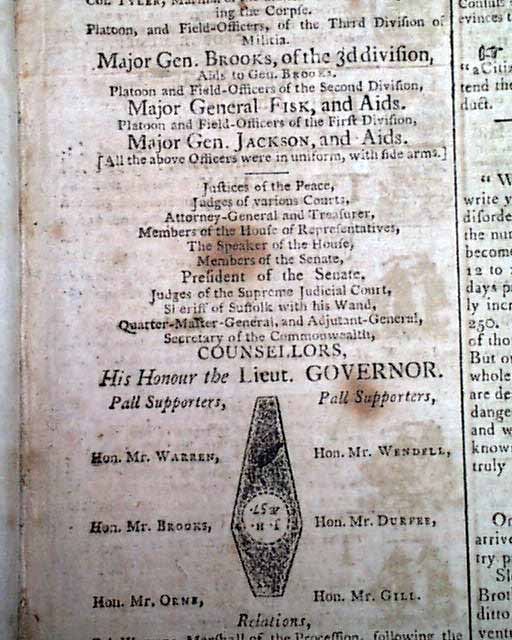
Four to six young men hired to be “under-bearers” probably lifted the small coffin onto their shoulders. It was draped in a black velvet pall that mostly hid those men from view. Some British pictures of funeral processions don’t show the under-bearers at all while a French picture of a British funeral (above, courtesy of Colonial Williamsburg) shows two of them peeking out from holes in the front of the pall.

All the honor of escorting the corpse went to the pall-bearers, who grasped the sides of the pall cloth but didn’t do the heavy lifting. As Samuel Johnson wrote in his dictionary, underbearers were, “In funerals, those that sustain the weight of the body, distinct from those who are bearers of ceremony, and only hold up the pall.”

For the funeral of Christopher Seider, the Boston Gazette said:
The Pall was supported by six Youths, chosen by the Parents of the Deceased. Upon the Foot of the Coffin was an Inscription in silver’d Letters, Latet Anguis in Herba! Intimating that in the gayest Season of Life amidst the most flattering Scenes, and without the least Apprehension of an evil Hour, we are continually expos’d to the unseen Arrows of Death: The Serpent is lurking in the Grass, ready to infuse his deadly Poison!—

Upon each Side Haeret Lateri lethalis arundo! In English, the fatal Dart is fix’d in the Side!

And on the Head was another Inscription, Innocentia nusquam tuta! The original Sentiment revers’d; and denoting that we are fallen into the most unhappy Times, when even Innocence itself is no where safe!
The first two phrases came from one of Virgil’s Eclogues and from his Aeneid. The last phrase was a variation on another phrase Virgil used in the Aeneid, Nusquam tuta fides, “confidence is nowhere safe.”

The Sons of Liberty who guarded Liberty Tree had fixed a board to its trunk with more quotations:
  • “Thou shall take no Satisfaction for the Life of a MURDERER;—He shall surely be put to Death.” (Numbers 35)
  • “Though Hand join in Hand, the Wicked shall not pass unpunish’d.” (Proverbs 16)
  • “The Memory of the Just is Blessed.” (Proverbs 10)
More New Englanders could recognize those words since they came from the English Bible.

At about three o’clock in the afternoon, the procession moved out from Liberty Tree.

TOMORROW: The turnout.

Monday, February 24, 2020

The Life and Death of Christopher Seider

The younger boy hit by “Swan shot” from Ebenezer Richardson’s musket on 22 Feb 1770 was named Christopher Seider (although that last name also showed up as Snider and in other forms).

Christopher’s story starts with an effort to settle Maine. Around 1740, Massachusetts land speculators recruited German-speaking immigrants to live in the area around Broad Bay now called Waldoboro. At first this community was very small, but immigrant-laden ships arrived in Boston harbor beginning in November 1751.

The 25 Sept 1752 Boston Evening-Post reported:
a ship arrived from Holland with about 300 Germans, men, women and children, some of whom are going to settle at Germantown [in Braintree] and the others in the Eastern parts of the Province [i.e., Maine]. . . . a number of very likely Men and Women, Boys and Girls, from Twelve to twenty-five years old, will be disposed of for some Years according to their Ages and the different Sums they owe for their Passage.
In other words, some of the younger immigrants were to be indentured servants.

On that ship, the St. Andrew, came Heinrich Seiter, a farmer from Langensteinbach, and his family. Their home country was ruled by Charles Frederick, Margrave of Baden-Durlach. He was among the more enlightened of Europe’s noble despots, but Seiter was “very poor” and sought better opportunities. In that family, it appears, was a young man named Georg Frederich Seiter, born in 1727.

Around the same time, a woman named Christine Salome Hartwick, born about 1723, arrived with several of her relatives. That family’s name showed up in New England records as Hardwick, Hartig, and other forms.

Heinrich Seiter settled in the Waldoboro area. George Seiter may have lived with him for a while or gone directly to Braintree, where locals were trying to develop a little manufacturing center. Some of the new Germans were said to be glassmakers, and Joseph Palmer and Richard Cranch were building a glass factory.

We know that Georg Frederich Seiter married Christine Salome (soon Sarah) Hartwick on 20 Mar 1753 at Germantown. They had three children in Braintree:
  • Christina Elizabeth, born 26 Dec 1754.
  • Sophia, born 29 June 1756.
  • Christopher, baptized 18 Mar 1759.
By then the family name was written as “Sider.” If Christopher was baptized a week or two after birth, like his sisters, then he was born in early March 1759.

In 1755, the glass factory was struck by lightning and burned. Palmer and Cranch tried to keep the venture going, but in 1760 they gave up and mortgaged the land to Thomas Flucker. Some of the German workers went to Maine, some to a new town soon called Ashburnham—and George and Sarah Seider moved their family to Boston, where their daughter Mary was baptized at King’s Chapel on 10 June 1761.

The Seiders lived in a little house at the bottom of Boston Common on Frog Lane, later gentrified to Boylston Street. On the other side of the street was the giant elm that in 1765 the Sons of Liberty dubbed “Liberty Tree.”

As the 1760s came to a close, Christopher was no longer living with his family, however. He was in the household of the very wealthy widow Grizzell Apthorp, working as a servant. Apthorp was a pillar of the King’s Chapel congregation, which was probably how she came to know the Seiders.

There’s evidence that Christopher also attended a school of some sort. In the 1840s a woman named “Mrs. Preston” told a writer that she had gone to school with him, probably a reading school when they were younger. The Boston News-Letter reported that Christopher “was going from School” on 22 Feb 1770.

It’s quite clear that Christopher Seider was a reader. The Boston Evening-Post reported that he carried “several heroic pieces” or broadsides “in his pocket, particularly Wolfe’s Summit of human glory.” A broadside titled Major-General James Wolfe, who reach’d the summit of human glory, September 13th, 1759 is now on display at the Massachusetts Historical Society. The 17" by 24" sheet describes the taking of QuĂ©bec in 1759, illustrated with a large colored woodcut of the general.

On the morning of 22 February, Christopher was among the boys outside Ebenezer Richardson’s house. It’s not clear how much he participated in the young mob’s attack on that house. Prosecutor Robert Treat Paine took notes that a witness named Jonathan Kenny said, “Syder threw nothing stood looking,” and “I was by Syder 5. minutes. Saw him throw nothing.” But Charles Atkins testified, “Syder was stooping to take up a Stone as I thought.”

Christopher must have been toward the front of the crowd when Richardson pulled his trigger because his torso was hit by eleven lead pellets. In addition, said the Boston Evening-Post, “The right hand of the boy was cruelly torn, whence it seems to have been across his breast.” Christopher fell and was carried into a nearby house.

The Evening-Post reported, “all the surgeons, within call, were assembled and speedily determined the wounds mortal.” Among the doctors we know examined the boy were the radical Dr. Thomas Young, the apothecary Dr. John Loring, and Dr. Joseph Warren, who afterward conducted an autopsy.

In addition, there were “clergyman who prayed with” Christopher. The newspaper praised “the firmness of mind he showed when he first saw his parents, and while he underwent the great distress of bodily pain, and with which he met the king of terrors.”

Christopher Seider died “about nine o’clock that evening.” Some reckonings say he was the first person killed in the American Revolution. He was probably just a few days short of his eleventh birthday.

TOMORROW: The older boy.

Tuesday, February 11, 2020

The Great 1770 Quiz Answers, Part 1

Thanks to everyone who puzzled over the Great 1770 Quiz, whether or not you entered answers in the comments!

It looks like the competition is down to John and Kathy since they answered both parts. If I try this again I hope to remember the bunch all the questions in one posting.

In this Age of Google, it’s increasingly easy to find information—as long as one knows how to ask and how to assess sources. That means it’s also increasingly difficult to come up with trivia questions that can’t be answered with a few keystrokes.

This week I’ll share the answers to the questions and point to sources where people could find those answers. So let’s go!

I. Lord North became prime minister of Britain in January 1770. On March 5, the date of the Boston Massacre, what motion did he make in Parliament?

The answer is that on 5 Mar 1770 Lord North stood up and proposed in the House of Commons that Parliament repeal the duties on glass, paper, lead, and painter’s colors instituted by the Townshend Act.

Simply Googling the phrases “Lord North,” “Parliament,” and “March 5, 1770” (each phrase within quote marks, of course) brings up that answer in this essay at History Is Fun.

But of course an online tertiary source should be confirmed, ideally with period references that would pass muster in scholarship. The Annual Register for 1770 describes North’s proposal and the debate next to the date “March 5.”

Notably, that account doesn’t use Lord North’s name. It simply refers to “the government,” which he headed. British printers in this period were still testing the water of reporting Parliamentary debate, so they often didn’t identify speakers by name.

A few years later, however, an anonymous author rewrote the Annual Register into A View of the History of Great-Britain, during the Administration of Lord North, and that book was explicit about Lord North’s action:
One of the first acts of the new minister, was the bringing in a bill [footnote: March 5, 1770] for the repeal of so much of a late act of parliament as related to the imposing of a duty on paper, painters colours, and glass, imported into America; the tax upon tea, which was laid on by the same act, was still continued.

This repeal was made in compliance with the prayer of a petition, presented by the American merchants to the house of Commons, setting forth the great losses they sustained, and the fatal effects produced by the late laws, which for the purpose of raising a revenue in the colonies, had imposed duties upon goods exported from Great-Britain thither.
Both books report that some Members of Parliament proposed repealing the tea tax as well. Again, the names of those politicians don’t appear. But in a 1908 biography Charles A. W. Pownall credited his ancestor, former Massachusetts governor Thomas Pownall, with forcing a vote on that issue. Pownall lost, and the tea tax remained.

All four people who responded to this question—kmjones234, Kathy, Justin C, and John—answered correctly!

II. According to the records of King’s Chapel, which of the following events did NOT occur in that church in early 1770?
  • the funeral of Christopher Seider, killed by Ebenezer Richardson
  • the funeral of Patrick Carr, killed in the Boston Massacre
  • the baptism of Ebenezer Richardson, on trial for killing Christopher Seider
  • the marriage of John Murray, representative to the Massachusetts General Court from Rutland
Last November I featured the Colonial Society of Massachusetts’s online publication of the records of King’s Chapel, which inspired this question. The second of those two volumes contains the records on baptisms, marriages, and funerals.

In those webpages we can find mentions of all four of the events listed above: John Murray’s wedding on 24 January, Christopher Seider’s funeral on 26 February (though his name is spelled “Sider”), Patrick Carr’s funeral on 17 March, and Ebenezer Richardson’s baptism on 14 April.

The funerals included processions through the streets, but some religious service evidently took place in King’s Chapel or else they wouldn’t be recorded here. However, the listing for Richardson’s baptism says it took place “In Prison” rather than in the church, so that’s the correct answer.

Richardson’s was an unusual “Adult” baptism in the Anglican church. The man’s birth in 1718 is listed in the records of Woburn’s meetinghouse, indicating that he’d been baptized as an infant there, but in April 1770 he apparently wanted more salvation. Since he was about to go on trial for killing a child and none of the lawyers in Boston wanted to represent him, Richardson evidently felt he could use all the help he could find.

This question may have been too tricky by half because no one got it entirely right, but John noted all four events are in the King’s Chapel records while Kathy discerned that Richardson was in jail.

TOMORROW: Weapons and the legislature.

Sunday, December 29, 2019

EXTRA: Radio Interviews This Week

I’m scheduled to do two radio interviews this week.

In the hour after midnight on Tuesday morning, I’ll speak to Bradley Jay at WBZ, Boston’s 1030 AM. Our topic will be Henry Knox’s expedition to the Lake Champlain fortifications to collect heavy artillery for the Continental lines around Boston.

On Friday morning, 3 January, in the 10:00 hour I’ll represent the Journal of the American Revolution on the “Revolution Road” segment of the Dave Nemo Show on Sirius/XM146. We’ll discuss the events of 1770, which include non-importation, the Seider killing, the Boston Massacre, Boston’s second tar-and-feathering, a General Court session in Cambridge, and the four Boston Massacre trials.

Sunday, November 10, 2019

“Voices from the Boston Massacre” Exhibit at M.H.S.

The Massachusetts Historical Society has opened a new exhibit called “Voices from the Boston Massacre,” displaying documents and artifacts from its collection illuminating that Sestercentennial event of 5 Mar 1770.

The exhibit includes trial notes and letters from the collections of such attorneys as John Adams, Robert Treat Paine, and Samuel and Josiah Quincy, Jr. There’s a full series of Massacre engravings by Henry Pelham, Paul Revere, and the artists who copied them. We can see the musket balls that Edward Payne dug out of his doorway after he was wounded in the arm. We can read parts of the newspaper reports, orations, and memoirs of the event.

One document new to me is the recently acquired handwritten memoir of Julia Bernard Smith, daughter of Gov. Francis Bernard. He left Massachusetts in August 1769, but his family remained behind until December 1770, in part because the children were still in school.

Later in life, Smith wrote: “Captain [Thomas] Preston had performed at my Father’s Concerts and was well known to us.” I knew Preston was generally well regarded, but I had no idea he was musical.

This exhibit holds personal meaning for me. Twenty years ago, I was drawn into the study of Revolutionary Boston through the figure of Christopher Seider, the young boy killed eleven days before the Massacre by Customs officer Ebenezer Richardson.

As I wrote back here, I spent years looking for a broadside that a newspaper said Christopher had in his pocket when he died, and I finally found it in the M.H.S. catalogue. Now that broadside is in a display case near the beginning of the exhibit, illustrating Christopher’s importance in the events that followed. And the label cites my work identifying its significance.

There are also a couple of video displays in this exhibit. One shows actors reading various witnesses’ accounts of the shooting (or, in the case of Charles Bourgate, what he claimed was his account). Another shows historians speaking about the event from Serena Zabin and Hiller Zobel down to myself.

The M.H.S.’s “Voices from the Massacre” website features online resources about the period for researchers and educators. Folks can visit the exhibit at 1154 Boylston Street in Boston every Monday through Saturday from 10:00 A.M. to 4:00 P.M., and as late as 7:00 P.M. on Tuesdays. It will be up through the Massacre anniversary until June 2020.

Speaking of the Massacre, I’ll be speaking of the Massacre with Bradley Jay on WBZ radio’s Jay Talking Show—what led up to the confrontation on King Street, how it happened, and why it mattered. That conversation will run from midnight to 1:00 A.M. on the morning of Tuesday, 12 November. If our chat is particularly interesting, it will become one of the show’s podcasts.

Saturday, August 10, 2019

“An especially clever piece” in Children of Colonial America

While preparing for a teachers’ workshop next week, I came across for the first time Judith Ridner’s review of Children in Colonial America, a volume edited by James Marten and Philip J. Greven, for the journal Pennsylvania History.

You’ll forgive me for quoting a passage:
The volume concludes with an especially clever piece by J. L. Bell about the politicization of youth in pre-Revolutionary Boston. Fifty-two percent of Boston’s population in 1765, he notes, were white youth under the age of sixteen (204). Yet, when scholars write of that city’s famous series of pre-revolutionary protests, they rarely acknowledge the unique contributions children and youths made to the crowd. Bell corrects that shortcoming. He describes the functions of Boston’s youth gangs and also analyzes the symbolic importance of eleven-year-old Christopher Seider at the Boston Massacre. For him, the actions of Boston’s youth demonstrate how the Revolution was about lived experience, not ideology.
That’s Pennsylvania History: A Journal of Mid-Atlantic Studies, 76 (2009), 379-80.

Ridner is now a professor of history at Mississippi State University and author most recently of The Scots Irish of Early Pennsylvania: A Varied People. I’m grateful for her kind words.

Sunday, March 10, 2019

Maintaining the Memory of the Massacre

We know that Boston kept the memory of the Massacre of 1770 fresh in people’s minds with an annual oration on or about 3 March until 1783. Those orations were published, so they remain visible.

The town had another way to highlight each anniversary of the Massacre which we can no longer see. That tradition started in 1771 when Paul Revere mounted an illuminated display in the upper windows of his newly acquired house in the North End. I quoted the full description of it from Edes and Gill’s Boston Gazette back here.

There were three pictures in three windows:
  • Christopher Seider showing his wound to weeping friends, with his bust on an obelisk that also listed the names of the Massacre victims.
  • ”the Soldiers drawn up, firing at the People assembled before them—the Dead on the Ground—and the Wounded falling,” which was of course was Henry Pelham and Paul Revere had shown in their prints published the previous year.
  • “the Figure of a Woman, representing AMERICA, sitting on the Stump of a Tree, with a Staff in her Hand, and the Cap of Liberty on the Top thereof,—one Foot on the Head of a Grenadier lying prostrate grasping a Serpent.” This is similar to the figure shown above, from the lower right of Revere’s engraving of the regiments landing in Boston in October 1768. But the illuminated America held a staff with a Liberty Cap, like the allegorical woman on the Boston Gazette masthead.
I believe Revere must have copied the Seider image from a British print, but I haven’t spotted the model yet.

The next year, the nighttime exhibit moved to the Royal Exchange tavern on King Street, a couple of doors west from the Customs office where the soldiers shot into the crowd. The proprietress of that tavern was a divorcée named Mary Clapham.

The 9 Mar 1772 Boston Gazette reported on that anniversary:
In the Evening a select Number of the true Friends of Constitutional Liberty, met at Mrs. Clapham’s in King-Street, and exhibited on the balcony a Lanthorn of transparent Paintings, having, in Front, a lively Representation of the bloody Massacre which was perpetrated near that Spot.

Over which was inscribed,
“The fatal Effect of a standing Army, posted in a free City.”

On the Right, was the Figure of America sitting in a Mourning Posture, and looking down on the Spectators, with this Label, “Behold, my SONS.”

On the left Side, a Monument inscrib’d,
“To the Memory of
Messrs. Samuel Gray,
Samuel Maverick,
James Caldwell,
Patrick Carr, and,
Crispus Attucks, who were barbarously murdered by a Party of the 29th Regiment, on the 5th of March 1770.”


At a Quarter after Nine, the Painting was taken in, and the Bells muffled toll’d ’till Ten.

The whole was conducted with the greatest Regularity; and the Spectators, though amounting in the Course of the Evening to some Thousands, behaved with that Gravity as well as Decency, which evidently show’d, that their Hearts were deeply affected with the Retrospect of so horrid a Transaction.
Of course, deeply affecting hearts was the whole point of the commemoration.

TOMORROW: Two more years.

Thursday, February 22, 2018

The “Swan Shot” that Killed Christopher Seider

On 22 February 1770, Customs service employee Ebenezer Richardson killed a young boy named Christopher Seider.

Christopher was part of a crowd of boys mobbing Richardson’s house. Indeed, he had just stooped to pick up a stone when he was hit by the discharge from Richardson’s gun.

Richardson had not shot a musket ball. Instead, he had loaded his musket with “Swan shot.” What that meant is clear from the Whig newspapers’ report on the boy’s injuries:

soon after the child’s decease his body was opened by Dr. [Joseph] Warren and others and in it were found eleven shot or plugs, about the bigness of large peas; one of which pierced his breast about an inch and one-half above the midriff and passing clear through the lobe of the lungs, lodged in his back.

This, three of the surgeons deposed before the Jury of Inquest, was the cause of his death; on which they brought in their verdict, wilful murder by Richardson. The right hand of the boy was cruelly torn, whence it seems to have been across his breast and to have deadened the force of the shot, which might otherwise have pierced the stomach.
“Swan shot” was a common term at the time. For example, in the 6 Nov 1729 Pennsylvania Gazette Benjamin Franklin reported:
We are inform’d that the following Accident lately happen’d at Merion, viz. A Man had order’d his Servant to take some Fowls in from Roost every Night for fear of the Fox: But one Evening hearing them cry, he look’d out and saw, as he thought, a Fox among them; accordingly he took his Gun, charg’d with Swan Shot, and fir’d at him; when to his Surprize it prov’d to be the Servant’s Arm, which taking down the Fowls he had mistaken for a Fox. The Man receiv’d several Shot, some thro’ his Arm, but none of them are thought to be dangerous.
In 1751, reporting on how he had knocked himself out with an electric shock, Franklin wrote, “I afterwards found it had rais’d a Swelling there the bigness of half a Swan Shot or pistol Bullet.” Likewise, in Robinson Crusoe, Daniel Defoe had his hero speak of “swan-shot, or small pistol bullets.”

On 22 Aug 1774, a crowd surrounded the house of Daniel Leonard of Taunton, protesting his appointment to the Council under Parliament’s new Massachusetts Government Act. According to Leonard, most people went home but “at 11 o’Clock in the evening a Party fixed upon the house with small arms and run off;...four bullets and some Swan-shot entered the house at the windows.” This is the earliest incident I’ve found of Massachusetts Patriots firing guns in their long political dispute with the royal government and its supporters.

Back in 1770, Richardson’s gun might have contained even smaller pellets than swan shot. During his trial, prosecuting attorney Robert Treat Paine took notes on testimony about George Wilmot, who had helped Richardson defend his house (and was acquitted of murder). If we can read Paine’s handwriting accurately, a witness said: “I took from W[ilmot]. a Gun loaded with 179 Shots. 17. Swan Shot. The rest Goose and Duck.” “Goose shot” and “duck shot” were evidently smaller pellets. Nowadays we’d lump them all together as “birdshot” and assign them numbers.

Saturday, October 14, 2017

“The concourse of spectators was greater than we ever remember”

Earlier in the week I wrote about the funeral of Christopher Seider. The merchant John Rowe stated in his diary, “I am very sure two thousand people attended his Funerall.” That would have been one of every eight people in Boston.

John Adams watched that event with Rowe and wrote:
a vast Number of Boys walked before the Coffin, a vast Number of Women and Men after it, and a Number of Carriages. My Eyes never beheld such a funeral. The Procession extended further than can be well imagined.
But within a couple of weeks came the funeral of the first four victims of the Boston Massacre, and that was even bigger. “Such a Concourse of People I never saw before—I believe Ten or Twelve thousand,” wrote Rowe. That was more than twice the reported capacity of Old South Meeting-house.

A report printed in several newspapers guessed:
It is supposed that there must have been a greater Number of People from Town and Country at the Funeral of those who were massacred by the Soldiers, than were ever together on this Continent on any Occasion.
However, back in 1740 Boston newspapers estimated that on several days the Rev. George Whitefield had preached to crowds of 15,000 to 23,000 people on Boston Common. The siege of Fort Carillion in 1759 also involved more than 20,000 people.

Be that as it may, the grandest if not the most crowded funeral that eighteenth-century Boston ever saw took place on this date in 1793: the send-off for Gov. John Hancock. The Guardian of Freedom, published in Haverhill, stated: “The concourse of spectators was greater than we ever remember to have seen on any occasion.”

The main reason for that turnout was fond feelings for Hancock. Most people in Massachusetts admired their governor. Many authors have written that Hancock accomplished little in his final years, but that assumes he went into politics to make changes. Once independence was achieved, and perhaps even before, I think Hancock’s main aim was to increase and preserve his own popularity by keeping most people happy, and in Massachusetts he achieved that.

Another reason for the big occasion on 14 Oct 1793, I think, arose from the circumstance of Hancock’s death on 8 October.

TOMORROW: How the governor died.

Thursday, October 12, 2017

“A Monument over the grave of young SEIDER”?

On 5 Mar 1770, the Boston Gazette reported on the grand funeral for little Christopher Seider, shot by Ebenezer Richardson on 22 February, and added:
We can assure the Publick, that a Monument will be erected over the Grave of young Snider, with an Inscription, to perpetuate his Memory; A Number of patriotic Gentlemen having generously subscrib’d for that Purpose——It is said it will be done in an elegant Simplicity, and that the Overplus Money, if any, will be given to the Parents.
However, over a year later the 21 Mar 1771 Massachusetts Spy ran this item on the same matter:
For the MASSACHUSETTS SPY.
Mr. [Isaiah] THOMAS,

As there was a collection made some time ago by a Gentleman who had a considerable share in the popular transactions of the year past, for the professed purpose of erecting a Monument over the grave of young SEIDER; if the above Gentleman will condescend to inform the Public, why the Money so collected, has not been approproiate to the avowed design, he will oblige a number of your readers, as well as your humble servant,

The TRIFLER.
The Spy had published another item signed “The TRIFLER” on 10 January. It was a snide attack on Jonathan Sewall, identified by his own newspaper pseudonym “Philanthrop.” It said he should be “satisfied with his 600l. sterling per annum, and no longer prostitute his pen.”

That presents a political mystery. The “Gentleman who had a considerable share in the popular transactions of the year past” had to be one of Boston’s Whigs. But Sewall was a friend and vocal supporter of the royal government. Would the same newspaper writer attack both sides?

One possible explanation is that the Trifler supported the Crown but resented how Sewall was hogging two lucrative government appointments: Massachusetts Attorney General and Judge of the Vice Admiralty Court. Several letters and even newspaper reports from that period show how royal officials wanted Sewall to hand over the judgeship to Customs Commissioner John Robinson. (In the end, Sewall clung to both jobs.)

So who was the “Gentleman who had a considerable share in the popular transactions of the year past”?  I think the most likely candidate is William Molineux. He was definitely the Whigs’ leader in street demonstrations. He was close to Madam Grizzell Apthorp, who had employed Christopher Seider as a house servant, and he was on the scene when people arrested Richardson.

Molineux was also in need of money. On 1 May 1771 he was supposed to repay the town of Boston £300 it had loaned him to kickstart a cloth-weaving enterprise that would employ the poor. He never did pay that back. By 1774 Molineux had probably applied money he was supposed to manage for Charles Ward Apthorp of New York to the weaving scheme. So it’s not hard to imagine that the funds collected for a monument to Christopher Seider went into the same hole.

Then again, the first report from 1770 said merely that some gentlemen had “generously subscrib’d” or promised money for a monument. The Trifler may have been wrong to say that funds had actually been collected. After all, in the evening after the Gazette reported on the possibility of a monument, the Boston Massacre took place. Suddenly everyone had something new to focus on and argue about.