J. L. BELL is a Massachusetts writer who specializes in (among other things) the start of the American Revolution in and around Boston. He is particularly interested in the experiences of children in 1765-75. He has published scholarly papers and popular articles for both children and adults. He was consultant for an episode of History Detectives, and contributed to a display at Minute Man National Historic Park.

Subscribe thru Follow.it


•••••••••••••••••


Showing posts with label Dr. Thomas Bulfinch. Show all posts

Thursday, April 09, 2026

“This Party behaved very Insolently & with Great Rapacity”

Samuel Austin, quoted yesterday, wasn’t the only Boston merchant to complain about how Crean Brush had confiscated cloth in March 1776.

Capt. Samuel Dashwood also groused about Brush. As cited by Eric Wiser, the captain described how Brush pushed through the back door of his house, strode past the family, and opened their front door for his assistants. At the end of the day, Dashwood determined he was missing nine trunks and two chests of silks and cloth.

Dashwood made a point that Brush had been wearing a sword (as many gentlemen did). “If any person should presume to interrupt,” Dashwood quoted his unwanted visitor saying, “[soldiers] would thrust their bayonets into such a person.”

Capt. Dashwood wasn’t above violence himself, though. Back in 1769, he was among the merchants who challenged printers John Mein and John Fleeming on King Street. And the next year, during an anti-import protest, Theophilis Lillie described Dashwood as “in a great rage, challenging me to come out of my house and he would break my neck, my bones, and the like.”

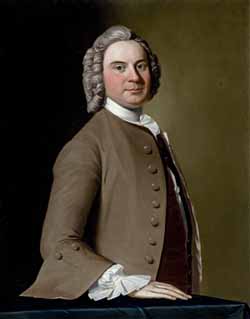
While Dashwood was a virulent Patriot, John Rowe (shown above) was a trimmer, trying to stay neutral. He lamented the outbreak of war, lived in Boston through the siege, and then chose to remain as the king’s military left. But he also objected to Brush’s actions.

I quoted Rowe’s complaints about how Crean Brush seized property on 11 March back here. At that time I assigned “Mr. Hill” the first name William, but now I think it was more likely either Robert or John.

The next day Rowe collected a receipt for his goods from Brush but wrote, “[I] dont expect—much Good from it.”He told his diary, “This Party behaved very Insolently & with Great Rapacity & I am very well Convinc’d exceeding their orders.”

The next few days were even worse, however. Rowe found other men breaking into his warehouses and stealing more goods, not just the cloth that Gen. William Howe had authorized Brush to take. And of course those men left no receipts at all.

Between Rowe’s diary, documents that Brush signed, and postwar legal filings, we can identify a few more people besides those I’ve already discussed who lost property to Crean Brush’s team: selectman John Scollay, Capt. Samuel Partridge, “Widow [Mary?] Newman,” “John Barret & Sons,” and Dr. Thomas Bulfinch.

TOMORROW: Brush’s response.

Tuesday, March 21, 2023

“They Stole many things & plunder’d my Store”

John Rowe reported that Monday, 11 Mar 1776, brought “Gloomy heavy Weather,” and his mood wasn’t any better.

The day before, as quoted yesterday, Gen. William Howe issued a proclamation requiring everyone with “Linnen and Woolen Goods” to turn them over to the evacuating army lest they fall into Continental hands.

That proclamation promised that the New York merchant Crean Brush (shown here) “will give a Certificate of the Delivery, and will oblige himself to return them to the Owners.” But if people didn’t comply, they risked being treated as rebel sympathizers.

Rowe appears to have been surprised that this proclamation applied to him, too. His 11 March diary entry says:

This morning I Rose very Early and very Luckily went to my Warehouse

when I Came there I found Mr. Crian Brush with an Order & party from the Genl. who were just going to Break Open the Warehouse which I prevented by Sending for the Keys & Opening the Doors—

They took from Mee to the Value of Twenty Two hundred & Sixty Pounds Sterling According to the best Calculation I Could make in Linnens Checks Cloths & Woollens—

This Party behaved very Insolently & with Great Rapacity & I am very well Convinc’d exceeding their orders to a Great Degree They Stole many things & plunder’d my Store. Words cannot Describe it

This Party consisted of Mr. Blasswitch who was one of the Canceaux people [i.e., an officer on H.M.S. Canceaux] Mr. Brush the Provost Mr. [William] Cunningham A Refugee Mr. [James or Peter] Welch The Provost Deputy—A Man nam’d [William] Hill & abo. fifteen Soldiers—with others—

I Remained all Day in the store but Could not hinder their Destruction of my Goods This day I Got a piece of Bread & one Draft of Flip

I Spent the Evening at home with Mr. [Samuel] Parker Rich’d Green Mr. [Jonathan] Warner of Portsmouth who assisted Mee very much with Mrs. Rowe & Jack Rowe

They are making the Utmost Speed to get away & carrying Ammunition Cannon & every thing they Can away taking all things they meet with never asking who is Owner or whose Property making havock in Every house & Destruction of All kinds of Furniture

There never was Such Destruction & Outrage committed any day before this Many other People have suffer’d the Same Fate as Mee— Particularly—
Mr. Saml. Austin Mr. John Scolly Capt. [Samuel] Partridge Capt. [Samuel] Dashwood Mr. Cyrus Baldwin The Widow [Mary] Newman
In May 1776, Austin, Scollay, Partridge, Dashwood, and Rowe petitioned the Continental Congress to speak up for them about their confiscated goods. But there was a war on.

Nine years later, in 1785, Rowe, Partridge, Dashwood, and Austin sought help from Gov. James Bowdoin and American minister John Adams in gaining redress from Britain. (I don’t know why Scollay dropped out; he was still alive at the time.)

Responding to a similar claim from Dr. Thomas Bulfinch, Adams wrote back on 13 Oct 1786:
I have not yet presented any of these Claims at Court, because there is not even a Possibility of their being regarded— . . . I frankly own I do not think, that the Dignity or the faith of the United States ought ever to have been compromised in these Matters—
If those Boston merchants had left with the British military, they might have regained their property after landing in Halifax. But they did, after all, show themselves to be rebel sympathizers.

TOMORROW: A receipt, and more disorder.

Sunday, March 20, 2011

“Onboard the Prison Ship at New York”

A little more than nine months after Richard Carpenterimmigrant, barber, and former prisoner of warresigned from the Continental Army, his wife Elizabeth had another child. That boy died young and was “Buryd in the Burying ground at the back of the Alms house” in what we now call the Granary Burying Ground.

In March 1778 the Carpenters’ older three children were “Inoculated by Doctor [Thomas] Bulfinch for the Small Pox.” In February 1780 Elizabeth Carpenter had her second daughter, Kathrine. However, she held off on the baby’s baptism at Trinity Church for over two years, until July 1782.

I suspect that was because Richard had once more left town, and she was hoping to have the ceremony when he was back. According to the memoir of Ebenezer Fox, apprenticed to another barber in Boston around 1780, there wasn’t enough hairdressing work in town. Inflation was high, and Richard Carpenter had that growing family to feed. In addition, his swimming adventures in 1775 suggest he might have been a man of bold ideas. Like Fox, Carpenter apparently signed onto a privateer or naval warship.

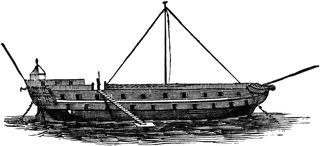
Carpenter’s ship was then captured by the Royal Navy (as was Fox’s). The barber’s name appears as “Richards Carpenter” on the British government’s roll of prisoners put on board the Jersey in New York harbor. That was an overcrowded, disease-ridden hulk.

The last entry on the family records page says:

Richard Carpenter Senior, Died onboard the Prison Ship at New York 6th Jany 1781 in the 35th Year of His Age
Carpenter had been caught and locked up by the British twice before, in Boston and then after escaping in Halifax. The third time he didn’t survive.

Later, someone made additions to earlier entries in the family records to say that Richard and Elizabeth’s three youngest children all got through the measles in February 1790.

An Elizabeth Carpenter married Thomas Lewis, Jr., in King’s Chapel in 1794. Another Elizabeth Carpenter married Josiah Nottage in 1796. Those brides could have been the barber’s widow or daughter, or unrelated women with the same name.

The records of King’s Chapel say that Samuel Carpenter and his wife Abigail had a son named George Washington Brackett Carpenter on 15 Feb 1801. I’m convinced Samuel was Richard’s second son, born while he was locked up in Boston jail; the little baby’s long name honors his father’s commander-in-chief and his mother’s family.

Samuel and Abigail named their other children William Dodd Carpenter and Caleb Strong Carpenter. They actually had three other boys, but the first William Dodd and Caleb Strong died within weeks of each other in 1803, so the couple named their next baby William Dodd as well. I haven’t found any more information about the family.

Sunday, March 23, 2008

No Pox Party in John Adams

I thought I was done writing about H.B.O.’s John Adams miniseries for a while, but interesting comments on Dr. Samuel Gelston’s smallpox hospitals got me thinking about that part of the show. Many critics have singled out the sequence in which Abigail Adams and the children are inoculated against smallpox as a particularly gritty portrayal of history.

There were actually two significant epidemics during the siege of Boston:

  • “The bloody flux,” a form of dysentery that Judy Cataldo wrote about back here. This disease reached Braintree in October 1775, making Abigail and her three-year-old Tommy sick. Her mother, Elizabeth Smith, and John’s younger brother Elihu Adams both died.
  • Smallpox, an untreatable, contagious disease with a death rate of close to 30% and a really scary rash.
The screenplay apparently combined these two diseases into something called “the bloody pox.”

After the winter of 1775-76, smallpox was the bigger worry for both armies and the civilian populations. Indeed, the epidemic eventually affected the whole continent, as Elizabeth Anne Fenn described in Pox Americana.

John Adams’s great-uncle, Dr. Zabdiel Boylston (1676 or ’79-1766), was the first American physician to try inoculating people against smallpox, provoking a huge controversy in 1720s Boston. The Rev. Dr. Cotton Mather supported him, citing advice from his enslaved man Onesimus. James and Benjamin Franklin attacked the practice in their newspaper. Because inoculation involved deliberately giving people (what everyone hoped was) a mild case of the disease, and those people remained contagious for a while, at first it seemed like a step backward in public health.

In 1730 Dr. Boylston published his results in London (as shown above, courtesy of the New York Academy of Medicine). He reported that although some patients had died after inoculation, their death rate was significantly smaller than that of people who caught the disease naturally. And the more smallpox survivors there were in a population, the less easily the disease could spread. By the middle of the 1700s, it was clear that inoculation saved lives. But it was still risky.

John had himself inoculated shortly before marrying. As a lawyer, he expected to travel and meet a lot of people, so he needed to protect himself. Abigail and the children were still vulnerable to smallpox in the summer of 1776, however. She decided to make arrangements for inoculation as she described to John in a letter dated 13 July:
I now date from Boston where I yesterday arrived and was with all 4 of our Little ones innoculated for the small pox. My unkle and Aunt [probably James and Elizabeth Cunningham] were so kind as to send me an invitation with my family.

Mr. [Richard] Cranch and wife [Abigail’s older sister, Mary] and family, My Sister Betsy and her Little Neice, Cotton Tufts [a cousin and physician] and Mr. [John] Thaxter [another cousin and tutor to the boys], a maid who has had the Distemper and my old Nurse compose our family. A Boy too I should have added. 17 in all. My unkles maid with his Little daughter and a Negro Man are here.

We had our Bedding &c. to bring. A Cow we have driven down from B[raintre]e and some Hay I have had put into the Stable, wood &c. and we have really commenced housekeepers here. The House was furnished with almost every article (except Beds) which we have free use of, and think ourselves much obliged by the fine accommodations and kind offer of our Friends. All our necessary Stores we purchase jointly.

Our Little ones stood the opperation Manfully. Dr. [Thomas] Bulfinch is our Physician. Such a Spirit of innoculation never before took place; the Town and every House in it, as are as full as they can hold. I believe there are not less than 30 persons from Braintree. Mrs. Quincy, Mrs. Lincoln, Miss Betsy and Nancy [okay, I’m giving up on the identifications] are our near Neighbours. God Grant that we may all go comfortably thro the Distemper, the phisick part is bad enough I know.

I knew your mind so perfectly upon the subject that I thought nothing, but our recovery would give you eaquel pleasure, and as to safety there was none. The Soldiers innoculated privately, so did many of the inhabitants and the paper curency spread it everywhere. I immediately determined to set myself about it, and get ready with my children. I wish it was so you could have been with us, but I submit.
The last paragraph reveals that Abigail had decided to go through with the treatment without waiting for a decision from John. As the war went on and their separations increased, she grew more comfortable making such decisions on her own. The whole family survived, as did most of their friends.

In the miniseries, Abigail and the Adams children undergo the inoculation and recovery at their home in Braintree without any servants, relatives, or neighbors in sight. A physician comes to their home with a poxy teenager in a wagon; that was the least realistic aspect for me. As the story of Dr. Gelston shows, towns were extremely edgy about confining and isolating people who might be infectious.

The actual inoculation process shown on screen—scraping pus from an infected person’s sores and inserting it into a cut on the inoculatee—was one of the cruder medical protocols of the time. Physicians also used ground-up scabs and threads dipped in pus to transmit the disease. They looked for infected people who seemed to have mild cases. According to an anonymous commenter on this posting, the series showed pus too thick to be from the early stage of the disease, and thus not contagious. I must confess that I don’t know my pus that well. But I commend the miniseries for including this unattractive but common aspect of eighteenth-century life, even within the confines of its budget.