


J. L. BELL is a Massachusetts writer who specializes in (among other things) the start of the American Revolution in and around Boston. He is particularly interested in the experiences of children in 1765-75. He has published scholarly papers and popular articles for both children and adults. He was consultant for an episode of History Detectives, and contributed to a display at Minute Man National Historic Park.

Subscribe thru Follow.it


•••••••••••••••••


Showing posts with label Charles Ward Apthorp. Show all posts

Saturday, November 10, 2018

Wheelwright to Apthorp to Molineux

Yesterday I quoted a letter from William Molineux stating that in October 1768 he had agreed to rent buildings near the center of Boston to the royal army, despite being one of the Whig activists most opposed to having troops in town. Was that rank hypocrisy?

When the historian John Richard Alden published that letter for the first time in the New England Quarterly in 1944, he wrote:
It is possible that Molineux acted merely as an agent in these transactions, but it is most likely that he rented his own properties to the British army, in full knowledge that they would be used as quarters for the redcoats.
But a 28 Oct 1768 letter from provincial secretary Andrew Oliver, while also portraying Molineux as a money-grubbing hypocrite, shows that the man was indeed acting as an agent for the real property-owner.

As I quoted yesterday, Oliver wrote that Molineux
made an Offer of the Stores on Wheelwrights Whff. at the modest rate of £400 Sterl. p. Ann:? The General has however agreed with Mr. Apthorp himself for them at the rate of £300 and you may guess who will finally pay the reckoning.   
The final price, per Molineux’s letter, was indeed £25 per month or £300 per year—the price “Mr. Apthorp” had arranged.

“Mr. Apthorp” was Charles Ward Apthorp, oldest son of Boston’s richest merchant and military contractor of the previous generation, Charles Apthorp. The younger man had migrated to New York City with the army command. There he built a successful mercantile career and served on the governor’s council.

After Charles Ward Apthorp dissolved his Boston partnership with his brother-in-law Nathaniel Wheelwright, that led to a frightening wave of bankruptcies in early 1765. Apthorp ended up owning most of Wheelwright’s property. And to manage that property, Apthorp made William Molineux his Boston agent.

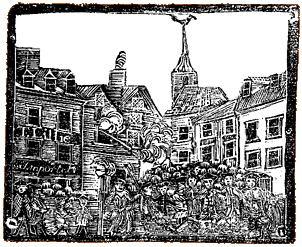
Thus, when Molineux wrote that he leased “all the Stores on Wheelwrights Warffe, (so Called)” to the army, he was leasing Apthorp’s property. The 1769 map of Boston even relabeled that wharf as “Apthorp’s” (shown above in the lower left, next to John Rowe’s Wharf).

Oliver’s statement that “The General has however agreed with Mr. Apthorp himself for them” indicates that Gen. Thomas Gage had made a deal with Apthorp before he even left New York. The owner of those buildings wanted the army to have them. Molineux wasn’t acting on his own.

But that doesn’t mean Molineux was above blame. He always had a hard time distinguishing the public good from what was good for himself. In this case, he first offered the Wheelwright’s Wharf buildings for £400 per year. Did he think that would be a prohibitive price that would keep the army out, or did he just want the extra £100? Did Apthorp require him to rent the sugar-distilling house as well, or did Molineux decide to do that on his own?

It’s pertinent that Molineux wasn’t just forwarding the proceeds of these deals to Apthorp with a little commission retained. He was apparently living off the Apthorp properties, tallying up revenue and expenses for some future settlement. In late 1774 that would catch up with him—but that’s a story for another time.

What mattered on 10 Nov 1768, 250 years ago today, was that as the first transport ships carrying soldiers of the 64th and 65th Regiments arrived from Cork, Ireland, the army had secured quarters inside Boston for them.

Thursday, October 12, 2017

“A Monument over the grave of young SEIDER”?

On 5 Mar 1770, the Boston Gazette reported on the grand funeral for little Christopher Seider, shot by Ebenezer Richardson on 22 February, and added:
We can assure the Publick, that a Monument will be erected over the Grave of young Snider, with an Inscription, to perpetuate his Memory; A Number of patriotic Gentlemen having generously subscrib’d for that Purpose——It is said it will be done in an elegant Simplicity, and that the Overplus Money, if any, will be given to the Parents.
However, over a year later the 21 Mar 1771 Massachusetts Spy ran this item on the same matter:
For the MASSACHUSETTS SPY.
Mr. [Isaiah] THOMAS,

As there was a collection made some time ago by a Gentleman who had a considerable share in the popular transactions of the year past, for the professed purpose of erecting a Monument over the grave of young SEIDER; if the above Gentleman will condescend to inform the Public, why the Money so collected, has not been approproiate to the avowed design, he will oblige a number of your readers, as well as your humble servant,

The TRIFLER.
The Spy had published another item signed “The TRIFLER” on 10 January. It was a snide attack on Jonathan Sewall, identified by his own newspaper pseudonym “Philanthrop.” It said he should be “satisfied with his 600l. sterling per annum, and no longer prostitute his pen.”

That presents a political mystery. The “Gentleman who had a considerable share in the popular transactions of the year past” had to be one of Boston’s Whigs. But Sewall was a friend and vocal supporter of the royal government. Would the same newspaper writer attack both sides?

One possible explanation is that the Trifler supported the Crown but resented how Sewall was hogging two lucrative government appointments: Massachusetts Attorney General and Judge of the Vice Admiralty Court. Several letters and even newspaper reports from that period show how royal officials wanted Sewall to hand over the judgeship to Customs Commissioner John Robinson. (In the end, Sewall clung to both jobs.)

So who was the “Gentleman who had a considerable share in the popular transactions of the year past”?  I think the most likely candidate is William Molineux. He was definitely the Whigs’ leader in street demonstrations. He was close to Madam Grizzell Apthorp, who had employed Christopher Seider as a house servant, and he was on the scene when people arrested Richardson.

Molineux was also in need of money. On 1 May 1771 he was supposed to repay the town of Boston £300 it had loaned him to kickstart a cloth-weaving enterprise that would employ the poor. He never did pay that back. By 1774 Molineux had probably applied money he was supposed to manage for Charles Ward Apthorp of New York to the weaving scheme. So it’s not hard to imagine that the funds collected for a monument to Christopher Seider went into the same hole.

Then again, the first report from 1770 said merely that some gentlemen had “generously subscrib’d” or promised money for a monument. The Trifler may have been wrong to say that funds had actually been collected. After all, in the evening after the Gazette reported on the possibility of a monument, the Boston Massacre took place. Suddenly everyone had something new to focus on and argue about.

Sunday, September 13, 2015

A Preemptive Resignation from New York’s Stamp Agent

After Parliament enacted the Stamp Act in early 1765, Treasury Department officials asked London alderman Barlow Trecothick for recommendations about which American gentleman to appoint as stamp agent for each colony.

Trecothick had started out working for the rich Boston merchant Charles Apthorp, married an Apthorp daughter, and then settled in London as a merchant doing business with North America and the Caribbean. He had argued against the Stamp Act, so officials hoped that other opponents of the law would accept his choices as fair.

The stamp agents would have to be reliable for the imperial government, of course. Trecothick figured it would help if they were established in American business or legal circles. And since selling the stamped paper and stamps would bring in a steady income, he wanted to reward his own connections—that’s just how the Empire worked.

For New York he chose the merchant James McEvers (1705-1768, shown here). McEvers was another brother-in-law of Charles Ward Apthorp, whose move from Boston to New York in the early 1760s turned out to be a major blow to Boston’s economy.

Everything seemed to be going along fine until the newspapers brought word of the demonstration and riot in Boston on 14 August. Twelve days later, McEvers wrote to Jared Ingersoll in Connecticut about his correspondence with the Treasury Department’s “Secretary to the Stamp-duties”:
I rec’d a Letter from John Brettel Esq. Forwarded by you, Inclosing a Bond to Execute for the Due Performance of the Office of Stamp Master for this Province, which I Readely Did (and Return’d it per the Last Paquet that Sail’d from hence) as there was then Little or no Clamour here about it, and I Immagin’d I Should be Able to Transact it; but since Mr. [Andrew] Olivers Treatment att Boston has Been Known here and the Publication of a Letter from New Haven, the Discontent of the People here on Account of the Stamp Act Publickly Appears, I have Been Threaten’d with Mr. Olivers Fate if not Worse, to Prevent which I have Been under a Necessity of Acknowledgeing I have Wrote for a Resignation which I have Accordingly Done, and have Been Inform’d you have Done the Same, of Which I Beg you’l Advise me, and if you have not should be Glad to Know how you Purpose to Act, as it may be some Government to me in Case I Cant Procure a Release.
On the same day McEvers also wrote to Trecothick, explaining that he wanted to be relieved of the office.

The New York merchant worried that backing out would cost him respect in London, but local Whigs insisted that he would benefit in America. A letter from New York published in the 6 Sept 1765 Pennsylvania Gazette said:
We congratulate our Countrymen upon the late Resignations of the Stamp Officers - ------ and especially the Friends and Well wishers of the Gentleman appointed to that Office in this City. The Number of his Friends and Well wishers, which was considerable before, is greatly increased by this Resignation; which has entirely cleared his Character from the Imputation of joining in the Design to enslave his Country; for we are well assured, as his Appointment was without his Solicitation or Knowledge, so his Resignation was voluntary, and not the Effect of any Menace or Disturbance, nothing of which has yet appeared in this Place.
Thus, the 14 August demonstration and riot in Boston not only caused Massachusetts’s stamp agent to resign, but also inspired the New York stamp master to do the same.

Thursday, April 03, 2014

Memories of History Camp

Remember last month’s History Camp? If you weren’t able to make it, you can still partake of some of the program through the videos that organizer Lee Wright has just posted on YouTube.

Here I am talking about “The Boston Bankruptcy That Led to the American Revolution” (about forty minutes with questions).

Here’s Liz Covart on “How the Patriots Almost Lost the Battle of Saratoga.”

And here’s a panel I missed: “Employment Options for History Lovers.”