J. L. BELL is a Massachusetts writer who specializes in (among other things) the start of the American Revolution in and around Boston. He is particularly interested in the experiences of children in 1765-75. He has published scholarly papers and popular articles for both children and adults. He was consultant for an episode of History Detectives, and contributed to a display at Minute Man National Historic Park.

Subscribe thru Follow.it


•••••••••••••••••


Showing posts with label John Burgoyne. Show all posts

Sunday, March 29, 2026

“After this they went to it with their fists”
Here’s an example of how Gen. John Burgoyne’s diary of the late 1775, just brought to light, offers new detail on life inside besieged Boston.

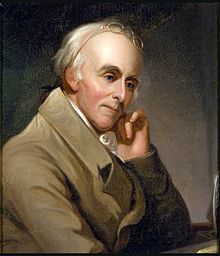
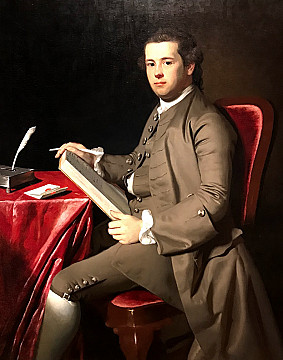
We’ve long known that in August 1775 Adm. Samuel Graves (shown below) and Customs Commmissioner Benjamin Hallowell (shown at right) got into a fistfight. In 1929, Allen French delivered a whole paper on this incident to the Massachusetts Historical Society.

The two men had already butted heads over the unloading of a merchant ship. One report suggests that Hallowell had critiqued the way Graves deployed warships during the Battle of Bunker Hill. But the immediate conflict was over hay growing on Gallops Island in the outer harbor.

Hallowell had purchased the right to harvest that hay. Graves wanted that hay, or at least half of it, for the navy. (Or maybe he wanted half the value of the hay for himself.) Hallowell secured permission from Gov. Thomas Gage to harvest. Graves refused to allow haying on the islands, and he had warships.

Hallowell sent increasingly angry letters to the admiral. Graves sent no replies. Hallowell took that silence as a sign of disrespect, and he was probably right.

The next time the commissioner saw Adm. Graves, on Milk Street on 11 August, he demanded the sort of answer that he, “as a gentleman, had a right to expect."

A letter sent from Boston on 19 August and printed in the 21-23 Sept 1775 London Chronicle stated:
To this civil question, the Admiral replied in his usual style; and while the Commissioner was whispering a challenge to him, returned a blow in the face.

Though Mr. Hallowell was unarmed, the Admiral had recourse to his sword, on which the former rushed upon him, forced it from him, broke it over his knee, and then flung it in Greaves’s face; after this they went to it with their fists, but were soon parted.—

The Admiral has come off with a black eye. He has not yet proposed a renewal of battle, probably preserving himself for the Yankies, who have already carried off all his fresh stock, burnt his hay on the islands, and destroyed the light-house twice under his very nose.
Over the next couple of days Graves’s nephew, Capt. Thomas Graves, R.N., twice challenged Hallowell on the admiral’s behalf. Another nephew, Capt. Samuel Graves, R.N., hit the commissioner on the back of the head with a cane, and Sheriff Stephen Greenleaf had to separate the men. Hallowell declared he wouldn’t duel on instructions from Gen. Gage—at least not with anyone but the admiral.

According to a 21 August letter from Capt. Samuel Graves summarized in the Dartmouth Manuscripts, the dispute was heard by a court martial. The board faulted the admiral for “An error in judgment for disobedience of orders and neglect of duty.”

Our most detailed description of this fight comes from Hallowell, and most of the other sources sympathize with him, too. (Given the commissioner’s snappish temper, that shows how many people disliked Adm. Graves.) At least a couple of those sources say the admiral came away with a black eye, suggesting the commissioner got the better of the fight.

Per Andrew O’Shaughnessy, Gen. Burgoyne called the whole incident “shameful” and recorded that Hallowell suffered a black eye, too.

Prof. O’Shaughnessy will share more details about the Burgoyne diary and how it came to light in an online “fireside chat”/Zoom webinar on 15 April at 6 P.M. Harvard time.

Saturday, March 28, 2026

Gen. Burgoyne’s Backstage Diary

Since I mentioned Gen. John Burgoyne a few days back (even if Robert Woolf didn’t), that gives me a reason to point to the big Burgoyne news of the month.

In the Washington Post, Andrew O’Shaughnessy disclosed:
…a previously unknown journal kept by…British Gen. John Burgoyne, was discovered in the archives of Knowsley Hall, the Liverpool-area estate of the earls and countesses of Derby. In 1751, Burgoyne married Lady Charlotte Stanley, daughter of the 11th Earl of Derby. The family archives also contain letters he wrote to his wife from Europe in the 1760s, as well as his personal, annotated copy of the evidence he gave in Parliament in defense of his command at the Battles of Saratoga. After that 1777 defeat, Burgoyne spent significant time at the hall. The journal does not bear his name, but it could have been written by no one else.
Just how do we know that only Gen. Burgoyne could have written this journal? After all, there were scores of British army officers in Boston in late 1775.
The oddest feature is Burgoyne’s obsession with putting on plays. The journal’s three final entries concern rehearsals for a performance of “The Tragedy of Zara,” an adaptation of Voltaire’s “Zaïre” featuring a prologue by Burgoyne. On Dec. 1, he describes holding a final rehearsal and putting his bags on board a naval ship for his passage back to England, where he remained till returning to help lead the British force in Canada in May 1776. The play was performed the next day, shortly before his departure.
Yeah, that checks out.

I heard about this journal a few weeks back as Prof. O’Shaughnessy assessed it since he was looking for corroborating sources on events in besieged Boston. I look forward to seeing the text published. Already it promises more details about life inside the town.

TOMORROW: An example.

Wednesday, December 17, 2025

Eight Runaway Men in a Boat from Boston

Capt. Richard Dodge was a Continental Army officer stationed in Chelsea during the second half of 1775. Like his regimental commander, Lt. Col. Loammi Baldwin, he sent periodic reports to Gen. George Washington’s headquarters about what he saw in Boston harbor.

On 16 December, Dodge reported some exciting news: “Last Eveing Eight men Runaway in a bote from Boston to our guard at the farry.”

Following recently enacted protocol, Dodge sent those men to a local health committee who “Clensed them by Smooking them” against the smallpox.

Six (or seven, according to the 25 December Boston Gazette) of those eight men were “masters of Vassels” captured by the Royal Navy and brought into Boston over the preceding months.

One, Capt. James Warden, had sailed for the Philadelphia merchant Thomas Mifflin and was anxious to renew their acquaintance now that Mifflin was the army’s quartermaster general. Naval Documents of the American Revolution reports that Warden was commanding the schooner Tryal on 22 August when it surrendered to H.M.S. Nautilus under Capt. John Collins.

The Essex Journal of Newburyport identified another of those ship’s captains as named Nowell, possibly Silas Nowell (who wouldn’t have been held that long). He came out with a copy of the Boston News-Letter, the only newspaper still being published in the town, and the news that Gen. John Burgoyne had sailed for England.

On 17 December, 250 years ago today, Dodge wrote out a précis of what those men told him about life inside Boston. The prices for food were high. One escapee reported that “he Dined with a man that Dined with Lord parsey a feu Day ago upon horse beaff.”

Firewood was even scarcer with winter coming on. Gen. William Howe had ordered the Old North Meeting-House and empty houses torn down for fuel. We also know Howe told London that he might have to order wharves torn up next.

Citing Capt. Nowell, the newspapers added that “all the drugs and medicines in the town have been seized for the use of the army.”

TOMORROW: Tales of the searcher.

Monday, June 23, 2025

“Major Pitcairn was a brave and good man”

Laying the ground for Tuesday’s online presentation for Old North Illuminated about the legends associated with Maj. John Pitcairn, here are some articles that appeared in the British press in the latter part of 1775 which were then reprinted in American newspapers.

Pennsylvania Packet, 2 Oct 1775:
Extract of a letter from Chatham, July 31.

“The chief topic in this town for several days past has been concerning the death of the unfortunate Major Pitcairn, who died of his wounds in the late engagement in America. He was late Major of his Majesty’s division of Marines at this place. He was a Gentleman of universal good character, and beloved by his officers and men, and much esteemed by all ranks of people here for his affability and genteel address. He was a tender husband, and an affectionate father.

[“]On the news being brought to his lady last Thursday evening, she immediately dropped down, and for several hours it was thought she was dead; she has not spoke since, and her life is not expected; their mutual happiness was beyond conception. The unfortunate Lady’s character is no ways deficient to that of the Major.”
Pitcairn had married Elizabeth Dalrymple, and she lived until 1809.

Pennsylvania Gazette, 4 Oct 1775:
A letter from Boston, dated July 18, says, “Lieutenant [William] Pitcairn, son to our Major of that name, was standing by his father when that noble officer fell, and expired without uttering a word; he looked very wishfully at the Lieutenant, who kneeled down, and cried out, “My father is killed: I have lost my father!”

This slackened the firing of our corps for some minutes, many of the men echoing the words, “We have all lost a father!”
When Frank Moore sampled this item as a footnote in his Diary of the American Revolution, he changed “our corps,” which seems to point to the marines, to “the regulars,” a larger group.

As an anecdote it’s quite touching, but the description of Pitcairn having “expired without uttering a word” is contradicted by many contemporaneous reports of the major lingering after being shot. For example, Gen. John Burgoyne wrote:
Major Pitcairn was a brave and good man. His son, an officer in the same corps, and near him when he fell, carried his expiring father upon his back to the boats, about a quarter of a mile, kissed him, and instantly returned to his duty. This circumstance in the hands of a good painter or historian, would equal most that can be found in antiquity.
Gen. Thomas Gage listed Pitcairn as mortally wounded, not immediately dead. There’s a story from Boston of the major’s long dying conversation with Dr. Thomas Kast.

Pennsylvania Mercury, 13 Oct 1775:
It is said that a pension of 200l. per annum is settled on the Widow of the late Major Pitcairn, who has eleven children.
New-York Gazette, 16 Oct 1775:
Extract of a letter from Plymouth, August 15.

“Lieut. Pitcairn, of the marines, (who brought his father, Major Pitcairn, when mortally wounded at Boston, off the field of action) is appointed a Captain Lieutenant and Captain in the said corps, (though not in his turn) as an acknowledgement of the services of his gallant father.”
Virginia Gazette, 19 Oct 1775:
July 28. Major Pitcairne, of the marines, who was killed in the late action in America, has left 7 children. Four balls were lodged in his body, and he was taken off the field upon his son’s shoulders.
The History of the Fife Pitcairns says John and Elizabeth had nine children, one of whom had been lost at sea in 1770.

Monday, August 19, 2024

“Claimed to be Burgoyne in order to get better quarters”?

Sherman Lohnes left a helpful comment on these lines in yesterday’s posting about Elisha Porter:
He later served in the Saratoga campaign as a militia colonel and escorted Gen. John Burgoyne east. According to the Porter family, Burgoyne left his host a dress sword.
Since December 2022 Lohnes has shared a blog on The 1777 March of the Saratoga Convention Army, the prisoners of war in Continental custody after the Saratoga battles.

Using sources and reminiscences of that journey, the blog reexamines a lot of the lore and local traditions about it.

Lohnes commented:
It's highly unlikely that General Burgoyne gave Elisha Porter his sword - or even that Porter accompanied Burgoyne from Saratoga to Cambridge.

Burgoyne offered his sword in surrender to General Horatio Gates on October 17th at Saratoga, who graciously allowed him to keep it. Prior to the surrender, Burgoyne took pains to negotiate terms with Gates that allowed all of his officers to not only keep their swords, but wear them while they were being held in Massachusetts.

Finally, Burgoyne didn't stay with Porter in Hadley. New Hampshire Militia Brigadier-General William Whipple, who did travel with Burgoyne and kept a journal of their trip, indicates that they crossed the Connecticut River south of Hadley, from West Springfield into Springfield, before continuing on through Palmer to Brookfield, and eventually Cambridge…
In this blog post, Lohnes wrote:
Though Porter was a colonel, and commanded the 4th Hampshire County Regiment of the Massachusetts Militia, which marched on September 24, 1777, to reinforce the Northern Army and served until October 17, 1777, Brigadier-General William Whipple’s Journal indicates Burgoyne did not pass through Hadley.

If Burgoyne didn't stop in Hadley (or Northampton), what may have led its residents think that he did? Perhaps the source of these tales is explained by British Ensign (and author) Thomas Anburey. According to Anburey, at some point along the march one of the officers with the British column went on ahead, and claimed to be Burgoyne in order to get better quarters. Being the first to reach "a small village, he personated General Burgoyne, and with such an air of confidence..." that his hosts being "compleatly outwitted, they assigned him the best quarters."
Another possibility is simply that the Porter family’s understanding of what happened grew in the telling from one generation of children to another. Marching out to Saratoga and back again in parallel with some prisoners from Burgoyne’s army could have become escorting the British general himself. A British officer’s dress sword acquired in any sort of way could have become connected to the most famous officer in that army.

Family and local historians writing in the 1890s and 1900s described seeing that sword, and they didn’t use the same language, indicating they observed independently. That strongly suggests the Porter family did own such an artifact. But evidently not an accurate knowledge of where it came from.

Sunday, August 18, 2024

The Life of “an exceeding active Man”

As I recounted this past week, in the summer of 1774 Elisha Porter of Hadley traveled to New York, Providence, and at least some way to New London seeking military supplies for the Continental Army besieging Boston.

In late September, the Patriot authorities called on Porter for another sensitive job: deciphering the letter that Dr. Benjamin Church, Jr., had given to his mistress Mary Butler, and which she unwisely asked her ex-husband, Godfrey Wenwood, to send into Boston.

Elbridge Gerry gave Porter a copy of that letter to work on. Porter’s deciphering exactly matched one by the Rev. Samuel West. Gerry then spread around news of the results.

During those months Porter was also busy on many committees of the Massachusetts General Court, and in August 1775 he became sheriff of Hampshire County.

In January 1776, Porter volunteered to raise a Massachusetts regiment to go into Canada and shore up the effort to win over that territory by force. Gen. George Washington introduced him by letter to Gen. Philip Schuyler as ”Colo. Porter, said to be an exceeding active Man.” I think that praise is a little faint for someone who had worked directly for the general.

Washington also gave Porter instructions urging him to act quickly, and the Massachusetts government supplied him with money.

Col. Porter started to keep a diary in January 1776, published in 1893. It describes how he got as close as the Plains of Abraham outside Québec City on 27 April, and how a week later the American forces started to withdraw.

Porter took a leave in August because of illness but returned in time to help with the Trenton campaign. He later served in the Saratoga campaign as a militia colonel and escorted Gen. John Burgoyne east. According to the Porter family, Burgoyne left his host a dress sword.

In 1778 Porter married a second time, to Abigail Phillips of Boston, first cousin of his first wife. That couple had no children, and I have no clue who brought up the young children of his first marriage while he was away from home.

After the war, Porter continued to serve as sheriff and militia officer and occasionally a town representative. He argued for Massachusetts to ratify the new U.S. Constitution. In 1796 he died unexpectedly at the age of fifty-four.

As for the other man involved in Gen. Washington’s plan to obtain gunpowder from Bermuda, sea captain William Harris appears to have gone back to sailing out of New London, Connecticut. He may have been the captain named Harris who spread word of a British fleet approaching New York in August 1776.

The 15 Mar 1809 Connecticut Gazette of New London reported the death of “Capt. WILLIAM HARRIS, aged 66 years.”

Saturday, January 06, 2024

Joseph Reed’s Second Source

As I discussed yesterday, Joseph Reed (or someone close to him) adapted a 4 Jan 1776 letter from Gen. George Washington into part of an article that appeared in John Dunlap’s Pennsylvania Packet on 15 Jan 1776.

That article started by announcing its sources: “authentic advices from the Camp at Cambridge, of the 3d and 4th instant”—i.e., letters sent on 3 and 4 January. That meant it was based on at least one other source.

The second major source was Stephen Moylan’s letter to Reed dated 2–3 January, particularly the later pages penned on the 3rd. That document has been digitized by the New-York Historical Society.

Reed knew Moylan in Philadelphia before the war. The two men worked together in Cambridge as Washington’s military secretary and muster-master general. When Reed went home to his wife, he passed off a lot of his tasks to Moylan. So it was natural for those two men to correspond.

The Pennsylvania Packet article contained many items of intelligence, in addition to the general’s anecdote about the new flag. Here are those topics, and in whose letter that information appeared:

  • Boston’s harbor was open. (Moylan)
  • A British warship was outside Salem, Beverly, and Marblehead harbor. (Moylan)
  • 500 British soldiers arrived from Ireland, later identified as from the 55th and 17th. (Moylan, Washington)
  • Two British regiments had been sent to Halifax. (Moylan, Washington)
  • Two more regiments were moving up the St. Lawrence River to Québec. (Moylan)
  • Admiral Molyneux Shuldam arrived in Boston. (Washington)
  • H.M.S. Scarborough and Fowey would lead nine transport ships and other vessels south; they were said to be headed to Newport, but more likely were going to Long Island or Virginia. (Washington, Moylan slightly different)
  • British ships were taking on drinking water and biscuits. (Washington, Moylan slightly different)
  • The British army had no intention of attacking the Continental siege lines. (Moylan)
  • The redcoats were grumbling, so they were told that Gen. John Burgoyne had headed home to Britain to help settle the whole colonial dispute. (Moylan)
  • Four ships had sailed from Hispaniola with arms and ammunition. (Moylan)
  • The Continental “army were all in barracks, in good health and spirits.”
  • Five thousand militiamen were filling in for soldiers who had gone home when their enlistments ran out. (Washington)
  • The “whole army [was] impatient for an opportunity of action.”
Thus, almost every piece of information in the article came from one or both of those letters. The few exceptions were details of the anecdote about the flag, as listed yesterday, and positive descriptions of Continental soldiers being “all in barracks, in good health and spirits,” and “impatient for an opportunity of action.”

In fact, Gen. Washington had written gloomily about how few troops he had left after the end of 1775 and what he could now expect:
for more than two Months past I have scarcely immerged from one difficulty before I have plunged into another—how it will end God in his great goodness will direct, I am thankful for his protection to this time. We are told that we shall soon get the Army compleated, but I have been told so many things which have never come to pass, that I distrust every thing.
But of course Reed would never have those thoughts printed in a Patriot newspaper. In fact, sections like that are probably why he edited the general’s letter for public consumption.

Likewise, Moylan wrote a lot about how George III’s uncompromising speech to Parliament should impel the Continental Congress into seeking help from foreign powers like Spain—a big step toward independence which top politicians were not yet ready to go public with. His 2–3 January letter is becoming famous for containing the earliest appearance of the phrase “the United States of America,” months before the Congress adopted that moniker.
In the quest to find out more about the flag on Prospect Hill, however, Moylan’s letter is a dead end. He wrote nothing about the banner, and therefore didn’t provide the details that appeared in the Pennsylvania Packet without first appearing in Washington’s letter. Did Reed draw on another source?

TOMORROW: My theory that belongs to me.

Tuesday, January 02, 2024

“Authentic advices from the Camp at Cambridge”

On 15 Jan 1776, John Dunlap’s Pennsylvania Packet newspaper in Philadelphia published a round-up of war news for its readers.

Here are some selections:
By authentic advices from the Camp at Cambridge, of the 3d and 4th instant [i.e., written on the third and fourth of this month], we learn, that the bay and harbour of Boston yet continue open; that a man of war is so stationed as to command the entrance of Salem, Beverly and Marblehead harbours.— . . .

An intellligent person got out of Boston on the 3d instant, who informed General [George] Washington that a fleet consisting of 9 transports, containing 360 men, were ready to sail under convoy of the Scarborough and Fowey men of war, with two bomb vessels and some flat bottomed boats; their avowed destination in Boston was to Newport, but it was generally supposed to be Long-Island or Virginia— . . .

This person also informs, that they have not the least idea in Boston of attacking our lines, but will be very thankful to be permitted to remain quiet—That before General [John] Burgoyne’s departure it was circulated thro’ the army, in order to keep the soldiery quiet under their distresses, that the disputes would soon be settled, and that he was going to England for that purpose— . . .

Our advices conclude with the following anecdote:—That upon the King’s Speech arriving at Boston, a great number of them were reprinted and sent out to our lines on the 2d of January, which being also the day of forming the new army, the great Union Flag was hoisted on Prospect Hill, in compliment to the United Colonies—

this happening soon after the Speeches were delivered at Roxbury, but before they were received at Cambridge, the Boston gentry supposed it to be a token of the deep impression the Speech had made, and a signal of submission—That they were much disappointed at finding several days elapse without some formal measure leading to a surrender, with which they had begun to flatter themselves.——

When these accounts came away the army were all in barracks, in good health and spirits—That 5000 Militia had taken the places of those soldiers who would not stay beyond their time of service; that they were good troops, and the whole army impatient for an opportunity of action.
This newspaper article is a crucial piece of evidence for the raising of the “Grand Union Flag” in Somerville each New Year’s Day, as shown above. No other source names Prospect Hill as the high point where that banner flew.

The British lieutenant William Carter wrote that the flag appeared on “Mount Pisga.” This hand-drawn map of the siege at the Massachusetts Historical Society shows that was the British officers’ term for the Continental fort on Prospect Hill.

One curious detail is that the Pennsylvania Packet article says the flag went up on 2 January, not New Year’s, when Somerville celebrates it.

The American commander-in-chief’s general orders seem clear that he considered New Year’s Day to be the launch of the new army—“new” in the sense that the men were enlisted and organized into regiments to serve for all of 1776.

Most historians have therefore concluded that the flag went up on the first of January, and somehow a dating error was introduced in the chain of communication from Cambridge to Dunlap’s print shop.

I’m going to do more analysis of this article over the next few days.

TOMORROW: From “great Union Flag” to “Grand Union Flag.”

Thursday, January 05, 2023

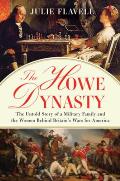
McCurdy on Flavell’s The Howe Dynasty

John G. McCurdy, author of Quarters, recently reviewed Julie Flavell’s The Howe Dynasty: The Untold Story of a Military Family and the Women behind Britain's Wars for America for H-Net.

McCurdy starts with the challenge of getting close to the British commanders in the Revolutionary War:
Some of these generals and admirals are unknowable because of their aristocratic stoicism and others because their papers have been lost. The Howe brothers are particularly enigmatic for both reasons…
Flavell’s approach was to widen her lens, so her book looks at multiple generations of the Howe family. More important, it looks at the female Howes, who left longer paper trails than the brothers but haven’t been well studied. In particular, Flavell drew on the letters of their sister Caroline.

When a set of sources is the only material you have, there’s always a challenge not to overstate their importance or the importance of the people who produced them. But Flavell makes the case for Caroline Howe as an important contributor to the family’s rise within the British establishment:
George, Richard, and William all headed to North America for the Seven Years’ War and earned accolades for their heroic service. Yet their success would have been impossible without the clever politicking of their mother, sisters, and wives. Because “a great deal of public business was also transacted in private settings,” Flavell observes, the dinners, parties, and visits “gave women many informal levers of influence” (p. 51).

Following Britain’s victory in the war, the brothers returned to England with three simultaneously holding seats in Parliament. Wielding both official and unofficial power, the siblings constituted a formidable Howe “interest” (p. 103).

From inside Caroline’s residence at Number 12 Grafton Street, the Howes watched events in America build toward revolution. In one of the most compelling chapters of The Howe Dynasty, Flavell unearths that it was Caroline who arranged for peace talks between her brother Richard, Benjamin Franklin, and representatives of the cabinet in late 1774. Over a seemingly innocent game of chess, Caroline orchestrated “this last-ditch and secret government peace initiative” as the British government sought to prevent an imperial rupture (p. 137).
In 1776, Richard and William Howe were back in America, tasked with both commanding the imperial military and negotiating peace. A little more than a year later, William had taken the American capital while Richard maintained the Royal Navy’s command of the sea. That wasn’t enough.
Yet even indomitable women could not salvage William’s command after the British loss at Saratoga. Although William seized Philadelphia and dealt Washington’s army another blow, his decision to leave the Hudson Valley to General John Burgoyne was assailed in the British press once Burgoyne surrendered and the French entered the war on the side of the Americans. In May 1778, Sir William Howe departed for England, leaving the war to other men.

For the remainder of the American Revolutionary War, the Howes fought for their reputation in London. They demanded a Parliamentary investigation into their leadership, which they received although William was not exonerated. Even Caroline lost her influence. As the Howe interest declined, she was no longer “courted as a woman who had the ear of government ministers” (p. 313).
Because she didn’t. The family that rose together subsided together. Ultimately, however, Richard won a major naval victory against Revolutionary France, restoring the Howe stature.

Wednesday, August 17, 2022

“More of the spirit of party, than of poetry”

The precocious poet Richard Polwhele’s The Spirit of Frazer (discussed yesterday) tries to use the form and language of heroic national verse to praise Gen. John Burgoyne’s surrender at Saratoga and urge Great Britain to withdraw from its American war.

That would be a hard task for any writer, let alone a teenager. As the literary scholar Dafydd Moore wrote in what might well be the only recent study of Polwhele, “The language and devices of martial heroism are pushed beyond the point they can be credibly flexed.”

But back in 1778, when young Polwhele had his poem printed in Bath and sent to the London bookseller William Goldsmith and literary reviewers, reactions appeared to have hinged on politics.

The Spirit of Frazer was undoubtedly political, and magazine editors didn’t even have to read the poem to get that. By putting the name of “Mrs. [Catharine] Macaulay” on the title page, Polwhele allied himself with the country’s radical Whigs.

The Westminster Magazine’s reviewer wrote:
The inscription to the great Commonwealth heroine, or queen of the Amazons, sufficiently hints the principle on which these pieces are written; and as for the rest, there plainly appears more of the spirit of party, than of poetry, in them.
The Critical Review started out on the same point but actually had something to say about the poetry as poetry:
When the reader observes that these two poems are inscribed to the female historian, we need not add that they are of the patriotic cast. In the Tale we find some strokes of the pathetic, and the Ode contains some flashings of poetical fire.
In contrast, all the Town and Country Magazine had to say was, “Another patriotic reverie in verse.” British Whigs, like Americans, had adopted the term “Patriot” for their platform of political reforms, so it meant both more and less than basic loyalty to Britain.

Some reviewers really didn’t like Polwhele’s message. The Monthly Catalogue stated:
Of all the spirits we ever conversed with, this is the most spiritless. It persuades General Burgoyne (who, it seems, took its advice) to yield the day to [Horatio] Gates. . . . This is the genius—this the language of the gallant [Simon] Frazer!—No, ’tis a base counterfeit—the ghost of a By—g [Adm. John Byng],—or it is some dastard soul, the body of which had been shot in the back.—S’death! if the real spirit of General Frazer, now, perhaps, hovering, melancholy, over the fatal plain of Saratoga, could but hear of this poem, it would certainly waft itself back to Britain, and pull the Author by the nose.
And the London Review of English and Foreign Literature called The Spirit of Frazer:
A piece of Bath metal sent up to a London Goldsmith, to make money of.—What punishment ought not to be inflicted on such counterfeiters of poetical coin.
Still, nothing could daunt young Richard Polwhele from his literary career. He studied for a couple of years at Oxford and then went into the ministry, married, and raised a family while working as a country cleric. And he continued to write—more long poems, antiquarian and topographical studies, biographies.

People care about only one of Polwhele’s books, though: The Unsex’d Females, a 1798 poem (with lengthy footnotes) about the dangers of the French Revolution and Mary Wollstonecraft. And that’s only because it shows the environment that women faced as public authors in the period.

Tuesday, August 16, 2022

“Reason’s voice commands thee, yield”

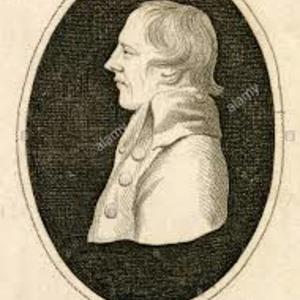
The first person to use the death of Gen. Simon Fraser at Saratoga in art might have been the young poet Richard Polwhele (1760–1838, shown here).

His first tiny splash in the British literary world was as the youngest of the admirers writing odes to Catherine Macaulay for her birthday in 1777, mentioned back here.

Through the same printer the teenager soon published The Fate of Lewellyn; or, the Druid’s Sacrifice. A Legendary Tale. In Two Parts. To which is added Carnbré, a Poem. Agnes Repplier later wrote of that book:
The title-page stated modestly that the writer was “a young gentleman of Truro School”; whereupon an ill-disposed critic in the “Monthly Review” intimated that the master of Truro School would do well to keep his young gentlemen out of print. Dr. [Cornelius] Cardew, the said master, retorted hotly that the book had been published without his knowledge
Undaunted, in 1778 Polwhele enrolled at Oxford and put out yet another volume: The Spirit of Frazer, to General Burgoyne. An ode. To which is added, The Death of Hilda; an American Tale. Inscribed to Mrs. Macaulay. In fact, according to a 1798 profile, he wrote those poems before leaving school.

I haven’t found any online texts, and for that most people would be grateful. However, Dafydd Moore quoted and analyzed The Spirit of Frazer in his monograph Richard Polwhele and Romantic Culture: The Politics of Reaction and the Poetics of Place. So you’re not getting off that easily.

As Polwhele spins his tale, a few days after his death Fraser appears to Gen. John Burgoyne and poetically urges surrender to the American army. The brigadier’s ghost argues that this is the most honorable course because the war in America is both unjust and unwinnable.
Reason’s voice commands thee, yield:
Ev’n Frenzy’s self would scarce oppose!
Tempt not the horrors of the field,
Nor brave surrounding foes!
Nor Slavery’s dungeon be thy meed!
For Honour would disclaim the deed!
Yet stamps the Roll that bids the battle cease!
Burgoyne, the ghost says, should return to Britain and advocate for peace.
Go! and bid her spread no more
Her thunders o’er the Atlantic wave,
While glooms destruction’s threatning power,
Pointing to the yawning grave!
No more let War his flaming brand
Wide wave o’er Freedom’s ravag’d land,
Where soon a glorious Empire shall arise!
Polwhele thus had Fraser echo how Britain’s most radical anti-war Whigs were responding to news of Saratoga.

TOMORROW: The reviews roll in.

Monday, August 15, 2022

The Memory of Gen. Simon Fraser

Brigadier general Simon Fraser had a long career in the British army before dying in the Battle of Saratoga.

Even so, it appears that Gen. John Burgoyne’s description of his funeral, quoted back here, made Fraser into a British icon of sorts.

Burgoyne’s efforts were helped along by another narrative of that event in Lt. Thomas Anburey’s Travels Through the Interior Parts of America, published in 1789. Anburey wrote:
About sun-set, the corpse was carried up the hill; the procession was in view of both armies; as it passed by Generals Burgoyne, [William] Phillips and Riedesel, they were struck at the plain simplicity of the parade, being only attended by the officers of his suite…and urged by a natural wish to pay the last honors to him, in the eyes of the whole army, they joined the procession.

The enemy, with an inhumanity peculiar to Americans, cannonaded the procession as it passed, and during the service over the grave. The account given me by your friend Lieut. [Quin John] Freeman was, that there appeared an expressive mixture of sensibility and indignation upon every countenance—the scene must have been affecting.
Anburey spent years as a prisoner of war with the Convention Army—that was how he traveled through the interior parts of America. He didn’t come away with any fondness for the host nation.

In the same year Anburey’s account was published, a print appeared on the London market titled “View of the West Bank of the Hudson’s River, 3 Miles above Still Water, Upon which is the Army under the Command of Lt. Gen. Burgoyne (Showing General Frazer’s Funeral).”

Follow this link to a digitized image of this print from the Yale University Art Gallery. On the rightmost of the three hills is a line of tiny figures following two coffins. Some experts interpret the second one as representing Burgoyne’s aide-de-camp Sir Francis Clarke, also killed in the battle though not in any account buried with Fraser.

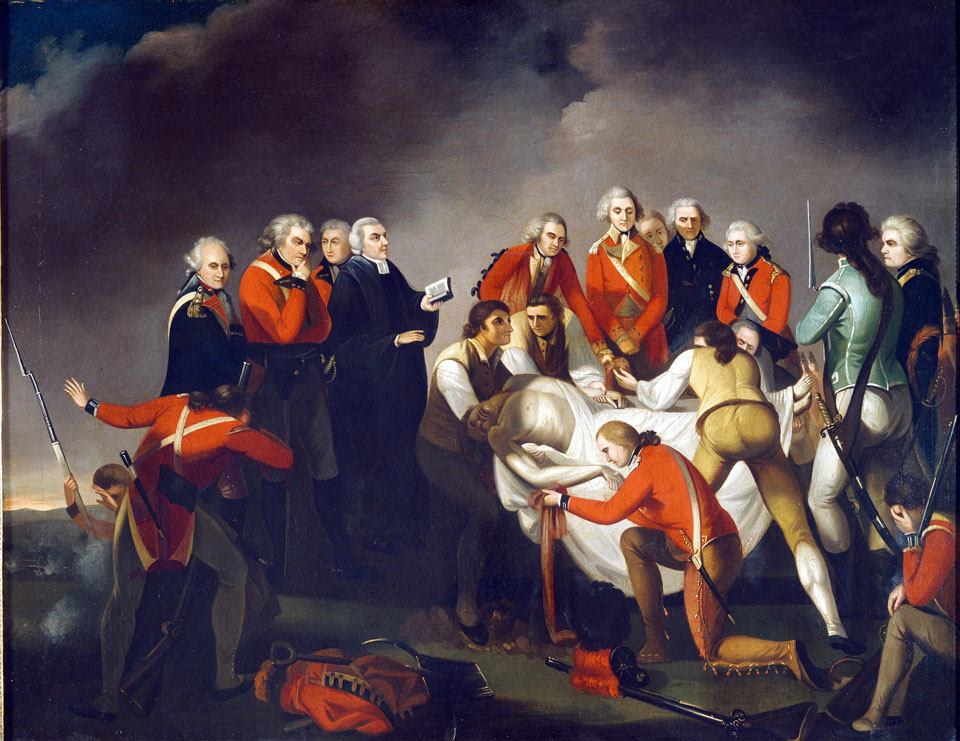
Finally in 1791 the Scottish artist John Graham (1754–1817) exhibited a painting of Fraser’s funeral. Graham was influenced by Benjamin West’s picture of the death of Gen. James Wolfe in 1759. So much so, in fact, that one critic of the time reviewed The Funeral of General Fraser by saying: “We should have been more pleased with the picture if we had not seen The Death of General Wolfe by West.”

As West had done before him (and as other West acolytes like John Singleton Copley and John Trumbull did), Graham sought out the officers who had been at the event he was depicting. He made studies of those men and portrayed them as individuals in his scene. That painting was made into a print in 1794, and the print was issued with a key to the figures.

(I can’t find Graham’s original on the web; the image above shows a copy in the collection of the National Army Museum.)

Burgoyne, Anburey, and Graham thus crafted Fraser’s funeral into an emblem of British fortitude and propriety even in defeat. This stuff-upper-lip behavior could easily, as Don Carleton commented last week, tip into Monty Python–style satire. Still, it was effective.

American chroniclers of the Battle of Saratoga felt a need to quote Riedesel and Burgoyne on Fraser’s death and metal—those sources are just too full of drama to ignore. But the same historians often added a protest that if only the British commanders had told the Americans that the generals were gathering for a funeral there would have been no artillery fire. I’m not entirely convinced.

Friday, August 12, 2022

The Funeral of Gen. Simon Fraser

Yesterday I quoted Frederika von Massow Riedesel on the death of Gen. Simon Fraser at Saratoga.

Wounded at Bemis Heights on 7 Oct 1777, Fraser died the following morning. By then the Crown forces had pulled back to their fortified camp, and the Continentals were attacking them.

Riedesel's memoir, in the 1827 translation, continued:
After he had been washed, he was wrapped in a sheet, and laid out. We then returned into the room, and had this melancholy spectacle before us the whole day. . . .

We were informed, that general [John] Burgoyne intended to comply with general Fraser’s last request, and to have him buried at 6 o’clock, in the place which he had designated. This occasioned an useless delay, and contributed to our military misfortunes. At 6 o’clock, the corpse was removed, and we saw all the generals, with their retinues, on the hill, assisting at the funeral ceremony.
Among those generals was Riedesel’s own husband, making what followed particularly unnerving for her. Especially since she obviously felt the army should be moving to a place of greater safety rather than going through this ceremony.

The chaplain who presided was the Rev. Edward Brudenell.

Gen. Burgoyne devoted space in his report to the House of Commons on the failed campaign to Fraser’s funeral:
The incessant cannonade during the solemnity; the steady attitude and unaltered voice with which the chaplain officiated, though frequently covered with dust, which the shot threw up on all sides of him; the mute but expressive mixture of sensibility and indignation upon every countenance: these objects will remain to the last of life upon the minds of every man who was present. The growing duskiness added to the scenery, and the whole marked a character of that juncture that would make one of the finest subjects for the pencil of a master that the field ever exhibited—

To the canvas and to the faithful page of a more important historian, gallant friend! I consign thy memory. There may thy talents, thy manly virtues, their progress and their period, find due distinction; and long may they survive;—long after the frail record of my pen shall be forgotten.
Can you tell that Burgoyne (shown above) was a dramatist?

COMING UP: A scene of British fortitude.

Thursday, March 31, 2022

The Lord of the Manor Americanized

The new issue of Colonial Williamsburg’s Trend & Traditon magazine offers an interesting article by Jon Kukla about a 1781 copy of the play The Lord of the Manor.

That copy is also featured in this online exhibit from Stanford University, the current owner.

The Lord of the Manor was a loose adaptation of the French comic opera Sylvain. It opened at “the Theatre Royal Drury-Lane” in 1780 and was a hit.

William Jackson of Exeter Cathedral had composed the new score, and once the play was a success the author of the libretto came forward: John Burgoyne, home from his flop in America.

Burgoyne arranged for his script to be published with a preface. A copy of that publication crossed the Atlantic to the household of Patrick Henry, who wrote his name on the title page.

But that wasn’t all. Kukla guesses that some of the many Henry children put on their own production of The Lord of the Manor and that, before they did so, their father edited the text for them.

Henry “deleted three passages with dialogue referring to prostitution or adultery—as well as the sleazy remarks of an upper-class character lusting after a servant girl.” (Not that Virginia aristocrats didn’t lust after their servants—they just didn’t remark about it in front of the children.)

Also edited out were two scenes satirizing British customs that didn’t pertain to America. One went on about hunting laws, and the other portrayed an army recruiting officer. The latter, Kukla says, was already “extraneous” to the plot, created by Burgoyne for some laughs.

Most interesting, Henry made changes to Americanize a few lines, though the play still seems to be set in Britain. He replaced “old Britons” with “our Fathers,” removed the words “king and” from the phrase “enemies of my king and country,” and added a speech about one’s “birth-right as a free man.”

Henry also took out Burgoyne’s criticism of the French—a long-standing national habit made especially acute in wartime. The line “though I hate the French in my heart, as a true Englishwoman, I’ll be friends with their sunshine…” became “though I never was in France, yet I’ll be friends with their sunshine…” After all, in the 1780s France was America’s far-off friend.

Wednesday, October 20, 2021

Gen. Gates’s Articles of Convention

As I said yesterday, on 23 Oct 1777 John Gill’s Continental Journal printed the “ARTICLES of CONVENTION between Lieutenant-General [Horatio] GATES and Major-General [John] BURGOYNE.”

Gates must have hurried that document to Boston, not simply because the Battle of Satatoga was big news but also because the state of Massachusetts had to prepare for the arrival of thousands of prisoners of war.

The full text of the surrender terms is here. I’ll quote the most important passages, those involving substance rather than details of implementation, as they appeared in the Continental Journal.

ARTICLE I. The troops under Lieutenant-General Burgoyne, are to march out of their camp with the honors of war and the artillery of the intrenchments, to the verge of the river where the old fort stood, where the arms and artillery are to be left; the arms to be piled by word of command from their own officers.

Art. II. A free passage to be granted to the army under Lieutenant-General Burgoyne to Great Britain, on condition of not serving again in North America during the present contest, and the port of Boston is assigned for the entry of transports to receive the troops, whenever General [William] Howe shall so order. . . .

Art. IV. The army under Lieutenant-General Burgoyne, to march to Massachusetts-Bay by the easiest, most expeditious and convenient route; and to be quartered in, near, or as convenient as possible to Boston, that the march of the troops may not be delayed when transports arrive to receive them.

Art. V. The troops to be supplyed on their march, and during their being in quarters, with provisions by General Gates’s orders, at the same rate of rations as the troops of his own army, and if possible, the officers horses and cattle are to be supplyed with forage at the usual rates.

Art. VI. All officers to retain their carriages, batt-horses and other cattle, and no baggage to be molested or searched, Lieutenant General Burgoyne giving his honor that there are no public stores secreted therein.—Major-General Gates will of course take the necessary measures for the due performance of this article; should any carriages be wanted during the march for the transportation of officer’s baggage, they are if possible to be supplyed by the country at the usual rates. . . .

Art. IX. All Canadians and persons belonging to the Canadian establishment, consisting of sailors, batteaumen, artificers, drivers, independent companies and many other followers of the army, who come under no particular description, are to be permitted to return there . . .
Gates was a veteran of the British army. He and Burgoyne had enlisted as young officers at the same time, and he had served under Burgoyne earlier in their careers.

The American general knew what supplies and housing a large army, including families, would need. He was also sensitive to the honor of British officers; one of the thirteen articles guaranteed those gentlemen the privilege of walking around greater Boston wearing their arms. 

About 5,900 Crown troops surrendered at Saratoga. On 8 November they started to arrive in Cambridge, which in 1776 had an official population of 1,586.

Tuesday, October 19, 2021

“Receiving confirmation various ways of the surrender”

The army around Philadelphia wasn’t alone in waiting anxiously for news from northern New York in October 1777. The publisher of the Massachusetts Spy was gleaning every bit of information that came through Worcester for his readers.

That publisher wasn’t Isaiah Thomas, who had co-founded the Spy in Boston in 1770 and moved it out to Worcester just before the outbreak of war.

In the middle of 1776 Thomas stepped away from day-to-day operations in order to tend to family business—namely, divorcing his wife, finding care for their children, and helping his mother at her home in Cambridge.

Thomas leased the Massachusetts Spy to other printers as a (barely) going concern. Starting in mid-1777 the publisher was Anthony Haswell, a former Thomas apprentice who turned twenty-one that year.

On 23 October Haswell’s Massachusetts Spy printed extracts from a Continental officer’s letter dated eleven days before, reporting that Gen. John Burgoyne’s army had attacked and been pushed back:
Friday [10 October] the whole army marched with three days provision, and we found the road strewed with baggage of all kinds; horses killed in the waggons, and all their sick and wounded, with Burgoyne’s chief surgeon
Then came another letter from the same officer, dated 14 October:
We have now entirely surrounded the enemy, and it is common to have forty or fifty deserters and prisoners come in per day. The Canadians we are informed have mutinied, and decline having anything further to do in the matter, and that the General had promised they should go home in a few days.
Then a letter from Saratoga dated 14 October:
Last night General [Horatio] Gates received a card from General Burgoyne, requesting to know when it would be agreeable to him to have a field officer of his army wait on him with proposals of great consequence to both armies. . . . General Gates sent the articles on which he would agree . . .

P.S. I believe that General Gates rather than not get Burgoyne and his army, will soften his terms a little.
In the next paragraph the publisher lamented receiving “many different” reports raising doubt about what had really happened next. But then a seemingly reliable witness arrived:
A Gentleman who passed through town yesterday informed, that General Burgoyne was arrived at Albany, on his way to Boston, where it is said he is to take ship for England, according to the capitulation said to be entered into between him and Gen. Gates.

In consequence of receiving confirmation various ways of the surrender of Gen. Burgoyne, a number of the sons of liberty in this town, met on the common and expressed their joy by thirteen discharges of cannon, and drinking several toasts. The whole was conducted with a decency suitable to the occasion, and truly characteristic of the supporters of the glorious cause in which we are engaged.
On the same day that Haswell was printing these bare tidbits, in Boston John Gill was printing the entire Articles of Convention, or terms of surrender, for readers of his Continental Journal. That document must have been couriered to Boston by a route that bypassed Worcester.

Tuesday, June 15, 2021

Nostalgia “a frequent disease in the American army”

The words “nostalgia” and “nostalgic” don’t appear in any of the letters and other sources available at Founders Online. But of course most of those writers weren’t physicians.

American doctors did use the diagnosis of nostalgia, learning it from European medical authorities. Their uses reflected the original meaning of the word as homesickness rather than how we use the term today.

In “An Account of the Influence of the Military and Political Events of the American Revolution upon the Human Body” (published with other essays in 1789), Dr. Benjamin Rush wrote:
THE NOSTALGIA of Doctor [William] Cullen, or the homesickness, was a frequent disease in the American army, more especially among the soldiers of the New-England states. But this disease was suspended by the superior action of the mind under the influence of the principles which governed common soldiers in the American army.

Of this General [Horatio] Gates furnished me with a remarkable instance in 1776, soon after his return from the command of a large body of regular troops and militia at Ticonderoga. From the effects of the nostalgia, and the feebleness of the discipline, which was exercised over the militia, desertions were very frequent and numerous in his army, in the latter part of the campaign; and yet during the three weeks in which the general expected every hour an attack to be made upon him by General [John] Burgoyne, there was not a single desertion from his army, which consisted at that time of 10,000 men.
Rush’s essay was as much political as medical. He wanted to make the case that, while the disruptions of revolution and war caused stress and illness, the best remedy was more republicanism. Nothing cured the New Englanders’ nostalgia quicker than the imminent prospect of being hanged as traitors by an invading monarchical army.

Rush’s memory may have been faulty about dates. He said Gen. Gates told him in 1776 that nostalgia cleared up because of the threat from Gen. Burgoyne. In that year, Gen. Guy Carleton was in command, with Burgoyne serving under him. Burgoyne led the bigger advance from Canada in 1777. Rush may have amalgamated the events in his mind, but such detail doesn’t matter much to how Rush understood nostalgia.

Dr. James Thacher of Plymouth served the entire war as a surgeon’s mate and military surgeon for the Continental Army. Decades later, in 1823, he adapted his wartime diaries into A Military Journal During the American Revolutionary War.

In that book Thacher wrote under the date of late June 1780:
Our troops in camp are in general healthy, but we are troubled with many perplexing instances of indisposition, occasioned by absence from home, called by Dr. Cullen nostalgia, or home sickness. This complaint is frequent among the militia, and recruits from New England. They become dull and melancholy, with loss of appetite, restless nights, and great weakness. In some instances they become so hypochondriacal as to be proper subjects for the hospital.

This disease is in many instances cured by the raillery of the old soldiers, but is generally suspended by a constant and active engagement of the mind, as by the drill exercise, camp discipline, and by uncommon anxiety, occasioned by the prospect of a battle. 
Rush and Thacher didn’t use the term “nostalgia” in a way that we can easily map onto the modern diagnosis of post-traumatic stress disorder. Thacher definitely saw signs of anxiety and depression with physical manifestations. Rush linked the condition to desertions. But they didn’t see nostalgia as a reaction to combat.

Both of these doctors described nostalgia as prevalent in soldiers away from home (particularly from New England), not in those soldiers who had been through hard fighting. In fact, both of these American doctors saw “the prospect of a battle” as dispelling nostalgia, and Thacher viewed “old soldiers” as less prone to it than fresh militiamen.

It’s possible that other American doctors diagnosed Revolutionary soldiers or veterans with nostalgia based on symptoms and circumstances that correspond better with what we call P.T.S.D. I’ve looked for such cases, haven’t found any, and would welcome references.

TOMORROW: A British case study.

Wednesday, June 09, 2021

The Early Career of Henry DeBerniere

Earlier in the year I analyzed a map almost certainly made by Ens. Henry DeBerniere after his scouting expeditions in the Massachusetts countryside in early 1775.

I also promised a look at DeBerniere’s career after the outbreak of the Revolutionary War, which he helped to make happen when and where it did.

My research was complicated and delayed by what David C. Agnew wrote about the DeBerniere family in the genealogical reference book Protestant Exiles from France, Chiefly in the Reign of Louis XIV (1874):
Jean Antoine de Bernière…came over to Ireland. He is reputed by the present French representatives of the family to have been the chief of his name. For conscience sake he left the estate of Bernières near Caen; he is called in the Crommelin Pedigree, “gentilhomme d’aupres d’Alencon.”

The refugee served under the Earl of Galway at the battle of Almanza; he was wounded and lost a hand; his life was also in danger, but by means of an ancient ring which he wore, and which had been the gift of a French king to one of his ancestors, he was recognised by a tenant on the Bernières lands and received quarter.

On his return to Ireland he married Madeleine Crommelin, only daughter of the great Crommelin. His grandson was Captain [Louis Crommelin] De Bernière of the 30th Regiment, who died from exhaustion after the siege of Senegal in 1762, leaving an only son and heir, Henry Abraham Crommelin de Bernière, who rose to be a Major-General in the British army.

Major-General de Bernière, was born in 1762, and joined the 10th regiment in 1777, at once entering upon active service in America under General [John] Burgoyne.
If that birthyear is correct, then Ens. Henry DeBerniere was only twelve or thirteen years old when he scouted the roads to Worcester and Concord, drew his maps, and wrote his report. That narrative doesn’t read like the writing of a young teenager, and there’s no indication that the people DeBerniere met perceived him as unusually young.

Furthermore, Agnew was obviously wrong about when Henry DeBerniere joined the British army. He was serving in Boston in early 1775, so he probably enlisted before that. Plus, he wasn’t his father’s “only son.”

This webpage about the Crommelin family offers different and seemingly more reliable information, though it doesn’t cite sources:
In 1739 Louis Bernière married Elinor Donlevy, sister-in-law of the Bishop of Dromore, Louis was also a soldier and saw service in Canada and Senegal where he became ill and was sent home on furlough. He never reached Lisburn, dying at sea in 1762. His wife had died previously in 1759 and their children were taken by relatives to be brought up.

The elder son, John Anthony De Bernière born in Lisburn in 1744, was sent to his aunt, the wife of Bishop Marlay, and eventually entered the army. The younger son [Henry] went to Dublin, to the home of Paul Mangin, and in time he also became a soldier, serving in America and France and rising to the rank of Brigadier.
Since Henry’s mother died in 1759, he must have been at least sixteen and quite possibly a little older when he did his scouting missions. Not too much older since ensign was the most junior officer’s rank, but at least in his late teens.

In the 1890s Washington Chauncey Ford published a compilation of “British Officers in America, 1754–1774” in the New England Historical Genealogical Register. It included these listings of commissions:
Birniere, Henry / Ensign / [blank] / 22 August, 1770.
Ensign / 10[th Regiment] / 14 September, 1779.

Birniere, John de / Ensign / 55 / 22 November, 1755.
Lieut. / 44 / 9 August, 1760.
Lieut. / 18 / 4 February, 1769.
Because of the contradictory information, I had to consider the possibility that there were two men named Henry DeBerniere, perhaps cousins, serving in the British army at the same time. But the Army Lists published in the 1770s and 1780s show only one.

In the end, I concluded that Henry DeBerniere followed his father and his older brother John into the army in 1770. It looks like the DeBerniere family had connections and a military pedigree but not a lot of money, plus Henry was the younger son. His army career was probably slower than other officers because he couldn’t buy higher ranks as easily.

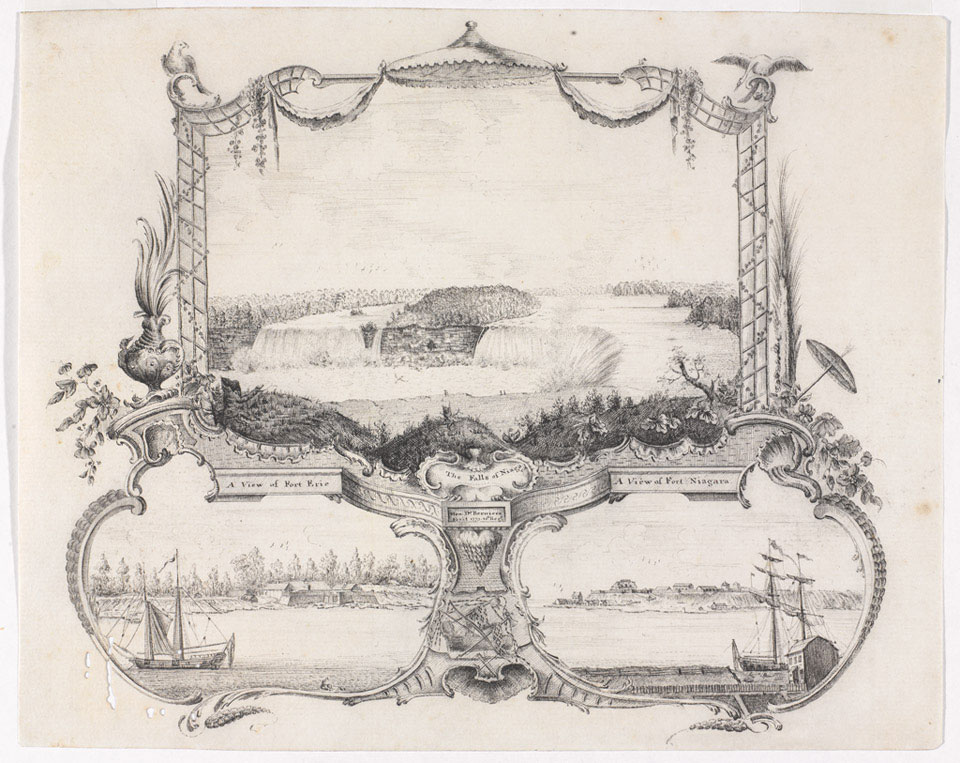
In 1773 the 10th Regiment was stationed along the Niagara River. And we have Ens. DeBerniere’s sketches of Fort Erie, Fort Niagara, and Niagara Falls from that year. Those appear above, courtesy of the U.K.’s National Army Museum. I found another statement saying he probably drew a map of Detroit around the same time.

Thus, by early 1775 Ens. DeBerniere had nearly five years of experience in the army and in North America, and was a practiced draftsman.

TOMORROW: DeBerniere after 1775.

Tuesday, December 15, 2020

What Happened to the Boston Massacre Defendants?

After being acquitted of murder at the Boston Massacre on 5 Dec 1770, Cpl. William Wemys and five private soldiers “went their Way thro’ the Streets,” the Boston Gazette reported. They probably boarded a boat to Castle William, where the 14th Regiment of Foot was stationed.

Nine days later, fellow defendants Edward Montgomery and Mathew Kilroy joined them, each with one hand bandaged after branding.

Lt. Col. William Dalrymple of the 14th had already decided how he would send those men back to the 29th Regiment, which had been moved to New Jersey. The commander wrote:
A bad disposition appearing in the Soldiers who were confined I shall send them round by sea, we have but too much reason to suspect their ententions to desert they are not at all to be depended on.
“I do not chuse to trust them any other way,” he added on 17 December. It would be great to know why Dalrymple was suspicious, but we don’t.

Until recently, the story of those eight British enlisted men stopped there. But Don Hagist has been doing thorough research on British troops during the War for Independence, culminating in the new book Noble Volunteers. Don found more information on some of those soldiers in the muster rolls and Chelsea pensioner records, which he generously let me publish here. I’ve added information on others over the years. So here’s what happened to all the defendants.

By May 1771, William Wemys was promoted to sergeant. He was still a sergeant when the company was stationed at Chatham, England, on 29 July 1775. His company’s muster rolls end there, so we lose track of him.

In the grenadier company, John Carroll and William Macauley were both made corporals. William Warren, despite being the tallest of the defendants, transferred out of the grenadiers to another company in the 29th.

As I related in this posting from 2006, Pvt. James Hartigan died on 4 Nov 1771 at the 29th’s next assignment in St. Augustine, Florida.

The regiment was in England when the war began, and army commanders decided to send it back to North America. That could have exposed Pvts. Montgomery and Kilroy to being captured by the American rebels, their hands still bearing the brand of the Massacre. On 22 Feb 1776 those two men appeared before a board of examiners for military pensions administered by Chelsea Hospital. Montgomery, age forty-one, was deemed “Worn Out,” and Kilroy, only twenty-eight, was found to have “a Lame Knee.” The board discharged both men from the army with pensions.

The rest of the 29th Regiment sailed to Canada, where different fates awaited different companies. Pvt. Warren and Pvt. Hugh White, the sentry, spent the American war at separate stations in Canada. White was finally discharged from the army on 10 Nov 1789, then aged forty-nine.

John Carroll, promoted to sergeant by February 1777, and Cpl. Macauley were still with the 29th’s grenadier company, which was assigned to Gen. John Burgoyne’s invasion force. Those two men might therefore have become part of the “Convention Army” of prisoners of war marched from Saratoga to Cambridge at the end of that year. But there’s no record of anyone in Massachusetts recognizing those two soldiers from the Massacre trial.

I discussed the evidence about Capt. Thomas Preston’s retirement here. He started to receive an annual £200 royal pension in 1772, and it continued until at least 1790. In the 1780s Preston was living in Dublin.

Of the defendants in the third trial, I profiled Hammond Green in this posting. He evacuated Boston in 1776 as a Customs employee, and his wife and children followed the next year. The royal government gave Green a Customs job at his new home of Halifax, and he was still working there in 1807.

Thomas Greenwood was working for the Customs service in 1770 but wasn’t listed among the employees who evacuated in 1776. I don’t know anything more solid about him.

Edward Manwaring retained the post of chief Customs officer on the Gaspé peninsula until 1785 when he was succeeded by his neighbor Felix O’Hara.

John Munro carried on his business as a notary “at his Office South Side of the Town House.” The 12 Jan 1775 issue of the Massachusetts Spy reported that he had died the previous Tuesday at the age of thirty-nine after a “tedious illness.” He was buried out of Christ Church on 13 January.