J. L. BELL is a Massachusetts writer who specializes in (among other things) the start of the American Revolution in and around Boston. He is particularly interested in the experiences of children in 1765-75. He has published scholarly papers and popular articles for both children and adults. He was consultant for an episode of History Detectives, and contributed to a display at Minute Man National Historic Park.

Subscribe thru Follow.it


•••••••••••••••••


Showing posts with label Edmund Randolph. Show all posts

Monday, June 27, 2022

The Marriage of Edmund and Elizabeth Randolph

Edmund Randolph and his future wife, Elizabeth Carter Nicholas, were born only a day apart in 1753. They learned to read at the same school.

Edmund returned to Virginia in late 1775 after a few months as an aide de camp to Gen. George Washington in Cambridge. He rekindled his acquaintance with Elizabeth, whom he called Betsey. In August 1776 they married.

Edmund later said he was a deist at that time, but Elizabeth’s faith won him back to Episcopal worship. They had children about once every two years while he rose in state politics.

From all accounts, Elizabeth Randolph wasn’t interested in politics or public life. People didn’t speak of her as a beauty or a glittering conversationalist, and she often complained of illness. But Edmund was devoted to her.

Having served as U.S. attorney general and secretary of state, Edmund Randolph’s career in government ended badly in a tiff with Washington and a costly lawsuit. In the early 1800s the Randolphs settled in Richmond, where Edmund commissioned the house shown above and practiced law, including representing Aaron Burr at his treason trial. Most of their children had grown up to marry other elite Virginians.

Elizabeth Randolph died on 6 Mar 1810. Nineteen days later, Edmund wrote a long letter to their children about their lives and emotional bond. He concluded:
My eyes are every moment beholding so many objects with which she was associated; I sometimes catch a sound which deludes me so much with the similitude of her voice; I carry about my heart and hold for a daily visit so many of her precious relics; and, above all, my present situation is so greatly contrasted by its vacancy, regrets, and anguish, with the purest and unchequred bliss, so far as it depended on her, for many years of varying fortune, that I have vowed at her grave daily to maintain with her a mental intercourse.
After visiting his Betsey’s grave on 9 April, Edmund suffered what he told President James Madison was a “dreadful attack from a hemiplegia, with which, by a kind of sympathy with my poor wife, I was afflicted in a few weeks from her death.”

Edmund reported that the stroke “happily affected no faculty of my mind,” and also reported that he felt “no pain,” but he developed trouble walking and came to “require in rough ground the aid of a crutch.” He cut back on his law practice and tried warm springs, but never fully regained his health. 

Edmund Randolph died on 12 Sept 1813 at age 60 while staying with a friend. He was buried in the nearby churchyard, his grave unmarked until decades later.

Sunday, June 26, 2022

“My affectionate bosom friend will be with me”

I told the story of Elizabeth and Edmund Randolph’s distress over a miscarriage through Edmund’s correspondence with James Madison.

Since the Randolphs were together at the time, there were of course no letters between them. But I find that Edward had written to Elizabeth just before he came home from New York, telling her he was moving the family to the capital for his job, and he knew she wouldn’t be happy about that.

Edmund wrote on 14 Feb 1790:
My dearest Betsy:

I can now inform you with certainty that I shall return to Virginia to bring my treasures thence; and indeed if the importunity of the President with me to stay had not been overwhelming I should not have hesitated about a resignation. . . .

The President insists, and I have promised to be here by the 20th April precisely. We must therefore without fail begin our journey on the first day of April. . . .

I am afraid it may be inconvenient and indeed painful to you, my dear wife, but I candidly tell you that I shall not be able to return to accompany you after the present trip. Let us not, I beseech you, be longer separated than the strange vicissitudes of life render indispensable. Prepare yourself and the girls for the trip. I shall provide the conveyances. . . .

My two chief anxieties on this subject are the difficulty of your travelling in your present situation [i.e., pregnancy], and the preference you would give to being confined in Virginia rather than here. But what am I to do, thou dearest object of my soul? I will consent to any thing but an absence from you. I will provide you with a gentle and easy passage.

I undergo a mixture of sensations when I think of our new plans. But it comforts me to think that my affectionate bosom friend will be with me, and that I really believe she may be happy. Until we meet, keep in remembrance my never-failing love for the best of women. Adieu, my dearest girl.
That text is quoted from Omitted Chapters of History Disclosed in the Life and Papers of Edmund Randolph by Moncure Daniel Conway.

It shows that Elizabeth was already reluctant to make a big move, even before her pregnancy went awry. It also states exactly when Randolph had promised to be back at George Washington’s side while the new federal governmet took shape. The attorney general missed that deadline by weeks, so no wonder he was anxious about what the President would say.

At the same time, this letter shows how Edmund was still gushing with affection for Elizabeth fourteen years after their marriage—though also cajoling her into what he wanted.

TOMORROW: The farewell.

Saturday, June 25, 2022

“The escape of our friend from the most critical danger”

As I’ve been recounting, in the spring of 1790 Edmund Randolph felt torn between his family responsibilities and his duties to the new federal government.

On the one hand, his wife Elizabeth was carrying an apparently dead fetus and fearing she might die.

On the other hand, Edmund had just become the first attorney general of the U.S. of A., and President George Washington was expecting him to return to New York as fast as possible.

On 27 April, Randolph wrote to his friend James Madison, who was in the capital as a member of Congress: “I see no other alternative, than this; that I must surrender the office, if my absence cannot be dispensed with.”

Randolph had asked Madison to tell the President why he couldn’t immediately come to New York. Well, not “tell” exactly. The younger men seem to have been squeamish about informing Washington frankly about Elizabeth Randolph’s medical condition.

On 6 May, Madison tried to assure his friend:
I can not suppose that under your circumstances any criticism can be made on your absence from this place, or that you are under the least necessity of deciding on the alternative which you state.
But he still didn’t report that he’d told the President what was happening, or what the man’s response was.

Fortunately, fate provided a way out of the dilemma. Washington himself got sick! On 19 May, Madison wrote:
The President has been critically ill for some days past, but is now we hope out of danger. His complaint is a peripneumony, united probably with the Influenza. Since my last I have found that I did not go too far in intimating that the cause of your delay would forbid the smallest criticism on it. I earnestly pray that you may no longer have occasion to plead that apology.
And on the same day the situation in Virginia resolved itself as well as could be expected. Well before he got Madison’s news about the President, Randolph wrote on 20 May:
Very unexpectedly a diminished fœtus appeared; manifesting, that it had lost every energy of life for more than four months. The gloom of our house is converted into general satisfaction, at the escape of our friend from the most critical danger.

I have this moment informed the president, that I shall accompany my family by sea, or the head of the bay; and that we shall have no delay, but what may be necessary for Mrs. R. to recover from her temporary weakness.
Elizabeth Randolph did recover, make the trip north, and live for another twenty years. She may not have had another pregnancy after this one; capsule biographies say the Randolphs had six children, but I find lists of only five, the last born in 1788.

TOMORROW: Randolph looks back.

Friday, June 24, 2022

“To intimate the circumstances which you wish him to know”

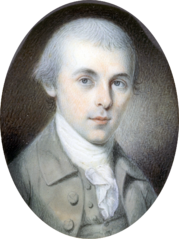
As I recounted yesterday, in March 1790 Edmund Randolph wrote from Williamsburg, Virginia, to Rep. James Madison (shown here) in New York.

The sad news was that Randolph’s wife Elizabeth appeared to have lost the unborn child she was carrying.

The more dire news was that Randolph wouldn’t be able to come back to New York to resume his job as U.S. attorney general until Elizabeth had passed the fetus and was out of danger—and he wanted Madison to tell that to President George Washington.

On 23 March, Randolph sent Madison his third letter in the space of two weeks: “My dear wife is not better, than when I wrote to you last. I expect something determinate in a few days.”

The mail was unusually slow, so Madison didn’t respond to any of Randolph’s missives until 30 March:
Your favr. of the 15. which requests an immediate acknowledgment, by some irregularity did not come to hand till I had recd. that of the 18, nor till it was too late to comply with the request by the last mail. I have been so unlucky also as to miss seeing the President twice that I have waited on him in order to intimate the circumstances which you wish him to know. I shall continue to repeat my efforts until I shall have an opportunity of executing your commands.
As the end of April approached, Elizabeth Randolph still had the unmoving fetus inside her, and Edmund was feeling even more torn. On 27 April he told Madison:
I have been looking most anxiously for the second communication, which you promised me, as soon as you should have had an interview with the President.

Many times have I endeavoured to break in an easy way to my wife the necessity of my return to N. Y; in order to try her spirits, should I go off. As often has she been thrown into an agitation of real agony.

Prepared as I am, I would have entered upon the journey long ago; and were her indisposition of a common kind, or her situation no more than an usual approach to the increase of our family, I should quit her without hesitation. But she is impressed with a belief, that she cannot escape death, and, altho’ tolerably lively now, would sink, I suspect, into despair, were I to leave her.

What am I to do?
Stay with a wife who’s afraid she’s about to die or hurry back to President Washington? A tough choice for an eighteenth-century American gentleman!

TOMORROW: Can this marriage be saved?

Thursday, June 23, 2022

“The situation of my wife was very alarming”

In February 1790, Edmund Randolph (1753–1813) became the first attorney general of the U.S. of A.

As a young lawyer, Randolph had been one of Gen. George Washington’s first aides de camp to during the siege of Boston. He didn’t stay long, however. The death of his uncle Peyton Randolph in October 1775 took him back to Virginia to manage family affairs.

The next year, Randolph married Elizabeth Nicholas. He remained in Virginia during the war, serving in political posts, and won a term as governor in 1786.

At the Constitutional Convention of 1787, Randolph declined to sign the document. Nonetheless, as chair of his state’s ratifying convention, Randolph convinced some fellow skeptics to vote for the document while hoping for amendments.

President Washington pressed Randolph to join him in setting up the federal government in New York. Randolph started work as attorney general, then returned to his home in Williamsburg, Virginia, to fetch his family. On 10 March, he wrote back to a fellow Virginian in the capital, James Madison:
After a fatiguing journey we arrived here on sunday evening, when I found all my family well, except my wife, who, I fear, is incumbered with a dead fœtus of more than seven months old. I am endeavouring to ward off by medical aid the consequences of this event. She is now in good spirits, and therefore I trust, that the mischief will not be fatal.
Five days later, the attorney general wrote with more anxiety about Elizabeth Randolph:
When I came home, I found my family in a really deplorable condition. Not to mention my children, most of whom were sick, the situation of my wife was very alarming. She gave every symptom of a painful and dangerous abortion being at hand. It is now a fortnight since she was first confined to her room, and every appearance grows more and more critical. It is almost certain, that the fœtus, now about six months old, is dead.
At this time “abortion” meant what we call a miscarriage; it could be either natural or induced. [I came across these letters while searching for what the correspondents on Founders Online had to say about what we call abortion.]

Randolph had something else on his mind: what would Washington think of his extended absence? And how to tell him?
Altho’ I know your readiness to sympathize with me, I should not have troubled you with this detail, were it not for a wish, that the outlines of it should be conveyed to the ears of the president. I would write to him; but the subject does not become an official letter, to be filed away in the public archives; and a private letter, does not seem adviseable, when the design is to premonish him of the cause of any delay, which may occur in my return. But I do not mean by this, that it is improbable that my return should be by the stipulated day; for if an abortion should take place, or there is a likelihood of a mature delivery, or in short if my absence would not precipitate her death I shall leave home, without any hesitation, that my family may follow in the summer.

I feel this request, not a little awkward to me, by being perhaps not less so to you. But the peculiarity of my situation will, I hope, apologize for the intrusion. Let me have a single line from you, as soon as you receive this.
But no response came for weeks.

TOMORROW: Madison’s advice at last.

Monday, November 15, 2021

“The unanimous assent of 11 States and Colonel Hamilton’s”

The Statutes and Stories blog has a couple of new posts detailing an archival discovery related to the New York delegation to the Constitutional Convention.

The first article by University of Wisconsin professor John Kaminski, attorney Adam Levinson, and Sergio Villavicencio of the Alexander Hamilton Awareness Society is a bit breathless for my taste, but the second steps back and raises a lot of thoughtful questions about how to interpret incomplete evidence.

The background of this story is that the state of New York sent three delegates to the Philadelphia Convention of 1787, aimed at revising the Articles of Confederation. One of those men was a leading proponent of having that meeting, Alexander Hamilton. You may have heard of him.

The other two were judge Robert Yates (1738-1801) and his former trainee, attorney John Lansing, Jr. (1754-1829?), both from Albany. The two men were related by marriage and also allied in politics. Like Gov. George Clinton, they opposed strengthening the national government. In sum, they went to Philadelphia to outvote Hamilton on the state’s delegation.

Around 30 June, after the convention had met for a little more than a month, Hamilton went home to New York City. He was getting to propose his ideas, but he couldn’t even get his own state to support them.

Yates and Lansing followed about 10 July. They could see that the convention was moving toward creating a constitution for a stronger federal government, and they didn’t want any part in that.

As the blog posts explain, on 20 August Hamilton told his fellow Federalist Rufus King:
I have written to my colleagues informing them, that if either of them would come down I would accompany him to Philadelphia. So much for the sake of propriety and public opinion.
No one has found Hamilton’s actual letter, so we don’t know how he phrased that offer. As the three authors ask, “Did Yates and Lansing understand Hamilton’s letter to mean that he would only go back to Philadelphia if one of them joined him?” The comment “So much for the sake of propriety and public opinion” suggests Hamilton wrote to the two men purely as a political move.

In any event, Hamilton did go back to participate in the closing sessions. He couldn’t vote on behalf of New York since that state had required all three of its delegates to be present for votes. But he was talking.

In early September the meeting approved a new draft Constitution for the U.S. of A., totally rebuilding the national government. On 17 September the chairman of what had become a Constitutional Convention, George Washington, wrote in his diary:
Met in Convention, when the Constitution received the unanimous assent of 11 States and Colonel Hamilton’s from New York.
Washington distinguished between the eleven states that had a quorum of delegates at the convention and the lone voice from New York piping up unofficially. (Rhode Island wasn’t there at all.) Everyone knew Hamilton didn’t represent his colleagues’ views. Nonetheless, New York didn’t oppose the new document.

Proponents of the new Constitution emphasized that seemingly unanimous vote of the states. Hamilton insisted that every delegate present should sign it. Gouverneur Morris came up with language to indicate the men were signing as witnesses to the state votes, not to endorse the new document personally. Even so, Elbridge Gerry, George Mason, and Edmund Randolph refused to sign.

The new archival discovery is an expense report from Robert Yates to the government of New York for his service as a delegate, including “May June & July 1787 59 Days at 32s pr Day.” At the bottom of that document is the entry:
To my Comming as far as New York in my Way to Philadelphia for the Same purpose where I heard that the Convention rose [i.e., adjourned] a Day after my arrival and my return home 12 Days at the Same rate
As Kaminski, Levinson, and Villavicencio point out, this record shows Yates was on his way to Philadelphia as the convention was completing its work. Had he arrived in early September, his voice would have canceled out Hamilton’s approval of the Constitution. He could have added to the chorus protesting the document and refusing to sign. He could even have sent for Lansing and turned New York’s vote to a no.

Instead, Yates got as far as New York City, learned the convention was done, and went back home. He and Lansing both argued against ratifying the proposed Constitution at New York’s state convention. Their side lost narrowly, 30 votes to 27.

The Statutes and Stories blog posts discuss other small revelations coming out of these expense records, as well as questions they don’t answer but other documents might. It’s a good example of how even mundane bureaucratic documents can reveal crucial facts.

Thursday, January 02, 2020

“Aged SAM. in dotage frail”?

Yesterday I quoted some lines from Dr. Lemuel Hopkins’s poem welcoming the year 1795 for the Connecticut Courant.

Having praised Federalist heroes from Massachusetts, Hopkins turned to attacking the state’s Jeffersonians:
But still no flowers of greatness grow,
Where thorny plagues lurk not below:
There swarms Honestus’ rabble throng,
And Lawyer Incest joins the song;
While Jarvis with his bob-tail crew,
Retreats before great AMES’s view.
“Honestus” was a pen name of Benjamin Austin, Jr. “Lawyer Incest” referred to Perez Morton, who had been caught having an affair with his wife’s sister. “Jarvis” was Dr. Charles Jarvis. They were all Jeffersonian politicians. Against them, Hopkins favored the Federalist party of Fisher Ames.
And now, O Muse! throw Candour’s veil,
O’er aged SAM. in dotage frail;
And let past services atone,
For recent deeds of folly done;
When late aboard the Gallic ship,
Well fraught with democratic flip,
He praying fell on servile knees,
That France alone might rule the seas;
While Sense and Reason took a nap,
And snor’d in Jacobinic cap.
This political attack had to start out more delicately. No one could deny Samuel Adams’s leadership during the Revolution. He was still popular enough to have just been elected governor. Finally, though Adams was senior voice for limiting federal power in Massachusetts and still saw potential in the French Revolution, he didn’t oppose all of President George Washington’s policies like some of his younger colleagues.

On the other hand, on 3 Nov 1794 Gov. Adams had issued a proclamation reminding Massachusetts officials of their obligations under Article Seventeen of the Treaty of Amity and Commerce between France and the U.S. of A. That agreement required American ports not to offer refuge to British naval vessels or formerly French ships that they had captured.

In doing so, Adams cited a recent message from Edmund Randolph, Secretary of State, who was struggling to maintain President Washington’s neutrality policy. Hopkins and his fellow New England Federalists revered Washington, but they leaned heavily toward Britain and disliked any accommodation of the French.

Therefore, Hopkins attacked Samuel Adams as “in dotage frail,” “on servile knees” about a “Gallic ship.” Because that’s the true spirit of the New Year.

Monday, February 19, 2018

Are You Ready for a Cabinet Meeting?

For Presidents Day, we look in on George Washington’s meetings with his cabinet on 1-2 Aug 1793.

The issue on the table was what to do about Edmond-Charles Genet, the French diplomat who was stirring up support of Revolutionary France, resentment of Britain, and friction within the U.S. of A.

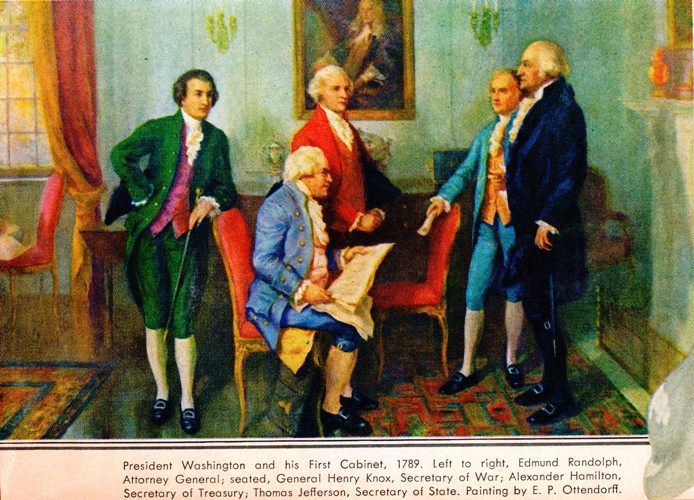
The cabinet members—Secretary of State Thomas Jefferson, Secretary of the Treasury Alexander Hamilton, Secretary of War Henry Knox, and Attorney General Edmund Randolph—all agreed to ask France to recall Genet. They differed on how peremptorily to do so. They really differed on whether to report the decision and the reasons for it to the American public.

Hamilton liked the idea of an official “appeal to the people,” despite not usually being interested in public opinion, because it offered an opening for a full-throated critique of Revolutionary France. According to Jefferson’s notes:
Hamilton made a jury speech of 3/4 of an hour as inflammatory and declamatory as if he had been speaking to a jury. E.R. opposed it. I chose to leave the contest between them.
The President adjourned that meeting until the next day. “Hamilton spoke again 3/4 of an hour,” Jefferson wrote then. “I answered on these topics.” He kept minimal notes on Hamilton’s remarks and detailed notes on his own, indicating that he didn’t write those notes at the time but afterwards, and he really didn’t care about Hamilton’s opinion.

Eventually it became clear which way Washington was leaning:
The President manifestly inclined to the appeal to the people. He said that Mr. [Robert] Morris, taking a family dinner with him the other day went largely and of his own accord into this subject, advised this appeal and promised if the Presidt. adopted it that he would support it himself, and engage for all his connections.—The Presidt. repeated this twice, and with an air of importance.—

Now Mr. Morris has no family connections. He engaged then for his political friends.—This shews that the President has not confidence enough in the virtue and good sense of mankind to confide in a government bottomed on them, and thinks other props necessary.
Jefferson distrusted campaigns for public opinion by his political opponents. He was, of course, promoting his own ideas with allies like James Madison. He had also recruited Philip Freneau to come to Philadelphia and start the anti-Federalist National Gazette, giving the writer a sinecure in the State Department.

Then the meeting took an awkward turn.
Knox in a foolish incoherent sort of a speech introduced the Pasquinade lately printed, called the funeral of George W—n and James W[ilso]n, king and judge &c. where the President was placed on a Guillotin.

The Presidt. was much inflamed, got into one of those passions when he cannot command himself. Run on much on the personal abuse which had been bestowed on him. Defied any man on earth to produce one single act of his since he had been in the government which was not done on the purest motives. That he had never repented but once the having slipped the moment of resigning his office, and that was every moment since. That by god he had rather be in his grave than in his present situation. That he had rather be on his farm than to be made emperor of the world and yet that they were charging him with wanting to be a king. That that rascal Freneau sent him 3. of his papers every day, as if he thought he would become the distributor of his papers, that he could see in this nothing but an impudent design to insult him. He ended in this high tone.

There was a pause. Some difficulty in resuming our question—it was however after a little while presented again, and he said there seemed to be no necessity for deciding it now: the propositions before agreed on might be put into a train of execution, and perhaps events would shew whether the appeal would be necessary or not.
It took another three weeks for the cabinet to complete their dispatch to the American minister in Paris, Gouverneur Morris, telling him to ask the French government to withdraw Genet. Meanwhile, it became clear to Washington that most informed Americans disapproved of the French diplomat’s behavior, so he no longer saw any need for a public appeal.

Tuesday, December 06, 2016

Oney Judge and “the President’s Wishes”

As I reported yesterday, George Washington has been our richest President so far. Most of his property consisted of land, both plantations in Virginia and unsettled claims to the west, and slaves. A lot of those slaves had come to his wife Martha or her children, inherited from her first husband’s family, and George felt obliged to preserve that wealth.

When the federal government moved to Pennsylvania in 1791, that state’s law gradually ending slavery posed a problem for the Washingtons. If they brought their household servants to Philadelphia—and how could a rich couple live without their household servants?—then those people were entitled to be free after six months in the state.

On 24 April Washington’s plantation manager, Tobias Lear, wrote to him about what the U.S. Attorney General, Edmund Randolph, had said about that law:
But he observed, that if, before the expiration of six months, they could, upon any pretence whatever, be carried or sent out of the State, but for a single day, a new era would commence on their return, from whence the six months must be dated for it requires an entire six months for them to claim that right.
Lear then discussed the specific situations of several enslaved people, including: “Mrs Washington proposes in a short time to make an excursion as far as Trenton, and of course, she will take with her Oney & Christopher, which will carry them out of the State; so that in this way I think the matter may be managed very well.”

Oney Judge was Martha Washington’s personal maid. She had been born at Mount Vernon around 1774. Judge was part of Martha’s property, and the First Lady planned to bequeath her to a granddaughter. So the Washingtons made sure that she was never in Pennsylvania for six months at a stretch.

Five years after Lear’s letter, on 21 May 1796, Judge slipped away from the Presidential mansion. She later told an interviewer, “I had friends among the colored people of Philadelphia, had my things carried there beforehand, and left Washington’s house while they were eating dinner.” Frederick Kitt, the President’s steward in Philadelphia, placed an advertisement seeking Judge in the 24 May Philadelphia Gazette.

At the end of June, Thomas Lee, Jr., wrote from New York to President Washington in response to, as he wrote, “the desire you expressed that I should make enquiry about your runaway Woman.” Lee reported a cook saying that Judge had gone north to Boston, and he planned to make inquiries there. Washington knew multiple men named Thomas Lee, and I’m not sure which one this was, but he appears to have been pursuing Judge as a private favor.

Later that summer Elizabeth Langdon, daughter of Sen. John Langdon, recognized Oney Judge on the street in Portsmouth, New Hampshire. Slavery was already unenforceable in that state. According to Washington’s understanding, Langdon “was about to stop and speak to her, but she brushed quickly by, to avoid it.”

The President moved to track Judge down—but instead of continuing his efforts through private channels, he began to use the resources of the federal government. On 1 Sept 1796 he wrote to his Secretary of the Treasury, Oliver Wolcott:
Enclosed is the name, and description of the Girl I mentioned to you last night. She has been the particular attendent on Mrs Washington since she was ten years old; and was handy & useful to her, being perfect a Mistress of her needle. . . .

Whether she is Stationary at Portsmouth, or was there en passant only, is uncertain; but as it is the last we have heard of her, I would thank you for writing to the Collector of that Port, & him for his endeavours to recover, & send her back: What will be the best method to effect it, is difficult for me to say. If enquiries are made openly, her Seducer (for she is simple and inoffensive herself) would take the alarm, & adopt instant measures (if he is not tired of her) to secrete or remove her. To sieze, and put her on board a Vessel bound immediately to this place, or to Alexandria which I should like better, seems at first view to be the safest & least expensive. But if she is discovered, the Collector, I am persuaded, will pursue such measures as to him shall appear best, to effect those ends; and the cost shall be re-embursed & with thanks.
The “Collector” was Joseph Whipple (1738-1816, shown above), the head of the Customs service in Portsmouth and thus a federal employee who answered to Wolcott. He had held the same position for the state of New Hampshire until 1789, and the new President had reappointed him on John Langdon’s recommendation.

Whipple wrote back to the Treasury Secretary on 10 September, “I shall with great pleasure execute the President’s wishes in the matter.” The next month, on 4 October, he wrote again, telling Wolcott that Judge had expressed “a thirst for compleat freedom” as well as “great affection & reverence for her Master & Mistress”; she was (at least initially) willing to return to Mount Vernon if the Washingtons guaranteed her freedom on their deaths.

The President replied directly to Whipple on 28 November, rejecting those terms. He also told the Collector:
…you would oblige me, by pursuing such measures as are proper, to put her on board a Vessel bound either to Alexandria or the Federal City; Directed in either case, to my Manager at Mount Vernon, by the door of which the Vessel must pass; or to the care of Mr Lear at the last mentioned place, if it should not stop before it arrives at that Port.

I do not mean however, by this request, that such violent measures should be used as would excite a mob or riot, which might be the case if she has adherents, or even uneasy sensations in the minds of well disposed Citizens. rather than either of these shd happen, I would forego her services altogether; and the example also, which is of infinite more importance. The less is said before hand, and the more celerity is used in the act of Shipping her, when an opportunity presents, the better chance Mrs Washington (who is desirous of receiving her again) will have to be gratified.
Again, this wasn’t government business. Washington was asking Whipple to do him a big favor, one gentleman for another. But Whipple was a federal government employee, and he owed his position to Washington. Today that would strike us as a clear conflict of interest.

There’s more to Oney Judge’s story, and the Washingtons’ pursuit of her. Today I’m just looking at how having the resources of government presents a great temptation to a President with private interests.


Friday, March 15, 2013

Washington Asks Lee for an Aide

In February 1776, Gen. George Washington was desperate enough for an aide de camp with the right skills that he asked Gen. Charles Lee to send him one. Specifically, he wanted William Palfrey (1741-1780, shown here), one of Lee’s aides in New York. Palfrey had worked for John Hancock before the war and was well respected by the Boston Whigs.

At that time, Washington was keeping the job of his military secretary open for Joseph Reed to return to it—which Reed never did. Aide de camp Robert Hanson Harrison was doing the secretary’s job, mustermaster general Stephen Moylan was helping out, but aide de camp George Baylor wasn’t much help at all when it came to office work.

On 10 February, Washington explained the situation to Lee in a letter:
It is unnecessary for me to observe to you, the multiplicity of business I am Involved In—the number of Letters, Orders, & Instruction’s I have to write—with many other matters which call loudly for Aids that are ready Pen-men—I have long waited in exasperation of Colo. Reeds return, but now despair of it. [Edmund] Randolph who was also ready at his Pen, leaves me little room to expect him [back from Virginia]; my business in short, will not allow me to wait, as I have none but Mr. Harrison (for Mr. Moylan must be call’d of to attend his duty as Commissary of Musters) who can afford me much assistance in that way, and he, in case Colo. Reed should not return, has the promise of succeeding him.

Now the Intention of this preamble is to know, whether, if Mr Palfrey (who from what I have seen and heard, is ready at his Pen) should Incline to come into my Family, for I have never directly or indirectly intimated the matter to him, although he has been very warmly recommended to me by some of his Friends for any thing that might cast up, you would consent to it—He would be of Singular use to me on another Acct also, and that is, the universal acquaintance he has with the People & characters of this Government [i.e., Massachusetts], with whom I have so much business to Transact.

Mr Baylor is as good, and as obliging a young Man as any in the World, and so far as he can be Serviceable in Riding, & delivering verbal Orders as useful; but the duties of an Aid de Camp at Head Quarters cannot be properly discharged by any but Pen-men—Mr [Anthony Walton] White in case of vacancy expected to be provided for in my Family, but as I believe he would be just such another as Baylor I must however disappointed he is be excused. Business multiplies so fast upon my hands that I am confined almost intirely to the House, and should be more so, if I am depriv[e]d of that assistanc[e] which is necessary to divide, & take of part of the trouble from my own Shoulders.
Lee would have had to invoke a military emergency to resist such a clear request by his superior and stand in the way of a promotion for Palfrey. At the time there was much more action in Boston than in New York. So Lee cheerfully sent Palfrey north, thus saving Washington’s headquarters from the return of Anthony Walton White.

In 2005 Sotheby’s sold this letter for $36,000.

TOMORROW: How Washington managed to divest himself of George Baylor.

Wednesday, March 13, 2013

Anthony Walton White Does Not Impress

On Thursday, I’m going to Gen. George Washington’s headquarters in Cambridge to speak about how he managed his generals and his staff. Back on 25 July 1775, a young man showed up at the same building hoping for a place on that staff.

Anthony Walton White (1750-1803) was a grandson of Lewis Morris, governor of New Jersey. He arrived with a recommendation letter from George Clinton of New York. His grandfather wrote another letter on his behalf, and his father wrote to Washington twice.

White wanted to join the Continental Army—but not, of course, at the enlisted level. All the New England regiments were fully stocked with officers or didn’t want anything to do with a stranger from New Jersey. So the only opportunity was in some sort of staff job.

The Continental Congress had authorized Gen. Washington to hire a military secretary and three aides de camp. As of late July, he had filled two of those aide positions with Thomas Mifflin and John Trumbull. So White stuck around.

In August, Mifflin took the more important post of quartermaster general. Two young men from Virginia, Edmund Randolph and George Baylor, arrived and became aides de camp. But Trumbull went back to the Connecticut troops, leaving an opening. And White still stuck around.

Washington wrote to White’s father about his “modest deportment,” but what worried him were White’s modest talents. In fact, he was more interested in the young man’s horse. On 3 October, the general paid White £48 “for a Riding Mare.” White may have needed that money to get home. He returned to New Jersey and sought a commission there instead.

Months later, Washington was still using White as an example of someone he did not want as an aide. In January 1776 he told former secretary Joseph Reed that it “pains me when I think of Mr. White’s expectation of coming into my family if an opening happens.” (In fact, there was still an opening at that time—Washington was keeping the secretary post vacant, hoping Reed would return.)

White never grew in Washington’s esteem. In September 1798 the former President told federal officials that the man hadn’t accomplished anything but “frivolity—dress—empty shew & something worse—in short for being a notorious L—r.” Authors have interpreted the last word as “liar,” but it could also have been “lecher.” And I doubt White developed any personal fondness for Gen. Washington.

Thursday, February 21, 2013

Washington’s Birthday at Washington’s Headquarters

Tomorrow, 22 February, is the date America finally settled on as the anniversary of George Washington’s birth. And shortly before the Bicentennial the federal government established its Washington’s Birthday (Presidents’ Day) holiday as the third Monday in February, which can never be the 22nd.

At least one part of the government still celebrates Washington on the 22nd, however. The National Park Service rangers at Longfellow House–Washington’s Headquarters National Historic Site in Cambridge are offering free tours of that mansion each half-hour from 1:00 to 4:00 on Friday afternoon. These tours focus on how the commander-in-chief used the house as his headquarters in 1775-76. Each tour takes about half an hour, well suited for kids on school vacation.

On Thursday, 14 March, the site will offer longer tours on the hour from 1:00 to 4:00 P.M. These, too, will focus on Gen. Washington’s life and work in the house as Evacuation Day approaches.

That evening, I’ll speak at the site on:
George Washington, Crisis Manager: The Shaky Startup of the Continental Army Headquarters

When George Washington became commander-in-chief of the Continental Army, he had to assemble an effective headquarters staff. Over his first several months the new general struggled to identify the talents he needed, to recruit the right men, and then to replace them when they left. This talk looks at Washington’s learning curve as a manager and the workings of the military “family” he brought together in Cambridge.
At this talk I’ll gossip about which men Washington insisted that the Continental Congress commission as generals. And what quartermaster Thomas Mifflin and military secretary Joseph Reed didn’t tell their wives. And why, after Reed and aide Edmund Randolph left the Cambridge headquarters short-handed in the fall of 1775, Washington nevertheless sent his other aide George Baylor off to Connecticut.

To reserve a seat for that 14 March talk or any of the house tours about Gen. Washington, email the site.