J. L. BELL is a Massachusetts writer who specializes in (among other things) the start of the American Revolution in and around Boston. He is particularly interested in the experiences of children in 1765-75. He has published scholarly papers and popular articles for both children and adults. He was consultant for an episode of History Detectives, and contributed to a display at Minute Man National Historic Park.

Subscribe thru Follow.it


•••••••••••••••••


Showing posts with label Christopher Anstey. Show all posts

Sunday, August 20, 2023

“Did you see Mr. Anstey’s verses at Bath-Easton?”

What happened in Batheaston didn’t stay in Batheaston.

Within three weeks after Christopher Anstey read his ode “Winter Amusements” and its pointed follow-up at the Riggs-Millers’ salon on 3 Dec 1778, those poems were circulating in manuscript. Along with knowledge of what recently remarried lady he had written about.

On 29 December, the Blue Stockings Society hostess Elizabeth Montagu wrote to her sister-in-law Mary Robinson:
I have sent you some Verse of Mr Ansteys on ye subject [of Catharine Macaulay]. The first copy he put into ye Urn at Mrs Millers at Bath Easton & being desired when he drew them to read them a second time, instead of so doing he read ye other copy.
The previous year, the artist Richard Samuel had depicted both Montagu and Macaulay, along with seven other female British authors, as the Muses.

In January 1779 Anstey’s ode appeared in the Gentleman’s Magazine, the Westminster Magazine, the Scots Magazine, and other periodicals, usually linked to the Batheaston salon.

I haven’t found any hint of Anstey’s second poem being printed until the Riggs-Millers published the fourth volume of their Poetical Amusements in 1781. But people continued to hear about it.

On 14 January, Horace Walpole (shown above) wrote to the Countess of Ossory:
Did you see Mr. Anstey’s verses at Bath-Easton? They were truly more a production of this century; and not at all too good for a schoolboy. In the printed copy they have omitted an indecent stanza or two on Mrs. Macaulay. In truth Dame Thucydides has made but an uncouth match; but Anstey has tumbled from a greater height than she. Sense may be led astray by the senses; but how could a man write the ‘Bath Guide,’ and then nothing but doggerel and stupidity?
I suspect that when Walpole wrote, “they have omitted an indecent stanza or two,” he was referring to Anstey’s follow-up rather than lines suppressed from the original ode.

Now one rule about spreading unabashed gossip in eighteenth-century Britain was that when Horace-freakin’-Walpole said you’ve gone too far, you were deep into rudeness.

But what people wrote about Macaulay’s new marriage in poems and magazines was nothing compared to what they wrote in letters.

TOMORROW: Passion’s wild career indeed.

Saturday, August 19, 2023

“A sweet pretty nostrum, quite pleasant and new”

After Christopher Anstey won Lady Anna Miller’s biweekly poetry contest at Batheaston on 3 Dec 1778, as described yesterday, he waved aside calls to read his ode “Winter’s Amusement” again.

Instead, he pulled out what he later called an “Epode.” That word signals that it was part of the ode, though written with a different metre and tone.

When both poems were published in The New Foundling Hospital for Wit (1786), Anstey’s lines were simply headed: “LINES Repeated by the Author, on Being Asked to Read the Preceding Stanzas a Second Time.”

That’s the version I’m following rather than the one in the collection of Anstey’s work published by his son in 1808, on the assumption that it’s closer to the original:
Must I read it again, Sir?—So—here do I stand,
Like the priest that holds forth with a skull in his hand—
Repeat such a dreadful memento as this is,
To spleen the young fellows, and frighten the misses?
When beauties assemble to laugh and be gay,
How cruel to preach upon beauty’s decay!
How hard, that the fairest of all the creation,
Should suffer one wrinkle by anticipation!
What delicate nymph but must shrink when she hears
Her charms will all fade in the winter of years?
What languishing widow would e’er wish to know
Her charms were all faded a long while ago?
Unless one could bring some receipt to supply
Fresh Cupids to bask in the beam of her eye.
Recall the lost rose, or the lily replace,
That have shed their dead leaves o’er her ever green face!
And this (thank the gods) I can promise to do,
By a sweet pretty nostrum, quite pleasant and new,
Which learned historians and doctors, I find,
Have lately reveal’d for the good of mankind.
A nostrum like which, no elixir yet known,
E’er brac’d a lax fibre, and strengthen’d its tone.
Nore’er was so grand a restorative seen,
For bringing back sixty—to lovely sixteen!
To you then, ye fair, if old Time should appear,
And whisper a few little hints in your ear,
That Cupid his triumphs begins to resign,
Your nerves are unstrung, and your spirits decline,
You have no other physical course to pursue,
Than to take—a young husband your springs to renew;
You may take him—I think—at—about twenty-two!
For when both the spirits and nerves are in fault,
Platonic affection is not worth a groat.
The conjugal blessing alone is decreed
The truest specific for widows indeed;
And I trust they will find it, as long as they live,
The best of amusements that winter can give!
The opening line shows that Anstey wasn’t surprised to win the poetry competition that day. He’d already prepared this encore.

While people might have wondered about the relevance of Anstey’s ode to people they knew, they couldn’t miss his allusion to “learned historians and doctors”—the famous historian Catharine Macaulay had recently left nearby Bath and married Dr. William Graham.

Macaulay had indeed been a “languishing widow,” complaining about her “nerves,” albeit more than a decade from “sixty.”

Graham was indeed “about twenty-two!” In fact, he was twenty-one, but that didn’t rhyme.

Even the phrase “Platonic affection” was a jab. The previous year, a London publisher had issued this print of Macaulay with her then-housemate, the Rev. Thomas Wilson, calling them “The Political Platonic Lovers.”

TOMORROW: Audience response.

(The photograph above by Ian is here via Flickr shows a statue in the form of a large ornamental vase standing in the Royal Victoria Park in Bath. Many sources say this is the vase the Riggs-Millers brought back from Rome and used at their literary salons, or a replica of that vase. It’s neither of those things. It doesn’t look like the engraving the couple published in 1775, and it’s not even hollow. Like Anstey’s second poem, it’s a heavy-handed follow-on to an original.)

Friday, August 18, 2023

“Oft where the crouded stage invites, The laughing Muses join”

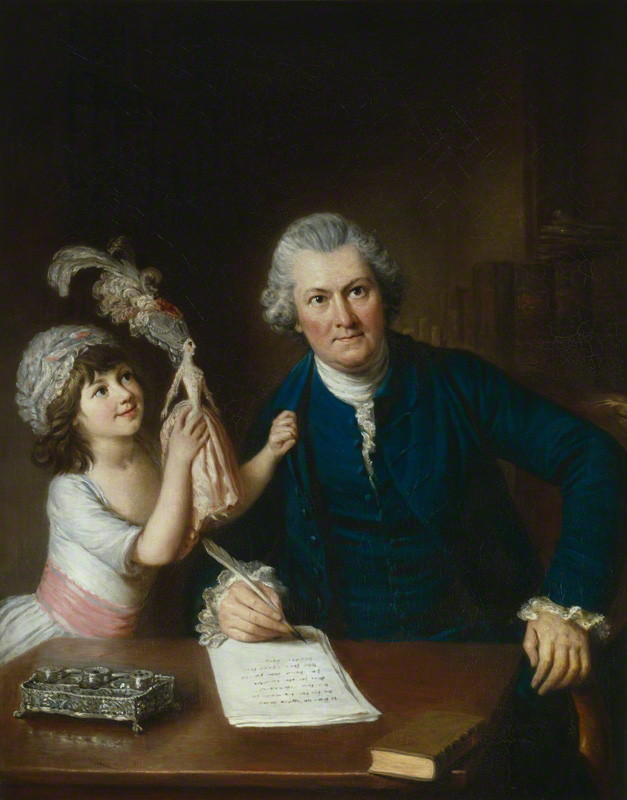
Christopher Anstey (1724–1805, shown here by William Hoare ignoring his daughter and her dolly) was the son of a Cambridgeshire minister who showed a great talent for Latin poetry at school and university.

The market for Latin poetry being small, Anstey was lucky enough to inherit considerable estates. He married and had a large family. In the 1760s he started to spend time in Bath, at first for his mood and then because he liked it.

In 1766, Anstey published The New Bath Guide: or Memoirs of the B–n–r–d Family in a Series of Poetical Epistles, a long satirical poem that became hugely popular.

Ten years later, having moved to Bath, Anstey wrote An Election Ball, in Poetical Letters from Mr. Inkle at Bath to his Wife at Gloucester. He dedicated that satire to John Riggs-Miller, host of a literary salon at Batheaston.

Anstey was a regular at the Riggs-Millers’ every-other-Thursday parties, including one on 3 Dec 1778. That was a little more than two weeks after Catharine Macaulay married Dr. William Graham in Leicester, a development that people in greater Bath were already gossiping about.

The poem that Christopher Anstey threw into the Riggs-Millers’ Roman vase for judgment that day was an ode titled “Winter’s Amusement.” That might have seemed a mere comment on the season. But as the lines were read aloud, the audience detected a more serious message: people should avoid passion and folly in love, especially as they grow older.
Ye beauteous nymphs, and jovial swains,
Who, deck’d with youthful bloom,
To gay assemblage meet to grace
Philander’s cheerful dome,

Mark how the wintry clouds hang o’er
Yon frowning mountain’s brow;
Mark how the rude winds warp the stream,
And rock the leafless bough.

The painted meads, and flow’ry lawns,
Their wonted pride give o’er;
The feather’d flocks in silence mourn;
Their notes are heard no more.

Save where beneath the lonely shed,
Or desolated thorn,
The red-breast heaves his ruffled plumes,
And tunes his pipe forlorn.

Yet shall the sun’s reviving ray
Recall the genial spring;
The painted meads resume their pride;
The feather’d flocks shall sing.

But not to you shall e’er return
The pride of gaudy years;
When pining Age with icy hand,
His hoary mantle rears.

When once, alas! his churlish blast
Shall your bright spring subdue,
I know not what reviving sun
Can e’er that spring renew.

Then seize the glorious golden days
That fill your cups with joy!
Bid every gay and social scene
Your blissful hours employ.

Oft where the crouded stage invites,
The laughing Muses join;
Or woo them while they sport around
Eugenia’s laurel’d shrine.

Oft seek the haunts where health and joy
To sportive numbers move;
Or plaintive strains breathe soft desire,
And wake the soul to love.

Yet ah! where-e’er you bend your way,
Let fair Discretion steer:
From Folly’s vain delusive charms,
And Passion’s wild career.

So when the wintry hours shall come,
When youth and pleasure fly,
Safe shall you ward th’ impending storm,
And Time’s rude blast defy.

Perpetual charms, unfading spring,
In sweet reflection find;
While innocence and virtue bring
A sun-shine to the mind!
(I’m following the title and text printed in The Scots Magazine in January 1779 rather than in the 1808 collection of Anstey’s work.)

The judges at the salon chose Anstey’s ode as that day’s best offering. Lady Miller asked him to read it again. Instead, he pulled another poem out of his pocket.

TOMORROW: The epode.