
J. L. BELL is a Massachusetts writer who specializes in (among other things) the start of the American Revolution in and around Boston. He is particularly interested in the experiences of children in 1765-75. He has published scholarly papers and popular articles for both children and adults. He was consultant for an episode of History Detectives, and contributed to a display at Minute Man National Historic Park.

Subscribe thru Follow.it


•••••••••••••••••


Showing posts with label Thomas Gage. Show all posts

Friday, October 16, 2026

“The Right of the Governor to carry them to Houssatonick”

John Hancock and Samuel Adams split in early 1772 over a few small issues—at least according to Gov. Thomas Hutchinson.

The first involved where the Massachusetts General Court was meeting.

Under orders from London, Hutchinson had summoned the legislature to meet in Cambridge instead of in Boston. His predecessor, Gov. Francis Bernard, had done the same. The General Court had also gone to Cambridge during a smallpox outbreak.

In the eighteenth-century British Empire it was widely accepted that colonial legislatures would be elected once a year, but then the royal governors could convene those legislatures where and when they chose. This power derived from their being representatives of the monarch in Britain.

According to Hutchinson in June 1771:
Mr [James] Otis in a Speech the first day after the Election gave his opinion to the house that we had a very good Governour and he was sure the People in all parts of the Province thought so, he condemned the proceedings of the House the last year & acknowledged the Right of the Governor to carry them to Houssatonick, the Western extreme part of the Province, was sensible that it would be inconvenient and that he would not do it and hoped he would carry them back to Boston. This gave a shock to the party and the House voted to go on with their business as usual without a division or opposition.
This speech immediately made Otis’s colleagues and constituents worry about which side he was on.

Soon Adams as assembly clerk rallied the legislators to complain bitterly about being summoned to an inconvenient meeting place and refuse to do any business until they were back in Boston. Hutchinson tried to bring up issues that the representatives, especially those from western towns, couldn’t resist acting on.

As the spring of 1772 came around, Hutchinson let it be known that as long as the house petitioned him to convene the General Court in Boston for practical reasons, with no challenge to his chartered power to summon them elsewhere, he would accede to that preference. (After all, as house speaker decades earlier, he had maneuvered to keep the legislative seat in Boston.) 

Adams wanted to stick to the principled, no-compromise confrontation. Hancock, along with speaker Thomas Cushing, was willing to couch their complaint on practical grounds. Ultimately, so did the majority of legislators.

The difference between Adams’s and Hancock’s positions was not that big, and Hancock may have had a better sense of what his fellow lawmakers and voters were up for. Still, this disagreement over wording or tactics was enough to give Hutchinson hope that two of his biggest opponents were splitting.

One of the grievances in the Declaration of Independence would be:
He has called together legislative bodies at places unusual, uncomfortable, and distant from the depository of their public records, for the sole purpose of fatiguing them into compliance with his measures.
That referred to this dispute over where the General Court should gather, which became an even bigger deal in 1774 when Gen. Thomas Gage summoned the legislature to Salem.

The Revolutionary War ended up changing the norm about where and when American legislatures met. The U.S. Constitution gave Congress authority over “the Seat of the Government of the United States” and provided for regular meetings there. Only “on extraordinary Occasions” can the President convene Congress, and only “in Case of Disagreement between” the two houses can the President adjourn them.

TOMORROW: Another chronicler.

Tuesday, October 06, 2026

Speeding Up “Slow-Motion Scholarship”?

I’ve been doing test drives on the Clements Library’s machine-made transcriptions of documents from the Thomas Gage Papers, seeing how useful those texts from Transkribus are.

Archiving documents already costs money, of course. Systematic scanning of those documents and making them available online costs more.

Producing accurate transcriptions for those documents requires even more labor, with a lot of expertise and patience thrown in. That might be the most expensive stage.

The U.S. government once deemed that work important enough to fund. We can look back at precedents like the Varick Transcripts of Gen. George Washington’s letters made in the 1780s, Peter Force’s American Archives in the ante-bellum period, and the major scholarly projects of the Progressive, New Deal, and Cold War eras.

Originally based on thick printed volumes, that effort has naturally spread to computers and computer networks. Founders Online is not only hosted by the National Archives, but its constituent projects received funding through the National Historical Publications and Records Commission (N.H.P.R.C.).

But that was all before the current administration set out to slash funding for historical projects that don’t feed its leader’s ego, both within the budget process and illegally outside of it. In June the Organization of American Historians issued a report titled “The Federal Assault on History: A Record of Executive Actions,” (P.D.F. download). It says:
Despite the impressive work done with the assistance of NHPRC grant awards, the program created by Congress often finds itself eliminated in presidential budget requests. FY 2026 and 2027 were no different, with the Trump Administration attempting to zero out the funding. As in prior years, Congress recognized the value that NHPRC brings to their districts and rebuked the effort, providing $5 million in grantmaking funds, though this represents a 50 percent cut to the program from FY2025.

Funding is only one of the challenges faced by NHPRC in 2025 and now in 2026. NHPRC is convened twice a year by the Archivist of the United States, its chair, to review grant proposals, recommend awards, and approve new calls for proposals. Without an Archivist of the United States duly confirmed by the Senate, the Commission has no chair to convene it and has not been able to meet since November 2024. This little-understood effect of the firing of the Archivist of the United States in February 2025 has blocked Congress’s intention to award millions of dollars in grant funding to archives and other historical institutions throughout the country.
That’s yet another part of our national government and polity that will need repair.

To be sure, there were limitations in that approach to transcribing archives. For example, there’s always been more funding available for the papers of elite American Founders than for other sorts. (Gen. Thomas Gage came from an elite class, too, but he was on the Wrong Side.)

Those monumental projects also took decades. Back in 1997 Lingua Franca magazine published an article by Jack Hitt titled “In the Franklin Factory: Slow-Motion Scholarship in an Age of Academic Obsolescence.” It concluded with a glimpse of the Benjamin Franklin Papers editors looking ahead to the end of their work after four decades. They’re still at it.

Given that environment, it’s easy to see the appeal of artificial-intelligence software as a way to ease, speed up, and democratize the transcription of handwritten documents. If, that is, the technology actually works.

TOMORROW: Alternative approaches.

Monday, October 05, 2026

Reading Documents about the Governor and the Towns

I plucked out a couple more documents from the digitized Thomas Gage Papers to see how well the automated handwriting-recognition program Transkribus has worked there.

Here’s a bit of “Intelligence” dated 25 Feb 1775. It’s a casual note, written quickly for Gov. Gage’s files, rather than an official letter. The transcription reads:
St.
It having been reported that aquantity of Shan Outs &c is
confesting of persons
now buying up for the use of the Army a Committee, from
all the Towns round met last might to consult measures to
prevent this supply from being bro: down & effectually
hinder the people from selling any hereafter & also to him,
der any large quantity of any kind of Provisions beyond
what may be daily expended from being sent into Town
I read it as:
It having been reported that a quantity of Straw Oats &c is now buying up for the use of the Army a Committee consisting of persons from all the Towns round met last might to consult measures to prevent this supply from being brot: down & effectually hinder the people from selling any hereafter & also to hinder any large quantity of any kind of Provisions beyond what may be daily expended from being sent into Town
The phrase “consisting of persons” is an insert between lines marked by a caret, and the second “hinder” fell over a line break, so it’s less surprising the program glitched on those. The “St.” at the beginning of the automatic transcription appears to be an echo of “It”—in other words, the program transcribed those marks twice. All told, not a bad start, but still falling short.

Here’s a crowded document with bleeding through the paper: a 3 Feb 1775 petition from the selectmen of six towns urging Gov. Gage not to send troops to Marshfield. It begins:
We his Addutys loyal Subjects, Selectmen of the Sevent
town of Otimouth, Kingston, Dubord, Pembrook Hanour
& Lastrate, alenly affected with a Sence of the Encreasincy
Danger Realamities, which menace one of the most prom-
ifing country upon tenth, with Political Action, cannot
but lement, that while we are Endeavouring to preserve
peace & maintain the authority of the laws; at a perod
When the bunds of Government are relieved, by Violent
Infructions on the Chinster of the Province, our Enemies
are prutifing Every Mydim, Strutages, to Seduce the
people into act of Violance, & ontrage.
My reading of those lines:
We his Majestys loyal Subjects, Selectmen of the Several towns of Plimouth, Kingston, DuxborĂ´, Pembrook, Hanover & Scituate, deeply affected with a Sense of the Encreasing Danger & calamities, which menace one of the most promising countrys upon Earth, with Political Exition; cannot but lament, that while we are Endeavouring to preserve peace & maintain the authority of the laws; at a period When the bonds of Government are relaxed, by Violent Infractions on the Charter of the Province, our Enemies are practising Every Insidious Strategem to Seduce the people into acts of Violance, & outrage.
Then software had a much tougher time with this one. Though I can’t blame a large language model for not recognizing the word “Exition,” which the Oxford English Dictionary says went out of use by 1820. I had to look that up myself.

Perhaps the biggest flaw in the automatic transcription is the town names. Those are important since researchers might scan for those terms. Granted, the selectmen didn’t help by using unorthodox spellings. To their credit, the cataloguers at the Clements Library listed all the towns in their standard forms in the metadata for this document, so it will come up in a local-history search.

Peter Force included this petition in his American Archives, changing the spelling, capitalization, and punctuation to conform to the standards of 1837. So historians have already had the chance to see local office-holders refer to Massachusetts as “one of the most promising countrys upon Earth.”

A quick scan of the automated transcription would probably bring the phrase “we are Endeavouring to preserve peace & maintain the authority of the laws” out of the unrecognizable gobbeldygook. That might lead one to think these selectmen were supporting Gov. Gage’s policies.

In fact, these selectmen were protesting the idea of stationing soldiers in Marshfield. They said those redcoats would provoke “the people,” already upset by the Massachusetts Government Act. That law-and-order language was a way to head off criticism and turn it against the local Loyalists asking for military protection. Another lesson in the value of reading the whole document in its historical context.

TOMORROW: The present and future of transcription.

Sunday, October 04, 2026

“Even the best quality HTR will contain errors”

Yesterday I described how the Clements Library in Michigan has provided transcripts of handwritten documents in the Thomas Gage Papers.

The library website explains:
The plain text we provide for this collection was created using Transkribus, a tool that uses machine learning and artificial intelligence to transcribe handwritten documents. Handwritten Text Recognition (HTR) “reads” the page images and makes a best guess at identifying the letters and words on a page. This is an automated process and subject to error, particularly if the original handwriting is difficult to read.

Even the best quality HTR will contain errors. This means that the plain text is not a fully faithful reproduction of the scanned original document. Proper nouns such as names of individuals, groups, and places are especially subject to recognition errors. Text written at an angle or vertically on the page will likely not be recognized at all. In addition, any spelling errors, line breaks, or abbreviations in the original document will be represented verbatim.

We provide this uncorrected plain text in the interests of improving accessibility and searchability of the collection. Please keep in mind that full text search results may not be fully accurate for specific keywords and we encourage you to use multiple search strategies to find relevant materials.
I’m very grateful to the Clements Library for providing scans online. As for the transcriptions, I chose an incoming document at random to assess.

On 29 Dec 1774, New Hampshire governor John Wentworth (shown above) wrote to Gen. Gage about how his authority was crumbling. The transcription of that document currently reads in part:
It is very certain that the peoples
minds, are too generally prepared, by
factions artifices and falwhoods wickedly
disseminated by the popular Laders, for any
violences whatever. This Spirit, I observe,
has been exceedingly angmented since the
return of the Delegates, from the continental
Congress; And having broken forth into
overt Acts, in the late repeated assaults on
His Majesty's Castle William and Mary,
those persons & all they can influence are
less restraind, and more readily disposed
to pursue any violences that may be
recommended by their Party in Boston,
or in contemplation hers, among which

I have strong reasons to beleive, Reprisals
on the King's Servants mentiond by the
Congress, will be the earliest & most sudden,
His Majesty's Ships Searborough and
Cancanx are not sufficient to frustrate
such intentions, and at the same time
cover of sure the Castle Wm. and Mary,
which is situate three mites from this
Town, which wou'd receive protection
from one additional Sloop or small Rigate
of war; with an angmentation of about
Forty or Fifty Mariness to their Compliment
To quote those lines here on Boston 1775, I’d begin with this text but carefully read the scans to confirm or correct it. The result is:
It is very certain that the peoples minds, are too generally prepared, by factious artifices and falsehoods wickedly disseminated by the Popular Leaders, for any violences whatever. This Spirit, I observe, has been exceedingly augmented since the return of the Delegates, from the continental Congress; And having broken forth into overt Acts, in the late repeated assaults on His Majesty’s Castle William and Mary; those persons & all they can influence are less restrain’d, and more readily disposed to pursue any violences that may be recommended by their Party in Boston, or in contemplation here, among which I have strong reasons to beleive, Reprisals on the King’s Servants, as mention’d by the Congress, will be the earliest & most sudden;

His Majesty’s Ships Scarborough and Canceaux are not sufficient to frustrate such intentions, and at the same time cover & secure the Castle Wm. and Mary, which is situate three miles from this Town, which wou’d receive protection from one additional Sloop or small Frigate of war, with an augmentation of about Forty or Fifty Marines to their Compliment.
The A.I. transcription has some errors, but Gov. Wentworth’s main topic and message come through: Send in the Marines!

It helped that this document was clearly written. Wentworth had received an elite education at a time when handwriting was part of a gentleman’s training. He had time to compose and write out this letter; I saw only one word squeezed in as an afterthought.

As for the peculiarities of eighteenth-century writing from our perspective, Wentworth’s spelling was rather modern. He used the long s less often than many contemporaries. However, he wrote many of his lowercase e backwards to our eyes—the root of several transcription errors.

TOMORROW: What about less elegant documents?

Sunday, August 16, 2026

“May God preserve this second Sodom”

On 25 May 1775, one week after the New-England Chronicle’s initial, hazy report on the fire that started in the 65th Regiment’s barracks, printers Samuel and Ebenezer Hall returned to the subject with a longer dispatch.

This article started by summarizing the account of how the fire started and listing a few damaged buildings. It continued:
The following Letter contains an Account of the Transactions of the Military at the Fire; and will give the Public some Idea of the present wretched Police of that once well governed Town.

Extract of a Letter from Boston.

“I propose to give you a circumstantial Account of the late Fire, previous to which please to observe, that for ten Days past, a Report has been propagated, that the Liberty Party intended to set Fire to the Town in different Places as soon as the greater Part of them had got out.

The General [Thomas Gage] took the Alarm, and took the Engines under Guard, and appointed new Captains; the late Engine Men took umbrage at it; but to the Point.---

I being informed that Barrack was on Fire, ran through the Street crying Fire, (as no Bells rang) but was stopped by a Man who told me it was the Officer’s Order not to cry Fire, one having threatened to beat the Man’s Brains out that did. The Drums all this Time beating to Arms.

When I came to the Fire I found no engine there. Applying to one of the late Engine Men to know the Reason, was informed that he had applied for the Engine, but the Bayonet was pointed at him, and he was told that he must apply to some Officer for an Order before he could have it.

After this fatal Delay the Engines appeared with the new appointed Captains and military Firewards, and a miserable figure they cut, the former not knowing how to obey if the latter had known how to command.---

Upon the whole, it appears to me as plain as the meridian Sun, had the Engines been on the old Footing, the Fire would have been put out, and *twenty thousand Pounds Sterling Loss prevented. Let that be as it may, I will venture to say, had the Fire broke out in the Center of the Town it would have laid it in Ashes, in the Direction it took to the Water. May God preserve this second Sodom from the Fate of the First.”

* The whole Loss is thought to be £40,000 Sterling.
After that Hall printed the complete list of property losses that had already appeared in the Newport Mercury and other papers. That list included: “50 Barrels of Flour, belonging to the Donation Stock, destroyed.” That stock was food donated to feed the poor of Boston since the previous year’s Port Bill.

That contemporaneous account was rewritten for the Saturday Morning Transcript of 15 Mar 1834 under the headline “Fire Reminiscences: No XVI.” The best new line put into the original voice was: “I asked the reason of such extraordinary delay, and was told by an Engineman that he had been to his Engine, but the bayonets were too thick.”

That text in turn was printed with small changes in Arthur Wellington Brayley’s A Complete History of the Boston Fire Department in 1889.

As a first-person account, it was more dramatic than the list of burned buildings alone. At the same time, the writer and printers had a political message about how military occupation was damaging the community.

TOMORROW: Back to Benjamin Davis.

Thursday, August 13, 2026

“A fire broke out in the barracks of the 65th regiment”

When the British army returned to central Boston in 1774, Benjamin Davis, Sr., rented his store on the south side of the Town Dock as a barracks.

Davis later told the Loyalists Commission that he “put his own goods in a Cellar” to make room for the redcoats. That turned out to be a costly decision.

On 24 May 1775, Isaiah Thomas’s Massachusetts Spy reported that on 17 May:
a fire broke out in the barracks of the 65th regiment on the south side of the Town-Dock, occasioned by a serjeant of said regiment delivering cartridges to the men by candle-light, a spark from the candle falling amongst them, set fire thereto and immediately the building was in a blaze.

Upon discovery of the fire the troops immediately beat to arms, which being unusual upon such occasions, caused great consternation amongst the inhabitants, and but few dared to leave their habitations; some that did repaired to the engine houses as usual, but to their surprize were told, the engines were not to be delivered without an order from the General [Thomas Gage] (he having a few days before taken the engines under his care, information being given to him, as he said, that when the inhabitants had removed some desperate people, purposely left, were to set fire to the town;)

by this delay the fire got to so great a height, as put it out of the power of the people to stop its progress speedily: It raged with uncommon fury till near three o’clock next morning, in which time all the barracks on the Dock, with a number of stores adjoining, near thirty buildings in the whole, were entirely consumed, with merchandize to a great amount.

The merchandize was chiefly taken out of the stores and put upon the wharf, and might have been saved had not the Admiral [Samuel Graves] some time before taken every boat from the town, and at the time of the fire cruelly refused any assistance.

It was the opinion of the inhabitants, that had the engines been in their hands as formerly, or could they have got them in any season, the fire might have been stopped at the first barrack.
Earlier in the occupation, redcoats and locals had worked together to stop a fire. But with the town besieged and the military commanders on edge, there was more finger-pointing than cooperation.

TOMORROW: Eyewitness reports.

Sunday, August 09, 2026

“The Women from the Windows asking Davis whether he wanted any Gingerbread”

Massachusetts ships captured the Peggy on its voyage from Halifax to New York on 22 July 1776, as described yesterday.

The civilians aboard that ship were taken to Marblehead, then to Boston under guard. Word spread quickly that one of them was Benjamin Davis, a merchant who had left town months before.

On 28 July, Joseph Ward wrote to John Adams from Boston about the ship: “There are many Tories on board, among whom is the noted Benjamin Davis.”

The next day, Ezekiel Price put in his diary: “Brought to town Benjamin Davis and a number of other Tories, who were committed to jail.”

Why was Davis being singled out? He’d made himself notorious in some way, and we have a couple of hints about how.

David Cobb wrote to Robert Treat Paine on 29 July:
Just now the Tories were Landed at the Long Wharf from Marblehead & were attended from thence to the Prison by 2 thousand people; the Women from the Windows asking Davis whether he wanted any Gingerbread, refering to his treatment of the little Chreldren when they were going out of Town last Year. I wish the Devil had ’em.
Abigail Adams alluded to the same scuttlebut in her letter to John the same day:
we have taken a vessel from Halifax bound to New York, which we should call a prize but that it containd about 14 Tories among whom is that infamous Wretch of a Ben Davis the Ginger Bread Robber. How many little ones can say I was an Hungry and you gave me no Bread, but inhumanely took what little I had from me. I wish the Sea or any other Element had them rather than we should be tormented with them.
The editors of the Adams and Paine Papers weren’t sure what to make of those remarks about gingerbread.

I can’t find any sources providing a definite answer, but here’s my guess. At the start of the war, many families sought to leave Boston. Gen. Thomas Gage didn’t want refugees to take out food, which his army needed, or weapons, which the provincial army needed. So the governor set up a system of passes and inspections using both military and civilian administrators.

In the 5 June 1775 Boston Gazette, Benjamin Edes published an open letter addressed “To the perfidious, the truce breaking THOMAS GAGE” and signed “Massachusettensis.” (This was not, presumably, the Loyalist political writer.) Among its complaints about Gage was:
Nay, have not you, and your associates by your orders, been mean enough to steal rum and sugar from a poor teamster, half a cake of gingerbread, a nutmeg, and half a bisket from a poor woman who was flying half famished out of Boston from your low lived tyranny and oppression?
That item was reprinted in several other Massachusetts and Connecticut newspapers over the next couple of weeks. It’s the one gingerbread-related complaint I could find from the period.

That complaint shows that people working for the royal government were confiscating food from folks trying to leave Boston, even mundane food like gingerbread, even from “a poor woman.”

I suspect that Benjamin Davis had agreed to work for Gage’s royal government as some sort of inspector or administrator. At some point that spring, he took gingerbread from a family or two trying to leave town. Children may have cried. That incident didn’t get into the newspapers, but it made him notorious enough that citizens yelled at “Ben Davis the Ginger Bread Robber” more than a year later.

And, unlike Hopestill Capen, few people in Boston minded seeing Davis locked up.

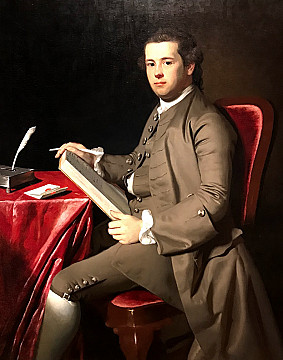
(The picture above shows the Pennsylvania politician Joseph Galloway, not mentioned anywhere in this posting. In September 1774 John Adams wrote in his diary that he was “introduced to Mr. Galloway, the Speaker of the House in Pensylvania. He looks like Ben. Davis the Sandimanian.”)

Thursday, May 14, 2026

Twenty Years of Boston 1775

Twenty years ago today, on 14 May 2006, I posted my first item on this blog.

That post was a link to an article I’d written for the magazine then called New England Ancestors, now American Ancestors, published by the New England Historical and Genealogical Society.

The original link broke. A subsequent link from 2012 broke. But Boston 1775 is still here.

That article described how a message from Dr. John Homans to his mentor, Dr. Joseph Gardner, in the first days of the Revolutionary War was detoured by the duplicitous Dr. Benjamin Church, Jr.

Last August I revealed other messages that Dr. Church diverted into the files of Gen. Thomas Gage, from Boston magistrate Edmund Quincy to his daughter Dorothy and her fiancé, John Hancock.

Tonight I’m speaking in Stoneham about how Dr. Church managed to infiltrate Gen. George Washington’s network for sneaking intelligence out of besieged Boston before the Continentals realized their surgeon-general as a spy.

One way to look at this situation is that after twenty years of daily blogging I’m still working the same ground.

Another is that Dr. Benjamin Church’s treachery is an endless source of revelations and fun.

Monday, April 13, 2026

Caleb Wheaton “industriously vindicating the Measures of the Ministry”

In yesterday’s discussion of how the Massachusetts legislature dealt with Loyalists captured on the Elizabeth in April 1776, I left out Caleb Wheaton and his sons: Caleb, Jr.; Joseph; and John.

That’s because their story is complex and detailed enough to deserve a few postings on their own. And even then there will be holes and mysteries.

Vital records of Rehoboth show Caleb Wheaton born there in 1713. There were lots of Wheatons in that region, however, including across the nearby border in Rhode Island. Unfortunately for us, that means there were other men with the same name moving in and out of the eighteenth-century record.

Documents in Caleb Wheaton’s filing to the Loyalist Commission in 1784 show that he served in the Massachusetts army raised by Gov. William Shirley to hold Annapolis Royal in 1744. Later he was “Commandant of St. George’s Fort in the Eastern Part of the Province of Massachusetts,” now Thomaston, Maine.

Customs Commissioner Charles Paxton certified that his agency made Wheaton “a preventive Officer at Machias in which he conducted himself faithfully and diligently to the Acceptance of the Board.” That couldn’t have been a full-time position, given the size of trade in the region.

By 1774, Wheaton owned 200 acres in Machias, Maine, where he lived, and 173 more acres in Dedham. Capt. Solomon Smith wrote that he “was Situated in the most advantagest place for traid in the harbour of Machias.” Wheaton’s family consisted of a wife and nine children, some grown.

That year, Caleb Wheaton testified, he was “obliged to fly from his Estate and Property…on Account of his Attachment to the British Government.”

The 13 Feb 1775 Newport Mercury ran these two articles:
Rehoboth, February 3, 1775.

A Number of the Inhabitants of this Town assembled on Monday last [28 January], to enquire into the Conduct of Mr. Caleb Wheaton, who lately came here from the Eastward, and who had rendered himself obnoxious, by openly espousing & vindicating the Plan of Despotism now carrying on against the Colonies. A Committee was appointed to wait on him, and after making an Acknowledgment of his Villany, asking Forgiveness, and promising Amendment, he was ordered to depart the Town in twelve Hours. . . .

PROVIDENCE, Feb. 4.

Mr. Caleb Wheaton, who some Time since was obliged to quit this Town for industriously vindicating the Measures of the Ministry, returned here from Rehoboth the Beginning of this Week, which Place he had likewise been obliged to leave; and Yesterday a Number of the Inhabitants paid him a second Visit, to remind him of their former Request, when he thought proper to make a precipitate Flight.—So many all the Enemies to America become destitute of a Resting-Place for the Soles of their Feet.
The reference to “the Eastward” makes me think these items referred to Caleb Wheaton, Sr., from Maine.

Like other New England Loyalists, Wheaton found protection in army-occupied Boston. Gen. Thomas Gage certified that “he was employ’d as an Officer of Guides in the Kings Service.” According to E. Alfred Jones’s Loyalists of Massachusetts, “By orders of General Sir William Howe he pulled down the Old North Meeting House,” which happened on 16 Jan 1776.

TOMORROW: The Wheaton brothers.

Saturday, April 04, 2026

Crean Brush’s American Career

Yesterday’s post reported that among the people captured aboard the evacuation ship Elizabeth in April 1776 was Crean Brush.

Eric Wiser wrote a good article about Brush for the Journal of the American Revolution: “Hell’s Half-Acre: The Fall of Loyalist Crean Brush.” More information can be found in “Crean Brush vs. Ethan Allen: A Winner’s Tale” by John J. Duffy and Eugene A. Coyle, published in Vermont History (P.D.F. download). I’ll review just the main points here.

Brush came to America from county Tyrone in Ireland in the 1760s when he was in his thirties and already a widower. He soon established himself as a lawyer and government appointee in New York City.

Brush married Margaretha Schoolcraft, who had a daughter named Frances from her previous relationship with Capt. John Montresor, the British army engineer. (Some sources say this girl was Margaretha’s niece. Others give the girl’s surname as Montezuma. It seems clear those were cover stories.)

In 1772, after accumulating grants of tens of thousands of acres of frontier land, Brush moved his family to the new town of Westminster, New York, between Lake Champlain and the Connecticut River. Soon he was a leader of the new community, variously commissioner of the court, surrogate of the court, county clerk, and representative in the colonial legislature. Brush worked with Philip Schuyler to establish the rule of (New York) law in his new county.

Unfortunately for Brush, others had settled the same region with grants from New Hampshire that overlapped and competed with the grants from New York. These men, led by Ethan Allen, Seth Warner, and Remember Baker, called themselves the Green Mountain Boys. Brush called them the Bennington Mob, becoming an early opponent and target of that faction. The London government had approved New York’s side of that dispute, giving Brush more reason to support royal policies.

On 13 Mar 1775, while Brush was away at the legislature, there was a fatal fight around the Westminster courthouse. Then war broke out in Massachusetts. The Green Mountain Boys seized Fort Ticonderoga for the rebels. Brush realized the region wasn’t safe for him, and neither was his former home in New York City. The Brush family moved into besieged Boston.

On 1 October, Gen. Thomas Gage gave Brush a commission to collect goods from the buildings of people who had left Boston so they wouldn’t be damaged when British soldiers were lodged in those homes and warehouses. The general required Brush “to take all due Care thereof, and to deliver said Goods when called upon, to those to whom you shall have given Receipts for the same.”

What Brush really wanted, though, was the British commander’s approval for his scheme to raise a Loyalist regiment and take back his corner of New York from the Green Mountain Boys. Gage never authorized that, which probably saved Brush from dying in a futile battle. Still, Brush presented the same proposal to Gen. William Howe in early 1776, but he didn’t get any further before it was time to leave.

TOMORROW: Preparing to evacuate.

Sunday, March 29, 2026

“After this they went to it with their fists”

Here’s an example of how Gen. John Burgoyne’s diary of the late 1775, just brought to light, offers new detail on life inside besieged Boston.

We’ve long known that in August 1775 Adm. Samuel Graves (shown below) and Customs Commmissioner Benjamin Hallowell (shown at right) got into a fistfight. In 1929, Allen French delivered a whole paper on this incident to the Massachusetts Historical Society.

The two men had already butted heads over the unloading of a merchant ship. One report suggests that Hallowell had critiqued the way Graves deployed warships during the Battle of Bunker Hill. But the immediate conflict was over hay growing on Gallops Island in the outer harbor.

Hallowell had purchased the right to harvest that hay. Graves wanted that hay, or at least half of it, for the navy. (Or maybe he wanted half the value of the hay for himself.) Hallowell secured permission from Gov. Thomas Gage to harvest. Graves refused to allow haying on the islands, and he had warships.

Hallowell sent increasingly angry letters to the admiral. Graves sent no replies. Hallowell took that silence as a sign of disrespect, and he was probably right.

The next time the commissioner saw Adm. Graves, on Milk Street on 11 August, he demanded the sort of answer that he, “as a gentleman, had a right to expect."

A letter sent from Boston on 19 August and printed in the 21-23 Sept 1775 London Chronicle stated:
To this civil question, the Admiral replied in his usual style; and while the Commissioner was whispering a challenge to him, returned a blow in the face.

Though Mr. Hallowell was unarmed, the Admiral had recourse to his sword, on which the former rushed upon him, forced it from him, broke it over his knee, and then flung it in Greaves’s face; after this they went to it with their fists, but were soon parted.—

The Admiral has come off with a black eye. He has not yet proposed a renewal of battle, probably preserving himself for the Yankies, who have already carried off all his fresh stock, burnt his hay on the islands, and destroyed the light-house twice under his very nose.
Over the next couple of days Graves’s nephew, Capt. Thomas Graves, R.N., twice challenged Hallowell on the admiral’s behalf. Another nephew, Capt. Samuel Graves, R.N., hit the commissioner on the back of the head with a cane, and Sheriff Stephen Greenleaf had to separate the men. Hallowell declared he wouldn’t duel on instructions from Gen. Gage—at least not with anyone but the admiral.

According to a 21 August letter from Capt. Samuel Graves summarized in the Dartmouth Manuscripts, the dispute was heard by a court martial. The board faulted the admiral for “An error in judgment for disobedience of orders and neglect of duty.”

Our most detailed description of this fight comes from Hallowell, and most of the other sources sympathize with him, too. (Given the commissioner’s snappish temper, that shows how many people disliked Adm. Graves.) At least a couple of those sources say the admiral came away with a black eye, suggesting the commissioner got the better of the fight.

Per Andrew O’Shaughnessy, Gen. Burgoyne called the whole incident “shameful” and recorded that Hallowell suffered a black eye, too.

Prof. O’Shaughnessy will share more details about the Burgoyne diary and how it came to light in an online “fireside chat”/Zoom webinar on 15 April at 6 P.M. Harvard time.

Thursday, March 12, 2026

“Without the leave of the Governor”

Earlier this month the Journal of the American Revolution ran an article by Ray Raphael about colonial Massachusetts’s constitution and how the royal government tried to curtail it.

Here’s a taste:
Of the four punitive acts passed in response to the Boston Tea Party, closing the port of Boston receives most attention in textbooks today—but at the time, with 95 percent of the colony’s population living outside Boston, it was “An Act for the Better Regulating the Government of the Province of the Massachusetts Bay”—known today as the Massachusetts Government Act—that sparked the people’s fury and led them to cast off British rule.

Under the 1691 Charter, “freeholders” could call a town meeting whenever they saw fit—but no longer: “Whereas a great abuse has been made of the power of calling such meetings, and the inhabitants have, contrary to the design of their institution, been misled to treat upon matters of the most general concern, and to pass many dangerous and unwarrantable resolves,” the 1774 act declared, “no meeting shall be called by the Selectmen, or at the request of any number of freeholders of any township, district, or precinct, without the leave of the Governor, or, in his absence, of the Lieutenant Governor, in writing, expressing the special business of the said meeting.”

Likewise, on the provincial level, power was wrested from the people. No longer would the incoming “general court or assembly” choose the Governor’s Council:
Whereas the said method of electing such counsellors or assistants. . . hath been so far from contributing to the attainment of the good ends and purposes thereby intended, and to the promoting of the internal welfare, peace, and good government of the said province, or to the maintenance of the just subordination to, and conformity with, the laws of Great Britain, . . . the said method of annually electing the counsellors or assistants . . . should no longer be suffered to continue . . .

Be it therefore enacted . . . that the council, or court of assistants, shall be composed of such of the inhabitants or proprietors of lands within the same as shall be thereunto nominated and appointed by his Majesty.
All other officers would also be appointed by the governor, who could remove them at will…
The voters of Massachusetts didn’t like to see Gov. Thomas Gage implement the new law. Soon they were protesting against it—and shutting down the colonial government to do so.
The next courts were scheduled for Springfield, shiretown of Hampshire County, two weeks later, on August 30—but some 1,500 citizens made sure they did not sit. One eyewitness, Joseph Clarke of Northampton, gave a vivid account: “The people of each town being drawn into separate companies marched with staves & musick . . . The trumpets sounding, drums beating, fifes playing and Colours flying, struck the passions of the soul into a proper tone, and inspired martial courage into each.”

The judges and justices of the peace offered no resistance to “the body of the county,” as Clarke called the men who marched with their town’s militia companies. When a committee asked them “whether they meant to hold their commissions and exercise their authority according to the new act of parliament for altering the constitution of the province,” they all said they would not.
One corrective for the article: The Boston Port Bill went into effect on 1 June 1774. The Massachusetts Government Act may have been drafted to start at the same time, but the final language said it took effect on 1 August. And then the text didn’t arrive in Salem until a few days after that.

In other words, it took only about two weeks from the start of the law for people in western Massachusetts to organize major protests and shut down a branch of the royal government. That’s how much people wanted to maintain their constitution.

Monday, February 23, 2026

“At length we have had the Commencement of Hostilities begun”

Here’s an account of the start of the Revolutionary War that I don’t believe has been published before.

It’s a letter dated 11 June 1775 from Jonathan Hastings, Jr. (1751–1831), son of the steward of Harvard College, to a friend named Jacob.

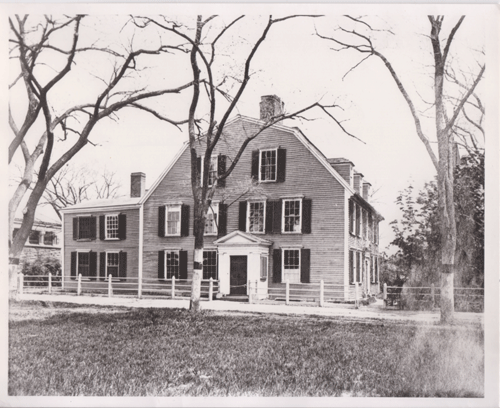
Hastings graduated from Harvard in 1768 and a few years later become one of Cambridge’s school teachers. He was living in his father’s house beside the common, shown here. On 8 June, three days before writing this letter, the young man took the job of town postmaster.

Ironically, his letter appears to have been intercepted by the Crown forces because it’s filed among Gov. Thomas Gage’s papers at the Clements Library. The library offers scans and an imperfect transcription.

Hastings wrote:
Your Brother’s Letter of 18th. May we received the 9 of June. Notwithstanding my many Avocations (our House being made Head Quarters) I cannot miss an Opportunity of sending you a Letter. Am happy you had so safe a Passage & found your Friends well.

At length we have had the Commencement of Hostilities begun by Gage’s Troops, at the Battle of Lexington, where 8 of our Men were killed, there being about 50 assembled on a Green.—

The Evening preceeding the 19 of April, I was met by 11 Officers equipt with Pistols & Cutlasses; when I got Home I acquainted several Gentlemen therewith; but they thought it was like to prove nothing but a false Alarm. They were mistaken. About 2 OClock the next Morning, we were roused out of Bed to pursue 1100 Grendadiers & Light Infantry being a Detachment from all the Regiments in Boston.—

They made their way to our Magazines at Concord, but affected nothing more than destroying 80 Barrels Flour, knocking of [sic] the Ears of 3 twenty four pounders & burning the Carriages. A Quantity of Bullets they threw into a pond, but have been got out since.

Coll. [Thomas] Gardner ordered our Regiment to parade at Watertown, not knowing but that Gage’s Reinforcement would take that Course. He was mistataken [sic], they marched thro’ Cambridge, wch. being known our Regiment took the nearest Way to meet the Detachment. Unluckily for us we had no sooner placed ourselves in an advantageous Post near Lexington Meeting House to give Battle to the Detachment, than we perceived the Brigade in the other Side of us. Our Situation was bad, being between both Armies.
Well, that seems like an exciting place to break, doesn’t it?

TOMORROW: Under fire.

Wednesday, January 21, 2026

“Also embarked Colonel Richard Prescott”

In late 1774 the British 7th Regiment, known as the Royal Fusiliers, was stationed southwest of Montréal, guarding the frontier of the British Empire.

But its commanding officer, Col. Richard Prescott (shown here), wasn’t with them.

The 17 October New-York Gazette reported:
On Thursday Morning last Major General [Frederick] Haldimand embarked on board the Transport named the Countess of Darlington, attended by Major of Brigade [Thomas] Moncrieff, Capt. Thomas Gamble, Assistant Quarter-Master General, Captain [Dietrich] Brehm, Aid de Camp, and Captain [Francis] Hutcheson;

with General Haldimand also embarked Colonel Richard Prescott of his Majesty’s Royal Fusileers, a Company of the Royal Artillery, with a large Quantity of Ordnance Stores for Castle-William.
Also headed to Boston were the 47th Regiment, three companies of “the Royal Regiment of Ireland” (18th), an artillery company, and artificers to build barracks.

Those transport ships arrived on Sunday, 23 October, as reported four days later in the Boston News-Letter. This was part of Gen. Thomas Gage’s military build-up after the “Powder Alarm.” Indeed, by the end of the year the 7th would be one of the few regiments in North America not stationed inside Boston.

Col. Prescott was still in Boston when the war began because on 12 June 1775 Gen. Gage wrote to the Secretary of War, Viscount Barrington, that “Colonel Prescot, now declared Brigadier,…is going to Canada to Assist General [Guy] Carleton.”

In addition, this 1905 publication by the Canadian Archives stated that Gage sent the same news that day to Lord Dartmouth, the Secretary of State: “The Colonel Prescott goes immediately to Canada to assist General Carleton, for I hear the Rebels, after surprising Ticonderoga, made Incursions, and committed Hostilities upon the Frontiers of the Province of Quebec…” I haven’t found a copy of that letter in Gage’s papers at the Clements Library, but its online database and transcriptions are still a work in progress.

Thus, through the first half of October 1774 Col. (later Gen.) Richard Prescott was in New York, where Hugh Gaine printed A Letter from a Veteran, to the Officers of the Army Encamped at Boston, as discussed here.

Prescott then sailed north. Eight days after he arrived, booksellers Cox and Berry advertised that pamphlet for sale in Boston.

As a senior officer in Gage’s force, particularly one not engrossed in the daily duty of his regiment, Prescott had the motive and opportunity to pen advice from a “Veteran” to younger officers. He was much closer to the situation in Boston than his younger brother Robert.

When William Tudor, Jr., recorded that people said A Letter from a Veteran was written by “General Prescott,” he most likely meant Richard Prescott.

Thank you for your attention to this matter.

Monday, November 10, 2025

“Writing this has employed a day”

Dr. Benjamin Church, Jr., used a variety of ways to send messages into Boston after the start of the war, including:
  • crossing the siege lines himself in April 1775 and pretending to have been placed under arrest.
  • having a letter “sewed in the waist of [a paid confederate’s] breeches.” That unnamed man was stopped and “confined a few days,” but the letter wasn’t found.
  • possibly piggybacking on a letter from Gen. Charles Lee that Church arranged to be sent into Boston in early July.
  • meeting a Crown agent in Salem. William Warden told the Loyalists Commission “he was sent by General [Thomas] Gage to Salem and Marblehead to receive intelligence from Dr. Benjamin Church, but failed to execute his business.” Church wrote in July, “I have been to Salem to reconnoitre, but I could not escape the geese of the capitol.”
  • asking Gen. George Washington’s staff to send in a letter through the channel they established to communicate to their agent, John Carnes. That document was sent through the hands of military secretary Joseph Reed, Lt. Col. Loammi Baldwin, a man named Tewksbury raising sheep what’s now Winthrop, and a waterman going into Boston.
  • And of course asking his mistress, Mary (Butler) Wenwood, to arrange for someone she knew in Newport, Rhode Island, to deliver a letter to a royal official there to pass into Boston. Unluckily for them, she chose her ex-husband, Godfrey Wenwood.
Of those communications, only the last letter survives and can be connected with a transmission route because it was intercepted, proving to be Church’s undoing.

For that letter through Newport, Dr. Church used a cipher for added security. One of the many fine questions asked after yesterday’s presentation on Dr. Church was if there were any other ciphered letters from him in Gen. Gage’s papers. I don’t think there are others. And in fact, since the one that incriminated Dr. Church was never delivered, there aren’t any at all.

As part of his defense Dr. Church displayed and translated a letter from his brother-in-law, John Fleeming, written using the same cipher. The doctor said Fleeming had asked him to use the cipher. That letter survives only in printed translations. Earlier Church told Washington that he had received and destroyed another ciphered letter from Fleeming, but that might have been the same one he later displayed.

In General Gage’s Informants, Allen French identified other letters from Dr. Church in the general’s papers on the basis of internal detail (the writer was about to leave for Philadelphia) or handwriting. Those were all in plain English.

As is the long letter written on 24 Sept 1775 and published in Henry Belcher’s The First American Civil War, which I identified in this post as probably Church’s last report to his royal handlers.

It appears, therefore, that Church used the cipher only in exchanges with Fleeming. Why not all the time?

One reason is that having a cipher and sending lots of coded letters might have raised questions. In one of those letters in Gage’s files Church said that an encounter with an angry man named Timothy had prompted him to destroy his cipher lest people suspect him.

Another factor may simply have been time. It took extra effort to copy each letter symbol by symbol. In the intercepted letter the doctor complained, “Writing this has employed a day.”

We might say that using every means to conceal a spy letter would be time well spent. But in Church’s case, the cipher roused Godfrey Wenwood’s suspicions and was soon broken, but the letters the doctor sent in other ways remained secret for over a century.

Monday, October 13, 2025

On the Trail of Capt. William Browne

In the HUB History podcast episode “Drinker, Draftsman, Soldier, Spy,” Jake Sconyers quotes my remark on how difficult it is to track Capt. William Browne of the 52nd Regiment before 1775 because there were so many men named William Brown(e).

He also quoted a portion of Ens. Henry DeBerniere’s report on his spy missions with Capt. Browne that I’d read many times but hadn’t tumbled to how it’s helpful with that precise challenge.

One of my favorite moments in that narrative is when Browne, DeBerniere, and their manservant have reached Jonathan Brewer’s tavern in Waltham.

a little out of this town [Watertown] we went into a tavern, a Mr. Brewer’s, a whig, we called for dinner, which was brought in by a black woman, at first she was very civil, but afterwards began to eye us very attentively; she then went out and a little after returned, when we observed to her that it was a very fine country, upon which she answered so it is, and we have got brave fellows to defend it, and if you go up any higher you find it so,—

This disconcerted us a good deal, and we imagined she knew us from our papers which we took out before her, as the General had told us to pass for surveyors; however, we resolved not to sleep there that night, as we had intended, accordingly we paid our bill which amounted to two pounds odd shillings, but in [sic] was old tenor.

After we had left the house we enquired of John, our servant, what she had said, he told us that she knew Capt. Brown very well, that she had seen him five years before at Boston, and knew him to be an officer, and that she was sure I was one also, and told John that he was a regular—he denied it; but she said she knew our errant was to take a plan of the country; that she had seen the river and road through Charlestown on the paper; she also advised him to tell us not to go any higher, for if we did we should meet with very bad usage
That waitress didn’t just recognize Brown—she recognized him from “five years before at Boston.” That was in 1770, and there were only two British army regiments in Boston then: the 29th and the 14th. That narrows the field considerably.

Sure enough, the officers of the 14th included Lt. William Browne. On 12 July 1771, the War Office announced that “Lieut. William Brown, of the 14th regiment of Foot,” had purchased the rank of captain in the 52nd in the place of Archibald Williams. In the 14th, Ens. William Napier moved up to lieutenant’s rank.

One implication of that fact is that Gen. Thomas Gage might have chosen Capt. Browne to scout the countryside in 1775 because that officer was more familiar with Massachusetts than most of his colleagues, having spent about two years in Boston and on Castle Island back in 1768–1770.

Of course, that had the drawback of more people in Massachusetts being familiar with Browne, as the woman in Waltham showed.

For earlier information on Lt. Browne I hunted down the Army List for 1767. And I found this list of lieutenants in the 14th Regiment of Foot:
Goddammit!

Two men named William Browne became lieutenants in the 14th Regiment four days apart in June 1766. One of them had joined the army in 1762, the other at some unknown time. They were both still lieutenants in the 14th at the start of 1771. 

And during the same period when one or both of these lieutenants were serving in Boston:
And there were probably others.

TOMORROW: Capt. Browne’s own voice?

Saturday, September 06, 2025

“He Lieut. Thos. Hawkshaw did affirm this to be the Fact & Truth”

On 23 Apr 1775, Lt. Thomas Hawkshaw of the 5th Regiment was lying near death.

He’d been shot through the throat during the Battle of Lexington and Concord. He’d lost a lot of blood, not only from that wound but from supposedly therapeutic bleeding. He was suffering spasms of pain. He had trouble swallowing pain relief, much less solid foods.

And his commander-in-chief, Gen. Thomas Gage, had just intercepted a letter from justice Edmund Quincy to the Patriot leader John Hancock saying Hawkshaw had been heard saying that British troops had fired first and started the war.

Hawkshaw’s regimental commander, Lt. Col. William Walcott, and other officers came to speak to him. They went away with this document, now in Gage’s papers. It said:
Boston, 23d. April 1775

Lieut. Thos. Hawkshaw of the 5th: Regt. of Foot, declares in the most solemn Manner to Lt. Col. Walcott, in the Presence of Capt. Smith & Lieut. Ben. Baker All of the same Regimt.,

That, he, Lieut. Thos. Harkshaw, never did say to any Person whatsoever, that, the King’s Troops gave the first Fire upon the People of this Country in the Affair which happened between the said Troops & the said Country People on Wednesday last the 19th. April;

that, so far from knowing or believing that the Troops were the first who fired, he, Lieut. Thos. Harkshaw, knows & believes that the Country People did fire first upon His Majesty’s Troops, & that he Lieut. Thos. Hawkshaw did affirm this to be the Fact & Truth to Lt: Col. [Francis] Smith of the 10th: Regt. of Foot who commanded the Grenadiers & Light Companies, upon the Spot, and that he, Lt. Thos. Harkshaw, did again upon his being brought into Boston, make the same Declaration to Capt. [John] Gore of the 5th. Regt. of Foot, That, to the best of his Knowledge & Belief, the Country People fired first upon His Majesty’s Troops.

Thomas Hawkshaw
Lieut 5th Regt. Foot

Wm: Walcott, Lt: Col. 5th. Foot.
John Smith Capt: 5th. Foot
Ben Baker, Lt. & Adjt. 5th. Foot
The regiment contained lieutenants named Benjamin Baker and Thomas Baker, so they used first names to sort out those men. The handwriting of the document looks like Walcott’s.

The detail about Hawkshaw telling Lt. Col. Smith (shown above) that the provincials in Lexington had fired first suggests the lieutenant was on or near the common during that shooting while Smith was still back with the grenadiers.

However, the document doesn’t add any detail about what Hawkshaw actually heard or saw there, and Gage was collecting such detail from other officers at this time. That makes me think Hawkshaw had passed on what he’d heard from other officers. (If Hawkshaw turns out to have been a light-infantry officer, then that’s off.)

In any event, from his sickbed Lt. Hawkshaw was insisting that he’d consistently blamed the provincials for shooting first.

TOMORROW: Corroborating witnesses.

Friday, August 29, 2025

Bell on “Dr. Benjamin Church,” 9 Nov.

As long as I’m discussing Dr. Benjamin Church, Jr., here’s early notice of a talk I’ll give about him for the Historical Society of Watertown this fall.

Sunday, 9 November, 2:00 P.M.
Dr. Benjamin Church
Watertown Free Public Library

The society’s event description says:
Dr. Benjamin Church was a patriot activist who was exposed as a spy for British Major General Thomas Gage. The Massachusetts General Court held an inquiry into his activities from October to November 1775. November 2025 will mark the 250th anniversary of the legislature’s decisions. New details regarding Church's spying activities will be revealed. Attendees will also learn where the Massachusetts General Court held the Church inquiry.

J. L Bell is a writer who specializes in the start of the American Revolution in New England and is the proprietor of the popular Boston 1775 website. A Fellow of the Massachusetts Historical Society and elected member of the American Antiquarian Society and Colonial Society of Massachusetts, he authored the book The Road to Concord: How Four Stolen Cannon Ignited the Revolutionary War as well as a National Park Service study of George Washington’s work in Cambridge. He has written many articles, delivered papers to the Massachusetts Historical Society and appeared on a panel of the Organization of American Historians. Some of his lectures have been broadcast on the C-Span Networks and he has spoken at many historic sites around greater Boston and beyond.
This event will be free and open to the public. Parking in the Watertown library lot is free on Sundays. This historical society’s programming is funded by a 2025 grant from the Watertown Community Foundation.

Thursday, August 28, 2025

“By Doctor Church I send”

As recounted yesterday, after returning from besieged Boston on 23 Apr 1775, Dr. Benjamin Church told Paul Revere that he’d been detained by Gov. Thomas Gage’s troops and kept in a North End barrack for most of his time in town.

Church’s Patriot colleagues accepted that story, probably even admired his daring. They chose him to travel to Philadelphia and consult with the Continental Congress, and the Congress in turn made him Surgeon-General of its army.

However, the documentary record I explored earlier this week casts doubt on Church’s story. While in Boston he was clearly communicating with relatives of his colleagues and offering to deliver letters for them.

On 22 April, Edmund Quincy gave Church two letters to carry out of town: to his daughter Dorothy and to her fiancĂ©, John Hancock. The letter to Dolly Quincy refers to the “opporty (unexpected) by Doctr. Church” to communicate. There’s no apparent worry about Church being under the royal authorities’ control.

In addition, Edmund’s son Henry Quincy wrote a letter to the elder Dr. John Sprague in Dedham, shown here. That too stated: “Dr. Church Arrived here this PM. from Concord on Business with the General is Allowed in the Morning to Return.”

In further addition, Rachel Revere (shown above) wrote a short, undated note to her husband Paul. That began “by Doctor Church I send a hundred & twenty five pounds”—probably devalued Old Tenor currency.

All those documents are in the files of Gen. Gage. Did soldiers seize them from Dr. Church as he left Boston? That wouldn’t explain how those same files contain Dr. John Homans’s note to Dr. Joseph Gardner asking for surgical knives, which Church carried into town. 

When Allen French explored Church’s activities in General Gage’s Informers (1932), the letter from Rachel Revere was one of the prime pieces of proof that the doctor was cooperating with the royal authorities. I wrote about the Homans letter in an article for New England Ancestors in 2006. The Quincy letters add more evidence to that pile.

I wonder what Dr. Church told his colleagues when he arrived back in Cambridge, knowing that their relatives inside Boston would eventually mention that they’d given him letters to deliver. Presumably to maintain his cover the doctor spoke ruefully of having the big, bad soldiers take all his papers away. No one appears to have spoken of those missing documents as evidence of Church’s treachery, even after Gen. George Washington put him under arrest in October.

All the documents I’m speaking of remain in the Thomas Gage Papers at the Clements Library in Michigan. The library has just released digital scans of Gage’s correspondence in the weeks after the start of the war (along with poor computerized transcriptions which I’ve largely ignored). I’m sure there are some surprises to be found, as well as more evidence for what we already know.

Wednesday, August 27, 2025

“Are you serious, Dr. Church?”

In a letter to the Rev. Dr. Jeremy Belknap, Paul Revere recalled a dramatic moment on 21 Apr 1775:
The Friday evening after [the Battle of Lexington and Concord], about sun set, I was sitting with some, or near all that Committee [of safety], in their room, which was at Mr. [Jonathan] Hastings’s House at Cambridge. Dr. [Benjamin] Church, all at once, started up—

Dr. Warren, said He, I am determined to go into Boston tomorrow—

(it set them all a stairing)—

Dr. [Joseph] Warren replyed, Are you serious, Dr. Church? they will Hang you if they catch you in Boston.

He replyed, I am serious, and am determined to go at all adventures.

After a considerable conversation, Dr. Warren said, If you are determined, let us make some business for you. They agreed that he should go to git medicine for their & our Wounded officers.

He went the next morning; & I think he came back on Sunday evening.
As part of his medical mission, Dr. Church carried in a note from Dr. John Homans of Brookline to his mentor Dr. Joseph Gardner, asking for surgical knives.

Revere recalled speaking to Church after his return:
After He had told the Committee how things were, I took him a side, & inquired particularly how they treated him? he said, that as soon as he got to their lines on the Boston Neck, they made him a prisoner, & carried him to General [Thomas] Gage, where He was examined, & then He was sent to Gould’s Barracks, & was not suffered to go home but once.
In Igniting the American Revolution, Derek W. Beck guessed that the Gould of “Gould’s Barracks” was Lt. Edward Thoroton Gould, who on that day was a wounded prisoner of war outside of Boston. But I think the answer appears in a letter of merchant John Andrews on 11 January:
This morning the soldiers in the barrack opposite our house, left it, and took quarters with the royal Irish in Gould’s auction room or store—in the street leading to Charlestown ferry.
Bostonians often referred to barracks by the name of the local landlord who had rented those buildings to the army, making “Gould’s barracks” a big building on Back Street in the North End.

Robert Gould was a merchant who in August 1773 announced that the Boston selectmen had authorized him to set up as an auctioneer. He advertised heavily over the next several months (usually signing those notices “R. Gould”) before the Boston Port Bill hit. Renting his store to the army might have seemed like the best possible deal.

Robert Gould had also invested in Maine land along with Francis Shaw, Sr., a settlement that became Gouldsboro. He had trained Francis Shaw, Jr., in business, and newspaper ads in 1770 show that the younger man was selling ceramics out of “the store lately improved by Mr. Robert Gould.” In June 1776, Francis, Jr., and his wife Hannah had a boy they named Robert Gould Shaw. That man would pass the name on to his grandson, the Civil War hero.

Robert Gould remained in Boston after the British evacuation, but the Patriot authorities were suspicious of his dealings with the king’s army. The selectmen recommended detaining him for questioning, but the Massachusetts General Court decided to drop him from the list. Gould went back to advertising as a regular merchant in late 1776. But then he died unexpectedly, intestate and in debt, in January 1777, aged 57.

TOMORROW: The doctor’s documents.