J. L. BELL is a Massachusetts writer who specializes in (among other things) the start of the American Revolution in and around Boston. He is particularly interested in the experiences of children in 1765-75. He has published scholarly papers and popular articles for both children and adults. He was consultant for an episode of History Detectives, and contributed to a display at Minute Man National Historic Park.

Subscribe thru Follow.it


•••••••••••••••••


Showing posts with label digital historiography. Show all posts

Monday, June 29, 2026

Show Changes on the Declaration of Independence

On this date 250 years ago, the Continental Congress was taking the weekend off from formal sessions.

The Congress’s proposed Declaration of Independence was lying “on the table,” discussion of it tabled in favor of tasks like a naming a committee on manufacturing sulphur and choosing who would sign another $1,000,000 in currency.

Of course, a lot of politicking happened that weekend, off the record. Delegates were no doubt reading the draft submitted on 28 June 1776, composed by Thomas Jefferson with input from John Adams, Benjamin Franklin, Roger Sherman, and possibly Robert R. Livingston. Obviously, it needed further revision.

Earlier this year, the Thomas Jefferson Papers project at Princeton University created a website laying out that writing and revision process in detail, displaying and analyzing the existing documentary record. It’s well worth a visit.

It’s also interesting to think about the pedagogical and design challenge of this project. As the editors explain:
Past editors of Jefferson’s papers employed different techniques to show the declaration’s development and the committee’s revisions to the draft. Some used the root text before any revisions were made and added extensive annotation to explain later changes. Others printed the draft as it was submitted to Congress, using annotation to describe the changes that had been made up to that point. One edition printed three stages of revision as three separate, side-by-side columns for comparison. Others simply included an image of the chaotic draft without attempting to transcribe or break down the contents . . .

The Papers of Thomas Jefferson, in the series’ first published volume, printed the underlying “original Rough draught” with footnotes showing changes made before Adams made his copy. In a different part of the same volume, the Papers printed the draft as submitted to Congress, with the changes made by the committee marked, and also printed the final Declaration of Independence. While a dedicated researcher could piece together the development of the draft, it is difficult to get a clear narrative of the draft’s development through print sources alone. For this exhibit, we separated stages of revision into three tabs, so changes to the text can be viewed side by side with zoom-capable images of the manuscript.

The first tab shows the base text before any alterations were made. This is completely in Jefferson’s hand and strips out changes and corrections that were later marked on the page.

The second tab shows changes marked before Adams made his copy. These might be early revisions Jefferson made to his own work or revisions made in early consultations with committee members.

The third tab shows the remaining revisions marked on the document prior to its submission to Congress. To ascertain this stage, we examined three copies that Jefferson sent to friends in the days shortly after July 4, in which he reconstructed the draft that the committee had laid before Congress. We also consulted another copy of the draft that Jefferson transcribed into his Notes of Proceedings of the Continental Congress, which he compiled sometime between August 1776 and August 1783. When possible, we have identified the committee member who contributed each revision.
Adams and Jefferson both left recollections of the writing process. Unfortunately, that means we don’t know what happened.

TOMORROW: The Adams chronicle.

Thursday, June 25, 2026

“From which patterns of everyday life and social change would emerge”

Back in April the Concord Bridge published a nice retrospective profile of Robert Gross, author of The Minutemen and Their World.

Published in 1976 and recently updated, that book has proved the most lasting of the New England community studies that came out in the middle of the twentieth century.

No doubt Minutemen gets a boost from its connection to the nation’s origin story, but it’s a really good book that offers both an early example of computer-aided data analysis and interesting new ideas about how generations interact.

Plus individual stories, as the article says:
Gross wanted to write about “men, women, free and slave, native and newcomer, patriot, neutral, and loyalist” — all of those who had been excluded from conventional accounts — recovering their voices. His approach would reflect his interest in social history, a method that was growing in popularity. It involved tapping overlooked sources such as tax lists, censuses, vital records, genealogies, and town meeting minutes, from which patterns of everyday life and social change would emerge, he says.

Among those who people “Minutemen” is John Jack, an enslaved man who worked for a cobbler, bought his freedom, built a cabin in Great Meadows, and paid his taxes, but was never allowed to vote. At the time of Jack’s death, he owned eight acres, a pair of oxen, and seven barrels of cider. “His was a marginal place in the community, but it was nonetheless a real place,” Gross writes.

And there is Lucy Barnes Hosmer, daughter of a prosperous farmer and town clerk. When Joseph Hosmer, a cabinet maker, asked for permission to marry 16-year-old Lucy, her father refused, wanting her to wed someone wealthy and important.

Though a father could not dictate his daughter’s choice of spouse, he could try to arrange unions and pressure her to agree, Gross says. Lucy rebelled, denying her father’s choice of a cousin for her, and acted on her own. When she married Hosmer at 19, she was two months pregnant.
Highlighting people like that reflects the appeal of such human detail in a study of a society, a balance that The Minutemen and Their World achieved.

Wednesday, June 17, 2026

“Ye pasture where ye fight was in June”

On this anniversary of the Battle of Bunker Hill, I’m taking note of a document the City of Boston Archaeology Department recently highlighted which touches on the term “Breed’s Hill.”

The department’s social media stated:
Samuel Swan, who owned the pasture where the battle took place, wrote in his claim for damages, “the Pasture where the fight was in June & pasture on Bunker’s Hill, breastwork on it & the ground almost all cut up within the breastwork.” The actual owner of the hill calls it Bunker’s Hill.
I was excited by this finding and was planning to simply pass on the news. But on digging down to the documents I’m not convinced.

The problem is that Samuel Swan owned three pastures on the Charlestown peninsula, according to his claim in March 1776. One was on the hill where the provincials built their redoubt, the focus of the 17 June battle. Swan’s larger tracts were to the west, near the neck. We can see all three on the map of 1775 Charlestown real estate that the department has created.

The department has shared a scan of Samuel Swan’s document about his pastures. I wish the wording, punctuation, and difference between “ye” and “&” were clearer, but I think it says:
Swans Act. of Trees Apple, Loacust, Button wood Pair [pear] in my 3 pastures. 250 at Least my son sett 200 Loacust & Aple trees—

Stone Walls [of ye?] 3 pastures Great part took away. all ye Rales Gone. ye Ground Cutt Great part of it ye pasture where ye fight was in June. ye pasture on Bunker hill Brest work on it & ye Ground almost all Cutt up within ye Brest work ye Loer part ye other Pasture Cutt up not much ye Well wholly Filled up—
It looks to me like Swan was distinguishing between “ye pasture where ye fight was in June” and “ye pasture on Bunker hill Brest work on it.” I think the latter phrase referred to the large fortification that the Royal Engineers built on Bunker’s Hill rather than to the provincials’ redoubt.

(As for Swan’s “other Pasture,” that sustained less damage because it was on lower ground, so neither the provincials nor the regulars built works there.)

By my reading of his claim, Swan referred to the promontory near the neck as “Bunker hill” and didn’t name the hill where the monument now stands at all.

TOMORROW: Words, not deeds.

Wednesday, June 10, 2026

Three Podcast Episodes

Producing a podcast strikes me as a lot of work, but speaking about Boston history on other folks’ podcasts is always fun.

Here are three episodes I’ve recorded in the last few months. Enjoy all you can.

“The Spark: How Boston Ignited the American Revolution” on The Object of History from the Massachusetts Historical Society

We ask several historians for their thoughts on why Boston helped light the spark of the American Revolution. Was there something unique about Boston's community or geography that made it prone to a rebellious spirit? We sit down with J. L. Bell, Historian of the Revolutionary Era in Massachusetts, Garrett Dash Nelson, President & Head Curator at the Leventhal Map & Education Center at the Boston Public Library, and Kathryn Lasdow, Assistant Professor of History and Director of Public History at Suffolk University, to answer this question.
I’d already been mulling about “Why did the Revolutionary conflict flare up in Boston?” when the invitation to explore that question arrived. Hear my threefold answer and more.

“Boston” on History’s Greatest Cities from History Extra
As one of the oldest cities in the United States, Boston played a pivotal role in the outbreak of the American Revolutionary War, as well as the signing of the Declaration of Independence that followed. In this episode of History’s Greatest Cities, Paul Bloomfield is joined by writer John Bell to explore the storied history of the capital of Massachusetts. Together, they wander through Boston’s oldest neighbourhoods, tracing the story of this harbour city from its pre-colonial roots, through Puritan settlement, to its rise as a major port and administrative centre of the British Atlantic world.
This podcast asks its guests to answer a series of questions, from major events to foods a visitor mustn’t miss.

“Not What You Hurd” on Antiques Roadshow Detours from GBH
In the world of rare silver, American Colonial silver is the stuff collectors dream of. So, when a pair of drinking vessels or “canns,” complete with intricate engraving by a master Boston craftsman, were discovered during ROADSHOW’s visit to Akron in 2023, expert Nick Dawes examined the cups’ clues to reveal both the silver’s early-American history and extraordinary value. But does Nick’s tale of the tankards hold water? Join host Adam Monahan as he searches for the untarnished truth, picking through the many stories, half-truths, and wishful legends in a quest for what may or may not have been lost to history forever.
My voice pops up occasionally on this episode, leaving more time for the fine local historians Joel Bohy and Caitlin DeAngelis.

Wednesday, May 27, 2026

Uncovering Boston Jersey

Earlier this month the Guardian reported on how researchers had unearthed new information about a figure in this portrait.
For hundreds of years, he was known only as “Jersey”, an enslaved boy of about 11 rendered in oil on canvas by the great 18th-century portrait painter Sir Joshua Reynolds. . . .

The painting, thought to have been completed around 1748, shows the boy and his “master”, the naval officer and MP Paul Henry Ourry. While Ourry looks out into the distance authoritatively, the enslaved child gazes up at the officer tentatively. . . .

Scouring admiralty records, letters, muster books (ships’ registers) and captains’ logs, [Mark] Brayshay and Katherine Gazzard, a curator at Royal Museums Greenwich, found him named as “Boston Jersey” on ships that Ourry was attached to.

They believe he may have been given the surname Jersey because Ourry was born in the Channel Islands. It is possible he had his first name because he once lived in Boston, Massachusetts.

The researchers discovered Jersey was baptised as George Walker (possibly a name he had been known by earlier in his life) on 30 July 1752, probably in a chapel in Westminster.
The article has a little more to say about George Walker and much more about the restoration of the painting.

This discovery led to the quick creation of a Wikipedia page about Boston Jersey/George Walker.

Tuesday, May 26, 2026

“Environmental History & the War of Independence” in Boston, 27 May

David Hsiung is the Dr. Charles R. and Shirley A. Knox Professor of History at Juniata College in Pennsylvania.

For several years he’s been working on the problem of how the enviroment affected the American Revolution, how the Revolution affected the environment, and how it’s possible to study those interactions with the data we have.

That is, of course, a huge topic, so part of the historiographical challenge is, I’m sure, to narrow down and define the questions in a manageable way. In the meantime, I’ve been enjoying his articles and lectures, which always open my eyes to new ways of seeing this history.

On Wednesday, 27 May, David Hsiung will be at the Massachusetts Historical Society for a conversation with Joyce A. Chaplin of Harvard, author most recently of The Franklin Stove: An Unintended American Revolution.

The description of “Curious & Complex Connections: Environmental History & the War of Independence” says:
Many of us give only a moment’s thought about the environment when considering the War of Independence: the slope of Breed’s Hill, the ice-choked Delaware River, and diseases such as smallpox. But what might we gain by connecting biology, ecology, and geology to the thinking and actions of soldiers and civilians? Rebels and British soldiers acquired and used energy in the form of food, fuel, and work animals, which shaped people’s lives, the course of the war, and the direction of environmental change.
This is a hybrid event starting at 6 P.M., with a reception in the preceding half-hour for people attending in person. Attendance costs $10, but is free to M.H.S. members and Card to Culture participants. Listening in online is free. Register for either form of access through this page.

Folks can also take in these talks from Prof. Hsiung:

Monday, May 18, 2026

“In what a defenceless State we still remain”

I was preparing to write about a document from the Samuel Adams Papers at the New York Public Library, digitized as “Letter from John Scollay” dated 22 Apr 1776.

But after taking a closer look, I realized that only the first two four pages at that link come from a letter by selectman John Scollay. And the first two pages of Scollay’s letter are at this link, called “Letter from William Davis”—which is indeed accurate for the first two of four pages there.

The file called “Letter from John Scollay” also contains a two-page letter from the Rev. Samuel Cooper, dated 29 Apr 1776. His signature is abbreviated, but the handwriting matches Cooper’s other letters in this collection.

The Cooper letter closes by saying he’d recently written to John Hancock and John Adams. The letter to Hancock isn’t listed in the John Hancock Papers project, so it probably hasn’t survived. But the Adams Papers does offer a 22 April letter from Cooper matching the style and concerns as the letter to Samuel Adams.

In particular, Cooper told John Adams he was worried about Boston’s defenses:
After so many Weeks Possession of this Town you would be surpriz’d to see in what a defenceless State we still remain. The Business of Fortifying has lain between Genl. [Artemas] Ward and a Committee of the General Court: Between them both, little or nothing has yet been done. We have but 7 or 8 Guns mounted on Fort Hill. Nothing yet done on any Island in the Harbor.

A British Ship of 40 or 50 Guns with two or three small arm’d Vessells are in Possession of King Road and Nantasket. They take or drive away almost all supplies coming to us by Water; and (would you believe it!) with this inconsiderable Force the Harbor has been, and is now effectually block’d up. Two or three Ships of War have had it in their Pow’r ever since the Evacuation of the Town to come up and cannonade it.
That warship’s primary mission was to stop other British ships from going into the harbor unaware that it waw now in rebel hands. But of course Cooper and other Bostonians couldn’t be sure it wouldn’t attack.
Ward complains that too small a Force, but 5 Regiments not full, were left him. The Court blame him for Inactivity, and He them. I was pleas’d to see your Letters and others from Gentlemen of the Congress mentioning the Importance of putting this Harbor into the best State of Defence. Pray write again and again to press this Matter.

There is a Report here that Ward has desir’d to resign. I wish from my Heart He would do it. He is a good Man, a thoro N. England man, and dispos’d to do us ev’ry Service in his Power. But He certainly wants Decision and Activity. It is of absolute Necessity that some General Officer of the best Qualities be sent to this Department immediately. Pray let [Nathanael] Green or some other be plac’d here.

We are in the utmost Hazard, should the Enemy return, of loosing in this Quarter much more than we have gain’d, by the Departure of the British Forces. Had there been a Man here, at the Head of the Military who would have discern’d at once what was proper to be done; and stated it to the Court, we might have been in a good Posture of Defence Weeks ago.
Ward had indeed put in his resignation on the grounds of ill health, then asked to remain so he could help Massachusetts rebuild. Cooper wasn’t the only local to say Ward moved too slowly. When the minister wrote this letter, however, it had been less than three weeks since Gen. George Washington had departed and left Ward in charge. It therefore doesn’t seem fair to suggest Boston could have been fortified against ocean attack “Weeks ago.”

Thursday, May 14, 2026

Twenty Years of Boston 1775

Twenty years ago today, on 14 May 2006, I posted my first item on this blog.

That post was a link to an article I’d written for the magazine then called New England Ancestors, now American Ancestors, published by the New England Historical and Genealogical Society.

The original link broke. A subsequent link from 2012 broke. But Boston 1775 is still here.

That article described how a message from Dr. John Homans to his mentor, Dr. Joseph Gardner, in the first days of the Revolutionary War was detoured by the duplicitous Dr. Benjamin Church, Jr.

Last August I revealed other messages that Dr. Church diverted into the files of Gen. Thomas Gage, from Boston magistrate Edmund Quincy to his daughter Dorothy and her fiancé, John Hancock.

Tonight I’m speaking in Stoneham about how Dr. Church managed to infiltrate Gen. George Washington’s network for sneaking intelligence out of besieged Boston before the Continentals realized their surgeon-general as a spy.

One way to look at this situation is that after twenty years of daily blogging I’m still working the same ground.

Another is that Dr. Benjamin Church’s treachery is an endless source of revelations and fun.

Thursday, April 30, 2026

“Now in his majesty’s Goal in Boston” in January 1775

Yesterday I illustrated a posting that quoted Boston jailer Joseph Otis’s list of prisoners with a small image of such a list.

However, that picture didn’t show the list I quoted from 1777, which is reportedly at the Boston Public Library. I couldn’t find a digital image of that document.

Instead, I ran an image of Otis’s list of prisoners from 3 Jan 1775, in the collection of the Newberry Library in Chicago.

That list includes Samuel Dyer, whom I wrote about in these articles, so I was eager to see if this source said anything more about him. It says he was being held for assault and battery, though he had clearly tried to murder two British army officers. 

But before I got to Dyer my eye fell on the top of the list.

First name on list is John Bell, held for Breach of Peace
The first prisoner was “John Bell,” held for “Breach of Peace.” I’m taking that personally.

Tuesday, March 03, 2026

“Touch-screen displays, Revolutionary War artifacts, and A.I. slop”

Among the Trump administration’s Sestercentennial initiatives are modern gladiatorial games outside the White House on the President’s birthday. Less decadently imperial are the Freedom Trucks mentioned yesterday.

These trucks were clearly inspired by the Freedom Train that traveled the country in 1947–49, giving citizens a look at 127 documents from the National Archives and other artifacts.

The most detailed list of those documents that I found is a Huntington Library catalogue description of “Heritage of Freedom,” the booklet given out to explain those items to visitors. The selection didn’t include the handwritten Declaration of Independence, Articles of Confederation, or Constitution, but it did have the Congress-approved Bill of Rights, George Washington’s copy of the printed Constitution, and various letters and pamphlets from the Founding era. The display went back as far as the Magna Carta and Christopher Columbus, and as recently as the surrender of Germany and Japan.

The 1940s Freedom Train previously inspired the American Freedom Train of the Bicentennial period, 1975–76. This one carried Washington’s copy of the Constitution again, the original Louisiana Purchase, and other documents, but also one of Judy Garland’s dresses from The Wizard of Oz, Martin Luther King Jr.’s pulpit, and a Moon rock. It was like a rolling Smithsonian.

What will be in the Freedom Trucks? The New York Times reported:
The truck exhibits were designed in collaboration with Hillsdale College, a conservative school in Michigan, and PragerU, a company that makes conservative educational materials. . . . The trucks prominently feature quotes from Mr. Trump and a video he filmed inside the Oval Office.
On 27 February, the New Yorker offered a story by Jessica Winter about PragerU’s projects:
Last year, PragerU unveiled the Founders Museum, a “partnership” with the White House and the U.S. Department of Education featuring A.I.-generated video testimonials from luminaries of the American Revolution. These include a digitized John Adams who ventriloquizes the words of the right-wing influencer Ben Shapiro, almost verbatim: “Facts do not care about our feelings.”

PragerU is also supplying the multimedia content for the Freedom Truck Mobile Museums, a travelling exhibition of touch-screen displays, Revolutionary War artifacts, and A.I. slop that will chug across the country on tractor-trailers throughout 2026, in celebration of the two-hundred-and-fiftieth anniversary of the Declaration of Independence. It seems that the battle over who defines good and evil—or, at least, over who defines American history—will be waged, in part, from the helm of an eighteen-wheeler. . . .

Prager’s nonprofit is just one of dozens of conservative organizations, many of them Christian, that are named as “partners” in the America 250 Civics Education Coalition, which is overseen by Linda McMahon, the Education Secretary. The coalition has the secular task of developing programming for America’s birthday, such as PragerU’s Founders Museum and the Freedom Trucks, the latter of which received a fourteen-million-dollar grant from the federal Institute of Museum and Library Services. (In March, President Trump signed executive orders to dismantle both the I.M.L.S. and the D.O.E.; they remain alive, albeit in shrunken, ideologized versions of their former selves.)

Other America 250 partners include both of the major pro-Trump think tanks (the America First Policy Institute and the Heritage Foundation), a Christian liberal-arts school (Hillsdale College), the Supreme Court’s favorite conservative-Christian legal-advocacy group (the Alliance Defending Freedom), the Christian-right-aligned church of Charlie Kirk (Turning Point USA), and something called Priests for Life.
Another notable detail from the New York Times: “Both institutions [Hillsdale and Prager U] said that they had not received any of the $10 million in taxpayer money and that they had funded their work with private donations.” That $10 million, you may remember from yesterday, was shifted by the White House from the Institute of Museum and Library Services to America250 and then to Freedom 250, ostensibly for these very trucks. What pocket is that money sitting in now?

TOMORROW: Up in the air.

Sunday, February 08, 2026

Museum of African American History Events on the Revolution

The Museum of African American History in Boston has opened a new exhibit called “Black Voices of the Revolution: Liberty, Emancipation, and the Struggle for Independence.”

The museum website says:
What do you do when a country cries out for liberty—but won’t offer it to you? In the shadowed alleys and crowded docks of Revolutionary-era Boston, Black men and women—enslaved and free—listened as white colonists thundered about freedom. They heard the speeches. They read the broadsides. But they knew: the liberty being shouted from the rooftops was not meant for them. Still, they stepped forward.

Interact with AI-driven, holographic images of primary sources, and the men and women who represented the African American community in Massachusetts during the period from the 1620s to 1800. Ask questions of the interactive using a voice activated program or by simply typing your queries on a touchscreen.
Those personages include Lucy Terry Prince, Phillis Wheatley Peters, Chloe Spear, and more.

On Tuesday, 17 February, the museum will host an event called “Digging Deeper into Black Voices of the Revolution.” Chief Curator and Director of Collections Angela Tate and Prof. Nedra Lee will discuss the process of assembling that exhibit. That free event is due to run from 5 to 7 P.M. at the museum on 46 Joy Street. Register to attend here.

On Wednesday, 18 February, the Massachusetts Historical Society will host a panel discussion on the topic “Whose Independence: Black Experiences During the American Revolution.” The panelists will be:
  • Dr. Noelle Trent, Museum of African American History | Boston & Nantucket
  • Dr. Benjamin Remillard, Providence College
  • Dr. Chernoh Sesay Jr., DePaul University
  • Dr. Kyera Singleton, Royall House and Slave Quarters
The panel description says:
As cries for liberty and clashes with the British broke out in the American colonies, enslaved and free Black people fought for independence on the battlefield, in courtrooms, and their communities. In petitions and writings, they argued that there were contradictions in a fight for freedom that didn’t include a full abolishment of slavery. Following the promise of freedom advertised, many enslaved men enlisted as soldiers. Many joined the Patriot cause while others volunteered with British forces. Throughout the war and in the years following, free Black leaders built the African Lodge and African Meeting House and established spaces for religion and education in their communities.
That event will run 6 to 7 P.M. Register to attend in person or online starting at this page.

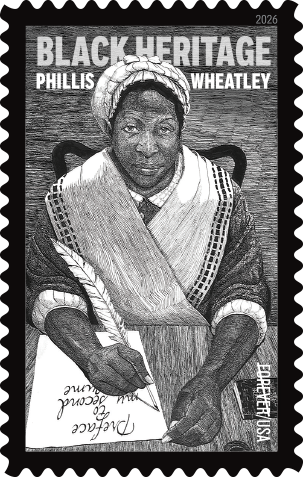
Back at the Museum of African American History, on Thursday, 26 February, it will host the first U.S. showing of “In Search of Phillis Wheatley Peters,” Leslie Askew’s thirty-five-minute documentary about the poet, her work, new discoveries about her life after marriage, and her cultural legacy. That event is scheduled from 6 to 8 P.M. It is free, with donations welcome. Reserve a space here.

Shown above is the first-class stamp featuring Phillis Wheatley, just issued by the U.S. Postal Service.

Wednesday, February 04, 2026

“Causes of the breaking out of this ill Humor”

Among the items in the Boston Public Library’s manuscripts department is a 21 Apr 1770 letter from Charles Lloyd (1735–1773) to George Grenville, former prime minister of Britain (shown here).

Lloyd was working at the Treasury office by 1761. His elder brother had tutored Grenville’s sons before becoming dean of Norwich, and through him Charles secured the job of secretary to the new prime minister in 1763.

After the Marquess of Rockingham took over government, Lloyd lost some patronage appointments but continued working at the Treasury. As of 1770, he was writing from the “Salt Office”; that department collected the salt tax, operating somewhat independently.

Lloyd also continued serving Grenville, who remained in Parliament, as a source on London news and a pamphleteer. According to the Dictionary of National Biography, Lord North even suspected that Lloyd wrote the radical Junius letters, a theory most later scholars called “absurd.”

This particular letter passed on news from Boston, which is probably why it ended up on this side of the Atlantic. It began:
Salt Office Saturday
21st April 1770.

Dear Sir

Nothing has occurred since youn left Town that I thought worth troubling you with till this morning when Mr. Robertson [John Robinson] (one of the Commrs. of the Customs in America) arrived in Town with an account that he left the whole Town of Boston in the utmost Confusion.

The immediate Causes of the breaking out of this ill Humor arose from some petty Quarrel between a Townsman & a Soldier. Each had their respective Partizans from words they came to Blows some were killed by the Soldiers & many wounded—

The next Day, a more General Engagement took place between the Civil & military when the Commander in Chief [acting governor Thomas Hutchinson] to prevent further Effusion of Blood order’d the Troops to retire into the Castle, & the Commrs. of the Customs are lodged there likewise—

The Townsmen were guilty of several outrages before the military Fired.
Lloyd then went on to write more about a lottery. He added a brief postscript of political gossip.

We can barely recognize the Boston Massacre in Lloyd’s description. The “petty Quarrel” was probably the ropewalk brawl. Robinson or Lloyd put less significance on the people killed than on Lt. Gov. Hutchinson agreeing to the town’s demand to move the troops—“a more General Engagement…between the Civil & military.” That was how some conservative elements in London first learned about the Massacre. 

Saturday, January 31, 2026

Lunch with Maj. Thomas Musgrave, 6 Feb.

In last week’s talk about the end of the siege of Boston, I recounted the story of the British army raid on the Dorchester peninsula.

For action details I drew on Francis E. Blake’s 1899 article for the New England Historical and Genealogical Register, reprinted with additional realty information as a short book titled Dorchester Neck (Now South Boston): The Raid of British Troops, February 13, 1776.

In fact, most of that action happened in the early morning hours of 14 February. I quoted reactions to the raid in this posting from 2008.

Yet my favorite detail about the event is that Maj. Thomas Musgrave, who led a squad of elite troops across the ice from Boston Neck, was considered the best skater in the British force, as quoted here in 2010.

It was therefore intriguing to learn that the American Revolution Insitute will feature Maj. Musgrave in an online presentation on Friday, 6 February.

Here’s the event description:
Join the Institute’s museum collections and operations manager, Paul Newman, for a discussion of a 1780s manuscript account of the American Revolution by Lt. Col. (later made a General and Baronet) Thomas Musgrave, a British officer who served extensively throughout the war.

At the battle of Germantown, he commanded the British 40th Regiment of Foot that famously defended the Chew House against attacking American forces. Subsequently, he was restationed in the West Indies in 1778, before returning to New York as the last British commandant of the city.

Following the war, Musgrave authored a manuscript, housed in our library collections, that offers extensive details of his service throughout the Revolution.
The presentation will emphasize “the 40th Regiment of Foot at the Battle of Germantown.” But maybe there will some seasonal information about Maj. Musgrave on ice.

Saturday, January 24, 2026

Talking about “The Spark” on The Object of History

Last April I spoke at the U.S.S. Constitution Museum by invitation of the Paul Revere House on the topic “The Reasons for Revere’s Ride.”

I decided not to stick to the events of 1774–75, or even 1765–75. I dug further back into why Boston, of all the parts of the British Empire, was the epicenter of resistance to the Crown’s new revenue measures.

My first reason was: Puritanism, and its effects. Later came: General Economic Anxiety. And a crucial ingredient for heightening the crisis: Crown Crackdowns.

That talk wasn’t recorded, and I started thinking about turning it into an article. But before I could get around to that, folks at the Massachusetts Historical Society invited me to speak about the same question for their podcast, The Object of History.

Here’s what the M.H.S. has just announced for “The Spark: How Boston Ignited the American Revolution”:
Season 5 of The Object of History is dedicated to topics related to the American Revolution. On this first episode, we ask several historians for their thoughts on why Boston helped light the spark of the American Revolution. Was there something unique about Boston's community or geography that made it prone to a rebellious spirit?

We sit down with J. L. Bell, Historian of the Revolutionary Era in Massachusetts, Garrett Dash Nelson, President & Head Curator at the Leventhal Map & Education Center at the Boston Public Library, and Kathryn Lasdow, Assistant Professor of History and Director of Public History at Suffolk University, to answer this question.
And here’s the link.

Wednesday, January 21, 2026

“Also embarked Colonel Richard Prescott”

In late 1774 the British 7th Regiment, known as the Royal Fusiliers, was stationed southwest of Montréal, guarding the frontier of the British Empire.

But its commanding officer, Col. Richard Prescott (shown here), wasn’t with them.

The 17 October New-York Gazette reported:
On Thursday Morning last Major General [Frederick] Haldimand embarked on board the Transport named the Countess of Darlington, attended by Major of Brigade [Thomas] Moncrieff, Capt. Thomas Gamble, Assistant Quarter-Master General, Captain [Dietrich] Brehm, Aid de Camp, and Captain [Francis] Hutcheson;

with General Haldimand also embarked Colonel Richard Prescott of his Majesty’s Royal Fusileers, a Company of the Royal Artillery, with a large Quantity of Ordnance Stores for Castle-William.
Also headed to Boston were the 47th Regiment, three companies of “the Royal Regiment of Ireland” (18th), an artillery company, and artificers to build barracks.

Those transport ships arrived on Sunday, 23 October, as reported four days later in the Boston News-Letter. This was part of Gen. Thomas Gage’s military build-up after the “Powder Alarm.” Indeed, by the end of the year the 7th would be one of the few regiments in North America not stationed inside Boston.

Col. Prescott was still in Boston when the war began because on 12 June 1775 Gen. Gage wrote to the Secretary of War, Viscount Barrington, that “Colonel Prescot, now declared Brigadier,…is going to Canada to Assist General [Guy] Carleton.”

In addition, this 1905 publication by the Canadian Archives stated that Gage sent the same news that day to Lord Dartmouth, the Secretary of State: “The Colonel Prescott goes immediately to Canada to assist General Carleton, for I hear the Rebels, after surprising Ticonderoga, made Incursions, and committed Hostilities upon the Frontiers of the Province of Quebec…” I haven’t found a copy of that letter in Gage’s papers at the Clements Library, but its online database and transcriptions are still a work in progress.

Thus, through the first half of October 1774 Col. (later Gen.) Richard Prescott was in New York, where Hugh Gaine printed A Letter from a Veteran, to the Officers of the Army Encamped at Boston, as discussed here.

Prescott then sailed north. Eight days after he arrived, booksellers Cox and Berry advertised that pamphlet for sale in Boston.

As a senior officer in Gage’s force, particularly one not engrossed in the daily duty of his regiment, Prescott had the motive and opportunity to pen advice from a “Veteran” to younger officers. He was much closer to the situation in Boston than his younger brother Robert.

When William Tudor, Jr., recorded that people said A Letter from a Veteran was written by “General Prescott,” he most likely meant Richard Prescott.

Thank you for your attention to this matter.

Tuesday, January 13, 2026

Online Lecture Series from Historic Deerfield

Here’s another series of online lectures exploring the Revolution during the Sestercentennial, this time from Historic Deerfield.

Sunday, 25 January, 2 P.M.
Mighty Microbes: The Deadly 1775 Massachusetts Dysentery Epidemic and the Other Diseases That Shaped the American Revolution
Woody Holton, Professor of History at the University of South Carolina, author of Liberty Is Sweet

Sunday, 22 February, 2 P.M.
Spain, Native Nations, and the American Revolution
Kathleen DuVal, Carl W. Ernst Distinguished Professor of History the University of North Carolina, author of Native Nations

Sunday, 29 March, 2 P.M.
Picturing the American Revolution
Paul Staiti, Professor of Fine Arts on the Alum Foundation at Mount Holyoke College, author of Of Arms and Artists

Historic Deerfield says this series will “explore the American Revolution not just as a political conflict, but as a broad and complex global event that profoundly shaped the lives of everyone in the colonies. The war’s impact extended far beyond political fervor, crucially affecting Native nations seeking autonomy, free and enslaved Black people across the continent, and every sphere of social, cultural, and economic life—from material culture and daily labor to political ideology.”

All three lectures will be free of charge and presented virtually via Zoom webinar. Register for the links through this page.

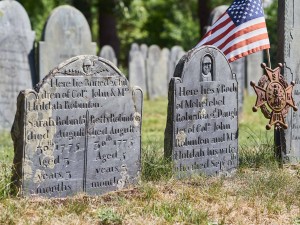
(The picture above shows the gravestones of young sisters Betty, Huldah, and Mehetebel Robinson, dead of dysentery in late 1775, courtesy of the Westford Museum.)

Monday, January 12, 2026

Online Lectures from the National Parks of Boston

The National Parks of Boston and the Boston Public Library are teaming up to offer some online lectures for the Sestercentennial.

The announcements of these events don’t names the speakers, but they’re usually N.P.S. rangers and other experts who have researched the topics thoroughly.

Wednesday, 14 January, 6 to 7:30 P.M.
Benedict Arnold: The Trials and Contributions of an Early Patriot
Register here

Before his name is booed across the land, Benedict Arnold was an avid supporter in the Patriot cause. In order for his name to be so reviled he first had to make an impact to the cause. This program will explore the contributions made by Benedict Arnold in the early stages of the Revolutionary War and shed light on the complexities of a man who has become synonymous with betrayal.

Wednesday, 28 January, 6 to 7:30 P.M.
In the Shadow of the Declaration: Boston’s Hidden Architects of American Freedom
Register here

Explore how the Declaration of Independence reshaped Boston by examining the experiences of communities often excluded from its promises. Look at how Black Bostonians organized and petitioned for freedom while women questioned their exclusion from political and social rights. Together, these perspectives reveal how independence sparked debates over who truly benefited from the Revolution, showing 1776 Boston as a place where the ideals of freedom were contested, expanded, and reimagined.

Wednesday, 25 February, 6 to 7:30 P.M.
“Donation People”: Refugees from the Siege of Boston
Register here

The talk will examine the experience of the poor and ill forced out of Boston during the 1775-1776 siege. The refugees, known as donation people, bore the brunt of the American Revolutionary war in Boston, yet their treatment by the people of Massachusetts represented a spirit of welfare in the new nation.

Wednesday, 11 March, 6 to 7:30 P.M.
The Siege of Boston: An Ending and Beginning
Register here

This talk will explore the Siege of Boston – its origins, impacts, and conclusion – and how the departure of the British Military from Boston would influence the pivotal year of 1776 and what became the Revolutionary War.

Wednesday, 25 March, 6 to 7:30 P.M.
Remembering Revolution: Protest and Celebration of the Bicentennial
Register here

This talk will explore how the Bicentennial was celebrated in Boston. Learn how through protest, reenactments, and celebrations, Bostonians claimed the legacy of the Revolution for themselves 50 years ago.

In addition, the central library’s exhibit “Revolution!: 250 Years of Art & Activism in Boston” is open to all in-person visitors through 21 April. “Featuring over 100 artworks and documentary materials from the Boston Public Library’s Special Collections…this exhibition brings to light both familiar and lesser-known stories about America’s ongoing struggle for freedom, civil rights, and belonging for all.”

Thursday, October 30, 2025

“Complicated US peoples’ relationship with Loyalists”

H-Net’s online collection Remembering the American Revolution at 250 shares G. Patrick O’Brien’s article “‘Men who Deserve Nothing Better from a Wronged and Insulted Country than Exile’: The Loyalists and Popular American Misunderstanding.”

Here’s a taste of its analysis:
In the early twentieth century, the emergence of the United States as a world power and its strengthening political and cultural ties with Britain led English-speaking people on both sides of the Atlantic to reexamine the historical relationship between the two nations. During the so-called Great Rapprochement, scholars in the United States again revisited the revolution eager to highlight the ways the war grew from, rather than rejected, British traditions. Like [Lorenzo] Sabine decades before, these historians took the view that the Loyalists had been unjustly exiled, not only depriving the young nation of strong leaders, but also unnaturally dividing English-speaking people. . . .

But these scholarly approaches to revolutionary loyalism appear to have done little to sway popular opinion. If anything, they may have further complicated US peoples’ relationship with Loyalists at a time when traditional conceptions of US nationalism were being reworked. Those who decried what they saw as an increasingly Anglophilic US identity came in myriad forms, but a new wave of anti-Loyalist sentiment was among the most popular. . . .

Isolationists criticized prominent historians for rewriting US history in favor of the Anglo-American alliance. “It is in order now to admit that the Loyalists had a fair cause to defend,” balked one writer for the Nonpartisan Leader, who also predicted that Anglophilic promoters “will put into our schools and universities a series of royalist textbooks to poison the minds of our youth against the American Revolution.”
That didn’t happen. And in this century, we’ve seen hyperpatriotism and royalist policies grow closer together.

It’s very hard for the public to resist identifying “good guys” in our national origin story, as this anecdote from the Bicentennial period shows:
In Boston’s famed Quincy Market, an exhibit installed by Boston 200, the nonprofit agency created in 1972 to plan celebrations in the city, used a computer program to probe visitors’ loyalties by asking them how they would respond to events leading up to and in the earliest days of the war. For the price of admission—$1.50 for adults and 75 cents for children—the computer labeled respondents on a scale from vehement Patriot to resolute Tory, and even compared visitors’ views to those of historical figures, including Thomas Hutchinson and Samuel Adams. Unsurprisingly, most visitors, especially Boston locals, tried to skew their answers to earn a Patriot label. Visitors could also take with them a “Patriot” or “Tory” button as a souvenir, with most choosing the former.
This past 18 April I spoke about what led up to Paul Revere’s ride at the U.S.S. Constitution Museum. On the street afterward I met a couple of ladies who’d heard my talk, and one told me that, to her surprise, she’d ended up siding with the Loyalists.

That wasn’t my intention, but I did try to illuminate the real political arguments—not just us vs. them, but how we got to the point of drawing the line between us and them when we started with so much in common.

Monday, October 06, 2025

“Patriot, Hero, Distracted Person” Online

At the end of the summer Revolutionary Spaces and the National Museum of Mental Health Project debuted an online exhibit titled “Patriot, Hero, Distracted Person: James Otis, Jr. and Mental Health in the Eighteenth Century.” It’s well worth a visit.

For decades the standard American story of James Otis was shaped by the Massachusetts Whigs, particularly his sister Mercy Warren and his admirer John Adams.

That narrative had Otis staunchly leading the political resistance to the British ministry’s corrupt laws until Customs Commissioner John Robinson assaulted him in the British Coffee-House. That severe head injury tipped Otis into bouts of insanity.

In the twentieth century historians noted that Otis’s family had noticed him behaving erratically earlier in life. Adams’s diary and newspapers show that Otis was especially verbose and bellicose in the days leading up to his confrontation with Robinson. The fight in the British Coffee-House might thus have been the result of mental difficulties, not just the cause.

This web exhibit shares all that evidence as well a note from a psychiatrist saying that Otis’s head injury could have brought on or severely exacerbated his manic episodes. It also explores his treatment and family life in more detail than I’ve seen elsewhere.

Without completely neglecting politics, the exhibit thus reframes Otis’s life “from an epic tragedy to a much more familiar story of loss and sacrifice.” It puts particular emphasis on his later years when he was unable to work and often separated from his wife and children. The final page shares artistic responses to his story.

Kate LaPine, Lucy Pollock, Paul Piwko, and their colleagues at Revolutionary Boston and the National Museum of Mental Health Project have produced a website evoking sympathy for Otis as an individual facing human difficulties, not a distant historical figure. It provides a different dimension to our grand Sestercentennial narrative.

Monday, September 29, 2025

America 250 Warding off Trumpist Takeover

Nearly a fortnight ago I shared Bert Dunkerly’s Emerging Revolutionary War post about Sestercentennial logos, observing at the end that “the America 250 Facebook feed is being politically partisan and literally divisive.”

A few days later, the nonpartisan U.S. Semiquincentennial Commission in charge of America 250 fired its executive director, as reported in the Wall Street Journal, at Newsweek, and on C.N.N.

The commission stated that this administrator “initiated a security breach of a Commission social media account, attempted to procure the resignations of multiple commissioners by misrepresenting himself as acting on behalf of Congressional leadership, and engaged in multiple other serious and repeated breaches of authority and trust.” It accused him of having “engaged in unauthorized actions related to Commission approved programming, finances, and communications.”

In particular, weeks ago the commission “removed its website and social media platforms” from this administrator’s control. He then accessed those accounts to send out the Facebook post that I called politically partisan and others like it.

That now-former executive director is twenty-five years old. He was previously an assistant to Melania Trump as First Lady and a producer at Fox News. The Trump White House installed him at America 250 and assigned him to organize the U.S. Army parade in Washington, D.C., on Donald Trump’s birthday. The commission never officially voted to approve that parade, which received criticism for many reasons.

Meanwhile, the White House is proceeding with plans to celebrate the 250th anniversary of American independence in 2026 with various other forms of trumpery: gladiatorial games on the White House lawn, videos of historical figures created by theocratic propagandists, and pitting state fairs against each other to be designated by Trump as “most patriotic.”