J. L. BELL is a Massachusetts writer who specializes in (among other things) the start of the American Revolution in and around Boston. He is particularly interested in the experiences of children in 1765-75. He has published scholarly papers and popular articles for both children and adults. He was consultant for an episode of History Detectives, and contributed to a display at Minute Man National Historic Park.

Subscribe thru Follow.it


•••••••••••••••••


Showing posts with label David Humphreys. Show all posts

Sunday, September 06, 2026

“Came under the bottom of the ship”

After his brother Ezra Bushnell fell ill, the inventor David Bushnell asked Gen. Samuel Holden Parsons to send three men who might be able to operate his submarine against the Royal Navy in New York harbor.

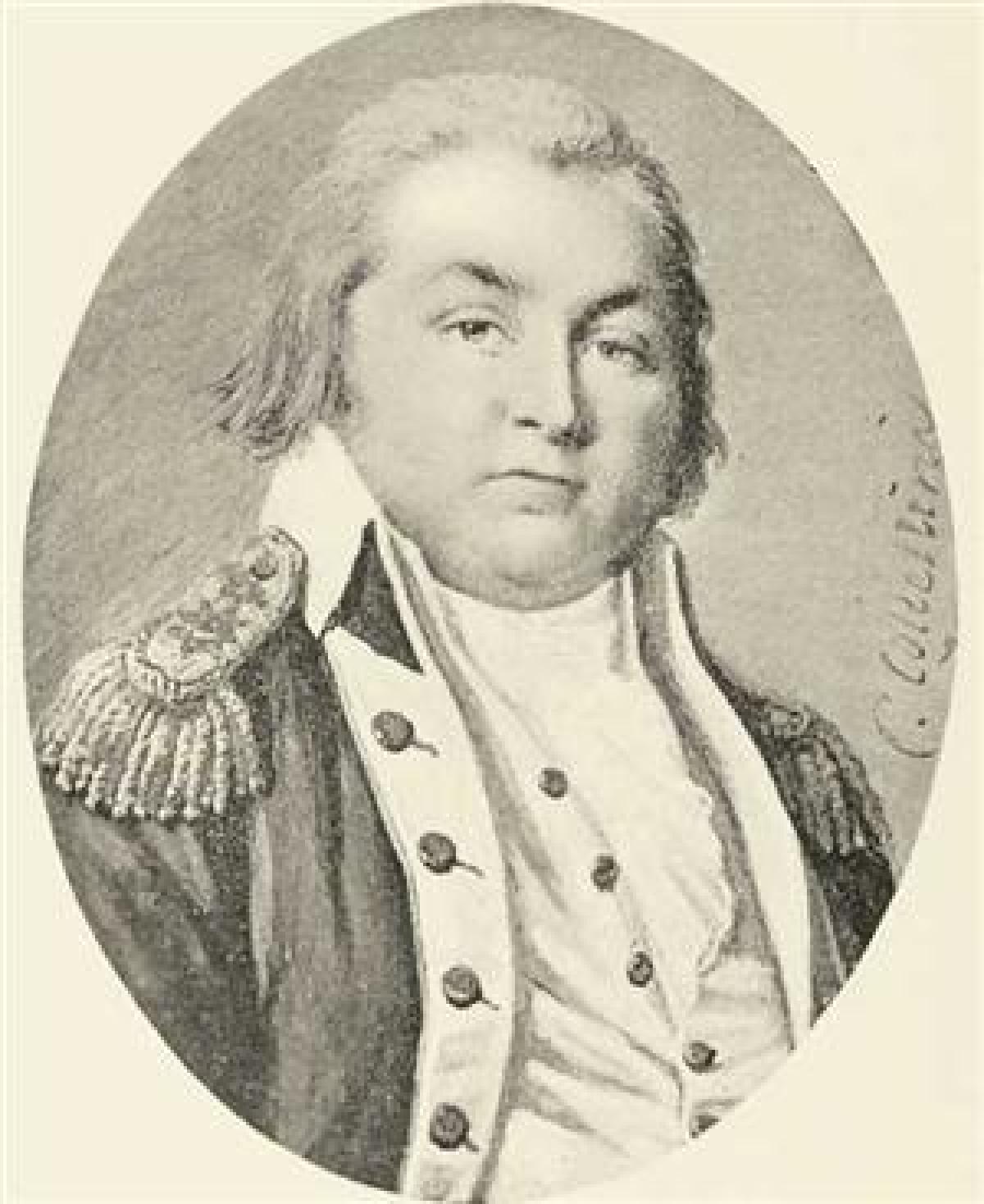
Parsons already had a list of volunteers ready to sail a fireship toward the fleet, another risky venture. One of them was his brother-in-law, Sgt. Ezra Lee (1749–1821, shown here).

Bushnell brought the machine back to Saybrook, Connecticut, for the three men to practice. Eventually Lee got the assignment. His mission: Screw a timed explosive charge (Bushnell’s other invention, called the “magazine”) to the hull of H.M.S. Asia.

Lee went into action on 6 Sept 1776, 250 years ago today. Decades later, in 1815, he wrote an account of his mission for David Humphreys:
We set off from the City—the Whale boats towed me as nigh the ships, as they dared to go, and then cast me off—I soon found that it was too early in the tide, as it carried me down by the ships—I however hove about, and rowed for 5 glasses, by the ships’ bells, before the tide slacked so that I could get along side of the man of war, which lay above the transports—

The Moon was about 2 hours high, and the daylight about one—when I rowed under the stern of the ship, could see the men on deck, & hear them talk—I then shut down all the doors, sunk down, and came under the bottom of the ship, up with the screw against the bottom but found that it would not enter—

I pulled along to try another place, but deviated a little one side, and immediately rode with great velocity, and come above the surface 2 or 3 feet between the ship and the daylight—then sunk again like a porpoise I hove partly about to try again, but on further thought I gave out, knowing that as soon as it was light the ships boats would be rowing in all directions, and I thought the best generalship, was to retreat, as fast as I could as I had 4 miles to go, before passing Governor’s Island.—

So I jogg’d on as fast as I could, and my compass being then of no use to me, I was obliged to rise up every few minutes to see that I sailed in the right direction, and for this purpose keeping the machine on the surface of the water, and the doors open—

I was much afraid of getting aground on the island as the Tide of the flood set on the north point While on my passage up to the City, my course owing to the above circumstances, was very crooked & zig zag, and the enemy’s attention was drawn towards me, from Governors Island—

When I was abreast of the fort on the island 3 or 400 men got upon the parapet to observe me,—at leangth a number came down to the shore, shoved off a 12 oar’d barge, with 5 or 6 sitters, and pulled for me—I eyed them, and when they had got within 50 or 60 yards of me, I let loose the magazine, in hopes, that if they should take me, they would likewise pick up the magazine, and then we should all be blown up together, but as kind Providence would have it, they took fright, and returned to the island, to my infinite joy.—

I then weathered the Island, and our people seeing me, came off with a whaleboat, and towed me in—

The Magazine after getting a little past the Island, went off with a tremendous explosion, throwing up large bodies of water to an immense height.
On seeing that explosion, Humphreys wrote, Gen. Israel Putnam shouted, “God’s curse ’em, that’ll do it for ’em.” But the bomb merely startled the enemy, not doing any physical damage.

Why hadn’t Sgt. Lee been able to attach that bomb to H.M.S. Asia as planned? Humphreys explained:
The reason why the screw would not enter, was that the ship’s bottom being coppered it would have been difficult under any circumstances to have peirced through it—but on attempting to bore with the auger, the force necessary to be used in pressing against the ships bottom, caused the machine to rebound off
In this series about David Bushnell and his submarine, I’ve cut down long letters that the U.S. Navy has collected on this website. Though the submarine was a top-secret operation in 1776, men like Humphreys and Thomas Jefferson made a concerted effort after the war to gather information about the machine and its operation.

Authors have written several books about the submarine. I’m linking to Arthur S. Lefkowitz’s The American Turtle Submarine because he gave me a nifty cap.

TOMORROW: Bushnell’s secrets.

Saturday, August 06, 2022

James Leander Cathcart on Three Continents

At Common-place, Julie R. Voss discussed the self-fashioned career of James Leander Cathcart (1767–1843).

Cathcart was born in Ireland and, according to an autobiographical manuscript he left with his family, came to America at age eight with a relative who was a sea captain. That would have been just as the war began.

Within a couple of years, both James and his relative were working on privateers. He reported that he out on the Connecticut-based Continental warship Confederacy under Capt. Seth Harding (1734–1814). That frigate had 32 guns and galley oars as well as sails for better maneuvering, but, when faced with two British warships, Harding surrendered on 18 April 1781.

Cathcart thus became a teen-aged prisoner of war. Voss writes:
In his narrative, Cathcart claims the frigate was seized and the sailors held on a prison ship in New York harbor, from which he and a friend escaped. This striking and adventurous story cannot be corroborated, and it’s at least equally possible that Cathcart claimed his British citizenship when he was seized and then served in the British Navy in order to escape being a prisoner of war.
There are Admiralty Office records of at least some of the New York prison ships, so it might be possible to find young Cathcart’s name and know how long he was a prisoner and how he got out.

After the war, Cathcart continued to work as a sailor, running into another danger:
The Mediterranean practice of seizing ships and holding the crews for ransom or hard labor was common. In fact, the practice dated back centuries, and went in multiple directions. In the heyday of galley ships, European nations captured North Africans to work the oars; and the Catholic Church engineered an entire enterprise of “redemption” for Catholics seized by the ships of Barbary.

By the late eighteenth century, European nations signed treaties with the Barbary States to protect their shipping, and these treaties were renegotiated frequently. After the American Revolution, American ships were no longer protected by British treaties, and Cathcart and his shipmates quickly learned the consequences.
James spent eleven years as a captive, coming of age in northern Africa. At first assigned to be a menial servant, James finessed what Voss calls his “remarkable facility with languages” to become a clerk for the local official and a business owner.

When David Humphreys arrived to neogtiate for the Americans, Cathcart became the man’s aide, helping to obtain his and his fellow prisoners’ release in 1796.

One might think James Leander Cathcart had then had enough of north Africa, but he had lived as long on that continent as any other. He lobbied to be appointed a U.S. consul.

For all his skills, some people thought Cathcart was duplicitous. The American diplomat Joel Barlow stated, “He has neither the talent nor the dignity of character necessary” for his role. Mustafa Baba, the Dey of Algiers after the one Cathcart served, sent a similar message to President Thomas Jefferson. In modern translation:
If he comes to me, I shall in no way receive him since he is not a good man. It is clear that wherever he spends time he creates a great disturbance. For this reason, our not accepting him is for our and your good.
As translated at the time:
his Character does not Suit us, as we know, wherever he has remained That he has created difficulties and brought On a war And as I will not receive him I am shure it will be well for both nations
But the U.S. didn’t have a lot of people experienced in the Arab world and willing to serve the government. Cathcart thus remained consul in Tunis and Tripoli, helping to negotiate again with Algiers. Later he spent more than fifteen years in Madeira and Cadiz before returning to the U.S. of A. and working for the Treasury Department.

Wednesday, December 08, 2021

“I fear’d young HAMILTON’S unshaken soul“

As David Humphreys and his fellow Hartford Wits composed the early installments of their Anarchiad, states were deciding whether to send delegations to a constitutional convention in Philadelphia.

The stated purpose of that convention was to revise the Articles of Confederation, but many people hoped—or worried—that the gathering might make very deep revisions indeed.

The Hartford Wits supported big change. Their fellow citizens of Connecticut were not so sure. The middle installments of the Anarchiad spent a lot of lines attacking James Wadsworth, state comptroller and a strong opponent of a new national constitution.

In March 1787 Humphreys wrote to his former boss George Washington that Connecticut might not send a delegation to Philadelphia at all. But most other states had committed by then, so the poets saw reason for optimism.

The 5 April installment of the Anarchiad depicted the villain Anarch lamenting his defeat, as in these lines:
Ardent and bold, the sinking land to save,
In council sapient as in action brave,
I fear’d young HAMILTON’S unshaken soul,
And saw his arm our wayward host control;
Yet, while the Senate with his accents rung,
Fire in his eye, and thunder on his tongue,
My band of mutes in dumb confusion throng,
Convinc’d of right, yet obstinate in wrong,
With stupid reverence lift the guided hand,
And yield an empire to thy wild command.
Allegorically this referred to New York’s choice to name a delegation, as Alexander Hamilton championed. The Hartford Wits thus lauded Hamilton’s political speeches in verse more than two centuries before Lin-Manuel Miranda.

On 12 May, Connecticut finally voted to send William Samuel Johnson, Oliver Ellsworth, and Erastus Wolcott to Philadelphia. Wolcott declined, citing fear of smallpox, so four days later the legislature chose Roger Sherman instead. Their mandate was “for the Sole and express Purpose of revising the Articles of Confederation.”

The Hartford Wits saw that as a win, and the Anarchiad lines published on 24 May expressed Hesper’s hopes for a better future. But there were still dire warnings about what might happen if people didn’t support significant change:
Yet, what the hope? The dreams of Congress fade,
The federal UNION sinks in endless shade;
Each feeble call, that warns the realms around,
Seems the faint echo of a dying sound;
Each requisition wastes in fleeting air,
And not one State regards the powerless prayer.

Ye wanton States, by heaven’s best blessings curst,
Long on the lap of softening luxury nurst,
What fickle frenzy raves! what visions strange
Inspire your bosoms with the lust of change,
And flames the wish to fly from fancy’s ill,
And yield your freedom to a monarch’s will?
The Anarchiad’s last installment appeared in September 1787 as the Constitutional Convention was wrapping up. Because of the body’s secrecy, no one yet knew the scope of the changes it would recommend. Sherman and Ellsworth had proposed the critical “Connecticut Compromise,” and Hamilton maneuvered to make the final vote appear unanimous.

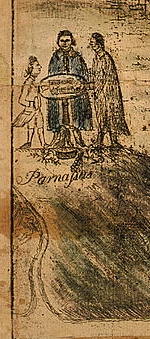
In November, the Connecticut government called a state convention to discuss whether to ratify the new and very different U.S Constitution. During that debate Amos Doolittle issued a year-end-review cartoon titled “The Looking Glass for 1787.” In one section it showed three Hartford Wits on a hill labeled “Parnassus” reading their “American Antiquities”—the supposed fragments of The Anarchiad. At least in Connecticut, they had been a prominent voice of the debate.

Tuesday, December 07, 2021

The Hartford Wits and the Voice of Anarch

The “Poetry and the Constitution” event I described yesterday made me think there must have been poetry about the Constitution, part of the debate around that document. So I went looking.

In October 1786, some fraction of the “Hartford Wits”—David Humphreys (shown here twenty years later), Joel Barlow, John Trumbull, and Dr. Lemuel Hopkins—published a poem in The New Haven Gazette and Connecticut Magazine.

Those verses were represented to the public as fragments of an ancient text found in a fort somewhere off to the west, like Ohio.

Over the next several months the Wits produced more verses for the newspaper, most supposedly pieces of a mock epic called The Anarchiad. This text told the story of a war between the spirit Anarch [boo! hiss!] and Hesper, “the guardian of the clime.”

By presenting these poems as “fragments,” the authors could eschew narrative or logical coherence and present their views on current troubles, such as:
  • The Articles of Confederation just weren’t working out, and Connecticut hadn’t even participated in the Annapolis Convention to fix them.
  • In western Massachusetts middling farmers were resisting taxes and shutting down courts while Rhode Island was issuing lots of paper money.
  • A couple of local officials were being a real bother. (The Wits were already feuding with those men in the newspapers.)
  • Young people today.
Here’s a short taste from Book IV, in the voice of Anarch:
Behold the reign of anarchy, begun,
And half the business of confusion done.
From hell’s dark caverns discord sounds alarms,
Blows her loud trump, and calls my SHAYS to arms,
O’er half the land the desperate riot runs,
And maddening mobs assume their rusty guns.
From councils feeble, bolder faction grows,
The daring corsairs, and the savage foes;
O’er Western wilds, the tawny bands allied,
Insult the States of weakness and of pride;
Once friendly realms, unpaid each generous loan,
Wait to divide and share them for their own.

Now sinks the public mind; a death-like sleep
O’er all the torpid limbs begins to creep;
By dull degrees decays the vital heat,
The blood forgets to flow, the pulse to beat;
The powers of life, in mimic death withdrawn,
Closed the fixed eyes with one expiring yawn;
Exposed in state, to wait the funeral hour,
Lie the pale relics of departed power;
While conscience, harrowing up their souls, with dread,
Their ghost of empire stalks without a head.
That installment was first published on 11 Jan 1787. A couple of weeks later, Daniel Shays’s Regulator force tried to seize the federal armory in Springfield. Militia general William Shepard and his men fought them off, killing four. “Behold the reign of anarchy,” indeed.

TOMORROW: More constitutional commentary.

Monday, October 31, 2016

Furstenberg on Washington’s Abolitionist Pamphlets, 2 Nov.

On Wednesday, 2 November, the Boston Athenaeum will host a lecture on one highlight of its collection: George Washington’s library.

As explained on this webpage, a nephew of a nephew of the President sold much of the family library to “a flamboyant American bookseller” named Henry Stevens in 1848.

Stevens tried to sell the collection to the U.S. government, then to Harvard University. With no takers, he began to point out loudly that the British Museum had hired him to buy American books, hinting that it might also want Washington’s library.

About seventy Massachusetts men pooled their money to buy the collection and keep it in the U.S. of A. They never managed to hit Stevens’s asking price after sending their first installment. But he’d spent some of that money and couldn’t send a refund, so he had to compromise and send the books. The group then donated them to the Athenaeum.

The full title for this lecture is “George Washington’s Library at the Athenaeum: Transatlantic Dialogues of Slavery and Freedom.” Here’s the description:
Why might an obscure pamphlet collection housed in the Boston Athenæum archives offer new insights on the abolition movement of the late eighteenth century? It's simple: the tract collection belonged to George Washington. In this lecture, Professor of History François Furstenberg will explore the early history of abolitionist debates from the perspective of book history, using these leaflets to link Mount Vernon to a broad transatlantic conversation about slavery and freedom.
Furstenberg, who grew up in Boston, is author of In the Name of the Father: Washington’s Legacy, Slavery, and the Making of a Nation and When the United States Spoke French: Five Refugees who Shaped a Nation.

Admission to this event costs $15 for Athenaeum members, $30 for others. Advance registration is required. The talk is scheduled from 6:00 to 7:00 P.M., and a reception will follow.

Further lectures in this program, “Rookie Republic: Early America and Its Place on the Global Stage,” will include “Black Pepper: Taste a Revolutionary Story” by Sarah Lohman on 16 November and “Muslims in America since 1619” by Shareda Hosein on 13 December.

(Shown above: Washington’s nicely bound 1790 collection of writings by his former aide de camp and secretary, David Humphreys.)

Saturday, February 15, 2014

A Solid Source for the “Whites of Their Eyes” Tradition

“Don’t fire till you see the whites of their eyes” is the most famous quotation arising from the Battle of Bunker Hill. Authors have debated which American officer said it, which has been another way of debating who was in command. In recent decades most historians have treated those words as a legend, or at least a tradition that can’t be verified.

That tradition doesn’t benefit from the fact that for a long time the earliest chronicle known to quote the line was the biography of George Washington by Mason Weems, whose tales of cherry trees and praying in the snow at Valley Forge have become exemplars of American mythology.

This month I got lucky in some digital databases and found an earlier source for the “whites of their eyes” tradition, with a clear chain of transmission from the battlefield.

The story starts with David Humphreys’s publication of An Essay on the Life of the Honourable Major-General Israel Putnam in 1788. That book’s description of Bunker Hill does not include the quotation. It also suggested that Dr. Joseph Warren was directing the New England forces in his new capacity as a Massachusetts major general.

The Rev. Josiah Whitney (1731-1824), minister in Brooklyn, Connecticut, followed that up with his most famous parishioner, Israel Putnam. The retired general said that Warren had come onto the battlefield as a volunteer, not a commissioned officer, and didn’t presume to take command. Putnam died in 1790, and Whitney described their conversation in a footnote to his sermon A Sermon Occasioned by the Death of the Honorable Major-General Israel Putnam, of Brooklyn.

Ten years later, the Rev. Elijah Parish (1762-1825) of Byfield, Massachusetts, published An Oration, Delivered at Byfield, February 22d, 1800, the Day of National Mourning for the Death of General George Washington. On page 15 he added his own footnote describing the Battle of Bunker Hill. Parish, who originally came from Lebanon, Connecticut, said he’d discussed that battle with his older colleague Whitney.

Parish wrote:

Putnam was the commanding officer of the party, who went upon the hill the evening before the action: he commanded in the action: : he harangued his men as the British first advanced, charged them to reserve their fire, till they were near, ‘till they could see the white of their eyes,’ were his words.—At the second assault he commended their former calmness, assured them “they would now do much better,” and directed them “to aim at the officers.” They obeyed. The fire was tremendous. ‘My God,’ said said Putnam, in telling the story, ‘I never saw such a carnage of the human race.’

These things he related to the Reverend Mr. Whitney, his Minister, by whose permission they are now published.
Parish repeated this story in a history textbook he cowrote with the Rev. Dr. Jedidiah Morse, A Compendious History of New England (1804).

Thus, we have a clear line of transmission for the quotation:
  • Gen. Israel Putnam reminiscing to Rev. Josiah Whitney, probably between 1788 and 1790.
  • Whitney passing on an interesting anecdote to Rev. Elijah Parish between 1790 and 1800.
  • Parish publishing the story twice in the early 1800s, enough to bring it to the attention of the Rev. Mason Weems by 1810.
That doesn’t mean Putnam coined the “white of their eyes” phrase, but it’s more likely that he said those words at Bunker Hill, just as a few veterans reported later. Eventually the phrase evolved into the now-famous “Don’t fire till you see the whites of their eyes.”

TOMORROW: When Howe said “not to fire before he could see the whites of their eyes.”

Tuesday, February 16, 2010

“Account of the Declaration being read upon Prospect-Hill”

Yesterday I quoted a description of the flag that Gen. Israel Putnam (shown here) had raised in July 1775 from David Humphreys’s short biography of the man, published thirteen years afterwards. I knew I’d seen a contemporaneous report in a newspaper, though, so I tracked that down.

This quotation comes from the 25 July 1775 New Hampshire Gazette. The same item was printed in several other papers, and this might not have been its first appearance. The “Declaration of the Continental Congress” that it refers to is not the Declaration of Independence, but the Declaration of the Causes and Necessity of Taking Up Arms, drafted mainly by John Dickinson and issued on 6 July 1775.

A Gentleman has favoured us with the following Account of the Declaration being read upon Prospect-Hill.

Last Tuesday Morning, according to Orders issued the Day before, by Major-General Putnam, all the Continental Troops under his immediate Command assembled on Prospect-Hill, when the Declaration of the Continental Congress was read, after which an animated and pathetic Address to the Army was made by the Rev. Mr. [Abiel] Leonard, Chaplain to General Putnam’s Regiment and succeeded by a pertinent Prayer; when General Putnam gave the Signal, and the whole Army shouted their loud Amen by three Cheers; immediately upon which a Cannon was fired from the Fort, and the Standard lately sent to General Putnam was exhibited flourishing in the Air, bearing on one Side this Motto, AN APPEAL TO HEAVEN--- and on the other side, QUI TRANSTULIT SUSTINET.

The whole was conducted with the utmost Decency, good Order, and Regularity, and to the universal Acceptance of all present.----And the Philistines on Bunker’s Hill heard the Shout of the Israelites, and being very fearful, paraded themselves in Battle Array.
Humphreys’s account complements this one by stating that the flag came from Connecticut and bore that colony’s symbols. This report is less parochial, but still reflects New England culture in its easy allusion to the enemy as “Philistines” and the writer’s own side as “Israelites.”

Monday, February 15, 2010

New Englanders’ “Appeal to Heaven”

Paul Lunt, lieutenant of a company from Newburyport at the siege of Boston, wrote in his diary for 18 July 1775:

This morning a Manifesto from the Grand Continental Congress was read by the Rev. Mr. Leonard, chaplain to the Connecticut forces upon Prospect Hill in Charlestown, to those troops encamped upon and near said hill.

Our standard was presented in the midst of the regiments with this inscription upon it, “Appeal to Heaven;” after which Mr. Leonard made a short prayer, and then were dismissed by the discharge of a cannon, three cheers, and a war whoop by the Indians.
In his essay on the life of the Honorable Major-General Israel Putnam, former aide David Humphreys later described this flag as:
the new Standard, lately sent from Connecticut. . . .

On one side was inscribed in large letters, of Gold “An Appeal To Heaven,” and on the other were delineated the armorial bearings of Connecticut, which without supporters or crest, consist unostentatiously of three Vines: with this motto, “Qui transtulit, sustinet” [He who transplants, sustains]
By the fall, other New England units had adopted this flag, or at least the English motto on it. On 20 Oct 1775, Gen. George Washington’s military secretary, Joseph Reed (shown above, courtesy of the U.S. Army’s Center for Military History), wrote to the colonels who were in Beverly arming schooners to attack British supply ships with this instruction:
Please to fix upon some particular color for a flag, and a signal by which our vessels may know one another. What do you think of a flag with a white ground, a tree in the middle, the motto “Appeal to Heaven”? This is the flag of our floating batteries.
The ships those men were equipping did adopt that flag. We know that from sources in London reporting on the capture of one such ship, the brig Washington, out of Plymouth. The descriptions were:
  • Sir Hugh Palliser to the Earl of Sandwich, First Lord of the Admiralty, 6 January 1776: “Captain Medows has brought the American vessel’s colours, it is a white field with a green pine tree in the middle: the motto, Appeal to Heaven.”
  • London Chronicle: “In the Admiralty office is the flag of a provincial privateer. The field is white bunting; on the middle is a green pine-tree, and upon the opposite side is the motto, ‘Appeal to Heaven.’”
  • Almon’s Remembrancer, item dated 6 Jan 1776: “Captain Meadows has likewise brought her colours, which are a pale green palm-tree, upon a white field, with this motto, ‘We appeal to heaven.’”
(I have to think an error crept into that last description; would New Englanders have taken pride in a “pale green palm-tree”? Or were palms and pines interchangeable?)

No actual period examples of this flag survive, to my knowledge. All the designs in flag books are guesses at what they looked like.

Thursday, August 06, 2009

Putting Words in Washington’s Mouth

Last month the St. Petersburg Times reported on yet another attempt to enlist the politicians of the late 1700s in today’s culture wars, and yet another misrepresentation:

The billboards showcase quotes from early American leaders like John Adams, James Madison and Benjamin Franklin. Most of the quotes portray a national need for Christian governance.

Others carry the same message but with fictional attribution, as with one billboard citing George Washington for the quote, “It is impossible to rightly govern the world without God and the Bible.”

“I don’t believe there’s a document in Washington’s handwriting that has those words in that specific form,” [billboard renter Terry] Kemple said. “However, if you look at Washington’s quotes, including his farewell address, about the place of religion in the political sphere, there’s no question he could have said those exact words.”
Kemple apparently feels no embarrassment about repeating a lie because, he says, Washington “could have said those exact words.” Never mind that he didn’t—according to Kemple, he could have, and that’s just as good. Entertainingly, Kemple has cast himself as a truthteller, insisting that the U.S. Constitution’s separation of church and state is a “lie.” 

Earlier in the month, Kemple organized a “tea party” protest, another attempt to coopt the U.S. of A.’s founding symbolism for his causes. More often he’s demanded that governments adopt his narrow religious positions on social issues such as forbidding same-sex marriage (he’s on his second marriage, but doesn’t want other couples to have their first), and making schools teach creationism but not sex education.

The Washington misquotation that Kemple tried to justify isn’t a recent coinage, having appeared in an 1893 book titled A Lawyer’s Examination of the Bible, written by Howard H. Russell and published by an evangelical press. It was debunked in 1990 in They Never Said It, by Paul F. Boller, Jr.

Boller went on to offer what he believed was one of the rare statements by Washington on the Bible, from an early draft of his first inaugural address:
The blessed Religion revealed in the word of God will remain an eternal and awful monument to prove that the best Institutions may be abused by human depravity; and that they may even, in some instances be made subservient to the vilest of purposes.
Though referring to “the word of God,” that passage actually looks more like a warning that people can use organized religion as an excuse for bigotry and other wrongdoing—not what Kemple’s group would choose to advertise, I suspect.

What’s more, as Jon Rowe pointed out, that passage was probably drafted by Washington’s aide David Humphreys. The President threw out the whole thing and started over, never mentioning the Bible during his speech. Or, for that matter, in his other political statements. He could have, but he didn’t.

Saturday, March 28, 2009

David Humphreys Bids Adieu

According to sonnets.org, the first American poet to write sonnets was Col. David Humphreys of the Continental Army. And one of his earliest efforts was:

Addressed to my Friends at Yale College, on my Leaving them to join the Army.

Adieu! thou Yale! where youthful poets dwell,
No more I linger by thy classic stream.
Inglorious ease and sportive songs farewell!
Thou startling clarion! break the sleeper’s dream!

And sing, ye bards! the war-inspiring theme.
Heard ye the din of battle? clang of arms?
Saw ye the steel ’mid starry banners beam?
Quick throbs my breast at war’s untried alarms,
Unknown pulsations stirr’d by glory’s charms.

While dear Columbia calls, no danger awes,
Though certain death to threaten’d chains be join’d.
Though fails this flesh devote to freedom’s cause,
Can death subdue th’ unconquerable mind?
Or adamantine chains ethereal substance bind?
For more on Humphreys’s long and busy life, here’s a biography from the Connecticut Sons of the American Revolution.

Thursday, June 21, 2007

Who Said, "Don't Fire Till You See the Whites of Their Eyes"?

The Battle of Bunker Hill yielded one of those quotations that every American is supposed to know: “Don’t fire till you see the whites of their eyes!” Meaning, “Don’t use any of your gunpowder until they’re really, really close, so you won’t miss.” But it’s still debatable which American officer said this, if anyone. Some sources credit Gen. Israel Putnam of Connecticut, some Col. William Prescott of Massachusetts.

In 1788 David Humphreys published an Essay on the Life of the Honourable Major General Israel Putnam. I haven’t rustled up that edition, but I found an 1818 printing through Microsoft’s Live Search, and it did not contain the “whites of their eyes” quotation. That leads me to think the original didn’t have it, either.

Which means the first book attributing this quotation to Gen. Putnam might well be that great font of American myth, Mason Weems’s Life of George Washington, with curious anecdotes, equally honourable to himself and exemplary to his young countrymen. In the 1808 edition of that book (and perhaps earlier ones), Weems quoted Putnam saying:

Don’t throw away a single shot, my brave fellows; . . . don’t throw away a single shot, but take good aim; nor touch a trigger, till you can see the whites of their eyes.
As with his legends of Washington and the cherry tree and Washington praying in the snow at Valley Forge, Weems gave no source for this anecdote. He wasn’t a scholarly writer, and (unlike Humphreys) he didn’t know his subjects personally. But Weems’s biography was immensely popular in the early republic, and helped form the public understanding of Bunker Hill.

It’s no surprise, therefore, that a book titled The Life and Heroic Exploits of Israel Putnam, published in 1847 and credited to the long-dead Humphreys, did contain the famous quotation amidst the general’s other orders:
Powder was scarce and must not be wasted. They should not fire at the enemy till they saw the white of their eyes, and then fire low, take aim at their waistbands. They were all marksmen, and could kill a squirrel at a hundred yards; reserve their fire, and the enemy were all destroyed. Aim at the handsome coats, pick off the commanders.
This book then goes on to say, “The same orders were reiterated by Prescott at the redoubt, by Pomeroy, Stark, and all the veteran officers.” In other words, every top officer was giving the same orders, but Putnam gave them first.

That version of Putnam’s words, and the sentence that followed, came straight out of Samuel Swett’s History of Bunker Hill Battle, published first in 1818 and reissued in 1826. Swett’s appendix quoted the testimony of three men who said they had been in the battle: John Stevens of Frye’s regiment, Philip Johnson of Little’s regiment, and Elijah Jourdan. All said they heard Putnam speak about the “whites of their eyes” or heard other officers say those orders came from Putnam.

Swett and other New England historians saw such a sequence of orders as highly significant because, as the fiftieth anniversary of the battle approached, they had drowned themselves in ink debating who was in command of the provincial forces. Was it Putnam, Connecticut’s general and hero? Col. Prescott, in the redoubt? Gen. Seth Pomeroy, who was in the ranks as a volunteer? Dr. Joseph Warren, who had also been commissioned a general and was also in the ranks as a volunteer?

The good thing about this debate is that it spurred writers to find veterans of the battle and put their recollections into print. The bad thing is that so many of those sources were focused on boosting the case for a particular candidate for command rather than providing a complete picture of the action. Furthermore, if lots of officers were saying the same thing, it would be almost impossible for a soldier in one part of the line to know who said it first. Finally, all those reminiscences went into print after Weems’s book, raising the possibility that his popular tale had affected how men recollected or recounted their experiences forty years before.

Richard Frothingham’s History of the Siege of Boston, first published in 1849, attributed a variety of phrases to a variety of officers. “These phrases occur frequently in the depositions [of veterans], the same one often being ascribed to different officers.” Frothingham did cite Johnson saying Putnam had voiced the “white of their eyes” remark. However, since he concluded that Prescott did the most commanding during the battle, his book led many later writers to credit the colonel with the famous quotation, not Gen. Putnam.

The best Boston 1775 guess? I think the weight of the evidence favors Putnam (shown above) with the “whites of their eyes” phrase, even if Prescott was doing more in the redoubt to make provincial soldiers hold their fire. But that doesn’t mean Putnam coined the phrase.

TOMORROW: The real source of the quotation?

Sunday, January 28, 2007

Why Israel Putnam?

Someone using the handle “richmond va” has sent in this question:

I’d like to ask if you could tell me why a Petersburg, Va. foundry in the early 1800’s would create a number of andirons in the likeness of Israel Putnam, rather than someone else more famous like G Washington. Thanks
Questioning the fame of Israel Putnam (1718-1790) shows that you’re not from Connecticut. I’m not, either, so I can answer the question.

In the early republic, Gen. Putnam was to Connecticut what Stonewall Jackson was to the Old Dominion after Reconstruction, except that the state didn’t also have a Robert E. Lee to share the attention. Connecticut’s modern household-name Revolutionary heroes hadn’t yet been discovered: Nathan Hale was still nothing more than an agent caught and hanged on his first mission, and the legend of Sybil Ludington was unknown outside her immediate family (if it was known there).

Putnam had been famous before the Revolution began because of his personal bravery, both in fighting against French and Indians and in bagging a wolf on his farm. Private soldiers also seem to have remained fond of “Old Put,” who could never act as aloofly as Washington. (He was also popular with a small coterie of British officers he had befriended during the earlier wars.) As a result, Connecticut and areas settled by folks from that state provided a strong market for Putnam memorabilia. The Petersburg foundry might also have made souvenirs of Washington and other Revolutionary heroes, of course.

Putnam’s actual record during the Revolutionary War never matched those early expectations. In the early 1800s there was an ongoing and sometimes vituperative argument over whether he or Col. William Prescott was in command at Bunker Hill. Now historians agree that Putnam spent most of his time riding around behind the lines unsuccessfully urging more provincial troops to join the fray.

Putnam didn’t have the strategic sense to match his personal bravery. He was forced into retreat at the Battle of Long Island in 1776, and abandoned Fort Clinton and Fort Montgomery to the British in 1777. Washington then assigned him to recruiting duty and later to regional commands. In 1779, Putnam suffered a bad stroke and had to retire to his farm.

Despite that record, early U.S. historians treated Putnam very well, listing him among the Continental Army’s most important commanders. Col. David Humphreys, a former aide (who was also from Connecticut), wrote a laudatory biography of the general in 1818. The general’s hasty retreat from British troops in Greenwich was turned (with a little massaging of the facts) into a legend. Even now, admirers and descendants of “Old Put” can be fervently loyal.