


J. L. BELL is a Massachusetts writer who specializes in (among other things) the start of the American Revolution in and around Boston. He is particularly interested in the experiences of children in 1765-75. He has published scholarly papers and popular articles for both children and adults. He was consultant for an episode of History Detectives, and contributed to a display at Minute Man National Historic Park.

Subscribe thru Follow.it


•••••••••••••••••


Showing posts with label Christmas. Show all posts

Thursday, December 25, 2025

John Rowe’s Christmas Gift to Himself
On 25 December 1775, 250 years ago today, the Boston merchant John Rowe began a new volume of his daily diary.

The Massachusetts Historical Society has preserved and digitized that document, so that page is available here with a good crowd-sourced transcription.

Rowe wrote:
Monday December 25. 1775 Christmas Day — The Weather A Little Moderated but Cold W W —

I went to Church this morning. Mr. [William] Walter Read prayers & Mr [Samuel] Parker preachd A very Good Sermon from the 2d Chapter of St Lukes Gospell and 14th. Verse Glory to God in the Highest and on Earth Peace Good Will towards Men.

I dind at home with Mrs. Rowe the Revd Mr Parker & Jack Rowe and spent the Evening at home with Richd Greene Mrs. Rowe & Jack Rowe

I Staid & partook of the Sacrament

The Mony gather’d for the Use of the Poor of this church amo to Sixty Dollars —
Rowe was an Anglican, a vestryman at Trinity Church. Unlike the colony’s more numerous Congregationalists, he and his fellow parishioners observed Christmas. But of course Christmas in a besieged town wasn’t a terrifically joyous occasion; “Peace [and] Good Will towards Men” were in short supply.

Rowe’s diary entry for this day is innocuous. This volume raises questions mainly in how the previous volume, covering the days from 1 June to 24 December 1775, is missing. What did Rowe do during the siege? How closely did he cooperate with the royal authorities? What sentiments did he express about the Battle of Bunker Hill and other fatal fights?

The only previous volume of the diary to go missing covered 18 Aug 1765 to 10 Apr 1766, a gap starting shortly before the attack on Thomas Hutchinson’s house. (The lieutenant governor suspected Rowe was somehow behind that attack.) Rowe’s numbering indicates that he filled 138 pages in those eight months.

In contrast, Rowe wrote only 72 pages in the missing volume from late 1775, which would be by far the shortest volume in his journal. Still, those pages would be good to have.

We know John Rowe altered a 1775 diary entry to reverse what he first wrote about the Massachusetts Provincial Congress’s fast day. We know his description of his speech during one of the 1773 tea meetings doesn’t match what an observer in the room reported. It’s easy to imagine, therefore, that Rowe at some point looked at what he wrote about the Stamp Act and its opponents, and about the early months of the war, and decided that those pages no longer reflected his views. Or how he wanted people to view him.

Sunday, December 25, 2022

A “Christmas eve” in John Adams’s Imagination

On 23 July 1813, John Adams wrote to his son-in-law, William Stephens Smith, then serving in the U.S. House of Representatives.

That letter was about political affairs, with the war going badly for the U.S. of A., but another big theme was how no one appreciated John Adams.

In making that case, the former President drew up a picture, possibly conjectural, of a Christmastime tradition among certain Boston gentlemen of the mid-1700s:
Remember the fate of Cassandra. The prophet of ill ’tho’ as true as a goose’s bow is always detested. I also have been now and then reckoned among the minor prophets. Not a bone of any Goose ever picked by Jo Green, Nick Boylston, & Master Lovel on a Christmas eve, tho’ they had Nat Gardner for a guest, and exhausted all their wit, Gibes, & Jokes upon it, ever foretold an approaching winter, with more certainty that I have foreseen two or three small events in the course of my Life, such as the American Independence, & the result of the french revolution for example. But I was always execrated for it; & persecuted worse than the hebrew prophets, when they were set in the stocks.
“Jo Green” was Joseph Green (1706–1780), known for his biting literary wit. That seems to have manifest mostly in semi-anonymous verse poking at the Rev. Mather Byles, Sr., and anything new in town, like Freemasons. After a career as a merchant, Green took a post in the Customs service and then had to evacuate town as a Loyalist.

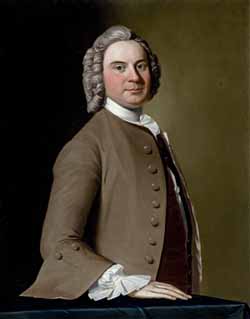
“Nick Boylston” was Nicholas Boylston (1716–1771), Green’s even more wealthy business partner. He and Green, both bachelors, owned houses near each other on School Street. Boylston is best known these days for his portraits by John Singleton Copley (one shown above). For those he posed as a wealthy man of learning, wearing a casual banyan and nightcap and leaning on a book. But I don’t recall any example of Boylston’s own writing or wit.

“Master Lovel” was John Lovell (1710–1778), master of the South Latin School for decades. He, too, was known for writing poetry, in his case serious verse and in various languages. Like Green and Boylston, Lovell’s surviving portrait shows him in a nightcap instead of a formal wig, signalling that he was concerned more with learning than with commerce. He, too, left Boston with the British troops in March 1776.

“Nat Gardner” was Nathaniel Gardner, Jr. (1719–1760), regarded in the 1750s as Boston’s leading poet, particularly in Latin. He was Lovell‘s usher, or assistant master, at the grammar school. Gardner died at forty-one and was soon largely forgotten. In 1989 David S. Shields wrote a study designed to bring him and his work back “from limbo.”

The appearance of Gardner at this Christmas Eve gathering shows that Adams was imagining a scene in the 1750s, when he himself was a university student, country schoolmaster, and legal trainee. He wouldn’t have been invited.

Nonetheless, Adams left a picture of how Boston’s small intellectual crowd spent their Christmas Eves, exchanging witticisms over a roasted goose.

Friday, January 01, 2021

“May grateful omens now appear, To Make the New a happy Year”

Boston 1775 observed its first new year back in 2007 by establishing an annual tradition of quoting a newspaper carrier verse.

Those verses were usually composed, printed, and distributed and/or sung by boys who worked for newspapers as a way to ask for end-of-year tips.

The example I quoted then, and am repeating now, was dated 1 Jan 1771—250 years ago today.

This handbill was created for the apprentices and journeymen in Isaiah Thomas’s print shop and saved by him for the collection of the American Antiquarian Society in Worcester.

The LAD who carries
The MASSACHUSETTS SPY,
Wishes all his kind Customers
A Merry Christmas, and a Happy New Year!
And presents the following:


May grateful omens now appear,
To Make the New a happy Year,
And bless th’ ensuing days:
May future peace in every mind,
Like odours wafted by the wind,
Its sweetest incense raise.

May GEORGE in his extensive reign,
Subdue the pride of haughty SPAIN,
Submissive to his feet.
Thy princely smiles our ills appease,
Then grant that harmony and peace
The dawning year may greet.

Kind Sirs! your gen’rous bounty show,
Few shillings on your Lad bestow,
Which will reward his pains,
Who piercing Winter’s cold endures,
And to your hands the SPY secures,
And still his task maintains.
Among carrier verses from colonial New England, this one is unusual in mentioning Christmas as well as New Year’s. Thomas had spent some time as a printer in Nova Scotia and the Carolinas, colonies that didn’t have such strong Puritan roots. 

Monday, January 06, 2020

Twelfth Night in Occupied Boston

On Friday, 6 Jan 1775, the Boston merchant John Andrews reported:
This morning we had quite a novel sight. The Sailors belonging to the Transports [i.e., the ships that had brought army regiments to Boston] consisting of about 30 or 40 dress’d in white shirts ornamented with various color’d ribbons dispos’d crossways on their bodies with knots and garlands, paraded each side of a long rope dragging a plow, accompanied with one compleatly tar’d and feather’d, representing a he Devil, together with a She Devil, and an attendant, each furnish’d with a bag to collect money, stopping every person of genteel appearance to request a remembrance of Old England, wishing ’em a merry Christmas.

The former look’d as compleatly like the devil as the most fertile invention could form an idea of or picture. The General [Thomas Gage] gave them two half Joes, and it is suppos’d that they collected at least forty guineas. The design of it was to celebrate the twelfth night, or the breaking up of Christmas.
Those sailors were enacting a variation of the folk rituals that rural Britons traditionally performed on “Plough Monday,” the first Monday after Twelfth Night. That day signaled the end of the Christmas season and the return to fieldwork.

There were many ways to observe Plough Monday, but the one closest to this was described in a footnote in the December 1762 issue of The Gentleman’s Magazine:
On this day the young men yoke themselves, and draw a plough about with musick, and one or two persons, in antic dresses, like jack-puddings, go from house to house, to gather money to drink. If you refuse them, they plow up your dunghill. We call them here [Derbyshire?] the Plough-Bullocks.
Other sources describe the “color’d ribbons” tied into knots and roses like those the sailors wore. Early nineteenth-century authors identified the male and female figures as the Fool and Bessy.

Most Bostonians didn’t celebrate Christmas, of course, and therefore didn’t recognize Twelfth Night, either. But they should have seen some similarities between this ritual and a holiday they knew well: Pope Night. The procession, the requests for money, the strange costumes, the central tarred figures representing devils, the young man dressed as a female—those were all part of how Boston youth celebrated the Fifth of November.

Pope Night, Plough Monday, and the “Christmas Anticks” that appeared in Boston after the war were all variations on the British mumming tradition. Undoubtedly the sailors off the troop ships knew that Bostonians didn’t welcome Christmas misrule. However, by begging money in “remembrance of Old England” they were making the same sort of patriotic appeal that local youths invoked to justify their rowdiness in November.

Thursday, December 26, 2019

“On Christmas-Day” in Fredericksburg

Sometime between 1745 and 1747, just a few years after the Gentleman’s Magazine published Elizabeth Teft’s poem “On Christmas-Day” (quoted yesterday), a teenager in Virginia copied it into a notebook.

That teenager was George Washington, and his copybook has of course become a precious national artifact.

Most of that volume was devoted to the texts of legal and business forms. After the one poem came a recipe for ink and the famous “Rules of Civility and Decent Behaviour,” also copied from a British source.

In this blog post and his book George Washington: A Life in Books, Kevin J. Hayes strives mightily to find significance in how the young teen copied this poem. Unlike the way it appeared in the magazine, George capitalized all the nouns, which “reveals Washington’s fastidiousness”—or perhaps his tutor’s insistence.

As for the content, Hayes concludes the young man was “confident in his religious beliefs but pleased to have another confirm them.” Or perhaps someone told him to copy that poem.

At the time, George Washington was living at his late father’s slave-labor plantation called Ferry Farm, across the river from Fredericksburg, Virginia. The minister at St. George’s parish in that town was the Rev. James Marye, who had actually been born in France and educated for the Catholic priesthood before converting to the Church of England. Did he assign that poem as a handwriting exercise (and theological reminder) to the young planter’s son?

The Rev. Mr. Marye died in 1767, after Washington had grown up and moved away to Mount Vernon. The new rector at St. George’s parish was the old minister’s son, also the Rev. James Marye (1731-1780). According to David DeSimone of Colonial Williamsburg, he thought enough of “On Christmas-Day” to set Teft’s words to music sometime in the early 1770s.

Wednesday, December 25, 2019

“And with officious joy the scene attend!”

In February 1743, the Gentlemen’s Magazine published this religious poem:
ON CHRISTMAS-DAY.

ASSist me, muse divine! to sing the morn,
On which the saviour of mankind was born;
But oh! what numbers to the theme can rise?
Unless kind Angels aid me from the skies!
Methinks, I see the tuneful host descend,
And with officious joy the scene attend!
Hark, by their hymns directed on the road
The gladsome shepherds find the nascent god!
And view the infant conscious of his birth,
Smiling, bespeak salvation to the earth!

For when th’ important Aera first drew near
In which the great Messiah should appear;
And to accomplish his redeeming love,
Resign awhile his glorious throne above;
Beneath our form should every woe sustain,
And by triumphant suffering fix his reign!
Should for lost man in tortures yield his breath,
Dying, to save us from eternal death!
Oh mystick Union!—salutary grace!
Incarnate God our nature should embrace!
That deity should stoop to our disguise,
That man recover’d should regain the skies!
Dejected Adam! from thy grave ascend,
And view the serpent’s deadly malice end,
Adoring bless th’ Almighty’s boundless grace
That gave his son a ransom for thy race!
Oh never let my soul this day forget,
But pay in grateful praise her annual debt
To him, whom ’tis my trust, I shall adore,
When time, and sin, and death, shall be no more!
Those lines were credited to “Orinthia.” That pen name reappeared four years later in the collection Orinthia’s Miscellanies, credited to “Elizabeth Teft of Lincoln,” born in 1723. At least one poem from that volume had previously appeared in The Gentleman’s Magazine, and there are stylistic similarities between Test’s work and this Christmas hymn. She’s probably the author, even if she didn’t include it in her collection.

TOMORROW: Across the Atlantic.

Tuesday, December 24, 2019

Christmas Presents Fit for Princes and Princesses

A couple of years ago, Robert Paulett at the George Papers Programme shared a list of what the future George III and his siblings received in the Christmas season of 1750-51.

Prince George was then twelve years old. He had one older sister and six younger siblings, the last less than a year old. (A final sister would come the next year.)

Paulett wrote:
Young George and his six siblings received a very modest haul indeed in the year 1750, receiving courtesy of toymaker Michael Dassonville only “a Red trunk” “a fine Landau [toy carriage] & 6 horses” “2 Chairs… with Dolls in them” and “4 whirligigs.” These all arrived right on Christmas Day, Dec. 25.
But there were “a few modest packages” arriving the next twelve days.

And then, on the morning after Twelfth Night, there was a whole ’nother load of presents!
2 large Carts
A Long Gunn
A Bureau
A Bird Cage on Bellows
A small Bird Cage on bellows
A musical Castle
2 fine Pewter Potts
A Pigeon house in a Boxe
An Armey on Cariadge
2 large Brass Canons
2 ivory tea totums
A Aarons Bells
A Dutch tauper
A Boxe of household furnitures
A Dulcimer
A fencing Master
A Set of Gild Penns
A Charm
A large Barril
The two sizes of “Bird Cage on Bellows” refer to singing bird automata, discussed here. A teetotum was a type of top with a string, though it could also have sides with numbers like a dreidel. An “Aarons Bells” is the wooden and ribbon toy that today we usually call a Jacob’s Ladder. I’m guessing a “Dutch tauper” was a figure of a Dutchman with a drink.

(The picture above shows Prince George about age nine.)

Monday, December 23, 2019

A “Publick Notice” about Christmas and Its Real Source

This image gets a lot of circulation this time of year, supposedly illustrating Puritan New England’s laws against celebrating Christmas. Often it’s attached to the year 1660.

It’s been featured on Mass Moments and other websites. And it’s always looked suspect to me, Donna Seger at Streets of Salem, Lee Wright at The History List, and other folks I’ve talked to.

To begin with, the typography is suspicious, indicating a modern compositor trying to replicate antique style without really knowing how. The long s is usually rendered as an f with the crossbar all the way across, but that long s is missing altogether in “similar.” There are no ligatures. The elevated C in the first line would be almost impossible to produce with hand type held in place by leading.

The “folds” are awfully conveniently placed so as not to really impede reading the message. We can see lines of text on the other side of the paper, which doesn’t usually happen in real seventeenth-century printing.

Furthermore, as Snopes found, that isn’t actually the text of the Massachusetts ban on Christmas. As enacted in 1651, Chapter 50, Section 2, of the colonial laws said:
For preventing disorders arising in several places within this Jurisdiction, by reason of some still observing such Festivals, as were Superstitiously kept in other Countries, to the great dishonour of God and offence of others:

It is therefore Ordered by this Court and the Authority thereof, that whosoever shall be found observing any such day as Christmas or the like, either by forbearing labour, feasting, or any other way upon any such account as aforesaid, every such person so offending, shall pay for every such offence five shillings as a fine to the county.
Here’s a reprint of the 1672 edition of Massachusetts’s laws. Taking off work and feasting were concerns for the Puritans, but “the exchanging of Gifts and Greetings” wasn’t yet the center of Christmas in America.

Snopes also discovered an item in the 2 Nov 1963 Freeport Journal-Standard crediting this exact text—including every out-of-place f—to “the Atlantic Monthly magazine.” The 27 Dec 1969 Baton Rouge Advocate was even more specific, citing “a subscription renewal advertisement” in the magazine.

Looking at Atlantic Monthly volumes on Google Books, I found the image above with the misused letters and the artificial folds in the magazine as early as 1969 and as late as 1982. Indeed, it was part of a subscription promotion. I suspect a more thorough search of printed volumes would pinpoint just when that ad started to run and thus when this visual myth entered American culture.

Monday, December 24, 2018

Anna Green Winslow’s Cold Christmas Eve

On 24 Dec 1771 twelve-year-old Anna Green Winslow sat down to write a letter to her mother in Halifax. Anna was living with an aunt in Boston for the better educational opportunities. Of course that meant private lessons, not the town schools, since she was a girl.

Anna started this letter with the winter weather:
to-day is by far the coldest we have had since I have been in New England. (N.B. All run that are abroad.)
Which I think means that anyone who had gone outside hurried through their errands in order to get back inside as fast as possible.
Last sabbath being rainy I went to & from meeting in Mr. Soley’s chaise. I dined at unkle Winslow’s, the walking being so bad I rode there & back to meeting. Every drop that fell froze, so that from yesterday morning to this time the appearance has been similar to the discription I sent you last winter.

The walking is so slippery & the air so cold, that aunt [Sarah Deming] chuses to have me for her scoller these two days. And as tomorrow will be a holiday, so the pope and his associates have ordained, my aunt thinks not to trouble Mrs Smith with me this week.
“Mrs Smith” was Elizabeth Murray Campbell Smith, who was teaching Anna embroidery and other needle crafts. The Smiths were Anglican, so they celebrated Christmas. So between that holiday and the weather, Aunt Deming decided to keep the young “scoller” at home so she wouldn’t slip and fall on the ice.

Anna and her aunt attended the Old South Meeting-House, and like a good descendant of the early Puritans, she viewed the 25 December holiday as a fallacy of “the pope and his associates.” Still, she got to stay home from schooling.

Tuesday, November 27, 2018

Holiday Traditions at the Paul Revere House, 1-2 Dec.

This weekend, 1-2 December, the Paul Revere House is hosting “Traditions of the Season,” a series of special events free with admission to the site.

The event description says:
Why did New England colonists consider Thanksgiving “the one day above all others”? Which Bostonians kept Christmas and which did not? What types of gifts were exchanged at New Years? Learn the answers while helping us celebrate the holiday season in the style of colonial Bostonians with 18th-century music, culinary delights, and crafts.

Festivities will be held on Saturday and Sunday; sample warm, mulled cider and treats baked from period recipes all day.

Visit with Rachel Revere, portrayed by History At Play’s Judith Kalaora, from 11:00-3:00 throughout the site.

Craftspeople working in traditional methods will demonstrate and sell wares from 12:00-4:00 in our Education and Visitor Center.

R. P. Hale will play 18th c. Advent music on the harpsichord and hammered dulcimer from 12:00-4:00 in the Pierce/Hichborn House.
At the top of this post is the music for “A Christmas Hymn” engraved by Revere for a collection titled Sixteen Anthems, published by fellow silversmith Josiah Flagg (1738-1795) in 1766. This image comes courtesy of the American Antiquarian Society’s online display of Revere’s engravings.

Regular admission to the Paul Revere House is $5.00 for adults, $4.50 for seniors and college students, and $1.00 for children ages 5 to 17. (Members and North End residents can visit free at all times.) The house will be open 9:30 A.M. to 4:15 P.M. that weekend.

Monday, December 25, 2017

Moses Brown’s Malden Christmas

In December 1775, Moses Brown led a delegation of Quakers from Rhode Island up to the Boston siege lines to bring relief to the suffering poor.

Brown and his comrades went to Gen. George Washington in Cambridge and explained how they wanted to go into Boston with money they had collected. A siege is of course an attempt to deny resources to the enemy, so the commander-in-chief couldn’t have been enthused about this idea.

Quartermaster general Thomas Mifflin was even more negative, thinking that such charity would prove unpopular with the Massachusetts populace.

In consultation with Washington and members of the Massachusetts General Court, the Quakers decided they would meet some of their contacts at the siege lines and hand over the money. But Sheriff Joshua Loring and Maj. John Small came out and told them that the poor in Boston didn’t need money and the town had adequate food.

So the Quakers went off to hand out their money to the poor people they found in Marblehead, Salem, Lynn, Chelsea, and the smallpox hospital at Point Shirley.

Soon enough it was Christmas Day, as Brown described in his report on the journey:
We went to Malden and Lodged at —— where were the Select men upstairs on business and below a Noisey Company of Soldiers fidling and Danceing after supper.

David [Buffum] and I proposed to see the Select Men and Inform them of our Business went up stairs and I spoke to them of the Noise etc not being sufferable it was not only rong in itself but contrary to Every prospect of the present time and Even the Congress Discouraged it by Resolves.

They allowed it was not agreeable but thought as they were Soldiers it must be allowed. It was what they called a Christmas frolich and they had been up all the Night before, were principaly of the Riflemen.
As an eighteenth-century Quaker, Brown didn’t celebrate Christmas. Neither did most New Englanders. But these riflemen were from the Middle Colonies, many of them transplants from Britain, and they didn’t adhere to Puritan customs. And thus we discern the limits of Moses Brown’s charity.

Sunday, December 24, 2017

Lt. Martin Hunter Sent to Coventry in Boston

Lt. Martin Hunter did not have an enjoyable Christmas in 1775.

That wasn’t just because he was besieged in Boston with the 52nd Regiment and the rest of Gen. William Howe’s British forces. Having already experienced the Battles of Lexington and Concord and Bunker Hill before he turned eighteen, Hunter was presumably pleased that the fighting had reached a stalemate.

But the lieutenant wasn’t feeling jolly enough to participate in his fellow officers’ holiday revelry on 24 December. Decades later, as a knighted general, Hunter wrote in his memoirs:
On the evening of Christmas Day I was sent to Coventry for not singing, as I was desired. I was kept in Coventry three days, not a member of the mess speaking to me.
The 1793 slang dictionary Blackguardiana defines the term “To send to Coventry” this way:
a punishment inflicted by officers of the army, on such of their brethren as are testy, or have been guilty of improper behaviour, not worthy the cognizance of a court martial. The person sent to Coventry is considered as absent; no one may speak to him, or answer any question he asks, except relative to duty, under penalty of being also sent to the same place. On a proper submission, the penitent is recalled, and welcomed by the mess, as just returned from a journey to Coventry.
After three days, it appears, Hunter’s comrades thought he was sufficiently sorry. He later wrote, “I never refused to sing again.”

(The picture above is a 1752 view of Coventry from the London Magazine, available from Lindisfarne Prints.)

Saturday, December 31, 2016

Carriers’ New Year Messages—“often tip the newsboy”

Longtime Boston 1775 readers know that every year ends and/or begins with some “carrier verses”—the doggerel that newspaper apprentices wrote, printed, and distributed at the turn of the year to earn a few coins for themselves.

The library at Brown University has a website devoted to those broadsides, though almost all are from the early 1800s and not the Revolutionary era. In addition to good digital images of those pages, the site includes helpful introductory essays by Mary T. Russo and Leon Jackson.

Jackson’s essay, which was also published in Common-Place, explains the form in both literary and commercial terms:
The typical newspaper carrier’s New Year’s address—as they were known—began with a salutation to the customer; mythologized the newsboy as the embodiment of Hermes or Mercury, messenger to the Gods; summarized the news of the year in brisk and vivid couplets; and concluded with a plea for money. Appearing first in the 1720s in sporadic numbers, the vogue for addresses caught on in the 1760s, and by the end of the eighteenth century almost every newspaper issued one. . . .

The challenge of the addresses lay in identifying precisely the sort of economic arrangement of which they were a part. Was it a form of extortion, a kind of gift exchange, an instance of charity, a variety of purchase, or some other part of the economic repertoire? . . . The monies associated with carriers’ addresses…were not quite a payment for delivery, since this was included in the cost of the paper; they were not quite charity, since something was given as well as received; and they were not extortion, because of the ongoing nature of the relationship between the carrier and the customer, both of whom knew one another; yet they could not be considered gifts either, since they were not exchanged between equals but given to lower-class men by their social betters. The concept of the tip would seem to capture perfectly the nature of the carriers’ transaction in its ambiguity, its scripted, ritualized nature, its awkwardness, and its potential for social transgression, and I was at first quite happy to call the money the carriers’ received tips. That seemed easy enough.

The only problem is that even though the word tip was used in its modern sense as early as 1733, at precisely the same time that the carriers’ addresses were starting to appear, tip does not appear in even one of the seven hundred or so addresses at which I looked. The money for which the carriers asked was, rather, described as a “boon,” a “bounty,” “a gift,” a “blessing,” “a present,” “a reward,” a form of “charity,” and much else. Indeed, every economy other than tipping was invoked. This surfeit of names led me to three provisional conclusions. Firstly, even as they bestowed addresses on their customers, the carriers were seeking to define the transactions in which they were engaged in terms of economies other than tipping. Secondly, such acts of economic designation obscured the precise—which is to say tipping—nature of the transactions in question. And lastly, this obfuscation was designed to give what was essentially a discretionary bestowal the force of an obligatory act. While tipping, in essence, demanded something for nothing, the economic labels invoked by the carriers’ addresses, as one of them explained, required “something for something.” . . .

In eighteenth-century America, Christmas gift exchange was marked by a powerful reciprocity: one gave a present and received one back, or on the other hand, one received a present and then offered a counter-gift. In arguing that what they were due from their customers was nothing more than a gift well-earned and deserved, the carriers often described a number of gifts they had, or would, offer in return. Typically, the carriers pointed to the broadside poem itself, which they depicted as a gift to their patrons and for which they expected a gift of money in return. . . .

The carrier for the 1791 Baltimore Gazette exploited the reciprocity inherent in this form of exchange still more when he concluded his address by writing,
Then Masters kind reward the Boy,
Whose labours brings the News
To oblige you is his chief employ
The GIFT you’ll not refuse.
His careful use of syntax helps to obscure whether the gift that will not be refused is the broadside the carrier is handing to his customer or the money the customer is giving him in return.

More common still was the practice of making the traditional seasonal gift of a blessing. “I wish you a happy new year,” wrote one Massachusetts diarist in 1838, “is sounded from all most all lips.” Benedictions likewise run rampant through the carriers’ addresses, in which customers receive an endless barrage of May you alwayses, May you nevers, and May you oftens. A typical carriers’ blessing took the form of the hope that the customer would always be rich, never be poor, and often tip the newsboy.
TOMORROW: A few lines from the boys of the Independent Chronicle.

Saturday, December 24, 2016

“St. A Claus, was celebrated at Protestant-Hall”

In the 20 Dec 1773 New-York Gazette, alongside the first reports of the destruction of the tea in Boston harbor, printer Hugh Gaine ran this little item about a local event:
Last Monday [i.e., 13 December] the Anniversary of St. Nicholas, otherwise called St. A Claus, was celebrated at Protestant-Hall, at Mr. Waldron’s, where a great Number of the Sons of that ancient Saint celebrated the Day with great Joy and Festivity.
(Three days later, James Rivington put the same item in Rivington’s New-York Gazetteer, which sometimes gets him credit for the first American mention of “St. A Claus.” But Gaine’s paper was earlier.)

According to James Riker’s Annals of Newtown (1852), Samuel Waldron (1738-1799) was a blacksmith who lived in Newtown on Long Island, which is now part of Queens. In March 1771 Waldron hosted what looks like a similar gathering in honor of St. Patrick. I haven’t found any mention of his house or tavern being called “Protestant-Hall” except in connection with those banquets.

The photo above, from the collections of the New-York Historical Society, shows Waldron’s house in 1923. If he hosted the Sons of St. Nicholas in that building in 1773, then it was a significant location in the development of the American legend of Santa Claus.

Friday, December 27, 2013

The St. Michael’s Tercentenary in Marblehead

Over the next week I’ll highlight some intriguing historical events coming up in the new year.

In Marblehead, St. Michael’s Church will celebrate its 300th anniversary. This is the oldest Episcopal Church in New England still conducting services in its original building, erected in 1714. Its first minister, supplied by the Society for the Propagation of the Gospel in Foreign Parts, arrived from Britain the next year, and the building grew with a new roof in 1728.

In that century Marblehead was the second-largest town in Massachusetts, with its own port. The townspeople were more focused on fishing and trading than the farmers of rural towns, and more open to immigrants and Anglicans. Still, the Rev. George Pigot’s sermon defending the celebration of Christmas in 1728 prompted a pamphlet war.

The reredos or altarpiece inside the church is thought to date to 1714. Other eighteenth-century artifacts include the twelve-branched chandelier, donated in 1732 by a Customs official in Bristol, and a 1745 silver flagon.

According to the church’s website, “St. Michael’s first bell was hung in 1718. When news of the Declaration of Independence broke out in 1776, it was rung so hard by fervent patriots that it cracked.” (Those Patriots, who were probably not part of the congregation, also pulled down the royal coat of arms.) The bell in the tower today was cast by the Paul Revere & Sons Foundry in 1818.

In the coming year, historians of early America and architecture will present a series of public lectures about the church’s history. Musicians will perform concerts on its organ. On 7 June there will be a scholarly symposium produced with the Peabody Essex Museum in Salem. The 28 September anniversary worship service will include the Bishop of London, whose predecessors oversaw St. Michael’s Church up until the Revolution.

Wednesday, December 25, 2013

Toys for the Custis Children

As I described yesterday, a number of recent publications have included a list of toys that George Washington supposedly ordered for his new stepchildren, Jacky and Patsy, on his first Christmas with them in 1759. But no such list appears in The Papers of George Washington, Colonial Series, which can be searched at Founders Online.

However, I found that John C. Fitzpatrick used some of the phrases on that list in his 1933 biography, George Washington Himself. Fitzpatrick was then overseeing the edition of Washington’s papers put out by the federal government in the early twentieth century.

That encouraged me to revisit the Library of Congress’s American Memory digital database of Washington’s papers, which includes transcriptions of the notes that Fitzpatrick included in that edition. Those notes quote some documents not included in the current edition of the papers (which is in other ways more complete).

And indeed, Fitzpatrick noted a March 1760 invoice to Washington from Robert Cary & Co. that included:
from Unwin & Wrigglesworth—
A Tunbridge Tea Sett ... ¼
3 Neat Tunbridge Toys ... 1/
A Neat Book lash Tea Chest ... 4/6
A Bird on Bellows ... 5d.
A Cuckoo ... 10d.
A turnabout Parrot ... 1/3
A Grocers Shop ... 5/

and from Mount & Page—
6 Small Books for Children ... 3/.
A Box best Household Stuff ... 4/6
A Straw patch box wt. a Glass ... 2/
A Neat dressd Wax Baby ... 3/6
An Aviary ... 1/3
A Prussian Dragoon ... 1/3
A Man Smoakg. ... 1/
For his biography Fitzpatrick plucked out items from that list which were most likely children’s toys. The Mount Vernon Midden blog shows images from those invoices. The 1760 Universal Pocket Companion for Londoners listed Unwin & Wrigglesworth as “hardwaremen” doing business on Cheapside; they probably sold more than toys.

Olive Bailey included a similar list in Christmas with the Washingtons (1948). She also transcribed a list of toys that Unwin & Wrigglesworth had shipped earlier, billing Daniel Parke Custis, Martha’s first husband, who died in 1757:
A child’s fiddle
A coach and six in a box
A stable with six horses
A corner cupboard
A neat walnut bureau
A filigree watch
A neat enameled watch box
A toy whip
A child’s huzzif
So we’re on solid ground to say that Washington bought that list of items I quoted yesterday, and that most of those things were toys. But we can’t say that Washington ordered those toys specifically. The Mount Vernon Midden blog quotes him as vaguely ordering “‘10 [shillings] worth of Toys’ for Jacky and ‘A Fash[ionably] Dres[sed] Baby…& other Toys’” for Patsy in September 1759. The London merchants picked out what they thought those children would like.

We also can’t say those goods had anything to do with Washington’s first Christmas as a stepfather. They were apparently ordered in September 1759 but not shipped until March 1760. In fact, Washington’s papers say almost nothing about Christmas celebrations at Mount Vernon. (In 1769 he won some money on cards that evening while visiting Fielding Lewis.)

Instead, it appears that twentieth-century authors chose to view these goods through the lens of our own traditions. Most Americans give children lots of toys on Christmas, and our culture encourages us to give even more. Therefore, these toys appeared in Christmas with the Washingtons and Reader’s Digest Book of Christmas even though they had no link to the Washington-Custis family’s holiday. Jacky and Patsy were probably glad to get them whenever they arrived.

(The image above shows the remains of two small clay figurines found in an archeological dig at Mount Vernon. Were those some of Jacky and Patsy Custis’s toys? Or the toys of Jacky’s children?)

Tuesday, December 24, 2013

Christmas Shopping with George Washington?

This month HistoryTube shared a heart-warming glimpse of George Washington, the just-retired young colonel of the Virginia forces, as a new stepfather:
In 1759 George and Martha Washington spent their first Christmas together at Mount Vernon. They had been married less than a year. A list of presents George Washington intended to purchase for stepson John (Jacky), age 5, and stepdaughter Martha (Patsy), age 3, shows a heartfelt appreciation for the joys of childhood. His list reads:

A bird on Bellows
A Cuckoo
A turnabout Parrott
A Grocers Shop
An Aviary
A Prussian Dragoon
A Man Smoaking
A Tunbridge Tea Sett
3 Neat Tunbridge Toys
A Neat Book fash Teas Chest
A box best Household Stuff
A straw Patch box w. a Glass
A neat dressed Wax Baby

The items on the list would have likely been handmade and imported from Europe. Many mechanical and hand-carved toys of this period were produced in the cities and towns of northern Germany, such as Hamburg and Hannover. Although we can’t be sure what each one looked like, several were fairly common. The bird on bellows, cuckoo, turnabout parrot and “smoaking” man were probably mechanical toys made of metal. The bird and parrot would have contained whistles and may have had flapping wings. The grocer’s shop also likely was made in northern Germany, where elaborate miniature toy room settings were crafted and sold. The Prussian dragoon was probably a metal toy soldier, and the wax baby doll would have been made of poured, tinted and painted wax, a common method for doll construction in the 1700s.

The three Tunbridge toys were probably made in Tunbridge, Kent, England. They may have been puzzle boxes, yo-yos or small decorative chests, made in the Tunbridge fashion, of many small pieces of wood glued together to create a mosaic effect. The tea set and tea chest may have been toys or could have been for a dowry for Patsy. The patch box contained small cloth patches to apply to the face as beauty marks. Were these for Patsy to play with, or meant as a present for Martha?
I’m always touched by watching Washington try so hard to do the right thing. Here he was achieving his social and economic aims by marrying wealthy widow Martha Custis, and he’s suddenly thrust into the role of patriarch responsible for providing for two young children as well.

Since I usually like to add a little something when I quote from other blogs, I went looking for more context for that list of toys. And I found that phrases like “Prussian Dragoon” and “turnabout Parrott” don’t appear in Founders Online, which includes the latest edition of Washington’s colonial papers.

Instead, my searches found this list appeared in a lot of recent books, in the 1973 Reader’s Digest Book of Christmas, and in a 1969 editor’s note at the start of an issue of the American Bar Association Journal. None of the publications I saw indicated a source. So I started to worry.

TOMORROW: It’s a Christmas miracle. (Sort of.)

Saturday, December 25, 2010

“He Would Much Rather Sit on Christmas-Day...”

On Monday, 19 Dec 1774, the British Parliament debated “raising the Supply granted to his Majesty”—i.e., enacting taxes, in this case a land tax. The country’s landowners were, understandably, against raising this charge, so the House of Commons agreed to Lord North’s proposal to keep it at “three Shillings in the Pound.”

Then a member named David Hartley (1732-1813) rose to speak. Representing Kingston upon Hull, he was one of the radical Whigs opposed to the government’s American policy, meaning the Boston Port Bill, Massachusetts Government Act, and duties enacted since 1767. He insisted that Parliament had to deal with the crisis in the Massachusetts Bay colony, where nearly all the army troops on the continent were holed up in Boston.

This description of Hartley’s speech comes from a record of Parliamentary activity published in 1775 (which leaned toward the Whigs):

Mr. Hartley rose, and in a mild, sensible speech, enlarged upon the very extraordinary conduct of Administration concerning American affairs.

He said the accounts from that country were truly alarming; that the Resolutions of the Continental Congress evidently proved that the people were determined not to submit to the late Acts passed in relation to America, nor to any other of a like complexion; that the Troops now stationed at Boston, and the inhabitants of that Town, had no means of procuring subsistence but by Sea, or from the country; that either method was now equally difficult, as the Harbour would be frozen up, and the land carriage, even if subsistence was to be had, rendered impracticable, as the country would be covered with snow; and that, under such circumstances, the situation of the Troops would be no less deplorable than that of the miserable inhabitants.

He continued to say, that he was not well versed in sieges; but if he understood right, he took it that the Town of Boston was surrounded by General [Thomas] Gage with lines of circumvallation, and that such being the very critical state of things, respecting both the situation, the temper, and disposition of the military and the natives, he submitted it to the gentlemen on the other side how they could reconcile it to the duty they owed to the Nation in their publick, or to their constituents in their private capacity, to agree to a long adjournment, while things remained in so dangerous and alarming a state, without taking any one step to avert the numerous and fatal mischiefs which they portended.

For his part, he affirmed solemnly, he would much rather sit on Christmas-day, and continue to do so, de die in diem [from day to day], than go to the country [i.e., adjourn] in so critical a season, without at least agreeing to some measures, though they should extend no further than prevention.
According to Nathaniel Wraxall, who entered Parliament in 1780, Hartley was by no means a stirring orator:
The Rockingham Party had not among them a more zealous adherent; but in Parliament, the intolerable length, when increased by the dullness of his Speeches, rendered him an absolute nuisance, even to his own friends. His rising always operated like a dinner bell.

One day, that he had thus wearied out the patience of his audience; having nearly cleared a very full House, which was reduced from three hundred, to about eighty persons, half asleep; just at a time when he was expected to close, he unexpectedly moved that the Riot Act should be read, as a document necessary to elucidate, or to prove, some of his foregoing assertions.

[Edmund] Burke, who sat close by him, and who wishing to speak to the Question under discussion, had been bursting with impatience for more than an hour and a half; finding himself so cruelly disappointed, bounced up, exclaiming, “The Riot Act! my dear friend, the Riot Act! to what purpose! don’t you see that the mob is already completely dispersed?”

The sarcastic wit of this remark, in the state of the House, which presented only empty Benches; encreased by the manner and tone of despair, in which Burke uttered it; convulsed every person present except Hartley, who never changed countenance, and insisted on the Riot Act being read by one of the Clerks.
Be that as it may, I found that Hartley’s argument had a certain resonance this month, when American legislators also argued about whether to stay in session, not on Christmas but in the days after Christmas. And ended up finishing before the holiday after all.

Back in 1774, the House of Commons “adjourned for Christmas recess” on Friday, 23 December, after the king approved the renewed act “granting to his majesty certain duties upon malt, mum, cyder and perry” as before. The land tax was completed in February. Lord North and his ministers maintained their American policy, and war began in April.

During the war, North’s government had to raise the land tax, which cost it support. After years of fighting and the defeat at Yorktown, a new ministry in London changed policy and started to negotiate a withdrawal from those thirteen colonies. That government appointed David Hartley to represent Britain at the signing of the Treaty of Paris.

Friday, December 25, 2009

“So much for Christmas”

Here are entries from the diary of Manasseh Cutler (1742-1823) in 1765. At the time, this Yale graduate was teaching school in Dedham, starting to court Mary Balch, and trying to figure out his career.

Cutler was a Congregationalist, but on this trip to Boston he investigated the holiday rituals of the Anglicans.

Dec. 24, Tuesday. Set out for Boston in the carriage with Miss Polly Balch; very cold. Spent the evening at Captain Hart’s. Lodged at Mr. Williams’. It being Christmas eve the bells in Christ Church were rung, chimed, played tunes, etc. Christ Church is a large brick building, situated at the north end, and is the first church [i.e., Anglican place of worship, not a meeting-house] founded in the town.

Dec. 25, Wed. Christmas. Went to church at King’s Chapel, where was a very gay and brilliant assembly. Several intervals, in reading service, made for singing anthems, which were performed extremely well. Service was read by Parson [Henry] Caner, and a sermon preached, or rather a harangue pronounced by Parson Trouback [John Troutbeck]. After the sermon a collection was made for the poor. Then the sacrament was administered (which I did not tarry to see).

Dined at Mr. Williams’. A very handsome dinner.

In the afternoon service was read, and anthems sung, but no sermon. This church is built of stone, is very beautifully adorned with carved pillars, several images, etc. Here is a very good set of organs, but no bells, as the steeple is not erected. This is the most grand church in town, where His Excellency [i.e., the governor] is obliged to attend.

This evening we came to Roxbury and spent it very agreeably at Mr. Increase Sumner’s, and lodged at Mr. Samuel Sumner’s.

Dec. 26, Thurs. This morning began to snow. At 10 o’clock we set out for the city of Tiot (Indian name of Dedham), and came to an anchor at Dr. [Nathaniel] Ames’, where we dined, drank tea, and spent a very agreeable evening. We came home at 10 o’clock. As it had cleared up, and was a bright moonlight night, and not cold, we had a very pleasant ride. So much for Christmas.
Cutler tried the whaling business, studied law, and finally became a minister in 1771. During the Revolutionary War he was a chaplain, but also studied medicine. In the 1780s Cutler promoted settlement in Ohio, investigating the pre-Columbian mounds in that territory, but he returned to Massachusetts and ended up serving a couple of terms in Congress. So, though he remained the Congregationalist minister in Hamilton, I’m not sure he really settled on a career.

The picture above is King’s Chapel today, courtesy of Light Boston.

Tuesday, December 25, 2007

How Jeduthan Baldwin Spent Christmas 1775

One of my favorite Revolutionary War diarists is Col. Jeduthan Baldwin of North Brookfield, Massachusetts. He was an artillery engineer, which required technical knowledge, but he had a farmer’s blunt style. He tended to punctuate casually and spell phonetically. For instance, he wrote the town name Dorchester as “Dotchester”—which is, after all, still the way it’s pronounced. And he wrote down everyday details that humanize him and his fellow high officers. On 23 Dec 1775, as on example, Baldwin recorded that he “Wore Genl. [Israel] Putnams great coat.”

How did Col. Baldwin spend the next two days? As a New Englander, he had no tradition of treating Christmas as a holiday. Indeed, Congregationalists seem to have taken pride in treating the 25th of December like any other working day. But the Continental Army’s commander-in-chief observed Anglican norms. On Christmas in 1775, therefore, Baldwin both paid a visit to Gen. George Washington and did some dirty work that he saw needed doing.

24 Lords Day & a very Snowy cold Day. Cut down the orchard at Leachmor point, & laid the trees round the fort[.] had 4 oxen Drowned coming of ye point.

25 a Very cold Day. Dind with Genl. Putnam. went upon leachmor Point at Sunset, & then went to Genl Washing. in the Evning. found & Skind ye 4 drownded oxen.
(Click on the image above for a larger map of the siege, published in the late 1800s and posted on a Phipps family genealogy page. The 1906 edition of Col. Baldwin’s diary is available through Google Books.)