J. L. BELL is a Massachusetts writer who specializes in (among other things) the start of the American Revolution in and around Boston. He is particularly interested in the experiences of children in 1765-75. He has published scholarly papers and popular articles for both children and adults. He was consultant for an episode of History Detectives, and contributed to a display at Minute Man National Historic Park.

Subscribe thru Follow.it


•••••••••••••••••


Showing posts with label Samuel Holden Parsons. Show all posts

Tuesday, September 15, 2026

New York City Has Fallen

On 15 Sept 1776, 250 years ago today, the Continental Army withdrew from the southern end of Manhattan Island, leaving the city of New York to the British army.

That’s an orderly way to describe what happened. Here’s Gen. George Washington’s official dispatch to John Hancock and the Continental Congress the next day:
in the morning they began their Operations—Three Ships of War came up the North River as high [as] Bloomingdale which put a total stop to the removal by Water of any more of our provision &c. and about Eleven OClock those in the East River began a most severe and Heavy Cannonade to scour the Grounds and cover the landing of their Troops between Turtle-Bay and the City, where Breast Works had been thrown up to oppose them.

As soon as I heard the Firing, I road with all possible dispatch towards the place of landing when to my great surprize and Mortification I found the Troops that had been posted in the Lines retreating with the utmost precipitation and those ordered to support them, [Samuel Holden] parson’s & [John] Fellows’s Brigades, flying in every direction and in the greatest confusion, notwithstanding the exertions of their Generals to form them.

I used every means in my power to rally and get them into some order but my attempts were fruitless and ineffectual, and on the appearance of a small party of the Enemy, not more than Sixty or Seventy, their disorder increased and they ran away in the greatest confusion without firing a Single Shot—

Finding that no confidence was to be placed in these Brigades and apprehending that another part of the Enemy might pass over to Harlem plains and cut off the retreat to this place, I sent orders to secure the Heights in the best manner with the Troops that were stationed on and near them, which being done, the retreat was effected with but little or no loss of Men, tho of a considerable part of our Baggage occasioned by this disgracefull and dastardly conduct—

Most of our Heavy Cannon and a part of our Stores and provisions which we were about removing was unavoidably left in the City, tho every means after It had been determined in Council to evacuate the post, had been used to prevent It. We are now encamped with the Main body of the Army on the Heights of Harlem where I should hope the Enemy would meet with a defeat in case of an Attack
William Douglas, a Connecticut militia colonel whose troops had been guarding an area near Kip’s Bay, told his wife that “my Left wing gave way” under the initial artillery fire:
I Lay myself on the Right wing, wateing for the boats untill Capt. [Jonas] Printice Came to me and told if I ment to Save my Self to Leave the Lines for that was the orders on the Left and that they had Left the Lines. I then told my men to make the best of their way as I then found I had but about ten Left with me.
Caesar Rodney, one of Delaware’s delegates to the Congress, was in the region, and he gathered this information:
the Ships…began a verry heavy Fireing at Turtle-Bay, to Scour the Country previous to their landing the troops, but hurt no Body that I Can hear of—When the Fireing ceased their Troops began to Land and ours to Run as if the Devil was in them in Spite of all the Genel. Could do. They never fired one Gun—

General Whashington haveing discovered their intention to Land at that place, and haveing properly disposed of his troops in case of an Attempt in either or both the other places, ordered a Reinforcement and set out there himself. However before he Got to the place, met our people runing in Every direction. He Endeavoured by persuasion, Threats &c. to get them back, but all to no purpose, in Short they Run till they left the General to Shift for himself—
A story went round that Gen. Washington was so angry that he threw his hat on the ground and shouted, “Are these the men with which I am to defend America?” (per Gen. William Heath) or “Good God, have I got such troops as those?” (per George Weedon). No one who was with Washington at the time described him behaving that way. But of course those men had other things on their minds—and may have thought such behavior was perfectly understandable.

Sunday, September 06, 2026

“Came under the bottom of the ship”

After his brother Ezra Bushnell fell ill, the inventor David Bushnell asked Gen. Samuel Holden Parsons to send three men who might be able to operate his submarine against the Royal Navy in New York harbor.

Parsons already had a list of volunteers ready to sail a fireship toward the fleet, another risky venture. One of them was his brother-in-law, Sgt. Ezra Lee (1749–1821, shown here).

Bushnell brought the machine back to Saybrook, Connecticut, for the three men to practice. Eventually Lee got the assignment. His mission: Screw a timed explosive charge (Bushnell’s other invention, called the “magazine”) to the hull of H.M.S. Asia.

Lee went into action on 6 Sept 1776, 250 years ago today. Decades later, in 1815, he wrote an account of his mission for David Humphreys:
We set off from the City—the Whale boats towed me as nigh the ships, as they dared to go, and then cast me off—I soon found that it was too early in the tide, as it carried me down by the ships—I however hove about, and rowed for 5 glasses, by the ships’ bells, before the tide slacked so that I could get along side of the man of war, which lay above the transports—

The Moon was about 2 hours high, and the daylight about one—when I rowed under the stern of the ship, could see the men on deck, & hear them talk—I then shut down all the doors, sunk down, and came under the bottom of the ship, up with the screw against the bottom but found that it would not enter—

I pulled along to try another place, but deviated a little one side, and immediately rode with great velocity, and come above the surface 2 or 3 feet between the ship and the daylight—then sunk again like a porpoise I hove partly about to try again, but on further thought I gave out, knowing that as soon as it was light the ships boats would be rowing in all directions, and I thought the best generalship, was to retreat, as fast as I could as I had 4 miles to go, before passing Governor’s Island.—

So I jogg’d on as fast as I could, and my compass being then of no use to me, I was obliged to rise up every few minutes to see that I sailed in the right direction, and for this purpose keeping the machine on the surface of the water, and the doors open—

I was much afraid of getting aground on the island as the Tide of the flood set on the north point While on my passage up to the City, my course owing to the above circumstances, was very crooked & zig zag, and the enemy’s attention was drawn towards me, from Governors Island—

When I was abreast of the fort on the island 3 or 400 men got upon the parapet to observe me,—at leangth a number came down to the shore, shoved off a 12 oar’d barge, with 5 or 6 sitters, and pulled for me—I eyed them, and when they had got within 50 or 60 yards of me, I let loose the magazine, in hopes, that if they should take me, they would likewise pick up the magazine, and then we should all be blown up together, but as kind Providence would have it, they took fright, and returned to the island, to my infinite joy.—

I then weathered the Island, and our people seeing me, came off with a whaleboat, and towed me in—

The Magazine after getting a little past the Island, went off with a tremendous explosion, throwing up large bodies of water to an immense height.
On seeing that explosion, Humphreys wrote, Gen. Israel Putnam shouted, “God’s curse ’em, that’ll do it for ’em.” But the bomb merely startled the enemy, not doing any physical damage.

Why hadn’t Sgt. Lee been able to attach that bomb to H.M.S. Asia as planned? Humphreys explained:
The reason why the screw would not enter, was that the ship’s bottom being coppered it would have been difficult under any circumstances to have peirced through it—but on attempting to bore with the auger, the force necessary to be used in pressing against the ships bottom, caused the machine to rebound off
In this series about David Bushnell and his submarine, I’ve cut down long letters that the U.S. Navy has collected on this website. Though the submarine was a top-secret operation in 1776, men like Humphreys and Thomas Jefferson made a concerted effort after the war to gather information about the machine and its operation.

Authors have written several books about the submarine. I’m linking to Arthur S. Lefkowitz’s The American Turtle Submarine because he gave me a nifty cap.

TOMORROW: Bushnell’s secrets.

Wednesday, February 18, 2026

A Last Word on Basile Boudrot

Whenever I recount a story at length, I like to add some new sources, connections, or interpretations. I don’t want to just repeat what other writers have said.

But when I started researching suspected murderer Basile Boudrot, I couldn’t find that sort of material. I felt so stymied that I thought I’d have to confine the story to my Ko-fi updates, where I’ve started to share loose ends and research in progress. 

Ultimately, I spotted enough sources to fill the past several postings. But like everyone else who’s written about this case, I hit a brick wall in August 1776, when the Continental Congress voted to send Boudrot to Massachusetts.

As my closing thoughts, I’ll offer this scenario for how the sources fit together. Bear in mind that this is only one possible reconstruction, perhaps tinged by a fiction writer’s search for plot twists, liable to be upended with a single new document. But here goes.

February 1772: Capt. Thomas Parsons and his eight-man crew sail a schooner (name unknown) out of Newburyport, headed for the Caribbean.

March 1772: Parsons’s ship founders in a storm that blows a lot of vessels north. Meanwhile, Basile Boudrot boards a ship in France, heading to Nova Scotia. Along the way he opens a letter from his relative Marguerite Landry to the D’Entremont family, describing where their relatives hid money as the British expelled Acadians almost twenty years before.

April 1772: Boudrot reaches Nova Scotia and registers for his land grant on St. Marys Bay. But first he follows the directions in the Landry letter and unearths “1004 pieces of money.” Meanwhile, people in Newburyport worry about Thomas Parsons’s ship; no one reports seeing it in the Caribbean.

May 1772: Boudrot visits the D’Entremonts in Pubnico, assuring them that Marguerite Landry and her family are in good circumstances in France. Then he takes off for the province of Canada, abandoning his land since he’s already found a fortune with much less work. Benoni d’Entremont gets suspicious and writes to Landry in Cherbourg.

Summer 1772: The D’Entremonts ask questions in Nova Scotia about Boudrot. Passing ship captains from Massachusetts, including Hector McNeill, ask questions about the missing schooner. Locals talk about Basile Boudrot suddenly having a lot of money and no good explanation for it.

Fall 1772: Folks in Newburyport piece together information and conclude that Basile Boudrot was behind the disappearance of Parsons’s schooner, that he got suddenly rich from plundering that ship after killing all its crew.

Spring 1773: Marguerite Landry writes to the D’Entremonts from Cherbourg, describing the buried money and reporting that French sea captains have spotted Basile Boudrot in North America. In Massachusetts, the Parsons family presses for an inquiry into the alleged attack on the schooner.

Late 1773: Basile Boudrot has spent through most of his windfall. He picks up whispers that the D’Entremonts and Yankee mariners are all hunting him. He adopts the alias “Dugan” to work on ships around Montréal, Lake Champlain, and points west.

Fall 1775: Americans invade Canada, besieging Québec. Massachusetts mariners Hector McNeill and William Farris leave the city and go to work for the Continental Army.

Spring 1776: As the Continentals withdraw to Montréal, McNeill spots “Dugan” working on another supply ship. McNeill identifies this man as Basile Boudrot and demands his arrest.

Summer 1776: The Continental Army holds Boudrot prisoner in New York City until the Congress endorses Gen. Samuel Holden Parsons’s plan to send him to Massachusetts to stand trial.

Fall 1776: Soon after Boudrot reaches Massachusetts, the authorities realize the accusation against him doesn’t hold water: he wasn’t even in North America when Thomas Parsons’s ship disappeared. Out of embarrassment, they drop the case and never mention it again. People in Newburyport persist in believing that Nova Scotians plundered the schooner. Basile Boudrot disappears once more.

[The photograph above shows Smuggler’s Cove park on St. Marys Bay, Nova Scotia. Nothing says “law-abiding maritime community” like naming a place Smuggler’s Cove.]

Tuesday, February 17, 2026

“A Difficult Case” in Late 1776

As recounted yesterday, in August 1776 the Continental Congress voted to send Basile Boudrot to Massachusetts to be tried for murdering Thomas Parsons and his crew or, failing that, to send him to Nova Scotia for trial.

There were some problems with that plan. As John Adams said, “It is a difficult Case.”

Yet the Congress had little choice. Just that month, its members had signed the Declaration of Independence, which complained about the king (among other things) “depriving us in many cases, of the benefits of Trial by Jury.” So the new American union had to provide Boudrot with a jury trial.

Was Essex County the right venue, even if Capt. Parsons had sailed from Newburyport? One fundament of British law was that the accused should be tried in the jurisdiction where the crime was allegedly committed. And the accusation against Boudrot was that he’d attacked Parsons’s ship up at St. Marys Bay.

Again, the Declaration might come into play. Another of its grievances was that the king was “transporting us beyond Seas to be tried for pretended offences.” The Continental Army had transported Boudrot out of Canada down to New York, and now was sending him to Massachusetts. But really he should be tried in Nova Scotia.

That of course raised practical problems. Would Nova Scotia authorities share the Continental leaders’ wish to try Basile Boudrot, pushed by the desire of the victim’s brother, Gen. Samuel Holden Parsons of the Continental Army? How would that conversation go?
“So you want us to take this man and put him on trial for plundering a ship from Massachusetts four years ago?

“Yes!”

“Will you also send us Captains Nicholasson Broughton and John Selman, who plundered our Charlottetown just last year?”

“Oh, no, no, no.”

“Ah.”

“That happened during the war, you see.”

“The war that’s still going on.”

“Yes. But our commander-in-chief didn’t let those two men back into our army!”

“So you have them in jail, awaiting trial?”

“Er, no. They’re officers in the Essex County militia.”
And speaking of practical matters, even as the Congress in Philadelphia laid out this plan for dealing with Boudrot, the Continental commanders in New York were seeing the harbor fill up with Royal Navy ships and army transports. On 27 August, the British and American armies clashed in the Battle of Brooklyn. About a month later, the redcoats were on Manhattan Island, and New York City was burning.

Given all that, it’s not so surprising that Basile Boudrot’s paper trail ends. American Patriots felt obliged to try him in the proper legal venue, but preserving the paperwork to get him there might not have been the highest priority.

I hold out hope that an archive in Massachusetts, or in Nova Scotia, contains more clues to Boudrot’s fate. Perhaps as “Boudreau,” or “Dugan” (his reported alias), or “the Acadian” (as American generals referred to him). But given the murky case, his use of aliases, the fog of war, and the passage of time, I don’t hold out much hope.

TOMORROW: One scenario.

Monday, February 16, 2026

“An Order to try one Basil Bouderot, Accused of Murther”

According to the New-York Journal article I quoted yesterday, on 10 July 1776 Basile Boudrot was sent from New York to Newburyport to stand trial for murdering Thomas Parsons and his crew in Nova Scotia four years earlier.

But it appears that rendition wasn’t official; it may never have happened at all. Although newspapers in Massachusetts reprinted the New York article, none confirmed that Boudrot actually arrived in the commonwealth.

Instead, the next document in this case is a letter from Thomas Parsons’s brother, Samuel Holden Parsons, to John Adams. The two men had been at Harvard College together. Parsons was now a respected colonel in the Connecticut Line of the Continental Army.

On 24 July, Col. Parsons wrote to Adams from New York:
The Unhappy Fate of my Brother about 4 Years ago occasioned my prefering a Memorial to Congress for an Order to try one Basil Bouderot, Accused of Murther and Robbery, in the Province of the Massachusetts Bay; The Propriety of the Application I am in some Doubt of; whither it should be to Congress or to your Provincial Legislature. I beg you Sir to take the Memorial, make such Alterations as you think proper, or if not proper to be Preferd to Congress advise me in what Way to proceed to Avenge my Brother’s Death.
That memorandum has been lost, alas. All we have in the Continental Congress’s records is that the file was referred to a committee of Thomas Jefferson, James Wilson, and Roger Sherman the next day.

On 3 August, Adams wrote back: “Your Memorial has been duely attended to, and is under Consideration of a Committee. It is a difficult Case.” But for several days, nothing happened except that Parsons was promoted to brigadier general.

On 16 August, Adams got himself “added to the Committee to whom were referred the Letters and Papers respecting the murder of Mr. Parsons.” Five days later, that committee offered its recommendation, which the Congress adopted:
Resolved, That Bazil Bouderot…be sent to the state of Massachusetts bay, and there delivered to the council of the said state, and that it be recommended to the said council to proceed against the said Bazil Bouderot according to the laws of their state; but, if they have no law by which crimes committed out of their state may be tried within the same, that then they confine the said Bazil Bouderot, until the situation of public affairs will admit his being removed to Nova Scotia, where the crime is alleged to have been committed, and there submitted to a fair trial, according to the ancient laws of that province.
That wording suggests that Boudrot had not actually been sent from New York in July, but would be now. Or maybe this resolve made an earlier action official, legally turning over the case, and the prisoner, to one of the new states. The Congress record thus offers another place to look for more documents, in the archive of the Massachusetts Council.

Because that’s where the trail ends. The Congress never took up the case again. The editors of the Washington Papers found no more traces. The editors of the Adams Papers wrote:
This episode remains a mystery. . . . The full story was in a memorial Parsons sent to Congress, but this has not been found, and the ponderous Life and Letters of Samuel Holden Parsons by Charles S. Hall, Binghamton, 1905, does not even mention the matter.
TOMORROW: A change of venue?

Sunday, February 15, 2026

“The Villain that murdered Colo: Parsons Brother is here”

Back here I described the family of the Rev. Jonathan Parsons of Newburyport, including his fourth son, Thomas Parsons, who disappeared in 1772.

The third son, Samuel Holden Parsons, became an attorney in Lyme, Connecticut. He prospered, getting elected to the colonial assembly, and then moved to New London. At the start of the Revolutionary War Parsons raised a regiment and marched north.

Parsons served through the siege of Boston and in the spring of 1776 led his troops south through Connecticut to defend New York.

Soon after Continental officers detained Basile Boudrot (alias Dugan) on suspicion of murdering Thomas Parsons and his crew, someone sent the news to Col. Parsons.

The next trace of Boudrot that we have is therefore Gen. Philip Schuyler’s 12 June letter from Albany to Gen. George Washington:
The Villain that murdered Colo: Parsons Brother is here. The Colo: desired Me to send him to New York I wait Your Excellency’s Directions.
Washington replied on 24 June:
As Colonel Parsons has requested you to send the Person who is supposed to have murdered his Brother, I have no objection to your doing it, if you judge it necessary. He, from what I have been told, designs to apply to Congress, for instituting some Mode of Trial for the Offence.
Schuyler (shown here) proceeded on that course. On 11 July, John Holt’s New-York Journal reported:
Last Sunday [7 July] one Bazel Bonderot, a native of Nova-Scotia, was brought to this city from Canada, charged with being a principal in the murder of Captain Thomas Parsons, and eight other persons, in Nova-Scotia, in February 1772.

Soon after this murder was perpetrated, he fled his country, and has been wandering from place to place ever since, till last April, when he was providentially detected by Captain Hector McNeil, properly secured, and sent forward to receive the just reward of his crimes.

He was yesterday sent on from this city to Newbury Port, the place where Captain Parsons last lived, for examination and trial.
That article was reprinted in several newspapers, and eventually in the 19 July Essex Journal of Newburyport.

That same issue of the Essex Journal reported:
This Morning, between 6 and 7 o’clock, departed this life after a long tedious illness, the Rev. JONATHAN PARSONS, in the 71st year of his age, and in the 31st of his MINISTRY in the PRESBYTERIAN Church, in this Town—His remains to be interred on Tuesday next, at three o’clock in the afternoon.
It’s not clear whether the minister heard about the capture of his son’s alleged killer before he died.

TOMORROW: Deliberations in the Congress.

Tuesday, February 10, 2026

Parson Parsons and His Sons

Jonathan Parsons was born in West Springfield in 1705, the son of a church deacon. As an adolescent he “worked at a trade,” but a Yale tutor named Jonathan Edwards persuaded him to try college.

Parsons graduated at the late age of twenty-four. He then studied more theology under Edwards, who had become the minister at Northampton.

In 1731 Parsons took the pulpit himself in the town of Lyme, Connecticut. He married Phebe Griswold, from a prominent local family, and they started having children—thirteen in all, but six died in infancy.

The children who grew up were four sons, born every two years from 1733 to 1739 (Marshfield, Jonathan, Samuel Holden, and Thomas), and three daughters, born 1748 to 1755 (Phebe, Lucia, and Lydia).

At Lyme the Rev. Mr. Parsons also got caught up in the “New Light” revival inspired by his old mentor Edwards and further inspired by the Rev. George Whitefield, who came through town in 1740. Parsons was soon known for his energetic preaching and evangelical outreach.

In 1745 the minister’s fervor grew too much for his congregation, and they decided on a separation. Parsons moved his family to Newbury to preach to a small “New Light” congregation that set itself up as Presbyterian, independent of New England’s independent network.

That meeting grew, erecting what’s now called the Old South Presbyterian Church in Newburyport in 1756. Whitefield died during a visit to Parsons in 1770 and was buried in its crypt. The minister’s wife Phebe died later the same year. He married the widow Lydia Clarkson of Portsmouth, New Hampshire, in 1771. 

Of the Parsons sons, Marshfield and Samuel Holden moved back to their birthplace of Lyme. Marshfield was a merchant and with his succession of four wives kept a tavern. Samuel Holden graduated from Yale and became a lawyer. Jonathan, Jr., and Thomas kept Newbury as their base and went to sea.

In particular, Thomas Parsons had a son by his first wife, Mary Gibson, and four daughters by his second wife, Sarah Sawyer. The New-Hampshire Gazette shows a captain named Thomas Parsons sailing out of Portsmouth harbor:
  • on the Charming Sally to Guadaloupe in 1762.
  • on the Success to Dominica and the West Indies in 1769.
  • on the Three Friends to the West Indies and Guadaloupe in 1770.
In February 1772, according to secondary sources, Capt. Thomas Parsons took a schooner out of Newburyport for another voyage to the Caribbean. He never came home.

TOMORROW: Mystery off Cape Sable.

Saturday, March 01, 2025

“He will do every Thing any Man can do towards a full Supply”

Philip Mortimer was not from an old New England family and he was Anglican, two traits that might have made him more likely to support the Crown in the pre-war political conflict.

Instead, Mortimer served on the Middletown, Connecticut, committee of correspondence. On 6 Mar 1775, the Connecticut Courant announced that he and George Philips would oversee the public sale of molasses and coffee brought in from Jamaica “agreeable to the 10th Article of said Association.”

That part of the Continental Congress’s boycott agreement said that goods landed between 1 Dec 1774 and 1 Feb 1775 could “be sold under the direction of the committee” covering that region, with “the profit, if any, to be applied towards relieving and employing such poor inhabitants of the town of Boston, as are immediate sufferers by the Boston port-bill.”

Mortimer was also a selectman for the first two years of the war and a justice of the peace.

In 1781, French troops on their way to Yorktown camped on Mortimer’s land in Middletown, according to an article by Allen Forbes for the Massachusetts Historical Society.

The young merchant who married Mortimer’s niece Ann Catharine Carnall, George Starr, was even more active in supporting the American cause. In 1778 Starr, who had the militia rank of captain, became a deputy commissary of hides for the Continental Army. On 26 October Gen. Samuel Holden Parsons wrote to the commander-in-chief from Middletown:
I find Capt. George Starr of this Town is appointed by the Board of War to take Charge of the Leather belonging to the Continent, purchase Shoes, Cartouch Bozes & other Military Accoutrements, by the inclosd Order you will find the Board have impowerd him to contract for those Articles in Exchange for raw Hides; I am fully Satisfied he will do all that any Man can do in that Department;

he informs me he Shall be able to send on about Twelve Hundred pair of Shoes within four Weeks about Seven Hundred of which are now On Hand & will be forwarded as soon as he can procure Buckles for about 300 or 400 Cartouch Bozes which are made and with the Shoes will compleat A Load for One Waggon; he Says he will take every Measure in his Power to procure a large Quantity of Shoes & thinks tis probable he Shall be able to furnish about 1000 or 1500 Pair a Month if the Leather can now be had in exchange for Hides as he is a Man very assiduous in his Business I have no Doubt he will do every Thing any Man can do towards a full Supply—

As to Caps he Says tis impossible to make an Estimate of the Quantity of Leather on Hand suitable for that Business which is not fit for Shoes or to be Usd for Accoutrements or in the Quarter Master’s Department as ’tis not in whole Sides, but part of most of the Leather in working is found unsuitable for other Business which will well Answer for this.
Starr did that job for three years. Even after stepping down he sent George Washington two pairs of boots for his personal use in 1783, though the general was unsatisfied.

TOMORROW: The new postwar order.

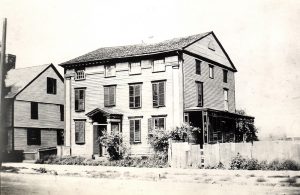
(The photo above shows Samuel Holden Parsons’s house in Middletown, now gone, from Damien Cregeau’s article “Top Ten Demolished Houses of Revolutionary War-Era Connecticut” for the Journal of the American Revolution.)

Saturday, March 23, 2024

Lt. Ragg in the Assault on Brooklyn

In June 1776, Lt. John Ragg of the marines was in Halifax, Nova Scotia, with the rest of the British military force evacuated from Boston.

In July, Ragg was in the fleet of forty-five ships that started unloading British soldiers onto Staten Island, New York.

More troop transports and Royal Navy warships arrived from other parts of the empire. By the end of July, Adm. Lord Richard Howe was overseeing more than one hundred ships while Gen. Sir William Howe commanded 32,000 soldiers.

Those numbers continued to grow in early August. Among the new arrivals were 8,000 Hessian soldiers.

On the morning 22 August, 4,000 redcoats moved onto Long Island. This was significantly more than the British force in the Battle of Bunker Hill, but it was only an advance guard, about a tenth of Howe’s entire land army.

The Americans drew back. By the end of that day, the British had landed 15,000 men at Gravesend Bay, with 5,000 more to follow a couple of days later.

The two armies dug in warily for the next two days. The Americans held the Brooklyn and Guan Heights, guarding the main passes.

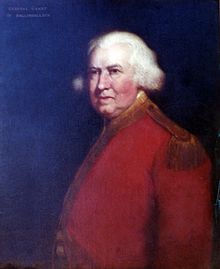
Late in the evening of 26 August, Gen. James Grant (1720–1806, shown above) sent a force of about 4,000 British and Hessian men forward against the Continentals. The first major skirmish was around the Red Lion Inn. The British captured the American commander, Maj. Edward Burd, and sent his forces fleeing.

Gen. Samuel Holden Parsons of Connecticut managed to gather Continental troops along the Gowanus Road and to send for reinforcements. Gen. Stirling arrived with about 1,500 men from Maryland and Delaware. Under his command, the Continentals moved back toward the Red Lion Inn.

Meanwhile, Gen. Grant’s Crown troops were also growing, up to 7,000. That force included the 2nd battalion of marines.

According to a letter written on 4 September by a British officer to a friend in Aberdeen, and published in the Scots Magazine, the marine battalion “was sent from our right to support Gen. Grant.”

In the fighting on 27 August, those marines came under “several fires” from a unit dressed in blue uniforms with red facings. Those were the colors of some Hessian regiments while most of the Continental Army had no uniforms at all, so the British officers assumed that was friendly fire.

Lt. Ragg and twenty men from his grenadier company were “sent out to speak to” those Hessians.

TOMORROW: They weren’t Hessians.

Wednesday, February 05, 2020

Trading for Gunpowder Just Before the War

Last year I wrote about the New London, Connecticut, merchant Nathaniel Shaw, Jr., and his many ways of evading Customs duties on molasses and other goods.

Shaw’s experience moving molasses from the Caribbean to mainland North America was useful as New England went to war in 1775. The army outside Boston needed gunpowder and weapons, things that were on sale in West Indies as long as Americans had money to pay for them and ships to carry them past Royal Navy patrols.

In fact, Nathaniel Shaw started to trade in military supplies even before the war began. On their website the authors of a new book, Two Revolutionary War Privateers: William and Joseph Packwood of Connecticut, describe the voyage that the older of those two brothers undertook on Shaw’s orders:
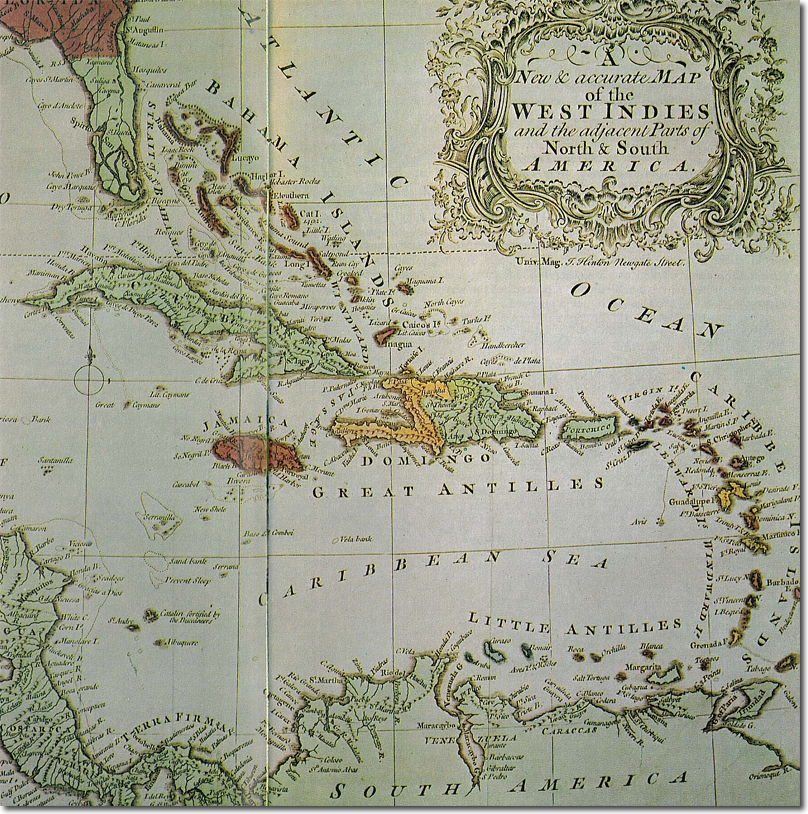
Capt. William set sail on 7 Feb 1775 on the Macaroni with orders to obtain as much gunpowder and arms as he could. He visited many Caribbean islands in his search. After a three-week time period, Capt. William was at Anguilla (British) which is 230 miles east of Puerto Rico. . . .

Unable to purchase gunpowder at most places he stopped, Capt. William made his way down the Leeward Islands to St. Eustatius (Dutch) on March 1, Martinique (French) on March 4, and Dominica (French until 1763, then British) on March 6. . . .

Capt. William then went to Guadeloupe (French) on March 7, back to St. Eustatius on March 9, and finally to Haiti (French) on March 15. During the last half of March, he went back and forth between two of the major trading ports in Haiti: Môle Saint-Nicolas on the northwest tip of the island and Cap-Haïtien (called Cap François at the time) on the north coast midway to the Dominican Republic, the Spanish part of the island. He returned to St. Eustatius on April 9 and then went back down to the Môle on April 16.
Back in Connecticut, Shaw was keeping a keen watch on the markets. On 6 April, he wrote to a merchant in Guadeloupe that gin was selling slowly in New York and “Nothing will command cash but Molas. and Powder.” Two days later, after a request that Samuel Holden Parsons passed on for Roger Sherman, Shaw ordered “fifteen Tons of Lead” from his usual trading partners in Philadelphia.

On 25 April, soon after New London received word of the fighting in Massachusetts, Capt. Packwood returned to port. Shaw immediately wrote to Gov. Jonathan Trumbull:
Agreable to your Desire I have Sent up Eighty Three Barrels of Powder to Colo. Jed. Huntington Containg about 108 Each

the Remainder is in this Town I hourly Expect Thirty Two Barrels more that I have Account of the Capt. having it on bord

the Remainder of what Moneys was in My hands Capt William Packwood left with Capt. Jno. Mckibbin who is in One of my Vessels in the West Indies to Lay out in the first Powder that Arives, he says that a large Quantity was Daly Expected

he purchased all that Could be had and thought it best to push home with this Rather than Tarry Longer—this Quantity he Obtain’d through the Influence of the Famous Palunkey (who was An Old Commander of a Private Tear the Warr before Lasts) who Prevailed with the Governour of the Cape to take it out of the Kings Store—

In Short Packwood Says the French Seem to be Disposed in the Islands to Assist in this way as Much as in their power, I Intend he Shall Sail Again for the Cape Next Week and I Don’t Imagine he will be Gone More than Six weeks If you Intend to have any more Money Laid out in that way it will be a good Oppertunity 
The same day, Shaw told his New York connection that Packwood had brought back “fifty One Hogsheads and Eleven Terses of Mollasses and four hogsheads of Cocoa.” That voyage wasn’t just about military supplies. And Shaw hadn’t lost his usual “hope you’l Save the Dutys” by evading the Customs men.

TOMORROW: Placing a bigger order.