


J. L. BELL is a Massachusetts writer who specializes in (among other things) the start of the American Revolution in and around Boston. He is particularly interested in the experiences of children in 1765-75. He has published scholarly papers and popular articles for both children and adults. He was consultant for an episode of History Detectives, and contributed to a display at Minute Man National Historic Park.

Subscribe thru Follow.it


•••••••••••••••••


Showing posts with label John Bourne. Show all posts

Friday, November 24, 2023

“Three days after the Boston Tea Party”
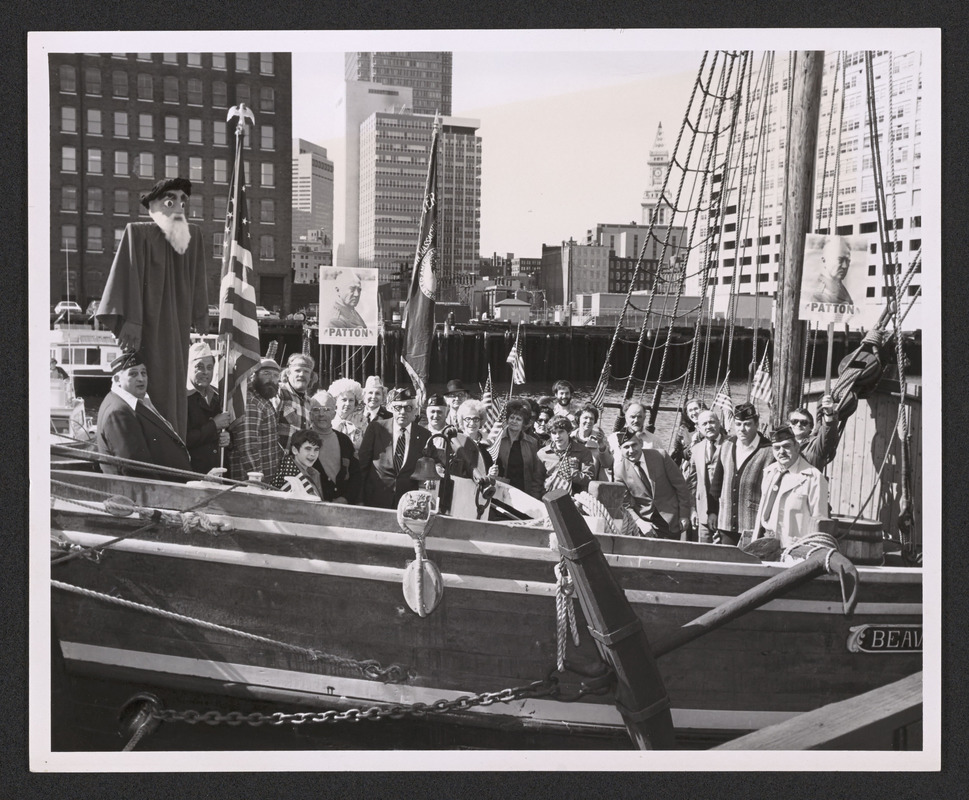
In 1966, Congress and President Lyndon B. Johnson established the American Revolution Bicentennial Commission.

That body would accomplish little, but it shows that some Americans were looking ahead to the anniversaries of the Revolution.

On 16 December of that year, the Disabled American Veterans of Massachusetts performed a reenactment of the Boston Tea Party. The first replica ship wouldn’t open for another seven years, so they used another sailing vessel moored along the waterfront.

The next day, people in Marshfield reenacted the burning of tea in their town. According to the Quincy Patriot-Ledger, this commemoration took place “at the foot of Tea Rock Hill.” The tea was paraded from “the old Proctor Bourne Store (now LaForest’s),” and a Bourne descendant set it alight. There was a handbell choir.

The Patriot-Ledger’s stories on the event, both before and after, quoted liberally from Joseph C. Hagar’s tercentenary history of Marshfield, as I did yesterday.

The newspaper said the tea-burning in Marshfield happened “a few nights after the famous Boston Harbor event in December, 1773,” but was no more specific than that.

Ten years later, a Bicentennial publication pinned the event to a specific date. Of Tea and Tories was written by Cynthia Hagar Krusell, a granddaughter of Joseph C. Hagar and also a descendant of someone named Thomas involved in the original burning. (Two families named Thomas were among the first English settlers in the town, so by 1773 this could mean any number of people.)

Krusell was vice-chairman of the Marshfield Bicentennial Committee, which published her booklet in 1976. A trained artist, she drew a map and genealogies for it. About the tea-burning she wrote:
The first rebel action occurred at midnight December 19, 1773, three days after the Boston Tea Party. A band of local Patriots, emboldened by fellow rebels in Boston, crept by night into the John Bourne ordinary by the town training green. They seized boxes of British tea stored there and in Nehemiah Thomas’s cellar, piled them on an ox-drawn wagon and silently bore them to “a stone quite flat on top” which stood on the crest of a nearby hill, thereafter immortalized as Tea Rock Hill.

Sensing the impact of the moment, they knelt in humble prayer while Jeremiah Lowe touched the tea with his torch, igniting simultaneously the spark of Revolutionary fervor in Marshfield.
So far as I can tell, Krusell’s publication was the first to specify a date for the burning, 19 December. But she didn’t cite evidence for that detail or others. Nothing in her list of sources leaps out to suggest the date came from a diary or other document that previous historians hadn’t seen.

In 1773, the 19th of December was a Sunday. People gathered in their congregations, and they probably did discuss the destruction of the tea in Boston. However, New Englanders tended not to carry out political actions from Saturday night through Sunday night, viewing that stretch as the Sabbath.

COMING UP: After a Thanksgiving break, lingering questions.

(I couldn’t find good photographs of the 1966 reenactments. The photo above, courtesy of Digital Commonwealth, shows a different Disabled American Veterans demonstration aboard the recreated tea ship Beaver, probably in 1979 or 1980, since the group was protesting Ayatollah Ruhollah Khomeini.)


Thursday, November 23, 2023

The Tercentenary Telling of the Marshfield Tea Burning

In 1940, the town of Marshfield celebrated the 300th anniversary of its founding.

Among the projects of the Tercentenary Committee was the publication of a new town history assembled by Joseph C. Hagar, who had succeeded Lysander S. Richards as head of the local historical society.

That book’s title page says: Marshfield 70°–40´W : 42°–5´N: The Autobiography of a Puritan Town. Book cataloguers have been divided on whether the title includes that longitude and latitude, or whether they’re just too much trouble.

On the burning of tea in the town, Hagar wrote:
The British had brought a large quantity of tea to the town, which they were unable to sell on account of the high price. They stored it in various places in the village.

On the southwest side of the old Marshfield Training Green is a hill on which now stands quite a modern residence. This hill is known as Tea Rock Hill, although the rock itself has been blasted and pieces used in the foundations of two nearby homes. The ledge, however, is still visible.

Not far away toward the South river, but northeast from the hill, stands the former old John Bourne store, now a fairly modern Post Office. The store was built in 1709. Toward the east are two houses of interest, both being old Thomas homes. . . . [One was] the residence of Nehemiah Thomas; and in his cellar was stored some of the tea which had been brought into the town. More tea was stored in the old Bourne store.

A few days after the Boston Tea Party, the enthusiastic patriots of Marshfield (one of whom, Jonathan Bourne, fought in the battle of Bunker Hill) marched quietly and earnestly to these places and secured the tea there stored. This act required courage and conviction as Marshfield had such a strong Tory element. The tea was loaded onto an ox-cart and hauled to Tea Rock Hill.

Among the patriots were women and children as well as men. Mr. Charles Peterson remembers that his grandmother told him she was one of the group.

On the top of the hill they placed the tea “upon a stone quite flat on top” and as it was evening, they knelt in the dim light of the primitive lanterns and offered prayer. A torch carried by Jeremiah Lowe was applied to the tea and it was burned. Jeremiah Lowe was later forced to flee to New York with his family.
Hagar’s book doesn’t cite evidence for specific statements. It echoes passages from sources like the D.A.R. description of the event, sometimes word for word, without acknowledgment. It contains errors. (There was no Jonathan Bourne, for instance.) All that makes it a frustrating source to work with, but it was the towns’s official tercentenary history.

This book adds a couple of details to the story of the tea burning, such as the pause for prayer before the bonfire—apparently based on what Charles Petersen’s grandmother told him.

Most important, Hagar’s recounting specified a new location for the stash of confiscated tea: “the former old John Bourne store.” In terms of commemoration, that had a couple of advantages over Deacon Nehemiah Thomas’s house, the only place previously named:
  • First, it was closer to Tea Rock Hill, making for a more compact commemoration.
  • Second, it still existed, albeit as a part of a larger building.
That building still stands today, as shown above in a photograph from Patrick Browne’s article at Historical Digressions.

TOMORROW: Two generations on, and the first reenactment.