J. L. BELL is a Massachusetts writer who specializes in (among other things) the start of the American Revolution in and around Boston. He is particularly interested in the experiences of children in 1765-75. He has published scholarly papers and popular articles for both children and adults. He was consultant for an episode of History Detectives, and contributed to a display at Minute Man National Historic Park.

Subscribe thru Follow.it


•••••••••••••••••


Showing posts with label Rufus King. Show all posts

Wednesday, May 13, 2026

“Stimuli to induce him to be useful to this Country”

One of the questions asked after yesterday’s talk on young Benjamin Thompson’s life in America was whether he interacted with any representatives of the U.S. of A. during his European career.

For example, did the former Woburn farmboy, royal government undersecretary, and British cavalry officer cross paths with John Adams, minister to Britain in the 1780s?

It appears that the two men never met since the first letters they exchanged, in 1796, show no personal acquaintance. By then Thompson had become the celebrated Count Rumford, and he was sending Adams a volume of his scientific papers and a large sum to endow a prize through the American Academy of Arts and Sciences. Rumford continued sending volumes to Adams through the Rev. William Walter.

In 1799, Abigail Adams wrote of “Rumfording our Chimney’s, which I shall be for trying. I am persuaded half the expence of fuel may be saved, and Rooms kept equally warm.” The Woburn native had become famous enough to be a verb.

In 1820, John Adams sent off multiple letters pursuing the theory that “the late learned ingenious scientific public Spirited and benevolent Count Rumford” was a descendant of “the well known Rev. William Tompson of Braintree.” (He was not.)

But the most striking intersection between Rumford and Adams arose in June 1799, when Adams’s secretary of war, James McHenry, wrote about inducing the count to offer his talents to the U.S. Army:
I think it was mentioned to you, some time last winter, by the Secretary of State [Timothy Pickering], in consequence of a letter he had just received from Mr. [Rufus] King [minister to Britain 1796–1803 and 1825–26], that Count Rumford intended to visit his native country, at which you seemed pleased, and expressed yourself favourably of his talents.

Mr. King has renewed the subject to the Secretary of State, and in a letter to me, which I have the honour to inclose. As the reference of the subject to me, can only be meant so far as it respects the military department, I beg leave to submit for your consideration, whether it would not be to the advantage of the United States to make such a proposal to the Count, which if accepted, would ensure to the army the full benefits of his skill and experience.

There is still a vacancy of Lt. Colonel, to be filled for one of the Regiments of Artillerists & Engineers. . . .

1. He may be offered the vacant commission of Lt. Colonel and be made also Inspector of Artillery. Or if he prefers it. 2d. He may be invited to accept of the office of Engineer…

As I consider him to be less of an Engineer than an Artillerist, altho in this I may be mistaken I should think it most adviseable to give a preference to the first proposition. If he accepts of it, he can also superintend the establishment of a military academy which the laws so far contemplate, as to have made provision for books, instruments, and teachers.

At any rate, if the Count should refuse himself to either office, the offer cannot be otherwise than grateful, and if he wanted any stimuli to induce him to be useful to this Country, to the extent of his talents, it might have its effect.
Adams had no idea that back in 1775 Thompson had been slipping secret intelligence to Gen. Thomas Gage—a fact that would probably have changed his admiration for the man.

As for Rumford, it’s hard to imagine that a man who had administered an entire country in Europe could be swayed by the prospect of being a lieutenant colonel in America. He never did come back.

Tuesday, October 20, 2015

Panel on Washington in Roxbury, 24 Oct.

On 3 May 1797, Rufus King, then in London as the U.S. minister to Great Britain, wrote this in his diary:
Mr. [Benjamin] West called on me—we entered into politics after speaking of the Dinner at the Royal Academy and of the annual exhibition; Mr. West said things respecting Amer. had changed very much; that people who cd. not formerly find words of unkindness enough now talked in a different language; that the King had lately spoken in the most explicit manner of the wisdom of the American Gov. and of the abilities and great worth of the characters she produced and employed. He said the King had lately used very handsome expressions respecting Mr. [John] Jay and ——— and that he also spoke in a very pleasing manner of Mr. [Christopher] Gore.

But that in regard to Genl Washington, he told him since his resignation that in his opinion “that act closing and finishing what had gone before and viewed in connection with it, placed him in a light the most distinguished of any man living, and that he thought him the greatest character of the age.”
Two years later, on 28 Dec 1799, the British painter Joseph Farington called on West, and the older man began telling stories about British-American relations. According to Farington’s diary, West described this conversation with George III at some unspecified time toward the end of the war:
The King began to talk abt. America. He asked West what would Washington do were America to be declared independant. West said He believed He would retire to a private situation.—The King said if He did He would be the greatest man in the world.
West might have amalgamated his conversations with the king, but it’s clear that by the late 1790s George III firmly admired Washington for how he stepped away from positions of authority.

On the afternoon of Saturday, 24 October, the Shirley-Eustis House in Roxbury will host a panel discussion about Washington’s recurrent decision to give up power: “George Washington: The Ruler Who Would Not Be King.” The panelists include:
  • Dr. Robert Allison, chair of the History Department at Suffolk University and author of numerous histories of the Revolution.
  • Dory Codington, author of the Edge of Empire series of novels.
  • Stephanie Davis, journalist and founder of Embedded Systems of Boston.
The event begins at 3:00 P.M. Refreshments will be served in the second hour. Admission is $10 in advance, $15 at the door. Register through Eventbrite.

Monday, December 13, 2010

The Ratification Response

Thanks to everyone who submitted answers to Friday’s quiz on Constitutional trivia. All commenters got at least one answer correct, many got more than one, and correct answers seemed to be proportionate to amount of time available for Googling.

Here are the answers I was looking for.

1) Of the South Carolina delegates to the Constitutional Convention, Pierce Butler had lived in Boston in 1769-70. Younger son of an Irish baronet, Butler entered the British army and in the late 1760s was a major in the 29th Regiment of Foot. That regiment was sent to Boston in late 1768, and Butler arrived a few months later.

On 5 Mar 1770, Pvt. Hugh White of Butler’s company was on sentry duty at the Customs house, where he started the spiral of violence that led to the Boston Massacre. Butler played little role in that crisis. He had apparently already set his sights on marrying the heiress to some South Carolina slave-labor plantation, and in 1771 he achived that goal and retired from the army. At the Constitutional Convention and later in the U.S. Senate, Butler was a strong voice for his elite landed class.

2) When Rufus King hypothesized on 20 Jan 1788 that another politician would “improve in his Health as soon as a majority shews itself on either side of the convention,” he was writing about Massachusetts governor John Hancock, and his state’s ratifying convention.

Hancock was very good at amassing popularity in Massachusetts, and very reluctant to spend any of that political capital. He reserved judgment on the new U.S. Constitution for a long time, pleading illness as a reason for keeping away from the public debate. Federalists convinced Hancock to become the spokesman for the idea of ratifying the document while proposing amendments, which might have been decisive in building a majority. (Some historians suggest they dangled the possibility that Hancock himself might become President.)

I chose that quote from King in part because I found it interesting, and in part because it’s not easy to Google. The document apparently wasn’t known when King’s writings were published in 1894. But the letter does appear in the Documentary History of the Ratification of the Constitution, thanks to the Wisconsin Historical Society.

Hancock also pled illness as an excuse for not coming out to meet George Washington when the President visited New England in late 1789. As at the ratifying convention, the governor finally had himself carried in, swathed in flannel bandages, which deflected criticism that he was being petulant, at least at that moment. Which brings me to the third question, about Washington’s tour…

3. In asking, “Of our six New England states, which did he not visit and why?” I wanted to signal that the question applied to all the New England states that exist now. Some folks missed that parameter at first glance, but, hey, I was being tricky.

As folks noted, two of today’s New England states didn’t exist as such in 1789. Vermont was an independent country, so Washington never went there. (In 1912 one regional historian tried to claim otherwise.) Maine was still part of Massachusetts, but Washington’s record of his 1789 trip includes a brief touchdown “at a place called Kittery in the Provence of Main,” so I count that as a visit.

The second New England state Washington didn’t visit was Rhode Island. In late 1789 it had yet to ratify the Constitution or send delegates to the new bicameral Congress. The President’s choice to skip entering that state was taken as a sign of displeasure. The next year, Rhode Island finally ratified with suggestions and started participating in the new national government.

Congratulations to all the commenters who posted correct answers. The randomly chosen winner of a copy of Pauline Maier’s Ratification: The People Debate the Constitution, 1787-1788, supplied by the publisher, is Liberty Atheist. (L.A., please send me an email or comment with a surface-mail address, and I’ll mail the copy this week.) For the rest of us, we can enjoy Maier’s talk about her new book at the Massachusetts Historical Society, via the Forum Network.

Friday, December 10, 2010

The Great Ratification Giveaway

Simon & Schuster sent me an extra copy of Pauline Maier’s new book Ratification: The People Debate the Constitution, 1787-1788, so I’m going to pass it on to a Boston 1775 reader. I’ve never done this sort of thing before, so I’m making up rules and hoping they work.

Below are three New England-based trivia questions about the complex process by which the U.S. of A. reshaped its government in 1787-1789. Answer all three Constitutional questions in a comment to this posting on this Blogspot/Blogger site.

I’ll screen all those Blogspot/Blogger comments so they’ll remain hidden until after Sunday at 9:00 P.M., Boston time. At that time, I’ll number all the comments that contain the correct answers and pick one winner randomly. After posting the answers here on Monday, I’ll contact that winner by email to get a surface-mail address where I’ll send the book. Sound like a plan?

(If you can’t sign in to Blogger, please add a name or pseudonym to your comment instead of remaining anonymous so I can identify you. If you comment on Facebook, your answers will be visible to some people—but to be honest I don’t understand how Facebook works.)

Here are the three questions:

1) Of South Carolina’s four delegates to the 1787 Constitutional Convention in Philadelphia, one lived in Boston for several months in 1769-70. Who was this man, and what was he doing in New England?

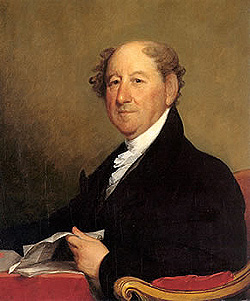
2) On 20 Jan 1788, federalist Rufus King (shown above, courtesy of Springfield Tech’s Shays Rebellion site) wrote to Horatio Gates that one prominent politician

has been confined to his Chamber ever since the Convention met [i.e., convened]—I have called on him several Times, and been indulged in common with every other person, to see him in his Chamber—he is not yet able to attend the Convention, but I hope he will improve in his Health as soon as a majority shews itself on either side of the convention—
Which convention was King writing about, and who might have been using illness to avoid committing himself until he knew which way the wind would blow?

3) After becoming President under the new Constitution, George Washington made a trip through the northern United States in late 1789. Of our six New England states, which did he not visit and why?

Good luck!

Friday, April 04, 2008

Royall Tyler and What “Dissipation” Meant

So what do I have against Royall Tyler, the young lawyer who said such flattering things about Abigail and John Adams while he courted their daughter in 1782? (This was the younger son of the canny Boston politician Royall Tyler. Picture at right courtesy of NNDB.com.) Why do I say that John’s first, unfavorable response to news of the young suitor, when he wrote to Abigail, “I dont like your Word ‘Dissipation’ at all. I dont know what it means, it may mean every Thing,” was probably wise?

The younger Tyler (1757-1826) received his bachelor’s degree from Harvard in the exciting year of 1776, and then stayed around Cambridge for a while to earn a master’s. During this time he studied law under Francis Dana, who showed up in the John Adams miniseries as minister to Russia (and as such boss of young John Quincy Adams), and Benjamin Hichborn, who didn’t show up on T.V. as the young lawyer who was captured carrying some letters that embarrassed John Adams.

The painter John Trumbull later wrote:

At this period, 1777-8, a club was formed in Boston of young men fresh from college, among whose members were Rufus King, Christopher Gore, William Eustis, Royal Tyler, Thomas Dawes, Aaron Dexter, &c. &c.,—men who in after life became distinguished. The club generally met in my room, regaled themselves with a cup of tea instead of wine, and discussed subjects of literature, politics and war.
Tyler probably drank more than tea during these years. In 1777 he and King were accused of “profanity, noises and breaking windows in Cambridge.” To the university disciplinary committee he declared, “What do I care for a little paltry Degree which may be bought at any time for twenty shillings”?

In 1779 a twenty-three-year-old Harvard housekeeper named Katherine Morse gave birth to an illegitimate child she named Royall. He was long but unofficially identified as Tyler’s child.

Tyler inherited a fairly large fortune and spent about half of it before moving to Braintree to establish himself as a lawyer in early 1782. That was when he began courting the Adams family. His practice did well, and he bought a farm. He secured John and Abigail’s blessing to marry their daughter, Nabby, when the family returned from Europe—and then he neglected her while she was away. Nabby broke off the relationship, as I described yesterday.

Tyler then moved to Boston. In Braintree, he had first lived in the house of Richard and Mary Cranch; Mary was Abigail Adams’s older sister. In Boston, he moved in with another family he’d met in Braintree, the Palmers. Joseph Pearse Palmer was a nephew of Richard Cranch and son of Joseph Palmer, an important Massachusetts official at the start of the war. However, the family had suffered financial difficulties. Joseph P. Palmer was away from home seeking work, and his wife Elizabeth was renting out rooms.

“Family tradition” is often unreliable, especially when it puts the family in a more favorable light than any documentation suggests. However, traditions among Palmer descendants say that Tyler was the father of at least one daughter by Elizabeth Palmer while her husband was out of town. Tyler apparently also had sexual relations of some kind with the Palmers’ daughter Mary, born in 1775. One theory even suggests that Elizabeth’s youngest daughter, born in 1791, was actually Mary’s daughter by Tyler.

By then, Tyler had written The Contrast, the first significant American play. He had also established himself as an attorney in Vermont, settling there in 1790 and eventually becoming chief justice. He would continue to write for the public throughout most of his life, publishing political satires, travel essays, and the popular novel The Algerine Captive in 1797.

According to Mary Palmer’s memoirs, published in Grandmother Tyler’s Book (1925), she and Royall Tyler secretly married in Framingham in May 1794. She gave birth in December, eight months later. As she saw it, “it was ordered by Providence that my first-born, Royall, should compel his father to acknowledge the state of affairs before he meant to do so.” However, it wasn’t until February 1796 that Royall Tyler finally arrived at the Palmer family home to take Mary and the baby to Vermont with him. Even if there had actually been a secret marriage before the birth, that doesn’t reflect well on Tyler.

Other branches of the Palmer family spoke less well of the man than his wife Mary did. In 1833, her sister Elizabeth Peabody published an essay in the Christian Examiner describing an unnamed villain:
a polished man of literary eminence, [known] to enter the sanctuary of sleeping innocence, of absolute childhood, for the basest purpose. . . . He seduced the woman, whose children he would have corrupted, caused the self-murder of a wife and mother, and afterwards married the daughter of that victim.
Five years later Nathaniel Hawthorne wrote in his notebook of plans for “A political or other satire” in which “the incident of Judge Tyler as related by E—— might be introduced.” Hawthorne’s informant was his future sister-in-law Elizabeth Palmer Peabody, daughter of Elizabeth Peabody. The book Hawthorne planned became The House of Seven Gables, and Royall Tyler was supposedly the inspiration for Judge Jaffrey Pyncheon.