J. L. BELL is a Massachusetts writer who specializes in (among other things) the start of the American Revolution in and around Boston. He is particularly interested in the experiences of children in 1765-75. He has published scholarly papers and popular articles for both children and adults. He was consultant for an episode of History Detectives, and contributed to a display at Minute Man National Historic Park.

Subscribe thru Follow.it


•••••••••••••••••


Showing posts with label Joseph Palmer. Show all posts

Friday, July 05, 2024

Isaac Bissell and My “More Plausible Scenario”

Earlier this week the Journal of the American Revolution published my article “The Story of Isaac Bissell—and the Legend of Israel Bissell.”

With the sestercentennial of the Battle of Lexington and Concord coming up next spring, I thought it was high time to put on record the evidence that the name of the man who carried Joseph Palmer’s alert from Watertown was Isaac Bissell, not (as the name was first misspelled by people copying it in a hurry) Israel Bissell.

That core identification was made years back by Lion G. Miles, and I give him full credit in the article, as I have in my talks on the topic.

I also felt obligated to add something new to the story if I could. That led me into digging up new material on the close but secret relations between the Massachusetts Provincial Congress and the government of Connecticut, an earlier note sent by Palmer, and the details of Connecticut’s alert.

But still, the core of this article is Isaac, not Israel, Bissell.

The first footnote ends:
As of this writing, Wikipedia includes entries for both Isaac Bissell and Israel Bissell, the latter supposedly taking over in Worcester from a man with a nearly identical name. This article presents a more plausible scenario.
The same situation pertains today. It’s hard to correct hallowed traditions, even if replacing the name of one young Connecticut farmer for another makes little difference to most people today.

If during next spring’s anniversary more commemorations and articles name Isaac Bissell, I’ll feel this study has fulfilled its purpose.

We can thank Israel Bissell for his brief military service in 1776 and acknowledge that lauding him for the last century was literally a typographical error.

Tuesday, April 09, 2024

“The Regular Troops have this morning kill’d six men”

Here’s what appears to be an authentic document from 19 Apr 1775. It was sold by Heritage Auctions in June 2017, but the company has preserved an image for us.

This short note reads:
To all whom it may concern, be it known, that the Regular Troops have this morning kill’d six men near Lexington Meeting House; this news is brot: to Watertown by Mr. Sanger, who told me that he saw the men lie dead.

J. Palmer
of the Congress Com:tee

Watertown, Wednesday Morning abt 8 o’Clock
Joseph Palmer (1716–1788) was a Massachusetts Provincial Congress delegate from Braintree and a member of the committee of safety and supplies. He was staying in Watertown with in-laws.

Two hours later, “near 10 o’Clock,” Palmer wrote a longer, more detailed letter that he sent to Hartford, Connecticut, with courier Isaac Bissell. That dispatch reported that a British relief column was out. By then, Palmer wrote, he had “spoken with Several Persons who have seen the Dead & Wounded.”

Along the way that letter was copied and sent south, its text mutating as it was hurriedly transcribed. I don’t think the original of that letter exists, but many handwritten and printed copies do, making it rather famous.

This first, shorter letter shows that Palmer had heard about the deaths on Lexington common by eight o’clock and started to spread the news on behalf of the congress’s committee. It’s unclear whom he addressed this particular note to, however.

I also can’t identify “Mr. Sanger.” There were multiple men with that surname in Watertown at this time, including David Sanger, on an October 1774 committee to equip two cannon, and Samuel Sanger, first sergeant of the militia company.

That’s a reminder that, even though some documentation survives to show such men as Joseph Palmer spreading the alarm in April 1775, many more people did so without leaving a firm trace in the historical record.

Wednesday, August 02, 2023

“To pass unmolested into the town of Boston”

On Sunday, 30 April, the Massachusetts committee of safety:
  • heard from Col. Benedict Arnold of Connecticut about artillery up along Lake Champlain.
  • ordered Maj. Timothy Bigelow to move weapons from Worcester to the siege lines.
  • hired an express rider.
  • urged its subcommittee of Azor Orne, Richard Devens, and Benjamin White to “form a plan for the liberation of the inhabitants” of Boston now that Gen. Thomas Gage was allowing them to leave.
So this committee wasn’t idle.

Probably after being stung by the letter from the Massachusetts Provincial Congress quoted yesterday, the committee appointed its chair, Dr. Joseph Warren, along with Joseph Palmer and Orne, to take their resolution out to that body in Watertown.

The committee’s recommendation was:
Whereas, proposals have been made by General Gage to the inhabitants of the town of Boston, for the removal of their persons and effects into the country, excepting their arms and ammunition:

Resolved, that any of the inhabitants of this colony, who may incline to go into the town of Boston with their effects, fire-arms and ammunition excepted, have toleration for that purpose, and that they be protected from any injury or insult whatsoever. This resolve to be immediately published.

The following orders were delivered to Col. Samuel Gerrish:
You are hereby empowered, agreeably to a vote of the Provincial Congress, to grant liberty, that any of the inhabitants of this colony, who may incline to go into Boston with their effects, fire-arms and ammunition excepted, have toleration for that purpose; and that they be protected from any injury or insult whatsoever, in their removal to Boston.

The following form of a permit is for your government, the blanks in which you are to fill up with the names and number of the persons, viz.:
Permit A. B., the bearer hereof, with his family, consisting of persons, with his effects, fire-arms and ammunition excepted, to pass unmolested into the town of Boston, between sunrise and sunset. By order of the Provincial Congress.
Dr. Warren signed that report “clerk pro tem.,” indicating he had taken on yet another job.

The committee of safety addressed only the question of how to reciprocate to Gen. Gage’s decision and let Loyalists enter Boston. It left the bigger question of how to help refugees who had left their homes in that town up to the congress.

The provincial congress made some amendments to the committee’s recommendation, so this is what went out officially:
In PROVINCIAL CONGRESS, Watertown, April 30, 1775.

Whereas an agreement has been made between General Gage and the inhabitants of the city of Boston, for the removal of the persons and effects of such of the inhabitants of the town of Boston, as may be so disposed, excepting their fire arms and ammunitions into the country:

RESOLVED, That any of the inhabitants of this colony, who may incline to go into the town of Boston with their effects, Fire-Arms and Amunitions excepted, have toleration for that purpose; and that they be protected from any injury and insult whatsoever, in their removal to Boston, and that this resolve be immediately published.

P. S. Officers are appointed for the giving permits for the above purposes; one at the sign of the Sun at Charlestown, and another at the house of Mr. John Greaton, jun. at Roxbury.

Ordered, That attested copies of the foregoing resolve be forthwith posted up at Roxbury, Charlestown and Cambridge.

Resolved, That the resolution of Congress, relative to the removal of the inhabitants of Boston, be authenticated, and sent to the selectmen of Boston, immediately, to be communicated to general Gage, and also be published in the Worcester and Salem papers.

Ordered, That Doct. Taylor, Mr. Bailey, Mr. Lothrop, Mr. Holmes and Col. Farley, be a committee to consider what steps are necessary to be taken for the assisting the poor of Boston in moving out with their effects to bring in a resolve for that purpose; and to sit forthwith.
The congress delegates, having given up their whole Sunday waiting for the committee, then adjourned for the day.

By the time the congress’s resolve was published in the 3 May Massachusetts Spy, the Rev. John Murray had stepped down as its president pro tempore and James Warren of Plymouth had declined the post. So the resolution was published over the name of the new president pro tem., Dr. Joseph Warren. As if he didn’t already have plenty to do.

TOMORROW: Spreading out the refugees.

Monday, April 05, 2021

Commemorating Patriots Day 2021 Safely

Here in Massachusetts we’re still in a race to vaccinate people against the Covid-19 virus even as cases are rising again. The end of the pandemic is in sight, but we need to minimize casualties.

Wisely, the local organizations that lead the commemoration of the Battle of Lexington and Concord are offering online events and discouraging crowds.

On Tuesday, 6 April, the Concord Museum is hosting a “Virtual April 19, 1775, Community Night,” as described here:
Local communities answered the alarm on April 19, 1775. Now, we muster again to commemorate the towns that responded to Paul Revere, William Dawes, and additional alarm riders and converged on the British Regulars in a fight that began an eight-year war for independence.

Join us for a virtual evening with Curator, David Wood, Peggy N. Gerry Curatorial Associate, Erica Lome, and historian and author of The Minutemen and Their World, Robert Gross, for an inside look at the roles Provincials from communities across Massachusetts played in the events now celebrated on Patriots Day.

Get an inside look at the Museum’s new April 19, 1775 exhibition including animations and signature artifacts including the signal lantern hung in the North Church that began the events of that faithful day.
Other organizations involved are the Acton Historical Society, Arlington Historical Society, Bedford Historical Society, Billerica Historical Society, Cambridge Historical Society, Lexington Historical Society, Lincoln Historical Society, Maynard Historical Society, Medford Historical Society, Sudbury Historical Society, The Historical Society of Watertown, and the Edmund Fowle House & Museum.

The community event is scheduled to take place from 7:00 to 8:00 P.M. It’s possible to register and tune in for free, but a $5 donation is requested from those who can afford it.

The town of Lexington is offering similarly safe activities for families and individuals through the 19th. These include online talks by John U. Rees, Carol Berkin, Alexander Cain, and other historians through the Cary Memorial Library. The Lexington Historical Society’s historic taverns are open on a limited basis.

The Scottish Rite Masonic Museum and Library in Lexington has put up an online exhibit of a copy of Joseph Palmer’s letter reporting on the first fighting carried by Isaac Bissell and other riders.

The staff and volunteers of Minute Man National Historical Park have prepared many videos to share for a “Virtual Patriots’ Day” experience through Facebook, YouTube, and other platforms. The Friends of Minute Man webpage explains the offerings. In addition, the park’s main visitor center is now open at limited capacity seven days a week, there are staff outside the North Bridge visitor center Wednesday through Sunday, and the park grounds remain open for outdoor exploration.

Wednesday, October 14, 2020

A New Women’s History Podcast to Enjoy

Your Most Obedient & Humble Servant is a new podcast hosted by Kathryn Gehred, one of the editors working on the forthcoming scholarly collection of Martha Washington’s correspondence.

Each episode digs into one letter to or from a woman in the eighteenth or nineteenth century, highlighting the historical and personal context of that communication.

I like how Gehred and her guests are comfortable with the fact that one of the appeals of historical research is being able to read other people’s private mail.

Episode 5, “An Age of Discovery,” is a fine example. This conversation delves into a letter that Mary Cranch wrote to her younger sister Abigail Adams in 1786. As Gehred and her guest Rachel Steinberg discuss, Cranch crafted her letter to lead up to the juiciest piece of local gossip.

Go listen and come back. Or at least read the letter. Because I’m going to tack more gossip onto this episode.

Mary Cranch was married to Richard Cranch, as the podcast says. He came to America in 1746 with his sister Mary and her husband, Joseph Palmer. The Palmers and Cranches joined the locally grown Quincys and Adamses in making up north Braintree’s Whig gentry.

The Palmers’ eldest son was Joseph Pearse Palmer, who married Elizabeth Hunt across the border in New Hampshire in 1772. He was twenty-two, a recent Harvard graduate; she was seventeen. After the war, the Palmer family moved into Boston, but their fortunes fell through a combination of business failures, ill health, and general economic stress. The elder Joseph Palmer ended up in a dispute over debts with John Hancock before dying in 1788.

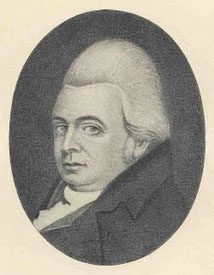
Joseph Pearse Palmer, through professional setbacks, psychological depression, and perhaps other personal issues, spent months at a time away from his family. Elizabeth Palmer took in boarders, including a young attorney and author named Royall Tyler (shown above).

Back in 1782, Tyler had settled in Braintree, boarding with the Cranches. During that time he wooed Nabby Adams, the Adamses’ eldest child. Her parents and the Cranches were more enthused about this than she was. Nabby put Tyler off until she sailed with her mother to Europe. There she met and married William Stephens Smith, the “Coll Smith” mentioned in this letter. Tyler came away with the first surviving volume of John Adams’s diary, eventually discovered among his papers, and looked around for new conquests.

That provided the conditions for the scene Mary Cranch described at the end of this letter, which must have taken place at Elizabeth Palmer’s boarding house in Boston. In the spring of 1786, Joseph P. Palmer had come home after many months to find his wife very friendly with boarder Tyler and a few months pregnant. The baby arrived in September 1786.

“I was determin’d to see” the newborn girl, Mary Cranch told her sister, to confirm that the baby had arrived full term. She saw Joseph P. Palmer, Elizabeth Palmer, and Royall Tyler all in a bedroom together, resolutely not acknowledging anything odd about the situation.

And this is the point I can’t stress enough: Joseph P. Palmer, the dupe of Mary Cranch’s story, was her own nephew.

Monday, February 11, 2019

Abigail Adams Finds “an honest faithfull Man Servant”

On 11 Feb 1784, Abigail Adams was preparing to join her husband John in Europe after years apart.

She wrote to John about hiring household staff:
I am lucky too in being able to supply myself with an honest faithfull Man Servant. I do not know but you may recollect him, John Brisler, who was brought up in the family of Genll. [Joseph] Palmer, has since lived with Col. [Josiah] Quincy and is recommended by both families as a virtuous Steady frugal fellow, with a mind much above the vulgar, very handy and attentive.
John George Briesler had been born in the Germantown section of north Braintree on 4 Dec 1756. Starting in May 1775, he served a little over eight months in an independent company of Massachusetts militia commanded by Capt. Seth Turner. His only experience of battle, he said in his 1832 pension application, was “with the boats from the British Fleet on Nantasket beach.” Evidently he didn’t have his own land to work, but he had the confidence of the town’s richest families.

For a maidservant, Abigail hoped to hire John Briesler’s sister; on “many accounts a Brother and Sister are to be preferred,” she wrote. But she ended up taking Esther Field, a neighbor’s daughter. Esther had been born on 7 Oct 1764, meaning she was nineteen.

Abigail Adams and her household sailed in June 1784. She had an eye-opening time in Europe, living in Paris and then in London after John became the U.S. of A.’s first minister to Great Britain. A New England minister’s daughter, she discovered she actually liked theater and city life, at least in moderate doses.

Young Esther Field seems to have had a mixed time. She resisted French fashions at first. Of even more concern, her mistress reported that “her general state of Health is very bad.” As 1788 came around, Field was sick so often that Adams even arranged for her to be treated with the “Elictrisity.” Not until February did they discover the source of the problem.

TOMORROW: John Briesler had made Esther Field pregnant.

Sunday, September 16, 2018

The News from 250 Years Ago

While looking at the newspaper coverage from 250 years ago this month, I was struck by some of the stories that Bostonians were reading at the same time they digested news of the imminent arrival of army regiments.

For example, the Boston Evening-Post of 12 September contained several reports of lightning strikes on the evening of Wednesday the 7th. One bolt in Wrentham “tore to pieces” a “very large white Oak Tree, which was more than two Feet Diameter,” and threw some pieces ten rods away. Another hit Daniel Mann’s inn, causing lots of miscellaneous damage but not hurting any of the thirty-odd people inside. Unfortunately, that same night lightning killed a ten-year-old boy in Rehoboth. The next evening, lightning set fire to a barn belonging to Joseph Palmer of Braintree, causing £200 worth of damage.

In other news from the 12 September Evening-Post:
Last Wednesday sailed from this Port his Majesty’s Sloop of War the Senegal, as also the armed Schooners, supposed to be bound to Halifax: There now remains in this Harbour with their Pendants flying, his Majesty’s Ship Romney, of 50 Guns, and the Sloop Liberty.

The above Sloop Liberty was sold at public Auction last Tuesday, and was struck off to the Collector of his Majesty’s Customs for this Port, and its said is now to be improved [i.e., used] as a Cruiser for the Protection of Trade.
The Customs service, having confiscated John Hancock’s ship Liberty for alleged smuggling and other legal violations, had bought that ship and planned to hunt down other smugglers with it. I don’t think the Customs service had had its own patrol ship before.

The 12 September Boston Chronicle:
We hear from Salem, that a person there, having given information of a vessel that arrived there with molasses, the populace were so enraged, that they stript him, then wrapped him in a tarred sheet, and rolled him in feathers; having done this, they carried him about the streets in a cart, and then banished him the town for six weeks.
This was the first documented example of tarring and feathering in New England. It established the pattern for such attacks: a crowd publicly punishing a working-class man believed to have helped the Customs service capture smugglers.

The 19 September Boston Chronicle:
Captain [James] Scott brought the account of the arrival of Benjamin Hallowell, jun. Esq; after a passage of twenty-nine days.

Letters brought by Captain [James] Bruce mentioned, that Mr. Hallowell, since his arrival, has had frequent conferences with the ministry…
Hallowell was the Comptroller of Customs in Boston, as well as the son and namesake of a well known merchant captain. He was one of the officers that carried out the confiscation of the Liberty and was then attacked by the crowd. Hallowell had gone to London to complain to the government on behalf of all the Customs officers and to see what compensation he could receive. Eventually he was promoted to be one of the Commissioners of Customs.

More from the 19 September Chronicle:
The Rev. Mather Byles [Jr.]. who went home last May with Capt. Davis, met with a favourable reception from the Bishop of London, was ordained, and is appointed missionary for Christ’s Church in this town, with a salary, it is said, of 40 l. sterling, per annum, and is expected to return with Capt. Davis.
Byles (shown above) was another son and namesake of a well known figure in town—in his case, the learned, punning minister of the Hollis Street Meetinghouse near the Neck. For the younger Byles, a descendant of the Puritan Mathers, to take orders within the Church of England was a big deal. It presaged the family’s long-lasting Loyalism.

From the 19 September Boston Gazette:
Monday in the Night [i.e., on 12 September] the Post contiguous to Liberty Tree was sawed off, the Damage was inconsiderable, but discovers the evil Disposition of the Perpetrators of such a base Action.
The 19 September Gazette:
We hear that last Saturday se’nnight [i.e., 10 September] two Informers, an Englishman and Frenchman, were taken up by the Populace at Newbury-Port, who tarred them; but being late they were handcuffed and put into custody until the Sabbath was over:—Accordingly on Monday Morning they were again tarred and rolled in Feathers, then fixed in a Cart with Halters, and carried through the principal Streets of the Town, to the View of the Gallows, but what further we know not.
The practice of tarring-and-feathering spread rapidly in Essex County.

Finally, from the 19 September Gazette:
We are credibly informed, that the Selectmen of a neighbouring Town have taken Care that their Town be supply’d with a sufficient Quantity of Gun-Powder, as the Law directs; and that the Col. of the Militia there, has declared his Intention to order a strict Enquiry into the State of his Regiment, respecting Arms, Ammunition, &c. . . .

Thursday next there will be a general Muster of the Regiment in this Town, and we hear a critical View of the Arms of the Soldiers.
These actions reflected Boston’s discussion of strengthening the militia ahead of the troops’ arrival.

Friday, September 16, 2016

Guns from Governor’s Island and the Old Gunhouse

On the morning of 15 Sept 1774, Bostonians were buzzing about the action inside their North Battery the night before.

As I described yesterday, British soldiers and sailors had entered that harborside fortification and spiked all the cannon inside. That ensured  that those guns, normally used by a local militia company, could not be fired at the Royal Navy ships in the harbor—at least not for a while.

Whig activist Joseph Palmer assured Robert Treat Paine that those cannons’ touch-holes were soon “drill’d” so they could be used again.

However, within hours Bostonians learned that the maneuver at the North Battery had been only part of the British military’s work the previous night. The Boston Post-Boy had to report, “the Cannon in the Batteries back of Governor’s Island were removed by the General’s Order.”

Gen. Thomas Gage had thus secured ten larger guns from a hard-to-patrol harbor island. Even with the North Battery cannon back in working order, British soldiers patrolling the North End made it hard for the locals to do anything with those guns. The general definitely seemed to come out ahead in that leg of the “arms race” to control local artillery.

However, another development that night never got into the newspapers. Merchant John Andrews explained in a letter to a Philadelphia relative:
Ever since ye. cannon were taken away from Charlestown, the General has order’d a double guard to ye. new and old gun houses, where ye. brass field pieces belonging to our militia are lodg’d:

notwithstanding which, the vigilance and temerity of our people has entirely disconcerted him, for We’n’sday evening, or rather night, they took these from the Old house (by opening the side of the house) and carried [them] away through Frank Johonnot’s Garden.
Those two brass field-pieces were small cannon—probably only two-pounders, compared to six-, nine-, and twelve-pounders in the North Battery and on Governor’s Island. But because they and the Boston train’s other pair were bronze, they stood out from all the other militia cannon in Massachusetts. The Patriots prized them. Gage wanted them back.

Eventually, as I claim in the subtitle to The Road to Concord, those militia guns became the Four Stolen Cannon that Ignited the Revolutionary War.

Wednesday, June 15, 2011

“To take immediate Possession of Bunker’s Hill, and Dorchester Neck”

A couple of days ago, I quoted a warning from New Hampshire to Massachusetts about the British army planning to seize the Charlestown and Dorchester peninsulas.

In response to that and other warnings, the Massachusetts Committee of Safety met on 15 June at the house of Harvard steward Jonathan Hastings and came to this conclusion:
Whereas, it appears of Importance to the Safety of this Colony, that possession of the Hill, called Bunker’s Hill, in Charlestown, be securely kept and defended; and also some one hill or hills on Dorchester Neck [i.e., peninsula] be likewise Secured. Therefore, Resolved, Unanimously, that it be recommended to the Council of War, that the abovementioned Bunker’s Hill be maintained, by sufficient force being posted there; and as the particular situation of Dorchester Neck is unknown to this Committee, they advise that the Council of War take and pursue such steps respecting the Same, as to them shall appear to be for the Security of this Colony.
As Charles Martyn interpreted the documentary evidence in his biography of Gen. Artemas Ward, that commander convened his council of war, also in the Hastings house, and decided:
Resolved in Council of War to take immediate Possession of Bunker’s Hill, and Dorchester Neck.
But Gen. John Thomas wasn’t at Ward’s council of war in Cambridge. In fact, I’m not sure whether he was at any of Ward’s councils of war. And Thomas had responsibility for Dorchester and the southern wing of the siege.

So the Committee of Safety sent two members, Joseph Palmer and Benjamin White, to meet with Thomas. And Ward’s council of war sent Gen. Israel Putnam, Col. Joseph Ward (the commander’s secretary), and Col. Samuel Gerrish to relay its resolve. They were all “to consult with the Commanding Officers at Roxbury respecting the expediency of carrying the above Resolutions into Execution.”

Thomas didn’t take the decision of Ward’s council as an order. He evidently convened his own council of war, and they concluded that they didn’t have the resources to hold the Dorchester peninsula against a likely British countermove. As a result, that area remained a no-man’s land until the following March.

Would the siege of Boston have been different if Gen. Thomas’s troops had taken possession of the Dorchester peninsula at the same time that Ward’s wing marched into Charlestown? Well, sure. But different in what way is hard to figure.

Would Gen. Thomas Gage have split his forces to attack both peninsulas, and not been able to capture either? Or would sending men into Dorchester have weakened Thomas’s defenses in Roxbury, opening the door for a British charge down the Boston Neck?

Given the topography of the Dorchester peninsula, would its hills’ defenders have been cut off? (Most of the provincials who went into Charlestown got out.) Would holding the heights of either peninsula have mattered for the New England forces when they had little to no heavy artillery? We’ll never know.

Meanwhile, in Philadelphia, on 15 June 1775, the Continental Congress appointed George Washington as commander-in-chief of the army it had just created on paper.

(Above is Thomas’s headquarters in Roxbury, now known as the Dillaway-Thomas House. The photograph is by Tim Sackton via Flickr through a Creative Commons license.)

Wednesday, January 26, 2011

“General Washington was exceedingly affronted…”

Back in 2007, when I first wrote about Dr. Benjamin Church’s intercepted letter into Boston, I said that among the men who volunteered to decipher it “was Elbridge Gerry, the Marblehead merchant and politician, who also recruited Col. Elisha Porter.”

And that’s what several authors say. But Gerry’s own letters suggest that he played only a minor part in the deciphering. His major role was obtaining a copy of the coded letter for Porter, a Massachusetts House representative from Hadley, and then spreading around the results.

On Sunday, 1 Oct 1775, Gerry started a letter to Continental Congress delegate Robert Treat Paine with the bad news about Church’s apparent treachery. The next day, Porter received a copy of the doctor’s document. Before Gerry mailed his letter to Paine on 3 October, he could add this confirming postscript:

the Letter (I am informed by Colo. [Joseph] Palmer) is decyphered; the Contents respect the State of the Army, the Quantity of powder now in our possession, what is expected & where, together with other Intelligence of a black & treacherous Nature.
Porter’s decoding exactly matched a translation by the Rev. Samuel West, who had delivered his work directly to Washington at what is now Longfellow House–Washington’s Headquarters National Historic Site. Thus, no one could deny what Church’s letter said.

Was Gen. Washington pleased with Gerry’s activity? Not at all. Gerry also sent Paine a copy of the deciphered letter, and Washington disliked having the Congress learn important news from anyone but him. He hadn’t written his own report on the Church affair yet.

Washington expressed his displeasure to his secretary Joseph Reed, who sent a note to James Warren, speaker of the Massachusetts House and thus in some way Gerry’s boss. On 5 October, Gerry responded to Reed somewhat hotly:
Col. Warren communicated your Letter which you sent him yesterday, affirming that General Washington was exceedingly affronted at my sending to Philadelphia a copy of Dr. Church’s Letter, that I ought to have known better than to have interfered in a matter in which I had not been consulted, to have seen ye impropriety of copying a Letter intrusted in confidence to another person & that I had just as much Right to have taken the original; all of which must appear highly injurious & if not supported by reason & grounded on Facts to be meer Invective, rendered the more unjustifiable by ye Manner in which it was conveyed.

With respect to ye Letter of Doctor Church’s referred to, hearing Sunday Morning that it was intercepted & wrote in cypher, & knowing the Colo. Porter was expert in decyphering, I desired him (as every friend of America had a Right to do) to offer to ye General his services for ye purpose mentioned, but did not apply in person, or by any other conduct whatever give you an opportunity of asserting as you ungenerously have that I had interfered in a Matter in which I had not be consulted. When ye Letter was sent here on Monday Evening Colo. Porter informed me of it, & shewed it without ever a suspicion that it was intrusted in Confidence as is unreasonably represented in your letter to Colo. Warren.

In consequence of which & being somewhat acquainted with decyphering I continue with him untill ye Business was finished agreeable to his desire, He had no objection to my taking a copy & ye person who wrote it having contrary to Directions taken a second copy it was immediately recovered & delivered to Colo. [Thomas] Mifflin who promised to hand it to ye General and take no other without his leave

I think it must now appear that ye copy of ye Letter came properly into my hands; that ye sending it to some particular Gentleman of ye Congress cannot effect ye Tryal of Doctor Church or with any propriety be considered an affront to ye General
Washington and Gerry—who was elected to the Continental Congress and then the Constitutional Convention—continued to work together, but I don’t think their relationship was ever warm. Gerry became an Anti-Federalist, then a Republican governor of Massachusetts and Vice President of the U.S. under Madison. (The bust of Gerry above sits in the U.S. Capitol.)

Saturday, May 01, 2010

“To alarm the country quite to Connecticut”

Last year I quoted Elizabeth Palmer on how her husband and her father-in-law, Joseph Palmer (shown here, courtesy of Warren S. Parker), responded to news of the shots on Lexington common at dawn on 19 Apr 1775.

As I noted in discussing Elizabeth’s tale of Dr. Joseph Warren’s last day, not all that family’s lore pans out. But in this case we have evidence that Joseph Palmer was at work that morning, spreading the word about that shooting.

Joseph Palmer was a member of the Massachusetts Provincial Congress’s Committee of Safety, basically the executive power in the province outside of Boston. He and his extended family had moved from Boston to Watertown to keep away from the royal authorities. Palmer decided to alert other Patriots about the start of the armed conflict by sending a letter off with the post rider heading west toward Worcester and down into Connecticut.

Palmer’s original letter hasn’t survived, but copies did, including this one on display at the National Heritage Museum in Lexington (and conveniently quoted on its blog):

Watertown Wednesday Morning near 10 o’Clock

To all the Friends of American Liberty, be it known that this Morning before breake of Day a Brigade consisting of about 1000 or 1200 Men landed at [David] Phip’s Farm at Cambridge & marched to Lexington where they found a Company of our Colony Militia in Arms, upon Whom they fired without any Provocation and killed 6 Men and Wounded 4 others.

By an Express from Boston this Moment, we find another Brigade are now upon their march from Boston supposed to be about 1000.
This was the reinforcement column under Col. Percy. And the earlier column under Lt. Col. Francis Smith would certainly have argued with Palmer’s statement that they had “fired without any Provocation.”
The Bearer Mr. Israel Bissel is charged to alarm the Country quite to Connecticut and all Persons are desired to furnish him with Fresh Horses as they may be needed.

I have spoken with Several Persons who have seen the Dead & Wounded. Pray let the Delegates from this Colony to Connecticut see this they know.

J. Palmer, one of the
Committee of S——y
Copies of Palmer’s letter provided the first news of the war to many people between Watertown and Philadelphia. It was printed in various newspapers and handbills, and eventually reprinted in the Remembrancer, a London review of the past year’s news.

But Palmer’s short, sketchy report was quickly superseded by more detailed accounts, and this letter was basically forgotten for about a hundred years. Then historians started to cite it as evidence of how the Lexington alarm spread. By the late 1800s Henry W. Longfellow’s poem had made Paul Revere a household name in the U.S. of A., so people wanted to know more about the rider whom Palmer had “charged to alarm the Country.”

TOMORROW: On the trail of Israel Bissell.

Monday, December 28, 2009

Choc-Talk at the Boston Athenaeum, 7 Jan.

On Thursday, 7 January, the Boston Athenaeum will host a lecture by Anthony M. Sammarco on “The Baker Chocolate Company: A Sweet History,” which is also the title of his new book. The talk will start at 12:00 noon. It’s free, but one must reserve a spot by calling 617-720-7600.

The event description says:

The Baker Chocolate Company was founded along the Neponset River in 1765 by Dr. James Baker and James Hannon, a skilled chocolate maker. Over the next two centuries, the company became one of the leading manufacturers of chocolate and cocoa in North America.
I’ve seen notices of similar talks by Mr. Sammarco at other venues, too.

The Baker chocolate factory in Dorchester is often said to be the first in North America. However, the descendants of Joseph Palmer of Braintree wrote that a chocolate factory was among the workshops he and Richard Cranch erected in the Germantown section of that town before the Revolution. And other Bostonians were advertising chocolate in the newspapers as early as the 1720s.

I’m not sure how the Baker Chocolate Company documentation stacks up against the rest. The company has not been shy about promoting its history. Then again, neither were the Palmer descendants.

Tuesday, April 21, 2009

Joseph Palmer’s Letter on Lexington

At the blog of the National Heritage Museum in Lexington, Jeff Croteau offered a look at an official period copy of Joseph Palmer’s letter about the shots at Lexington, sent south with an express rider named Israel Bissell. That letter will be on display in the museum for the rest of this week only.

Joseph Palmer (1716-1788) was born in England and came to Massachusetts in 1746 with his wife Mary and her young brother, Richard Cranch. The two men developed a glass factory (archeological debris here) and other workshops in the Germantown section of Braintree, as explained in this lecture by Warren S. Parker. Cranch married Abigail Adams’s older sister Mary. The Palmers had a son, Joseph Pearse Palmer, and all three men were drawn into Revolutionary politics. Reportedly the older Joseph broke with the London government only after the Boston Massacre.

In 1774, Joseph Palmer became a member of the Massachusetts Provincial Congress, and then of its Committee of Safety. On 18 Apr 1775, he was staying in Watertown at the house of Joseph P. Palmer’s in-laws, the Hunts. That son’s wife, Elizabeth Palmer, later wrote this account:

On the night of the eighteenth of April, I heard the drum beat; I waked Mr. Palmer and said, “My dear, I hear the drum”

He was out of bed with the rapidity of a bullet from a gun and, while he was dressing, his father entered and said, “My son, we must ride, I have received an express. Three men lie dead at Lexington.” My husband was off in an instant.

I entreated the old gentleman not to go, but he would not stay. He told me that there would probably be another brigade along soon and that I had better remove out of the way. They had their horses saddled and their pistols loaded in the barn, for they expected some sudden alarm. They were gone immediately. I never saw anything more of them until the next night at ten o’clock.
I don’t believe all that; the family’s legends don’t all add up. But the letter in the National Heritage Museum’s collection shows that Palmer was active on the morning of 19 Apr 1775, spreading the word about the fight at Lexington on behalf of the Provincial Congress.

Today Jeff has posted about Israel Bissell’s route from Watertown to New York, using Google Maps. It took Bissell only four days riding, which shows how much he hurried. Along the way officials copied Palmer’s letter in order to pass the news on to others, and this document is one of those hurried copies, made for the Committee of Correspondence in Norwich, Connecticut.

[ADDENDUM: Please see Boston 1775’s 2010 postings about Isaac Bissell.]

Wednesday, January 07, 2009

“The Importation of Germans”

In a recent Boston Globe, Stephen Kenney described how our country’s conflicting attitudes toward immigrant labor—both “Stay Out” and “Come Do Our Dirty Work”—have deep roots:

In the mid-18th century, the Province of Massachusetts Bay recruited German immigrants to work as printers and glassmakers. A lottery was established to finance the project, and skilled workers were exempted from military service. . . .

In 1750, the Massachusetts General Court crafted an immigration reform measure: “An Act to prevent the Importation of Germans and other Foreign Passengers in too Great a Number in one Vessel.” It reflected a fear of disease. “Through want of necessary room and Accommodations,” aboard ships, “they may often Contract Mortal and Contagious Distempers [and infect others] on their arrival.” . . .

Today, records of this German immigration remain in the Massachusetts Archives. During the Great Depression they were taped into notebooks as part of a WPA project. A grant from the National Foundation for the Humanities funded their conservation, preserving them from the corrosive effects of brown, oozing tape and iron gall ink.
Among those Germans coming into the Broad Bay area of northern Massachusetts (now Maine) in 1752 were Georg Frederich Seiter, born 1727 in Langensteinbach, and Christine Salome Hartwick. The following year, they moved down to Braintree, when Joseph Palmer and Richard Cranch were trying to establish a glass factory and other early industrial facilities in an area still called Germantown. George and Sarah, as the young immigrants came to be known, got married on 20 Mar 1753.

The Seiders (another name change) had three children in Braintree, the last being a son they named Christopher, baptized 18 Mar 1759. After the glass factory burned, the family moved to Boston, where they had three more children. Around the time of his eleventh birthday, Christopher became the first person to die in a Boston riot against the new Crown policies. (Here’s what happened.) So there’s a direct link between this wave of immigration at mid-century and the Revolution a generation later.

Most of the preceding genealogical information comes from Wilford W. Whitaker and Gary T. Horlacher’s Broad Bay Germans: 18th Century German-Speaking Settlers of Present-Day Waldoboro, Maine, published in 1998 by Picton Press.

Friday, April 04, 2008

Royall Tyler and What “Dissipation” Meant

So what do I have against Royall Tyler, the young lawyer who said such flattering things about Abigail and John Adams while he courted their daughter in 1782? (This was the younger son of the canny Boston politician Royall Tyler. Picture at right courtesy of NNDB.com.) Why do I say that John’s first, unfavorable response to news of the young suitor, when he wrote to Abigail, “I dont like your Word ‘Dissipation’ at all. I dont know what it means, it may mean every Thing,” was probably wise?

The younger Tyler (1757-1826) received his bachelor’s degree from Harvard in the exciting year of 1776, and then stayed around Cambridge for a while to earn a master’s. During this time he studied law under Francis Dana, who showed up in the John Adams miniseries as minister to Russia (and as such boss of young John Quincy Adams), and Benjamin Hichborn, who didn’t show up on T.V. as the young lawyer who was captured carrying some letters that embarrassed John Adams.

The painter John Trumbull later wrote:

At this period, 1777-8, a club was formed in Boston of young men fresh from college, among whose members were Rufus King, Christopher Gore, William Eustis, Royal Tyler, Thomas Dawes, Aaron Dexter, &c. &c.,—men who in after life became distinguished. The club generally met in my room, regaled themselves with a cup of tea instead of wine, and discussed subjects of literature, politics and war.
Tyler probably drank more than tea during these years. In 1777 he and King were accused of “profanity, noises and breaking windows in Cambridge.” To the university disciplinary committee he declared, “What do I care for a little paltry Degree which may be bought at any time for twenty shillings”?

In 1779 a twenty-three-year-old Harvard housekeeper named Katherine Morse gave birth to an illegitimate child she named Royall. He was long but unofficially identified as Tyler’s child.

Tyler inherited a fairly large fortune and spent about half of it before moving to Braintree to establish himself as a lawyer in early 1782. That was when he began courting the Adams family. His practice did well, and he bought a farm. He secured John and Abigail’s blessing to marry their daughter, Nabby, when the family returned from Europe—and then he neglected her while she was away. Nabby broke off the relationship, as I described yesterday.

Tyler then moved to Boston. In Braintree, he had first lived in the house of Richard and Mary Cranch; Mary was Abigail Adams’s older sister. In Boston, he moved in with another family he’d met in Braintree, the Palmers. Joseph Pearse Palmer was a nephew of Richard Cranch and son of Joseph Palmer, an important Massachusetts official at the start of the war. However, the family had suffered financial difficulties. Joseph P. Palmer was away from home seeking work, and his wife Elizabeth was renting out rooms.

“Family tradition” is often unreliable, especially when it puts the family in a more favorable light than any documentation suggests. However, traditions among Palmer descendants say that Tyler was the father of at least one daughter by Elizabeth Palmer while her husband was out of town. Tyler apparently also had sexual relations of some kind with the Palmers’ daughter Mary, born in 1775. One theory even suggests that Elizabeth’s youngest daughter, born in 1791, was actually Mary’s daughter by Tyler.

By then, Tyler had written The Contrast, the first significant American play. He had also established himself as an attorney in Vermont, settling there in 1790 and eventually becoming chief justice. He would continue to write for the public throughout most of his life, publishing political satires, travel essays, and the popular novel The Algerine Captive in 1797.

According to Mary Palmer’s memoirs, published in Grandmother Tyler’s Book (1925), she and Royall Tyler secretly married in Framingham in May 1794. She gave birth in December, eight months later. As she saw it, “it was ordered by Providence that my first-born, Royall, should compel his father to acknowledge the state of affairs before he meant to do so.” However, it wasn’t until February 1796 that Royall Tyler finally arrived at the Palmer family home to take Mary and the baby to Vermont with him. Even if there had actually been a secret marriage before the birth, that doesn’t reflect well on Tyler.

Other branches of the Palmer family spoke less well of the man than his wife Mary did. In 1833, her sister Elizabeth Peabody published an essay in the Christian Examiner describing an unnamed villain:
a polished man of literary eminence, [known] to enter the sanctuary of sleeping innocence, of absolute childhood, for the basest purpose. . . . He seduced the woman, whose children he would have corrupted, caused the self-murder of a wife and mother, and afterwards married the daughter of that victim.
Five years later Nathaniel Hawthorne wrote in his notebook of plans for “A political or other satire” in which “the incident of Judge Tyler as related by E—— might be introduced.” Hawthorne’s informant was his future sister-in-law Elizabeth Palmer Peabody, daughter of Elizabeth Peabody. The book Hawthorne planned became The House of Seven Gables, and Royall Tyler was supposedly the inspiration for Judge Jaffrey Pyncheon.

Tuesday, March 11, 2008

Dr. Samuel Gelston in and out of Custody

I’m finally getting back to Dr. Samuel Gelston from Nantucket, and how he went from being a respected smallpox inoculator before the war to a prisoner under the Massachusetts General Court.

According to Fred B. Rogers’s article in the 1972 Journal of History of Medicine and Allied Sciences, quoted on David Kew’s Cape Cod History, the friction started in Nov 1775 when H.M.S. Swan anchored off Nantucket. Its captain, James Ayscough, had a good reputation in Rhode Island before the war. He, his wife, and his crew were welcomed by at least some Nantucketers, who didn’t share the mainlanders’ enthusiasm for rebellion. On the 16th, Shubael Lovell (1740-1805) of Barnstable sent the captain a letter saying: “Pray, sir, be pleased to accept a few vegetables, to be delivered to you by Doctor Gelston, a bold and staunch friend to Government...” That letter seems to have been intercepted by Patriots.

On 12 December, after the Swan had left the Nantucket harbor, N. Freeman wrote to Gen. George Washington:

This Shubael, though he appears an ignorant fellow, hath considerable influence among the Barnstable Tories, hath practised coasting [i.e., sailing along the coast] to Nantucket the summer past, and I have no doubt hath communicated every thing of intelligence to the navy, if not frequently supplied them with provisions.

Doctor Gelston, to whom he alludes in his letter, we have taken a number of depositions of his having supplied them considerably from Nantucket. He swears he will do it in defiance of the people, and threatens communicating the small-pox to any one who resists him. I wish he was taken, but cannot get any one, as yet, to join me in sending on for him.
Maj. Joseph Dimmick, commander of Falmouth’s minuteman company, took on that task. He sailed to Nantucket on 30 December, arrested Dr. Gelston, and brought him back to the jail at Plymouth. Shubael Lovell was already there.

The legislature then had to decide what to do with the physician. On 16 Jan 1776, a committee composed of members of both the House and the Council concluded that he had “supplied the enemies of American liberties with sundry articles of provision“ and was “a dangerous person.” It recommended that the General Court make the doctor post a bond of £1,000 and promise not to “assist or correspond with any of the enemies of this country.”

However, the lower house considered that too lenient. Instead, the representatives voted:
whereas, the greatest danger must necessarily result from permitting such persons to go at large and continue their traitorous practices of opposing the measures adopted for our defence, of spreading false and discouraging rumours, and of communicating in formation of all our operations to our unnatural enemies:

And it is, therefore, Resolved, That the honourable Board be, and they hereby are desired to cause the said Samuel Gelston to be forthwith confined in some Jail in this Colony, until it shall appear to the General Court, or other proper authority of this Government, that he can with safety to the United Colonies be again set at liberty.
Two days later, Joseph Palmer of Braintree brought Dr. Gelston from Falmouth to Watertown, where the General Court was meeting. On 22 January, the Council offered another solution, according to Samuel Abbott Green’s Groton During the Revolution: Dr. Gelston should pay the bond of £1,000 and not leave the town of Groton. If he refused, then he would be put in jail in Newburyport. Once again, the House voted against this idea.

The provincial authorities finally sent Dr. Gelston back to the Plymouth County jail. It looks like he may never have reached there. On 3 February the Council acknowledged that he “did make his escape from the Messenger of the honourable House of Representatives, who had him in his keeping.”

The Library of Congress’s American Memory project offers a look at the broadside that the legislature issued on 26 Jan 1776. The text reads:
RAN AWAY from the custody of the Messenger of the General Court, a certain Dr. Samuel Gelston, belonging to Nantucket, a short well set man; had on when he went away a reddish Sheepskin coat, dress’d with the wool inside, and a scarlet waistcoat; he was apprehended as an enemy to this country, ’tis suppos’d he will attempt escaping to the enemy, by the way of Nantucket, Rhode-Island, or New York,—

Whoever will take up said Gelston and deliver him to the messenger of the House of Representatives, shall be well rewarded for his time and expence.
(Thanks to Tom Macy for that lead.)

Dr. Gelston got as far as Rhode Island before being recaptured by 3 February. He must have made contact with some Loyalist or Crown official since Timothy Newell heard news from the doctor in Boston on 29 January.

A man named John Brown [why can’t everyone have uncommon, easily tracked names?] was found to have helped the doctor escape; according to the Boston Gazette, he had agreed to do so for £50. When the authorities arrested Brown, they discovered that he had the audacity to be carrying ten pounds of tea. The Council ordered Gelston and Brown to jail and had the tea publicly burned. So there.

COMING UP: Dr. Gelston goes to trial.