J. L. BELL is a Massachusetts writer who specializes in (among other things) the start of the American Revolution in and around Boston. He is particularly interested in the experiences of children in 1765-75. He has published scholarly papers and popular articles for both children and adults. He was consultant for an episode of History Detectives, and contributed to a display at Minute Man National Historic Park.

Subscribe thru Follow.it


•••••••••••••••••


Showing posts with label Cyrus Baldwin. Show all posts

Friday, April 10, 2026

“With an Irony which inflamed their resentments”

As Crean Brush was seizing linen and woolens for the British military in March 1776, some of the wealthy merchants who owned that cloth complained to Gen. William Howe’s headquarters.

Brush responded with a memo to Gen. James Robertson, who was overseeing the evacuation:
if any Articles were removed which did not answer the description [in Howe’s order] the Parties are only to blame they being repeatedly called on to declare the Contents of each which they obstinately refused—

These People your Memorialist are irritated against him but your Memorialist begs leave to assure your Honor he is fully able to prove that his Conduct toward them was governed with politeness coolness & moderation

true it is that when attempts were made to engage his attention in tedious dissertations on Magna Charta & the rights of British Subjects with intent to retard him in the execution of his Office he did interrupt such Harangues & with an Irony which inflamed their resentments complimented them on their Eloquence which had in Town Meetings been so successful as to throw all America into confusion but that I was upon Business which I was determined to execute without interruption—

The Goods I received from the Stores were taken on board & stowed away with all the care & attention my peculiar Situation would possibly admit and I solemnly aver that from the 5th to the 13th March my own Assiduity was so great that I did not in any one Night allow Myself more than two Hours Sleep…
With the help of his assistants plus “two boys and a man” on board the Elizabeth, Brush managed to pack that brig. Some of Cyrus Baldwin’s goods went onto the Minerva.

At some point Brush’s assistants—Charles Blasquet, Richard and John Hill, and David Cunningham—appear to have asked what arrangements he’d made to get them and their families out of Boston. To his credit, he didn’t just ask what arrangements they’d made for themselves. Instead, Brush recognized that they’d “neglected their own Concerns to serve Government at my request.”

Crean Brush hustled those men and their families onto the Elizabeth into “a small space between Decks.” He later told Gen. Howe they had all brought their own provisions so they “cannot be the least convenience to any Person on board.” Basically, he asked for forgiveness instead of permission.

Brush’s memos to Robertson and Howe, published in the Naval Documents of the American Revolution, document the hurry and disorder of the evacuation. He was managing goods that merchants had asked him to store, goods that he’d seized from Patriots who had left Boston, the cloth that he’d been commissioned to keep out of rebel hands, and his own property. And he was trying, at least on paper, to keep these all separate and safely stored.

Conflict continued even on the Elizabeth. Brush had loaded nineteen barrels of flour on board, on “Major Hutchinsons orders”—I think this was Maj. Frances Hutcheson of the 60th Regiment, the army paymaster. Brush told Robertson:
the second Barrell which was opened I sent for some [flour] which when discovered by Mr [Caleb] Wheaten he imperiously flourished [his sword] over me while in Bed & told me he was surprized at the assurance I dared to shew in giving directions to have any,

Upon which I told him he was an insignificant inpertinent Puppy.

Captain [Peter] Ramsey at that instant came in declared he would not hear one word of the occasion which provoked me to use the words I have mentioned but that if I uttered three words more he would send me Prisoner on board the Commodore—
While dealing with such quarrels, Capt. Ramsey got the Elizabeth out of Boston harbor with the rest of the evacuation fleet by the end of March.

And on 2 April three American schooners captured the ship.

TOMORROW: In custody.

Sunday, April 05, 2026

The Weakness of Cyrus Baldwin’s Power of Attorney

As it became clear that the British military was about to pull out of Boston, Crean Brush moved to seize more property from absent townspeople, as Gen. Thomas Gage had commissioned him to do.

On the morning of 9 Mar 1776, Brush went to the store of Cyrus Baldwin, who had left for Woburn months before. Cyrus’s brother Loammi was even an officer in the Continental Army.

Baldwin’s neighbor, William Jackson, came out of the next shop, the Sign of the Brazen Head. He explained that Baldwin had asked him to look after his property, sending a power of attorney. Jackson had already chided people squatting in another nearby house for “the iniquity” of breaking into Baldwin’s.

Brush “pronounced Baldwin a rebel,” according to Benjamin H. Hall’s History of Eastern Vermont. He demanded that Jackson turn over the key he’d received from Baldwin’s clerk.

Back in 1770 the Sons of Liberty had declared William Jackson an enemy to his country for continuing to import goods from Britain. He had signed one complimentary address to a royal governor after another. He clearly leaned toward the Loyalist side. Nonetheless, Jackson felt honor bound to protect Baldwin’s property.

Jackson went off to find Gen. William Howe for support. Spotting an aide-de-camp, he lodged his complaint, explaining about the power of attorney. The officer sent an orderly sergeant back with Jackson to speak to Brush.

According to Jackson, however, the sergeant told Brush not to touch Jackson’s goods only. Jackson insisted that Baldwin’s goods should be protected as well. “Brush refused to receive the correction unless it was made in writing and by the proper authority.”

Jackson headed back to Gen. Howe’s headquarters, but this time he couldn’t get in to see anybody. By the end of the day Brush and his assistants had broken into the Baldwin storehouse and carted most of the contents to the brig Elizabeth.

According to a newspaper report in April 1776, William Jackson owned or chartered that ship for his departure from Boston. That looks like a mistake. Hall’s account says he ended up on that ship only because “he had determined to remain with his property”—and Baldwin’s property.

Meanwhile, Crean Brush got in to see Gen. Howe.

TOMORROW: A new commission.

Friday, January 12, 2024

“Some of the principal Venders of TEA in Boston”

Last month Prof. Carl Robert Keyes’s Advertisements 250 project highlighted a couple of notices that appeared one on top of the other in the 20 Dec 1774 Boston Evening-Post.

The first was dated 17 December, the day after the Boston Tea Party, and came from “some of the principal Venders of TEAS in Boston.” They were calling a meeting of all the merchants and shopkeepers selling tea to discuss how to respond to the public call for a complete boycott.

Just below that notice, the Fleet brothers printed the advertisement of Cyrus Baldwin, a young merchant. He was offering:
Choice Bohea and Souchong Teas,
Hyson Ditto, at 18s. L.M. [lawful money] per Pound, Indigo, and a small Parcell of Parchment Deerskins &c.—

N.B. The above Teas were imported before any of the East-India Company’s Tea arrived, or it was known they would send any on their own Account.
In other words, Baldwin (or his importer) had paid the Townshend duty on that tea, but before the commodity had become so politically charged.

Keyes noted four other people advertising tea in the same newspaper: “Archibald Cunningham, William Jackson, Samuel Allyne Otis, and Elizabeth Perkins.” None of them included the same disclaimer in their ads that Baldwin did, but tea was just one of the goods they offered. For Baldwin, tea was his main business.

Jackson kept his family’s hardware shop at the Brazen Head and had already become notorious in 1770 as one of the last people defying the non-importation movement. Cunningham was a native of Scotland and also supported the Crown.

Otis, in contrast, was the younger brother of James Otis, Jr., and Mercy Warren, closely tied to the Whigs. Baldwin also favored the Whigs, though not enthusiastically when their politics threatened his business.

As for Perkins, she had been recently widowed at age forty. Her late husband was the merchant James Perkins, and her father (and his mentor) was the wealthy hatter Thomas Handysyd Peck. Elizabeth had therefore been watching the import business all her life, and she was determined to support her children with a shop.

The business of selling tea thus cut across political lines in Boston—yet it had now become political. In the Boston Post-Boy that same day, the notice about the tea vendors’ meeting urged unity: “A common Cause is best supported by a common Association.” If only 90% of the town’s shopkeepers stopped selling tea, then the remaining 10% would benefit from all of that business, and that was a recipe for resentment.

On 29 December, Boston’s tea merchants declared they would stop selling tea after 20 January. And, even though customers might be wanting to stock up in the next three weeks, they wouldn’t take advantage of that situation by raising their prices above a certain level.

Still, that left Cyrus Baldwin with unsold tea. Back in 2015 Chris Hurley recounted what he tried to do with his stock, and what happened next, starting here.

As for the other people advertising tea in the 20 Dec 1773 Boston Evening-Post, Jackson and Cunningham became Loyalists, leaving Boston during the war. Otis parlayed his political connections into being the secretary of the U.S. Senate for its first twenty-five years.

Elizabeth Perkins did well enough in business to be able to make large charitable contributions after the war. One of her sons, Thomas Handysyd Perkins, did even better in the opium trade—another commodity fraught with political meaning.

Monday, August 24, 2015

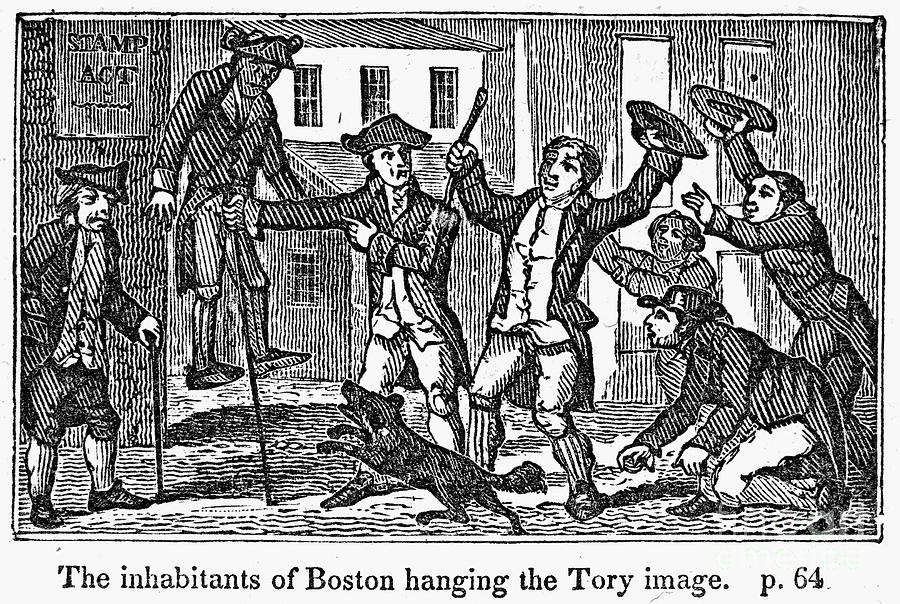
Details of the First Stamp Act Protest

The anonymous account of Boston’s 14 Aug 1765 Stamp Act protest I quoted yesterday also includes a passage that’s prompted a lot of questions about who was behind the event:
…thus Hung the Image thro all the Day tho Three Guineas [£3.3s.] was offerd to any one that should take it down and no one dared to make the Tryall. The Paper on which A. O in Capitals was wrote blew off and at mid Day a person came with an Hanchif over his Face went up with a Ladder and fastnid it on in the Sight of Numbers who dard not obstruct him. It was observd that in making a Slip his Trousers slide up and discovered a silke Stockinge and Breeches answerable in Goodness—from whence you may infer that some of them undress’d were not of the lowest Class.
Trousers were stereotypically sailors’ dress, and this anecdote suggests that a man wealthy enough to afford silk stockings and good breeches had disguised himself as a sailor during the protest. That man was probably a member of the Loyall Nine, the political club that included both better established craftsmen and young merchants.

That evening, “Forty or fifty tradesmen, decently dressed,” led the procession with the effigy, according to Thomas Hutchinson, writing in his capacity as historian. The organizers were obviously trying to present the protest as coming from the middling class, not the gentility.

Another passage from that letter that I skipped yesterday described where that procession went:
They…proceeded to the Town House [shown above in 1751], went thro that and here the noise was Bombs bursting and cannons firing, on this the Governor and Councillors who were above stairs consulting the Dispersion of the Mob, thought it prudent to extinguish their Lights and take to their Heels as fast as they could.
Gov. Francis Bernard’s account said only:
knowing that we were sitting in the Council Chamber, they gave three huzza’s by way of defiance, & passed on.
However, Lt. Gov. Hutchinson confirmed that the crowd was actually in the building:
Just at dark an amazing mob brought the image thro the court house [Town House] the council then sitting above…
And Cyrus Baldwin wrote that the effigy “was brought by the Mob through the main street to the Townhous, carried it through…” The street level of the Town House (now the Old State House Museum) was set aside for a merchants’ exchange. Evidently in the evening it was open to pedestrians.

Baldwin’s letter contains another curious phrase about how the procession started: “after sun sett the North gave up & the South keept not back.” That appears to refer to the North End and South End Gangs, best known from their annual brawl on Pope Night. The effigies, the procession to the center of town, and the bonfire on Fort Hill were all part of the South End Gang’s regular Pope Night ritual.

The South End’s “captain” for that year, shoemaker Ebenezer Mackintosh, was soon being called the leader of the protest movement, so he was probably at the head of those “forty or fifty Tradesmen” who marched the effigy through the Town House. However, as Loyall Nine member Henry Bass wrote at the end of the year, those men were “not a little pleas’d to hear that McIntosh has the Credit of the whole Affair.”

Saturday, August 15, 2015

“They stampd the Image & timber & made a great bonfire”

Yesterday I started quoting John Avery’s 19 Aug 1765 letter describing Boston’s first public anti-Stamp protest five days before. He continued this way:
About Day [i.e., the end of the day] the Mob to about three thousand assembled & cut the sd. Gentleman [effigy of Andrew Oliver], the Devil & Jack Boot down & naild them to a Board which was supported by Four, and carryed thro’ the Town.

When they came by the New Stamp Office they made a Halt, and in about a Quarter of an Hour levell’d it with the Ground. They made another Halt opposite his house where they sawed of his Head and then Proceeded to Fort Hill to burn him, after which they attacked his House, broke his Windows, his Fences were torn down & a fine flower Garden almost destroyed and damag’d his furniture.

The next Day he wisely resigned his office; however notwithstanding his Resignation the Minds of the Populace were so amazingly inflamed that the next Night the Mob assembled again with a Determination to level his House but with great difficulty was Pacyfied.

What will be the Consequence I know not neither do I care but hope that all the Provinces will follow this laudible Example & I pray God that New England assert their Rights & Priviledges and may maintain them & die like Freemen rather than live like Slaves. There are a great many other Impositions that desire as much Notice of in their Order.
Another eyewitness to those events, less involved in planning or trying to manage them, was the young businessman Cyrus Baldwin. The Massachusetts Historical Society has digitized his letter to his brother Loammi dated 15 August. Baldwin described the same events this way:
after sun sett the North gave up & the South keept not back the mob Increased every moment. and they took the Image down, after the performance of some Cerimonies it was brought by the Mob through the main street to the Townhous, carried it through and proceeded to the supposd Stap Office near Olivers Dock and in less than half an hour laid it even with the ground then took the timbers of the house and caryd ’em up on Fort Hill where they stampd the Image & timber & made a great bonfire.

at length the fuel faild they Immediately fell upon the stamp Masters Garden fence took it up stampd it and burnt it, if any piece happen’d to be cast upon the the fire before it was stampd it was puld of and the Ceremony pasd upon it and put on again. not contented with this they proceeded to his Coach house took off the doars stampd ’em & burnt ’em while they was doing this the Sheriff [Stephen Greenleaf] began to read the proclamation for the mob to withdraw which Insenc’d the Mob so much that they fell upon the Stamp Masters dweling house broke glass Casements & all; also broke open the doars enterd the house & bespoil’d good part of the house & furniture, braking the looking glasses which some said was a pitty, the answer was that if they would not bare staming they was good for nothing. the Coach & booby-hutt were drag’d up the Hill & would have been stamp’d & burnt had not some Gentlemen Oppos’d it & with much difficulty they prevented it.

they continued their fire till about 11 oClock then Retired. I beleve people never was more Univassally [illegible] pleasd not so much as one could I hear say he was sorry, but a smile sat on almost every ones countinance. It is reported that Mr. Olver the said Stamp Master wrote to the Governor [Francis Bernard] & Counsel that it was not worth while for him or any body else to accept the office of a Stamp Master in this place. . . . Tis hopd that Mr. Oliver has Suffer'd will be Sufficient warning to others not to take Offices that Encroach upon American liberty.
And indeed there weren’t any volunteers stepping forward to take Andrew Oliver’s place. What had seemed like a profitable appointment was turning quite costly, to both property and popularity.

TOMORROW: The view from the top.

Friday, February 27, 2015

“God Save the People!” Exhibit Opens in Boston

Today the Massachusetts Historical Society opens its “God Save the People!” exhibit about the political conflict in Boston that grew from 1765 to 1775 and exploded into war. Last night I attended a preview, and can happily recommend a visit for anyone interested in American history. The exhibit will be up through the “So Sudden an Alteration” conference and into September. It’s open Monday through Saturday from 10:00 A.M. to 4:00 P.M., and free.

In designing an exhibit worthy of the sestercentennial, the M.H.S. staff tackled a few challenges. One is the size of the exhibit space: three rooms (though one can also peek into the Treasures Room with its semi-permanent display of portraits of James Bowdoin, George Washington, young John and Abigail Adams, and old Lafayette). Any exhibit is a fraction of the available material, but, given the size of the M.H.S. holdings, this exhibit had to show a very small selection indeed.

Another challenge was that the society chose long ago to focus on documentary material. Most of its holdings are letters, diaries, and other writings. Multiple pages plucked from the John Rowe’s extensive (if suspiciously incomplete) diary and Harbottle Dorr’s newspaper collection provide continuity over the decade. But such writings are best read while sitting down at length instead of gazed at.

To enhance the exhibit’s visual dimension, the society has drawn on its fine collection of portraits—though those of course show only the very top of society. The engravings of Paul Revere and other cartoonists, usually shown both in original form and enlarged for easier examination, illustrate stages of the conflict. And we get to see some of the grab-bag of artifacts that the society has accumulated over the years, such as:
The family of those officers also loaned other items to illustrate the courtship of Capt. John Linzee of the Royal Navy and local miss Sukey Inman.

The tent poles of the exhibit are the most famous Boston events: the Stamp Act protests, the conflict over non-importation leading up to the Massacre and succeeding trials, the Tea Party, and Bunker Hill. Ironically, conflicts that were played out largely in documents, such as the argument over judicial salaries, are less visible.

There was, of course, a parallel struggle for liberty in those years, by blacks both free and enslaved. The exhibit represents that history through the figure of Phillis Wheatley; it shows her portrait, one of the few surviving documents in her own handwriting, and her writing desk. Beside them is the Bucks of America medal, though I think that’s really a relic of the African-American community’s strive for acceptance in the early republic of the 1780s rather than of the Revolutionary War.

Among the exhibit’s strengths is being able to see some of the same figures at different times. Thus, one of the first items is shopkeeper Cyrus Baldwin’s 15 Aug 1765 letter to his brother Loammi describing “an effigy of the honorable stamp master of this province” hanging from a big tree in the South End. (That was weeks before that tree was designated Liberty Tree.) Among the later items is Cyrus Baldwin’s complaint about losing a chest of tea to Charlestown Patriots, as Chris Hurley narrated earlier this year. We see Samuel Quincy telling his legal colleague Robert Treat Paine that prosecuting Customs official Edward Manwaring for the Massacre will be “another Windmill adventure,” and later Quincy exchanging letters with his dying Patriot brother Josiah.

Perforce, the exhibit focuses on the top of society, the class involved in formal politics, the class most likely to save their papers. That stratum offers a variety of stories—even, in the portrait of Customs commissioner Charles Paxton, a silent bit of queer history.

The dimension of pre-Revolutionary Boston I think this exhibit can’t capture so easily is the everyday life of most Bostonians and how that intersected with the political developments. But there are glimpses—in, for example, Isaac Vibird’s newspaper protest that his wife had visited a proscribed importer’s shop just to pick up some locally made shoes. So when you go, take some extra minutes to read the newspaper pages and see what else was going on.

Saturday, January 31, 2015

More Woes for Cyrus Baldwin

Guest blogger Chris Hurley finishes up his look at the merchant Cyrus Baldwin.

This series so far has revolved around one incident: how Cyrus Baldwin’s 26 pounds of (technically non-odious) Bohea tea was stolen from his brother’s cart near Winter Hill on 4 Jan 1774 and dumped in the river by some who “tho’t it an Insult to be sent through their Town.” The Charlestown Committee of Correspondence refused to involve themselves in the matter.

Baldwin continued to have difficulties as the war approached. His 24 Oct 1774 ad in the Boston Gazette carried a postscript assuring people he was “neither Addresser, Protester, nor Roman Catholick”—suggesting some were saying he was a Loyalist or worse. A 6 Mar 1775 ad in the same newspaper saw him distressed, selling his English and Scotch goods at “50 per cent from the Sterling Cost.”

On 2 May 1776, after the siege of Boston, Baldwin’s ad in the New-England Chronicle indicates that his Boston shop had been looted by the evacuating British troops (and Crean Brush likely). It said that “he once more requests all those who are indebted to him on note, book or otherwise to make speedy payment to him at Woburn, where”—being the indefatigable merchant he was—he was selling sugar, rum, coffee, and “sundry other articles.”

But those setbacks were nothing compared to what Cyrus Baldwin suffered back at Winter Hill in 1784. That was still a sparsely settled stretch on the road between Charlestown and Medford, all but unavoidable if one was traveling to Woburn. Boston’s Continental Journal of 29 July reported:
Mr. Cyrus Baldwin of Woburn, crossing Winter Hill, was attacked by three foot pads who robbed him of his watch and money and, after abusing him very much, made off.
Boston’s Independent Ledger for 26 July had more detail. In addition to robbing Baldwin of 14 shillings and his pinchbeck watch—which this article described very thoroughly—the criminals had beaten Baldwin badly:
during the greatest part of the time they were stripping him, one of the villians was dealing very heavy blows with a club on the left side of his head, and cut his scalp in several places: ’tis hoped they will not prove mortal
The wounds did not prove mortal. And in a stroke of good luck for justice, the theives were apprehended after a subsequent unsuccessful attack on another man. The Continental Journal stated:
At the house where they were concealed was found the watch, purse, pocket-book, &c. of which Mr. Baldwin was robbed.
This time, unlike 1774, the law prosecuted the attack on Winter Hill. The 23 Nov 1784 Connecticut Courant of Hartford reported:
Boston, November 15. Thursday next Barrack and Sullivan, who robbed Mr. Cyrus Baldwin on Winter-hill, and who attempted to rob Major John Swan on Boston neck, as lately mentioned, are to be executed at Cambridge—
(The 27 July Salem Gazette and other Massachusetts papers had reported the second victim was James Swan, shown above.)

The 24 November Massachusetts Spy confirmed the sentence was carried out:
On Thursday last were executed at Cambridge, pursuant to their sentence,…Richard Barrack and John Sullivan for highway-robbery.
Six years later, Cyrus Baldwin died of drowning in Dunstable; that day, 5 Nov 1790, was his fiftieth birthday.

Samuel Thompson of Woburn wrote in his diary two days afterward: “Cyrus Baldwin, Esquire’s, corpse brought to Woburn.” In all the news items and advertisements examined for this story, I never saw Cyrus Baldwin honored with the sobriquet “Esquire” until his death. But that was how the Herald of Freedom reported him on 9 November:
Died]—at Dunstable, the 4th inst. CYRUS BALDWIN, Esq. formerly of Boston.—His funeral will be this afternoon, at two o’clock, from the house of his brother Loammi Baldwin, Esq. at Woburn—where the friends and acquantence of the deceased are desired to attend.
And thus ends the luckless story of Cyrus Baldwin. Thanks for sharing his ups and (mostly) downs, Chris Hurley!

Friday, January 30, 2015

Cyrus Baldwin Can’t Get No Satisfaction

Chris Hurley continues the story of Woburn’s own Baldwin brothers and their unsellable tea.

The story to date: Three weeks after the dumping of the tea in Boston harbor, Cyrus Baldwin, merchant of Boston, and his brother Loammi, gentleman farmer of Woburn, tried to smuggle safely transport tea through Charlestown. A shady “Committee of Suspicion” confiscated and destroyed the tea. In a letter now in the collection of the Massachusetts Historical Society, Cyrus sought redress from the Charlestown Committee of Correspondence.

His letter wasn’t the only one. Four of the five members of Woburn’s Committee of Correspondence also wrote to their counterpart committee in Charlestown, all on behalf of their fifth member—Loammi Baldwin (shown here). After a bit of circumlocution framed in patriotic rhetoric, their letter starts to get specific:

Som* violent measures we know have been rendered necessary, in order to make a proper Stand against those incroachments that have been made upon our Liberties—But the measures that we would now draw your attention to, we look upon as violent, unjust, & cruel.
The Woburn writers then relate the attack on Loammi Baldwin’s ox-cart and teamster, and the confiscation of Cyrus Baldwin’s tea, but pointedly omit Cyrus Baldwin’s name and sibling relationship to Loammi. In fact, they attempt to distance Loammi, themselves, and Woburn as a whole from the tea itself.
[Loammi Baldwin’s] Team was stopped on the King’s highway, in sd Town; his Teamster abused—his Cart robed of several articles, belonging to him, And at the same time about 26 lbs of Tea, not belonging to him, nor any man in this Town—but only to be conveyed for a Gentleman, by his favour, to some distant place.
Ah, so the tea may not have been bound for Woburn after all. It could have been going anywhere. The letter tries to play off the privileged status of the gentility as exempt from interference by commoners. The Woburn letter ends framing their desire for compensation to the Baldwin’s as being one with the cause of liberty, declaring:
We Trust you will by no means encourage or connive at such Conduct as this, which is so dishonorary and predudicial to the Cause in which we are engaged—but will use your influence to detect & punish the aggressors—and will indeavour that proper compensation be made to the Sufferers.
Charlestown replied—first to the Woburn committee, then to Cyrus—with polite “get lost” letters. Here are excerpts from the Charlestown committee’s copies of those two letters:
We conceive, when the Town appointed us to this honorable Trust, they expected that we should attend to such Grievances of a publick Nature only as there was no legal Remedy for. . . . We can no Means suppose ourselves authorized to interfere in private Matters, where the legal Remedy is plainly pointed out. As to the Fact refer’d to in your letter, this is the first authentick Intelligence we have had of it, a Rumour has prevailed, that something of that kind had taken Place.
They then cast doubt on the honesty of Loammi’s teamster and chided Loammi:
It is generaly doubted whether the Teamster was ever assaulted or not. Nay if he was assaulted there is no reason to suppose any of the Inhabitants of this Town were concerned in it.

But this we dare affirm, that either the Teamster Who relates the Matter, or the Persons who are said to have attacked him, were guilty of an infamous Falsehood, in declaring that they were employed in this Business by Charlestown. . . . We are extremly sorry, that Mr. Baldwin at this trying Time after the Body of the People at Boston had resolved “that the Use of Tea was improper & pernicious” should become a Carrier of that detested Article.
Concluding with:
We can take no Notice of this Matter. Whenever the Committee of Correspondence for the Town of Woburn have any thing to communicate to us, which falls within our Province, we will chearfully attend to it. ———— And with sincere Attachement to the Cause of Liberty, your humble Servants
And be sure not to let the door hit you on the way out, Woburn.

What about that asterisk in Woburn’s letter, shown in the first quoted passage above? It led to a footnote which read simply, “Ed. Andrus.” Edmund Andros had been deposed as governor of the Dominion of New England in a popular rebellion in 1689. Interesting that Woburn went back as far as that as an illustration of necessary “violent measures.” I take that as a signal that in early 1774 the town was ready to support another insurrection, if called for. But obviously the Charlestown committee thought that destroying a barrel of tea was acceptable as well.

TOMORROW: More woes for Cyrus Baldwin.

Thursday, January 29, 2015

"This side Winter Hill": Cyrus Baldwin Tells his Story

Yesterday guest blogger Chris Hurley promised untold details about the dumping of a barrel of tea in Charlestown in January 1774. That incident was reported in Massachusetts newspapers with no names attached. This posting picks up the story.

From the Massachusetts Historical Society’s Miscellaneous Bound Manuscripts, a letter from Cyrus Baldwin to the Charlestown Committee of Correspondence:
Boston Jany 25 1774

Gentn.

On the 4th Instant I was sending a quantity of Goods to my brother Mr Loammi Baldwin at Woburn & pack’d a bag containing 26 lb. Bohea Tea into a Barrel not for secrecy but for safety of conveyance. In the evening the Team was stoped just on this side Winter hill and the driver interogated by three or four men who called themselves a Commitee of Suspiscion for Charlestown: what goods he had & whether any Tea? To which he answered generally that he knew nothing what goods were in the Cart. Upon which they insisted upon probing, & abused and drove off the Teamster, broke open the cask that contained the Tea, carry'd off the bag with the Tea—& some other articles are missing.
Cyrus Baldwin’s property had been stolen. But because his property was tea, who would be sympathetic to his complaint?
I cannot harbour the least suspicion that any Gentlemen of Charlestown, much less any of the respectable Committe of Correspondance were knowing to or any way incouraging such high handed Villany, yet as they assumed the character of a Committee from the Town of Charlestown I think it my incumbant duty to the Inhabitants of Charlestown to inform you of the above particulars, not doubting but you will properly resent such Wickedness perpetuated in the name of the Town, & if it is in your power, promise me satisfaction for my loss.
Why ask the Charlestown Committee for redress? Why not go to the Law?
I think it not proper or advisable to make a public stir about it just at present, least the Enemies to the good cause which we have imbarked in should triumph in our Divisions. But unless a speedy & intire stop be put to such attacks upon private property we shall fall into a greater Evil than we are endeavouring to avoid.

All which is submitted to your wisdom and confidence.

Your most respectfull and obediant Humble Serv't,
Cyrus Baldwin.

I shall inteem it a favour you'd return an answer as soon as convenience will permitt.
The Charlestown Committee did answer quickly.

TOMORROW: Cyrus Baldwin can’t get no satisfaction.

Wednesday, January 28, 2015

Tea “not intended to be smuggled”

This “guest blogger” posting continues Chris Hurley’s story of Cyrus Baldwin and his surplus tea.

We left Cyrus Baldwin sitting on a stockpile of tea in January 1774, weeks after the Tea Party. Other Boston dealers in tea were likely in a similar situation.

Early that month, one tea dealer realized there was no future in selling Bohea tea in Boston and tried to move his supply out of town. As reported on page one of the 13 January issue of the Massachusetts Spy:
Last week a barrel of Bohea tea which was attempted to be smuggled into some of the country towns, was detected and stopped at Charlestown, soon after it crossed the ferry, and the whole contents emptied into the river.
And the Spy was late to the story; the Essex Gazette and the Boston Evening-Post had it before them. In fact, the same day as the Spy item, the Boston News-Letter published an update:
We hear that the Barrel of Tea which was emptied into the River at Charlestown last Week, was not intended to be smuggled, as reported; it being Part of some that had been imported here before the East India Company’s Tea arrived, and publickly advertised for Sale: The Tea it is said belonged to Persons who are esteemed Friends to Liberty, and was sent, with other Goods, to a Trader in the Country: But the Inhabitants of Charlestown having resolved against the Use of that Article. and burnt their own, some of them tho’t it an Insult to be sent through their Town, and destroyed it as reported.
Clearly some people knew the names of the “Persons who are esteemed Friends to Liberty” who owned that tea, but that secret did not appear in the newspapers.

There were dozens of tea dealers in Boston, and any of them might have wanted to move their supply out of town. The route across the ferry to Charlestown suggested that the intended destination was north of the Charles River; otherwise, that barrel would probably have been shipped out by the Neck. But otherwise those reports offer no information about who owned this tea.

It’s rare to read a news item like this and have a chance to flesh out the story. In this case, though, more details are available.

TOMORROW: Cyrus Baldwin tells his story.

Tuesday, January 27, 2015

Tea Merchant Cyrus Baldwin Has Too Much Tea

Longtime Boston 1775 readers might recognize the name “Chris the Woburnite” in the comments, usually attached to choice observations and  stories from that old Middlesex County town. 

In real life that’s Chris Hurley, Revolutionary reenactor and researcher. And he generously offered a series of “guest blogger” articles sharing a story of Woburn’s Baldwin family. So let’s get started.

There were three kinds of tea in Boston near the end of 1773, here listed in decreasing level of unacceptability to the Boston Whigs:
  • Detested, new-duty British East India Company tea. Not available, due to premature steeping in the harbor.
  • Old-duty British East India Company tea. Tolerated for years, despite (unenforced) non-use agreements.
  • Smuggled (often Dutch) tea. Free of the taint of duty, but still tainted somewhat, by it being, well, tea.
At the very end of 1773, popular Whig sentiment simplified things by characterizing all tea as odious, which was bad news for Cyrus Baldwin, a Boston merchant of, among other things, tea. His advertisement in the 1 November Boston Gazette had proudly proclaimed in bold type: “Choice Souchong and Hyson Tea.”

Even though he was from a Whig-leaning family, Baldwin continued to advertise tea as the tea crisis deepened that fall. After all, he was not one of the hated new-duty consignees, and selling tea was his livelihood. Some Boston merchants had openly opposed the landing of the new-duty tea.

Some citizens in Boston accused those merchants of plotting to create scarcity, corner the tea market, and raise prices. They could have been talking about Cyrus Baldwin. He appears to have increased his stock of tea that season: when he advertised in the Boston Evening-Post on 20 December, he now included additional tea, some “Choice Bohea.”

In an attempt to render this offering acceptable, this new ad included a disclaimer: “The above Teas were imported before any of the East India Company’s tea arrived.” That continued to run into early January 1774.

Baldwin priced his tea at 18 shillings per pound. That was more than triple the price set on 29 December by the “principal dealers of teas in Boston”—those dealers being anxious to refute any charge of price gouging (as reported the 30 December Massachusetts Spy). But Baldwin’s 18s. price may have applied only to the high-class Hyson tea, and perhaps he priced his Bohea more reasonably.

In any event, those dealers also agreed not to sell any tea at all after 20 Jan 1774. Whether Cyrus Baldwin was then willingly in step with the association of tea dealers or not, his 20 January ad in the Massachusetts Spy no longer boasted tea.

But Cyrus Baldwin still had tea—too much tea. Even in early January 1774 he knew he couldn’t sell all the Bohea he had. What then to do with it? It did him little good in Boston. This valuable property could even have been in danger from the radical tea-burning element of the Patriot faction [Are you listening, Lexington and Charlestown?]. Where then to safely store it?

Luckily for Cyrus, he had a younger brother, Loammi, who lived on a farm in the nearby countryside town of Woburn. Loammi was a gentlemen of position there and on the town’s committee of correspondence, thus putting him beyond reproach. What better person to store the tea until it was marketable again? The brothers might also have been able to transport the tea to somewhere it could be readily sold. Loammi’s farm had at least one team of oxen and probably a number of wagons or carts. But first, could Cyrus get the tea out to Woburn?

TOMORROW: “Not intended to be smuggled”.