J. L. BELL is a Massachusetts writer who specializes in (among other things) the start of the American Revolution in and around Boston. He is particularly interested in the experiences of children in 1765-75. He has published scholarly papers and popular articles for both children and adults. He was consultant for an episode of History Detectives, and contributed to a display at Minute Man National Historic Park.

Subscribe thru Follow.it


•••••••••••••••••


Showing posts with label William Cobbett. Show all posts

Thursday, July 02, 2020

”Altering the Name of ROYAL Exchange Lane”

As I quoted yesterday, in 1796 William Cobbett, a Federalist writer based in Philadelphia, complained about Bostonians changing the name of “Royal Exchange Alley” to “Equality Lane.”

Cobbett said this showed the pernicious effect of the French Revolution on America. He thought that the name “Liberty Stump” showed the same effect even though, as discussed yesterday, that term for the remains of Liberty Tree predated the French Revolution by over a decade.

The name “Equality Lane” doesn’t appear in the records of the Boston selectmen. It’s not mentioned in the town directories of 1789 and 1796, the earliest issued. I haven’t found it on any maps of the town. In 1910 the city published A Record of the Streets, Alleys, Places, etc. in the City of Boston, and that doesn’t include “Equality Lane” as an entry or as an alternative name for Exchange Alley.

Nonetheless, Cobbett was correct. For a very short time, under the influence of news from republican France, at least some Bostonians did rename Royal Exchange Alley as Equality Lane. The new name shows up in newspapers of early 1793—and let me tell you, those newspapers are wild!

The first hint of a change appears in the 21 Jan 1793 issue of Benjamin Edes’s Boston Gazette. That paper was full of news from Europe, including a list of “Places subdued by the victorious French,” a description from London of a procession in “Stratsbourg" in which “Louis the last was personated,” and news of a “Tree of Liberty” planted in Belfast with “NO KING AND LIBERTY” inscribed on it.

A great deal of page 3 was about a Civic Feast that Bostonians were planning later that week to celebrate “the triumph of Liberty in France,” which had become a republic in September 1792. A committee was selling tickets to a banquet inside Faneuil Hall, trying to gather the banners left over from President George Washington’s visit in 1789, and urging people to close their shops at noon. There would be plenty of roast ox, the committee promised.

One of the paragraphs associated with that festival said of a volunteer militia company:
The Boston Independent Fusileers, are to celebrate the CIVIC FEAST at Bryant’s Hall, near the Exchange.—They will make their appearance with a Cockade similar to that worn by the National Guards of France, the form of which was recommended to the Company by Madame PLACIDE.
John Bryant had announced just the previous month that he had “opened a Boarding and Lodging-House, in that large, roomy, and elegant building in Exchange-Lane.”

In the midst of all that festive planning was this small item:
A correspondent submits to the Citizens Selectmen, the propriety of altering the Name of ROYAL Exchange Lane.
As I said, there’s no evidence in the selectmen’s records that they took up that question, but the newspapers of the following weeks show that John Bryant did.

COMING UP: The citizens’ feast of 1793.

Wednesday, July 01, 2020

The Origin of “Liberty Stump”

In 1796 the British-born, Philadelphia-based bookseller and publisher William Cobbett issued “A History of the American Jacobins, &c.” as an pseudonymous appendix to his edition of William Playfair’s The History of Jacobinism, Its Crimes, Cruelties and Perfidies.

Playfair (1759-1823) was the inventor of the bar graph, the pie chart, and other forms of presenting data that infuse our information culture. He was also a secret agent for the British government during its wars with Revolutionary France. At the same time Playfair wrote that book about Jacobinism, he was trying to collapse the French economy with counterfeit money. But I digress.

In that appendix on “American Jacobins,” Cobbett as “Peter Porcupine” claimed the French Revolution had inspired a fad for renaming places in America to reflect more radical, less royal values. He stated:
The rage for re-baptism, as the French call it, also spread very far. An alley at Boston, called Royal Exchange Alley, and the stump of a tree, in the same town, which had borne the name of Royal, were re-baptized with a vast deal of formality: the former was called Equality Lane, and the latter Liberty Stump.
Cobbett had arrived in the U.S. of A. in late 1792 and appears to have known Boston only through newspapers. He was mistaken about the origin of the phrase “Liberty Stump,” which Bostonians used for over a decade before the start of the French Revolution.

“Liberty Stump” was no more and no less than the remains of Liberty Tree, so dubbed by Boston Whig leaders in September 1765. Ten years later, in the summer of 1775, Loyalists and British soldiers chopped down that political landmark. That tree was a large and stately elm, but neither it nor its stump had ever been designated “Royal.”

The term “Liberty Stump” appeared in November 1776 in an advertisement in the Continental Journal. Locals must already have been referring to it by that phrase. Before the end of the war many other Bostonians used the same term in their ads, including the chemist Robert Hewes, the printers Ezekiel Russell and Nathaniel Coverly, the hostess Mary Freeman, and the maltster William Patten.

The last advertisement I found dropping the phrase “Liberty Stump” was in the Columbian Centinel in June 1803. Two years later the Boston Commercial Gazette received a letter signed “Liberty Stump,” but the editors declined to publish its contents as “too personal.”

After that, the phrase disappears from the newspaper database I use until 1824, when Lafayette came through town and stopped to view the half-century-old stump, prompting patriotic nostalgia.

Thus, “Liberty Stump” was in no way an example of American “Jacobins” renaming sites to reflect their new politics. Instead, it was a way Revolutionary Bostonians held onto a homegrown political tradition.

Of course, Liberty Tree had been an example of American “Patriots” renaming sites to reflect their new politics. But Cobbett didn’t object to that example of “re-baptism”—only to examples coming from a political movement he disliked.

TOMORROW: What about “Equality Lane”?

Wednesday, May 27, 2020

John Courtenay: “On the red herring scent of American taxation”

This week I learned from the Words for Granted podcast that one of the first documented uses of the phrase “red herring” as a metaphor for a distracting false lead arose from the American Revolution.

For centuries “red herring” meant a herring preserved by smoking, or a kipper. There are also references from the late 1600s to smelly red herrings being used to train horses or dogs to follow a scent in preparation for hunting.

On 20 Mar 1782, a Member of Parliament named John Courtenay (1738-1816) was speaking in the House of Commons. Courtenay was a former British army lieutenant born in Ireland. He represented Tamworth in the 1780s, but really he was a witty mouthpiece for his political patrons, at this point Viscount (later Marquess) Townshend.

As reported in volume 6 of The Parliamentary Register, published later in 1782:
The noise, clamour, and cry to adjourn were so strong, that Mr. Courtenay, though he spoke in a strong, and elevated tone of voice, could scarcely be heard, upon which he called out very audibly, “that neither his temper, disposition, nor country, inclined him to be intimidated, embarrassed, or easily put out of countenance, he would therefore finish what he had to say before he sat down,” which was, that though he had not the honour of being one of those sagacious country gentlemen, who have so long vociferated for the American war, (a war which he should ever think impolitic, unjust, and inexpedient) who had so long run on the red herring scent of American taxation, before they found out there was no game on foot; they, who like (their prototype) Don Quixote, had mistaken the barber’s bason for a golden helmet, he now congratulated them on having, at last, recovered their senses, and found out their error…
The references to “country gentlemen” and “no game on foot” clearly tie this metaphor to aristocratic rural hunters. Courtenay thus presented “American taxation” as a foolish and distracting political goal, not worth chasing.

As I’ve noted before, at the start of the unrest in America, British printers were still prosecuted for reporting on speeches in Parliament. John Almon had started to issue the Parliamentary Register in 1775, just in time for the American war.

By the 1780s reporting on debates had become acceptable enough for John Stockdale to issue Beauties of the British Senate: Taken from the Debates of the Debates of the Lords and Commons, as a “greatest hits” collection of rhetoric with extracts of speeches back to Robert Walpole’s ministry. Courtenay’s entries were listed in the contents under “Humour,” “Remarkable Sayings,” “Satire,” “Simile,” and “Wit” rather than, say, “East-India Affairs” or “Freedom of Election.” The red herring speech, rendered in first-person present instead of third-person past, was one of his memorable “Similes.”

A few years later, Courtenay broke with William Pitt’s party to join Charles James Fox’s opposition. Deploying truckloads of sarcasm, he supported the changes across the Channel in Philosophical Reflections on the Late Revolution in France (1790). In parliamentary debate Courtenay reminded Edmund Burke “how he exulted at the victories of the rebel [George] Washington.”

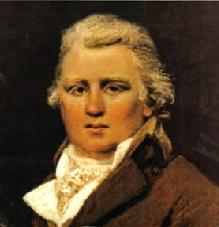
Many authorities credit William Cobbett (1763-1835, shown above) with coining the metaphor of a “red herring,” based on a story he published in his Political Register weekly in 1807 and expanded in 1833. Cobbett did indeed use the phrase “political red herring” at the end of a shaggy-dog story about him as a boy drawing hounds off the scent of a hare with a kipper.

However, in that period Cobbett and his printer, Thomas Curson Hansard, were also publishing their own Parliamentary Debates reports and a multi-volume Parliamentary History of England. Volume 22 of Cobbett’s Parliamentary History, which came out in 1814, presented Courtenay’s speech as printed back in 1782, with changes only in punctuation. So Cobbett knew about Courtenay’s earlier use.

TOMORROW: An even earlier appearance.

Sunday, November 20, 2016

How to Save a Penny and More at Franklin’s Grave

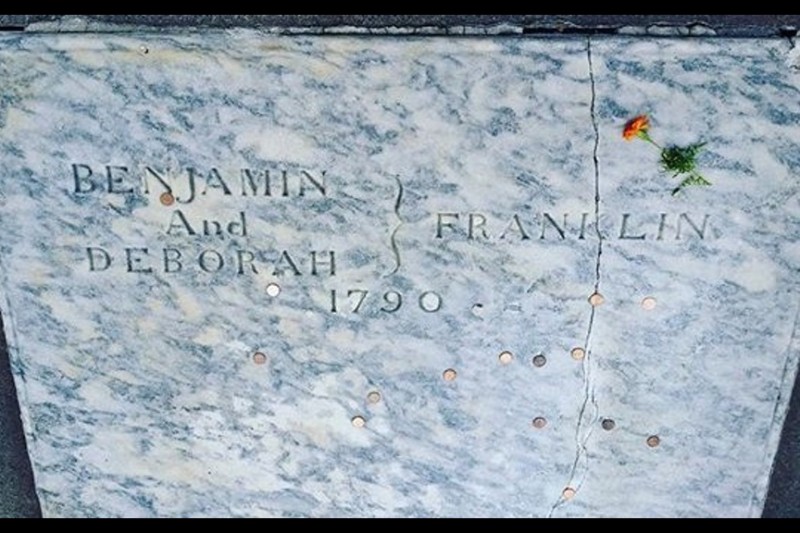
Last week the Philadelphia newspapers ran a short article about an effort to preserve the gravestone of Benjamin and Deborah Franklin.

That marble stone, in the Christ Church Burial Ground across from Independence Mall, has developed “developed a significant crack on top of the pitting caused by the tens of thousands of pennies tossed onto the marker annually in tribute to Franklin.”

The article suggested people threw those pennies on the stone “in tribute to Franklin, who coined the adage that ‘a penny saved, is a penny earned.’” But throwing pennies away is hardly saving them, is it?

No, this was just another manifestation of tourists’ wish to make their mark everywhere (while reassuring themselves they’re not actually vandalizing sites or causing damage). I recall climbing up the Bunker Hill Monument a few years back and seeing that people had shoved pennies through the wire grills on the windows, all to leave some hard sign they had passed through.

What’s more, though the “penny saved” adage sounds like something Franklin would write, he never actually did. He didn’t even quote it in Poor Richard’s Almanac, the way many other old sayings came to be attributed to him.

[CORRECTION: My source on that was wrong, as the comments below reveal. When I searched Founders Online to confirm that source, I searched for “penny saved”—but Franklin used the spelling “penny sav’d,” darn him.]

We have three examples of Franklin using variations on that adage:

  • In a 1732 Pennsylvania Gazette essay under the pseudonym Celia Single, Franklin wrote: “you know a penny sav’d is a penny got, a pin a day is a groat a year, every little makes a mickle…”
  • In his 1737 almanac’s “Hints for those that would be Rich,” Franklin offered an even higher return: “A Penny sav’d is Twopence clear, A Pin a day is a Groat a Year.”
  • In a 2 Oct 1779 letter on designing American coins, Franklin recommended that they display financial advice, including, “a Penny sav’d is a Penny got.”

But Franklin didn’t originate that saying.

According to this analysis, Thomas Fuller’s History of the Worthies of England (c. 1661) was the first book to note, “a penny saved is a penny gained.” Edward Ravenscroft’s Canterbury Guests (1695) preferred, “A penny sav’d, is a penny got.”

George Washington quoted the latter form of the adage to Anthony Whitting, an alcoholic farm manager at Mount Vernon, on 16 Dec 1792. And then again on 20 Jan 1793. And again on 5 May 1793. Whitting died later that year, or no doubt he would have read the words a lot more. Washington quoted the wisdom one last time to his last farm manager, James Anderson, on 29 Jan 1797.

At the end of 1831, the British and then American and then British political writer William Cobbett gave a lecture in Manchester in which he stated, “‘A penny saved is a penny earned,’ says the proverb.” Cobbett’s Weekly Political Register printed that version of the saying in January 1832.

But the adage wasn’t done evolving. In 1841 Gould’s Universal Index, and Every Body’s Own Book, by the American stenographer Marcus T. C. Gould, offered yet another version. A lecture in that schoolbook starts off, “Franklin has said that ‘Time is money;’ that ‘A penny saved is worth two earned.’” So American authors were starting to link versions of the adage back to Franklin.

Finally, everything came together in the form we know in the sixteenth Annual Report of the Perkins Institution and Massachusetts School for the Blind, published in Cambridge in 1848: “…according to Dr. Franklin, a penny saved is a penny earned.” Since then, many American sources have printed that version of the saying with that attribution. But Franklin himself said it a little differently.

Back to Philadelphia. The Christ Church Preservation Trust raised $66,000 for the gravestone restoration project before turning to GoFundMe for another $10,000. Within a day or two after local publicity hit, musician Jon Bon Jovi, his wife Dorothea, and the Philadelphia Eagles football team pledged the bulk of the money needed.

Tuesday, August 07, 2012

Porcupine’s “The Lion and the Pig”

Yesterday I quoted an advertisement from William Frederick Pinchbeck announcing the appearance of his learned pig in Salem in 1798. A couple of months before they had appeared in Boston.

In the 1790s, William Cobbett was another immigrant from England in America. He was publishing a high Federalist newspaper in Philadelphia called Porcupine’s Gazette. In addition to promoting pro-British policies, the newspaper also commented, usually acerbically, on public entertainments.

This is what Cobbett had to say about the wonderful pig in March 1798:
The LION and the PIG.

To Mr. Pinchbeck, Proprietor of the Learned Pig now in Boston.

“Corpora magnanimo satis est prostrasse LEONI.” Ovid.

Tell us no more of your learned little pig,
In size a mere runt, though in science very big.
Tell us no more of your little pig of knowledge,
Who can cipher and spell like a sophomore at college.
Can the grunting little thing, which you set so very high on,
Be compared to our beast, the GREAT AND MIGHTY LION?
You boast your little pig can spell the hardest word;
But did your little pig ever wear a wooden sword?
Your bonny pig may dance jigs, round-abouts, and reels;
But did he ever prance with rogue’s march at his heels?
I’ll allow your bristled beau can count and tell his letters;
But can he name and shew, his gammons to his betters?
Spades, diamonds, clubs, and hearts, your piggy well can handle;
But did his hinder parts ever hold a lighted candle?
Though your piggy screws his snout in such learned grimaces,
I defy the squeaking lout to spit in Christians’ faces,
And if the thing could be, is such the hoggish fashion,
That one third of the fly would applaud him for the action?
Then tell us no more of your little grunting creature,
But confess that the LION is the GREATEST BEAST in nature.
Cobbett returned to Britain in 1800 and eventually became a radical Member of Parliament, particularly interested in agricultural reform. (The portrait above comes from that period of his career.) Cobbett had another chance to comment on learned pigs in 1817 when yet another Toby made its London debut, but I don’t think he did so.

TOMORROW: But what the heck was that poem about?