J. L. BELL is a Massachusetts writer who specializes in (among other things) the start of the American Revolution in and around Boston. He is particularly interested in the experiences of children in 1765-75. He has published scholarly papers and popular articles for both children and adults. He was consultant for an episode of History Detectives, and contributed to a display at Minute Man National Historic Park.

Subscribe thru Follow.it


•••••••••••••••••


Showing posts with label New York. Show all posts

Thursday, September 17, 2026

“The Prize Papers of the American War” Workshop, 8 Oct.

On Friday, 8 October, the Prize Papers Project at Britain’s National Archives will host an international symposium on “The Prize Papers of the American War of Independence.”

Online registration to this event is available, but folks should know that it will take place in London. The discourse will start at 4:30 A.M., Boston time.

The workshop description says:
Bringing together specialists on prize law, the American War of Independence and the Prize Papers, the workshop approaches the collection as a transnational archive of wartime capture and its afterlives. The workshop creates a forum for sustained international exchange and collaboration.

The year 2026 marks the 250th anniversary of both the Declaration of Independence of the United States of America in July and the opening of the British Vice-Admiralty Court in newly-captured New York City in September 1776. Although exceptionally rich, the prize papers of this court have been largely inaccessible. The newly catalogued papers of the New York court (and its mother-court in London) provide new perspectives on the War of Independence at sea, and on lived experiences of the time, through the intercepted papers and letters found by the British on merchant and fighting ships.

Maritime warfare was central to the War of Independence. Controlling, disrupting, and capturing shipping was crucial to the war on both sides. America started privateering early, in 1775, and sought new (previously forbidden) trading partners. From 1778, French naval and privateering activity expanded the war against Britain, followed by Spain and the Netherlands. British naval forces and loyalist privateers sought to stop American and allied shipping, enforce their imperial authority, and weaken the Continental cause. The conflict eventually extended far beyond the North American seaboard.

An initial group of papers from 150 captured ships, American or supporting America, will be published online on 8 October in the Prize Papers Portal, the open-access online database of the Prize Papers Project. . . . Major bodies of captured material from American, French, Spanish, Dutch and recaptured British vessels will be published in the coming months and years…
Presentations schduled for 8 October include:
  • Amanda Bevan & Luan Cakolli: “A Voyage of Discovery and Delivery … and what we’re learning along the way”
  • Suzanne Foxley: “American Experience of British Prize Law”
  • Séverine Angers: “Write to me by different ships as the English capture many”
  • Randolph Cock: “Piecing Together Clues from the U.S.S. Lexington, 1777: A Whodunnit”
  • Rebekah Harbord: “Behind the Scenes: Preparing documents from the Prize Papers for digitisation”
  • Bethany Groff Dorau: “‘Taken by 64 Guns’: A Case Study of Dalton Marine Captain Offin Boardman”
  • Christopher Minty: “‘False & Colourable’: The Brigantine Adventure and the Paper War of the American Revolution”
  • Abby Mullen: “Mutiny or Loyalty?: Revolt from the Enemy in American Prizes”
  • Graham Moore: “Revolution 250: Exhibiting the Prize Papers at The National Archives”
  • John Beiner & Lucas Haasis: “History at the Helm: The Prize Papers and the Making of the Videogame Ahoy”
The keynote address to close out Friday will be delivered by Nathan Perl-Rosenthal, author of The Age of Revolutions and the Generations Who Made It (Basic Books, 2024).

The Prize Papers Project is run by the National Archives, U.K., and the University of Oldenburg, Germany. Other organizers of this event are the German Maritime Museum Bremerhaven and the German Historical Institute London. The workshop will be hosted by Nele Popp, Amanda Bevan, Oliver Finnegan, and Lucas Haasis.

This symposium occurs alongside an exhibit at the National Archives in Kew titled “Revolution 250: America's Independence Story 1763–1783,” which will run through 29 November.

Wednesday, September 16, 2026

“Behind Enemy Lines” along Lake Champlain, 25 Sept.

On Friday, 25 September, America’s History, L.L.C., is offering a unique tour titled “Behind Enemy Lines: General Benjamin Lincoln’s Pawlet Expedition and the Battle of Diamond Island.”

The event description explains:
In September 1777 during Lt. Gen. John Burgoyne’s campaign to capture Albany, American militia commanded by Maj. Gen. Benjamin Lincoln staged a daring raid on the British army’s supply line from Fort Ticonderoga to Lake George and Skenesborough. It is one of the most unappreciated operations of the campaign.

Although the Pawlet Expedition had some successes and some failures, in the main, it created major consternation in Burgoyne’s mind, forcing him to roll the dice in a failed attempt to turn the left flank of Maj. Gen. Horatio Gates’s army at Bemis Heights. Burgoyne’s defeat on October 7, 1777 paved the way for an ultimate retreat back to Saratoga (Schuylerville, New York) and the surrender of his army on October 17.

During this tour we will trace the march of Col. John Brown’s force from Pawlet to Ticonderoga Landing and Mount Defiance, Col. Samuel Johnson’s attack on Mount Independence, and Col. Benjamin Woodbridge’s actions at Skenesborough. We will take a boat ride to interpret Brown’s attack by water on the British supply depot on Diamond Island. Weather permitting (for docking purposes), we will land on the island, unlike Col. Brown, to see it from the British perspective.
This tour is limited to 39 participants. The bus will leave the parking lot of Fort Ticonderoga at 8 A.M. and return by about 5 P.M. (Fort Ti’s American Revolution conference starts that evening, with most presentations over the weekend.)

The $195 tour registration cost covers transportation by bus and boat; all admissions and gratuities; lunch, snack, and beverage breaks; a map and materials package; and the expertise of Bruce Venter as guide.

Dr. Venter is the author of The Battle of Hubbardton: The Rear Guard Action that Saved America. He created and co-manages the annual American Revolution conference in Virginia, as well as symposia, tours, and other events for students of American history.

For more information on this tour and to register, see this event page.

Tuesday, September 15, 2026

New York City Has Fallen

On 15 Sept 1776, 250 years ago today, the Continental Army withdrew from the southern end of Manhattan Island, leaving the city of New York to the British army.

That’s an orderly way to describe what happened. Here’s Gen. George Washington’s official dispatch to John Hancock and the Continental Congress the next day:
in the morning they began their Operations—Three Ships of War came up the North River as high [as] Bloomingdale which put a total stop to the removal by Water of any more of our provision &c. and about Eleven OClock those in the East River began a most severe and Heavy Cannonade to scour the Grounds and cover the landing of their Troops between Turtle-Bay and the City, where Breast Works had been thrown up to oppose them.

As soon as I heard the Firing, I road with all possible dispatch towards the place of landing when to my great surprize and Mortification I found the Troops that had been posted in the Lines retreating with the utmost precipitation and those ordered to support them, [Samuel Holden] parson’s & [John] Fellows’s Brigades, flying in every direction and in the greatest confusion, notwithstanding the exertions of their Generals to form them.

I used every means in my power to rally and get them into some order but my attempts were fruitless and ineffectual, and on the appearance of a small party of the Enemy, not more than Sixty or Seventy, their disorder increased and they ran away in the greatest confusion without firing a Single Shot—

Finding that no confidence was to be placed in these Brigades and apprehending that another part of the Enemy might pass over to Harlem plains and cut off the retreat to this place, I sent orders to secure the Heights in the best manner with the Troops that were stationed on and near them, which being done, the retreat was effected with but little or no loss of Men, tho of a considerable part of our Baggage occasioned by this disgracefull and dastardly conduct—

Most of our Heavy Cannon and a part of our Stores and provisions which we were about removing was unavoidably left in the City, tho every means after It had been determined in Council to evacuate the post, had been used to prevent It. We are now encamped with the Main body of the Army on the Heights of Harlem where I should hope the Enemy would meet with a defeat in case of an Attack
William Douglas, a Connecticut militia colonel whose troops had been guarding an area near Kip’s Bay, told his wife that “my Left wing gave way” under the initial artillery fire:
I Lay myself on the Right wing, wateing for the boats untill Capt. [Jonas] Printice Came to me and told if I ment to Save my Self to Leave the Lines for that was the orders on the Left and that they had Left the Lines. I then told my men to make the best of their way as I then found I had but about ten Left with me.
Caesar Rodney, one of Delaware’s delegates to the Congress, was in the region, and he gathered this information:
the Ships…began a verry heavy Fireing at Turtle-Bay, to Scour the Country previous to their landing the troops, but hurt no Body that I Can hear of—When the Fireing ceased their Troops began to Land and ours to Run as if the Devil was in them in Spite of all the Genel. Could do. They never fired one Gun—

General Whashington haveing discovered their intention to Land at that place, and haveing properly disposed of his troops in case of an Attempt in either or both the other places, ordered a Reinforcement and set out there himself. However before he Got to the place, met our people runing in Every direction. He Endeavoured by persuasion, Threats &c. to get them back, but all to no purpose, in Short they Run till they left the General to Shift for himself—
A story went round that Gen. Washington was so angry that he threw his hat on the ground and shouted, “Are these the men with which I am to defend America?” (per Gen. William Heath) or “Good God, have I got such troops as those?” (per George Weedon). No one who was with Washington at the time described him behaving that way. But of course those men had other things on their minds—and may have thought such behavior was perfectly understandable.

Tuesday, September 08, 2026

“The British Empire Strikes Back” in New Jersey, 6–8 Nov.

The next Pursuit of History Weekend session is called “The British Empire Strikes Back,” and it will cover the New York and New Jersey campaigns from August 1776 to January 1777.

Here’s how we’re describing the developments of 250 years ago:
Even as the United States declared their independence, the British military returned to New York. Starting in August 1776, Gen. William Howe pushed Gen. George Washington off Long Island, off Manhattan Island, and down into New Jersey. The Continental Army struggled through battles at Brooklyn, Harlem Heights, White Plains, and Fort Washington.

By late December, the Congress was evacuating Philadelphia, Washington was estranged from top aides, and Continental soldiers’ enlistments were about to run out. Only by counterattacking Gen. Cornwallis and his Hessian vanguard at Trenton and Princeton did Washington reenergize the American cause.
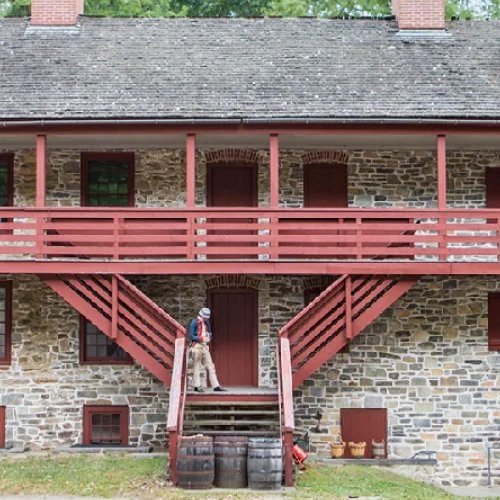
Our main meeting space for this weekend will be the Old Barracks Museum in Trenton, New Jersey, built to house troops in the French and Indian War. On 6–8 November, we’ll visit sites of fighting in that city; Washington Crossing, Pennsylvania; and Princeton, New Jersey. 

Here are some of the experts I’m eager to hear from:
  • Ricardo Herrera, Ph.D., joins the Pursuit of History Weekends as a program director and faculty member. He is Senior Historian at the George Washington Leadership Institute at George Washington’s Mount Vernon, having previously served as Professor of Military History at the U.S. Army War College and as an Armor and Cavalry officer. For the U.S. Army Center of Military History Rick wrote The New York Campaign 1776 (2026).
  • Friederike Baer, Ph.D. (friederikebaer.com), is the author of Hessians: German Soldiers in the American Revolutionary War (2022), honored with the American Revolution Round Table of Philadelphia’s Annual Book Award and the Society of the Cincinnati Prize. She is a Professor of History at Penn State University Abington College.
  • Benjamin L. Carp, Ph.D. (benjamincarp.com), wrote The Great New York Fire of 1776 (2023) and Rebels Rising: Cities and the American Revolution (2007), and other award-winning studies of the American Revolution. He holds the Daniel M. Lyons Chair in American History at Brooklyn College within the City University of New York.
  • William L. “Larry” Kidder, M.A. (wlkidderhistorian.com), has written several books about the Revolutionary War, including Ten Crucial Days: Washington’s Vision for Victory Unfolds, Crossroads of the Revolution: Trenton 1774–1783, and Revolutionary Princeton 1774–1783. He is a veteran of both the U.S. Navy and forty years of teaching high school.
  • Phillip Papas, Ph.D., explored the life of the Continental Army’s most confounding commander in Renegade Revolutionary: The Life of General Charles Lee (2014). Also author of That Ever Loyal Island: Staten Island and the American Revolution (2007), Papas is Senior Professor of History in the Economics, Government, and History Department at Union County College.
We’re still finalizing the schedule with the venues, but I expect to give some brief presentations as well.

Pursuit of History Weekends are limited to about forty people to facilitate discussion with speakers and among attendees. As of this holiday weekend, only ten slots are left.

For more information and to register, please visit this webpage.

Sunday, September 06, 2026

“Came under the bottom of the ship”

After his brother Ezra Bushnell fell ill, the inventor David Bushnell asked Gen. Samuel Holden Parsons to send three men who might be able to operate his submarine against the Royal Navy in New York harbor.

Parsons already had a list of volunteers ready to sail a fireship toward the fleet, another risky venture. One of them was his brother-in-law, Sgt. Ezra Lee (1749–1821, shown here).

Bushnell brought the machine back to Saybrook, Connecticut, for the three men to practice. Eventually Lee got the assignment. His mission: Screw a timed explosive charge (Bushnell’s other invention, called the “magazine”) to the hull of H.M.S. Asia.

Lee went into action on 6 Sept 1776, 250 years ago today. Decades later, in 1815, he wrote an account of his mission for David Humphreys:
We set off from the City—the Whale boats towed me as nigh the ships, as they dared to go, and then cast me off—I soon found that it was too early in the tide, as it carried me down by the ships—I however hove about, and rowed for 5 glasses, by the ships’ bells, before the tide slacked so that I could get along side of the man of war, which lay above the transports—

The Moon was about 2 hours high, and the daylight about one—when I rowed under the stern of the ship, could see the men on deck, & hear them talk—I then shut down all the doors, sunk down, and came under the bottom of the ship, up with the screw against the bottom but found that it would not enter—

I pulled along to try another place, but deviated a little one side, and immediately rode with great velocity, and come above the surface 2 or 3 feet between the ship and the daylight—then sunk again like a porpoise I hove partly about to try again, but on further thought I gave out, knowing that as soon as it was light the ships boats would be rowing in all directions, and I thought the best generalship, was to retreat, as fast as I could as I had 4 miles to go, before passing Governor’s Island.—

So I jogg’d on as fast as I could, and my compass being then of no use to me, I was obliged to rise up every few minutes to see that I sailed in the right direction, and for this purpose keeping the machine on the surface of the water, and the doors open—

I was much afraid of getting aground on the island as the Tide of the flood set on the north point While on my passage up to the City, my course owing to the above circumstances, was very crooked & zig zag, and the enemy’s attention was drawn towards me, from Governors Island—

When I was abreast of the fort on the island 3 or 400 men got upon the parapet to observe me,—at leangth a number came down to the shore, shoved off a 12 oar’d barge, with 5 or 6 sitters, and pulled for me—I eyed them, and when they had got within 50 or 60 yards of me, I let loose the magazine, in hopes, that if they should take me, they would likewise pick up the magazine, and then we should all be blown up together, but as kind Providence would have it, they took fright, and returned to the island, to my infinite joy.—

I then weathered the Island, and our people seeing me, came off with a whaleboat, and towed me in—

The Magazine after getting a little past the Island, went off with a tremendous explosion, throwing up large bodies of water to an immense height.
On seeing that explosion, Humphreys wrote, Gen. Israel Putnam shouted, “God’s curse ’em, that’ll do it for ’em.” But the bomb merely startled the enemy, not doing any physical damage.

Why hadn’t Sgt. Lee been able to attach that bomb to H.M.S. Asia as planned? Humphreys explained:
The reason why the screw would not enter, was that the ship’s bottom being coppered it would have been difficult under any circumstances to have peirced through it—but on attempting to bore with the auger, the force necessary to be used in pressing against the ships bottom, caused the machine to rebound off
In this series about David Bushnell and his submarine, I’ve cut down long letters that the U.S. Navy has collected on this website. Though the submarine was a top-secret operation in 1776, men like Humphreys and Thomas Jefferson made a concerted effort after the war to gather information about the machine and its operation.

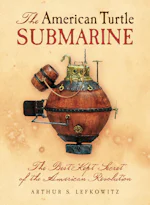
Authors have written several books about the submarine. I’m linking to Arthur S. Lefkowitz’s The American Turtle Submarine because he gave me a nifty cap.

TOMORROW: Bushnell’s secrets.

Saturday, September 05, 2026

“The first essays with the submarine Vessel”

On 2 Feb 1776, David Bushnell journeyed from his workshop in Saybrook, Connecticut, to Lebanon to meet with Gov. Jonathan Trumbull and his Council, telling those gentlemen about his “machine contrived to blow ships.”

After Bushnell left the room, the officials voted to keep the conversation secret and to send Matthew Griswold, the deputy governor, to Bushnell with £60 to encourage his work.

Back home, Bushnell resumed work on his machine—the first submarine to be deployed in warfare.

Years later, Bushnell described his invention to a curious Thomas Jefferson:
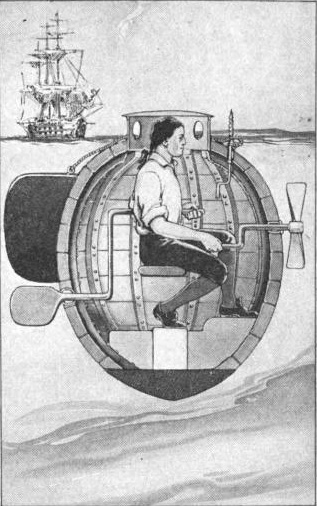
The external shape of the Submarine Vessel bore some resemblance to two upper tortoise shells of equal size, joined together: the place of entrance into the Vessel being represented by the opening, made by the swell of the shells, at the head of the animal. The inside was capable of containing the Operator, and air, sufficient to supply him, thirty minutes, without receiving fresh air.

At the bottom, opposite to the entrance, was fixed a quantity of lead for ballast. At one edge, which was directly before the operator, who sat upright, was an oar, for rowing forward or backward. At the other edge, was a rudder for steering. An aperture, at the bottom, with its valve, was designed to admit water for the purpose of descending; & two brass forcing pumps served to eject the water within, when necessary for ascending. At the top, there was likewise an oar, for ascending or descending, or continuing at any particular depth. A Watergage or Barometer, determined the depth of descent, a compass directed the course, & a ventilator within, supplied the Vessel with fresh air, when on the surface. . . .

The skilful operator could swim so low on the surface of the water, as to approach very near a Ship, in the Night, without fear of being discovered, and might if he chose, approach the stem or stern, above water, with very little danger. He could sink very quick, keep at any depth he pleased, and row a great distance, in any direction he desired, without coming to the surface; & when he rose to the surface, he would soon obtain a fresh supply of air, when, if necessary, he might descend again and pursue his course. . . .

In the first essays with the submarine Vessel, I took care to prove its strength to sustain the great pressures of the incumbent water when sunk deep, before I trusted any person to descend much below the surface: and I never suffered any person to go under water without having a strong piece of rigging made fast to it, until I found him well acquainted with the operations necessary for his safety. After that I made him descend and continue at particular depths, without rising or sinking, row by the compass, approach a Vessel, go under her, and fix the Woodscrew…into her Bottom, &c. until I thought him sufficiently expert to put my design into execution.

I found agreeably to my expectation, that it required many trials to make a person of common ingenuity, a skilful operator. The first I employed was very ingenious and made himself master of the business, but was taken sick in the campaign of 1776 at N.York, before he had an opportunity to make use of his skill, and never recovered his health sufficiently afterwards.
David Bushnell’s first operator was his own brother Ezra. They had inherited a farm together, and Ezra had bought out David’s interest to give him the capital to attend Yale College—an unusual course for a man in his late twenties.

Jefferson had Bushnell’s detailed description of his invention published by the American Philosophical Society in 1799. Those documents serve as the source for all attempts to depict and recreate the submarine, such as the 1916 illustration above.

TOMORROW: Into action.

Sunday, August 30, 2026

Long Island Has Fallen

On the morning of 30 Aug 1776, 250 years ago today, Gen. William Heath was stationed at Kingsbridge, New York, on the Hudson River just north of Manhattan Island.

Heath wrote urgently to his commander-in-chief:
A very Extraordinary Report has Just Spread here, that whether True or false we are as yet uncertain That Long-Island is Evacuated by Our Troops. . . .

I am in Anxiety Untill I hear from you
This letter is transcribed at Founders Online, and the Massachusetts Historical Society has digitized Heath’s copy.

Likewise, Abraham Yates, Jr., head of the New York committee of safety, wrote to the commander from the same place:
In our way to Fishkill agreable to an adjournment of the Convention, we are informed that the Army is removed from Long Island to the City of New York—

an anxiety to know the fact, as well as to be informed wether you think any measures necessary for us to take—Induces us to trouble your Excellency at this time for an answer hereto—

We have ordered last Night all the Militia of the Counties of Ulster, Dutchess, Orange and Westchester to be ready at a Minutes warning, with five days provisions.
Gen. George Washington wrote back to Yates:
Circumstanced as this Army was in respect to Situation Strength &c., it was the unanimous advice of a Council of General Officers to give up Long-Island, and not by divideing our Force be unable to resist the Enemy in any one point of Attack, this reason added to some others, particularly the fear of haveing our Communication cut of from the Main (of which there seemed to be no Small probability) and the extreame fatigue our Troops were laid under in guarding such extensive Lines, without proper Shelter from the weather, induced the above Resolution.

It is the most intricate thing in the World Sir to know in what manner to conduct ones self with Respect to the Militia, if you do not begin many days before they are wanted to raise them, you cannot have them in time, if you do they get tired and return, besides being under very little Order or Government whilst in Service—

However if the Enemy have a design of serveing of Us at this place as we apprehended they meant to do on Long-Island—it might not be improper to have a body in readiness to prevent or retard a Landing of them on the East of Harlem River, if need be—

In haste & not a little fatigued, I remain with great Respect & Esteem Sir Yr Most Obedt Hume sert…
Washington let the adjutant general, Joseph Reed, reply to Heath:
The Report of the Evacuation of Long Island last night is true—it was a Measure founded in the fullest Necessity after the Surprize of our Troops last Tuesday [the Battle of Brooklyn], by which the Flower of our Army & some of our best Officers were lost.

add to this that the constant Rains upon Troops without Cover has so spoil’d the Ammunition & enfeebled the Men that had the Enemy attempted to force our Lines they must have done it with great Ease. The Ships have also been trying to get up the whole Week, which if they could effect our Communication would have been cut off and the whole Army must have surrendered at Discretion.

Under these Circumstances the remaining General Officers were unanimously of Opinion that it was absolutely necessary to retreat which was done so as to bring off all our Ammunition & Artillery except the heavy Pieces & most of our Provisions—

Our Situation is in all Respects critical Ld. Stirling & Gen. [John] Sullivan are both Prisoners—the latter was permitted to come out this Morning on his Parole with a Message from Ld. Howe. This is the Substance of what has passed in this important Week.

Thursday, August 27, 2026

“Arnold’s Defeat or Ultimate Victory?” Conference at Fort Ti, 9–10 Oct.

On 9–10 Oct 2026, Fort Tionderoga will host a Special 250th Conference on “Arnold’s Defeat or Ultimate Victory?: Perspectives on the 1776 Campaign,” covering the Battle of Valcour Island and surrounding events.

The venue explains:
The failure of the British to seize Ticonderoga in the fall of 1776 was a critical, vital victory for the Americans in the early years of the Revolutionary War—acknowledged even at the time. But who gets the credit for the year’s victory? Benedict Arnold and his lake fleet? Horatio Gates and the defenses of Ticonderoga and Mount Independence? Sharing new perspectives and new research from a variety of disciplines, our panelists will detail, and debate, the critical actions of the campaign to better understand the impact of October 1776.
The event starts with optional programs on Friday:
  • 11 A.M.: Tour of Liberty Hill and the Outer Defenses of Fort Ticonderoga with Stuart Lilie, Vice President of Public History.
  • 1:15 P.M.: Crewing a Bateau—Join the fort’s Maritime Trades staff, take an oar, and head out on Lake Champlain in a bateau.
  • 3 P.M.: Ticonderoga’s Treasures: The 1776 Campaign on Lake Champlain with Dr. Matthew Keagle, Curator.
These programs have limited space and additional fees ranging from $35 to $50.

Here are the conference presentations scheduled for the Saturday conference:
  • “Carleton’s Race to Ticonderoga: His Opponents and Why He Lost” by Don Hagist, editor of the Journal of the American Revolution.
  • “Crafting Independence: The Work Behind the Battle of Valcour Island” by Kenneth Cohen, Chair of the Division of Military & Society at the Smithsonian’s National Museum of American History.
  • “‘To prevent Shipping coming past’: Ticonderoga’s Amphibious Fortifications” by Stuart Lilie, Vice President of Public History at Fort Ticonderoga.
  • “The day must shortly come when these facts will be known to the World” by Eric Schnitzer, ranger and military historian at Saratoga National Historical Park.
  • “‘An Active Part in Our Favour’: The Stockbridge Mohican Indians” by Mark R. Anderson, author of Down the Warpath to the Cedars.
  • “The Archaeology of ‘Destruction Bay’ and the Events of October 13, 1776” by Christopher Sabick, executive director of the Lake Champlain Maritime Museum.
The sessions will end with a panel discussion collecting all the speakers and moderator Dr. Matthew Keagle, Curator of Fort Ticonderoga.

The fort also organized a Sunday cruise on Lake Champlain, following the maritime action, but that’s already sold out.

The presentations will be livestreamed so people can register to listen online. For more information, including cost, meals, and schedule, visit the conference webpage.

And while you’re there, also check out Fort Ti’s annual conference on the American Revolution, scheduled 26–27 September.

Saturday, August 22, 2026

Benjamin Davis, Baker?

The record of Benjamin Davis, Sr.’s appearance before the Loyalists Commission in Canada states of his time in New York:
He was then a Baker in Govert. Service.
That detail has gone into every profile of Davis written from that source. Articles have discussed Davis as an example of the baking profession.

That puzzles me because nothing in Davis’s past shows any connection to baking. (Gingerbread, yes. Running a bakery, no.)

In Boston, Davis was a general import merchant, usually dealing in dry goods. He also invested in distilling, whaling, and other enterprises. Whigs denigrated him as a “Huckster,” not a baker. The goods he lost at Boston included “Iron, Tea, Liquor, Stockings, Haberdashery…”

Later the same Loyalists Commission document quoted Davis as saying that when he was captured on his voyage to New York in 1776 “He was then going into Trade on advice of Sir W. How.” The term “Trade” meant general mercantile trading. The cargo Davis was bringing to the city? Wine, not flour or bread.

An advertisement in the 13 Dec 1777 Royal Gazette shows that Benjamin Davis had opened a store in New York “in Queen-Street, the corner of King-Street.” He offered Madeira wine, tea, candles, sugar, cloth, clothing, blankets, and “An assortment of childrens toys.”

On 23 May 1778 “Benjamin Davis, & Son,” advertised in the Royal Gazette from “their Store, No. 229, Queen-Street, the Corner of King-Street.“ They sold cloth, garments, notions, and wine.

In 1779 the father and son offered “A neat and elegant assortment of BOOKS.” In 1781 they had “Four hundred gallons choice fresh South Carolina ORANGE JUICE.” In 1782 they advertised “Garden SEEDS” shipped from London. Several of their newspaper ads offered the cloth and trimmings for military uniforms. But never bread.

That firm’s advertisements disappeared after August 1783 as the British military left New York. That’s why I’m confident these merchants were Benjamin Davis, Sr. and Jr., from Boston. (Because of course there were a bunch of men with that name in Revolutionary America.)

It’s conceivable that Benjamin Davis, Sr., provided some capital for a bakery that supplied the British military in New York, but there’s no sign he was involved in running that operation. And I wonder if the word “Baker” was correctly transcribed.

TOMORROW: Benjamin Davis, to the end.

Friday, August 21, 2026

In Exchange for John Callender

In June 1777, as quoted here, the Massachusetts General Court voted to send imprisoned Loyalist Benjamin Davis, Jr., with his father to New York on condition that the royal authorities send back John Callender in exchange.

Callender (1747-1797) had been one of four provincial officers ordered to lead their artillery companies onto the field at the Battle of Bunker Hill.

Only one of those officers, Samuel Russell Trevett, actually stayed through the whole battle doing damage to the regulars. Only one—again, Trevett—kept any of the provincials’ valuable cannon from being captured.

However, two of the other officers had the advantage of being related to Col. Richard Gridley, commander of the artillery. They were Maj. Scarborough Gridley, the colonel’s son, and Capt. Samuel Gridley, his nephew.

Eventually both young Gridleys were removed from the ranks. But that took months, and in July 1775 the new commander-in-chief, Gen. George Washington, had to make an example of someone. So John Callender was cashiered in a very public way.

Callender carved out a second chance for himself. He went to New York in the fall of 1776 as a gentleman volunteer or “cadet” attached to the artillery company commanded by Capt.-Lt. John Johnson (c. 1753–1818, self-portrait shown above).

During the Battle of Brooklyn, Johnson was “desperately wounded,” in the words of Henry P. Johnston. Callender took command of the company and “fought his piece on Long Island until the enemy’s bayonets were at his breast.” Both officers and their men became prisoners.

Johnson was exchanged in May 1777 but was in no physical shape to return to the army. He became Boston’s leading portrait painter during and immediately after the war.

Callender was awarded a Continental Army commission as a captain-lieutenant, dated 1 Jan 1777. And the Massachusetts legislature tried to get him back, as its June resolution showed.

But that didn’t work. Callender was still a prisoner in New York in September. And I rather doubt Benjamin Davis, Jr., returned to Massachusetts to be locked up again.

I suspect the British authorities didn’t see a fair trade in exchanging a Continental officer captured in battle for a young man, barely of age, who just happened to be with his father on a merchant ship when it was seized. It’s possible the Crown freed another young American man whose identity I haven’t found, and it’s possible the issue of Benjamin, Jr.’s trade faded away.

In September 1777, John Callender’s wife Hepzibah asked the Massachusetts legislature to approve another swap for her husband. The man to be freed from the Boston jail this time was John Hill, a Loyalist captured during the evacuation in the spring of 1776.

The General Court approved that swap on 17 September. I presume it actually happened because by the end of the year Callender and Hill were both back on their own sides.

In subsequent years Hill served as “a Capt. of Marines on board a Privateer for 8 months, than as Capt. of Marines in the Jason.” Then with his brother Richard he was inspector of the ferry between Manhattan and Brooklyn.

Callender remained on duty in the Continental artillery force for the rest of the war, mustering out in 1784.

TOMORROW: The Davises in New York.

Thursday, August 20, 2026

The Capture and Release of Capt. Samuel Richards

By 1777, both sides of the Revolutionary War held a significant number of prisoners.

Some of those people were soldiers or sailors captured in military operations while others had been detained as politically suspect.

American authorities were ready to arrange exchange prisoners as long as the British released someone of equal importance.

There were disputes about what that meant, of course. In July, a Boston crowd forcibly prevented Dr. Benjamin Church, suspected traitor and spy, from being traded for Dr. James McHenry, a young military surgeon who had already been paroled.

The Massachusetts government balked at releasing the Loyalist merchant Benjamin Davis, Sr., until a petition linked his case to Samuel Richards of Norwalk, Connecticut, as quoted yesterday.

Richards (1716–1777) lived in the village of Rowayton. He was a committee man clamping down on local Loyalism and captain of the militia company that guarded the shore.

Another Norwalk man, Stephen Hoyt (c. 1750–1809), had crossed to Long Island, New York, to work for the Crown. He cruised the coast in a sloop, picking up recruits for a Loyalist regiment called the Prince of Wales’s American Volunteers.

On the rainy night of 16 March, Capt. Hoyt led about twenty men into Rowayton to raid Richards’s farm. He captured fifteen armed men, including Capt. Richards, three Continental soldiers on leave, and eleven local guards.

Hoyt took those prisoners to New York, where they were locked up in the Provost jail. On 10 April the city’s Royal American Gazette praised the raid: “Such excursions as these will keep the Rebels in constant trepidation & give life & Spirit to our new made Soldiers & Officers.”

In May, Richards’s brother petitioned the Massachusetts General Court to exchange Benjamin Davis, Sr., for Capt. Richards. The legislature approved that plan on 2 June.

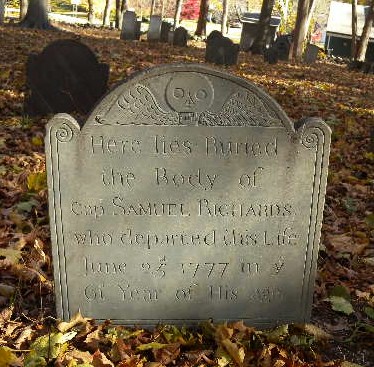
Davis traveled to New York. Samuel Richards returned to Norwalk but died very soon after, on 23 June. His gravestone appears above, courtesy of Find a Grave.

TOMORROW: Benjamin, Jr.

Wednesday, August 19, 2026

“Leave for his brother Benjamin, his son and servant, to depart this State”

As the year 1777 began, the Loyalist Benjamin Davis remained in the Boston jail along with his son and an enslaved servant.

Davis refused to petition the Massachusetts General Court for his release since he didn’t want to recognize the independent state government. But his religious scruples didn’t stop his brother Edward.

On 4 February, Massachusetts Council member Benjamin Austin came into the assembly chamber with
a petition of Edward Davis, of Boston, in behalf of his brother, Benjamin Davis, and son, prisoners in Boston Goal, praying that they may be permitted to go with a cartel to Newport
A “cartel” was the mechanism for a prisoner exchange.

The legislature named a joint committee of Austin and two House members to consider the request. The next day, that committee recommended “That the petitioner have leave to withdraw the same.” The General Court approved. That was a polite way of saying no.

On 18 February, jailer Joseph Otis listed his prisoners. Among the men noted as “being Enemical to the States” was Benjamin Davis but not his son. Benjamin, Jr., might have been paroled into the town, or at twenty years old he might still have been too young to merit his own listing.

On 6 March, the House noted
A petition of Edward Davis, praying leave for his brother Benjamin, his son and servant, to depart this State, in a cartel vessel bound for Halifax.
This time the response was “Read and dismissed.” That was a blunt way of saying no.

A newly elected legislature took their seats in May. Even as the House was getting itself in order
Nathan Cushing, Esq; brought down a Petition of James Richards, of Norwalk, praying that Mr. Benjamin Davis, a Prisoner in Boston, may be exchanged for his Brother Capt. Samuel Richards, a close Prisoner in New York Goal.
Again, the lawmakers referred this to a committee.

On 2 June, the Massachusetts House and Council reached this agreement:
Resolved that the prayer of the within petition be granted, & that Benjamin Davis now a Prisoner in the Goal in the town of Boston, be exchanged for Capt. Samuel Richards a prisoner in New York, provided that proper care be taken that sd Davis does not carry any papers with him & is cautiously sarched when deliver’d up. And it is also

Resolved that Benjamin Davis junr. Son of the aforesaid Davis, now a Prisoner in Boston Goal be exchanged for Mr John Callender a Prisoner in New York, provided due caution be taken that he does not carry any papers with him & is properly sarched when deliver’d up. But if said Callender or some person of equal rank should not be procured in Exchange for said Davis that said Davis be returned to this State.
Two days later, according to what Davis later told the British government, he was let out of the Boston jail. By the end of the year, it appears, the Davises were established in New York.

TOMORROW: The other side of those exchanges.

Saturday, August 15, 2026

Spreading the News of the Spread of a Fire

We can see the spread of news in the spring of 1775 through articles on the fire in Boston on the night of 17–18 May 1775.

The first printed report appeared in Samuel Hall’s Cambridge-based New-England Chronicle on 18 May, in the middle of other local news:
A terrible Fire broke out in Boston about 9 o’Clock last Evening, and raged a long Time. We hear it began just above the Draw Bridge, and burnt along the Town-Dock. A great Number of Buildings are doubtless consumed; but it is not possible to collect the Particulars for this Paper.
That same dire but vague paragraph was reprinted in Hartford on 22 May, Portsmouth on 26 May, and Philadelphia on 29 May.

Ebenezer Watson’s Connecticut Courant of Hartford confirmed that report in the 22 May issue by also quoting “a Letter from a Gentlemen in Cambridge…dated May 18”:
They had a great Fire in Boston last Night---it appeared to be between King-Street and the Market---it continued all night, and is not yet extinguished. What has really happened, is to us uncertain, as yet.
James Rivington chose to run the latter item in his 25 May New-York Gazetteer.

Meanwhile, on 22 May Solomon Southwick’s Newport Mercury offered an extract from “a manuscript account of the fire which happened in Boston last Wednesday night”:
The fire began in the barracks, under the arch formerly improved by Benjamin Davis, about half after eight o’clock, 17th May.—The soldiers were receiving some cartridges, by which means one took fire, and communicated to many more, which immediately set fire to the room.
That account then listed many property owners starting with John Hancock and including “a cooper’s shop, owned by Eliakim Hutchinson, adjoining the town dock, improved for barracks.” It concluded:
Instead of ringing the bells as usual, the soldiers beat to arms, by which means the people were in great confusion, not being used to such signals in time of fire.

N.B. The inhabitants took particular care to save the goods in Mr. Hancock’s store.
Curiously, in his 26 May New-Hampshire Gazette Daniel Fowle printed a version of that same detailed report on page 1 even as on page 3 he ran the New-England Chronicle’s first story saying it was “not possible to collect the Particulars for this Paper.”

John Holt put the “manuscript account” in his New-York Journal on 1 June with the dateline “CAMBRIDGE, May 12”—an obvious error since the fire hadn’t yet occurred then. Presumably Holt’s shop should have printed 19, 21, or 22 May, getting one digit wrong or transposing them.

No newspaper was published in Cambridge on those dates, suggesting Holt indeed took that text from a manuscript, not from a preceding newspaper. In addition, that text never appeared in the New-England Chronicle, the only newspaper then published out of Cambridge.

That strongly suggests that the Patriot authorities in Cambridge, perhaps Boston town officials in exile, sent their own quasi-official report on the fire out to newspapers in other colonies.

TOMORROW: A more pointed description.

Saturday, August 08, 2026

“Fell in with two Arm’d Schooners”

Yesterday I wrote about Benjamin and Edward Davis, two brothers who were mercantile partners in Boston until religion and Revolutionary politics split them apart.

Benjamin became a Sandemanian, devoutly guided not to oppose British Crown policies by, for instance, signing on to the non-importation boycotts.

Edward remained an Anglican, attending Trinity Church. By late 1774 the Whigs coopted him into helping to enforce their strongest boycott, the Continental Association.

Both brothers remained in Boston during the siege. But when the British military evacuated, Edward stayed while Benjamin sailed away to Halifax, Nova Scotia. In April 1776 the Patriot authorities ordered magistrates to question Edward about his loyalty, but evidently he passed muster.

Around the start of July, Benjamin Davis boarded the ship Peggy, headed for New York. Along with him came his son Benjamin, Jr., who turned twenty that year; an enslaved man; half a dozen other Loyalist men; and a few Loyalist women.

Evidently those refugees saw business opportunities supplying the huge British and Hessian army assembling at New York. The Peggy was loaded with provisions, including 2,648 “mutton hams,” 311 “tierces salted beef,” fish, flour, snuff, cloth, stockings, and a large quantity of alcohol in various forms.

The Peggy also carried six 3-pounder and two 2-pounder cannon. It sailed in convoy with dozens of other merchant ships and troop transports, all escorted by two Royal Navy warships. The sea voyage probably seemed safe.

We have the ship captain’s account of what happened next:
I James Kennedy, Master of the Ship Peggy, in the Merchant Service, declare that I left Hallifax about the first Inst. [i.e., of this month] under Convoy of the Renown of Fifty Guns, with a Fleet of sixteen [torn] Transports containing the 42nd & 71 Scotch Regiments & Fraziers new rais’d Regiment, about 3000 in all, & three Large Ships with Hessian Troops on board, about 600 in all, & one Ship with 5 companys of English foot Guards, & four Victualling Ships, the whole Fleet bound for New York.

Off Nantucket Shoals we fell in with the Flora Frigate of Thirty Guns & four Transports with Highland Troops, these had been in Boston Bay, where they got information from a Fisherman that the Town was Evacuated, on which they Stood for Hallifax untill they met with us, they then joyn’d our Fleet for New York.

The Scotch Troops were all to be of Coll [Archibald] Campbells division (of the Grand Army in America, the whole of which Army I was informd, would by the last of July, amount, to 50,000.) the Hessian Troops left England about the 12th of May, some of the Officers informd me they came out with 304 Sail under the Command of Commodore Hawtham [William Hotham], on board of whom were 10,000 Foreign Troops & some English Troops (number unknown).

last Fryday sennight [19 July] in a gale of wind & thick weather I lost the Fleet & on monday [22 July] I fell in with two [American] Arm’d Schooners, Capts. [John] Skimmer & [Samuel] Tucker, to whom I surrendered after a short engagement, in which I had only one man Wounded.

The day after the Fleet left Hallifax, I saw from my Deck forty Sail of Ships standing in for that Harbour, & which I suppose to be part of the Fleet under Commodore Hawtham.
Skimmer commanded the Franklin and Tucker the Hancock, schooners originally launched under the authority of the Continental Army commander. They were now sailing for Massachusetts.

The Patriot authorities who took Capt. Kennedy’s deposition were evidently pumping him for intelliegence on what other British ships and troops were out there rather than details of his engagement with the schooners.

For Benjamin Davis, all that mattered now was that he was a prisoner of the state he’d left four months before.

TOMORROW: The gingerbread man.

Saturday, July 18, 2026

“To hear the proclamation for independance read and proclamed”

On 18 July 1776, 250 years ago today, the Declaration of Independence was officially proclaimed in Massachusetts.

People had already heard about the Continental Congress’s vote, and many had probably read the Declaration in newspapers. But this was a governmental ceremony. It happened in two places, and on two levels.

With no governor, the highest executive authority in Massachusetts was the Council. Most of its members were meeting in the Edmund Fowle house in Watertown.

Therefore, one part of the official reading was performed by Council secretary Perez Morton, reading the Declaration to the Council and to a crowd gathered outside. Also present were delegates from the Mi’kmaq and St. John’s/Maliseet communities, ready to sign a treaty of friendship with this new United States.

In Boston, there was a parallel, larger ceremony. Inside the Council’s chamber in what was now the State House, Suffolk County sheriff William Greenleaf read the Declaration to some Council members and other officials.

Col. Thomas Crafts of the Massachusetts artillery regiment, who had a bellowing voice, then “deaconed” or repeated the text phrase by phrase from the balcony of the Council chamber to the crowd gathered on the street below.

Thus, most Bostonians at the event heard Col. Crafts’s reading, but the official proclamation in Boston came from Sheriff Greenleaf. The ceremony was meant for both government officials and the “people out of doors.”

On 21 July, Abigail Adams reported to her husband:
Last Thursday after hearing a very Good Sermon I went with the Multitude into Kings Street to hear the proclamation for independance read and proclamed. Some Field peices with the Train were brought there, the troops appeard under Arms and all the inhabitants assembled there (the small pox prevented many thousand from the Country).

When Col. Crafts read from the Belcona of the State House the Proclamation, great attention was given to every word. As soon as he ended, the cry from the Belcona, was God Save our American States and then 3 cheers which rended the air, the Bells rang, the privateers fired, the forts and Batteries, the cannon were discharged, the platoons followed and every face appeard joyfull.

Mr. [James] Bowdoin [a senior member of the Council] then gave a Sentiment, Stability and perpetuity to American independance.

After dinner the kings arms were taken down from the State House and every vestage of him from every place in which it appeard and burnt in King Street. Thus ends royall Authority in this State, and all the people shall say Amen.
Not everyone was entirely pleased. Merchant John Rowe characterized the celebration as “a Great Confusion in Town.”

Pulling the royal emblems of the lion and unicorn down from the State House roof was probably inspired by reports of New Yorkers toppling the statue of King George III after that city’s reading of the Declaration on 9 July. But the street was still called King Street until 1784.

Tuesday, July 07, 2026

“The Exertions of the Honest and sensible part of the Members”

Last week I shared sources detailing how the Declaration of Independence was drafted.

This post jumps back a few days to a last-ditch effort to head off the vote on independence.

Richard Henry Lee proposed that the Continental Congress declare the thirteen colonies separate from Britain on 7 June.

Delegates debated that measure in a committee of the whole, meaning everyone was involved but secretary Charles Thomson didn’t take official notes.

Meanwhile, Thomas Jefferson and his committee were drafting a Declaration just in case it would be handy, then or later. Other committees worked on what ultimately became the Articles of Confederation and Perpetual Union and a model treaty with a foreign power like, oh, say, France. (S’il vous plait!)

After a while, it became clear that most colonies favored independence, including Virginia and Massachusetts, populous anchors of their regions. But was that enough? Men on both sides of the question knew that resisting royal power required unity. If a chunk of colonies, or a big central colony, wasn’t ready to leave the British Empire, it would be a weak point for the rest. Thus, opponents of independence could win the argument by showing not that most colonies wanted to stay in the empire but that too many colonies wanted to stay to make leaving safe.

On 29 June, the South Carolina delegate Edward Rutledge (1749–1800, shown above) wrote to John Jay, another delegate known to oppose independence at that time. Jay had gone home to New York to serve in that colony’s legislature. Rutledge wrote frankly:
I write this for the express Purpose of requesting that if possible you will give your Attendance in Congress on Monday next [1 July]. I know full well that your Presence must be useful at New York, but I am sincerely convinced that it will be absolutely necessary in this City during the whole of the ensuing Week.

A Declaration of Independence, the Form of a Confederation of these Colonies, and a Scheme for a Treaty with foreign Powers will be laid before the House on Monday.

Whether we shall be able effectually to oppose the first, and infuse Wisdom into the others will depend in a great Measure upon the Exertions of the Honest and sensible part of the Members. I trust you will contribute in a considerable degree to effect the Business and therefore I wish you to be with us.

Recollect the manner in which your Colony is at this Time represented. [George] Clinton has Abilities but is silent in general, and wants (when he does speak) that Influence to which he is intitled. [William] Floyd, [Henry] Wisner, [Francis] Lewis and [John] Alsop though good Men, never quit their Chairs. You must know the Importance of these Questions too well not to wish to [be] present whilst they are debating and therefore I shall say no more upon the Subject.

I have been much engaged lately upon a plan of a Confederation which [John] Dickenson has drawn. It has the Vice of all his Productions to a considerable Degree; I mean the Vice of Refining too much. Unless it is greatly curtailed it never can pass, as it is to be submitted to Men in the respective Provinces who will not be led or rather driven into Measures which may lay the Foundation of their Ruin. If the Plan now proposed should be adopted nothing less than Ruin to some Colonies will be the Consequence of it.

The Idea of destroying all Provincial Distinctions and making every thing of the most minute kind bend to what they call the good of the whole, is in other Terms to say that these Colonies must be subject to the Government of the Eastern Provinces [i.e., New England].

The Force of their Arms I hold exceeding Cheap, but I confess I dread their over-ruling Influence in Council, I dread their low Cunning, and those levelling Principles which Men without Character and without Fortune in general Possess, which are so captivating to the lower Class of Mankind, and which will occasion such a fluctuation of Property as to introduce the greatest disorder.

I am resolved to vest the Congress with no more Power than what is absolutely necessary, and to use a familiar Expression to keep the Staff in our own Hands, for I am confident if surrendered into the Hands of others a most pernicious use will be made of it.
I don’t think we know when Jay received this letter. However, he was too busy with provincial business to respond until 6 July, and by that time the question of independence had been decided.

TOMORROW: And Rutledge had changed his vote.

Friday, June 12, 2026

Did Sybil Ludington’s Ride Really Happen?

Last month I talked with Ryan Chatelain of Spectrum News about the tale of Sybil Ludington.

His story, headlined “Sybil Ludington is called the ‘female Paul Revere.’ But did her ride really happen?” is a good primer on the historical debate.

On the one hand, Vincent Dacquino has succeeded in pushing back the documented mentions of Sybil Ludington’s ride, as shown in the most recent edition of his book Patriot Hero of the Hudson Valley:
Through his research, Dacquino uncovered that the earliest evidence of her ride actually came in 1854, when Charles Ludington — Henry’s grandson and Sybil’s nephew — argued in a letter to a group of Masons planning a statue for Gen. David Wooster, who was killed in the Battle of Ridgefield, that Henry and Sybil Ludington should also be included in their tribute.
On the other hand, as I state in the article, we still lack contemporaneous evidence about the Ludingtons’ effect on the Battle of Ridgefield or anything else to support the family lore. Knowing that Charles Ludington believed the story seventy years later isn’t proof that it actually happened.

On such lore, Chatelain quotes me on my theory of “grandmothers’ tales”:
“Women, sometimes men, involved in raising children would tell stories of the family’s involvement in historical events, presenting those stories simply as educational, as inspirational, as entertaining, not expecting them to be put into the public realm,” Bell said. “…But the children who are hearing those stories grow up — and because these are the earliest stories they’ve heard, because they have to do with their family, because they hear them maybe many times — they really stick with them. And so as they become older, they want these stories, which they believe to be gospel truth, out for everyone to hear.”
The legend of Sybil Ludington’s ride is one of many that fit that model. We know that in other ways the Ludington family lore exaggerates how central their ancestors were to events—just as most family traditions and many personal memoirs do. All the more reason to look for solid evidence.

As I said to Chatelain, the Sybil Ludington story may have some basis in fact. But we have to acknowledge how that account was massaged and enlarged over the years. In the early 1900s an author published a conjectural map of her ride, based on what he acknowledged was supposition. That’s became the basis of more maps, measurements, and highway markers, as well as the repeated claim that Sybil rode farther than Revere—without any additional evidence being offered.

Friday, June 05, 2026

“I know that our way will bring us there”

Yesterday’s posting mentioned the Rev. Samuel Ashbow, a Baptist minister from the Mohegan community in Connecticut.

A lot of information about Ashbow comes from Samson Occom and the Christian Indians of New England by W. DeLoss Love (1899). Both Ashbow and Occom studied with the Rev. Eleazer Wheelock and worked on his conversion missions before breaking with him theologically and organizationally.

The Rev. David McClure (1748–1820, shown here) also left a glimpse of Ashbow in his diary. This passage comes from the summer of 1768 when McClure was an undergraduate at Yale College. He “took a ride to the Sea Shore & in company with Mr. Chester Bingham tarried a few days at Narraganset,” the Native community in what’s now Charlestown, Rhode Island.
Sabbath, attended the Indian meeting, at their meeting house, which was small & about the size of a common school house. About 50 Indians were present. They were mostly elderly people. They sung, prayed & exhorted. There were 4 or 5 who exhorted. The principal speaker was called Sam’l Ashpo.

They were all very earnest in voice & gesture, so much so that some of them foamed at the mouth & seemed transported with a kind of enthusiasm. When they prayed, all spake audibly, some in english & some in Indian. It was indeed a confused noise. . . .

I stood near to Ashpo, and noticed the following expressions in his prayer er in confession of sins. We must allow for grossness of the style, from his imperfect knowledge. “Lord, thou knowest what a poor vile sinner I have been; how I have been a vile drunkard, and like a beast have lain drunk in my own spue, all night at taverns and on the road; but O Lord, thou has forgiven me my sins, for the sake of our blessed Saviour Jesus Christ, who can save the vilest sinner” &c.— . . .

As a sample of their ready wit even in serious things, among other instances, after meeting passing the house of one of the speakers, standing in his door, He said to me, “How do you like our way of worship?[”] I replied some things are very good; but would it not be more edifying, in prayer for one to pray & the congregation to join?—He replied “that will never do. Must make ’em all pray. Plaguy apt to cheat.”

When in the Meeting, one of the Exhorters addressed me & my companion, & said “this is the way that we Indians have to get to Heaven. You white people have another way. I don't know but your way will bring you there, but I know that our way will bring us there.”
Though McClure was contemptuous about the worshippers’ “simple and vulgar” way of expressing their understanding, I thought the metaphors he recorded them using were actually quite evocative.
One of the exhorters said, “I have been up the North ward in the french war, and when cold weather come on orders come—Go into winter quarters. This was dreadful news, to stay there all winter in cold & hunger; but soon word come again, strike your tents & home boys home. Then was all glad, and so it is with a christian going to Heaven.”

Another said, “I have been to New Port & down the wharf, & seen a ship just going to sea. There friends shake hands, and cry farewell, soon the sails are up & the wind comes & she goes, & all hands huzza, (hurraw) so it is with a christian going to Heaven.”
Three or four of Ashbow’s sons died fighting for the Continental cause, starting with Samuel, Jr., at Bunker Hill. He remained in Connecticut after the war while many other Christian Natives in the northeast, including Occom, were pushed to the Brotherton community in upstate New York and then on to Wisconsin. 

Monday, May 04, 2026

The Hill Brothers Settle in Canada at Last

On 27 Apr 1782, Elizabeth Hill died, “greatly lamented by her Family and Neighbours,” the New-York Gazette reported two days later.

In that news item her husband, John Hill, had “Esq.” after his name, a genteel reflection of his service to the Crown inspecting the Brooklyn ferry.

Also by that time, the Americans had won the war. Gen. Guy Carleton was about to be appointed commander of the British forces, charged with holding things together till the end. Gen. George Washington’s Continental Army was pressuring New York City, but not trying anything too risky. Lt. Col. Benjamin Thompson was getting his combat experience by leading dragoons on Long Island. But basically people were waiting for the final peace terms to be settled.

John’s brother Richard led one of the first contingents of Loyalists to leave New York, embarking in June 1783. He was in Carleton, Nova Scotia (which would become St. John, New Brunswick), in September when he wrote back to John about a ship captain named John Mason who had tried to make off with the vessel under his command.

Richard Hill was described as the first Loyalist to build a frame house in the town of Digby, Nova Scotia. He became a justice of the peace and a vestryman.

John Hill and his family evacuated New York late in 1783, eventually joining his brother in Digby. By the next year, John had remarried. His household consisted of him, his wife, a child over age ten, and three “servants” over age ten.

In 1786 the Loyalists Commission held hearings at Halifax. John Hill applied for “half pay, as a Quarter Master, but was told by their Honors that Pensions, and Half Pay, was to be Settled in England.” Four years later he was in London, petitioning for support for himself and his brother. Returning to Digby, he managed a store and was first treasurer of the local Freemasons’ lodge.

People think that Richard Hill died around 1803, three years after his wife Jane (her gravestone shown above).

John died on 23 Nov 1817—forty years after he had been released from the Boston jail, accused of helping to loot the town during the evacuation.

Sunday, May 03, 2026

“When passing at Brooklyn Ferry was strictly examined”

In October 1776, as recounted here and here, John Hill’s wife Elizabeth (?) and his daughter were stopped at New London and found to be carrying secret messages to the royal authorities on Long Island.

Ironically, a few years later John became inspector at the Brooklyn Ferry, charged with detecting deserters, smugglers, and spies.

That brings me to a letter that Abraham Woodhull wrote on 19 May 1781, after a visit to New York, as quoted by Morton Pennypacker in George Washington’s Spies on Long Island and in New York:
Your very pressing letter of the 3d inst. came to hand. And it is a matter of grief to me that I cannot completely execute your request. When at New York myself, together with Culper Junior [Robert Townsend] almost racked our invention to point out a proper person and made several attempts but failed—no person will write.

The enemy have got some hint of me for when passing at Brooklyn Ferry was strictly examined and told some vilian supported a correspondence from this place. I do assure you am greatly alarmed—and wished to be relieved from my present anxiety. I shall not think it safe for me to go to New York very soon—and can only supply you with verbal accounts as hath been the case for some time.

If that will answer let me know as shall continue as heretofore until I hear from you. . . .

In haste am Yours Sincerely,
Saml. Culper.
John or Richard Hill, or both, had put the scare into the leader of the Culper Ring. We don’t know if Woodhull was right to suspect those inspectors of suspecting him. But of course he had to be careful.

Other members of that cell, such as Austin Roe, were still getting information out of New York City, but Woodhull stuck to Long Island for a time.

TOMORROW: A second evacuation.