J. L. BELL is a Massachusetts writer who specializes in (among other things) the start of the American Revolution in and around Boston. He is particularly interested in the experiences of children in 1765-75. He has published scholarly papers and popular articles for both children and adults. He was consultant for an episode of History Detectives, and contributed to a display at Minute Man National Historic Park.

Subscribe thru Follow.it


•••••••••••••••••


Showing posts with label Watertown. Show all posts

Saturday, July 18, 2026

“To hear the proclamation for independance read and proclamed”
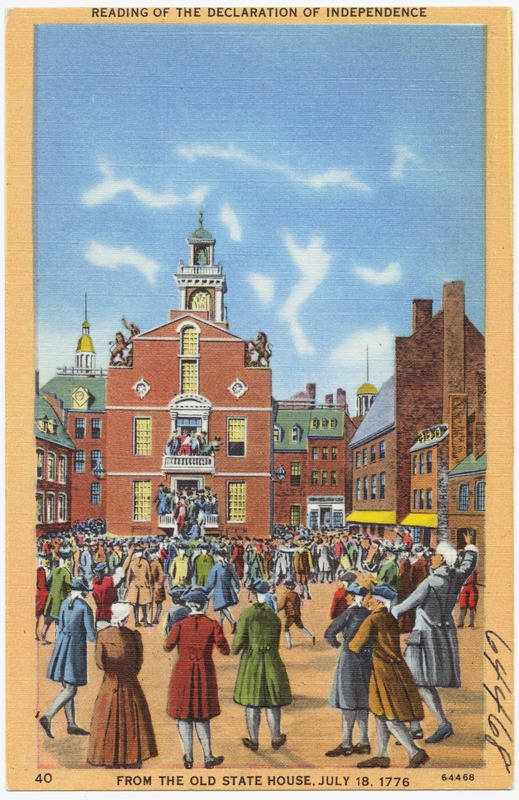
On 18 July 1776, 250 years ago today, the Declaration of Independence was officially proclaimed in Massachusetts.

People had already heard about the Continental Congress’s vote, and many had probably read the Declaration in newspapers. But this was a governmental ceremony. It happened in two places, and on two levels.

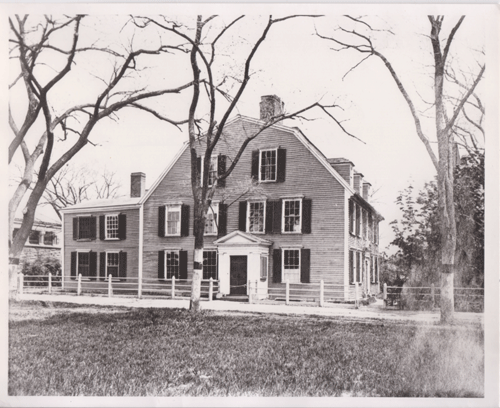
With no governor, the highest executive authority in Massachusetts was the Council. Most of its members were meeting in the Edmund Fowle house in Watertown.

Therefore, one part of the official reading was performed by Council secretary Perez Morton, reading the Declaration to the Council and to a crowd gathered outside. Also present were delegates from the Mi’kmaq and St. John’s/Maliseet communities, ready to sign a treaty of friendship with this new United States.

In Boston, there was a parallel, larger ceremony. Inside the Council’s chamber in what was now the State House, Suffolk County sheriff William Greenleaf read the Declaration to some Council members and other officials.

Col. Thomas Crafts of the Massachusetts artillery regiment, who had a bellowing voice, then “deaconed” or repeated the text phrase by phrase from the balcony of the Council chamber to the crowd gathered on the street below.

Thus, most Bostonians at the event heard Col. Crafts’s reading, but the official proclamation in Boston came from Sheriff Greenleaf. The ceremony was meant for both government officials and the “people out of doors.”

On 21 July, Abigail Adams reported to her husband:
Last Thursday after hearing a very Good Sermon I went with the Multitude into Kings Street to hear the proclamation for independance read and proclamed. Some Field peices with the Train were brought there, the troops appeard under Arms and all the inhabitants assembled there (the small pox prevented many thousand from the Country).

When Col. Crafts read from the Belcona of the State House the Proclamation, great attention was given to every word. As soon as he ended, the cry from the Belcona, was God Save our American States and then 3 cheers which rended the air, the Bells rang, the privateers fired, the forts and Batteries, the cannon were discharged, the platoons followed and every face appeard joyfull.

Mr. [James] Bowdoin [a senior member of the Council] then gave a Sentiment, Stability and perpetuity to American independance.

After dinner the kings arms were taken down from the State House and every vestage of him from every place in which it appeard and burnt in King Street. Thus ends royall Authority in this State, and all the people shall say Amen.
Not everyone was entirely pleased. Merchant John Rowe characterized the celebration as “a Great Confusion in Town.”

Pulling the royal emblems of the lion and unicorn down from the State House roof was probably inspired by reports of New Yorkers toppling the statue of King George III after that city’s reading of the Declaration on 9 July. But the street was still called King Street until 1784.

Saturday, April 25, 2026

“That the said Hill be immediately apprehended”

John Hill was yet another of the Loyalists captured aboard the brig Elizabeth.

[I feel like I’m never getting away! Then again, that’s probably how those passengers felt when they were brought back to New England after trying to evacuate.]

According to recent research shared in the Loyalist Directory, John Hill was born in Ireland about 1737. He moved to New York City in the early 1770s and ran an inn.

In March 1775, Hill came to the aid of William Cunningham during a fight near New York’s Liberty Pole (shown here). Hill later told the Loyalists Commission that “a Mob…beat us with Clubs, and stoned us.” The two men were thrown into prison and put on trial in April. But the foreman of the jury, John Wetherhead (another future Loyalist), kept them from being convicted and punished.

Cunningham and Hill “escaped to Boston,” reaching the besieged town by 5 May. They enlisted in the militia company of James Forrest, another man from Ireland. Hill said he was “appointed Quarter Master to the same Company.”

In March 1776, Gen. William Howe decided to evacuate the town. He ordered Crean Brush to confiscate all cloth that could be useful to the Continental Army. Brush enlisted Richard Hill, formerly sheriff in his county of northeastern New York (which would become Vermont), as an assistant. Richard presumably brought his younger brother, John Hill, onto that team.

As ships pushed off from Boston’s wharves, John Hill and his family squeezed onto the Elizabeth along with Brush, most of the confiscated goods, a squad of British soldiers, and other Loyalists. In Hill’s words, “on the 17th of March 1776, he left Boston, with the Royal Army; but was taken at Sea, by the Rebels.”

The brig, its property, and its wealthiest passengers were sent to Portsmouth, New Hampshire. The Hill family and several others were landed on Cape Ann by 7 April. The Massachusetts authorities summoned John Hill to Watertown for questioning.

On 19 April, the Massachusetts Council reported:
The Committee appointed to examine sundry Persons taken on board the Brigt Sally [sic] bound to Hallifax, & sent to the Council by the Committee of Marblehead…examined [John] Hill who informs your Committee that he is a native of Ireland that he came to New York three or four years since that he came to Boston about ten months ago on the removal of the troops from New York to Boston for the recovery of monies due to him from them and that for the same purpose he was going to Hallifax having acted as a Sutler among the troops.
Sailing off to Canada out of political loyalty was suspect. Sailing there just to collect debts from soldiers seemed more reasonable to these office-holders.

The Council agreed that Hill should be allowed to go free after providing a “written parole not to bear arms against the United Colonies, nor in any way aid or assist the Enemies of the said Colonies.” He probably headed back to Cape Ann to find his wife and at least one child.

In Boston, however, some merchants were still seething at how Brush and his assistants had taken their property. That property itself was up in Portsmouth, being sorted by Continental agent Joshua Wentworth. More information filtered back to Watertown.

On 25 April, 250 years ago today, the whole Massachusetts General Court passed a new resolve:
WHEREAS a certain John Hill, lately taken Prisoner by Commodore [John] Manly, in a Vessell bound from Boston to Hallifax, and brought into Portsmouth, was examined before the Council; and no Evidence then appearing against him, he was discharged & set at Liberty;

And whereas it hath since been made to appear to this Court; that the said Hill, at the time he was taken, as aforesaid, had in his possession Chests, Trunks & Packages of Goods and Merchandizes to the value of three hundred pounds Sterlg. supposed to have been stolen from the distressed Inhabitants of the Town of Boston; and was an Assistant to Crean Brush in his late unwarrantable and highhanded Thefts & Robberies
Therefore

Resolved, That the said Hill be immediately apprehended, wherever to be found, & brought before this Court for Examination, touching the Premises, and all Sheriffs, Constables & other executive Officers, and all the good People of this Colony, are hereby directed & impowered to apprehend the said Hill, wherever he may be found, and bring him forthwith before this Court, in order that he may be dealt with for his aforesaid highhanded Crimes, as to Law & Justice appertains.
TOMORROW: The manhunt was on!

[Boston also had a justice of the peace named John Hill, very involved in events surrounding the Boston Massacre. Unfortunately, the same tag applies to both men, but I think context will make it easy to sort out their stories.]

Thursday, April 23, 2026

“Without the Privelege of Pen, Ink, Paper or Candle”

In April 1776, Watertown was the seat of Massachusetts’s government.

Though people could now go into Boston, that town was still reeling from the siege. Plus, there was smallpox.

So the Massachusetts General Court stayed in Watertown—the assembly in the town’s meeting-house and the Council in an upper chamber of Edmund Fowle’s house (now headquarters of the Historical Society of Watertown, shown here).

Under the provincial charter, because the governor and lieutenant governor were absent (both driven away by the war), the Council exercised executive power.

That’s why, on 12 April, James Otis, Sr., as senior member of the Massachusetts Council, signed this order to imprison five genteel Loyalists captured aboard the brig Elizabeth:
To the Keeper of the Goal at Boston, in the County of Suffolk—Greeting—

You are hereby directed and commanded to take into your Custody Crean Brush, William Jackson, Peter Ramsey, Edward [K]eighley, and Richard Newton, lately taken in their flight from Boston in attempting to carry away from thence under the protection of the British fleet, large Quantities of Goods Wares & Merchandizes, the Rightful Property of the Inhabitants of that town, and having joined themselves with the Fleet & army employed against the united Colonies of America—

and you are commanded to confine the said Crean Brush William Jackson & Peter Ramsen [sic], each in an apartment by himself, without the Privelege of Pen, Ink, Paper or Candle, and not suffer them, or either of them to converse with any person whatever, unless in your hearing, and for the better Security of the said Crean Brush you are further ordered & commanded to put him into Handcufts immediately—

And them and each of them safely keep, ’till the further Order of the Major part of the Council, or they be otherwise discharged by due Course of Law—Hereof fail not at your Peril.
Two days later, Maj. John Grizzage Frazer, as assistant quartermaster for the Continental Army, wrote to Gen. George Washington to say that those men were now locked up. Brush was “in Irons.”

Frazer also passed on the news that on 12 April “8 british seamen” had made off with the cutter from H.M.S. Renown, one of the Royal Navy ships still hovering in the outer harbor, and got into Boston. Those defectors were much more welcome than the Loyalists who had tried to leave.

TOMORROW: Free William Jackson!

Monday, February 23, 2026

“At length we have had the Commencement of Hostilities begun”

Here’s an account of the start of the Revolutionary War that I don’t believe has been published before.

It’s a letter dated 11 June 1775 from Jonathan Hastings, Jr. (1751–1831), son of the steward of Harvard College, to a friend named Jacob.

Hastings graduated from Harvard in 1768 and a few years later become one of Cambridge’s school teachers. He was living in his father’s house beside the common, shown here. On 8 June, three days before writing this letter, the young man took the job of town postmaster.

Ironically, his letter appears to have been intercepted by the Crown forces because it’s filed among Gov. Thomas Gage’s papers at the Clements Library. The library offers scans and an imperfect transcription.

Hastings wrote:
Your Brother’s Letter of 18th. May we received the 9 of June. Notwithstanding my many Avocations (our House being made Head Quarters) I cannot miss an Opportunity of sending you a Letter. Am happy you had so safe a Passage & found your Friends well.

At length we have had the Commencement of Hostilities begun by Gage’s Troops, at the Battle of Lexington, where 8 of our Men were killed, there being about 50 assembled on a Green.—

The Evening preceeding the 19 of April, I was met by 11 Officers equipt with Pistols & Cutlasses; when I got Home I acquainted several Gentlemen therewith; but they thought it was like to prove nothing but a false Alarm. They were mistaken. About 2 OClock the next Morning, we were roused out of Bed to pursue 1100 Grendadiers & Light Infantry being a Detachment from all the Regiments in Boston.—

They made their way to our Magazines at Concord, but affected nothing more than destroying 80 Barrels Flour, knocking of [sic] the Ears of 3 twenty four pounders & burning the Carriages. A Quantity of Bullets they threw into a pond, but have been got out since.

Coll. [Thomas] Gardner ordered our Regiment to parade at Watertown, not knowing but that Gage’s Reinforcement would take that Course. He was mistataken [sic], they marched thro’ Cambridge, wch. being known our Regiment took the nearest Way to meet the Detachment. Unluckily for us we had no sooner placed ourselves in an advantageous Post near Lexington Meeting House to give Battle to the Detachment, than we perceived the Brigade in the other Side of us. Our Situation was bad, being between both Armies.
Well, that seems like an exciting place to break, doesn’t it?

TOMORROW: Under fire.

Wednesday, December 03, 2025

“The said Short is a midling sized man”

During the siege of Boston, Benjamin Edes published the Boston Gazette out of Watertown. His main competition was the New-England Chronicle that Samuel Hall printed in Cambridge.

Geography put Edes’s print office closer to the Continental camp in Roxbury. On 13 Nov 1775, and for the next two weeks after, the Boston Gazette carried this advertisement:
DESETED [sic] from Capt. Earl Clap’s company in Col. Theophilus Cotton’s regiment, on the 12th of June last, and taken up on the 9th of this inst. [i.e., this month] at Cambridge, John Short, and in conveying him to Roxbury he ran-away again.

The said Short is a midling sized man, goes a little stooping, fresh looking, lately had the small pox, with a scarr on the right side of his face, and dark complection: Had on when he was last taken a blue coat, wash leather breeches, a surtout of a greyish colour, small brim’d hat with a white ribbon round the crown, and boots on.——

Whoever will take up said run-away, and secure or return him to the regiment he deserted from, shall receive four Dollars reward and all necessary charges paid by me.

Roxbury, Nov. 10, 1775. EARL CLAP.
“Wash leather” meant a form of chamois.

Short was evidently caught in late November or early December since the ad stopped appearing and he was court-martialed on 4 December, as recounted yesterday.

In addition to running away twice, as the ad described, Short’s trial record says he’d gotten Capt. Clapp to pay 36 shillings “for a former theft.” No wonder the army was ready to throw the book at him.

Part of Short’s sentence was to repay Clapp that sum plus £1.16s. for the “expense of advertising and apprehending him.” Most of that was probably the $4 reward, then pegged at £1.

TOMORROW: Witnessing the punishment.

Saturday, November 08, 2025

“A proper Method for bringing Dr. Church before the House”

As described yesterday, on 17 Oct 1775 the Massachusetts General Court decided to summon Dr. Benjamin Church to Watertown to explain why he’d sent a ciphered letter into British-occupied Boston.

Dr. Church’s first response to that action arrived on 23 October, as reported by James Warren: “The Speaker communicated to the House a Letter received from Dr. Church, wherein he expresses a Desire to resign his Seat in the House of Representatives.”

The previous month, Church had also tried to resign as Surgeon-General of the Continental Army, following a month of turf disputes with regimental surgeons. Gen. George Washington and his aides had urged him to stay, only to be blindsided by that ciphered letter. Those two resignations suggest that Church was realizing what a hole he’d dug for himself and just wanted to go away.

The legislators didn’t want to let Church go, though. Particularly Speaker Warren. He’d been immersed in this case since Washington had called him to Cambridge to share the first hints of the doctor’s dealings.

Back on 1 October, Warren had written to his friend John Adams:
Dr. C——h has been detected in a Correspondence with the Enemy at least so far that a Letter wrote by him in Curious Cypher . . .

We all thought the Suspicion quite sufficient to Justify an Arrest of him and his Papers, which was done, and he is now under a Guard. He owns the writeing and sending the Letter. Says it was for [John] Fleeming in Answer to one he wrote to him, and is Calculated, by Magnifying the Numbers of the Army, their regularity, their provisions and Ammunition &c, to do great Service to us. He declares his Conduct tho’ Indiscreet was not wicked.
Something had to be done. The legislature therefore voted on 23 October to let Church’s resignation letter “lay on the Table, till the Committee who are directed to consider a proper Method for bringing Dr. Church before the House shall report.”

As Warren and others understood by this time, the Continental Army rules and regulations didn’t allow a court-martial to sentence a spy to death. Gen. Washington was therefore holding off on formal proceedings. His most recent council had decided “to refer Doctor Church for Tryal & Punishment to the General Court of Massachusetts Bay.”

On 26 October the house committee came back with their recommendation. They started by stating that Church “has been convicted by the Judgment of a Council of War, at which his Excellency [Gen. Washington] presided, of having carried on a criminal Correspondence with the Enemy.”

In fact, Washington’s councils weren’t courts and had no power to convict anyone. But neither did the legislature have the power to try and punish Church as the last council suggested—all the General Court could do was expel the doctor. Each body was pushing for the other to take on the authority of judging Dr. Church. And everyone was still waiting for guidance from the Continental Congress.

The General Court voted:
…whereas the said Benjamin Church is also a Member of this House, and the Charge brought against him is of so criminal a Nature, that it is the Duty of the House to make strict Enquiry into the Fact, and upon Proof of the same to manifest their utter Abhorrence thereof:

Therefore, Resolved, That Mr. William Howe, the Messenger of this House, be and he hereby is directed on Friday the 27th of October Instant [i.e., this month], to apply to his Excellency George Washington, Esq; for a sufficient Guard, safely to conduct the said Benjamin Church to and from the Barr of this House, and being furnished therewith, to take the Body of the said Church and bring him to the Barr of the House accordingly, at Ten o’Clock in the Forenoon of the same Day.
On that Friday morning, there was a motion “That there be fixed in the Alley [i.e., aisle] a Bar, at which Dr. Church will be brought.” The stage was set.

I’ll speak about what happened next in Watertown on Sunday afternoon, as detailed here.

TOMORROW: Records of the case.

Friday, November 07, 2025

“The House being jealous of their Priviledges”

As recounted yesterday, on 4 Oct 1775 Gen. George Washington and his fellow generals realized that the Continental Congress’s articles of war weren’t strict enough about passing information to the enemy.

Which was a problem since they had just uncovered evidence that the head of the army’s hospitals, Dr. Benjamin Church, had been doing just that.

In reporting the situation to John Hancock as chairman of the Congress, Washington respectfully wrote that he was “suggesting to their Consideration, whether an Alteration of the 28th Article of War may not be necessary.”

Dr. Church didn’t just have a military appointment. He was also one of Boston’s four representatives in the Massachusetts General Court, elected back on 18 July. Of course, that town meeting hadn’t happened inside British-held Boston. Instead, the “dispersed” inhabitants had gathered in the meetinghouse at Concord.

Dr. Church was active in the first few days of the legislative session in Watertown’s meetinghouse. But in August he took up his new job overseeing the medical care of the army. Two of the other men chosen to represent Boston, Samuel Adams and John Hancock, were away in Philadelphia. That left John Pitts to speak for the town. But that assembly couldn’t do much to affect life in Boston then anyway.

Then in early October came the bombshell news that the army had put Church under arrest. People were soon hearing about why, but this was the house’s first formal response on 14 October:
ORDERED, That Mr. [James] Sullivan bring in a Resolve making a proper Application to General Washington, relative to the imprisonment of one of the members of this House, viz. Doctor Benjamin Church.
The resulting resolution said:
…the House being jealous of their Priviledges, and desirous to know the Cause of said Imprisonment:—— Therefore

Resolved, That the Speaker [James Warren], Mr. Sullivan and Major [John] Bliss, be a Committee to apply to is Excellency George Washington, Esq; requesting him as soon as may be to certify to this House the Cause of the Detention and Imprisonment of said Benjamin Church, Esq; that they may advise thereon.
On 17 October, Warren reported that he had received from Joseph Reed, Washington’s military secretary, “a Letter from Dr. Church to the Enemy, as decyphered by the Rev. Mr. [Samuel] West.” The house voted:
Resolved, That Dr. Church ought to be brought to the Bar of this House, to shew Cause, if any he has, why he should not be expell’d the same.
The next day, Gen. Washington sat down for a council with Benjamin Franklin, Benjamin Harrison, and Thomas Lynch from the Continental Congress and with officials from the New England governments. That meeting would run through 24 October and cover many topics. One item on the agenda was “What Steps are necessary to be pursued with Regard to Dr Church?”

The developments in Watertown offered an out: “Upon a Discussion of all Circumstances it was agreed to refer Doctor Church for Tryal & Punishment to the General Court of Massachusetts Bay.” As for what the army should do, given the articles of war, Washington would wait for the Congress’s guidance.

TOMORROW: Dr. Church makes his move.

Thursday, November 06, 2025

“Examining Dr. Church” in Watertown, 9 Nov.

As previously announced, on Sunday, 9 November, the Historical Society of Watertown and Watertown Free Public Library will host me speaking about “Examining Dr. Church: The Trials of the Revolutionary War’s First Notorious Spy.”

Our event description:
In October 1775, Massachusetts politicians gathered in Watertown to try one of their own on the charge of supplying intelligence to the king’s army.

Dr. Benjamin Church, Jr., had been a leader of Boston’s resistance and then Surgeon-General of the Continental Army. The rebel authorities had collected the reluctant testimony of Church’s mistress and a letter written in cipher—but was that evidence strong enough to impeach the doctor as an enemy spy?
This Sestercentennial talk will start at 2 P.M. in the Watertown Savings Bank Room on the library’s first floor. It will be free and open to the public, thanks to a grant from the Watertown Community Foundation.

Here’s how this inquiry into the Continental Surgeon-General’s actions came to be held in Watertown.

On 14 June, 1775, the Continental Congress created a committee “to bring in a dra’t of Rules and regulations for the government of the army.” To chair that committee, the delegates chose George Washington, formerly colonel in charge of the Virginia regiment, just as they had put him in charge of previous committees on military topics.

However, the next day the Congress voted to make Washington commander-in-chief of that army. So the task of completing those rules shifted to other committee members—probably Silas Deane, Thomas Cushing, and Joseph Hewes. On 17 July the Pennsylvania Packet printed “the rules and articles of war agreed to by the Congress.”

Among those articles was:
Art. XXVIII. Whosoever belonging to the continental army, shall be convicted of holding correspondence with, or of giving intelligence to, the enemy, either directly or indirectly, shall suffer such punishment as by a general court-martial shall be ordered.
In late September, Gen. Washington learned that Dr. Church had broken that rule, at least the part about secretly corresponding with people inside Boston. As serious as that charge was, a Continental court-martial couldn’t order just any punishment. Its options were limited by another article:
Art. LI. That no persons shall be sentenced by a court-martial to suffer death, except in the cases expressly mentioned in the foregoing articles; nor shall any punishment be inflicted at the discretion of a court-martial, other than degrading, cashiering, drumming out of the army, whipping not exceeding thirty-nine lashes, fine not exceeding two months pay of the offender, imprisonment not exceeding one month.
The commander-in-chief called his generals together as a council of war on 4 October. According to the notes of that meeting:
after examining the Regulations of the Continental Army & particularly the Articles 28 & 51—

It was determined from the Enormity of the Crime, & the very inadequate Punishment pointed out that it should be referr’d to the General Congress for their special Direction & that in the mean Time he be closely confined, & no Person visit him but by special Direction.
The Continental commanders couldn’t ignore what Church had done. But they also couldn’t proceed against him, lest they have to let him off with punishment that would be, though degrading to a gentleman, far less than they thought a traitor deserved.

TOMORROW: Passing the buck.

Friday, August 29, 2025

Bell on “Dr. Benjamin Church,” 9 Nov.

As long as I’m discussing Dr. Benjamin Church, Jr., here’s early notice of a talk I’ll give about him for the Historical Society of Watertown this fall.

Sunday, 9 November, 2:00 P.M.
Dr. Benjamin Church
Watertown Free Public Library

The society’s event description says:
Dr. Benjamin Church was a patriot activist who was exposed as a spy for British Major General Thomas Gage. The Massachusetts General Court held an inquiry into his activities from October to November 1775. November 2025 will mark the 250th anniversary of the legislature’s decisions. New details regarding Church's spying activities will be revealed. Attendees will also learn where the Massachusetts General Court held the Church inquiry.

J. L Bell is a writer who specializes in the start of the American Revolution in New England and is the proprietor of the popular Boston 1775 website. A Fellow of the Massachusetts Historical Society and elected member of the American Antiquarian Society and Colonial Society of Massachusetts, he authored the book The Road to Concord: How Four Stolen Cannon Ignited the Revolutionary War as well as a National Park Service study of George Washington’s work in Cambridge. He has written many articles, delivered papers to the Massachusetts Historical Society and appeared on a panel of the Organization of American Historians. Some of his lectures have been broadcast on the C-Span Networks and he has spoken at many historic sites around greater Boston and beyond.
This event will be free and open to the public. Parking in the Watertown library lot is free on Sundays. This historical society’s programming is funded by a 2025 grant from the Watertown Community Foundation.

Monday, August 04, 2025

“The most profitable Business he could at present Employ himself about”

Here’s another transcribed letter from the Papers of John Hancock.

Thomas Cushing, having been replaced as a Massachusetts delegate to the Continental Congress in favor of Elbridge Gerry, was back home in Massachusetts as a member of the Council.

On 4 Apr 1776, less than a month after the British military evacuated Boston, Cushing wrote to Hancock:
Some time before you wrote to me concerning Your Brother [Ebenezer Hancock], I had not been unmindful of him, I saw him at Watertown & he told me he should like to be Employed if possible in that town in writing for the Council or House, as he should in that Care be near his family & could often Visit them, I accordingly made Enquiry after some Employ of this Sort for him & sspoke to divers Members of the Council & it appeared to me that there would soon be an opening for him –

a few days ago I saw him at Boston and told him what you hard wrote me concerning him & what prospect I thought there was of his being Employed, he told me he was oblidged to me, but it would not suit him & tarry at Watertown now as the Town of Boston was again retured to its Inhabitants, that he had found all his goods & merchandize were safe and in good Condition, that he determined to return to Boston & that he apprehended that the most profitable Business he could at present Employ himself about was in attending to the Sale of his Goods, in which I think he judged wisely. I give you joy that his Goods are Safe
John eventually got Ebenezer the job of a deputy paymaster of the Continental Army. As a result, Ebenezer sometimes had huge sums of silver money from France under guard in his Boston home.

Ebenezer Hancock’s house in downtown Boston is now on the market. It’s being promoted as John Hancock’s house because the older brother owned it, but he’d inherited a lot of property in Boston. Ebenezer, who had received a smaller bequest from their uncle, ran into business reverses and went bankrupt in 1769. According to W. T. Baxter’s article on Ebenezer’s bankruptcy, John helped him out with “rent-free premises.”

Eventually, Baxter noted, the property flowed the other way. Gov. Hancock died intestate, so Ebenezer inherited a third of his fortune, including the stone mansion on Beacon Hill.

Saturday, May 03, 2025

“Eads escaped out of town last night”

I got interested this week in how printers exited Boston around the start of the war because of a question from a Boston 1775 reader about Benjamin Edes.

The standard understanding of Edes’s departure goes back to the 1901 biography of his son, Peter Edes, Pioneer Printer in Maine. Samuel Lane Boardman wrote:
In the spring of 1775, the town of Boston being in possession of the British troops, Mr. Edes contrived to evade the vigilance of their guards and went to Watertown with an old press and one or two imperfect fonts of type. The escape was made by night in a boat up the Charles river.
We know Edes reestablished the Boston Gazette in Watertown on 5 June 1775, and the shortest distance between Boston and Watertown is indeed up the Charles River.

But Edes’s journey was more complicated than that. Let’s start with a letter from Peter Edes that Boardman reprinted later in his biography, the same letter that I quoted a couple of days ago in regard to the Tea Party.

Writing to a grandson in 1836, Peter Edes said his father:
made his escape by disguising himself as a fisherman, and getting on board a fishing boat; and when they were a few miles from town he was landed on one of the islands, from which he made his escape to the main land.
To escape from Boston on a fishing vessel and to land on an island meant heading out into the harbor or beyond, not up the Charles River.

That detail matches a couple of contemporary reports from south of Boston, both sent to John Adams.

First, on 7 May Abigail Adams told her husband:
Poor Eads escaped out of town last night with one Ayers in a small boat, and was fired upon, but got safe and came up to Braintree to day. His name it seems was upon the black list.
On the same day James Warren wrote to his friend:
By the way I have Just heard that Edes has stole out. I wish his partner was with him. I called on Mrs. Adams as I came along. Found her and Family well.
Thus, Benjamin Edes left Boston in disguise on the night of 6 May. He may have brought out printing equipment, though these early sources don’t say that. I’d love to identify “Ayers,” but I’m not even certain of that spelling.

Edes must have landed somewhere off the south shore, given how Patriots in Braintree heard about his arrival within a day. Did Warren tell Adams, or did Adams tell Warren?

Then Edes made his way back toward the siege lines, settling in Watertown to be close to the Massachusetts Provincial Congress, its news, and its printing jobs.

Edes’s partner, John Gill, didn’t get out of Boston. Instead, in the wake of the Battle of Bunker Hill he and the teen-aged Peter Edes were arrested and held in the Boston jail for several weeks.

COMING UP: Under one roof.

Friday, May 02, 2025

“He engages in the fight which was the beginning of the end”

The printer Isaiah Thomas’s family understood him to have been very active on the first day of the Revolutionary War.

As stated in the preface to the 1874 edition of Thomas’s History of Printing in America:
He went out on the night of the 18th of April, to assist in giving notice that the troops were crossing the Charles river. He returned, but was out again by daylight. Crossing the ferry with Dr. [Joseph] Warren he went into a public meeting at Charlestown and urged the arming of the people, and was opposed by one Mr. [James?] Russell “on principles of prudence.”
Gen. Thomas Gage ordered his forces to stop anyone trying to leave Boston via the Neck or the ferry on the night of 18 April, so as to prevent the sort of “notice” Thomas supposedly spread.

Not only did the printer get out of town, this family lore said, but he then got back in. Even though one of the main points of this passage was that Thomas was on the royal authorities’ enemies list.

We know Dr. Warren did get out of Boston early on the morning of 19 April. Richard Frothingham’s 1865 biography of the doctor quoted witnesses saying he rode the ferry to Charlestown, then headed west on horseback.

We also know there was debate in Charlestown about whether to oppose the British army by force. Ultimately most of the townspeople decided to hunker down because they were too vulnerable to counterattack from the army and navy.

As to what Isaiah Thomas did in those busy hours, I’m not sure. He definitely did thrust himself into events at other times, so I’m sure he would have spread the alarm and urged opposition to the troops if he could. I’m just not sure the opportunities were available.

For a couple of paragraphs, the 1874 account slips into a breathless present tense.
As one of the minute men, he [Thomas] engages in the fight which was the beginning of the end. At night he goes to Medford. On the morning of the 20th, he makes a flying visit to his family at Watertown, and then starts on foot for Worcester.

He is constantly met on his journey by bodies of armed men on their way to Cambridge, anxious to learn even the minutest details of yesterday’s fight. After traveling on foot some miles, he meets with a friend who procures him the loan of a horse. Late at night, weary and travel worn, he arrives at Worcester to begin life anew; a good head and stout heart his only capital. . . .

The presses and types sent before him were all that were left as the fruit of five years’ toil and peril. A sum exceeding three thousand dollars (and a dollar meant something then, though soon to lose its meaning) was due him from subscribers, scattered over the continent.
The printer may well have had debts due him, but he was also being sued for debt he owed. The war, a new government, and a new town offered the possibility of a new start.

Isaiah Thomas struggled through the war years but prospered in the new republic. He settled in Worcester, publishing the Massachusetts Spy and many books from that town, and also invested in other print shops and newspapers. Ultimately his estate was solid enough that he set up the American Antiquarian Society to maintain his printing archive and tell his story his way.

TOMORROW: How another printer left Boston.

Friday, July 05, 2024

Isaac Bissell and My “More Plausible Scenario”

Earlier this week the Journal of the American Revolution published my article “The Story of Isaac Bissell—and the Legend of Israel Bissell.”

With the sestercentennial of the Battle of Lexington and Concord coming up next spring, I thought it was high time to put on record the evidence that the name of the man who carried Joseph Palmer’s alert from Watertown was Isaac Bissell, not (as the name was first misspelled by people copying it in a hurry) Israel Bissell.

That core identification was made years back by Lion G. Miles, and I give him full credit in the article, as I have in my talks on the topic.

I also felt obligated to add something new to the story if I could. That led me into digging up new material on the close but secret relations between the Massachusetts Provincial Congress and the government of Connecticut, an earlier note sent by Palmer, and the details of Connecticut’s alert.

But still, the core of this article is Isaac, not Israel, Bissell.

The first footnote ends:
As of this writing, Wikipedia includes entries for both Isaac Bissell and Israel Bissell, the latter supposedly taking over in Worcester from a man with a nearly identical name. This article presents a more plausible scenario.
The same situation pertains today. It’s hard to correct hallowed traditions, even if replacing the name of one young Connecticut farmer for another makes little difference to most people today.

If during next spring’s anniversary more commemorations and articles name Isaac Bissell, I’ll feel this study has fulfilled its purpose.

We can thank Israel Bissell for his brief military service in 1776 and acknowledge that lauding him for the last century was literally a typographical error.

Monday, April 22, 2024

Washington on Franklin on Gage on Lexington

In 1789, President George Washington went on a tour (I might even say a progress) through the northern United States.

This is how he recorded his travel through Massachusetts in his diary on Thursday, 5 November:
About sunrise I set out, crossing the Merrimack River at the town, over to the township of Bradford, and in nine miles came to Abbot’s tavern, in Andover, where we breakfasted, and met with much attention from Mr. [Samuel] Phillips, President of the Senate of Massachusetts, who accompanied us through Bellariki to Lexington, where I dined, and viewed the spot on which the first blood was spilt in the dispute with Great Britain, on the 19th of April, 1775. Here I parted with Mr. Phillips, and proceeded on to Watertown, intending (as I was disappointed by the weather and bad roads from travelling through the Interior Country to Charlestown, on Connecticut River,) to take what is called the middle road from Boston.
Washington didn’t mention where he dined in Lexington, but other sources confirm that it was at the tavern of William Munroe, who had been a militia sergeant back in April 1775. That building is now one of the museums of the Lexington Historical Society.

The President’s travelogue sounds rather dry, but this item in the 7 Jan 1790 Berkshire Chronicle suggests he was actually in a cheerful mood:
ANECDOTE.
When the President of the United States, in his late tour, was at Lexington, viewing the field where the first blood was shed in the late war; he with a degree of good humor, told his informant, that the Britons complained to Dr. [Benjamin] Franklin, of the ill usage their troops met with at Lexington battle, by the Yankies getting behind the stone walls, and firing at them. The Doctor replied, by asking them whether there were not two sides to the wall?
Well, it’s not exactly Abraham Lincoln’s joke about Ethan Allen, but we rarely get to hear Washington tell funny stories at all.

Washington’s comment echoes a poem published in the 27 Nov 1775 Boston Gazette called “The King’s Own Regulars.” Written in the voice of the redcoats, it includes this couplet about Gen. Thomas Gage:
Of their firing from behind fences, he makes a great pother,
Ev’ry fence has two sides; they made use of one, and we only forgot to use the other.
The following spring, Charles Carroll described this poem to his wife as “a song made by Dr. Franklin.” It looks like Franklin might have written those lines while visiting Gen. Washington in Cambridge in October 1775, then left them behind for the local press. And President Washington remembered the doctor’s pithy point years later.

Tuesday, April 09, 2024

“The Regular Troops have this morning kill’d six men”

Here’s what appears to be an authentic document from 19 Apr 1775. It was sold by Heritage Auctions in June 2017, but the company has preserved an image for us.

This short note reads:
To all whom it may concern, be it known, that the Regular Troops have this morning kill’d six men near Lexington Meeting House; this news is brot: to Watertown by Mr. Sanger, who told me that he saw the men lie dead.

J. Palmer
of the Congress Com:tee

Watertown, Wednesday Morning abt 8 o’Clock
Joseph Palmer (1716–1788) was a Massachusetts Provincial Congress delegate from Braintree and a member of the committee of safety and supplies. He was staying in Watertown with in-laws.

Two hours later, “near 10 o’Clock,” Palmer wrote a longer, more detailed letter that he sent to Hartford, Connecticut, with courier Isaac Bissell. That dispatch reported that a British relief column was out. By then, Palmer wrote, he had “spoken with Several Persons who have seen the Dead & Wounded.”

Along the way that letter was copied and sent south, its text mutating as it was hurriedly transcribed. I don’t think the original of that letter exists, but many handwritten and printed copies do, making it rather famous.

This first, shorter letter shows that Palmer had heard about the deaths on Lexington common by eight o’clock and started to spread the news on behalf of the congress’s committee. It’s unclear whom he addressed this particular note to, however.

I also can’t identify “Mr. Sanger.” There were multiple men with that surname in Watertown at this time, including David Sanger, on an October 1774 committee to equip two cannon, and Samuel Sanger, first sergeant of the militia company.

That’s a reminder that, even though some documentation survives to show such men as Joseph Palmer spreading the alarm in April 1775, many more people did so without leaving a firm trace in the historical record.

Monday, January 15, 2024

“Very much subject to the Poorly’s”

Here’s my favorite Revolutionary document of the month, from the William Bond Papers at the University of California at San Diego library.

It’s labeled “James Richardson / Discharge,” and it reads:
Prospect Hill March 10th. 1776

James Richardson of Capt. [Abijah] Child’s Company & 25th. Regiment, being a Lazy, Idle Fellow, unwilling to do his Duty, & very much subject to the Poorly’s he is therefore Discharg’d from the Continental Service, he having provided Silas Lamson (a much better Man than himself,) to take his place, and serve the remainder of the time for which said Richardson was Inlisted—————
William Bond was from Watertown, as was Abijah Child. Bond became a Continental Army colonel in July 1775, taking over from Thomas Gardner, who died of wounds suffered at Bunker Hill. He led the regiment until 31 Aug 1776, when he died from illness at Mount Independence.

Among the many entries for James Richardsons in Massachusetts Soldiers and Sailors of the Revolutionary War, a man from Woburn is linked to Bond’s regiment. He enlisted in May 1775 and served the rest of that year. He was, incidentally, set down as 5'9" tall.

The one entry in those volumes for Silas Lamson describes a man from Greenwich, then out in Hampshire County (and now under the Quabbin Reservoir). He’s listed as serving under Col. Jonathan Brewer in the second half of 1775, which is odd since Brewer and most of his men came from Middlesex County.

One notable detail about this document is the date of 10 Mar 1776. That was just as it became clear that the British military was about to leave Boston. Col. Bond no longer needed to have so many men immediately on hand, but he did need someone reliable for the regiment’s next assignment.

Saturday, September 02, 2023

Elbridge Gerry and the Signing

On 3 August 1776, Elbridge Gerry sent a second letter to his Continental Congress colleagues Samuel and John Adams.

Gerry wrote this time from Watertown, still the home of the Massachusetts legislature. He had traveled through Boston, seeing both Adams wives.

Gerry and the Adamses were among the Congress’s most radical delegates, resenting men who hung back from independence. In this letter, for instance, Gerry wrote of “our old Friend Mr. L—— or any other suspected Characters.”

Generally, the Marblehead merchant was optimistic about “the true State of Things in the eastern Colonies,” as people called New England. He had ideas about moving troops around and getting Benjamin Lincoln, then still a Massachusetts militia commander, a Continental commission. But he was confident in the militia system, concluding, “We have eastward of Hudson’s River at least 100000 Men well armed, a Force sufficient to repulse the Enemy if they were forty thousand strong at New York and Canada.”

One significant detail about this letter isn’t its text but its date. It shows that Gerry was in Massachusetts on 2 August when, as the Congress’s official record states, the delegates then present signed the engrossed (handsomely handwritten) Declaration of Independence. Gerry must therefore have added his signature later in the year.

In this article for the Journal of the American Revolution I discussed a story told about Gerry’s signing:
I am credibly informed that the following anecdote occurred on the day of signing the declaration. Mr. [Benjamin] Harrison, a delegate from Virginia, is a large portly man—Mr. Gerry of Massachusetts is slender and spare. A little time after the solemn transaction of signing the instrument, Mr. Harrison said smilingly to Mr. Gerry, “When the hanging scene comes to be exhibited I shall have the advantage over you on account of my size. All will be over with me in a moment, but you will be kicking in the air half an hour after I am gone.”
This anecdote comes to us in somewhat different forms from two seemingly independent sources: Dr. Benjamin Rush and Dr. James Thacher, both probably writing decades later. John Adams read both men’s words and didn’t quibble with the tale. I therefore concluded that this story was more reliable than other legends of the signing.

At the same time I wrote: “Of course it is possible that Rush’s recollection was not accurate. For example, Harrison could have come up with the witticism days later instead of at the dramatic moment of signing.” Or weeks before, when the delegates voted for independence. As Ray Raphael wrote earlier this summer, delegates conglomerated their memories of the vote and the signing.

We can therefore say the anecdote about Harrison and Gerry couldn’t have happened on 2 Aug 1776 when most Congress delegates lined up to sign the Declaration. But Harrison might still have shared his gallows humor sometime that year.

Wednesday, August 02, 2023

“To pass unmolested into the town of Boston”

On Sunday, 30 April, the Massachusetts committee of safety:
  • heard from Col. Benedict Arnold of Connecticut about artillery up along Lake Champlain.
  • ordered Maj. Timothy Bigelow to move weapons from Worcester to the siege lines.
  • hired an express rider.
  • urged its subcommittee of Azor Orne, Richard Devens, and Benjamin White to “form a plan for the liberation of the inhabitants” of Boston now that Gen. Thomas Gage was allowing them to leave.
So this committee wasn’t idle.

Probably after being stung by the letter from the Massachusetts Provincial Congress quoted yesterday, the committee appointed its chair, Dr. Joseph Warren, along with Joseph Palmer and Orne, to take their resolution out to that body in Watertown.

The committee’s recommendation was:
Whereas, proposals have been made by General Gage to the inhabitants of the town of Boston, for the removal of their persons and effects into the country, excepting their arms and ammunition:

Resolved, that any of the inhabitants of this colony, who may incline to go into the town of Boston with their effects, fire-arms and ammunition excepted, have toleration for that purpose, and that they be protected from any injury or insult whatsoever. This resolve to be immediately published.

The following orders were delivered to Col. Samuel Gerrish:
You are hereby empowered, agreeably to a vote of the Provincial Congress, to grant liberty, that any of the inhabitants of this colony, who may incline to go into Boston with their effects, fire-arms and ammunition excepted, have toleration for that purpose; and that they be protected from any injury or insult whatsoever, in their removal to Boston.

The following form of a permit is for your government, the blanks in which you are to fill up with the names and number of the persons, viz.:
Permit A. B., the bearer hereof, with his family, consisting of persons, with his effects, fire-arms and ammunition excepted, to pass unmolested into the town of Boston, between sunrise and sunset. By order of the Provincial Congress.
Dr. Warren signed that report “clerk pro tem.,” indicating he had taken on yet another job.

The committee of safety addressed only the question of how to reciprocate to Gen. Gage’s decision and let Loyalists enter Boston. It left the bigger question of how to help refugees who had left their homes in that town up to the congress.

The provincial congress made some amendments to the committee’s recommendation, so this is what went out officially:
In PROVINCIAL CONGRESS, Watertown, April 30, 1775.

Whereas an agreement has been made between General Gage and the inhabitants of the city of Boston, for the removal of the persons and effects of such of the inhabitants of the town of Boston, as may be so disposed, excepting their fire arms and ammunitions into the country:

RESOLVED, That any of the inhabitants of this colony, who may incline to go into the town of Boston with their effects, Fire-Arms and Amunitions excepted, have toleration for that purpose; and that they be protected from any injury and insult whatsoever, in their removal to Boston, and that this resolve be immediately published.

P. S. Officers are appointed for the giving permits for the above purposes; one at the sign of the Sun at Charlestown, and another at the house of Mr. John Greaton, jun. at Roxbury.

Ordered, That attested copies of the foregoing resolve be forthwith posted up at Roxbury, Charlestown and Cambridge.

Resolved, That the resolution of Congress, relative to the removal of the inhabitants of Boston, be authenticated, and sent to the selectmen of Boston, immediately, to be communicated to general Gage, and also be published in the Worcester and Salem papers.

Ordered, That Doct. Taylor, Mr. Bailey, Mr. Lothrop, Mr. Holmes and Col. Farley, be a committee to consider what steps are necessary to be taken for the assisting the poor of Boston in moving out with their effects to bring in a resolve for that purpose; and to sit forthwith.
The congress delegates, having given up their whole Sunday waiting for the committee, then adjourned for the day.

By the time the congress’s resolve was published in the 3 May Massachusetts Spy, the Rev. John Murray had stepped down as its president pro tempore and James Warren of Plymouth had declined the post. So the resolution was published over the name of the new president pro tem., Dr. Joseph Warren. As if he didn’t already have plenty to do.

TOMORROW: Spreading out the refugees.

Tuesday, August 01, 2023

“With respect to the liberation of our friends in Boston”

Last month I left off a discussion of Boston’s first town meetings during the war with the agreement that Bostonians reached with Gen. Thomas Gage.

In exchange for lodging all privately owned firearms with the selectmen, the military authorities promised to let people leave the besieged town with their other goods.

Henderson Inches, a merchant and former selectman who had helped to negotiate that pact, brought news of the general’s approval to the Patriot committee of safety on 28 April. That group, chaired by Dr. Joseph Warren, was headquartered in Jonathan Hastings’s house in Cambridge (shown above).

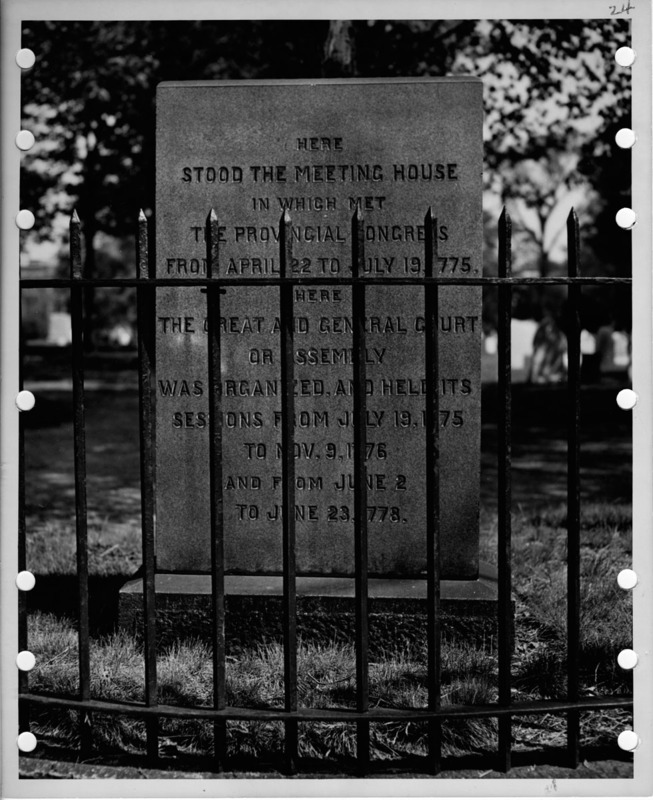
That committee answered to the Massachusetts Provincial Congress, which was out in the Watertown meetinghouse. Its president, John Hancock, was away at the Second Continental Congress, and other men were serving as president pro tempore. On 24 April that job had fallen on the Rev. John Murray (1742–1793) of Townsend/Boothbay, Maine, who had previously filled in as secretary.

The congress responded to the news out of Boston that afternoon with this resolve:
Ordered, That the committee appointed to introduce the honorable delegates from the convention at Exeter, in New Hampshire, to the committee of safety, apply to said committee for an authentic account of what transactions have certainly taken place, with respect to the liberation of our friends in Boston, and report as soon as may be.
The next morning, the committee reported they had delivered the message and “brought from the committee of safety a number of papers, which contain the proceedings of the town of Boston with general Gage, in respect to moving the inhabitants and their effects.” The committee asked that the larger legislature not take any action until they had come up with a recommendation.

On 29 April, the committee of safety appointed a subcommittee to draft that recommendation. The delegates named were Azor Orne of Marblehead, Richard Devens of Charlestown, and Benjamin White of Brookline—men from two communities neighboring Boston and the province’s second-largest port. Their towns would be among the first to receive refugees.

However, the committee of safety was managing many martial and political efforts, such as reorganizing the militia companies that had turned out on 19 April into an army enlisted till the end of the year and propagating the Patriot version of the fighting so far. Those subcommittee members were handling other tasks. They didn’t produce a quick plan.

The provincial congress in Watertown got antsy. On the morning of 30 April that body sent delegate John Grout of Petersham to ask for the committee of safety’s result. Delegates also discussed “an addition to the committee of safety”—i.e., adding more members so as to spread out the work.

There was still no response from Cambridge after the midday dinner break. The congress then sent John Mosely of Westfield “to procure their result with respect to moving out the inhabitants of Boston” with a letter that demanded a response:
IN PROVINCIAL CONGRESS, April 30, 1775.

SIR— I am directed to inform you, that it is with regret, this Congress find themselves obliged to send to the committee of safety a third messenger, to request their immediate report on the subject of the removal of the poor inhabitants of Boston.

To wait for that report, the Congress have suspended all proceedings on that matter, and sat in almost impatient expectation, by several adjournments, since seven o’clock this morning. I am obliged to request your answer by this express, without loss of time, that the Congress may then see what it is their duty to conclude on.

I have the honor to be, with great respect, Sir,
Your most obedient humble servant,
JOHN MURRAY.
TOMORROW: Resolutions at last.

Thursday, July 13, 2023

The Gap in the Town Clerk’s Records

The official published records of the town of Boston say that on Monday, 3 Apr 1775, the inhabitants held a meeting in Faneuil Hall.

With Samuel Adams busy at the Massachusetts Provincial Congress at Concord, that meeting chose Samuel Swift to preside in his place.

Voters filled some offices that the men they elected in the preceding month had declined. For instance, this town meeting chose the sons of William Molineux and Royall Tyler to be clerks of the market, an entry-level job for young gentlemen.

The other agenda item was collecting a tax approved in July 1774 “for the Relief of the Poor”—a response to the Boston Port Bill. A committee recommended naming collectors, but the citizens put off a decision until their next gathering.

To get around the Massachusetts Government Act’s limit on town meetings without Gov. Thomas Gage’s approval, the citizens then voted to adjourn to 17 April. As long as they kept the same meeting going by adjournment, they were within the law, right?

If a town meeting took place as scheduled on that day, it wasn’t recorded on the following page. That’s because the town clerk, William Cooper, slipped out of Boston around 10 April. He was apparently acting in response to intelligence that the secretary of state, Lord Dartmouth, had recommended to Gage that he start arresting leaders of the rebellion in Massachusetts.

Cooper took the notebooks that recorded town meetings with him. Some of the selectmen remained in town: Timothy Newell, John Scollay, Thomas Marshall, and Samuel Austin. In the following months, as Newell’s journal shows, they tried to document the damages and injustices of war and to stand up for their fellow citizens.

According to Cooper’s records, the next Boston town meeting took place in Watertown on 5 March. This was the annual oration in memory of the Boston Massacre, delivered that year by the Rev. Peter Thacher. That was, of course, the same day the British army saw the Continental fortifications on the Dorchester heights, so Thacher’s speech probably didn’t command people’s total attention.

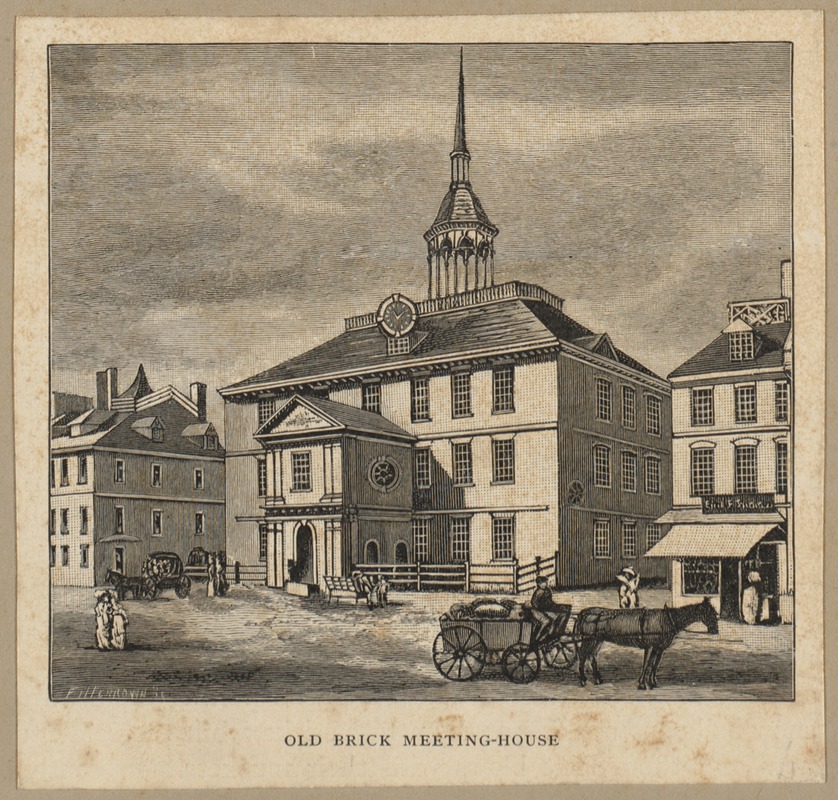
The British military sailed away on 17 March. Bostonians gathered for another town meeting twelve days later, on 29 March. They met in the Rev. Dr. Charles Chauncy’s church, the “old Brick Meeting House” (shown above). The main order of business was to elect officials for the upcoming year, starting with the town clerk. William Cooper continued to fill that role until his death in 1809.

However, there were at least two town meetings held inside besieged Boston that never got recorded in Cooper’s notes.

TOMORROW: The first lost meeting.