J. L. BELL is a Massachusetts writer who specializes in (among other things) the start of the American Revolution in and around Boston. He is particularly interested in the experiences of children in 1765-75. He has published scholarly papers and popular articles for both children and adults. He was consultant for an episode of History Detectives, and contributed to a display at Minute Man National Historic Park.

Subscribe thru Follow.it


•••••••••••••••••


Showing posts with label Margaret Thomas. Show all posts

Friday, September 18, 2026

Lund Washington’s Letter Mentioning William Lee’s First Wife

On 30 Dec 1775, Lund Washington wrote a letter to his distant cousin George, who was also his employer.

George was off in Cambridge commanding the Continental Army. As his cousin’s plantation overseer, Lund caught him up on various details of the operations at Mount Vernon.

As published in the Papers of George Washington in the 1980s and shared at Founders Online, that letter ended abruptly:
I will have gravel Carted for the walks. One of the men that went out with James Cleveland left him when he found they were likely to suffer.
There was no signature. “This document is incomplete,” said the editors, nonetheless adding a period to the end.

That letter was in the collection of Mount Vernon Ladies’ Association. At some point in the next quarter-century, scholars must have gotten a better look at it. Perhaps it had been mounted or otherwise sealed off.

Today Mount Vernon shares a scan of that page, plus the opposite side with the rest of the letter.

It turns out Lund Washington continued his sentence on the next page: “…were likely to suffer for want of provisions.” (George Washington had sent James Cleveland out to his Ohio claims.)

Later the letter says:
if it will give Will any pleasure he may be told his wife and child are both very well.
Directed to Gen. Washington from Mount Vernon, that comment had to refer to William Lee, his body servant, one of the few other people to make the trip to Massachusetts. It’s the only evidence to indicate that William, born about 1751, had married and fathered a baby before the war.

I didn’t know this source when I wrote about William Lee in a report for the National Park Service on Washington in Cambridge. That report highlights how in February 1776 the general paid Margaret Thomas to make shirts for Lee, years before the man told Washington that he and Thomas had married during the war. We don’t have any documents saying when Lee’s first marriage ended.

Mary V. Thompson, the Mount Vernon historian specializing in its enslaved community, cited Lund Washington’s 30 Dec 1775 letter in a 2014 article for the Journal of the American Revolution. It’s informed other writing about William Lee since, such as his entry at the Encyclopedia of Virginia.

However, Mount Vernon doesn’t share a transcript of the full letter. There’s no indication at Founders Online, which is based on the printed Washington Papers, that a more complete text exists. Rotunda’s index for William Lee doesn’t note this letter among the documents referring to the man.

The result is a scholarly paradox. Lund Washington’s letter to his cousin is now available for anyone to read. But half of it—perhaps the most interesting half—is impossible to find through the standard way to access George Washington’s correspondence.

Sunday, June 28, 2026

“By dawn on June 18, 1775, nothing was left standing”

The current issue of Archaeology magazine includes a dispatch about the City of Boston’s Archaeology Department recent work in Charlestown, filed by a journalist with the almost-too-good-to-be-true named of Jason Urbanus.

Urbanus writes:
In early 1775, Charlestown was already almost 150 years old. It was a bustling settlement of between 1,500 and 2,000 people representing all walks of life—farmers, artisans, merchants, and mariners, including both free and enslaved Black people.

There were large landholders, such as 53-year-old distiller David Cheever, who owned multiple properties across the peninsula, and those who were less well-off, such as widow Elizabeth Moore, who rented a simple room in a neighborhood tavern. The town’s diverse population also included Margaret Thomas, who bought a humble home in 1773, likely making her the first free Black woman to own property in Charlestown. Among the wide array of craftspeople were goldsmith Nathaniel Austin, chaise maker James Frothingham, and Cato Hanker, a shoemaker. Hundreds of houses, workshops, and other buildings lined the town’s streets and wharves.

By dawn on June 18, 1775, nothing was left standing and everyone was gone. Less than 24 hours earlier, a brutal engagement, known as the Battle of Bunker Hill, had raged across the Charlestown Peninsula. . . . Townspeople were sent fleeing, and many never returned. Nearly all lost everything they owned. . . .

Many of Charlestown’s inhabitants had departed over the previous month amid increasing unrest, but those who remained were jolted from their homes. A widow named Relief Ellery and her 20-year-old daughter of the same name were among those who narrowly escaped the bombardment. The younger woman pocketed two valuable silver tablespoons from the kitchen table—the only things she had time to grab. When the pair returned to Charlestown, none of their property remained. “We have records of British troops coming back the next day and setting fire to any building that still stood,” says [City Archaeologist Joe] Bagley. “It was vindictive.” In a matter of hours, one of the oldest settlements in Massachusetts had ceased to exist. . . .

At the urging of a committee of Charlestown residents, more than 450 families submitted inventories of their lost possessions after the battle in hopes of receiving restitution. . . . Usually, when archaeologists excavate a residence, they record the artifacts that they uncover during the process. In this instance, they already have a list of everything that was in a house before beginning excavations. They know exactly what they might expect to find buried in dozens of backyards and basements.
Or, rather, buried underneath a dense modern city, or perhaps already dug up and tossed aside in construction projects over the past two and a half centuries. It seems unlikely that we’ll see a confluence of household inventory and newly dug artifacts. Still, the written record provides a lot for scholars of domestic material culture to work with.

No doubt Archaeology readers love ceramics, and another section of the article discusses Charlestown early pottery industry, which can also be dated with finality:
No commercial sector was hit as hard as Charlestown’s once-thriving ceramics industry. Although not well-known today, Charlestown had been among the largest pottery production centers in the northeast. That all changed on the day of the battle. With their workshops burned to the ground, Charlestown’s potters scattered throughout New England. “They lost everything—their kilns, all of their work tools—everything was gone,” says Bagley. “None of them came back.”
Pictured above is a milk pan from the site of the Parker-Harris Pottery, excavated during the Big Dig highway project a generation ago.

Monday, July 08, 2024

A City Project to Reconstruct Charlestown in June 1775

Last month, on the anniversary of the Battle of Bunker Hill, the Boston’s Archaeology Program announced the release of research on the people who lived in Charlestown at that time.

During the battle, most of the town burned to the ground. That event provided a physical marker in the ground, and also a documentary milestone as inhabitants filed claims for their losses. However, the department notes, “Despite multiple attempts over half a century, no funds were ever granted.”

Using real estate records compiled by Thomas Bellows Wyman in The Genealogies and Estates of Charlestown (two volumes, 1879), the City Archaeology Team produced a map of property ownership in June 1775 that can be viewed here. The announcement says, “Each property is clickable, with details including a direct link to the property deed (via free familysearch.org account).”

The next step: “property descriptions based on deeds and claims documents to better understand the layout of buildings, structures, wharves, agricultural spaces, fences, and other landscape features for a future 3D landscape reconstruction of 1775 Charlestown.”

Another product of this effort is a reconstructed “census” for Charlestown in 1775, here in spreadsheet form.

Finally, there are multiple databases about the claims themselves, now housed in the Boston Public Library. Those documents have been scanned and are being transcribed, but the index is already available.

One name that stood out for researchers and myself was Margaret Thomas, filing for the loss of a house and furnishings worth £68.9, as shown here.

Wyman listed Margaret Thomas as “Spinster,” house owner, and “negro of Bartholomew Trow,” a Charlestown militia officer. Perhaps she had been enslaved in the Trow family, and anxious authorities still recorded that link even after she was buying real estate of her own.

Was this the same Margaret Thomas who worked at Gen. George Washington’s Cambridge headquarters by February 1776, joined the general’s traveling domestic staff, and married William Lee before the end of the war? We know that other people who came to work at the commander’s headquarters in 1775–76 had been burned out of Charlestown.

The handwriting on the “Summary Accompt.” filed with the town doesn’t match the signature on a receipt Margaret Thomas signed in Valley Forge in April 1778. But it’s possible that the claim was filed by someone else on Thomas’s behalf, or that this summary was copied by someone else. It’s definitely a lead worth following up.

Wednesday, June 22, 2022

“The Work of Revolution” in Cambridge, 23 June

History Cambridge (previously the Cambridge Historical Society) is headquartered in the oldest of the colonial houses along what was later dubbed “Tory Row.”

Some years before the Revolution, the families in those houses were all related, and they all had ties to slave-labor plantations on Jamaica and Antigua. Most if not all of those families also had enslaved people working for them on their Cambridge estates.

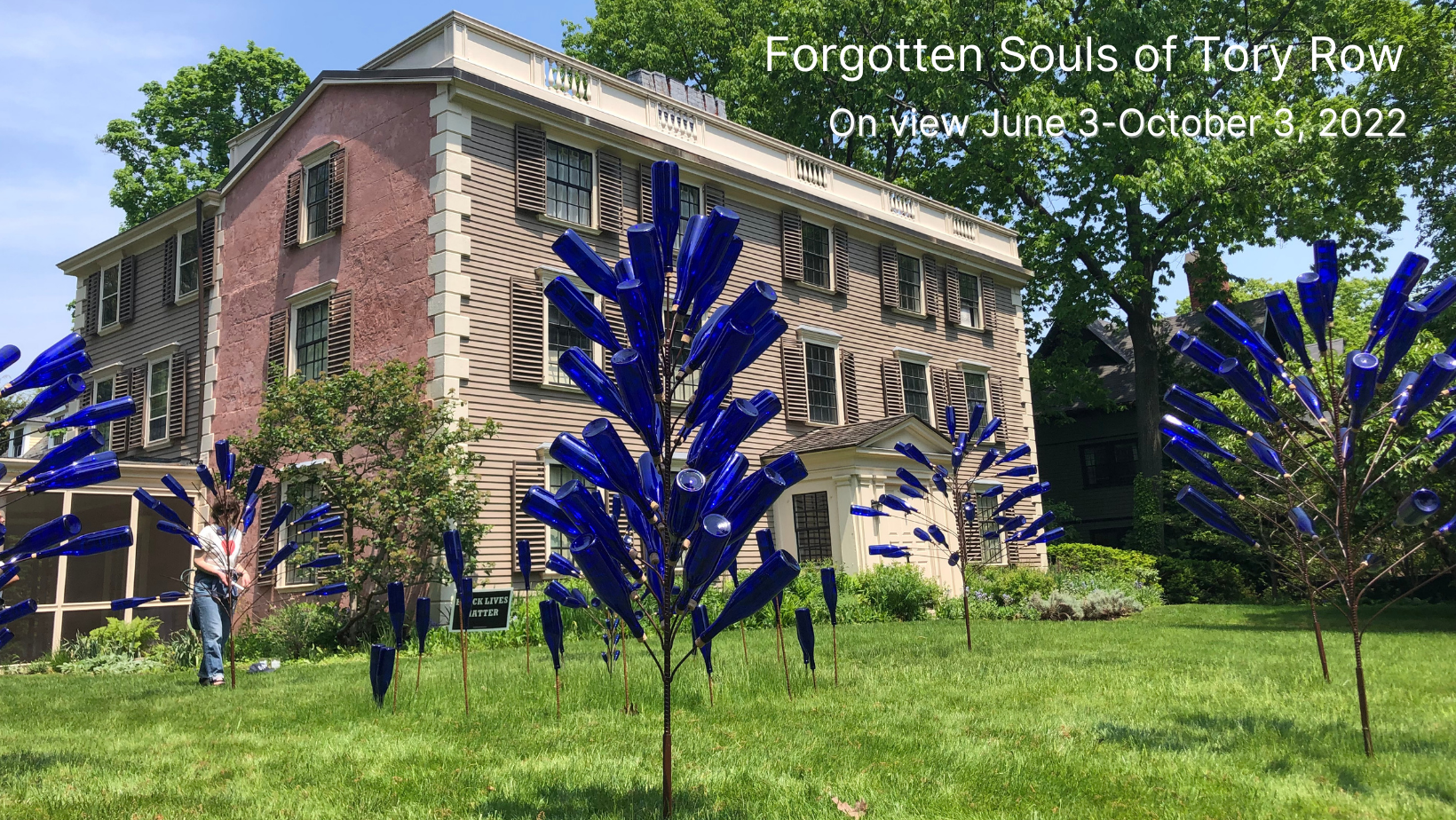
History Cambridge is now hosting an art installation on its lawn titled “Forgotten Souls of Tory Row: Remembering the Enslaved People of Brattle Street.” Created by Black Coral, Inc., this artwork in glass and metal adopts the tradition of bottle trees to evoke the power of ancestors.

History Cambridge is also organizing an online panel discussion called “The Work of Revolution” on Thursday, 23 June. Its event description says:
How did unpaid labor enable the Revolutionary leaders of Cambridge to foment rebellion and to carry out the political and military duties of the War?

Although much is known about George Washington’s residency in Cambridge in the early days of the Revolution, the reality is that it was the labor of women and people of color that enabled the Continental Army to function, as well as feeding, housing, and serving both the American and British troops present in the city. By centering the work experiences of women and BIPOC during this period, we will be expanding the scope of the Revolutionary narrative and bringing to light stories that have not often been shared with a wider audience.
Prof. Robert Bellinger, professor of history and founder and director of the Black Studies Program at Suffolk University, will lead the discussion.

History Cambridge has invited me to be part of this panel, talking about what we know of the people who tended Gen. George Washington’s headquarters in the years 1775 and 1776.

The general brought some enslaved workers from Mount Vernon with him, including his body servant William Lee. Martha Washington probably brought more. Washington also employed a free black woman named Margaret Thomas, as well as a family and a teenager burned out of their homes in Charlestown during the Battle of Bunker Hill. 

Though Tory Row was a place of slavery in those years, it soon became a place of liberation. While in Cambridge, Washington was convinced to let black soldiers remain in the Continental Army. The absence of the Loyalist homeowners, shifting mores, and a change in Massachusetts law meant the people enslaved on “Tory Row” had a good chance to become free by the end of the war.

The “Work of Revolution” discussion is scheduled to start at 7:00 P.M. Register at this page.

There will be a public celebration of the “Forgotten Souls” artwork on 16 July, and a question-and-answer session with the artists on July 21. For more information, visit this page.

Tuesday, March 11, 2014

“The Women of Washington’s Headquarters” in Cambridge, 13 Mar.

I’ll miss Ray Raphael’s talk in Worcester on Thursday evening because at that time I’ll be speaking in Cambridge on “The Women of Washington’s Headquarters.”

This is the latest in a series of talks I’ve given at Longfellow House–Washington’s Headquarters National Historic Site to commemorate Evacuation Day, when Gen. George Washington saw the siege of Boston brought to a successful end. This year’s topic, though we didn’t think about this when we planned, also fits with National Women’s History Month.

I’ll talk about some of the women who lived and worked at John Vassall’s confiscated mansion in 1775-76. In particular, I’ll discuss:
One of them is, of course, a household name. The others have their own stories, faintly recorded, and they helped to keep the military headquarters functioning.

This talk will start at 6:30 P.M. It’s free, but space is limited, so the park service asks people to phone 617-876-4491 to reserve seats. If you’ve got time, ask about Ranger Garrett Cloer’s Revolutionary-themed tour of the House in the afternoon before the talk.

(Seasonal photograph above by Tom Stohlman.)

Friday, November 03, 2006

Margaret Thomas: free black woman at Washington's headquarters

Margaret Thomas was a free black woman who joined the staff of Gen. George Washington's headquarters in February 1776, according to the accounts of his household manager Ebenezer Austin. At that time, Washington was living in the Cambridge mansion now known as Longfellow House, trying to push the British military out of Boston.

Thomas's duties included washing and mending clothes. She seems to have remained with the commander-in-chief's shifting headquarters throughout the first years of the war, judging by such documents as this 1778 receipt she signed at the bottom (courtesy of the Library of Congress's online collection of Washington papers). At the end of her service, she apparently went to live in Philadelphia, and the general never expected to see her again.

But in 1784, Washington's bodyservant and riding companion Will Lee came to him with a request, as he described in this 28 July letter to his Philadelphia agent, Clement Biddle:

The mulatto fellow William, who has been with me all the War is attached (married he says) to one of his own colour a free woman, who, during the War was also of my family.

She has been in an infirm state of health for sometime, and I had conceived that the connection between them had ceased, but I am mistaken; they are both applying to me to get her here, and tho' I never wished to see her more yet I cannot refuse his request (if it can be complied with on reasonable terms) as he has lived with me so long and followed my fortunes through the War with fidility.

After promising thus much, I have to beg the favor of you to procure her a passage to Alexandria either by Sea, by the passage Boats (if any there be) from the head of Elk, or in the Stage as you shall think cheapest and best, and circumstances may require.

She is called Margaret Thomas als. Lee (the name which he has assumed) and lives at Isaac and Hannah Sills, black people who frequently employ themselves in Cooking for families in the City of Phila.
As I read this letter, Washington was skeptical that Will Lee and Margaret Thomas were truly married. He may have suspected they had come up with this plan to secure Thomas a more comfortable home while she was sick. The general worried about creating resentment among his enslaved workers at Mount Vernon by employing free blacks, and he had no individual liking for Thomas.

Yet Washington didn't feel he could refuse Lee's request. He agreed to do a big favor for his long-time slave. To borrow an analogy from former Mount Vernon staffer Bruce Harris (now head of the Literary Trail of Greater Boston), since Washington had been raised to consider slaves as property, this was rather like one of us agreeing to make space for another refrigerator because our current refrigerator asked.

There's no evidence that Margaret Thomas ever made it to Virginia, however. It's unclear whether Biddle found her in Philadelphia, if she was in shape to travel, or if she cared to.

Washington freed Will Lee in his will, leaving it to his widow Martha to complete the emancipation of the rest of their human property. Lee remained at Mount Vernon until 1828, working for wages as a shoemaker. There's a chapter about him in Fritz Hirschfeld's George Washington and Slavery: A Documentary Portrayal.