J. L. BELL is a Massachusetts writer who specializes in (among other things) the start of the American Revolution in and around Boston. He is particularly interested in the experiences of children in 1765-75. He has published scholarly papers and popular articles for both children and adults. He was consultant for an episode of History Detectives, and contributed to a display at Minute Man National Historic Park.

Subscribe thru Follow.it


•••••••••••••••••


Showing posts with label Dr. James Graham. Show all posts

Monday, August 21, 2023

“Complying with her constitution’s earnest call”

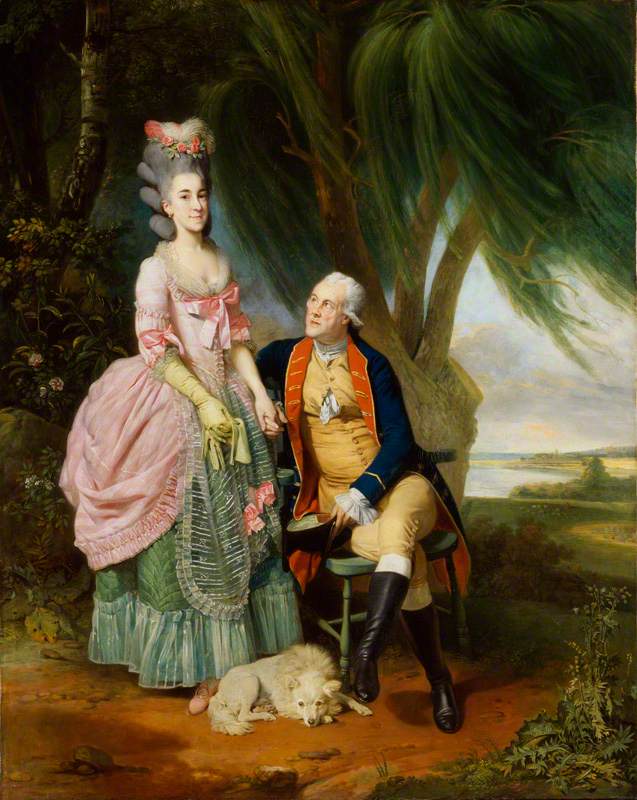
Sarah Robinson (1720–1795, shown here) was the younger sister of Elizabeth (Robinson) Montagu.

In 1748 Robinson started sharing a house in Bath with Lady Barbara Montague (c. 1722–1765). This lady’s Montague family was different from the Montagu family that Sarah’s sister married into.

Two years later, Robinson penned her first novel, The History of Cornelia—published, like all her work, anonymously or pseudonymously, and for money.

In 1751 Sarah Robinson married George Lewis Scott (1708–1780), one of George III’s instructors—a job she had helped to secure for him, apparently.

However, that marriage broke up within a year, with the Robinson family stating it was never consummated. The unhappy couple grumbled about each other for the rest of their lives. (George Lewis Scott would later introduce Thomas Paine to Benjamin Franklin, but that’s another story.)

The woman now called Sarah Scott went back to “Lady Bab” in Bath and back to earning money with her pen. By the end of that decade she was also translating from the French, creating educational materials, writing history books about Protestants on the continent. Scott’s most successful novel appeared in 1762: A Description of Millenium Hall and the Country Adjacent. Almost everything she wrote had a moralizing element.

By 1778 Lady Bab had died, but Sarah Scott had gained a comfortable income through family gifts and inheritance. She stopped publishing, but she kept up her lively literary correspondence with her sister.

In October of that year, Catharine Macaulay left Bath for Leicester, and the next month word got back that the celebrated historian had married William Graham. But that wasn’t all people heard.

On 27 November, Sarah Scott sent this news to Elizabeth Montagu, as transcribed in The Correspondence of Catharine Macaulay, edited by Karen Green:
Mrs Macaulay’s marriage was reported in good time to change conversation, of which the Duel between the two gaming counts had been the sole topic, and it was entirely worn out.

A Gamester appears to me so far from being a loss to the world that I consider the marriage as the more melancholy event of the two, because it is a dishonor to the sex. If I had not more pride than revengefulness in my temper I might derive much consolation from the moral certainty that her punishment will equal her offence.

The man she has married is in age about 22, in rank 2nd Mate to the Surgeon of an India man. He is brother to a Dr [James] Graham, who etherized and electrified her, till he has made her electric per se.

She wrote a letter to Dr Wilson acquainting him with her marriage, and her reasons for it, which she tells him in the plainest terms are constitutional; that she had been for some years struggling with nature but found that her life absolutely depends on her complying with her constitution’s earnest call (perhaps she calls it nature’s, but I shall not, for it is not the nature of woman, and woman cannot find her excuse in the nature of a beast) and she would have chosen him, if his age, as he must be sensible, did not disqualify him for answering a call so urgent.
In other words, Macaulay had discovered that all those medical symptoms that had crippled her for years—fatigue, weakness, “pains in my ears and throat,” “irritations of my nerves,” and above all “a Billious intermitting Autumnal fever”—would go away when she had sex. Really good sex. Sex with a man less than half her age just returned from the sea. Sex that her doting seventy-five-year-old patron, the Rev. Dr. Thomas Wilson, simply wouldn’t have been able to supply.

Which of course ticked Wilson off, as Scott’s letter went on to describe:
The Doctor shews the letter, but I have not seen it, and the Gentlemen declare it cannot be shown to a woman. Old Wilson is rewarded for his folly; he is in the highest rage, and having some years ago by Deed given her the furniture of the house they lived in and 300 peran[num] for her life, he intends to apply to the law to be released from this engagement; on pretence of its having been given without value received. It will make a curious cause, . . .

If there is any zeal still remaining in the world for virtue’s cause the pure Virgins and virtuous Matrons who reside in this place, will unite and drown her in the Avon, and try if she can be purified by water, for Dr Graham’s experiments have shown that fire has a very contrary effect on her, being a Salamander it is the element truly congenial to her. Were she flesh and blood one could not forgive her, but being only skin and bone she deserves no mercy.
Given Sarah Scott’s own unorthodox domestic history, perhaps she shouldn’t have looked down on Catharine Macaulay’s choice of a second husband. But, as the two poems that Christopher Anstey shared a week later demonstrate, all the fashionable people in Bath were gossiping about the Grahams.

COMING UP: The lawsuit.

Monday, January 16, 2023

“Poor Mrs. Macaulay! She is irrecoverably fallen.”

In October 1778, the historian Catharine Macaulay left Bath and the home she shared with the Rev. Thomas Wilson.

One possible reason for Macaulay’s move was that Wilson kept pressing her to marry him. Everyone knew the minister was besotted with the widowed author. He’d already signed over a lease to his house, erected a statue in London, and published a book of fawning poetry. But she declined to make him her second husband.

As Bob Ruppert described in this Journal of the American Revolution article, Macaulay moved across England to Leicester in the East Midlands. That was the city where her friend Elizabeth Arnold lived.

Arnold was the sister of Macaulay’s physician, Dr. James Graham, and wife of another physician who managed an asylum for the mentally ill. The two women had visited France together in late 1777.

On 14 November, a minister in Leicester married Macaulay to Dr. Graham. Not James Graham, who was with his wife and children in Scotland. That would have provided plenty of scandal and confirmed a rumor that John Wilkes had recorded earlier in the year.

Rather, the historian married William Graham, younger brother of Dr. James Graham and Elizabeth Arnold.

Much younger brother, in fact. William Graham was only twenty-one years old. He was barely a doctor, having studied in Edinburgh and trained as a surgeon’s mate for the East India Company. 

Even by the modern standard of “half your age plus seven,” William Graham seemed “too young” for Macaulay, who was forty-seven. And of course Macaulay was a woman. A woman who had put herself into the public eye by writing about history and politics.

The reaction was swift and negative. One acquaintance at Bath, Edmund Rack, wrote to Richard Polwhele, an eighteen-year-old admirer of the historian, on 29 December:
Poor Mrs. Macaulay! She is irrecoverably fallen. “Frailty, thy name is Woman!” Her passions, even at 52 [sic], were too strong for her reason; and she has taken to bed a stout brawny Scotchman of 21. For shame! Her enemies’ triumph is now complete. Her friends can say nothing in her favour. O, poor Catharine!—never canst thou emerge from the abyss into which thou art fallen!
And that was one of the more sympathetic responses.

COMING UP: More reactions.

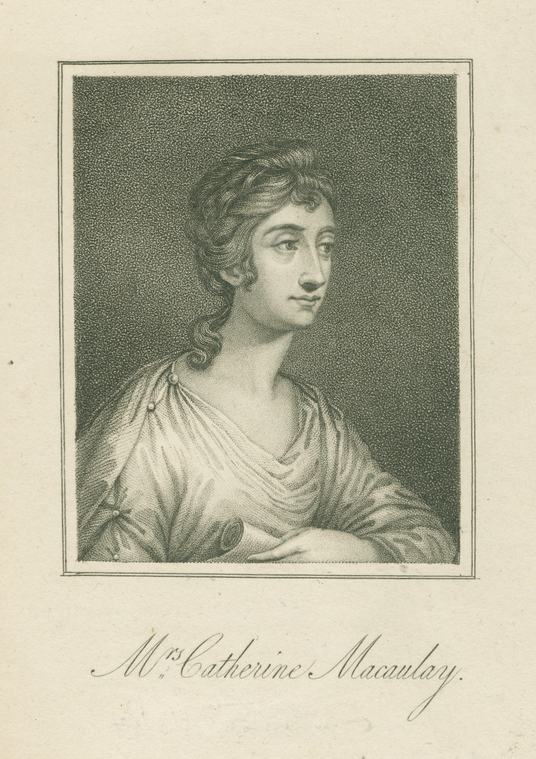
[The portrait of “Mrs. Catherine M’Caulay” above is a woodcut printed in Nathaniel Ames’s Astronomical Diary; or Almanack for 1772. Paul Revere supplied versions of this cut to both Ezekiel Russell and Edes and Gill for their competing editions. Printing this illustration of Macaulay shows the admiration, or at least curiosity, that she inspired in New England at that time. (The almanac’s other images featured John Dickinson and the dwarf Emma Leach.) This image comes courtesy of the American Antiquarian Society.]

Friday, January 13, 2023

John Wilkes’s Gossip about “Kitty Macaulay”

Catharine Macaulay was a celebrity in Britain, so her return from France at the start of 1778 attracted notice.

John Wilkes was in Bath when Macaulay arrived home. He wrote to his 28-year-old daughter Mary (called Polly, and shown here with dad) on 4 January:
Mrs. Macaulay returned to Dr. [Thomas] Wilson on Friday. I saw her yesterday very ill indeed, and raving against France and everything in that country. She even says their soups are detestable, as bad as Lacedemonian black broth, and their game insipid, all their meat bad, and their poultry execrable. Yet she says, that she dined at some of the best tables and was infinitely caressed.

She saw Dr. [Benjamin] Franklin, but refused his invitation to dinner, for fear of being confined on her return in consequence of the Habeas Corpus Act.

“Lord J——s C——t, Mr. Wilkes, you know, I am very fond of partridges. I saw them often served up, but could not eat them, I found them so hard and ill-flavoured.[”]

I stayed with her nearly an hour, in which time, I believe, she exclaimed twenty times, [“]Lord J——s C——t.” She was painted up to the eyes, and looks quite ghastly and ghostly. She has sent away her English woman, and has only a French valet-de-chambre and friseur, at which the reverend Doctor is indignant, and with whom the English servants already quarrel.
Three days later Wilkes told his daughter that his health had improved and he was thinking about returning to London. He added:
The rage of politics is, I think, more violent at Bath than even at London, and nothing is talked of but America, except Kitty Macaulay, who grows worse daily. The doctor [Wilson] looks stupid and sulky.
And the day after that Wilkes suggested Macaulay was having an affair:
It is not only my opinion, but that of the generality of Mrs. Macaulay’s friends, that her head is affected, and some indiscretions with Dr. G—— are the common topic of conversation.
Dr. James Graham had treated Macaulay’s headaches and other neurological symptoms, using her endorsement to build his career. Wilkes evidently thought their relationship went beyond doctor and patient. And of course he would know.

TOMORROW: Wilkes gives unabashed gossip a bad name.

Thursday, January 12, 2023

Catharine Macaulay “just returned from a Journey to Paris”

Today, after a gap of more than four months, I’m picking up the story of the British author Catharine Macaulay.

To catch us up, I’ll quote Macaulay’s own letter to the Earl of Buchan dated 23 Feb 1778:
The favor of your Lordship’s letter found me just returned from a Journey to Paris where I resided a few weeks for the recovery of my health after a long and dangerous illness.
Macaulay had gained the strength to undertake that journey only after Dr. James Graham had provided her with “a judicious mixture of the Bark” to treat her “Billious intermitting Autumnal fever,” as I quoted here. The doctor’s sister Elizabeth Arnold was Macaulay’s traveling companion.

Both Macaulay and Lord Buchan supported the American cause. France had just become a formal ally of the U.S. of A., and Macaulay wrote:
I have the pleasure to inform your Lordship that sentiments of liberty which are as you observe lost in these united Kingdoms never flourished in a larger extent or with more vigorous animating force than they do at present in France.
That reflected the Enlightenment circles that Macaulay visited since France was, after all, still a less democratic regime than Britain.

The author also told the earl: “I have this month published a vol of the history of England from the revolution to the resignation of Sir Robert Walpole.” That was the first volume of a never-completed set titled The History of England from the Revolution to the Present Time in a Series of Letters to a Friend. It was less formal than Macaulay’s earlier histories.

The “Friend” was the Rev. Dr. Thomas Wilson—Macaulay’s patron, host, and unrequited suitor in Bath. A portrait of Wilson with Macaulay’s daughter set me off on the author’s story last May. That daughter, Catherine Sophia, was “at a Boarding School at Chelsea” when her mother wrote to Lord Buchan; she would turn thirteen the next day. 

TOMORROW: The Wilkesite view.

Thursday, August 25, 2022

“Her fever seemed to have left her”

In late 1777, as I’ve been relating, doctors advised the historian Catharine Macaulay to leave her home in Bath and travel to Nice for her health.

Macaulay needed a companion on that trip, a genteel woman about her age. Her favored physician, Dr. James Graham, may have been the one who recommended Elizabeth Arnold (1743–1802).

This lady was the wife of Dr. Thomas Arnold of Edinburgh. More important, she was Dr. Graham’s older sister.

Years later, Arnold wrote about what she’d first heard of Mrs. Macaulay and the real person she met:
“She is deformed, (said her adversaries, wholly unacquainted with her person), she is unfortunately ugly, she despairs of distinction and admiration as a woman, she seeks, therefore, to encroach on the province of man.”

These were the notions…that I was led to entertain of Mrs Macaulay, previous to my introduction to her acquaintance. Judge then of my surprise, when I saw a woman elegant in her manners, delicate in her person, and with features, if not perfectly beautiful, so fascinating in their expression, as deservedly to rank her face among the higher order of human countenances. . . .

Infirm health, too often the attendant on an active and highly cultivated understanding, gave to her countenance an extreme delicacy, which was peculiarly interesting. To this delicacy of constitution was added a most amiable sensibility of temper, which rendered her feelingly alive to whatever concerned those with whom she was connected either by nature or by friendship.
Those impressions appeared in Mary Hays’s Female Biography, published in 1805.

The two women and their servants set off from Bath, but they didn’t get far. Although Dr. Graham’s preparation of “bark” (probably cinchona bark) did something to relieve Macaulay’s fever, it hadn’t fully kicked in yet. She later wrote, “I was so weak when I left Bath, that from Bath to London I was obliged to be six days on the road, and to remain one fortnight in London to recover strength sufficient to pursue my journey.”

Finally the ladies boarded a ship to cross the Channel. According to Hays, because Macaulay “was severely exhausted by sickness, she rested two days at Calais.” But suddenly she got better:
she soon experienced, from the change of air, or possibly from the sea sickness itself, a salutary effect. Her fever seemed to have left her, and she suffered in the remainder of her journey to Paris but little inconvenience.
In Paris, a stout British Whig like Macaulay expected to see the oppressive effects of French political and religious tyranny. To complicate matters, in late 1777 the French government was weighing whether to formally ally with Britain’s breakaway colonies and go to war.

TOMORROW: French food and French people.

Wednesday, August 24, 2022

“The dissolution of a very delicate frame”

Catharine Macaulay wasn’t a well woman, and she wanted people to know it.

She began her first letter to John Adams, on 19 July 1771, with:
A very laborious attention to the finishing the fifth vol of my history of England with a severe fever of five months duration the consequence of that attention has hitherto deprived me of the opportunity of answering your very polite letter…
And she quickly returned to that theme: “I am really very much concerned to hear that you labor under the heavy misfortune of a weak and infirm state of health. I simpathise with you in body and mind having rarely any alternative from either labor or pain.”

[I must note that Macaulay appears in Founders Online indexed under four separate names: Catharine Macaulay, Catherine Macaulay, Catharine Sawbridge Macaulay, and Catharine Sawbridge Macaulay Graham. No one click brings up all the letters to and from her. Linking those seems like a quick and useful digital humanities project.]

As I quoted here, in late 1776 the historian asked Dr. James Graham to treat her. Early the next year she offered a public testimonial to his experimental methods:
I have the happiness to declare, that a great part of my disease immediately gave way to your Chemical Essences, your Ætherial, Magnetic, and Electric Applications; the pains in my ears and throat subsided, the fevers and irritations of my nerves left me, and my spirits were sufficiently invigorated to break from a confinement of six weeks, and to exercise in the open air.
In the summer of 1777, however, Macaulay’s health took a bad turn. She later told the new Earl of Harcourt:
By the accident of going into a tepid bath rather too cool and after a hot day, I was attacked, my Lord, at the end of the summer with one of the most formidable of all the species of intermittent fevers, and every symtom which could threaten the dissolution of a very delicate frame.

The [medical] faculty here, after having made what was very bad much worse by their unavailing remedies, in despair of my life, and not caring that I should dye under their hands, sent me over to Nice for change of air.
But Macaulay was in no shape to travel to the south of France. Fortunately, Dr. Graham hurried back from his wife and children in Edinburgh to his celebrated patient in Bath.

In February 1778 Macaulay told the Earl of Buchan:
I must do Dr Graham the justice to observe to your Lordship that he not only strengthened and returned the injured state of my nerves, injured greatly by a long and severe application, but when on his return from Edinburgh he found me on the brink of the grave from the severe attack of a Billious intermitting Autumnal fever he under God gave me a rescue from the Grim Tyrant by a judicious mixture of the Bark,

often I had repeatedly taken that Drug not only without success but with very ill effects when administered by others of the faculty, I do assure your Lordship I look upon Dr Graham as a happy Genius in the medical line of knowledge…
Macaulay started to feel strong enough to consider that trip to France. Dr. Graham evidently seconded his colleagues’ recommendation. But the historian’s health was still shaky enough that she needed a traveling companion, preferably a genteel lady like herself.

TOMORROW: A doctor’s wife.

Tuesday, August 23, 2022

The Changing Image of Catharine Macaulay

In the mid-1760s, as I wrote yesterday, Catharine Macaulay became an icon for British Whigs.

Her History of England from the Accession of James I reinforced the Whiggish story of restoring and preserving ancient British liberties from the tyrannical encroachments of the Stuart monarchs.

Macaulay herself was from a respectable family, the sister of a Member of Parliament, after 1766 the widow of a physician with a young daughter. She wasn’t conventionally beautiful, with her thin face and long nose, but that face made her quickly recognizable.

The National Portrait Gallery in London shares some engraved images of Macaulay from this period, such as the one shown above, framing her as a matron from the Roman republic. Another print spelled out that linkage.

In the late 1760s, however, Macaulay’s public image began to change. The more she wrote about the English Civil War and the Commonwealth, the more radical she seemed. Then in 1774 she moved into the Rev. Dr. Thomas Wilson’s house in Bath, as discussed back here. And of course she was a woman in the public eye.

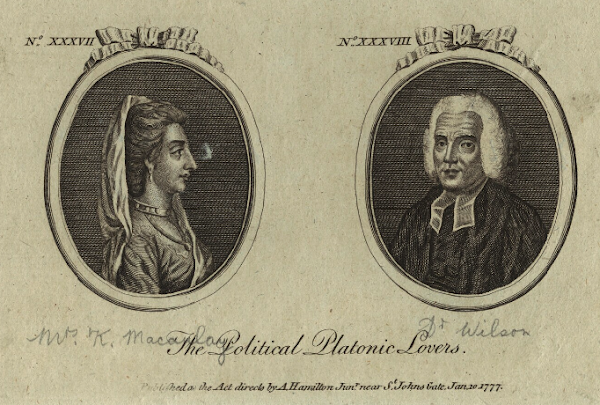
Those developments raised questions in people’s minds, which came out in this engraving issued in 1777, a double portrait of Macaulay and Wilson titled “The Political Platonic Lovers.” That label swirled together the two reasons people might look askance at Catharine Macaulay: her politics and her living arrangement.
Over the next couple of years, Wilson commissioned Robert Edge Pine to paint a portrait of Macaulay holding one of her letters to him. He commissioned Joseph Wright of Derby to paint himself and Macaulay’s daughter. He commissioned John Francis Moore to sculpt a statue of Macaulay as the muse Clio, which he eventually pressed upon the church he was supposed to be serving in London. He published odes to Macaulay on her forty-sixth birthday in 1777 from himself, the teenager Richard Polwhele, and Dr. James Graham. Clearly the minister was besotted with the historian.

Macaulay obviously appreciated the house to live in and the promised bequest to her daughter. But she resisted any offers or hints of marriage from Wilson. She maintained that the septuagenarian minister was merely a friend. Indeed, when she published the first volume of a less formal History of England from the Revolution as “a Series of Letters to a Friend,” that friend was Wilson.

In those same years, Macaulay was struggling to continue her history of 17th-century England; no volume had appeared since 1771. She was feeling sick much of the time. That was how she had become a patient and patron of Dr. Graham, who presented himself as an eye specialist with extra-special training from America.

Given her personal state, Macaulay surely would not have appreciated this crude colored print published later in 1777 and now digitized by the British Museum. Captioned “A Speedy and Effectual Preparation for the Next World,” the picture shows the historian, recognizable by her long nose, putting on her makeup as Death shakes sand out of an hourglass. A portrait of the Rev. Dr. Wilson hangs above her table.
TOMORROW: A journey for her health.

Thursday, June 02, 2022

“A great part of my disease immediately gave way to your Chemical Essences”

When the historian Catharine Macaulay contacted Dr. James Graham, he was changing his field of medical practice.

In his advertisements in American newspapers, similar notices in Bristol, and his 1775 London pamphlet, Graham presented himself as a specialist in problems of the eyes and ears.

But in 1776 he published another pamphlet whose title suggested new treatments for many more ailments:
A Short Inquiry into the Present State of Medical Practice, in Consumption, Asthmas, Gout in the Head or Stomach, Hysterical, Spasmodic, or Paralytic Affections of the Nerves in Every Species of Nervous Weakness and in Cancerous and Other Obstinate Ulcers and a More Elegant Speedy and Certain Method of Cure by Means of Certain Chemical Essences, and Aërial, Ætherial, Magnetic, and Electric Vapours, Medicines, and Applications—Recommended.

To which is added an Appendix on the Management and Diseases of the Teeth and Gums
In this pamphlet Graham declared that the electrical lectures he had attended in Philadelphia had inspired him to develop new methods of curing people. (He also mentioned trips to Germany and Russia, which must have been very short because I have no idea when he fit them in.)

This essay may well have been what prompted Macaulay to consult with Graham. And she was pleased with the results. On 18 Jan 1777 she wrote to the doctor from the home she shared with the Rev. Dr. Thomas Wilson in Bath:
…I was unfortunately born with a very delicate constitution, and a weak system of nerves; that from my earliest infancy to the age of maturity, my health was continually disturbed with almost every species of fever, with violent colds, sore throats, and pains in the ears, attended with all the variety of symptoms which accompany a relaxed habit, and an irritable state of nerves.

In this very weak state of health, I undertook the writing the History of the Stewarts; and I do not know whether it is not impertinent to add, that seven years severe application reduced an originally tender frame to a state of insupportable weakness and debility: continual pains in the stomach, indigestion, tremblings of the nerves, shivering fits, repeated pains in the ears and throat, kept my mind and body in continual agitation; and marked, those which would otherwise have been the brightest of my days, with sorrow and despair.

In one of these fits of despair, your pamphlet came to my hands. Its contents awakened my curiosity; I sent for you; you undertook my cure with alacrity, and gave me the pleasing hope of a restoration of health, or rather a new state of constitution; and I have the happiness to declare, that a great part of my disease immediately gave way to your Chemical Essences, your Ætherial, Magnetic, and Electric Applications; the pains in my ears and throat subsided, the fevers and irritations of my nerves left me, and my spirits were sufficiently invigorated to break from a confinement of six weeks, and to exercise in the open air.
Macaulay told Graham that she gave him “full liberty to publish this declaration,” and he seized the opportunity. He included the letter in a second edition of his Short Inquiry pamphlet and put her name on its title page, twice.

For that 1777 edition Dr. Graham also added an effusive 31 March letter back to Macaulay that filled seven printed pages, addressed her as “Madam” nine times, and used fifteen exclamation points (as well as slipping in “most hearty acknowledgements” to “the Revd. Dr. Wilson”).

In April 1777, as I wrote before, Wilson organized a grand celebration of Macaulay’s birthday. As a gift he gave her a gold medal that Queen Anne had presented to one of her negotiators at the Treaty of Utrecht—a historical artifact for a historian. The published description of that event then went on:
Next advanced the ingenious Dr. GRAHAM, to whom the world is so much indebted for restoring health to the Guardian of our Liberties, and thereby enabling her to proceed in her inimitable History;—he with great modesty and diffidence presented her with a copy of his works, containing his surprising discoveries and cures…
Furthermore, one of the odes presented to the lady that day and then printed was titled “On reading Mrs. Macaulay’s Letter to Dr. Graham.” It described Clio, “Th’ HISTORIC MUSE,” worrying about the lady’s health, even seeing the statue of her Wilson sent to his church in Walbrook as a “marble tomb.” But finally the god of healing Apollo promises:
“To stop the ravage of the foe,
My GRAHAM instantly shall go,
And set thy Fav’rite free;
No more let sorrow still thine eye—
On GRAHAM’s skill secure rely,
For he was taught by me.”
Those two 1777 publications—the doctor’s pamphlet and the birthday odes—publicly linked Graham and Macaulay. As he always acknowledged, her celebrity helped his pioneering ideas about “Chemical Essences, and Aërial, Aetherial, Magnetic, and Electric Vapours, Medicines, and Applications” reach a wider audience.

Later in the year, however, Catharine Macaulay took ill again.

COMING UP: Search for a cure.

Wednesday, June 01, 2022

The Progress of Dr. James Graham

Dr. James Graham disembarked in Baltimore late in the summer of 1769.

Graham had been born in Edinburgh twenty-four years before, son of a saddler. He had enough resources and drive to study medicine at the University of Edinburgh, though not enough to finish a degree. But he was tall, good-looking, and extremely interested in new ideas.

Before turning twenty, Graham set himself up as an apothecary in Yorkshire and married. But soon he left his wife and surviving young child to explore prospects in the American colonies, perhaps looking for a place for the family to settle.

In January 1770, Dr. Graham advertised a “Lecture on the Eye” in Annapolis. Such lectures were a way to establish his bona fides and attract patients. The advertisements Graham placed, Lydia Syson found in writing his biography, are the best way to track him in North America.

From August to November 1770, Graham promoted his talks and services in New York City, again emphasizing expertise on the eye and ear. By October 1771 he had moved on to Philadelphia. According to an article in Therapeutic Advances in Ophthalmology, Graham was the first specialist documented as using the term “glaucoma” in America. He also added music to his public lectures.

While in the colonies’ largest city, Dr. Graham also spent some of his time “attending the public Exhibitions and Lectures on Electricity” at the local college. Ebenezer Kinnersley, officially steward and professor of English and oratory, performed electrical demonstrations for the public based on Benjamin Franklin’s famous discoveries.

Interestingly, Graham also later claimed that he had learned medical secrets from “Indians” while in America. I’m not sure what these secrets were.

In the autumn of 1772, the doctor did a swing through the Pennsylvania towns of Lancaster, York, and Reading. By this time he was announcing that he could perform cataract operations and fit prosthetic eyes. The doctor was in New York again the following summer and Baltimore in November 1773.

Graham then sailed back to Britain and his family. He later wrote, “I returned to England at the commencement of the eternal downfall of European power in America!” That was a radical political statement, but it’s impossible to know how politics affected his decision to return home during the tea crisis.

Dr. James Graham set up a new practice in Bristol in May 1774, spent a month or so in fashionable Bath at the start of the next year, and went to London in February 1775.

By then he had accumulated enough testimonials to his medical skills to publish them in a pamphlet titled Thoughts on the Present State of the Practice of Disorders in the Eye and the Ear, combined with An Address to the Inhabitants of Great Britain. Late in 1775 he advertised the following success rate from February to October:
cures or relieved, 281
refused as incurable on their first Application, 317
after a short Trial (by desire) found incurable, 47
dismissed for Neglect, etc. 57
country, foreign, and other Patients, events unknown, 381.
It’s striking that Graham claimed to have cured only about a quarter of the people he saw, fewer than he had immediately sent away.

One of the people who read Graham’s writings was the author Catharine Macaulay. She turned forty-five in 1776 and had long worried about her health. Between 1763 and 1771 she had completed five volumes of her History of England, but she had been struggling with the sixth for half a decade. Macaulay decided to consult this Dr. Graham.

TOMORROW: Testimonials and travel.