J. L. BELL is a Massachusetts writer who specializes in (among other things) the start of the American Revolution in and around Boston. He is particularly interested in the experiences of children in 1765-75. He has published scholarly papers and popular articles for both children and adults. He was consultant for an episode of History Detectives, and contributed to a display at Minute Man National Historic Park.

Subscribe thru Follow.it


•••••••••••••••••


Showing posts with label Edmund Quincy. Show all posts

Thursday, May 14, 2026

Twenty Years of Boston 1775

Twenty years ago today, on 14 May 2006, I posted my first item on this blog.

That post was a link to an article I’d written for the magazine then called New England Ancestors, now American Ancestors, published by the New England Historical and Genealogical Society.

The original link broke. A subsequent link from 2012 broke. But Boston 1775 is still here.

That article described how a message from Dr. John Homans to his mentor, Dr. Joseph Gardner, in the first days of the Revolutionary War was detoured by the duplicitous Dr. Benjamin Church, Jr.

Last August I revealed other messages that Dr. Church diverted into the files of Gen. Thomas Gage, from Boston magistrate Edmund Quincy to his daughter Dorothy and her fiancé, John Hancock.

Tonight I’m speaking in Stoneham about how Dr. Church managed to infiltrate Gen. George Washington’s network for sneaking intelligence out of besieged Boston before the Continentals realized their surgeon-general as a spy.

One way to look at this situation is that after twenty years of daily blogging I’m still working the same ground.

Another is that Dr. Benjamin Church’s treachery is an endless source of revelations and fun.

Sunday, September 07, 2025

“The only two Gentlemen of the Town who have visited Lieut. Hawkshaw”

Alongside Lt. Thomas Hawkshaw’s declaration of what he’d said about the first shots of the war, quoted yesterday, Lt. Col. William Walcott collected a signed statement from two gentlemen inside Boston.

That undated document is also in the Thomas Gage Papers at the Clements Library. It says:
Mr. Lewis Gilbt. De Blois & Doctor Byles who were the only two Gentlemen of the Town who have visited Lieut. Hawkshaw since his being brought into Boston, both declare That,

Neither of Them had any the least Conversation with Lt. Hawkshaw upon the Subject of the affair of Wednesday last the 19th. April; & particularly that They nor Either of them ever heard Lt. Hawkshaw say that the King’s Troops had fired first upon the Country People

Gibert Deblois
Mather Byles
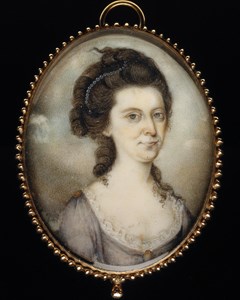
Gilbert Deblois (shown above, in a portrait made by John Singleton Copley a few years later) was a Loyalist merchant. Evidently Col. Walcott didn’t know him well enough to distinguish him from his brother Lewis.

The Rev. Dr. Mather Byles was one of the few Congregationalist ministers in Massachusetts siding with the royal government.

These two witnesses were thus inclined to be more friendly to the army and Gen. Thomas Gage than the average Bostonian. But what Patriot would be admitted to Lt. Hawkshaw’s sick chamber?

In an article for Common-place, Edward M. Griffin asked, “Could anyone believe that when Byles and Deblois had visited him [Hawkshaw] they simply passed the time in pleasant conversation without ever discussing the previous week’s armed confrontation between British troops and rebellious locals?”

I think the state of Hawkshaw’s health does make that plausible. He probably felt weak, had trouble speaking, and expected to die soon. I can imagine a scenario in which the lieutenant was renting a room from Deblois, who could think of nothing more helpful than bringing in the Rev. Dr. Byles to provide religious comfort. And the men kept their conversation brief.

When Edmund Quincy wrote that Hawkshaw “Call’d Several Credible persons to him & told ’em as a dying man…that the first Action of ye Whole at L. was done by the Kings troops,” he said that he’d heard that from “Capt. [John] Erving, at his house yesterday,” and that Erving said it was “proved to him at ye No: End yesterday to be real.”

The British mercantile economy ran passing on rumors like that because hard information was so hard to come by. In this case, Quincy or Erving or both were probably sucked in by wishful thinking. Or perhaps some Patriot propagandist thought it would be effective to attribute a confession to an officer on his deathbed.

So far as I can tell, no newspapers or other sources outside Boston picked up on the rumor about Hawkshaw, though Salem printer Ezekiel Russell did learn about his life-threatening wound. Perhaps the documents that Lt. Col. Walcott collected helped to quash the whispers. Perhaps they were so wispy to start with (who were these “Several Credible persons”?) that they dissipated on their own.

As I wrote before, Lt. Hawkshaw proved more durable. He recovered. In November 1777 he attained the rank of “Captain Lieutenant and Captain” as officers in the 5th moved up because another captain had “died of his wounds.” A year later, Hawkshaw was promoted to full captain in place of Capt. John Gore, the officer he had first spoken to on the evening of 19 April when he was brought back, bleeding, to Boston.

Friday, September 05, 2025

“Lt. Hawkshaw yesterday near expiring thro. his bad wounds”

During the British army withdrawal on 19 Apr 1775, Lt. Thomas Hawkshaw of the 5th Regiment was shot in the side of his face.

As recorded by his regiment’s surgeon, blood gushed from his nose and mouth as well as his wound. Some of the affected tissue became inflamed. He had trouble swallowing.

People thought Lt. Hawkshaw was lying on his deathbed. And according to legal and popular understandings of the time, that meant he couldn’t lie in another way. After all, a person wouldn’t utter a falsehood just before meeting his maker, right?

Or, as a legal maxim quoted in 1700s reference books said: Nemo moriturus præsumitur mentiri. A dying person is not presumed to lie.

Usually that “dying declaration” doctrine allowed testimony from a dead victim that would otherwise be ruled out as hearsay. Thus, Patrick Carr’s doctors could report his remarks about the soldiers holding back before the Boston Massacre in 1770. To discredit such strong evidence, Samuel Adams had to resort to sneering that Carr “in all probability died in the faith of a roman catholick.”

The same thinking made “deathbed confessions” convincing. In the case of Lt. Hawkshaw, word went around that as his life slipped away he blamed the army for starting the war. Justice of the peace Edmund Quincy wrote to John Hancock on 22 April:
Here they say & swear to it all round, in excuse of ye Regulars, proceeding at Lexinton—that they were attack’d first & I doubt not many oaths of Officers & men are taken before J. G—ley [Justice Benjamin Gridley], to confirm it—but among others who contradict ’em—Lt. Hawkshaw yesterday near expiring thro. his bad wounds——Call’d Several Credible persons to him & told ’em as a dying man—that he was obliged in Conscience to confess—that the first Action of ye Whole at L. was done by the Kings troops—wr. they killd & wounded eight men—but doubtless you have sufficient proof of ye Fact & every Circumstance attending near at hand— . . .

Capt. [John] Erving, at his house yesterday Gave me ye Account of Hawkshaws Confesso.-proved to him at ye No: End yesterday to be real
As discussed here, Quincy gave that letter to Dr. Benjamin Church, Jr., who slipped it to Gen. Thomas Gage. Which meant Lt. Hawkshaw’s commander read that he was contradicting the official army line.

TOMORROW: A quick response.

Thursday, August 28, 2025

“By Doctor Church I send”

As recounted yesterday, after returning from besieged Boston on 23 Apr 1775, Dr. Benjamin Church told Paul Revere that he’d been detained by Gov. Thomas Gage’s troops and kept in a North End barrack for most of his time in town.

Church’s Patriot colleagues accepted that story, probably even admired his daring. They chose him to travel to Philadelphia and consult with the Continental Congress, and the Congress in turn made him Surgeon-General of its army.

However, the documentary record I explored earlier this week casts doubt on Church’s story. While in Boston he was clearly communicating with relatives of his colleagues and offering to deliver letters for them.

On 22 April, Edmund Quincy gave Church two letters to carry out of town: to his daughter Dorothy and to her fiancé, John Hancock. The letter to Dolly Quincy refers to the “opporty (unexpected) by Doctr. Church” to communicate. There’s no apparent worry about Church being under the royal authorities’ control.

In addition, Edmund’s son Henry Quincy wrote a letter to the elder Dr. John Sprague in Dedham, shown here. That too stated: “Dr. Church Arrived here this PM. from Concord on Business with the General is Allowed in the Morning to Return.”

In further addition, Rachel Revere (shown above) wrote a short, undated note to her husband Paul. That began “by Doctor Church I send a hundred & twenty five pounds”—probably devalued Old Tenor currency.

All those documents are in the files of Gen. Gage. Did soldiers seize them from Dr. Church as he left Boston? That wouldn’t explain how those same files contain Dr. John Homans’s note to Dr. Joseph Gardner asking for surgical knives, which Church carried into town. 

When Allen French explored Church’s activities in General Gage’s Informers (1932), the letter from Rachel Revere was one of the prime pieces of proof that the doctor was cooperating with the royal authorities. I wrote about the Homans letter in an article for New England Ancestors in 2006. The Quincy letters add more evidence to that pile.

I wonder what Dr. Church told his colleagues when he arrived back in Cambridge, knowing that their relatives inside Boston would eventually mention that they’d given him letters to deliver. Presumably to maintain his cover the doctor spoke ruefully of having the big, bad soldiers take all his papers away. No one appears to have spoken of those missing documents as evidence of Church’s treachery, even after Gen. George Washington put him under arrest in October.

All the documents I’m speaking of remain in the Thomas Gage Papers at the Clements Library in Michigan. The library has just released digital scans of Gage’s correspondence in the weeks after the start of the war (along with poor computerized transcriptions which I’ve largely ignored). I’m sure there are some surprises to be found, as well as more evidence for what we already know.

Tuesday, August 26, 2025

“Pray the God of Armies to restrain Man”

John Hancock wasn’t the only person Edmund Quincy wrote to on 22 Apr 1775, just after the start of the Revolutionary War, as quoted yesterday.

Justice Quincy couldn’t very well write to Hancock and ignore the man’s fiancée, Dorothy Quincy, could he? After all, she was his daughter.

Thus, we have this second, shorter letter written inside “Boston (a Garison’d town)”:
Dear Dolly—

I’ve an opporty (unexpected) by Doctr. [Benjamin] Church, Just to tell you, that I’m kept from my intended Journey to L[exing]ton & [Lene’y?] by restraint of Princes—endeavors are using to obtain an opening but how soon, none know!

It’s ye. will of Heaven, that it should be thus—!—To His Will, let us learn Submission, thro’ all the Changing Scenes of a Short uncertain Life—I pray God we may all learn this profitable Lesson, that we may be reaping the advantage at all times, especially in a time of Sharp trials, to wch. we are in every State more or less liable

We are generally in good health—but as generally under great sorrow, for the loss of so many humane lives, Wednesday last: pray the God of Armies to restrain Man, from further Attempts of a Similar kind—

Your Bror. & family propose removal—to Providence—if the Gates are opened to us—your Trunk is here—if mine go, yours will also—

I condole with Madm. [Lydia] Hancock, & you, under present & late Circumstances of things—I hope to see you soon, if it please God

Interim recommending you to his protection, with. all your near-Connexions in this devoted Town—I am with my Sincere regards to Madm. H. Mr. [Jonas] Clark & Lady—, Dear Child, Your Affectionate Father & Friend
Edm: Quincy

[Postscript:] Your S[iste]r. [Esther] Sewall distress’d, with ye View she has of things

[Postscript vertical along left margin:] I hope Mr. H. is well on is Journey—you are happy in yo. being out of this town—tho’ ye. Govr. Speaks Fair He is much troubled himself
Esther Sewall was another of Edmund Quincy’s daughters, married to royal attorney general Jonathan Sewall. She evidently had a close-up “View” of the administration of Gen. Thomas Gage and was “distress’d” at what lay ahead.

TOMORROW: The letter carrier.

Monday, August 25, 2025

“No Carriage from L. & if there was—no permiso. to pass”

On 22 Apr 1775, three days after the Battle of Lexington and Concord, the Boston merchant and magistrate Edmund Quincy sat down to write a letter to John Hancock.

Quincy wasn’t just a colleague of Hancock in the Boston Patriot movement. He was also the father of Dorothy Quincy, Hancock’s fiancée (shown here).

Earlier that month, Dorothy had taken the family carriage out to Lexington and then used it to flee with Lydia Hancock from the regulars on 19 April. That left her father stuck inside Boston as the siege began.

Justice Quincy wrote to Hancock:

Dear Sir,

Referring you to a Ltr. wrote the 8th. currt: [i.e., of this month] I’m now to enclose you one I had this day out of [ship captain John] Callihan’s bag:—32 days fro. Lond: into Salem pr young Doct. [John] Sprague—who tells me [captain Nathaniel Byfield] Lyde sail’d 14 days before them wth. Jo. Quincy Esq & other passengers—that some of ye Men of War & transports sail’d also before Callihan. As to ye times [?] at home—ye Doctr. is little able to inform us—youl probably have Some papers via Salem.—————

As to my Scituation here ye unexpected extraordy. event of ye 19th: of wch. Ive wrote my thots—) now & for days past impedes my leaving town[.] No Carriage from L[exington]. & if there was—no permiso. to pass ye lines—The people will be distress’d for fresh provisions—in a Short time—

The Govr: & Genl.—is very much concern’d about ye Provl. troops without—wch. probably will be very numerous ’ere long if desired—Dorchester hill—I’m just now told, is possess’d by our provls—& I hope its true, for Ive reason to believe, ye Genl. had ye same thing in Contemplation——

Here they say & swear to it all round, in excuse of ye Regulars, proceeding at Lexinton—that they were attack’d first & I doubt not many oaths of Officers & men are taken before J. G—ley [Justice Benjamin Gridley], to confirm it—but among others who contradict ’em—Lt. [Thomas] Hawkshaw yesterday near expiring thro. his bad wounds——Call’d Several Credible persons to him & told ’em as a dying man—that he was obliged in Conscience to confess—that the first Action of ye Whole at L. was done by the Kings troops—wr. they killd & wounded eight men—but doubtless you have sufficient proof of ye Fact & every Circumstance attending near at hand—

my advice is that the Whole Matter—be forwarded at ye province expence or otherwise wth. the Greatest dispatch—that so your Advices may be in London as early as GG’s——

If the people of G:B: are not under a political Lethargy—The Account of ye late Memorable Event, will excite them to consider of their own Close Connexion wth. America; and to Suppose at length, that ye Americans especially N. Englanders will act as they’ve wrote, & engag’d—A Blessed Mistake our prudent G[ag]e has indeed made, & ye Sensible part of his Officers & Soldiers own it—& are vastly uneasie—

I had been at L— days to pay my real regards to yr. good Aunt & Dolly—but wn. we shall have ye passage clear I dont [know] we are in hopes of effecting soon. But ye Gl. is really intimidated & no wonder wn. he hears of 50.000 men &c.—Much is Confess’d of ye intripedity of ye provinls. Im much Surpriz’d to hear that the Regulars abt. 1700—were drove off & defeated by near an Equal Corps only.—

Capt. [John] Erving, at his house yesterday Gave me ye Account of Hawkshaws Confesso.-proved to him at ye No: End yesterday to be real, he also says that from all he can gather from ye Circumstances of the people of Gt. Bn. they are by this day in a State of fermentation—if we could be so happy, as to get speedily home, the necessary advices—I doubt not a Flame would soon appear—& ere its quench’d, may it burn up ye heads of the Accursed Faction fro. whence ye present British Evils spring

Genl. Gage is thrown himself into great perplexity—Ld. Percy is a thorn in his side & its said has menaced him Several times, for his late imprudence—a Good Omen

I cant nor ought I to add, but my best regards—& Love respectively & that I am
Dr. Sir Your most affecto: Friend
& H. Servt.
Ed. Quincy

youl excuse erro. for Ive not time to correct em
There are a lot of interesting bits of intelligence in this letter—Gen. Thomas Gage hoping to seize the heights of Dorchester, Col. Percy criticizing his Concord mission, Lt. Hawkshaw saying the British soldiers had fired first. Quincy urged Hancock and his colleagues to send the Patriot side of events to London as quickly as possible.

How did John Hancock respond to seeing this letter? In fact, he never saw it.

TOMORROW: Diverted mail.

Wednesday, April 23, 2025

“Putting all matters of politicks out of view”?

Esther Quincy married Jonathan Sewall in January 1764, after a courtship of more than four years.

She was the daughter of the Boston merchant and magistrate Edmund Quincy, who had come back from bankruptcy a couple of years before.

He was a young lawyer of sharp wit and moderate means trying to establish himself, building up from the position of justice of the peace.

Jonathan Sewall didn’t enter the political debate over the Stamp Act, but in December 1766 he came out swinging on behalf of Gov. Francis Bernard and royal policy in newspaper essays signed “Philantrop.”

The governor rewarded Sewall with appointments as the province’s solicitor general and then attorney general. He later got to be a judge in the Vice Admiralty Court as well.

Esther’s father was on the other side of the political divide. He was one of the justices the Boston Whigs called on when they had a complaint about a royal official or soldier. He joined other magistrates in resisting Gov. Bernard’s call for barracks in 1768. He took the (conflicting) testimony of Charles Bourgate after the Boston Massacre. He issued the warrant to arrest John Malcolm for assault.

Most of Esther Sewall’s other male relatives were also Whigs. Uncle Josiah Quincy, Sr., in Braintree was on the Council, one of several thorns in the royal governors’ sides. Cousin Josiah, Jr., practiced law in Boston, wrote newspaper essays, counseled local activists, and traveled to meet fellow Whigs in the southern colonies and London. The major exception within the Quincy family was cousin Samuel Quincy, who followed in Jonathan’s wake as the province’s solicitor general.

Many of Jonathan’s old friends were Whigs, including John Adams, and that produced some awkward social moments. Jonathan prosecuted John Hancock on smuggling charges (eventually dropping the case for lack of solid evidence). But in 1772 the merchant wrote to him expressing
my inclination and wish (putting all matters of politicks out of view) that a perfect harmony and friendship may be kept up between us, and wish rather more familiarity than the common shew of friendship expresses, considering the connection I have formed with the sister of your Lady.
That was Esther’s sister Dorothy. She became Hancock’s fiancée, their engagement almost as long as the Sewalls’ had been.

By 1774 the Sewalls were living in Cambridge in a country mansion bought from Richard Lechmere. Their household included three small children, three young men studying the law, and at least one enslaved young man.

Early on 1 September, Gen. Thomas Gage’s soldiers seized militia gunpowder in Charlestown and cannon in Cambridge. Around noon, Jonathan Sewall suddenly left home and headed to Boston. The governor might have sent for him, or he might have feared how the neighbors would react to the army operation. Or he might have had a whim.

After dark, those neighbors came to the Sewalls’ house. They refused to take Esther’s word that Jonathan was out. Some men pushed into the house, and the young men inside beat them back. One of those boarders, Ward Chipman, fired a pistol inside the house—some sources say accidentally, some not. Either way, that noise got everyone’s attention. The two groups of men agreed not to do further violence as long as they could enjoy some of the Sewalls’ wine.

Soon afterward, Esther took the children into Boston to be with Jonathan. That might have been as early as 2 September when the “Powder Alarm” brought thousands of militiamen into the street outside.

Unlike some people threatened by crowd violence, Esther Sewall never renounced Massachusetts. Her family ties were too strong. In 1778 she wrote to her father: “I had not forgot my own Country, and Friends no, my D[ea]r Father, I should as soon forget myself.” But as of September 1774 she was stuck inside Boston with her unpopular husband.

TOMORROW: Can this marriage be saved?

Wednesday, September 04, 2024

The Flight of the Cambridge Loyalists, part 1

The Cambridge neighborhood later dubbed “Tory Row” became a lot less populous after the “Powder Alarm” of 1774—which was only natural since all of those estates’ owners were either targets of the crowds or related to targets.

Attorney general Jonathan Sewall was the first to depart. He arrived in Boston “between 12 & one” on 1 September, having been “advised to leave his house,” according to a letter from his father-in-law, Edmund Quincy. (That letter is in the Massachusetts Historical Society’s Miscellaneous Bound Manuscripts collection.) 

William Brattle also left Cambridge on 1 September after learning that his letter to Gov. Thomas Gage, quoted here, had become public in Boston that afternoon. And that evening, a local crowd came looking for Brattle and Sewall.

Late the next afternoon, Lt. Gov. Thomas Oliver faced off against what he counted as 4,000 men demanding his resignation from the Council. After signing their document under protest, he also hightailed it to Boston.

If Elizabeth Oliver and her children didn’t accompany Thomas to Boston then, they followed within days. So did Esther Sewall and her children.

William Brattle’s daughter, the widow Katherine Wendell, remained in the family’s Cambridge home—not only for the next several months but through the siege of Boston. She thus kept ownership of the house for the family while several nearby properties were confiscated by the state during the war.

Thomas Oliver’s wife Elizabeth was a Vassall by birth, and thus related to several other families in the area. One of her maternal uncles was David Phips, the royal sheriff of Middlesex County. Notes taken by the Loyalists Commission say:
He apprehended that his Life was in danger after he had removed the Gunpowder to Boston. . . . In Consequence of this treatment he removed himself to Boston & his family soon followed him.
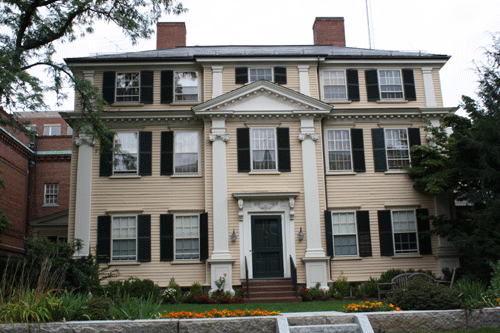
Elizabeth Vassall’s paternal aunt Anna had married her stepbrother John Borland when she was thirteen and he twenty. In 1774 they lived in a Cambridge mansion originally commissioned by the Rev. East Apthorp, not counted as part of “Tory Row” since it wasn’t on the road to Watertown but near Harvard College. (In fact, today that house, shown above, is in the middle of the university’s Adams House.)

The Borlands also felt the “Powder Alarm” was too close for their comfort and moved into Boston. The 8 June 1775 New-England Chronicle reported:
DIED ] At Boston, on the 5th Instant [i.e., of this month], John Borland, Esq; aged 47 [actually 46]. His Death was occasioned by the sudden breaking of a Ladder, on which he stood, leading from the Garret Floor to the Top of his House.
According to none other than Jonathan Sewall, Borland “lost his life by a fall in attempting to get upon the top of his house to see an expedition to Hog Island.”

TOMORROW: More departures.

Tuesday, July 23, 2024

“So they painted the little maid”

The Discover Quincy website now says in its description of the Dorothy Quincy Homestead in Quincy:
The childhood home of Dorothy Quincy, who became Mrs. John Hancock; the second President of the Continental Congress, first signer of the Declaration of Independence and the first Governor of Massachusetts.
There’s no mention of any other Dorothy Quincy.

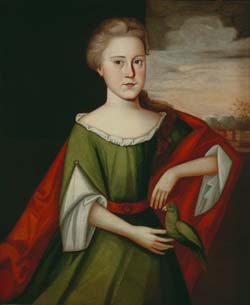
But there was (at least) one, and records are clear that that house was named after an earlier woman named Dorothy Quincy (1709–1762, shown here courtesy of the Massachusetts Historical Society). She was an aunt of the woman who married Hancock.

The earlier Dorothy Quincy married the merchant and mill-owner Edward Jackson. One of their children was the merchant and politician Jonathan Jackson. The other child, a daughter named Mary Jackson, married the Boston merchant and politician Oliver Wendell.

A portrait of young Dorothy (Quincy) Jackson descended in the Wendell family to Dr. Oliver Wendell Holmes, Sr., who became a very popular author. He wrote about the painting and its subject in “Dorothy Q.: A Family Portrait” in 1871. That poem begins:
Grandmother’s mother: her age, I guess,
Thirteen summers, or something less;
Girlish bust, but womanly air;
Smooth, square forehead with uprolled hair;
Lips that lover has never kissed;
Taper fingers and slender wrist;
Hanging sleeves of stiff brocade;
So they painted the little maid.

On her hand a parrot green
Sits unmoving and broods serene.
Hold up the canvas full in view,—
Look! there's a rent the light shines through,
Dark with a century’s fringe of dust,—
That was a Red-Coat’s rapier-thrust!
Such is the tale the lady old,
Dorothy’s daughter’s daughter, told. . . .
This was one of several poems Holmes wrote about the memory of the Revolution and its shadow on his time, such as “The Last Leaf” and “Under the Washington Elm.” He was so good at creating images and phrases that people overlook how he often simultaneously raised questions about those icons.

But Holmes wasn’t correct on the painting’s subject, either. His footnote for this poem said:
Dorothy was the daughter of Judge Edmund Quincy, and the niece of Josiah Quincy, junior, the young patriot and orator who died just before the American Revolution, of which he was one of the most eloquent and effective promoters. . . . The canvas of the painting was so much decayed that it had to be replaced by a new one, in doing which the rapier thrust was of course filled up.
Dorothy (Quincy) Jackson’s father was an Edmund Quincy, but a later Edmund Quincy was the father of the later Dorothy Quincy. That Dorothy Quincy did have an uncle named Josiah Quincy, but a later Josiah Quincy was the Patriot who died in 1775. So the confusion is understandable.

Nonetheless, it’s worth maintaining the knowledge of how the Dorothy Quincy Homestead got its name. It represents a confluence of the Colonial Revival and the Fireside Poets, and it stood for decades of family history. Discover Quincy’s current write-up is all about big names from the Revolutionary years only.

Sunday, January 28, 2024

“An ancedote of a hair’s breath escape” from George R. T. Hewes

It’s not that surprising that the two books based on the memories of George Robert Twelves Hewes, A Retrospect of the Boston Tea-Party (1834) and Traits of the Tea Party (1835), contain anecdote after anecdote placing Hewes at major events in pre-Revolutionary Boston.

After all, people’s memoirs often play up their role in history or their knowledge of events.

What’s remarkable about the Hewes books is that contemporaneous documents often bear out the little shoemaker’s memories. Details he recalled six decades later turn out to be consistent with the records of the time.

For both those books Hewes described how he had gotten into an argument with a Customs officer and suffered an injury, prompting his fellow Bostonians to attack that man. He had his own riot in pre-Revolutionary Boston!

Yet, as the account from the Massachusetts Spy shows, that’s exactly what happened on 25 Jan 1774. Hewes’s memories weren’t fully accurate—for example, he recalled this confrontation happening before the Boston Tea Party instead of six weeks after it. But they’re impressivelt consistent.

Here’s how James T. Hawke recorded Hewes’s memory in A Retrospect of the Boston Tea-Party:
One day, said he, as I was returning from dinner, I met a man by the name of John Malcom, who was a custom-house officer, and a small boy, pushing his sled along, before him; and just as I was passing the boy, he said to Malcom, what, sir, did you throw my chips into the snow for, yesterday?

Upon which Malcom angrily replied, do you speak to me, you rascal; and, as he raised a cane he had in his hand, aiming it at the head of the boy, I spoke to Malcom, and said to him, you are not about to strike that boy with your cudgel, you may kill him; upon my saying that, he was suddenly diverted from the boy, and turning upon me, says, you d——d rascal, do you presume too, to speak to me?

I replied to him, I am no rascal, sir, be it known to you; whereupon he struck me across the head with his cane, and knocked me down, and by the blow cut a hole in my hat two inches in length.

At this moment, one Captain [Isaac?] Godfry came up, and raising me up, asked who had struck me; Malcom, replied the by standers, while he, for fear of the displeasure of the populace, ran to his house, and shut himself up.

The people, many of whom were soon collected around me, advised me to go immediately to Doctor [Joseph] Warren, and get him to dress my wound, which I did without delay; and the doctor, after [he] dressed it, observed to me, it can be considered no misfortune that I had a thick skull, for had not yours been very strong, said he, it would have been broke; you have come within a hair’s breath of loosing your life.

He then advised me to go to Mr. [Edmund] Quincy, a magistrate, and get a warrant, for the purpose of arresting Malcom, which I did, and carried it immediately to a constable, by the name of Justine Hale [sic], and delivered it to him, to serve, but when he came to the house where Malcom was locked up, it was surrounded by such a multitude he could not serve it.

The people, however, soon broke open the door, and took Malcom into their custody. They then took him to the place where the massacre was committed, and their flogged him with thirty-nine stripes. After which, they besmeared him thoroughly with tar and feathers; they then whipped him through the town, till they arrived at the gallows, on the neck, where they gave him thirty-nine stripes more, and then, after putting one end of a rope about his neck, and throwing the other end over the gallows, told him to remember that he had come within one of being hanged. They then took him back to the house from whence they had taken him, and discharged him from their custody.

The severity of the flogging they had given him, together with the cold coat of tar with which they had invested him, had such a benumbing effect upon his health, that it required considerable effort to restore his usual circulation. During the process of his chastisement, the deleterious effect of the frost, it being a cold season, generated a morbid affection upon the prominent parts of his face, especially upon his chin, which caused a separation and peeling off of some fragments of loose skin and flesh, which, with a portion of the tar and feathers, which adhered to him, he preserved in a box, and soon after carried with him to England, as the testimonials of his sufferings in the cause of his country.

On his arrival in England soon after this catastrophe Malcom obtained an annual pension of fifty pounds, but lived only two years after to enjoy it.

On relating this adventure, the very excitement which the affront must have wrought upon him, evidently began to rekindle, and he remarked with emphasis, I shall carry to my grave the scar which the wound Malcom gave me left on my head; and passing my finger over the spot to which he directed it, there was obviously such a scar, as must have been occasioned by the wound he had described.
Hewes’s knowledge was of course more accurate about his own experiences than other details. Malcolm was awarded a sinecure but not a pension, and he lived many more than two years.

A year after that first book, Hewes sat for more interviews with the Bostonian journalist Benjamin Bussey Thatcher, and those conversations produced this version:
John [Malcom]…lived (says Mr. Hewes) at the head of Cross Street, where he worked in some capacity for a man by the name of Scott, when one day, as Hewes was returning from dinner to his shop, (for he continued at hard work all this time—as industrious and as impartial as ever,) he met Malcom at the mouth of the street.

He was engaged in an altercation with a boy who was dragging a hand-sled before him—the snow being a foot deep, or more, on the ground. The lad complained of his having turned over his chips, the day before, into the snow, and wanted to know what good that could do him.

“Do you talk to me in that style, you rascal!” said Malcom; and he was raising his cane, to give emphasis to his answer, over the boy’s head, just as Hewes came up. The latter was unarmed, and small, but it was no way of his, cost what it might, to see foul play. He stepped up to Malcom without ceremony, and warned him not to strike the lad with that cudgel. Malcom, in a rage already, now left his smaller game, and fronted Hewes:

”And do you presume to insult me, too, you scoundrel!—what have you to do with it?”

“I am no scoundrel, Sir,” said Hewes,—“and be it known to you”—

Malcom, at this, levelled a blow with his cane, which struck Hewes over the top of his head, cutting a hole two inches long through his hat, and brought him to the ground.

One Captain Godfrey came up at this moment, and helped him to rise. There was a bad wound on his temples, and the blood ran down his face in streams. “Who did this?” cried Godfrey, in a voice of thunder.

Hewes was known for a good Son of Liberty, as well as Malcom was for a Tory, and the by-standers, who were fast gathering by this time, quickly interfered. Malcom contrived to get a weapon into his hand and keep them at bay, till he could flee to is house, where he fastened himself in.

Hewes, meanwhile, had gone to Dr. Warren (Joseph) [footnote: in Orange-Tree Lane.] who was a relative (his grandmother’s sister’s son) and an old acquaintance of his; and the Doctor, after dressing his head, had advised him to get a warrant out against Malcom. He got one, accordingly, of Justice [Richard] Dana.

Constable Hale undertook to execute it. He found the house surrounded by a crowd of people. Malcom, from his back window, begged him to let him alone till morning, as he was afraid they would tear him to pieces, if he ventured out. He concluded to do so, and Hewes went away with him.

This, probably, only made the matter worse. The people became more furious, while Malcom, on the other hand, armed himself to the teeth, with sword, pistols, and broad-axe, took possession of the upper story, and threatened destruction to the first person who trespassed on the premises.

An acquaintance of his got in at the back-door, at length, by deceiving his wife, by a stratagem induced him to put his weapons by, seized him by the back in that condition, and hallooed to the people, who stood waiting to help him, which they did with a relish. They got a horse-cart, and lowered him out of the window by ropes into that.
This detail about the window appeared in the 27 January Boston News-Letter, but that newspaper retracted it the next week. According to Hewes, he had left the scene by that time. So either he heard a rumor of Malcolm being lowered out a window or read it in a newspaper, or Thatcher found the detail in the newspaper or some report based on it and inserted it into the book.
They called for feathers, and two pillow-cases-full were shortly produced—probably from Malcom’s own stores. They started for Henchman’s Wharf, and there took in a quantity of tar, the purpose of which…was soon explained by their stripping poor Malcom naked above the breast, and plastering over his upper extremities.

Thence they carted him to Butcher’s Hall [i.e., the Customs house]; thence to Shubael Hewess,’ who kept a butcher’s-market at that period on the Main Street, in a wooden house near the Old South Church, with a jutting upper story, which still stands there (and was pointed out by our veteran, on his last visit to the city.)

Here, as in King Street, a flagellation was tried. Then, they drove to Liberty-Tree—to the gallows on the Neck—back to the Tree—to Butcher’s Hall again—to Charlestown ferry—to Copp’s Hill,—flogging the miserable wretch at every one of these places, if not some more—a fact which the papers of the day overlook, for obvious reasons, though the Gazette acknowledges that he was “bruised” in such a manner “that his life is despaired of.”

Hewes states that when they left him at the door of his own house, after a four-hours’ torture, the poor creature was almost frozen, and was rolled out of the cart like a log. Dr. [Silvester] Gardiner, who met Hewes soon after, told him that it took three days to get his blood into circulation again; adding, in the same breath, the consolatory compliment, that he, as the cause of it, would infallibly be hanged, and ought to be.

The Doctor…was doubtless ignorant of one or two things which it is but justice to his patient to mention. Hewes could not be blamed, certainly, for complaining to the Justice and taking the warrant, had he done it at his own suggestion, instead of Dr. Warren’s, or any body’s else. The assault was unprovoked and outrageous; and the wound so serious that the indentation it made in his skull is as plainly perceptible to this moment as it was sixty years ago. Indeed, as the Doctor told him when he dressed it, it was within one of his life. “Cousin Hewes,” said he, good-humoredly, “you are the luckiest man I know of, to have such a skull—nothing else could have saved you;” and nothing else did. It was the narrowest of all his dodgings of death.

Nor was he accessory in any way to the disgraceful treatment which Malcom received; so far from it, that when he first heard of his miserable situation, his instant impulse was to push after the procession as fast as he could, with a blanket to put over his shoulders. He overtook them at his brother’s house and made an effort to relieve him; but the ruffians who now had the charge of him about the cart, pushed him aside, and warned him to keep off.

Malcom recovered from his wounds, and went about as usual. “How do you do, Mr. Malcom?” said Hewes, very civilly, the next time he met him. “Your humble servant, Mr. George Robert Twelves Hewes,” quoth he—touching his hat genteelly as he passed by. “Thank ye,” thought Hewes, “and I am glad you have learned better manners at last.”

Nor was that the only benefit which accrued to this unfortunate politician. The frost caused an affection which caused a considerable portion of the skin to peel off. This, with a quantity of the Tar and feathers that adhered to him, it is understood he carefully preserved, boxed up, and carried with him to England, as a testimonial of his sacrifices for the royal cause.
Hewes’s memory appears to be the only source for the statement that Malcolm preserved samples of his own skin (though Ann Hulton did write that “They say his flesh comes off his back in Stakes [steaks]”). Again, it’s not clear how Hewes would know that as a fact without any other record of it surviving. But authors love to include it.

Again, on details of his own experience, Hewes could be remarkably reliable. For example, there’s the constable he summoned to serve a writ on Malcolm, noted as “Constable Hale” and “Justine Hale” (which historian Alfred F. Young guessed was a typo for “Justice Hale”). Among the men the Boston town meeting elected as constables in 1773 was Augustus Hail.

Thursday, January 25, 2024

The Attack on Customs Officer John Malcolm

I’m interrupting what turned into Amputation Week at Boston 1775 to address a Sestercentennial event.

On 25 Jan 1774, the Boston crowd attacked Customs officer John Malcolm. Coming weeks after the Tea Party, this assault became one of the most notorious incidents in the months of political debate in London leading up to war, with multiple prints published. It helped to cement Parliamentarians’ image of Bostonians as showing no respect for the law.

Today the event is not as widely remembered. The main victim was a Loyalist, he wasn’t killed, and that day’s violence, though horrible, was soon overshadowed by years of warfare.

Here’s the first report of the attack in the 27 January Massachusetts Spy:
Mr. [Isaiah] THOMAS,

Last Tuesday about two o’clock Mr. George-Robert-Twelves Hewes was coming along Fore-street, near Captain [Isaac] Ridgway’s [inn at Dock Square], and found the redoubted John Malcom, standing over a small boy, who was pushing a little sled before him, cursing, damning, threatning and shaking a very large cane with a very heavy ferril on it over his head.

The boy at that time was perfectly quiet, notwithstanding which Malcom continued his threats of striking him, which Mr. Hewes conceiving if he struck him with that weapon he must have killed him out-right, came up to him, and said to him, Mr. Malcom, I hope you are not going to strike this boy with that stick.

Malcom returned, you are an impertinent rascal, it is none of your business. Mr. Hewes then asked him, what had the child done to him. Malcom damned him and asked him if he was going to take his part? Mr. Hewes answered no further than this, that he thought it was a shame for him to strike the child with such a club as that, if he intended to strike him. Malcom on that damned Mr. Hewes, called him a vagabond, and said he would let him know he should not speak to a gentleman in the street.

Mr. Hewes returned to that, he was neither a rascal nor vagabond, and though a poor man was in as good credit in town as he was. Malcom called him a liar, and said he was not, nor ever would be. Mr. Hewes retorted, be that as it will, I never was tarred nor feathered any how.

On this Malcom struck him, and wounded him deeply on the forehead, so that Mr. Hewes for some time lost his senses.

Capt. [Isaac?] Godfrey, then present, interposed, and after some altercation, Malcom went home, where the people gathering round, he came out and abused them greatly, saying, you say I was tarred and feathered, and that it was not done in a proper manner, damn you let me see the man that dare do it better! I want to see it done in the new-fashioned manner.

After Malcom had thus bullied the people some time, and Mr. [Hezekiah] Usher the constable had persuaded him into the house, Mrs. [Ann] Malcom threw up a sash, and begged the people to go away, and Malcom came suddenly behind her and pushing his naked sword through the opening, pricked Mr. Waddel [John Wardell, d. 1816?] in the breast; the bone stopping its course, which would otherwise have reached his vitals. Mr. Waddel on this made a stroke at the window with his cane, and broke a square of glass, through which breach he again made a pass, and slightly wounded Mr. Waddel, who a second time returned the blow, and Malcom withdrawing the people dispersed.

Mr. Hewes after having his wound taken care of, went to Justice [Edmund] Quincy and took out a warrant for Malcom, and gave it to a constable, who went to Malcom’s house to serve it, but found the doors shut against him, and was told by him, from a window, that he would not be taken that day, as he should be followed by a damned mob, but would surrender to-morrow afternoon.

Here the matter appeared to subside, till in the evening the people being informed of the outrages he had committed, the threatnings and defiances he had uttered, and among other things, that he would split down the yankees by dozens, and receive 20l. sterling a head for every one he destroyed, they mustered and went to his house, which being barred against them, and he menacing with his loaded pistols, which he declared he would fire upon them if they came near him, they got ladders and beating in an upper window, entered the house and took him without loss of blood, and dragging him out put him on a sled, and amidst the huzzas of thousands, brought him into King-street.

Several Gentlemen endeavoured to divert the populace from their intention, alledging that he was open to the laws of the land which would undoubtedly award a reasonable satisfaction to the parties he had abused; they answered he had been an old, impudent and mischevious offender—he had joined in the murders at North-Carolina—he had seized vessels on account of sailors having a bottle or two of gin on board—he had in office, and otherwise, behaved in the most capricious, insulting and daringly abusive manner—and on every occasion discovered the most rooted enmity to this country, and the defenders of its rights—that in case they let him go they might expect a like satisfaction as they had received in the cases of [Ebenezer] Richardson and the soldiers [at the Massacre], and the other friends of government.

With these and such like arguments, together with a gentle crouding of persons not of their way of thinking out of the ring they proceeded to elevate Mr. Malcom from his sled into a cart, and stripping him to buff and breeches, gave him a modern jacket [i.e., tar and feathers] and hied him away to liberty-tree, where they proposed to him to renounce his present commission, and swear that he would never hold another inconsistent with the liberties of his country; but this he obstinately refusing, they then carted him to the gallows, passed a rope round his neck, and threw the other end over the beam as if they intended to hang him: But this manoeuvre he set at defiance. They then basted him for some time with a rope’s end, and threatened to cut his ears off, and on this he complied, and they then brought him home.

See reader, the effects of a government in which the people have no confidence!
Immediately after that account Thomas printed three short letters describing ways that Malcolm had threatened people or abused his government position. Obviously people were anxious to justify the attack on the following day, and the printer was happy to help.

TOMORROW: John Malcolm’s version.

[The image of the crowd removing Malcolm through a window into a cart around town was published in France in the mid-1780s to illustrate a page on the “Origine de la Révolution Américaine.”]

Friday, February 03, 2023

“He particularly enlarged his accounts of our ammunition”?

On 28 Oct 1775, the Massachusetts House put Dr. Benjamin Church, Jr., on trial for corresponding with the British military inside Boston.

In his defense, the doctor pointed to a passage in the allegedly incriminating letter, dated 23 July (copy shown here):
20 Tons of Powder arroved at Philad. Connecticut and Providence, upwards of 20 Tons are now in Camp, salt petre is made in every Colony. Powder mills are erected and constantly employed in Philada & New York.
That wasn’t giving sensitive information to the enemy, Church told the legislators. Instead, he
declared that the only motive he had in writing was the publick good; that he took care to exaggerate our strength and firmness, with a view to dishearten and intimidate; that he particularly enlarged his accounts of our ammunition, at a time when an attack might have proved fatal, on account of the scarcity of that article…
Nobody believed that. But nobody could refute it, either. The deciphered letter certainly did declare that the Continental Army had a lot of gunpowder.

Some historians have wondered if Church was writing in a code, in addition to cipher—perhaps the men who received his letter would know by previous arrangement he was actually communicating the opposite of what it said. Or maybe the doctor was sincerely trying to reconcile the royal authorities to the provincial cause.

In fact, Church’s 23 July writing reflected a common understanding around the camp that summer. On 2 July, Ezekiel Price, living in Milton, wrote in his diary: “Mr. E[dmund]. Quincy reports that eighteen hundred barrels of powder is arrived at Philadelphia or New York.”

On 10 August, the Boston Gazette reported, “the Needfull is said to be not wanting,” probably a reference to gunpowder.

Down in Newport, on 15 August the Rev. Dr. Ezra Stiles noted: “I am told so that I rely on it, that our Army now have Fifty Tons of Powder.”

In fact, on 3 August Gen. George Washington had learned that the army was facing a gunpowder shortage. He and his generals were writing desperately—but secretly—to various governments asking for more. They were coming up with wild plans to grab powder from colonies still loyal to the Crown. But of course the commander worked to keep that news from spreading. (I wrote about that effort in this article for the Journal of the American Revolution.)

By late October, more gunpowder had arrived in the American camp, making it safe to acknowledge there had been a shortage a couple of months before. But when Dr. Church wrote his letter in late July, nobody knew about that shortage, not even Gen. Washington. So the doctor’s claim that he was deliberately trying to fool his correspondents on that point was plausible only if his listeners didn’t remember what happened when.

And those Massachusetts legislators wouldn’t have believed Dr. Church for an instant if they’d seen his next letter.

TOMORROW: Out of the files of Gen. Gage.

Friday, March 05, 2021

“My sincere attachment to the interest of my country”

On the morning of 3 Mar 1774, Andrew Oliver, lieutenant governor of Massachusetts, died. He had previously held the offices of provincial secretary and stamp agent, though of course he never got to do any work in that last capacity.

John Adams viewed Oliver as one of ”the original Conspirators against the Public Liberty,” for monopolizing offices with his brother Peter and their relative by marriage Thomas Hutchinson; for reporting on the Council’s sensitive discussion after the Massacre; and for urging changes to the colonial constitution in the “Hutchinson Letters.”

Adams and colleagues quickly started speculating about what Oliver’s death might mean. At a dinner party the consensus was “Peter Oliver will be made Lieutenant Governor, Hutchinson will go home, and probably be continued Governor but reside in England, and Peter Oliver will reside here and rule the Province.” (That didn’t happen.)

The more immediate worry for the Boston Whigs was the 1774 Massacre oration. Past orators had been Dr. Thomas Young, James Lovell, Dr. Joseph Warren, and Dr. Benjamin Church, all known for their newspaper essays and/or poetry. But for this year the oration committee had decided the speaker would be John Hancock.

Though Hancock had been a selectman, General Court representative, and militia officer for several years, he wasn’t known for his public eloquence. Nor his rhetorical skills. Nor his hale and reliable health. But Hancock was prominent and popular, educated and young. If he wanted to deliver the oration, his colleagues couldn’t say no.

Evidence suggests that the Whigs clustered around Hancock to ensure his speech was up to par. In his autobiography John Adams recalled, “Mr. Samuel Adams told me that Dr. Church and Dr. Warren had composed Mr. Hancocks oration…, more than two thirds of it at least.” Other sources credited Samuel Adams himself and the Rev. Dr. Samuel Cooper, Hancock’s eloquent minister.

On Saturday the 5th, Boston men gathered at Faneuil Hall for their first official town meeting since the previous November. They quickly went through the ritual of voting to have an oration, inviting Hancock to deliver it, and adjourning to the Old South Meeting-House, the largest enclosed space in town. The crowd gathered. The orator entered. The Whigs held their breaths.

Hancock’s speech began with remarks about his speaking abilities not being up to the occasion, traditional rhetoric but in this case perhaps right on the nose:
The attentive gravity; the venerable appearance of this crowded audience; the dignity which I behold in the countenances of so many in this great assembly; the solemnity of the occasion upon which we have met together, joined to a consideration of the part I am to take in the important business of this day, fill me with an awe hitherto unknown, and heighten the sense which I have ever had of my unworthiness to fill this sacred desk. But, allured by the call of some of my respected fellow-citizens, with whose request it is always my greatest pleasure to comply, I almost forgot my want of ability to perform what they required.

In this situation I find my only support in assuring myself that a generous people will not severely censure what they know was well intended, though its want of merit should prevent their being able to applaud it. And I pray that my sincere attachment to the interest of my country, and the hearty detestation of every design formed against her liberties, may be admitted as some apology for my appearance in this place.
Soon he started to spout the fiery rhetoric about the killings four years earlier:
Tell me, ye bloody butchers! ye villains high and low! ye wretches who contrived, as well as you who executed the inhuman deed! do you not feel the goads and stings of conscious guilt pierce through your savage bosoms? Though some of you may think yourselves exalted to a height that bids defiance to human justice, and others shroud yourselves beneath the mask of hypocrisy, and build your hopes of safety on the low arts of cunning, chicanery, and falsehood, yet do you not sometimes feel the gnawings of that worm which never dies? Do not the injured shades of Maverick, Gray, Caldwell, Attucks, and Carr attend you in your solitary walks, arrest you even in the midst of your debaucheries, and fill even your dreams with terror?
It’s noteworthy that that is the only passage in all the orations preserved between 1771 and 1783 to name all the people who died in the Massacre. I suspect that reflected Hancock’s instinct for democratic politics—which was actually sharper than most of his colleagues’.

Son and grandson of ministers, Hancock ultimately turned to exhorting his audience to look to their own moral virtue. He got particular points for warning the crowd against following the allure of rich, dishonest men:
Suffer not yourselves to be betrayed, by the soft arts of luxury and effeminacy, into the pit digged for your destruction. Despise the glare of wealth. That people who pay greater respect to a wealthy villain than to an honest, upright man in poverty, almost deserve to be enslaved; they plainly show that wealth, however it may be acquired, is, in their esteem, to be preferred to virtue.

But I thank God that America abounds in men who are superior to all temptation, whom nothing can divert from a steady pursuit of the interest of their country, who are at once its ornament and safeguard.
Again, I suspect that those words, whoever wrote them, reflected Hancock’s own convictions. He inherited a fortune and spent it down on politics, dying a popular but less wealthy man.

As for how people responded to John Hancock’s 1774 oration, I wrote about that last year.

Saturday, October 24, 2020

The Career of Dr. Bela Lincoln

When Bela Lincoln was growing up in Hingham in the 1740s, his father—a wealthy farmer, town official, and militia colonel—insisted on sending him to Harvard College.

Some people didn’t think Bela had the smarts for it. Others felt that his talent was merely hidden by "a natural bashfulness.”

Bela Lincoln did fine at Harvard. After graduating in 1754, he returned to Hingham to study medicine with Dr. Ezekiel Hersey. In 1756 he took a province job as doctor for the community of Acadian exiles (“French neutrals”) resettled in Sherborn.

Young Dr. Lincoln was building his practice during the time he became engaged to Hannah Quincy, from a similarly upper-class family in Braintree. Most of our information about their courtship comes from the diary of John Adams, who also entertained thoughts of proposing to Quincy and therefore wasn’t a neutral observer.

Bela Lincoln and Hannah Quincy married on 1 May 1760. Yesterday I shared Adams’s alarmed description from that December of how rudely the doctor behaved toward his wife, her parents, and the entire gathering. Whatever bashfulness Lincoln had shown as a child, he didn’t show it that night—though perhaps he was overcompensating.

I don’t know of other evidence of strains in the Lincolns’ marriage, though, unless their lack of children counts. I haven’t found anyone else writing of Bela Lincoln as such an obnoxious, overbearing man.

Dr. Lincoln’s career seemed to advance steadily. In 1761, Gov. Francis Bernard appointed him a justice of the peace for Middlesex County. The men of Sherborn elected him to the Massachusetts General Court.

In late 1764 Lincoln sailed to Britain for more medical training, also carrying messages from speaker of the house Thomas Cushing to the province’s agent. He came back the next year with an M.D. from King’s College in Aberdeen, which reflected some combination of study and payment.

Now looking even more prestigious, Dr. Lincoln returned to Hingham to resume his practice. The governor made him a justice in Suffolk County. He trained younger doctors, including the hapless schemer Amos Windship, whom he set up in practice in exchange for a mortgage on an inheritance.

Then Dr. Lincoln fell ill. In the summer of 1771 Edmund Quincy described him as “in a very dangerous State.” At the time he and Hannah were on Georges Island in Boston harbor, perhaps for his health. They had been married more than a decade.

Dr. Bela Lincoln finally died in Hingham on 16 July 1774, leaving his wife Hannah a widow at age thirty-five. (His older brother Benjamin went on to have a distinguished political and military career.)

TOMORROW: A better prospect?

Sunday, August 09, 2020

The Life and Death of Nathaniel Rogers

Nathaniel Rogers was born in Boston in 1737. His mother was a sister of Thomas Hutchinson, who later that year was chosen to be both a selectman and the town’s representative to the Massachusetts General Court.

Young Natty was orphaned as a small boy, and his Uncle Thomas raised him, treating him as another son. He didn’t attend Harvard College, but he nonetheless gained a degree by getting a master’s degree from the University of Glasgow and then asking Harvard to recognize that with a reciprocal (ad eundem) bachelor’s.

While Rogers was in Britain, he came across a copy of New-England’s Prospect by William Wood, a guide to joining the new Massachusetts Bay Colony published in 1634. This was just the sort of historical source his uncle liked. Rogers arranged for it to be reprinted in Boston in 1764, adding a long introduction that fit the founding of Massachusetts into the overall Whig history of Britain.

The political philosophy Rogers expressed in that introduction fit well alongside the arguments James Otis, Jr., was making in his pamphlets about recent Crown laws violating long established rights. In fact, James Bowdoin apparently assumed Otis wrote the introduction, writing his name into a copy.

Rogers saw himself as a Whig and a proponent of American interests. On a trip to London in 1767, he wrote to his uncle about former prime minister George Grenville:
Mr Greenville seems our most bitter enemy, & takes every opportunity to render us obnoxious. The only motion this session upon American matters was made by him, that an Enquiry should be entered into by the House upon a certain Boston paper of Octo. 5. containing the most virulent aspersions & insinuations . . .

As far as I can judge from the very short time I have been here, nothing like threatning will do here, it will serve to enflame minds already much agitated but representations supported by facts & strong reasoning will be attended to. America appears of Consequence, & the Nation in general seems interested, the Manufacturers & commercial people so far as their Interest is Affected are on our side, but all the Landed Interest are against us.
He also blamed the Customs service for having “stretched their Authority to the utmost,” which was “one great cause of their ill usage.”

Nonetheless, as Rogers’s warning against “threatning” suggests, he opposed the political methods of the Boston Whigs: public demonstrations, boycotts, harsh rhetoric in the newspapers, legislative confrontations with the governor, and of course riots. He was pleased when the Crown cracked down on his home town, writing, “We were grown into a most wretched state before the arrival of the troops. . . . the firmness of parliament will be the only cure of these Evils.”

Ultimately, Rogers was invested in the imperial patronage system. He used his connections with Lt. Gov. Hutchinson in business and in seeking royal appointments. He married into the extended Wentworth family that supplied New Hampshire with its governors, and he adopted his wife’s Anglicanism. In London he tried to line up support for himself to succeed Andrew Oliver, his uncle’s brother-in-law, as royal secretary of Massachusetts.

In the fall of 1769, Customs house records revealed that Rogers had continued to ship in goods from Britain in defiance of the non-importation agreement. A 4 October Boston town meeting condemned him along with a few other importers. That same day Hutchinson wrote to the absent governor:
Rogers…thinks himself in immediate danger and desired to know if I could protect him. I told him that if he could pitch upon any particular person he might go & make oath before a Justice of peace & he would bind him to keep the peace &c. I could do no more for him. He will not be able to hold out unless he quits the Town.
In early January 1770, William Molineux led a polite but ominous crowd to Rogers’s door. He still refused to yield—unlike his cousins, the Hutchinson brothers. Hosting British army officers in his house might have helped. But in May, with the regiments removed and the Whigs ramping up pressure, Rogers left for New York.

By then, however, Nathaniel Rogers’s name had become notorious. The Sons of Liberty paraded his effigy around the city, then hanged and burned it. He left Manhattan in the middle of the night. A few days later, another effigy appeared outside his inn on Long Island. Back in Boston in June, he found people “repeatedly breaking his windows and in a most beastly manner casting tubs of ordure at his door.” He tried New Hampshire but turned down a seat on that colony’s high court because he still held out hope for an appointment in Massachusetts.

Returning in Boston, on 9 August Rogers visited Justice Edmund Quincy to swear out a complaint against someone for harassing him. Hutchinson wrote:
As he held up his hand to swear that he had grounds to suspect the person the Justice observed a Tremor and asked if he was not well and advised him not to give himself so much concern. He had got but a few steps from the Justices door by the Post Office when he complained of being ill to a woman who stood at her shop door and who asked him in where he remain’d near half an hour fancying he should grow better but an apoplectic fit came on, his countenance changed to black instantly and before I could get to him after notice given to me he was in the Agonies of death.
Nathaniel Rogers died at the age of thirty-three, 250 years ago today.

TOMORROW: Posthumous notoriety.