


J. L. BELL is a Massachusetts writer who specializes in (among other things) the start of the American Revolution in and around Boston. He is particularly interested in the experiences of children in 1765-75. He has published scholarly papers and popular articles for both children and adults. He was consultant for an episode of History Detectives, and contributed to a display at Minute Man National Historic Park.

Subscribe thru Follow.it


•••••••••••••••••


Showing posts with label Benjamin Lay. Show all posts

Saturday, November 09, 2024

The Intriguing Portraits of William Williams

[Today’s posting would be simpler if so many of the people involved weren’t named Williams.]

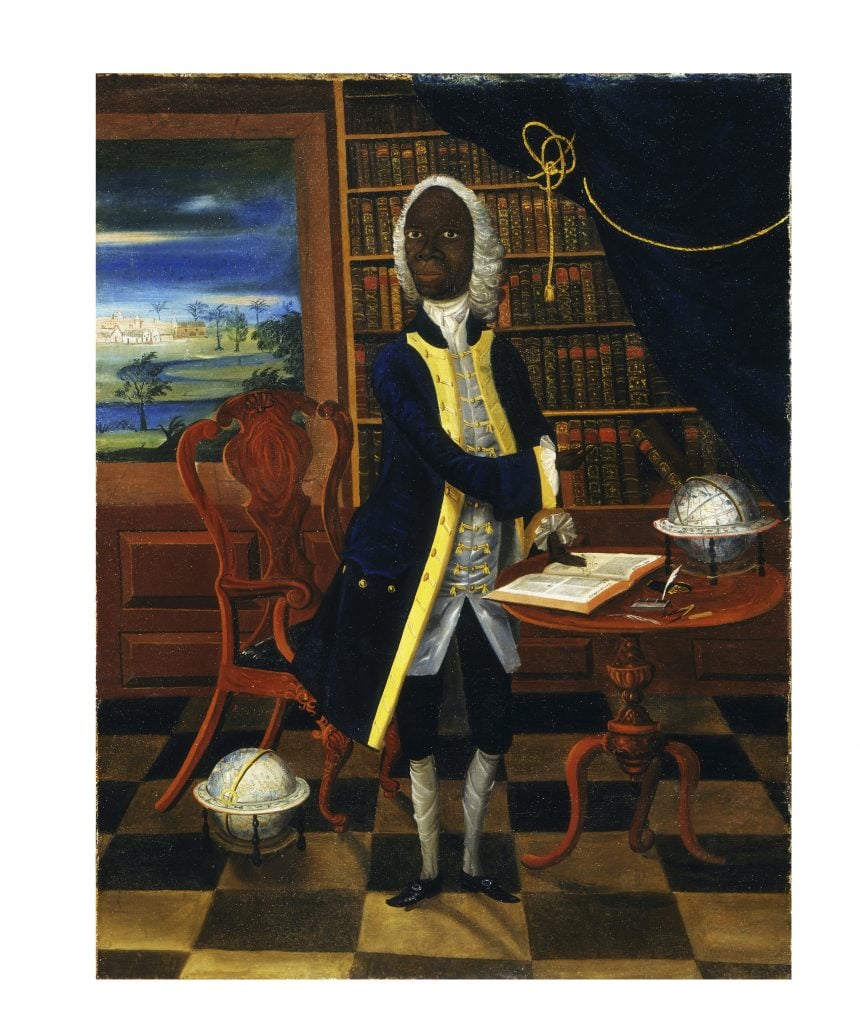
Yesterday I passed on articles about Fara Dabhoiwala’s conclusions about a painting of the Jamaican scholar Francis Williams.

Dabhoiwala hypothesizes that this portrait was made in or shortly after 1759 by the artist William Williams, born in Wales in 1727 but active in the American colonies.

William Williams is known for a couple of other portraits of unusual men in Britain’s American empire.

One portrait, now lost, showed the Haudenosaunee leader Theyanoquin, often called “King Hendrick” by British sources. In January 1755, Theyanoquin was in Philadelphia meeting with Gov. John Penn and the Council about a land dispute. At the time, British authorities were pleased to have the Haudenosaunee as allies in their growing conflict with the French.

The Fishing Company of Fort St. David’s, a genteel men’s club, commissioned William Williams to paint Theyanoquin’s portrait, and club records show it was displayed in their clubhouse. (This club later merged with the Schuylkill Fishing Company, discussed here.)

Later in 1755, Theyanoquin led a contingent of Native soldiers in a British force commanded by Sir William Johnson. Col. Ephraim Williams, Jr., led the Massachusetts contingent. (His brother, Dr. Thomas Williams of Deerfield, came along as a surgeon, and their relative, the Rev. Stephen Williams, as a chaplain.)

That British force clashed with the French beside Lake George on 8 September. Col. Williams and Theyanoquin were both killed, though ultimately Johnson claimed victory.

That event made Theyanoquin, or Hendrick, a martyr for people in Britain. Elizabeth Bakewell and Henry Parker issued an engraved portrait of him titled “The Brave old Hendrick the great Sachem or Chief of the Mohawk Indians” (shown above). That print isn’t dated, and its source is uncertain, but scholars appear to believe that it was most likely based on the William Williams painting. If so, it’s the only remaining version of that image.

In the same decade, Williams painted the radical Quaker Benjamin Lay. The earliest trace of this portrait appears to be a remark in Benjamin Franklin’s 10 June 1758 letter from London to his wife Deborah. The retired printer wrote: “I wonder how you came by Ben. Lay’s Picture.”

Unfortunately, Deborah’s letters to Benjamin before and after that one don’t survive, so we don’t know what she’d told him about that picture or how she answered his query. Franklin had published some of Lay’s writing decades earlier, but the man wrote a lot, and I don’t see signs of a close friendship.

Deborah Franklin might have commissioned William Williams to paint Lay because she sensed public interest in an engraved portrait. At some point such an engraving appeared, credited to painter “W. Williams” and engraver “H.D.” That was Henry Dawkins, another British-born craftsman who had come to the Middle Colonies of America to be a bigger fish in a smaller pond. (It’s also possible Dawkins published that engraving himself and the “Picture” Benjamin Franklin wrote about was a print, not the painting.)

That brings us back to Francis Williams, the Jamaican polymath. Did William Williams paint his portrait with an eye toward its eventual engraving? No such engraving survives.

The painting went into the hands of the planter and lawyer Edward Long (1734–1813), who published a history of Jamaica in 1774. That book includes a poem by Francis Williams and a short, inaccurate, racist biography of him. Did Long at some point also think of putting an illustration of Williams into the book?

For more about those unusual portrait subjects, see Eric Hinderaker’s The Two Hendricks: Unraveling a Mohawk Mystery, Marcus Rediker’s The Fearless Benjamin Lay, and Vincent Carretta’s article “Who Was Francis Williams?” in Early American Literature.

Friday, November 08, 2024

New Light on the Portrait of Francis Williams

Last month Artnet and the Guardian reported on historian Fara Dabhoiwala’s findings about a painting I discussed in 2009.

The painting shows Francis Williams (1697–1762), a Jamaican of African ancestry. Born into a free and prospering family with special legal status, he went to London for education and then returned to the family estate.

The painting is in the collection of the Victoria and Albert Museum, and fifteen years ago I quoted its webpage as saying:
Some writers have suggested that the painting is a caricature of Francis as he has been depicted with a large head and skinny legs. . . . Other critics have considered that the ‘unnaturalistic’ depiction may have been intended to emphasise the subject’s intellectual skills over his physical stature (Francis was alive at the time of the painting’s creation and may even have commissioned it). It may, more simply, be a reflection of the artist’s limited skills.
The new research connects the creation of the painting to a specific historical, and astronomical event.

The Guardian report explains:
Dabhoiwala…discovered the significance of the page number carefully inscribed on the book Williams is reading: it is the page in the third edition of Newton’s Principia that discusses how to calculate the trajectory of a comet by reference to the constellations around it.

An X-ray of the window scene depicted in the background of the painting showed lines intersecting what appears to be a luminous white comet, streaking through the sky at dusk, and connecting – with stunning accuracy – to constellations of stars. These stars would have been visible in that position in the firmament when Halley’s comet was in the sky over Jamaica in 1759, according to research by Dabhoiwala.
In other words, this picture shows a particular moment when Halley’s comet appeared over Williams’s estate, and it shows him as an educated gentleman who knew how to calculate the path of that comet.

Artnet adds:
As for the painting’s creator, Dabhoiwala is confident it’s the work of William Williams, an English-American artist who traveled to Jamaica in the 1760s. The comet together with the appearance [in the bookcase] of [Dr. Samuel] Johnson’s Dictionary, which was first published in 1755, align with this timing and the painting’s style is similar to other early Williams portraits of Benjamin Lay, a Quaker abolitionist, and Hendrick Theyanoguin, a Mohawk Indian.
The Lay portrait, now at the Smithsonian’s National Portrait Gallery, also shows a man “with a large head and skinny legs.” Like Williams, Lay (c. 1681–1759) was notable for standing out in British-American society rather than fitting in. Williams (1727–1791) might have specialized in such subjects.

TOMORROw: More on William Williams’s work.

Sunday, February 06, 2022

Spreading the Story of Benjamin Lay

Benjamin Lay (1682-1759) was one of the most unusual people in Britain’s early eighteenth-century American colonies.

Lay was only a little over four feet tall and hunchbacked, though fit enough to work as a sailor. He became a vegetarian and lived in caves. He owned hundreds of books, and he published scores of pamphlets, mostly jeremiads about social ills.

Born into an English Quaker family, Lay first encountered slavery on a large scale on Barbados. After that, he became a vocal abolitionist. At the time, the Society of Friends hadn’t yet adopted that position, much less Lay’s unwillingness to compromise on or shut up about it. 

After moving to Pennsylvania in 1731, Lay joined the Abington Friends Meeting, but that didn’t last. In 1737 he had Benjamin Franklin print his pamphlet All Slave Keepers That Keep the Innocent in Bondage, Apostates. As the modern meeting says on its website:
Benjamin Lay was written out of membership at Abington Monthly Meeting on the thirtieth day, eleventh month, 1737 (which by the Quaker calendar, while the Julian calendar was in use, would have been January 30, 1738), because his zealous actions were considered disruptive.

It is now known that at least two of the Friends who led the discernment about writing Benjamin Lay out of membership in the Society of Friends were slave-owners and were likely targeted by Benjamin Lay’s anti-slavery activism. Benjamin Lay was disowned decades before Quakers were disowned for being slave-owners.
Abolitionists such as Dr. Benjamin Rush, Roberts Vaux, and Lydia Maria Child wrote biographies of Lay in the early 1800s. Many featured portraits ultimately derived from a painting, shown above, that Deborah Franklin commissioned from William Williams (1727-1791) as a gift for her husband. But when slavery was no longer a burning political issue, Benjamin Lay became obscure again.

During the Bicentennial, that portrait was spotted at an auction and recognized. It was restored for the National Portrait Gallery. Nonetheless, Lay remained a footnote, occasionally profiled in an article or short entry in a larger book.

In 2010 Alexander Lagos, Joseph Lagos, and Steve Walker made Benjamin Lay a character in their two-volume Sons of Liberty graphic novel, a superhero story set in pre-Revolutionary Pennsylvania. Frankly, I didn’t think it was a good comic, but an uncompromising abolitionist dwarf mentor fit right into the genre.

Seven years later, Marcus Rediker published the first modern scholarly biography of the man, The Fearless Benjamin Lay: The Quaker Dwarf Who Became the First Revolutionary Abolitionist. He spoke at the Abington Friends Meeting, part of an effort coordinated with the organization to repudiate the disowning of 1737 and honor Lay for his egalitarianism. The meeting’s website details the results.

Rediker has now collaborated with David Lester and Paul Buhle to produce a graphic biography, Prophet Against Slavery, ensuring the memory of Benjamin Lay will continue to spread.