J. L. BELL is a Massachusetts writer who specializes in (among other things) the start of the American Revolution in and around Boston. He is particularly interested in the experiences of children in 1765-75. He has published scholarly papers and popular articles for both children and adults. He was consultant for an episode of History Detectives, and contributed to a display at Minute Man National Historic Park.

Subscribe thru Follow.it


•••••••••••••••••


Showing posts with label tea. Show all posts

Saturday, June 27, 2026

New Boston Museum Exhibits to Visit During the Sestercentennial

Two venerable Boston museums are unveiling big reworked exhibit spaces for the Sestercentennial.

At Revolutionary Spaces’ Old South Meeting House, “Ruckus!” opens formally on 2 July. This is a 25-minute “immersive” show that
drops you right into the heart of the debate and defiance that once filled this iconic space, where ordinary people set extraordinary change in motion.

From the floorboards to the balconies, you will be surrounded by dynamic sound, lighting, and projected animations of fiery revolutionaries, determined citizens, and some unlikely troublemakers whose courage shook these walls.
Revolutionary Spaces encourages people to buy tickets in advance since space at each showing is limited. Arrive around the top of the hour, and the show begins at fifteen minutes past. Tickets include admission to all of Old South’s exhibits and the Old State House.

“Ruckus!” includes loud noises and dynamic lighting to reflect the intensity of the story it tells. It therefore might not be comfortable all visitors. Revolutionary Spaces also offers “Sensory-Friendly Mornings” at the Old State House each month.

The Museum of Fine Arts has reopened its “Art of the Americas: 1700–1800” galleries with a new, hemispheric approach. Thomas Sully’s massive painting of Washington crossing the Delaware stayed where it is, but lots of other iconic artworks are arranged in a new way.

The museum says:
The MFA’s reimagined galleries of 18th-century Art of the Americas bring together works from across North, Central, and South America, and the Caribbean—including works by Native American and Indigenous makers. Together, the eight spaces in this suite, organized by theme, explore how artists have contributed to, or in some cases resisted, ideas of nationhood and identity. Visitors can immerse themselves in expansive versions of familiar stories, discovering the interconnectedness of the Americas and its history, institutions, and people.
The galleries have the themes of “Power and Resistance,” “History and Mythmaking,” “Asian Styles in the Americas,” “Boston’s World,” “Something’s Brewing” (not revolutions but caffeinated beverages), “Communities of Makers,” “Families at Home,” and “Copley’s Ambition.”

Friday, May 01, 2026

”No other Crime, but retaining their Allegiance to the King”

We left John Hill, his wife Elizabeth (?), and his daughter in the Boston jail in February 1777, suspected of “being Enemical to the States” and “attempting to Carry Intillegence to the Enemy.”

The next trace of Hill that I’ve found is from John Noble’s article “Some Massachusetts Tories” for the Colonial Society of Massachusetts in 1900:
At the July [court] Term, 1777, John Hill of Boston recovers judgment in a plea of the case against Crean Brush for £2.8s.10d lawful money, and costs.
Did Hill sue Brush, his employer during the evacuation from Boston, for some loss? Or was this another John Hill?

There’s firmer information from John Howe’s Newport Gazette, published in the British-occupied city on 20 Nov 1777:
By Mr. JOHN HILL, who left Boston the 15th of October, we learn, that Dr. [Benjamin] Church, Mr. John Dean Whitworth, of the Queen’s Rangers, and a Number of others, are yet confined in Boston; Dr. [Mather] Byles is confined in his own House; and upwards of 70 Persons, who can be charged with no other Crime, but retaining their Allegiance to the King, and Attachment to that happy Constitution under which they were born, and from which they have enjoyed the most solid and inestimable Blessings, are now confined on board a Prison Ship in that Harbour.—

He also adds, that almost every Goal in New England is filled with these unhappy People.

Mr. Hill has also favoured us with the current Prices, in Lawful Money, of the following Articles, at the Time he left it:
Beef, — — 0.1.3
Mutton, — — 0.1.6
Butter, — — 0.4.0
And so on through a list of other meats and foods, alcohols, sugars, teas, and cordwood to shoes for men (£2.2/pair) and women (£1.10/pair).

Presumably Howe was making the point about price inflation in Continental-governed areas, but we’d have to find pre-war costs for comparison.

Years later John Hill told the Loyalists Commission, as recorded by Todd Braisted:
That on the 17th of March 1776, he left Boston, with the Royal Army; but was taken at Sea, by the Rebels, . . . himself, his Wife, & Daughter was carried back to Boston, and he confined in Prison 19 months; they were all tried For their lives, but not Condemned.

In November 1777, they were Exchanged, went to Halifax, and afterwards to New York
Hill’s memory was off by just a few weeks. It’s possible he didn’t remember the port his family came through, or that the Hills went from Newport to Halifax. Adding to the confusion on that point, on 16 Oct 1777 the Independent Chronicle reported that “a Cartel” ship “with upwards 130 Prisoners on board” had sailed the previous day from Boston for Halifax. 

By whatever route they left New England, John Hill, his wife, and his daughter eventually returned to New York, the city he’d been chased out of in the spring of 1775. But now it was held by the British military.

TOMORROW: Inspector Hill.

Tuesday, December 09, 2025

Reenacting Tea Meetings in Faneuil Hall and Old South

Bostonians had lots of public debates over what to do about the East India Company’s tea, both before and after persons unidentified destroyed it in the harbor on 16 Dec 1773.

Some of the meetings before that event lasted hours and attracted so many people that the crowd had to gather in the Old South Meeting-House instead of Faneuil Hall.

In 1774, after Parliament passed the Boston Port Bill, the town meeting had more sessions devoted to discussing whether the town or any of its citizens should pay for the tea.

Families can sample the arguments at those meetings in two ways this season, both within the buildings where Bostonians actually gathered to debate.

Saturday and Sunday, 13 and 14 December, 1 P.M.
252nd Boston Tea Party Anniversary Town Meeting
Boston National Historical Park
Faneuil Hall

In early 1774 Parliament responded to the destruction of over 90,000 pounds of property by closing the port of Boston until the East India Company was compensated for its loss. In May, Bostonians gathered in the Great Hall in Faneuil Hall to vote on their response. Should they pay for the destroyed property, either officially or by private subscription, and reopen the port? Or should they endorse a boycott of British goods and continue protesting Parliament?

At 3 P.M. on each day, the same space will host the “1873 Women’s Tea Party,” a rally by the New England Women’s Suffrage Association. Leading suffragists argued that they were inheritors of the legacy of the American Revolution.

All these programs at Faneuil Hall are free and open to the public for all ages. They last 30-45 minutes. Sign up to attend here.

Tuesday, 16 December, 5 P.M.
Reenactment of the Meeting of the Body of the People
Revolutionary Spaces
Old South Meeting House

Commemorate the 252nd anniversary of the Boston Tea Party with a live reenactment of the Meeting of the Body of the People—held in the very room where it all began.

Feel the tension rise as fiery patriots debate the fate of the East India Company’s tea before thousands of restless colonists. Hear the shouts, the arguments, and the call for action that set a revolution in motion. Watch history come to life as Samuel Adams, John Hancock, Paul Revere, and others grapple with the decision to take bold action, ultimately leading to the dramatic event that became known as the Boston Tea Party.

(The Boston Tea Party Ships & Museum will not host a reenactment of the destruction of the tea in Boston Harbor this year.)

Ticket prices for the Old South reenactment range from $60 for V.I.P. seating to $25 for members of Revolutionary Spaces. Order tickets through this page. Doors will open at 5 P.M., and the reenactment will start at 6:15.

Monday, May 12, 2025

Thomas Newell and “that Detestable Tea”

Thomas Newell’s diary makes clear that he opposed Parliament’s tea tax in 1773, as most Bostonians did. On 2 December, for instance, he wrote about James Bruce bringing in the Eleanor with “116 Chest of that Detestable Tea.”

But what did Newell do to support that stance?

On 17 November the young man made clear he didn’t participate in the attack on the Clarke family’s warehouse, discussed back here: “This evening a number of persons assembled before Richard Clarke’s, Esq., one of the consignees of tea; they broke the windows, and did other damage. (I was at fire meeting this evening.)”

On 2 December, the same day Capt. Bruce arrived, Newell’s diary contains one of the longer bits of cipher in the diary. The word “Junr” is legible among the little symbols, and a squiggle that doesn’t fit the cipher turns out to be “St.” What was Newell hiding?

Not a whole lot, it turns out. Once deciphered, the line reads: “This Eving. was at St. Andrew’s Lodge, I was chosen Junr Deacon of said Lodge.” Well, good for Thomas Newell.

Some people credit that lodge of Freemasons with being at the heart of the anti-tea operation. (None give it more credit than the lodge itself.) And indeed Newell got more involved the next night.

On 3 December, Newell recorded: “This evening I was one of the watch on board of Captain Bruce (with twenty-four more), that has tea for the Clarkes & Co.” That patrol was to keep the tea from being landed so the tax could be collected.

Finally, here’s Thomas Newell’s account of 16 December:
Town and country sons mustered according to adjournment. The people ordered Mr. [Francis] Rotch, owner of Captain [James] Hall’s ship, to make a demand for a clearance of Mr. [Joseph] Harrison, the collector of the custom house (and he was refused a clearance for his ship). The body desired Mr. Rotch to protest against the custom-house, and apply to the governor for his pass for the castle. He applied accordingly, and the governor refused to give him one. The people, finding all their efforts to preserve the East India Company’s tea, at night dissolved the meeting. But behold what followed the same evening: a number of brave men (some say Indians), in less than three hours emptied every chest of tea on board the three ships, commanded by Captains Hall, Bruce, and [Hezekiah] Coffin (amounting to 342 chests), into the sea.
Was Newell among those “brave men”? I’d guess not. But he surely knew some of them.

A couple of details struck me Newell’s writing about the Boston tea protesters. First, he consistently referred to the people meeting in Old South Meeting-House as ”sons of liberty.” He didn’t worry about calling them the “body of the people.”

Second, in Newell’s telling the crowd that afternoon was trying “to preserve the East India Company’s tea.” By having it shipped back to Britain, that is. Would be a shame if anything else happened to it.

TOMORROW: A mystery name.

Saturday, May 10, 2025

The Cipher in Thomas Newell’s Diary

Last month I went to a one-day display of interesting Revolutionary documents from the Boston Public Library’s Archives & Special Collections department.

Among the items I saw for the first time was the diary of Thomas Newell (1749–1827), nephew and either protégé or employee of merchant and selectman Timothy Newell.

I’d read the text of that diary as published by the Massachusetts Historical Society and even quoted it for crucial details in The Road to Concord, but I didn’t know that the document still survived at the B.P.L.

Even more eye-catching, the archivists had opened it to a page about the lead-up to the Boston Tea Party, and one entry contains two lines of mysterious writing. Here’s a clip from the digitized version.

On 2 Dec 1773, Capt. James Bruce arrived in Boston harbor with the second shipment of East India Company tea. Thomas Newell did or saw something that evening. And the next day he joined two dozen other men in patrolling the docks to ensure no tea was landed.

I spoke to the archivists about the writing. Was it a cipher? An attempt to write in Hebrew? I put this diary on my list of things to investigate.

Now I can’t take all the credit for what I found because none other than the statesman Edward Everett worked out the cipher in the mid-1800s. He didn’t explain it, but he translated what Newell had written, and those translations are in the published transcript. That let me reverse-engineer the method.

As I suspected, Newell used a type of pigpen cipher, in which letters are written into tic-tac-toe grids and the boundaries of each cell stand in for the letter within. Newell’s cipher treats I and J as the same letter, and U and V as the same letter. So the grids are:
No dots over a symbol mean the letter is in the left-hand grid, one dot the middle grid, and two dots the right-hand grid. Thus, a square (all four boundaries) with no dot is an E, with one dot an O, and with two dots a Y.

That system let me decipher Newell’s secret lines. Or, rather, it let me confirm what Everett deciphered about a century and a half ago.

TOMORROW: So what did Thomas Newell write?

Sunday, December 08, 2024

The Ashley Family’s “commitment to tea-drinking”

Last month Historic Deerfield’s blog highlighted the consumption habits of the Rev. Jonathan Ashley (1712–1780), “Deerfield’s notorious Loyalist minister,” as the Revolution proceeded:
Reverend Ashley purchased his house lot in 1733 on the northern end of what is now Old Main Street. His successful career as a minister and his marriage into an elite Connecticut Valley family allowed him to emphasize his status through the furnishings and commodities with which he filled his home.

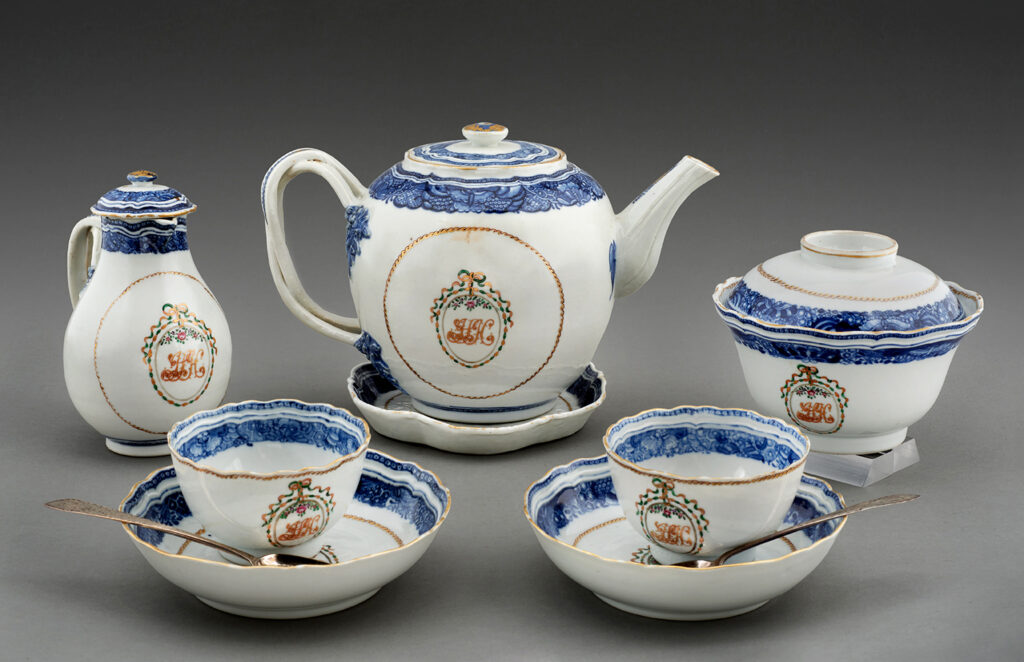
Few objects in Historic Deerfield’s collection have Ashley provenance, though a 30-piece Chinese export porcelain tea set belonging to the Ashley family bespeaks not only their desire to “maintain sufficiently affluent standards of hospitality,” but also their commitment to tea-drinking as it fell out of favor during the American Revolution.

The tea set consisting of a teapot and teapot stand, sugar bowl, cream pot, pickle or sweetmeat dish, six teacups, coffee cups, and saucers is decorated in a blue “Fitzhugh” butterfly pattern with the initials “H.H.” in a gilded oval cartouche. The Fitzhugh pattern is thought to be derived from the English Fitzhugh family, who held several positions within the English East India Company and is characterized by underglaze blue with a medallion, spearhead and trellis-diaper border, and four floral groups. . . .

as imported teas became symbolic of loyalism during the American Revolution—because of the taxes that were imposed on tea in 1773—several colonists turned to locally grown teas such as raspberry leaf to replace the imports from the British East India Company. Coffee, though not a new commodity in British North America, likewise became a popular drink amongst colonists, as it was a hot, caffeinated beverage that did not represent British economic interests. . . . Reverend Ashley continued to support the Crown by importing tea.
Collections Care Technician and blog writer Samantha Frost drew on Elizabeth Stillinger’s Historic Deerfield: A Portrait of Early America (1992) for details about the Ashleys’ purchases.

Speaking of tea, on Saturday, 14 December, the Lexington Historical Society will commemorate and recreate that town’s burning of local tea stocks in 1773, days before the Boston Tea Party. That event will take place at Buckman Tavern from noon to 3 P.M.

Tuesday, October 22, 2024

“Discovered skulking at the North-end of this city”

According to the Massachusetts Spy, when the Pennsylvania Journal printed its incendiary item about Ebenezer Richardson (quoted yesterday), people were already hunting for the man.

On 4 Nov 1773, Isaiah Thomas’s newspaper ran an “Extract of a Letter from a Gentleman in Philadelphia, to his correspondent in Boston, dated the 13th of October, 1773.” That was the same day that William and Thomas Bradford’s Pennsylvania paper published its alert.

The first paragraph of that letter was about the new Tea Act, Philadelphia merchants’ plans to respond, and concern about a report that “the duties on Tea have been regularly paid” in Boston.

The next extract said:
Your infamous Richardson, who has been concealed from public view until very lately, was yesterday haunted about, and very narrowly escaped. But a certain A. T———— who was supposed to have been his associate and patron here, was turned out of the Coffee-house in a very ignominious manner.—I pity him:—He always appeared to be decent and very civil; but to be subjected to a Murderer convict, is so injurious and unsafe, that his appointment here by the Commissioners could be only with a view to provoke to a riot: And if T——— made him his friend it could not be expected that the populace could well distinguish between them.
The Pennsylvania Journal had singled out this “A. T————” as “a Tide-Waiter” who’d said he’d work with Richardson if the Customs Commissioners ordered him to. I can’t identify him further, but folks who know the Philadelphia sources might. Clearly people in 1773 knew exactly whom the newspaper was referring to.

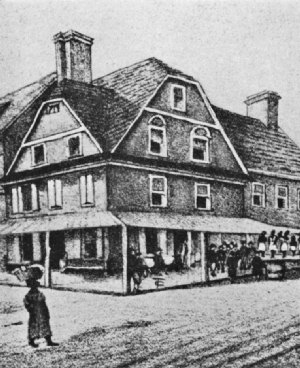
As for “the Coffee-house” that refused this man service, that was probably the London Coffee House (shown above, as drawn from William H. Ukers’s All About Coffee). The proprietor of that enterprise was none other than newspaper printer William Bradford.

A week later, the Bradfords’ 20 October Pennsylvania Journal proudly reported:
The description given in our last paper of the phiz of the Villain, EBENEZER RICHARDSON, being very accurate, he was last Monday [18 October] discovered skulking at the North-end of this city: and being closely pursued by many well-wishers to peace and good order, very narrowly escaped (by means of a wood) the TAR AND FEATHERS, which had several days before been prepared for HIM.—

As the city of Philadelphia is now, and forever must be too hot, to hold this Parracide, he will, in all probability, try his fortune in New-York; and if, contrary to expectation, he should not there meet his reward, but should experience another hair-breadth escape, he may probably, as a dernier Resorte, fly to the arms of his dear, dear P———, the surest and safest asylum for complicated Villainy, on this side the Atlantic.
“P———” was most likely Charles Paxton, Richardson’s longtime employer and one of the those Customs Commissioners in Boston.

TOMORROW: Back home in Massachusetts?

Monday, July 29, 2024

“Instead of the Agreement which the people have signed”

By the first week of July 1774, people in Westboro had started to sign the Solemn League and Covenant, promising not only not to buy goods from Britain but not to do business with anyone who did.

The town’s minister, the Rev. Ebenezer Parkman, had shown that he didn’t think that was a good idea. He wasn’t coming out and condemning this latest boycott, either, though. He just wanted to avoid controversy.

Supporters of the non-consumption movement kept up pressure on Parkman, presumably because if he came out on their side it would be even easier to sign up everyone else in town. Members of Westboro’s committee of correspondence visited Parkman again on 7 July, as he recorded in his diary:
Messrs. Daniel Hardy, Edwards Whipple etc. here. The former is disturbed that I would not so much as read, at the late Town-Meeting, what their Committee had prepared to be signed. I gave him some Reason for my refusing: namely that I was aware that if I heard it, I must either approve or condemn it — but do which I will, I must of necessity be blamed.

If I approved of their Draught, I must have exposed my Self to the resentments of Authority which I must teach all Men to avoid: for I must teach and injoin that “every soul be subject to the higher powers” — “to obey Magistrates” — as Rom. 13.1 and Tit. 3.1. If I Should dislike it, I was aware that they would not be easily turned aside notwithstanding from what they had done. I was not o’ mind to render my Self Obnoxious either way.
Soon Parkman received word from his son that “at Boston and other Towns, they did not conform to the Governors late proclamation etc.” Gov. Thomas Gage’s threats were having little effect.

Rather than openly oppose the boycott, some people suggested that communities shouldn’t commit to any action until they heard what the upcoming Continental Congress recommended. But that body wouldn’t meet for another two months. Some towns instead added clauses to their Solemn League and Covenant votes saying that they could revisit the details based on that congress’s resolves.

Parkman continued to try his own delaying tactics on 18 July:
The Town Met again on the Article of Signing the Engagement to break off the Commercial Dealings with Great Britain. They Send their Committee to Me to let me see what they have drawn up; and if I pleased in Order to my Signing it. I sent my Regards to the Town, with my Request, that it might be suffered in my Hands a little while for my Review, and I will make them Some Return before or at their next Meeting.
Nine days later, Dr. James Hawes of the town committee and his wife visited the minister in the afternoon. Avoiding another political sore spot, Parkman offered chocolate instead of tea. Hawes left a copy of Westboro’s agreement.

The next day, Parkman wrote:
Transcribed the Towns Agreement for my own use. I cannot, as it is, like it: It is ill draughted.
Ah, there was the problem! The prose. (Not.)

On 1 August, the minister once again recorded a gathering “on the Affair of Subscribing the Agreement” that didn’t make it onto the official record of town meetings. His own son Breck “found it necessary to subscribe,” he wrote.

By this point Parkman had come up with his own form of the pledge (which I don’t think survives). But the men of Westboro no longer cared about what their minister thought. “I went to the Meeting House with a paper fit to be subscribed and read it to a Number of persons,” he wrote; “but the Town were busy and did not call for it.”

At that same meeting, Westboro agreed to help pay for the Massachusetts delegates’ expenses going to Philadelphia; that money was being collected outside the province’s regular taxation process to avoid the governor’s veto. Ministers were usually exempt from taxation, but Parkman wrote: “I sent my Quota thereto.” He was willing to avoid this extralegal equivalent of tax to avoid controversy. (This was also the day Calvin Piper got badly hurt falling from a horse.)

Finally Parkman recognized he wouldn’t convince anyone but himself about the boycott. On 4 August he wrote:
N.B. Instead of the Agreement which the people have signed, I have drawn up what I think may be more Safe for me, if I shall be obliged to Sign any thing.
The town had yet another unrecorded meeting “upon some of their Liberty Affairs” on 8 August. Four days later, Parkman stated that he had received an issue of the Boston Gazette with news of the Massachusetts Government Act.

For years the province’s Whigs had been warning people that there was a conspiracy to take away people’s legal rights. This new law curbed town meetings, eliminated the elected Council, increased the royal governor’s appointive powers, and limited jury pools. The radicals’ dire warnings, which moderates like Parkman had thought overblown, appeared to be coming true. In his diary he wrote: “May God Sanctifie to us this heavy stroke! and help us rightly to improve such privilege and Libertys as remain!”

Sunday, June 30, 2024

When Adams Chaired the Boston Town Meeting

Friday, 17 June 1774, turned out to be the last day the Massachusetts assembly met under the Crown.

Before Gov. Thomas Gage shut them down, Samuel Adams and his allies used that session to authorize a delegation from the colony to the Continental Congress, as I’ve just recounted.

On the same day, there was the continuation of a town meeting in Boston. Some of that port’s merchants had started to grumble against the Whigs’ insistence that no one should pay for the tea destroyed in December (or in March, for that matter).

Adams was officially the moderator of that ongoing meeting. Expecting “a warm engagement” with the conciliatory party, Dr. Joseph Warren urged Adams to return to Boston to wield the gavel. But he was was stuck “at Salem, attending the Business of the General Court.”

At 10:00 A.M., the meeting began in Faneuil Hall. The first order of business was appointing a temporary moderator in Adams’s place. The gathering’s unanimous choice was James Bowdoin, a wealthy merchant, learned man, and genteel political leader for the Whigs.

A committee of three men went to Bowdoin’s home near Beacon Hill. He wasn’t there.

The meeting then selected merchant John Rowe to moderate. This was an unusual choice because Rowe was not a Whig stalwart. Nor was he really a Loyalist stalwart. He was a “trimmer,” adjusting his political sails according to the prevailing winds and what looked most advantageous to his business.

Perhaps the public remembered Rowe’s remark back in December about mixing tea and saltwater—the first public suggestion of that method of resolving the standoff over the East India Company cargo. Secretly Rowe appears to have regretted that remark and tried to keep a low profile afterward. So he would hardly want to chair a town meeting making controversial decisions.

In his diary Rowe wrote: “I was much engaged & therefore did not accept.” But he added a remark showing his real attitude: “The People at present seem very averse to Accommodate Matters. I think they will Repent of their Behaviour, sooner or later.”

Back at Faneuil Hall, the gathering moved on to vote for a gentleman who had never moderated the Boston town meeting before. In fact, he later said he usually kept away from town meetings. But he had represented Boston for one year in the Massachusetts General Court.

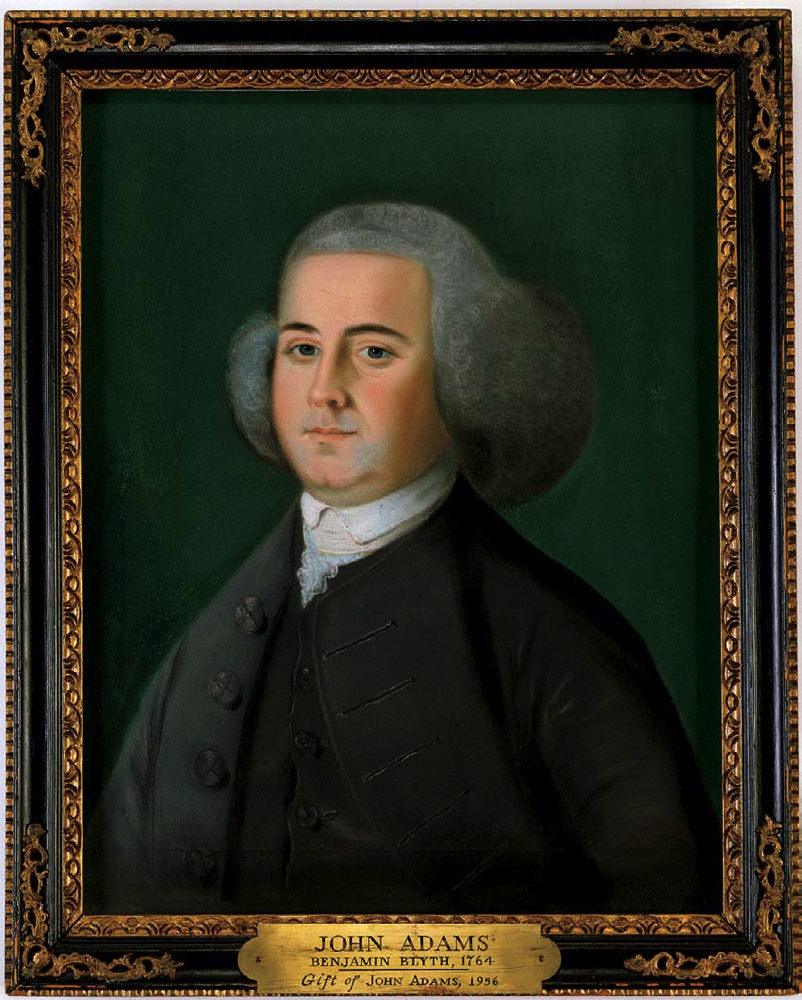
This was John Adams. Per the record, “a Committee of three Gentlemen” went to him with news of their choice, and Adams “gave his Attendance accordingly.”

TOMORROW: John Adams in the chair.

Monday, June 24, 2024

“It was known to all but Mr. Leonard”

Robert Treat Paine and Daniel Leonard were Taunton’s two representatives to the Massachusetts General Court in the spring of 1774.

Both Paine and Leonard were Harvard graduates and well regarded lawyers. Both men had, as I mentioned yesterday, courted Sarah White, with Leonard being successful and marrying her.

(Paine finally married Sally Cobb of Taunton in 1770, when he turned thirty-nine and she twenty-six. Losing no time, they had their first child two months later.)

On 9 June 1774, both Paine and Leonard were named to the assembly’s committee of nine members to consider how Massachusetts should respond to the Boston Port Bill.

Looking back after two decades, Paine described that period this way:
Mr. Leonard was a Gentleman of natural good Sence & Eloquence, polite & of engaging Adress & had been Chosen Several Years as member for the Town of Taunton, on the Idea of his being a firm & able freind to the Opposition in wch. his Town was so determined; but on the prevailing Address & Sollicitation of Govr. [Thomas] Hutchinson he had changed his principles, & considered himself now at Market to make the best of them;

all this was well known to the members of the Court & the rest of the Committee more especially to his Colleague the writer hereof; it was therefore considered unsafe for that committee to enter into the consideration of the State of the Province on principles of Opposition while he was present, & as it appeared by the Port bill that the only releif from the Continual Exn. of it was the payment for the Tea that was destroy’d, the Committee turn’d their whole Attention to that;

& as it was known to all but Mr. Leonard, that Another Committee of vastly more importance, form’d from Members of the house of Representatives by their own inclinations was beginning to operate in secret the committee of nine talkd very favourably of paying for the Tea, as a thing not to be compar’d with the Sufferings from the Port Bill:

it would be hard to discribe the Smooth & placid Observations made by Mr. S[amuel]. Adams, Saying that it was an irritating affair, & must be handled Cautiously; that the people must have time to think & form their minds, & that hurrying the matter would certainly create such an Opposition as would defeat the matter;

& many Observations of this kind, all tending to induce Mr. Leonard the Oblique Member of that Committee to think that matters would work terminate in Obedience to the Port Bill were made by Several other Members of the Committee, & then it was Observ’d that it was very hot, & that they had been engag’d in Court all day, & that it was unprofitable to set any longer at that time for the people must have time to bring their minds to a Compromise;

Proceedings of this kind took place on the PM & Evning of three days; as soon as the Committee on the State of the Province was adjournd, all the Members except Mr. Leonard immediately repaird to a retired room where the Self Created Committee before mention’d mett, & being cornpos’d of Such members only as had Signalized themselves in their Opposition to the British Aggressions of Tyrannick Govt., they Shut their Doors & entered freely & fully on all the Subjects of Grievances;…
Meanwhile, back in Boston some leading merchants were also arguing that the town should pay for the East India Company tea.

TOMORROW: Dr. Warren’s diagnosis.

Wednesday, June 12, 2024

Tea with Gen. Gage in Salem This Week

In June 1774, 250 years ago, Salem suddenly became more important.

Parliament’s Boston Port Bill took effect on 1 June, and the harbor of Salem and Marblehead became Massachusetts’s largest port open to trade from outside the colony. The Customs office moved there.

Also, Gov. Thomas Gage adjourned the Massachusetts General Court from Boston to Salem, following orders from London. That move didn’t require a new law since the royal governor already had the power to convene the legislature where he chose. That didn’t stop most of the new session being taken up with complaints about being in Salem.

When Gage moved to the region, renting a house in nearby Danvers, he also brought a contingent of British soldiers. There doesn’t appear to have been as much friction between those troops and the locals as in Boston in 1768–1770, but the town governments still raised concerns.

This week the city’s historical organizations are commemorating that period with some public events.

Thursday, 13 June, 7:00 P.M.
Tea’s Party: From Boston to Salem and Back Again
Salem Armory Regional Visitor Center

James R. Fichter speaks about how, despite the so-called Boston Tea Party of 1773, large shipments of tea from the East India Company were sold in North America. The survival of the Boston tea shaped Massachusetts politics in 1774, impeded efforts to reimburse the company for its losses, and hinted at the enduring conflict between consumer demand and political boycotts.

That tension was not confined to Boston. As Gen. Gage and the colonial government relocated to Salem in the summer of 1774, Essex County residents found committing to a boycott just as difficult as Bostonians had.

Fichter is Associate Professor in Global and Area Studies at the University of Hong Kong. He is the author of So Great a Profit: How the East Indies Transformed Anglo-American Capitalism and Tea: Consumption, Politics, and Revolution, 1773–1776.

This event is free. For directions, visit this page.

Saturday & Sunday, 15–16 June, 10 A.M. to 4 P.M.
Governor Gage Comes to Salem
Derby Wharf, Salem

The British army will encamp on the waterfront, with some of New England’s finest living history practitioners portraying soldiers, officers, legislators, and the Loyalist and Patriot citizens of Salem. Over the weekend, visitors can meet people from many walks of life: shoeblacks, teachers, merchants, tavern-keepers, midwives, and more. Activities to be reenacted include military drill, camp cooking, placing ads in a newspaper, and political debate at the tavern.

Here is the full schedule of events.

Sunday, 16 June, 9:00 A.M.
Join the Royal Governor at Church
St. Peter’s Church, Salem

Gen. Gage attended the local Anglican Church when he was in America. In Salem, that meant St. Peter’s, which will recreate an eighteenth-century service with the general occupying the same pew that he used in 1774.

Sunday, May 19, 2024

“The taste of their fish being altered”

Just because the British Empire was sliding toward internal warfare in 1774, that was no reason to stop laughing about the news.

Here are a couple of items that appeared in New England newspapers 250 years ago.

The first must have originated in a London newspaper. The earliest North American reprinting I’ve found is in John Dunlap’s Pennsylvania Packet on 18 Apr 1774. Four days later it appeared in both Isaiah Thomas’s Massachusetts Spy and Timothy Green’s Connecticut Gazette of New London, followed by other papers.

Jan. 28. Letters from Boston complain much of the taste of their fish being altered: Four or five hundred chests of tea may have so contaminated the water in the harbour, that the fish may have contracted a disorder not unlike the nervous complaints of the human body. Should this complaint extend itself as far as the banks of Newfoundland, our Spanish and Portugal fish trade may be much affected by it.
Needless to say, even 340 chests of tea dumped off Griffin’s Wharf weren’t really enough to affect the New England fisheries.
Earlier this month artist Cortney Skinner shared this clip from the 9 May 1774 Boston Gazette. It appeared on page 3 right after a political essay and right before the many mercantile ads it resembled.

This notice reads:
WANTED immediately,
A long, strong BOOM,
that will reach from Cape-Cod to Cape-Ann.———
Any Person having such an One to dispose of, will meet with a good Price, by applying to
N***H.
N. B. The Distance is only 18 Leagues.
This was a poke at Lord North’s plan to close Boston harbor to shipping. Unofficial hints of the Boston Port Bill had started to arrive, and Edes and Gill wanted readers to laugh at the folly of that policy.

The same satirical ad appeared the next day in Samuel and Ebenezer Hall’s Essex Gazette of Salem.

Then the text was reprinted (though no longer looking like an advertisement) in the 16 May New-York Gazette, the 18 May New-Haven Post-Boy and Pennsylvania Journal, and the 23 May Newport Mercury. For readers without so much maritime experience, the capper became “The Distance only 54 miles.”

When the Royal Navy and Customs service really did shut down the port of Boston in June, though, suddenly the situation didn’t seem so laughable.

Thursday, February 29, 2024

A Busy Week in Boston in March 1774

Even before Lt. Gov. Andrew Oliver died on 3 Mar 1774, Gov. Thomas Hutchinson knew he had to postpone his trip to Britain.

Oliver would have taken over certain gubernatorial duties while Hutchinson was out of Massachusetts. But if both men were gone, the executive power would have devolved onto the Council.

That upper house of the Massachusetts General Court hadn’t become as radical as the lower house, but it was still dominated by Hutchinson’s opponents.

Among those opponents was John Hancock, who on 5 March delivered Boston’s annual oration commemorating the Boston Massacre. This was probably the most politically radical thing he ever did before July 1776.

On Monday, 7 March the house sent a long response to Hutchinson’s message, quoted yesterday, dismissing the effort to impeach Peter Oliver, chief justice and brother of the now late lieutenant governor.

Much of that response was written by Robert Treat Paine of Taunton, as shown by a rough draft in his papers. However, some touches are more political than legal and may have come from Samuel Adams. Most pointedly, the response quoted the phrase “an abridgment of what are called English liberties” from one of Hutchinson’s own leaked letters, which was kind of rubbing it in.

The assembly’s response concluded with yet another complaint about officials like Hutchinson and the Olivers misrepresenting the state of the province:
We assure ourselves, that were the nature of our grievances fully understood by our Sovereign, we should soon have reason to rejoice in the redress of them. But, if we must still be exposed to the continual false representations of persons who get themselves advanced to places of honour and profit by means of such false representations, and when we complain we cannot even be heard, we have yet the pleasure of contemplating, that posterity for whom we are now struggling will do us justice, by abhoring the memory of those men ”who owe their greatness to their country’s ruin.”
That last quotation came from Joseph Addison’s Cato.

On the evening of 7 March, men carried out the second Boston Tea Party, dumping twenty-nine crates of tea from the ship Fortune. Some traders had thought that Bostonians would accept that tea since it wasn’t owned by the East India Company. They didn’t.

The funeral for Lt. Gov. Oliver was on 8 March. Prominent members of his family didn’t feel safe attending, and it did not go smoothly.

Meanwhile, there was still a stalemate on impeachment as the legislative session neared a close. On 9 March the house resolved, “it must be presumed that the Governor’s refusing to take any Measures therein is, because he also receives his Support from the Crown.” That same day, Secretary Thomas Flucker brought in Gov. Hutchinson’s message proroguing the legislature until April.

As it turned out, there would be no April session. The impeachment effort was dead.

TOMORROW: In the courtroom.

Wednesday, February 14, 2024

“Tea which Lot Cheever shook out of his shoe”

Here’s another in the seemingly endless tales of tea surviving from the Boston Tea Party.

The earliest sign of this tea I’ve found is an article in the 7 Nov 1864 Boston Evening Transcript:
Some of the Tea not Thrown Overboard. After the tea was thrown overboard in Boston harbor, Feb 10th, 1774 [sic], one of the party engaged in that movement, Lot Cheever, whose direct descendants now reside in Salem, stopped at the house of Col. Abner Cheever in Saugus to change his disguise. Some of the tea then in his shoes was saved by an old lady of the family, and has from that time until now been carefully preserved.

A lady of the highest respectability and a direct descendant of the Cheever here spoken of, has presented to the manager of the Salem Table at the Naval Fair at Boston a remaining portion of the tea, which will be offered for sale.
The Naval Fair was a fundraiser for sailors in the U.S. Navy, then engaged in quelling another rebellion.

The famous Boston Tea Party didn’t take place 250 years ago this February, and neither did the less famous second Boston Tea Party. No previous source links Lot Cheever to that action. (A Bostonian named Ezekiel Cheever was one of the volunteers patrolling the docks starting in late November.)

In fact, the only man named Lot Cheever I’ve found in the Revolutionary period lived in Danvers. It makes little sense for a man from that far away to take part in destroying the tea in Boston on 16 Dec 1773. It makes even less sense that such a man would travel all the way from Boston to Saugus before removing his disguise.

Incidentally, the man that newspaper story called “Col. Abner Cheever” was only eighteen years old in 1773. He family home was in Lynn, evidently the part of that town which became Saugus in 1815.

People must have realized that some details of that family lore made no sense because over the following decades it evolved to come closer to the standard story.

In 1878 Horace E. Scudder wrote in his novel/travelogue The Bodleys on Wheels about the main characters visiting the East India Marine Hall in Salem and seeing “a little packet of tea which Lot Cheever shook out of his shoe after he had been at the Boston Tea-party.”

A correspondent to St. Nicholas magazine in 1893 described seeing at the Essex Institute in Salem “two bottles of the tea that was thrown over board at the Boston tea-party,—it was found in the shoes of Lot Cheever after removing his disguise.”

That same year, at the 1893 Columbian Exposition in Chicago, the historical exhibits inside the U.S. pavilion included:
Tea in Bottle
Which was found in the boots of Col. Abner Cheever, of the Boston Tea Party, December 16, 1775 [sic], when changing his disguise after the affair was over. Loaned and collected by Dr. D. W. Cheever, Boston, Mass.
Lot Cheever was thus erased from the story. In 1888 the Essex Institute reported that it had received a “pocket-book of Col. Abner Cheever of the Boston Tea Party.”  

The longest presentation appeared in Lynn in the Revolution (1909), in the entry on Abner Cheever:
Family tradition says that he took part in the famous Boston Tea Party. His grand-niece, Miss Rachel Cheever, of Saugus, has still in her possession a small phial of tea which, it is said, he brought away from the party in his shoes.

Many of the older people remember the venerable patriot who was known as Colonel Cheever in his latter days. He was a tall man, rather thin in face, and smooth-shaven in accordance with the old-time custom. He was the last survivor but one in Saugus of the battle of Lexington. He died September 13, 1837, aged eighty-two, and was first interred in a private tomb which had been built upon his estate, but some few years ago his remains were transferred to the new Saugus cemetery and buried in the Perley lot. A marble stone and marker of the S.A.R. were erected at his grave in 1903.
Because one sample of tea can easily be divided, it’s possible there were multiple small containers of tea from the Cheever family on display in the late 1800s. These sources speak of “a little packet,” “two bottles,” one “Bottle,” and “a small phial.” These could all be separate items, or the family might have retrieved tea they loaned to various displays.

Might any of these tea samples survive today? The most likely depository would be the Peabody Essex Museum, successor of the East India Marine Hall and Essex Institute. But the last reports of the tea said samples were owned by “Dr. D. W. Cheever” and “Miss Rachel Cheever.”

(The photo of the Abner Cheever pocket-book above appeared in volume 5 of Elroy McKendree Avery’s A History of the United States and Its People [1908].)

Friday, February 02, 2024

“The licentiousness & barbarism of the times”

Another way to look at the mobbing of John Malcolm in January 1774 is through the issue of the rule of law.

At the end of her account of the event, friend of government Ann Hulton wrote:
These few instances amongst many serve to shew the abject State of Governmt & the licentiousness & barbarism of the times. There’s no Majestrate that dare or will act to suppress the outrages. No person is secure there are many Objects pointed at, at this time & when once mark’d out for Vengence, their ruin is certain.
Yet the Massachusetts Spy ended its Whig version of events by saying:
See reader, the effects of a government in which the people have no confidence!
For Hulton, the riotous attack on Malcolm showed that the people of Boston had no respect for the law, or common decency.

And as John Rowe’s diary entry shows, the crowd could intimidate justice of the peace Belcher Noyes from interfering with their violence.

However, people in the crowd would probably have said they were enforcing the law, not breaking it. It was Malcolm who had defied the law by refusing to obey a constable’s writ. It was Malcolm who had started the violence by clubbing George R. T. Hewes. It was Malcolm who had corrupted the law by abusing his authority as a Customs officer.

And as for waiting for the legal system to address Malcolm’s behavior, the Spy story said his attackers expected he would enjoy impunity like “[Ebenezer] Richardson and the soldiers [at the Massacre], and the other friends of government.”

It seems significant that all those cases involved grown men attacking children: Richardson shooting Christopher Seider, Pvt. Hugh White clonking Edward Garrick on the head, and Malcolm threatening the unnamed child whom Hewes defended. (To be sure, all those attacks on children started with children wising off to the men, but that wasn’t a crime.)

We can see the same sort of dueling accusations of lawlessness today. People on both sides of the political aisle say the other side routinely breaks the law and gets away with it through corruption. That makes it all the more important to look at actual evidence, not just rhetoric, since anyone can wail about “the abject State of Governmt.” 

(The picture above is a 1775 engraving of the attack on Malcolm, built off the previous year’s smaller scene shown here. Once again, tea plays a big part in how Londoners understood the event. Another early image of Boston’s destruction of the tea appears at right, and in the lower center a man is urinating into a teapot.)

Saturday, January 27, 2024

“The Custom house would drench us with this Poison”

Within a week after he was attacked by a mob, Customs officer John Malcolm petitioned the Massachusetts General Court for compensation.

He filed a memorial “setting forth great Abuses he has receiv’d, and praying to be enabled to take Measures for immediate Relief, and for Redress.”

The Council approved this petition on 1 February and sent it down to the assembly. The lower house voted “That the Petitioner have Leave to withdraw his Petition”—i.e., rejected.

On 17 March, almost two months after the riot, Malcolm published thanks to God that he was finally well enough to go back to church.

After another few weeks, on 4 May, H.M.S. Active sailed out of Boston harbor, “with whom went Passenger, the famous ’Squire Malcom,” according to the Boston Post-Boy.

In London, Malcolm told his story to a more sympathetic audience. He petitioned Lord North on 28 July. In the new year, he even presented his case to King George III.

The London newspapers reported on Malcolm’s sufferings, including a detail that hadn’t appeared in any American account so far:
A Correspondent says he has been informed, by a Gentleman lately arrived from Philadelphia, that when Mr. John Malcomb, an Officer of the Customs at Boston, was leading, tarred and feathered, to the Gallows, with a Rope about his Neck, he was asked by one of the Mob whether he was not thirsty, which was natural to a Man expecting to be hanged.

The unfortunate Officer of the Customs, as well as he could speak, answered yes; and immediately a large Bowl of strong Tea was put into his Hands, with Orders to drink the King’s Health. Whether it was owing to Loyalty or Thirst is not material; poor Malcomb Half emptied the Bowl.

He was then told he must mend his Draught, and drink the Queen’s Health. Though he had done his utmost for the King, he found he must do something for the Queen; and having taken off Half the Remainder of the Bowl, he presented it back to the Persons from whom he had received it.

Hold! hold! cries his Friend, you are not to forget the rest of the Royal Family; come, drink to the Prince of Wales. Replenish, replenish, cries the loyal American; and instantly poor Malcomb saw two Quarts more of what he was heartily sick of. Make Haste, cries another loyal American; you have nine more Healths to drink before you arrive at the Gallows.

For God’s Sake, Gentlemen, be merciful, I am ready to burst; if I drink a Drop more, I shall die.

Suppose you do, cries one of the Mob, you die in a good Cause, and it is as well to be drowned as hanged, and immediately the drenching Horn was put to his Mouth, to the Health of the Bishop of Osnabrug; and, having gone through the other eight, he turned pale, shook his Head, and instantly filled the Bowl which he had just emptied [i.e., vomited].

What, says the American, are you sick of the Royal Family? No, replies Malcomb, my Stomack nauseates the Tea; it rises at it like Poison.

And yet, you Rascal, returns the American, your whole Fraternity at the Custom house would drench us with this Poison, and we are to have our Throats cut if it will not stay upon our Stomachs. The merciful Americans desisted, and the Procession was continued towards the Gallows.
This anecdote was reprinted in Boston newspapers, including the Patriot Massachusetts Spy, in December. I haven’t found any local response saying it was untrue. However, it’s possible that at the time everyone saw this story—not attributed to Malcolm nor any Bostonian who actually witnessed the attack—as a joke using a newsworthy event to make a point about the Customs service and the Tea Act.

London artists seized on that detail about the tea. The “New Method of Macarony Making” print I showed yesterday included a Boston rioter pressing a big pot of tea on Malcolm. In the print above, “The Bostonians Paying the Excise-Man, or Tarring and Feathering,” the mob is actually pouring tea down Malcolm’s throat.

Furthermore, in the background of that print men are emptying tea chests off the side of a ship into the water—the earliest visual depiction of the Boston Tea Party. And as a reminder of the town’s ten-year history of trouble, “LIBERTY-TREE” holds an upside-down paper marked “Stamp Act.”

Malcolm hadn’t been personally involved in the stand-off over the East India Company tea, but he worked for the Customs Commissioners who had forced the issue. For Londoners, the attack on Malcolm and the destruction of dutied tea both showed the Bostonians’ contempt for the imperial government—“Paying the Excise-Man” with violence instead of their fair share of taxes.

TOMORROW: A retrospective on the riot.

Friday, January 12, 2024

“Some of the principal Venders of TEA in Boston”

Last month Prof. Carl Robert Keyes’s Advertisements 250 project highlighted a couple of notices that appeared one on top of the other in the 20 Dec 1774 Boston Evening-Post.

The first was dated 17 December, the day after the Boston Tea Party, and came from “some of the principal Venders of TEAS in Boston.” They were calling a meeting of all the merchants and shopkeepers selling tea to discuss how to respond to the public call for a complete boycott.

Just below that notice, the Fleet brothers printed the advertisement of Cyrus Baldwin, a young merchant. He was offering:
Choice Bohea and Souchong Teas,
Hyson Ditto, at 18s. L.M. [lawful money] per Pound, Indigo, and a small Parcell of Parchment Deerskins &c.—

N.B. The above Teas were imported before any of the East-India Company’s Tea arrived, or it was known they would send any on their own Account.
In other words, Baldwin (or his importer) had paid the Townshend duty on that tea, but before the commodity had become so politically charged.

Keyes noted four other people advertising tea in the same newspaper: “Archibald Cunningham, William Jackson, Samuel Allyne Otis, and Elizabeth Perkins.” None of them included the same disclaimer in their ads that Baldwin did, but tea was just one of the goods they offered. For Baldwin, tea was his main business.

Jackson kept his family’s hardware shop at the Brazen Head and had already become notorious in 1770 as one of the last people defying the non-importation movement. Cunningham was a native of Scotland and also supported the Crown.

Otis, in contrast, was the younger brother of James Otis, Jr., and Mercy Warren, closely tied to the Whigs. Baldwin also favored the Whigs, though not enthusiastically when their politics threatened his business.

As for Perkins, she had been recently widowed at age forty. Her late husband was the merchant James Perkins, and her father (and his mentor) was the wealthy hatter Thomas Handysyd Peck. Elizabeth had therefore been watching the import business all her life, and she was determined to support her children with a shop.

The business of selling tea thus cut across political lines in Boston—yet it had now become political. In the Boston Post-Boy that same day, the notice about the tea vendors’ meeting urged unity: “A common Cause is best supported by a common Association.” If only 90% of the town’s shopkeepers stopped selling tea, then the remaining 10% would benefit from all of that business, and that was a recipe for resentment.

On 29 December, Boston’s tea merchants declared they would stop selling tea after 20 January. And, even though customers might be wanting to stock up in the next three weeks, they wouldn’t take advantage of that situation by raising their prices above a certain level.

Still, that left Cyrus Baldwin with unsold tea. Back in 2015 Chris Hurley recounted what he tried to do with his stock, and what happened next, starting here.

As for the other people advertising tea in the 20 Dec 1773 Boston Evening-Post, Jackson and Cunningham became Loyalists, leaving Boston during the war. Otis parlayed his political connections into being the secretary of the U.S. Senate for its first twenty-five years.

Elizabeth Perkins did well enough in business to be able to make large charitable contributions after the war. One of her sons, Thomas Handysyd Perkins, did even better in the opium trade—another commodity fraught with political meaning.

Thursday, January 11, 2024

Who wrote, “we can make every Tory tremble”?

Earlier this year, I saw a tweet crediting Samuel Adams with the line: “With ladies on our side, we can make every Tory tremble.”

Adams wasn’t usually that pithy, and the statement doesn’t appear in the four volumes of The Writings of Samuel Adams.

The line first appeared in a letter to Daniel Fowle’s New-Hampshire Gazette published on 22 July 1774. Here’s more context:
The Consumption of TEA I think is in a fair Way of being totally laid aside in this Town, as there are but very few indeed, that will refuse to sign or solemnly ingage not to suffer it used in their Families;

and what adds a great Pleasure to us all, is, that the Fair Sex universally consent to give up, this detested superfluous Article; and under the Auspices of the worthy Doctor Clement Jackson, we hope soon to see a glorious List of Female Worthies, whose Virtue can withstand every daring Insult when put to the Test; and we all desire their Names may be recorded in the Town Books, to perpetuate their Memories:---

Then let us see who will sell that obnoxious Herb, for with the Ladies on our side, we can make every Tory tremble; as it is generally agreed upon, not to frequent those Shops were TEA is sold.
The signature, under a Latin quotation, was “AMICUS.”

A few weeks later, on 26 August, the New-Hampshire Gazette published another letter, addressed to the people of New Hampshire and signed “AMICUS PATRIAE.” It urged people in that colony to support Boston, suffering under Parliament’s Coercive Acts, with donations for the poor.

Both letters show a pattern of short italicized phrases and occasional all-capitalized nouns. Both end with Latin quotations. The signatures overlap. I therefore think it’s likely the two letters came from the same pen.

In his History of New-Hampshire (1792), the Rev. Jeremy Belknap printed a letter from New Hampshire governor John Winthrop to the Earl of Dartmouth dated 29 August, which said:
The town-clerk of Boston [William Cooper], who is said to be a zealous leader of the popular opposition, has been in this town about a week; immediately appears a publication in the New-Hampshire Gazette, recommending donations for Boston…
Belknap added a footnote to that sentence:
The publication here referred to was written by a person whom the Governor did not suspect, and the town-clerk knew nothing of it.
But Belknap obviously did know the author. In fact, his granddaughter Jane Belknap Marcou wrote in her 1847 biography that she had found “the imperfect manuscript [i.e., draft] remaining among Mr. Belknap’s papers.” In other words, he’d written it himself.

Back in 1774, Jeremy Belknap was the minister in Dover, New Hampshire. Ministers weren’t supposed to get directly involved in politics, but as “AMICUS PATRIAE” he had things to tell his fellow citizens. And Belknap also appears to have been the most likely author of the line “With ladies on our side, we can make every Tory tremble.” (I wonder if a draft of that essay might be in his papers at the Massachusetts Historical Society.)

The line resurfaced in John C. Miller’s Origins of the American Revolution (1943) as an example of American Whig sentiment before the war. Philip Foner picked it up in his History of the Labor Movement in the United States (1947), crediting the sentiment to “Sons of Liberty.” Charles O. F. Thompson included the line in A History of the Declaration of Independence: A Story of the American Patriots who Brought about the Birth of Our Nation (1947), curiously tossing in the word “blessed” ahead of “Tory.” Other books followed.

From there it appears that an author or authors decided that “Sons of Liberty” meant Samuel Adams. In the current century several books and authoritative websites attribute the statement to Adams, usually saying “often quoted” or “reported to have said” as a signal that the writers can’t find the words in those four volumes of Writings. In several places the quotation has also lost the article “the” before “Ladies.”

In conclusion, while it’s definitely possible to quote the line “with the Ladies on our side, we can make every Tory tremble” from the Revolutionary era, it should be tentatively attributed to Jeremy Belknap, not Samuel Adams.

Sunday, December 31, 2023

Ending the Year by Burning Tea

In my write-up of the Charlestown tea burning, I mixed up the date of the town meeting when everyone agreed to stop selling tea (28 Dec 1773) with the date the townspeople burned their stocks of tea (31 December, or 250 years ago today).

That in turn led to misdating when a crowd from Boston confiscated Ebenezer Withington’s tea in Dorchester.

I’ve corrected those postings.

To my chagrin, I found that I’d actually flagged a source to discuss on this date, but while traveling during this holiday season I overlooked that draft.

So here is a timely account of the events of 31 Dec 1773 from our old friend, merchant John Rowe:
The People of Charlestown collected what Tea they could find in The Town & burnt it in the View of a thousand Spectators.

There was found in the House of One Withington of Dorchester About half a Chest of Tea

the People gathered together & took the Tea Brought it into the Common of Boston & Burnt it this Night about Eleven of Clock—

This is Supposed to be part of the Tea that was taken out of the Ships and floated over to Dorchester—
Rowe’s recounting (probably second-hand) adds a couple of details to the newspaper report: the large crowd in Charlestown and a more precise timing of the tea-burning on Boston Common.

Overall, these incidents show that, despite fears of how the London government would react to the destruction of East India Company property, Bostonians were closing out the year by getting more strict about enforcing their tea boycott on everyone.

Thursday, December 28, 2023

Charlestown’s Tea Burning at High Noon

As I noted back here, when the Boston Gazette reported on the people of Lexington burning their tea on 13 Dec 1773, the newspaper said Charlestown was about “to follow their illustrious example.”

It took a little while, and perhaps a boost from the Boston Tea Party, but on 3 Jan 1774 the Boston Gazette was able to report:
The Inhabitants of Charlestown, agreeable to a unanimous Vote of said Town the Tuesday proceeding [28 December], on Friday last voluntarily bro’t all their TEA into the public Market Square, where it was committed to the Flames at high Noon-Day.—An Example well worthy Imitation.!!
The tea burned in Lexington and Charlestown (and in other communities later) had already come ashore, so importers had already paid the tariff on it (unless they smuggled it in, of course). That tea was also owned by private citizens and local shopkeepers, not by the distant, rich East India Company.

The folks burning their tea were thus making a bigger sacrifice than the men on Griffin’s Wharf, and for a purely symbolic result—signaling their solidarity with the continent-wide tea boycott. That sort of commitment is hard to square with the idea that the Tea Party movement was driven by a handful of tea smugglers. There was real communal fervor.

In his new study, Tea, James R. Fichter writes that Charlestown’s businesspeople agreed at that Tuesday town meeting to divide up their losses so the people who had large inventories of tea wouldn’t be wiped out financially.

Prof. Fichter will no doubt speak of this event when he talks tea, international commerce, and revolution to the Charlestown Historical Society next weekend. That event will take place on Sunday, 31 December, starting at 1:00 P.M. at the Bunker Hill Museum, 43 Monument Square.

TOMORROW: Meanwhile, on the other side of Boston…