


J. L. BELL is a Massachusetts writer who specializes in (among other things) the start of the American Revolution in and around Boston. He is particularly interested in the experiences of children in 1765-75. He has published scholarly papers and popular articles for both children and adults. He was consultant for an episode of History Detectives, and contributed to a display at Minute Man National Historic Park.

Subscribe thru Follow.it


•••••••••••••••••


Showing posts with label Benjamin Perkins. Show all posts

Wednesday, July 02, 2025

“Alarmed that the Regulars were advancing towards Our Entrencment”
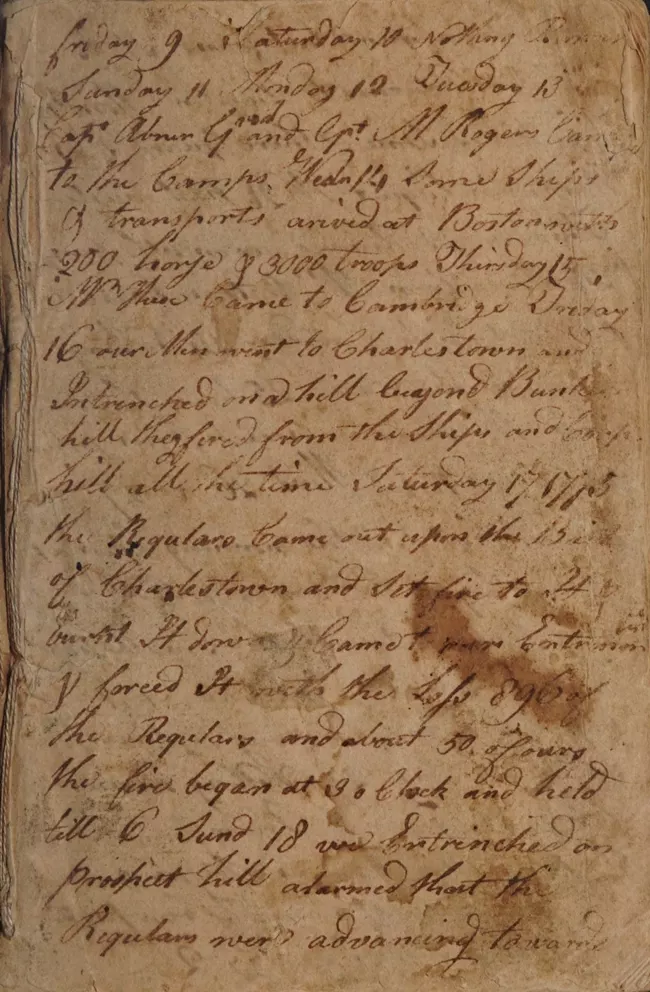
Among the presentations at this Saturday’s commemoration of Gen. George Washington’s arrival in Cambridge is a talk by Longfellow House archivist Kate Hanson Plass on the diary of Moses Sleeper.

Hanson Plass and her team have recently shared the diary online: transcription with annotations and illustrations, plus a link to page images on Archive.org.

The introduction explains:
In the museum collection of the Longfellow House-Washington’s Headquarters National Historic Site is a diary written by a soldier who participated in the early days of the American Revolution. No one knows how the diary got to the house, though it seems likely that a collector in the Longfellow family acquired it for its Revolutionary War connection in the early 20th century.

The book itself is small (5” by 8”), pocket size; its cover and the first and last three pages are missing. There is no indication of the identity of the writer of the diary; at first reading it seems to be anonymous. Using clues inside the diary – references to family members and locations of military service – the author has been established as Corporal Moses Sleeper of Newburyport, Massachusetts, who served for 19 months in Colonel Moses Little’s Regiment (later the 12th Continental Regiment).
Sleeper and Sgt. Paul Lunt of the same regiment obviously shared their diaries since many of their entries are the same. They weren’t keeping private, personal notes but making a record of their military service for people back home and in the future.

Cpl. Sleeper’s surviving pages start right before the Bunker Hill battle, which his regiment wasn’t involved in. Here’s his terse account of those days:
Friday 16 our Men went to Charlestown and Intrenched on a hill beyond Bunker hill they fired from the Ships and Copps hill all the time.

Saturday 17 1775 the Regulars Came out upon the Back of Charlestown and Set fire to It & burnt It down & Came to our Entrenen[?] forced It with the Loss 896 of the Regulars and about 50 of ours The fire began at 3 o Clock and held till 6

Sund 18 we Entrinched on prospect hill alarmed that the Regulars were advancing towards Our Entrencment but found It to be false Returned to Quarters

Mondy 19 Wee killed Some of there Guard

T 20 Went upon Picquet

W 21 past musters

Thirsday 22 Received our month pay
You wouldn’t know from those entries that Capt. Benjamin Perkins’s company, including Cpl. Sleeper, went onto the Charlestown peninsula on 17 June and saw combat. I’ve quoted later recollections of the Bunker Hill fight from other men in that company: Lt. Joseph Whitmore and Pvt. Philip Johnson.

Sgt. Lunt’s description of the battle offered a little more detail:
Saturday, 17th. - The Regulars landed a number of troops, and we engaged them. They drove us off the hill, and burnt Charlestown. Dr. [Joseph] Warren was lost in the battle: the siege lasted about three hours. They killed about 50 of our men, wounded about 80: we killed of the king’s troops 896, - 92 officers, 104 sergeants.
Both Sleeper and Lunt listed an exact number of enemy casualties—a piece of intelligence it usually takes days or weeks to acquire. In Sleeper’s case, we can see that number was written right into the entry, not inserted later. That suggests these provincial soldiers didn’t write their diary entries on the evening after the battle but after time had passed, they had recovered, and they might have had less to do.

Thursday, June 18, 2020

Another Recovered Source on Bunker Hill

In late 1825 the historian Samuel Swett sent the Boston Daily Advertiser two accounts of the Battle of Bunker Hill sworn to before a Newburyport magistrate in 1818. I shared one yesterday.

The other was undoubtedly published in the Boston Daily Advertiser sometime from 21 to 25 December, but those issues aren’t included in the database I can access from home. The New-York Daily Advertiser for 26 December reprinted that second affidavit, crediting the Boston paper. So I’m taking this text from New York, quirky quotation marks and all.

The source was Philip Johnson, a native of Newburyport. His recollection was:
Mr. Johnson states that he was a private in Capt. Benjamin Perkin’s company, and about 19 years of age, at the time of Bunker Hill Battle. The company proceeded as stated by Colonel [Joseph] Whitmore, till they came to within gunshot of the frigate Lively, [actually the Glasgow] which lay in the stream, and threw her shot across the neck—

As the company were proceeding, a shot from the frigate struck in the rear of them, and appeared to startle some of the men. Some cried out, “it is a shell.” Lieut. (now Colonel) Whitmore, immediately jumped over the fence, where it struck, took the ball and showed it to the company, and observed, ‘it was only a ball.’

When they crossed the neck, Capt. Perkins ordered the men to go in single file six feet apart. They reached Bunker Hill without any loss. The company were principally scattered, and the men took their places where they could find them. Mr. Johnson passed the redoubt and went to the left to the rail fence; he went back again and went into the redoubt. He was soon crowded out of the redoubt, and he and a Mr. [Jacob] Knapp of the company went again to the rail fence. All this was before the battle commenced.

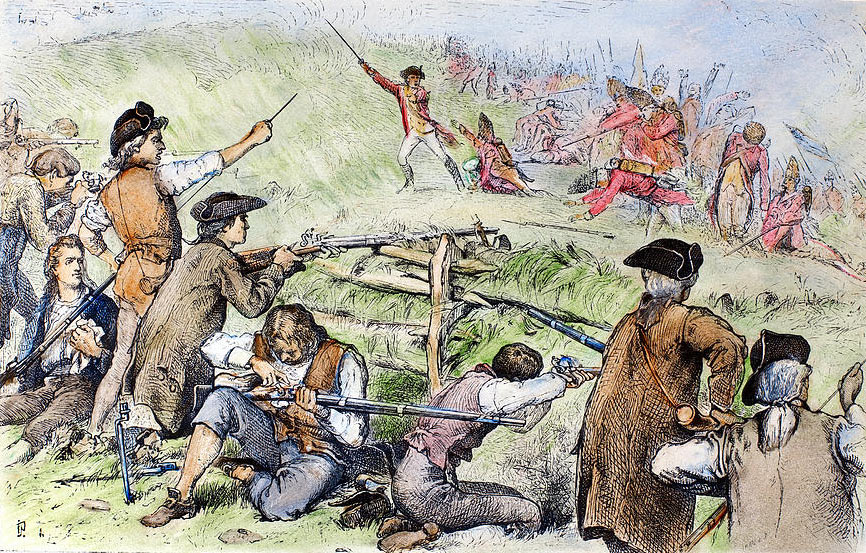
While he was at the rail fence, and just before the battle commenced, he saw Gen. [Israel] Putnam on horseback very near him, and distinctly heard him say, “Men, you know you are all marksmen; you can take a squirrel from the tallest tree; don’t fire till you see the whites of their eyes.’

Immediately after the first retreat of the British, Gen. Putnam rode up and said, ‘Men, you have done well, but next time you will do better, aim at the officers.’

The third time the British came up to the redoubt, they entered without much firing, and the retreat commenced.

Just as Mr. Johnson left his place at the rail fence, which was about half a gunshot from the redoubt, Gen. Putnam rode up, his horse covered with foam, and said something, he does not distinctly know what, and rode off. The balls were flying as thick as peas.

The particular manner in which the British came up the hill, and their several evolutions, Mr. Johnson does not recollect with sufficient accuracy to state. He heard no cheering by the Americans, till after the first retreat of the British. There were fifteen or sixteen killed and wounded in his company.

Mr. Johnson will excuse our preserving the very expressions he used, as the statement is so much more valuable for being a literal copy, though it was not intended for publication. He received in the engagement a slight wound in the hand.
In his history of the battle, Samuel Swett quoted (imperfectly) only the portion of Johnson’s statement from “was at the rail fence” to “thick as peas.” Still, that one paragraph contained the most echoed phrase from the whole battle: “don’t fire till you see the whites of their eyes.” Earlier sources quoted Putnam saying nearly the same thing, but Johnson’s affidavit supplied the wording that became famous.

In a footnote, Swett also cited Johnson for this detail, not mentioned in the letter: “His Capt. Perkins, finding it waxed warm when they arrived at the neck, threw away his wig, and led his men over at single file, the mode generally adopted.” Alas, “threw away his wig” never became as iconic a phrase as “whites of their eyes.”

Wednesday, June 17, 2020

Bringing Back a Source on the Bunker Hill Battle

Samuel Swett was one of the early historians of the Battle of Bunker Hill. He published a long essay titled “Historical and Topographical Sketch of Bunker Hill Battle” as an appendix to an 1818 reprint of David Humphreys’s biography of Gen. Israel Putnam.

The battle’s 50th anniversary came in 1825, bringing more interest from the public and more accounts from veterans. Some of those old men came to Charlestown for a public ceremony. Swett used interviews with them and his earlier research to publish Notes to the Sketch of Bunker Hill Battle at the end of 1825, quoting the sources he had used for the earlier essay and more.

Unfortunately for us, Swett didn’t tailor his publications and particularly his quotations around providing a comprehensive picture of the battle. Rather, in his own words, he wrote “for the defence of Gen. Putnam, did he need any.” In 1818 Gen. Henry Dearborn had published an article in The Port Folio basically saying that Putnam had been useless during the battle. This set off years of historiographical (and political) debate. Swett published a lot of evidence favoring Putnam, but he left out other testimony that later historians would have liked to see.

This spring I stumbled across two affidavits that Swett sent to the Boston Daily Advertiser for publication at the end of 1825. He had quoted parts of both in his Notes, and those quotations have been cited by many historians since. But as far as I can tell, scholars haven’t used the other parts of these documents, which offer more details about the battle. So I’m going to quote them in full. (As usual, I’ve added paragraph breaks for easier online reading.)

The first affidavit appeared in the Boston Daily Advertiser on 20 Dec 1825, and in a few other newspapers after that. This was how Swett introduced the source:
Col. JOS[eph]. WHITMORE, of Newburyport, a native of Charlestown, brought up there as an apprentice by Richard Devens, Esq., well known in both those places as a witness of the highest respectability, Aug. 6, 1818, stated before a magistrate, Hon. Eben. Moseley, “that he was a Lieutenant in a company from Newburyport, commanded by Capt. Benj. Perkins, and which was raised and marched to Cambridge soon after Lexington battle.”
Capt. Perkins’s company was evidently assigned to Abraham Watson’s house in Cambridge. Lt. Whitmore’s account:
While their company were at their quarters at ’Squire Watson’s, about a mile from the Colleges, an alarm was given on the 17th, [June] 1775. The company immediately formed, marched to Cambridge, and received orders from Gen. [Artemas] Ward to march to Charlestown. Col. Whitmore thinks the company arrived upon Breed’s Hill between 2 and 3 o’clock.

Soon after the company reached the hill, the British reinforcement landed, formed into columns, and marched up the hill. Col. Whitmore with a part of his company went down to the left of the redoubt, near some trees which were standing, and there received an attack. The British were twice repulsed, but the third time they made the attack with great fury, and drove the Americans from their works.

On the retreat, Col. Whitmore was wounded in his thigh. The Colonel states, that at the very moment he was wounded, Gen. [Joseph] Warren fell, and was within six feet of him.

As it respects Gen. Putnam, Col. Whitmore states, that he knew Gen. Putnam perfectly well, that he was well acquainted with him in the old French war—that he saw General Putnam on Breed’s Hill, when he went on with his company, and also on the retreat, soon after he was wounded, on the side of the hill.

He says, that well knowing Gen. Putnam, and the General knowing him, he said to him, “General, sha’nt we rally again?”

Gen. Putnam said, “yes, as soon as we can—are you wounded?”

Col. Whitmore answered that he was, but thought he should get over it.
Swett quoted Whitmore’s words starting at “with a part of his company…” and ending with “…are you wounded?”

A petition to the Massachusetts government printed in John J. Currier’s 1906 History of Newburyport shows that to “get over it” Whitmore had to go home and receive medical care until 8 August. In March 1776 he asked the General Court to reimburse him for that cost since he hadn’t taken a bed in an army hospital.

TOMORROW: Another voice from Newburyport.