J. L. BELL is a Massachusetts writer who specializes in (among other things) the start of the American Revolution in and around Boston. He is particularly interested in the experiences of children in 1765-75. He has published scholarly papers and popular articles for both children and adults. He was consultant for an episode of History Detectives, and contributed to a display at Minute Man National Historic Park.

Subscribe thru Follow.it


•••••••••••••••••


Showing posts with label John Timmins. Show all posts

Wednesday, July 15, 2026

“Touching the delivery of the Papers found upon Mrs. Hill”

As recounted yesterday, on 21 Oct 1776 Boston’s committee of correspondence, inspection, and safety questioned Elizabeth and Mary Hill about the documents they had tried to carry into British-occupied New York.

One of those letters was from Dr. Benjamin Church, Jr. The Patriot authorities were pretty certain he had spied for Gen. Thomas Gage, but they were still lacking solid evidence. If that letter had been incriminating, they would have used it.

In the second letter, Elizabeth’s husband John suggested that the merchant John Timmins was a fellow Loyalist.

And when asked who had brought John’s letter out of the Boston jail to her, Elizabeth said it might have been Richard Newton.

The committee sprang into action:
Collo. [Nathaniel] Barber and Mr. [Ebenezer] Dorr were appointed to go to Mr. [Alexander?] Orracks where Newton lodges in order to secure his Papers for the Inspection of the Committee.

A Complaint signed by the chairman [William Davis], was entered with Mr. Justice [Joseph] Greanleaff one of the Court of Enquiry; praying that the said Newton, might be immediately apprehended, & examined, touching the delivery of the Papers found upon Mrs Hill.
Richard Newton appears to have been a merchant, but not one who had been in Boston for long. He had evacuated Boston on the brig Elizabeth in March along with the Hills, William Jackson, Crean Brush, and other hopeful Loyalists. But Capt. John Manley captured that ship.

In April the Massachusetts Council had ordered Newton, Jackson, Brush, and a couple of other men to be detained in the Boston jail. Later they sent John Hill to jail, too.

In August, Newton signed a bond for good behavior, so he was presumably let out then. It seems quite plausible that Newton brought out a letter from Hill to his wife. That letter probably had more to say about the family’s survival than Boston’s defenses. After all, how much could Hill have learned over the summer in jail?

On 22 October the committee met “at their Chamber in King Street,” perhaps in the Town House. This time Ellis Gray chaired.
The Committee appointed to secure Mr. Newtons Papers Reported, that they had examined the same and could not find any one of a criminal nature among them.

Voted, that Mr. Newton shall have his Trunks of Papers returned him by the Committee — also —

Voted, that the Complaint entered with Mr. Justice Greanleaff, one of the Court of Enquiry against Richard Newton be withdrawn.
As for John Timmins, he was also a merchant. In 1768 he had married the young widow Mary (Olney) Greene, and they had children baptized at Trinity Church. During the tea crisis of 1773 he was agent for the cargo on the Beaver and publicly promised not to unload the East India Company’s tea.

The following year, Timmins signed the merchants’ addresses to Govs. Thomas Hutchinson and Thomas Gage. All of which is to say Timmins really did look like a Loyalist before the war. But he hadn’t left town with the British military.

The committee record says:
Mr. John Timmons name having been mentioned in one of the Papers found upon Mrs. Hill, the Committee sent for her Husband who gave the Paper, and having examined him strictly with respect to what he had written, together with his Wife and Daughter, and also made inquiry of Mr Timmins — the Question was put viz. — “Whether the Committee are fully satisfied, that Mr. Timmons conduct with respect to what passed between Mrs. Hill & himself has been quite unexceptionable — passed in the Affirmative unanimously.
The letters that Elizabeth and Mary Hill had been carrying therefore turned out to be less incriminating than first newspaper reports hinted. Yes, John Hill had communicated to them from the jail. Yes, he’d written about Timmins as a potential helper. Yes, Mary Hill and Ralph Cunningham, attached to the British army, were on their way to marrying. But the committee found no sensitive military information or the like.

Nonetheless, Elizabeth and Mary Hill were still locked up in the Boston jail in February 1777. According to John’s claim to the Loyalists Commission, the family “were all tried For their lives, but not Condemned.” Instead, “In November 1777, they were Exchanged, went to Halifax, and afterwards to New York…”

As for John Timmins and Richard Newton, both those men eventually left Boston for Britain. They decided to be Loyalists in the end.

Tuesday, July 14, 2026

Interrogating Elizabeth and Mary Hill at the Boston Jail

Back in April I wrote a series of postings about John Hill, his wife Elizabeth (?), and their daughter, captured on board the brig Elizabeth as they evacuated Boston in March 1776.

Recently I stumbled back across a source I may have seen before since I could have mentioned it in 2012. But I viewed it with new eyes.

As you recall, on 12 Oct 1776, Patriots in New London detected the two female Hills trying to carry secret letters onto British-occupied Long Island. They sent those women back to Boston, where John Hill was locked up, for questioning.

The records of the Boston committee, inspection, and safety, published by the New England Historical Genealogical Society in 1880, let us fill out that story.

On 21 October, the committee met at the house of Joseph Otis, the jailkeeper. The merchant William Davis chaired. They summoned “One Mrs. Hill Wife of one Hill now in the Jayl of this County examined together with her Daughter” about the incriminating papers they were carrying when detained.

The committee minutes say:
A Letter of recommendation given Mrs. Hill by Dr. [Benjamin] Church was read, together with the other Papers found upon her.

Mrs. Mary Hill the younger was brought in, and examined particularly with respect to Dr. Church, and one Ralph Cunningham mentioned in the Paper, the latter of whom appeared to be a Person who had made Courtship to the said Hill & supposed to be in the British Army at New York.
This source thus tells us that John Hill’s daughter was named Mary, and that she must have been the daughter of John Hill who married Lt. Cunningham of the Legion in 1779, as I guessed here.
Mrs. Hill the Mother was brought in & examined more particularly with respect to Mr. John Timmins of this Town Merchant, who was characterized by Hill the Husband, as a person who had been faithful to Government [i.e., Loyalist].

Mrs. Hill being asked who it was that delivered her the Paper wrote by her Husband answered. that she could not well recollect but thought it was one Richard Newton.
Well, of course we know what happened next: the authorities went on a hunt for Timmins and Newton.

TOMORROW: Further investigation.

Thursday, December 17, 2020

When John Piemont Set Up Shop in Danvers

At the website of the Danvers Archival Center, part of the town’s public library, Richard B. Trask shared his essay “Discovering Paul Revere in the Dried Prunes Box,” also published decades ago in Family Heritage.

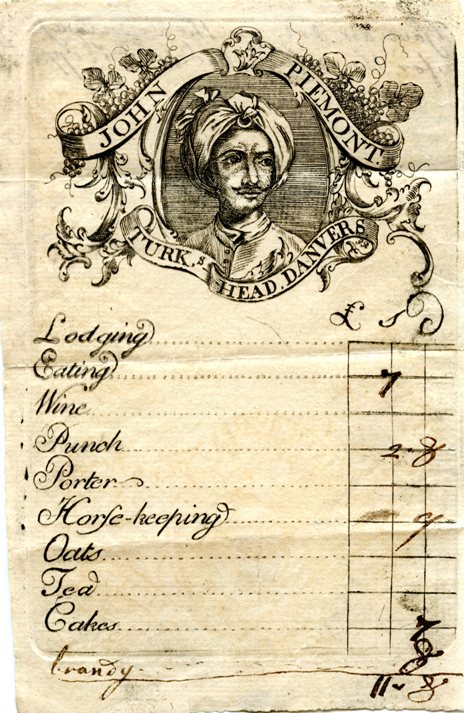
It involves the engraved billhead shown here.
It was the summer of 1969, and I was working for the local Historical Commission as a summer cataloguer and researcher, trying to put into order the thousands of town records. Most of the loose, individual town papers were enclosed in nailed wooden boxes as a result of a W.P.A. project in the 1930s when the records were roughly sorted into various departmental categories. The boxes had originally been used in food relief during the depression and were clearly, and to my eyes humorously, marked, “Dried Prunes–For Relief–Not to be Sold.” Unfortunately, the boxes were not good for storing manuscripts, and many of them had become nesting areas for all sorts of vermin. . . .

Among these handwritten slips of paper, I noticed a very handsome item containing a fine engraving of the shoulders and head of a turbaned and mustachioed man with banners about him proclaiming, “John Piemont. Turk’s Head, Danvers.” The item was a trade bill of John Piemont’s eighteenth-century Turk’s Head Tavern, which was located on the old post road near what is now the junction of Pine and Sylvan Streets in Danvers.

Subsequent to discovering the identity of the trade bill’s printer, I learned from Dr. Richard P. Zollo, who wrote an interesting study on the life of John Piemont titled, “Patriot in Exile,” that Piemont was a Frenchman who settled in Boston in about 1759 and took up the trade of peruke [wig] maker. While residing in Boston, Piemont apparently became enmeshed in the patriot cause. He was a member of St. Andrew’s Lodge of Masons and was actively involved in the events leading up to the Boston Massacre of 1770. In 1773, partly as a result of losing Tory patronage at his wig shop, Piemont moved to Danvers and took on the management of a tavern.
To be exact, apprentices from the shop Piemont shared with another barber and wigmaker were involved in the first violence on King Street on the evening of 5 Mar 1770. One of those teens, Edward Garrick, criticized a passing army officer, and Pvt. Hugh White called the boy over and clonked him on the head.

There’s also a complaint from Pvt. John Timmins about Piemont and some other barbers clonking him on the head, as I quoted way back here. I still can’t make sense of this unmotivated attack, especially since Piemont’s business catered to royal officials and army officers. He even employed a moonlighting private, Pvt. Patrick Dines. I suspect Timmins came up with the complaint after the Massacre when he knew his superiors were eager for complaints about the locals whose names had come up in that dispute.

As Trask writes, Piemont later left Boston and opened a tavern in Danvers. When the war broke out in 1775, some locals “called him a Tory,” and the local committee of correspondence had to vouch for him. But back to the essay.
Months later, while browsing in a local book store I was looking through a book titled Paul Revere’s Engravings by Clarence S. Brigham. A plate in the chapter on trade cards caught my eye. A bill from Joshua Brackett’s “O. Cromwell’s Head” tavern on School Street in Boston, was reproduced. The design, format and size of this Revere engraving was almost identical to the Piemont bill that I had found.

I quickly looked in the index for “Piemont” and was referred to page 175, which stated that Paul Revere’s day book included many charges for engraving advertising cards and bill heads, but that no specimen remains of many of them. In June 1774 Revere made two hundred prints for a charge of 8 shillings to Mr. John Piemont.
Check out Trask’s essay to see the clue that confirmed his suspicion that Paul Revere had engraved this image for the former barber from Boston.

Saturday, August 03, 2013

Looking for Loyalists in All the Wrong Places?

At All Things Liberty: The Journal of the American Revolution, Elizabeth M. Covart has contributed a series of articles on the interpretation of Loyalism in Boston’s Harborfest activities this year.

Among the sites Liz visited was the Old South Meeting House, which encourages visitors to help reenact the debate over the issues raised by the new tea tax of 1773. That church was the site of huge protest meetings in November and December, with thousands of people showing up to express their opposition to landing the tea and paying the tax. How many people showed up in 1773 to support the new Crown policy? Practically no one.

Our best source on the actual discussions at the tea meetings is a memo titled “Proceedings of ye Body respecting the Tea,” which L. F. S. Upton published in the William & Mary Quarterly in 1965. It was written by someone present at the tea meetings in November and December 1773. Similar reports in the same handwriting are marked “Colman,” suggesting the observer was Benjamin or William Colman, either way a cousin of Massachusetts Attorney General Jonathan Sewall.

The end of this report listed the eight “chief Speakers at the Meetings”: Samuel Adams, John Hancock, Dr. Joseph Warren, Dr. Thomas Young, Josiah Quincy, William Phillips, William Cooper, and William Molineux. Those men cover the political spectrum from radical Whig to deeply committed Whig. There was not much debate.

The tea meetings at Old South in late 1773 were not official town meetings, though they were conducted along similar lines. They were special meetings called to protest the tea tax. No one had to attend. Some friends of the royal government probably saw going to those meetings as lending them legitimacy that they didn’t deserve. Others might have gone and found the anti-tea sentiment so strong that they kept from speaking out.

The Colman report described just a few future Loyalists speaking at these meetings, and in limited ways. On 30 November Stephen Greenleaf, sheriff of Suffolk County, came in with a letter from Gov. Thomas Hutchinson (also father of two tea importers), “requiring him to read a Proclamation for them to disperse.” He read that proclamation to “a confused Noise and a general Hissing.” And then the gathering voted to ignore it. Greenleaf evidently went away again. He lost his job as sheriff in independent Massachusetts (his younger brother William took over), but he never left Boston.

John Singleton Copley also appeared. But he didn’t argue that loyalty to the British Empire should outweigh local economic needs, or that the principle of “no taxation without representation” could be safely bent for a small tax on one imported product. Instead, he came to the meeting as a representative of his new wife’s family, the Clarkes, who had imported a lot of the tea. He just asked for a guarantee of their safety if they returned to town, as the people had demanded. Later he returned to say that the tea consignees “thought it not prudent and would serve no valuable Purpose to appear at the Meeting.” Copley went away, apparently satisfied with his job as a go-between. He would sail to Britain the next year and live there for the rest of his life.

Francis Rotch, whose family owned the Dartmouth, was in and out of the meetings a lot. But he didn’t argue for the necessity of obeying Parliament’s laws, or the value of paying taxes for public services, or the divine right of kings. The Rotches were Quakers from Dartmouth, Massachusetts, and they kept out of Boston politics. Francis Rotch simply pleaded with the crowd not to do things that would cause his ship to be damaged or confiscated. Rotch spent the war in London, thus qualifying as a Loyalist, but in these meetings he spoke from a neutral perspective as a man caught in the middle.

John Timmins appeared as agent for the cargo on the Beaver and briefly promised that he wouldn’t unload the tea. Timmins also moved to England during the war.

Finally, there was John Rowe, wealthy merchant and part-owner of the Eleanor. Some people in the crowd identified him as “a good Tory” when he arrived. So what arguments did he make?

he expressed his Sorrow that any Vessel of his should be concerned in bringing any of that detestable and obnoxious Commodity, (Tea)” and seeing the Audience were pleased with what he had said, he proceeded and among other Things he asked, “Whether a little Salt Water would not do it good, or whether Salt Water would not make as good Tea as fresh.” And when he had done speaking and at several other Expressions in his Speech, the People testified their Applause by Shouting Clapping etc.
The report author heard crowd members saying quietly that “Mr. Rowe had now become a good Man and they should soon make all the Rest of the Tories turn to their Side as Mr. Rowe had done.”

Rowe went home that night and wrote bitterly in his diary but didn’t record his own words. Clearly he had been cowed by the people, or perhaps just eager for their approval. And in fact he managed to last out Bostonians’ distrust to remain in town through the war, eventually even becoming a representative to the Massachusetts General Court.

If the reenactments of the tea meetings followed that record as a script, the audience wouldn’t hear Loyalist political arguments. In Rowe’s case, we’d be hard put to distinguish his words from those of the most radical Whigs. (Indeed, Bostonians remembered Rowe as being the first to publicly raise the possibility of getting rid of the tea into the ocean. That may have helped his political career.)

I think Old South does good work by making sure visitors are exposed to a debate on the issues surrounding the tea in 1773. That can’t happen unless someone speaks up in favor of the British government. That viewpoint is all the more valuable in being less familiar to most modern Americans, and thus more effective at making us think in new ways. But in providing a forum for the Loyalists’ political positions, today’s Old South is offering a much broader spectrum of voices than people heard in that same space in late 1773.