J. L. BELL is a Massachusetts writer who specializes in (among other things) the start of the American Revolution in and around Boston. He is particularly interested in the experiences of children in 1765-75. He has published scholarly papers and popular articles for both children and adults. He was consultant for an episode of History Detectives, and contributed to a display at Minute Man National Historic Park.

Subscribe thru Follow.it


•••••••••••••••••


Showing posts with label Samuel Adams. Show all posts

Friday, July 31, 2026

“So severely & so meanly attack’d from that Quarter”

On 28 Oct 1775, John Dickinson finished writing a long letter to a Quaker banker in Britain, David Barclay—one of the documents just published in the William & Mary Quarterly.

Dickinson had written most of that letter in late September, starting with his comments on what he had filed in his papers as “Letter from John Adams of Massachusetts Bay, in which he abuses Me, for opposing the Violent Measures of himself & others in Congress.”

Dickinson told Barclay:
The inclos’d Letters written by John Adams one of the Delegates from Massachusetts, were intercepted, as the Boat was passing an Arm of the Sea, and have been publish’d by General [Thomas] Gage. These are now in every Body’s Hands, and indisputably prove the high projects that are in Agitation. . . .

I did not expect that my Reputation would be so soon so severely & so meanly attack’d from that Quarter. My Compassion for the unhappy Province of Massachusetts Bay was so sincere & tender, that I truly regarded her Delegates as my Brothers; and they ever behav’d to Me, especially the two, that, I am now convinc’d, are my Enemies, with the [illegible] greatest Marks of friendly Respect.
That second Massachusetts delegate was almost certainly Samuel Adams.
Tho We differed in Sentiments, yet I suppos’d without the least Hesitation, that as We had embarqued our Lives & Fortunes in the same Bottom, We should feel a manly & liberal Indulgence for each others particular Opinions.

I have been mistaken; for under the most silken softness of public pretensions, lurk the bitterest Resentments, which can only spring from the Disappointment of selfish Designs.

This Assault so far from hurting my Character, has, if I can form any true Judgment, been of Advantage to Me. It convinces those, who before doubted—that tho I am resolved, as is testified by my public Conduct, at every Hazard to act for the Wellfare of my Country, yet I am not hurried away by the Torrent of Passions, that has swept so many at this Time from their sure Footing: but still retain the heartiest wishes for a Reunion with G[reat] B[ritain].

But another Effect of vastly more Consequence, will be deriv’d, from the Publication of those intercepted Letters. It will prove, that a total Independence, & the Establishment of a Commonwealth, are seriously thought of, and that hitherto they have been successfully oppos’d…

You will observe, no Doubt, how…the Writer of the intercepted Letters, & his party…abhorr any prospect of Accommodation, before they have got “the whole legislative, executive, and judicial of the whole Continent in their Hands, have completely modell’d a Constitution, have rais’d a naval Power, opended all Ports wide” &c that is, before they have established an independent Commonwealth.
Dickinson was repeating phrases directly from Adams’s letter, using it to show that his August warning that some Americans actually wanted independence had been well founded.

TOMORROW: Up until then…

Monday, May 18, 2026

“In what a defenceless State we still remain”

I was preparing to write about a document from the Samuel Adams Papers at the New York Public Library, digitized as “Letter from John Scollay” dated 22 Apr 1776.

But after taking a closer look, I realized that only the first two four pages at that link come from a letter by selectman John Scollay. And the first two pages of Scollay’s letter are at this link, called “Letter from William Davis”—which is indeed accurate for the first two of four pages there.

The file called “Letter from John Scollay” also contains a two-page letter from the Rev. Samuel Cooper, dated 29 Apr 1776. His signature is abbreviated, but the handwriting matches Cooper’s other letters in this collection.

The Cooper letter closes by saying he’d recently written to John Hancock and John Adams. The letter to Hancock isn’t listed in the John Hancock Papers project, so it probably hasn’t survived. But the Adams Papers does offer a 22 April letter from Cooper matching the style and concerns as the letter to Samuel Adams.

In particular, Cooper told John Adams he was worried about Boston’s defenses:
After so many Weeks Possession of this Town you would be surpriz’d to see in what a defenceless State we still remain. The Business of Fortifying has lain between Genl. [Artemas] Ward and a Committee of the General Court: Between them both, little or nothing has yet been done. We have but 7 or 8 Guns mounted on Fort Hill. Nothing yet done on any Island in the Harbor.

A British Ship of 40 or 50 Guns with two or three small arm’d Vessells are in Possession of King Road and Nantasket. They take or drive away almost all supplies coming to us by Water; and (would you believe it!) with this inconsiderable Force the Harbor has been, and is now effectually block’d up. Two or three Ships of War have had it in their Pow’r ever since the Evacuation of the Town to come up and cannonade it.
That warship’s primary mission was to stop other British ships from going into the harbor unaware that it waw now in rebel hands. But of course Cooper and other Bostonians couldn’t be sure it wouldn’t attack.
Ward complains that too small a Force, but 5 Regiments not full, were left him. The Court blame him for Inactivity, and He them. I was pleas’d to see your Letters and others from Gentlemen of the Congress mentioning the Importance of putting this Harbor into the best State of Defence. Pray write again and again to press this Matter.

There is a Report here that Ward has desir’d to resign. I wish from my Heart He would do it. He is a good Man, a thoro N. England man, and dispos’d to do us ev’ry Service in his Power. But He certainly wants Decision and Activity. It is of absolute Necessity that some General Officer of the best Qualities be sent to this Department immediately. Pray let [Nathanael] Green or some other be plac’d here.

We are in the utmost Hazard, should the Enemy return, of loosing in this Quarter much more than we have gain’d, by the Departure of the British Forces. Had there been a Man here, at the Head of the Military who would have discern’d at once what was proper to be done; and stated it to the Court, we might have been in a good Posture of Defence Weeks ago.
Ward had indeed put in his resignation on the grounds of ill health, then asked to remain so he could help Massachusetts rebuild. Cooper wasn’t the only local to say Ward moved too slowly. When the minister wrote this letter, however, it had been less than three weeks since Gen. George Washington had departed and left Ward in charge. It therefore doesn’t seem fair to suggest Boston could have been fortified against ocean attack “Weeks ago.”

Friday, March 20, 2026

“Alarmed in Lexington” in Lexington, 21 Mar.

Evacuation Day over, so it’s time to look ahead to another Patriots Day season. 

On Saturday, 21 March, the Lexington History Museums will host two performances of Alarmed in Lexington, a series of three short plays by Debbie Wiess about events in the Hancock-Clarke House on 19 Apr 1775.

The audience will take in these three vignettes while moving through the house in small groups (including going up and down stairwells).

As the action begins, it’s shortly after midnight and Paul Revere and William Dawes have just left after bringing news of approaching British regulars. The vignettes dramatize the responses of the town minister, the Rev. Jonas Clarke, and his granddaughter Lucy; Massachusetts resistance leaders John Hancock and Samuel Adams; and Hancock’s fiancée, Dorothy Quincy, and his aunt, Lydia Hancock. Those conversations take place in the same rooms where those people were living in 1775.

The performances are scheduled for 4 and 7 P.M. Tickets are limited and cost $40, or $30 for Lexington History Museums members.

Wednesday, January 28, 2026

“All occupations resemble one another in some way…”

Back on 17 January, the New York Times columnist Jamelle Bouie drew a historical parallel in an essay for his newsletter:
Not since the British occupation of Boston on the eve of the Revolutionary War has an American city experienced anything like the blockade of Minneapolis and its surrounding areas by the federal government. . . .

All occupations resemble one another in some way, and it is striking to read descriptions and accounts of the occupation of Boston in light of events in Minnesota. “Having to stomach a standing army in their midst, observe the redcoats daily, pass by troops stationed on Boston Neck who occupied a guardhouse on land illegally taken it was said from the town, and having to receive challenges by sentries on the streets, their own streets, affronted a people accustomed to personal liberty, fired their tempers, and gnawed away at their honor,” writes the historian Robert Middlekauff in “The Glorious Cause: The American Revolution, 1763 to 1789.”

“Harrison Gray, a prominent merchant and a member of the council, told soldiers who challenged him one evening that he was not obligated to respond,” writes Richard Archer of the same period in “As if an Enemy’s Country: The British Occupation of Boston and the Origins of Revolution.” “They retaliated by thrusting their bayonets toward his chest and detained him for half an hour.”
Harrison Gray (shown above) was the province’s treasurer, a future Loyalist. Yet he had the same complaint as resistance leader Samuel Adams, who as “Vindex” complained in 1768:
when these gentlemens attendants [i.e., soldiers] take upon them to call upon every one, who passes by, to know Who comes there as the phrase is, I take it to be in the highest degree impertinent, unless they can shew a legal authority for so doing.

There is something in it, which looks as if the town was altogether under the government & controul of the military power: And as long as the inhabitants are fully perswaded that this is not the case at present, and moreover hope and believe that it never will, it has a natural tendency to irritate the minds of all who have a just sense of honor, and think they have the privilege of walking the streets without being controul’d.
The British army’s occupation of Boston ended in the Massacre. Bouie drew a parallel between that event and federal agent Jonathan Ross’s killing of Renée Good. When his essay appeared, two still-unidentified agents had not yet killed Alex Pretti.

Though there are similarities, I’ve been wary about analogizing the Massacre to this month’s events in Minneapolis. For instance, the eight soldiers in King Street were much more vulnerable than the heavily armed and armored federal agents shoving people around. And those soldiers weren’t grabbing people off the street just because they didn’t look white.

Nonetheless, it’s hard not to be reminded of the past. Bouie concluded, “I think the administration is more likely to break…and learn, as the British did in Boston, that Americans are quite jealous of their liberties.”

Friday, September 05, 2025

“Lt. Hawkshaw yesterday near expiring thro. his bad wounds”

During the British army withdrawal on 19 Apr 1775, Lt. Thomas Hawkshaw of the 5th Regiment was shot in the side of his face.

As recorded by his regiment’s surgeon, blood gushed from his nose and mouth as well as his wound. Some of the affected tissue became inflamed. He had trouble swallowing.

People thought Lt. Hawkshaw was lying on his deathbed. And according to legal and popular understandings of the time, that meant he couldn’t lie in another way. After all, a person wouldn’t utter a falsehood just before meeting his maker, right?

Or, as a legal maxim quoted in 1700s reference books said: Nemo moriturus præsumitur mentiri. A dying person is not presumed to lie.

Usually that “dying declaration” doctrine allowed testimony from a dead victim that would otherwise be ruled out as hearsay. Thus, Patrick Carr’s doctors could report his remarks about the soldiers holding back before the Boston Massacre in 1770. To discredit such strong evidence, Samuel Adams had to resort to sneering that Carr “in all probability died in the faith of a roman catholick.”

The same thinking made “deathbed confessions” convincing. In the case of Lt. Hawkshaw, word went around that as his life slipped away he blamed the army for starting the war. Justice of the peace Edmund Quincy wrote to John Hancock on 22 April:
Here they say & swear to it all round, in excuse of ye Regulars, proceeding at Lexinton—that they were attack’d first & I doubt not many oaths of Officers & men are taken before J. G—ley [Justice Benjamin Gridley], to confirm it—but among others who contradict ’em—Lt. Hawkshaw yesterday near expiring thro. his bad wounds——Call’d Several Credible persons to him & told ’em as a dying man—that he was obliged in Conscience to confess—that the first Action of ye Whole at L. was done by the Kings troops—wr. they killd & wounded eight men—but doubtless you have sufficient proof of ye Fact & every Circumstance attending near at hand— . . .

Capt. [John] Erving, at his house yesterday Gave me ye Account of Hawkshaws Confesso.-proved to him at ye No: End yesterday to be real
As discussed here, Quincy gave that letter to Dr. Benjamin Church, Jr., who slipped it to Gen. Thomas Gage. Which meant Lt. Hawkshaw’s commander read that he was contradicting the official army line.

TOMORROW: A quick response.

Tuesday, April 22, 2025

“A daughter of liberty, unequally yoked in point of politics”?

In his 1788 history of the American Revolution, the Rev. William Gordon shared this anecdote about what led up to the British army march on Concord:
A daughter of liberty, unequally yoked in point of politics, sent word, by a trusty hand, to Mr. Samuel Adams, residing in company with Mr. [John] Hancock at Lexington, about thirteen miles from Charlestown, that the troops were coming out in a few days.
Gordon was close to Adams, as other stories in his book indicate. Adams clearly knew the identity of this “daughter of liberty,” and Gordon might have known as well, but the book kept her name secret. Presumably she was still expected to appear loyal to a husband whose politics she didn’t share.

Some authors have taken this early statement as evidence that Margaret Gage might have leaked her husband’s plan for the march on Concord to Dr. Joseph Warren just before he dispatched William Dawes to Lexington. I don’t think that holds up to scrutiny, from several angles.

First, this “daughter of liberty” provided information to Adams, not Warren, and “a few days” before the march, not the evening it began. There’s no reason to believe those two informants were the same person—nor any indication that Warren’s source was a woman. (Once again, I think the doctor got the dope from William Jasper.)

Second, this “daughter of liberty” was worried that Hancock and Adams would be arrested, as was Warren, but someone truly privy to Gen. Thomas Gage’s plan would have known he was focused on the military supplies in Concord.

Third, while Margaret Gage expressed sadness at the prospect of war between Britain and the American colonies, she never showed any affinity for the Patriot cause. In fact, there doesn’t appear to be any evidence she ever even met Patriot leaders.

I think there are many stronger candidates to be this “daughter of liberty, unequally yoked in point of politics.” (Gordon took that phrase “unequally yoked” from Paul’s second epistle to the Corinthians.)

In my talk to the Colonial Society of Massachusetts last week, now viewable online, I shared my current idea of the most likely candidate.

TOMORROW: Gosh, this is suspenseful, isn’t it?

Thursday, April 17, 2025

Counterfactual 2: If Capt. Parker Hadn’t Assembled His Company

Picking up the “what if” thread from yesterday, I turn to this question: What would have happened if neither Paul Revere nor William Dawes had arrived in Lexington in the wee hours of 19 Apr 1775?

The town would still have been at a heightened level of military alert. That afternoon a young local named Solomon Brown had ridden out from Boston—not as a messenger, but just coming home from business.

On the road Brown had spotted a bunch of other men on horseback. They looked or sounded British. When their cloaks flapped back, he saw they were carrying pistols. Brown began to suspect they were British army officers.

Everyone in Lexington knew two important politicians from Boston were staying in the Rev. Jonas Clarke’s house: John Hancock, president of the Massachusetts Provincial Congress, and Samuel Adams, delegate to the Continental Congress. Were those army officers coming out to arrest those men?

In fact, Maj. Edward Mitchell was leading about a dozen mounted officers out into the countryside to keep alarm riders from getting to Concord. That town was the only goal of Gen. Thomas Gage’s mission. Lexington was just along the way.

Not knowing that, Solomon Brown went to his militia sergeant, William Munroe (shown above). Munroe gathered “a guard of eight men, with their arms,” at the parsonage. So some Lexington militiamen were already on the alert well before hearing from Revere or Dawes.

In real life, after receiving the Bostonians’ post-midnight warning, Capt. John Parker assembled the rest of the Lexington militia company on the town common. Nothing happened, so he let the men disperse to nearby houses and taverns to catch some sleep.

But let’s imagine that Revere and Dawes never arrived. The town picked up news of the approaching column hours later from a few travelers, from hearing bells and warning shots from towns to the east.

In that case, the Lexington men might have assembled more hastily. They might have headed for where they thought they might be most needed: at the parsonage, strengthening Sgt. Munroe’s guard.

Hancock and Adams might not have had time to leave town—or Hancock might have refused to do so with more men watching. So an armed crowd would have gathered on what’s now Hancock Street, determined to prevent the troops from arresting those political leaders.

The expedition’s light infantry companies were the first to march into town. But in this scenario the men of the 10th Regiment wouldn’t have seen a body of armed men lined up on the common. They wouldn’t have felt any need to veer off to confront those men. They would have kept marching swiftly along the road to Concord, half a mile from the Hancock-Clarke house.

The two bodies of armed men might have spotted each other in the early dawn light. But they would have been too far apart for either to present any threat. The army column would probably have passed through Lexington without any incident.

Contrary to the scenario Jim Piecuch found described in Kostya Kennedy’s The Ride, Hancock and Adams would not ”have been captured or killed” because the regulars weren’t looking for them.

(Well, if Hancock had insisted on rushing to the common to confront the regulars, he might have been captured or killed. But even he wasn’t that reckless.)

TOMORROW: Alternative scenarios for Concord.

Wednesday, April 16, 2025

Counterfactual 1: If Revere Had Never Reached Lexington

For the Journal of the American Revolution, Jim Piecuch just reviewed The Ride: Paul Revere and the Night that Saved America by Kostya Kennedy.

Piecuch writes:
Kennedy begins his book by posing an intriguing question: What might have happened if Massachusetts militia had not been present at either Lexington or Concord when British troops arrived on April 19? He speculates that John Hancock and Samuel Adams could have been captured or killed, that the munitions at Concord could have been seized, and that such events might have put the American Revolution on a completely different, perhaps even unsuccessful, course.

In Kennedy’s view, the question that gives rise to this hypothetical scenario can also be stated as: What might have happened had Paul Revere not made his ride to warn the inhabitants of towns outside Boston that British regulars were coming? While it is impossible to answer such a question, Kennedy uses it to underscore the importance of Revere’s ride, declaring that “Perhaps no night was more critical to [America’s] fate” (page 4).
I’ve been cogitating along similar lines but not coming to the same firm conclusions.

Let’s start with the question of what would have happened if Paul Revere had been satisfied with arranging for the signals from the North Church steeple to his colleagues in Charlestown. The rider they sent west toward Lexington never made it, probably stopped by a British mounted patrol. We don’t even know who that man was. But let’s imagine Revere went to bed thinking he’d sent the warning as Dr. Joseph Warren had asked.

Or we can imagine Revere heading out of Boston as he did but being stopped by the H.M.S. Somerset, or by that same mounted patrol in west Charlestown. If Revere had never made it past Medford, how would that have affected events the following day?

In that case, Dr. Warren’s warning would have reached Lexington about half an hour later than it did, as soon as William Dawes arrived in town. Since it took hours for Adams and others to persuade Hancock to leave Lexington, and since the regulars didn’t arrive until hours after that, those thirty minutes probably wouldn’t have made a big difference.

TOMORROW: But what if neither Revere nor Dawes had reached Lexington? 

Thursday, April 10, 2025

“That the leaning of the writer of the above might not be mistaken…”

Yesterday I quoted most of the Boston News-Letter’s 22 Aug 1765 report on the first anti-Stamp Act protest the week before.

In 1856 Samuel Gardner Drake (shown here) quoted the same article at length in his History and Antiquities of Boston. He appears to have missed printer Richard Draper’s sarcastic jibes at the crowd, however. Drake wrote:
That the leaning of the writer of the above might not be mistaken, he closed by a memorable saying of Lord Burleigh, much in use in those days, “England can never be undone but by a Parliament.” Thus the mob was encouraged, and, as by the sequel it will appear, a very partial account was given of what had taken place. The course taken by the papers under the control of the Government had some effect in producing the above, for the News-Letter had been jeered by them because it had not come out with early denunciations of the proceedings of the mob.
The criticism of the News-Letter appeared in an Whiggish newspaper, not in one “under the control of the Government.” The Boston Whigs faulted Draper for not reporting on the demonstration at all; if he’d “come out with early denunciations of the proceedings of the mob,” they’d have faulted him even more vigorously.

Drake’s extract included these lines from the News-Letter (with modernized capitalization and punctuation):
The populace after this went to work on the barn, fence, garden, and dwelling-house, of the gentleman against whom their resentment was chiefly levelled [Andrew Oliver], and which were contiguous to said hill. And here, entering the house, they bravely showed their loyalty, courage, and zeal, to defend the rights and liberties of Englishmen. Here, it is said by some good men that were present, they established their Society by the name of the Union Club.
In context, coming right after describing rioters breaking into Oliver’s house “to defend the rights and liberties of Englishmen,” the reference to the “Union Club” looks like another bit of Draper’s sarcasm.

Whigs in Bristol, England, had formed a Union Club by 1750, pushing for political reform and the protection of liberties. In the 1760s a ship of that name was visiting Boston. New Englanders would have known what the “Union Club” stood for—and should have seen the irony of forming one in somebody else’s house.

In 1865 William V. Wells quoted that line about the “Union Club” without its context in his Life and Public Services of Samuel Adams. He went on to say those men were doubtless the same group as the “Sons of Liberty” who had organized the protest.

Later authors repeated that equation: the Sons of Liberty, the Union Club, and the “Loyall Nine” (a term from yet another source, published later) were all names for the same protest organizers identified by the Rev. William Gordon.

In fact, I haven’t found a single source besides the Boston News-Letter using the name “Union Club” that way. It doesn’t reappear in the newspapers. It doesn’t show up in John Adams’s or Samuel Adams’s writings. It doesn’t show up in John Rowe’s or John Tudor’s diaries. Given the sarcasm in the initial report, I doubt the “Loyall Nine” ever really adopted the term.

(By December 1774 a Union Club was established in Salem. It contributed something for the poor after the Boston Port Bill, and on 16 December Samuel Adams sent a thank-you letter to Samuel King. I can’t find any other period mention of that organization.)

Friday, March 07, 2025

“Alarmed in Lexington” and More

The Lexington Historical Society is now the Lexington History Museums.

As the Sestercentennial of the start of the Revolutionary War approaches, the organization’s Buckman Tavern museum is open to visitors every day of the week but Wednesday, 10am–4pm.

Another of the museums, the Hancock-Clarke House, is about to host this special program.

Saturday, 8 March, 7 to 9 P.M.
Alarmed in Lexington
Hancock-Clarke House, 36 Hancock Street

Step back in time to experience the anxious hours before the start of the American Revolution. It’s past midnight on April 19th, 1775, and Paul Revere has just left the home of Lexington’s minister, Jonas Clarke, with news of an impending British attack. This leaves the home’s occupants to take in the news and prepare for what is to come.

In a series of three short plays by Debbie Wiess, see how John Hancock and Samuel Adams, leaders of the Revolution; Dorothy Quincy and Lydia Hancock, John’s family; and Jonas and Lucy Clarke, town leaders, process the impending crisis as they prepare for war in the very rooms in which these conversations took place 250 years ago.

Admission is $25, or $20 for museum members. This program has received funding from Kirkland and Shaw Plumbing and Heating and by a grant from the Lexington Council for the Arts, a local agency supported by the Massachusetts Cultural Council, which in turn receives funds from the National Endowment for the Arts.

[I hope those funds were received last year since the current administration has stopped many payments for work already done and contracts already awarded. The White House has also ordered future N.E.A. grants to conform to criteria not established by Congress; arts organizations just filed a lawsuit about the unconstitutionality of that order. Events like “Alarmed in Lexington” show how White House edicts can affect local endeavors that don’t have direct federal involvement.]

Next month, the Lexington History Museums will also reopen its Munroe Tavern for the season, and debut its new Depot museum covering all of Lexington history.

Wednesday, February 05, 2025

History Camp Discussion about the Outbreak of War, 6 Feb.

This Thursday, 6 February, at 8:00 P.M. Samuel A. Forman and I will appear live on the History Camp Author Discussion feed, talking about the Battle of Lexington and Concord with Lee Wright and Mary Adams and taking audience questions.

Sam is the author of Dr. Joseph Warren: The Boston Tea Party, Bunker Hill, and the Birth of American Liberty. He shared a great deal of his research for that book on his Joseph Warren website.

Sam and I are both members of the board of The Pursuit of History, Inc., the non-profit organization that organizes History Camp, these online author discussions, and the Pursuit of History Weekends, including the upcoming look at “The Outbreak of War” on 3–6 April. So we’ll talk about those things, too. 

One of the overlaps between my book and Sam’s is Dr. Joseph Warren’s 10 Feb 1775 letter to Samuel Adams, kept at the New York Public Library. It gives a vivid picture of the tension inside redcoat-occupied Boston 250 years ago:
We were this Morning alarmed with A Report that A Party of Soldiers was sent to Cambridge with Design to disperse the [Massachusetts Provincial] Congress many here believed it was in Consequence of what was Yesterday published by their Order, I confess I paid so much Regard to it as to be sorry I was not with my Friends and Altho, my Affairs would not allow of it I went down to the Ferry in a Chaise with Dr. [Benjamin] Church both determined to share with our Brethren in any Dangers that they might be engaged in but we there heard that the Party had quietly passed the Bridge on their Way to Roxbury up[on]. which we returned Home.

I have spent an Hour this Morning with Deacon [William] Phillips and am concerned that our Existence as a free People absolutely depends in acting with Spirit & Vigor, the Ministry declare our Resolution to preserve our Liberty and the common People there are made to believe we are a Nation of noisy Cowards, the Ministry are supported in their Plan of answering us by Assurances that we have not Courage enough to fight for our Freedom, even they who wish us well dare not openly declare for us lest we should meanly desert ourselves and leave them alone to content with Administrations, who they know will be politically speaking, omnipotent if America should submit to them,

Deacon Phillips Dr. Church and myself are all fully of Opinion that it would be a very proper Step should the Congress order A Schooner to [?] be sent Home with an accurate State of Facts, or it is certain that Letters to and from our Friends in England are intercepted, and every Method taken to prevent the People of Gt. Britain from gaining a Knowledge of the true State of this Country— I intended to have consulted with you had I been at Cambridge to Day on the Propriety of A Motion for that Purpose—but must defer it untill to Morrow—

One thing however I have upon my Mind which I think ought to be immediately attended to—the Resolution of the Congress published Yesterday greatly affects one [Obadiah] Whiston who has hitherto been thought firm in our Cause but is now making Carriages for the Army—He assisted in getting the four Field Pieces to Colo. [Lemuel] Robinson’s at Dorchester, where they are now, He says the Discovery of this will make him,—and He threatens to make the Discovery, perhaps Resentment and the Hope of gain may together prevail with him to act the Traitor—

Dr. Church and I are clear that it ought not to be one Minute in his Power to point out [to] the General [Thomas Gage] the Place in which they are kept but that they ought to be removed without pray do not omit to obtain proper Orders concern’g them
Whiston the blacksmith was cut out of the Patriot organization; eventually he left Boston as a Loyalist in March 1776. The committee of safety convinced Robinson to turn over those “four Field Pieces” so they could be moved further from Boston—out to Concord, in fact. However, since Dr. Church was or would soon be in Gage’s pay, the general tracked them out to that town. 

After war did break out, one of Dr. Warren’s first actions as head of the Massachusetts Provincial Congress was to assemble an account of the first battle from the Patriot perspective and send it by specially hired ship to London, just as this letter proposed.

This letter is one of many documents that show the Massachusetts Patriots making plans to respond to a British army action. Of course, every bit of military preparation convinced Gov. Gage that those men were planning an armed rebellion.

Back when Sam and I were writing our books, we had to go to New York to see that letter. Now it’s been digitized for anybody to read (though searching for it is still a challenge).

Thursday, December 12, 2024

“You found the money and Sam Adams the brains”

For the first years of the Revolutionary War, Massachusetts continued to operate on the basis of its provincial charter.

The General Court was elected each year, starting in the summer of 1775, when it took over from the Provincial Congress. Its members chose a Council.

That Council exercised executive power, as the charter had specified for times when the royally-appointed governor and lieutenant governor were absent from the province. Which they were, for obvious reasons.

It took years, and two tries, before the towns of Massachusetts ratified a new constitution in 1780. That provided for a governor again—to be elected by the people rather than appointed.

On 19 October, the Rev. William Gordon of Roxbury wrote to John Adams, then on a diplomatic mission in Europe, about that choice:
Mr. [John] Hancock will be governour, unless Death should prevent it. I was employed by a Boston representative under the rose, to plead with Mr. [James] Bowdoin that pro bono publico [for the good of the public] he would condescend to serve as Lt. Govr.: I urged that plea, and encourage the expectation from his not declaring off, that, if the Genl. Ct. are pritty well agreed, he will not decline. He will be a good poize, and prevent undue influence and eccentric motions.

Some time back several persons dined together with the above mentioned, the conversation turned upon old matters, a country booby of a representative said, “ay I remember we used to say that you found the money and Sam Adams the brains.” A pause commenced for some minutes before the conversation was renewed. The poor mortal, upon being afterwards spoken to upon the impropriety of his remark, apologized by pleading, it was the truth and he thought there could be no hurt in speaking it.
This was during a rift between Hancock and Samuel Adams, with Gordon on Adams’s side and relishing anecdotes that made Hancock look foolish.

Hancock did indeed become governor less than a week later, but his lieutenant governor was Thomas Cushing. Bowdoin was the next elected governor, serving two difficult terms before losing to Hancock, who had decided he was healthy again. Eventually Samuel Adams became lieutenant governor under Hancock, and then succeeded him in 1793.

Saturday, November 23, 2024

“Once cut for the Simples, but never cured”?

I can easily recognize some of the Revolutionary Bostonians being lampooned as “Characters” in a supposed “Tragi-comic Farce” announced in the 8 May 1770 Nova Scotia Chronicle, but not others.

For example:
Samuel Plunder, a Senator, formerly a Receiver of the Tribute of the Parish, Master of the black Art, can cheat without a Mask of Honesty, supported by Contribution, and the Votes of a Mobb.
That’s Samuel Adams, whom political opponents often criticized for his performance as a tax collector in the early 1760s.

And “Charles Spiritual, Guide and Protector of the Junto,” surely meant the Rev. Dr. Charles Chauncy, minister of the First Meeting and a close ally of the Boston Whigs.

But does that make “Samuel Tubb, private Chaplain to Simple John,” the Rev. Dr. Samuel Cooper, minister of the Brattle Street Meeting that included John Hancock, already called “John Dupe”?

That seems almost certain, but right after “Samuel Tubb” comes “John Simple, a mighty Coxcomb, very important and bigg with Nothing, well known for the Drubbings he has received.” So is “Simple John” in one sentence different from “John Simple” in the next? This “John Simple” doesn’t resemble Hancock, but who is he?

Speaking of Hancock, that “John Dupe” is called “remarkably melancholy on his Loss of Lady Beaver.” A couple of months earlier, on 22 February, the printer John Boyle wrote in his journal:
Married, Mr. Henderson Inches, Merchant, to Miss Sally Jackson, Daugh. Of Joseph Jackson, Esq.—Mr. John Hancock hath paid his addresses to Miss Jackson for about ten years past, but has lately sent her a Letter of Dismission.
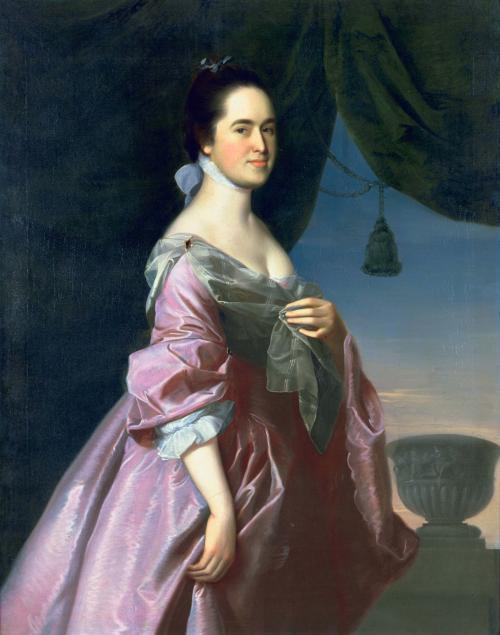
So was Sarah Jackson (1739–1771), shown above, courtesy of the Huntington) “Lady Beaver”? If so, does that let us interpret this entry among the characters:
Alderman Hemp, Son of the transported Cobler, well known for his great Judgment as a Politician, Chief of the grand Committee, by his wond’rous Capacity has cut off John Dupe’s Pretensions to Miss Beaver.
Henderson Inches (1726–1780) was a selectman (“Alderman”?) and active on merchants’ committees. He was born in Dunkeld, Scotland, and his father, Thomas Inches, brought the family to Boston when Henderson was a child. The town meeting voted to make Thomas Inches a sealer of leather for several years in the 1730s, so was he indeed involved in making shoes? But what might “transported” have meant? And why the name “Hemp,” which first made me think of ropemaker and selectman Benjamin Austin?

And as for profiles like these:
Edward Shallow, Friend and Neighbour to Squire Lemon, once cut for the Simples, but never cured, Carrier of Intelligence, full freight’d with Absurdities.

William the Gunner, or the one ey’d Philosopher, Brother to Shallow, formerly kept a chop House in one of the Danish Islands.

William Homer, Esq; the Jew, famous for his Treatise on Cuckoldom, well known for his Humanity and publick Spirit.
I’m at a loss.

TOMORROW: Did John Mein write this article?

Friday, September 13, 2024

“Boston was quiet & no hurt done”

On 8 Sept 1774, two days after the men at the First Continental Congress heard dire reports about the Crown military attacking Boston, accurate information arrived in Philadelphia.

The army had not killed half a dozen civilians. The navy had not bombarded the town. In fact, over two tense days nobody had been hurt at all.

Robert Treat Paine recorded the new news in his diary:
By the Post came advice from N. York that a person had arrived from Boston & Newport since the time Supposed in [Israel] Putnams Letters & that Boston was quiet & no hurt done.
John Adams did likewise, characteristically with more emotion:
The happy News was bro’t us, from Boston, that no Blood had been spill’d but that Gen. [Thomas] Gage had taken away the Provincial Powder from the Magazine at Cambridge [sic]. This last was a disagreable Circumstance.
Roger Sherman of Connecticut wrote the next day:
We were Alarmed a few Days ago with a report that Boston was fired upon by the Land and Sea forces, but it has been Since Contradicted.
Also on 9 September, Caesar Rodney of Delaware wrote about news from Massachusetts: ”A letter to Mr. [Thomas] Cushing by Express from Boston informs that all is Quiet as Yet…” He went on to discuss other forms of resistance snarling up the Suffolk County court sessions and mandamus Council.

People in the eighteenth century were used to hearing false reports and contradictory information to sort out. They knew that news could take days and weeks to travel, and be garbled along the way. They must have been used to rethinking how they understood distant events based on new facts.

Nonetheless, those reports of the British military attacking Boston must have tinged how the delegates at this Continental Congress viewed the ongoing dispute with the Crown. The news arrived just as those men were getting acquainted and setting out the rules for their body.

On 6 September, the same day that the false rumors prompted the Congress to adjourn early, Samuel Adams was proposing that the Rev. Jacob Duché, an Anglican, lead the body in prayer. As I wrote way back here, that “masterly stroke of policy” helped allay worries that the New Englanders were all religious bigots who would drag the whole continent into an unnecessary fight. And now Adams’s home town was under attack?

Philadelphians began to ring their church bells “muffled” in mourning for the Boston dead. According to Silas Deane, Christopher Gadsden (shown above) of South Carolina was “for taking up his Firelock, & marching direct to Boston.” John Adams wrote, “Every Gentleman seems to consider the Bombardment of Boston, as the Bombardment, of the Capital of his own Province.”

Then came the better news. Deane reported, “The Bells of the City are now ringing a peal of Joy on Acct. of the News of Boston’s having been destroy’d being contradicted.” The Congress didn’t have to consider military matters after all. At least, not right away. But for a couple of days, the delegates had faced the possibility of a war against the imperial government. Could their actions keep that from happening, or did they need to prepare for it—or was it possible to do both?

Sunday, September 01, 2024

“You have heard of the taking ye. Windmill”

In The Road to Concord I quoted a lot from accounts of the “Powder Alarm” that Dr. Joseph Warren and Dr. Thomas Young sent to Samuel Adams on 4 Sept 1774. (Warren’s letter is undated, so that date is a guess based on context.)

Both those physicians had gone out to Cambridge common on 2 September along with other genteel Boston Whig leaders, hoping to calm the crowd and prevent violence. They could therefore share eyewitness details with Adams.

(In fact, the crowd was already calm, though determined. It didn’t verge on violence until later in the afternoon when Customs Commissioner Benjamin Hallowell, Jr., happened to roll by. And the inland farmers wouldn’t have recognized Hallowell if Bostonians like printer Isaiah Thomas hadn’t pointed him out, calling, “Dam you how doe you like us now, you Tory Son of a Bitch[?]” Needless to say, Thomas wasn’t part of the Boston committee.)

Adams also received a 5 September letter from the Rev. Dr. Samuel Cooper describing the “Powder Alarm.” That minister was not an eyewitness, so all his information was second-hand at best and inaccurate in some details. But that letter offers a look at what the Whigs were telling each other about the event.
You have heard of the taking ye. Windmill, at Cambridg [sic—Charlestown] with the Province Powder there by a Detachment.

The next Morning three thousand assembled at Cambridg. They conducted with Order & great Firmness. [Samuel] Danforth & [Joseph] Lee, expecting a Storm had resign’d the Day before. Sheriff [David] Phips has promis’d not to act upon ye. new Laws. Even the Lt. Governor [Thomas Oliver] resign’d his Seat at ye. Board [i.e., the Council].

The Assembly having done their Business, retir’d.

Hallowell pass’d on that Day thro Cambridg from Salem. When he had got a little Way fro the Assembly, one or two Horsemen follow’d him. He gallop’d with all the Speed he could make thro the blazing Heat to Boston.

When he got upon ye. Neck, as if all the Sons of Liberty in the Province had been at his Heels, He scream’d for the Guard: They ran from their Station to meet him. The Alarm was soon given to the Camp—and an apprehension instantly propagated of a Visit from Cambridg. The Soldiers lay on their arms thro the Night.

They have since doubled their Guard at the Fortification, and planted four Pieces of Cannon there.
Dr. Cooper had other things to say about the mandamus Councilors and what Gen. Thomas Gage was writing to his superiors in London. (How could the minister know?)

Cooper signed this letter “Amicus,” adding, “If you are at a Loss, Mr. [Thomas] Cushing will explain my Signature—conceal my name.”

Thursday, August 01, 2024

“The Majority were four to One against them”

On 28 June 1774, the Boston town meeting witnessed “long Debates” about the committee of correspondence’s call for a non-consumption agreement, according to town clerk William Cooper’s record.

In his diary the merchant John Rowe confirmed, “The Debates very warm on both sides.” Unlike the previous day, alas, he didn’t record any of the speakers.

But the group urging a repudiation of the committee consisted mainly of major merchants, some with positions within the royal government. They worried that this boycott, on top of the Boston Port Bill, would doom the town’s economy.

The leaders of the Whigs, in reply, argued that standing up to Parliament’s Coercive Acts by not buying any more from Britain was their best way to force the repeal of those laws.

Eventually the meeting held a vote on the merchants’ motion to censure. Cooper recorded that “a great Majority” voted against repudiating the committee.

Rowe expressed disappointment, at least in his diary:
the Committee are wrong in the matter. The Merchants have taken up against them, they have in my Opinion exceeded their Power & the Motion was Put that they should be dismissed. the Gentlemen that made & supported this Motion could not Obtain their Vote, the Majority were four to One against them.

this affair will cause much evil one against the other. I wish for Peace in this Town I fear the Consequences.
The Whigs then sought to affirm the town’s support for the committee by offering their own motion:
That the Town bear open Testimony that they are abundantly satisfied of the upright Intentions, and much approve the honest Zeal of the Comittee of Correspondence & desire that they would persevere with their usual Activity & Firmness, continuing stedfast in the Way of well Doing
A “Vast” majority approved that.

After that, Samuel Adams returned to the chair, the committee on employing the poor said they were once again not ready to report, and the meeting adjourned until July.

That was the last attempt of the Boston Loyalists and/or merchants to curb the Whigs electorally, and they fell far short. Which wasn’t a surprise. The Whigs won every vote along the way, even on matters like which men would go ask if the gathering could move to the Old South Meeting-House.

The Boston town meeting would remain stalwart and implacably opposed to the royal administration until the war began.

COMING UP: Protests against the protest.

Sunday, July 14, 2024

“Universally come into a solemn league”

By the end of May 1774, Boston had held several sessions of a town meeting about how to respond to the Boston Port Bill.

On the afternoon of 13 May, the meeting had resolved, with no dissent, that some sort of continent-wide boycott was the solution to the crisis.

Over the next couple of sessions, the meeting kept asking for its committee to recommend a specific plan. Thomas Cushing kept replying that the committee didn’t yet have a report. Then the town would ask the committee to “sit again”—i.e., get to work.

On 30 May, the town meeting spelled out what it wanted by voting:
That the Committee appointed to receive Proposals & consider of Ways & Means, be desired to prepare a Paper, to be carried to each Family in the Town, the Report of which to be, not to purchase any Articles of British Manufactures, that can be obtained among Ourselves, & that they will purchase Nothing of, but totally desert those who shall Counter-work the Salutary Measures of the Town.

Voted, That the Comittee of Correspondence be & hereby are directed, to comunicate the Non Consumption Agreement aforesaid to the other Towns in the Province.
The meeting also said that the next session would be on 17 June. The committee shouldn’t expect any more guidance until then.

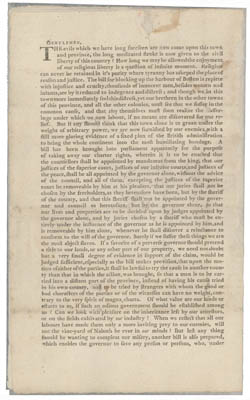
The committee of correspondence acted on 8 June. Town clerk William Cooper sent out a two-page printed letter to rural towns that began:
GENTLEMEN,

THE evils which we have long foreseen are now come upon this town and province, the long meditated stroke is now given to the civil liberty of this country? How long we may be allowed the enjoyment of our religious liberty is a question of infinite moment. . . .
How the committee got from trade restrictions to “our religious liberty” isn’t at all clear, but they definitely played on New England’s religious sentiment and tradition.

Boston’s letter said the people of Massachusetts should “universally come into a solemn league, not to import goods from Great Britain, and not to buy any goods that shall hereafter be imported from thence.” That phrase “solemn league” echoed the name of an agreement from 1643, early in the English Civil War. The actual agreement the committee sent included another word from that original, “covenant.” As a result, this boycott agreement came to be known as the Solemn League and Covenant, usurping that label from the earlier document.

On the day Cooper sent his circular letter, Cushing, Samuel Adams, and other elected politicians were in Salem for a session of the Massachusetts General Court. Perhaps Cushing’s caution and Adams’s savvy might have moderated the committee’s call for a boycott, or at least toned down the language. Or perhaps those leaders had signed off on the drafts before going to Salem.

In any event, some people thought the committee had gone too far.

TOMORROW: Complaints in and out of town.

Thursday, July 11, 2024

“Spent most part of the Day with the Town Committee”

The merchant John Rowe had an unusual perspective on the crisis of the Boston Port Bill.

On the one hand, he cared most about his business and trimmed his politics accordingly. Gov. Thomas Hutchinson suspected him of being behind all sorts of nefarious deals, but the local crowd considered him “a great Tory.”

I suspect Rowe also liked being liked, “trimming” to play to his current audience. During the big public meetings on the ships full of East India Company tea, he made an offhand remark about mixing tea with saltwater. That got him applause, and the crowd believed he’d come over to the radicals. Privately Rowe was upset, but he didn’t try to clarify his stance.

In those same months Rowe was spearheading a complex and costly effort to import and install Boston’s first street lamps. He seems to have long hoped to be elected to public office, and here he was visibly serving the public. How long could he keep that up?

On 10 May 1774, the same day Boston reelected its representatives to the Massachusetts General Court, the town received the first shocking news of the new law. Rowe went back to that day’s diary entry to add: “The Harmony Capt. Shayler arrived from London & brings the Severest Act ever was Penned against the Town of Boston.”

Three days later, with the news confirmed, Rowe lamented the “Late Act of Parliament for Blocking up the Harbour of Boston which is & will be a Great Evill.”

On that day, Boston called a sudden town meeting, ultimately choosing a committee to recommend what to do. The citizens put Rowe on that committee. In fact, he was the second man named, right after Samuel Adams.

This committee of eleven included gentlemen from various groups:
There was, to be sure, some overlap in those groups, particularly the centrists and merchants.

To his credit, Rowe actually participated in the committee discussions. On 14 May he “Spent most part of the Day with the Town Committee at the Representatives Room” inside the Town House and then went back on 16 May. Boylston and Appleton didn’t attend either of those meetings, so Rowe was the merchants’ voice.

Not that the discussions was productive. On 18 May, the committee reported back to the town that they had received “several Proposals & plans” but hadn’t had time to digest them. The ongoing meeting pushed them to hurry and come up with solutions.

Rowe never recorded attending any more of those committee discussions. Instead, he began to pay more attention to other sources of authority in town. As I wrote back here, he declined an invitation to chair the town meeting, and expressed deep disagreement with it—privately, of course.

TOMORROW: Here comes the general.

Wednesday, July 10, 2024

A Sestercentennial Town Meeting in Old South

Tomorrow, 11 July, and then again on Thursdays every two weeks, Revolutionary Spaces’ Old South Meeting House will host programs based on the Boston town meeting that started on 13 May 1774.

In fact, two town meetings happened in Faneuil Hall that day. The first convened at 10:00 A.M., a continuation of Boston’s regular May meeting. That’s when men who met the property qualification voted on the town’s representatives to the Massachusetts assembly and then dealt with various other matters.

That May those other matters included “firing small Arms on the Neck,” a proposal for a well and pump in Dock Square, and so on. Most questions, like the schoolteachers’ salaries, were put off. The citizens formally adjourned until the first Monday in July.

But at 11:00 A.M. a new meeting officially started. News of the Boston Port Bill had arrived in town, and it presented an emergency.

The gathering chose Samuel Adams as the moderator; he’d served the same role in the earlier meeting (after being reelected to the legislature).

The first motion was to read the Port Bill, the second to ask the Rev. Dr. Samuel Cooper (shown above) to lead a prayer. He came to do so, after making sure the meeting understood “he was just returned fatigued from a Journey.”

Then came the inevitable proposal to form a committee, in this case to formulate a response to the new law. “After some Debate” on that, the meeting broke off for midday dinner and resumed at 3:00 P.M.

In the afternoon, everyone (with no dissenting votes) agreed to appoint a committee “to take the several Proposals, that have been made, & others that may be made, relative to our Conduct on the present Exigency, into their Consideration, & report, as soon as may be, their Opinion.” That’s a very vague mandate, probably recognizing a range of proposals and a lot of unknowns.

There were practical problems, like how to employ or support the many people who would lose work without the maritime trade. There were political considerations like assessing and strengthening support elsewhere—one action everyone agreed right away was communicating with other towns, especially the port of Salem and Marblehead. And finally, there was the choice posed by the Boston Port Bill itself: Should the town (or citizens) repay the cost of the tea destroyed in December?

The staff of Boston National Historical Park designed a program to recreate that discussion, 250 years ago in May. That program is usually offered in the big meeting space in Faneuil Hall, but that’s being refurbished. Like Boston’s overflow public meetings, therefore, these sessions have been moved to Old South.

The events will start at 5:30 P.M. on 11 July, 25 July, 8 August, and 22 August. They’re free, but registration is encouraged.

The programs last about half an hour—much less time than Boston’s town meeting that began on 13 May—and I don’t think was ever officially dissolved.

Tuesday, July 02, 2024

“On the Conduct of the Comittee of Correspondence”

On Monday, 27 June 1774, the political argument over Boston’s committee of correspondence came to a head.

Merchants and friends of the royal government felt that the committee was wielding too much power, dragging the entire community into a costly and treasonous confrontation with the Crown.

Parliament’s Boston Port Bill was stifling every Bostonian’s livelihood, but that problem could go away at the (admittedly significant) cost of £9,660.

The committee’s Solemn League and Covenant boycott was going further than any non-importation measure so far, not only proscribing more goods from Britain and making people pledge not to do any business with people who did import goods. Was that going too far for the country folk?

The Boston Whigs, who had established the standing committee of correspondence back in November 1772, stuck to their position that for the people to make any retreat or compromise would be giving up their British constitutional rights.

The Boston town meeting resumed in Faneuil Hall at 10:00 A.M. His work with the Massachusetts General Court in Salem done (since the Massachusetts General Court in Salem was done), Samuel Adams was once again in the chair.

A motion passed that the meeting should review all the letters the committee of correspondence had written to other towns and colonies about the Port Bill.

But then came another motion: “that this Meeting be adjourned to the Old South Meeting House, the Hall not being sufficient to contain all the Inhabitants assembled.”

The committee chosen to go to Old South and ask if the town could use that space consisted of William Molineux, town clerk William Cooper, and Dr. Benjamin Church, Jr.—all radical Whigs. That alone signaled that their party had the votes to control the meeting. But what if more people came for one side or the other?

In Old South, the meeting reaffirmed its earlier vote to review the correspondence. Cooper began to read the letters aloud. After a while the crowd became bored, and they amended their earlier vote to cover only the Solemn League and Covenant, the letter sent out with that proposal, and “any other Letters that may be particularly called for.”

Eventually someone moved “that some Censure be now passed By the Town on the Conduct of the Comittee of Correspondence; and that said Committee be annihilated.” That would be a total repudiation of the committee and its work.

Adams stated that “he had the Honor of being a Member” of that committee, so someone else should moderate that discussion. By stepping away from the podium for a while, Adams not only made a point of being scrupulously fair but also allowed himself to speak, since the moderator usually didn’t express opinions on motions.

As the temporary chair, the meeting chose Thomas Cushing—merchant, speaker of the House, and another member of the Boston Whigs (though in the moderate set). Again, that showed how that group was in control of this body.

Nonetheless, the debate went on until dark, and still the opponents of the committee said “they had farther to offer.” The meeting voted to adjourn until the next morning at 10:00 A.M.

TOMORROW: The speakers and the vote.