J. L. BELL is a Massachusetts writer who specializes in (among other things) the start of the American Revolution in and around Boston. He is particularly interested in the experiences of children in 1765-75. He has published scholarly papers and popular articles for both children and adults. He was consultant for an episode of History Detectives, and contributed to a display at Minute Man National Historic Park.

Subscribe thru Follow.it


•••••••••••••••••


Showing posts with label Samuel Russell Trevett. Show all posts

Friday, August 21, 2026

In Exchange for John Callender

In June 1777, as quoted here, the Massachusetts General Court voted to send imprisoned Loyalist Benjamin Davis, Jr., with his father to New York on condition that the royal authorities send back John Callender in exchange.

Callender (1747-1797) had been one of four provincial officers ordered to lead their artillery companies onto the field at the Battle of Bunker Hill.

Only one of those officers, Samuel Russell Trevett, actually stayed through the whole battle doing damage to the regulars. Only one—again, Trevett—kept any of the provincials’ valuable cannon from being captured.

However, two of the other officers had the advantage of being related to Col. Richard Gridley, commander of the artillery. They were Maj. Scarborough Gridley, the colonel’s son, and Capt. Samuel Gridley, his nephew.

Eventually both young Gridleys were removed from the ranks. But that took months, and in July 1775 the new commander-in-chief, Gen. George Washington, had to make an example of someone. So John Callender was cashiered in a very public way.

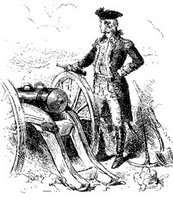
Callender carved out a second chance for himself. He went to New York in the fall of 1776 as a gentleman volunteer or “cadet” attached to the artillery company commanded by Capt.-Lt. John Johnson (c. 1753–1818, self-portrait shown above).

During the Battle of Brooklyn, Johnson was “desperately wounded,” in the words of Henry P. Johnston. Callender took command of the company and “fought his piece on Long Island until the enemy’s bayonets were at his breast.” Both officers and their men became prisoners.

Johnson was exchanged in May 1777 but was in no physical shape to return to the army. He became Boston’s leading portrait painter during and immediately after the war.

Callender was awarded a Continental Army commission as a captain-lieutenant, dated 1 Jan 1777. And the Massachusetts legislature tried to get him back, as its June resolution showed.

But that didn’t work. Callender was still a prisoner in New York in September. And I rather doubt Benjamin Davis, Jr., returned to Massachusetts to be locked up again.

I suspect the British authorities didn’t see a fair trade in exchanging a Continental officer captured in battle for a young man, barely of age, who just happened to be with his father on a merchant ship when it was seized. It’s possible the Crown freed another young American man whose identity I haven’t found, and it’s possible the issue of Benjamin, Jr.’s trade faded away.

In September 1777, John Callender’s wife Hepzibah asked the Massachusetts legislature to approve another swap for her husband. The man to be freed from the Boston jail this time was John Hill, a Loyalist captured during the evacuation in the spring of 1776.

The General Court approved that swap on 17 September. I presume it actually happened because by the end of the year Callender and Hill were both back on their own sides.

In subsequent years Hill served as “a Capt. of Marines on board a Privateer for 8 months, than as Capt. of Marines in the Jason.” Then with his brother Richard he was inspector of the ferry between Manhattan and Brooklyn.

Callender remained on duty in the Continental artillery force for the rest of the war, mustering out in 1784.

TOMORROW: The Davises in New York.

Monday, June 17, 2013

Ashley Bowen and the News of Bunker’s Hill

On 16 June 1775, mariner Ashley Bowen (1728-1813) of Marblehead wrote in his diary: “General [Israel] Putnam is a-trenching on Bunker’s Hill at Charlestown.”

Bowen seems to have known everything that happened in his home town, and on that evening he even apparently knew about the provincial army’s big move down the coast. Yet that action surprised the British commanders in Boston the next morning.

Here’s what Bowen recorded on 17 June:
This day the Merlin [a Royal Navy ship patrolling Marblehead harbor] firing on a target. This morning the King’s troops set fire to Charlestown and came under cover of the smoke and attacked the intrenchments on Bunker Hill and caused them to retreat. Sail small brig for Boston.
And on Sunday, 18 June:
This day much firing at Boston &c. Tis said a great number of men are killed on both sides.
On 19 June:
A grand muster with our Regiment. We cannot hear the particular at Charlestown. Some rain. Captain Sam Trevett under an arrest. For what?
Trevett was a Marblehead man, captain of the only American artillery company to remain on the field throughout the battle. Here’s his story of the fight, and the story of his arrest. Bowen’s sudden lack of clear information from the siege lines reflects the confusion and recriminations splashed up by that battlefield defeat.

The Marblehead regiment, commanded by Col. John Glover, marched for Boston later that month to reinforce the provincial lines, which suddenly seemed more stretched and vulnerable.

Tuesday, July 10, 2012

“Sam Trevett under an arrest. For what?”

Shortly after the Battle of Bunker Hill, Gen. Israel Putnam demanded that the army court-martial the artillery officer he had met pulling back from the fight. The general even threatened to resign if he didn’t get his way. Based on Putnam’s identification, the authorities detained Capt. Samuel Russell Trevett of Marblehead.

Unfortunately, as a committee from the Massachusetts Provincial Congress reported on 23 June, “by a mistake in the name, the wrong officer was confined.” Putnam, a Connecticut general, didn’t know the artillery officers from the other colonies. Trevett was actually the only commander of a provincial artillery company to keep fighting to the end.

Trevett’s arrest caused some consternation, particularly among his Marblehead matrosses, who had stuck out the battle with him. Back in their home town, the mariner Ashley Bowen wrote in his diary for 19 June:
A grand muster with our Regiment. We cannot hear the particular at Charlestown. Some rain. Captain Sam Trevett under an arrest. For what?
Within a couple of days the army brass had discovered the mistake. The congress’s committee reported on who really pulled back: “These Officers' names are, Captain [Samuel] Gridley and Captain John Kallander.” Callender was set up for court-martial instead.

But by then it was too late. Trevett and his men had gone home to Marblehead. On 29 June, the Massachusetts Committee of Safety tried to catch up to events through this resolution:
Mr. [Richard] Devens and Colonel [Azor] Orne, appointed to draw up a Vote relative to Captain Trevet and Company, reported the following, which was accepted, viz;

Whereas, from a mistake made by one of the General Officers, Capt. Samuel Russell Trevet has been put under arrest, which mistake is set forth in a Certificate by order of the General [Artemas Ward]; and upon examination it appears that said Trevet has approved himself a good officer, but said mistake has unhappily operated to the dispersion of his Company; therefore

Resolved, That said Captain Trevet be directed to collect his said Company as soon as possible, and then apply to this Committee in order to be commissioned.
Trevett declined the invitation and never rejoined the American army. Some of his men did, including his first sergeant and brother-in-law, Robert Wormsted. But Trevett had apparently had enough.

What happened to Callender, Gridley, and Gridley’s relatives in the regiment after Gen. George Washington arrived will be part of my talk tonight at Anderson House, the national headquarters of the Society of the Cincinnati. Come on by if you’re in the neighborhood!

Monday, July 09, 2012

Samuel Russell Trevett’s Story of Bunker Hill

As I’ve been describing, in the Battle of Bunker Hill the field officers of the American artillery didn’t cover themselves with glory:
The latter two pulled back, one even after Gen. Israel Putnam had met him and ordered him forward again at gunpoint.

The exception to that pattern was Capt. Samuel Russell Trevett of Marblehead. He was assigned to follow Maj. Gridley, but when he realized his superior wasn’t budging he defied orders and advanced to Charlestown on his own. Trevett and his company were the only American artillerists active in the thick of the battle.

Trevett described some of his experience in a letter he wrote on 2 June 1818:
I commanded a company of artillery from the town of Marblehead, attached to Col. Richard Gridley’s regiment, stationed at Cambridge. About one o’clock in the afternoon of the 17th of June, 1775, I left Cambridge with my company, for Bunker’s Hill. When about a quarter of a mile from the Colleges, I saw Gen. Putnam pass upon a horse towards the town of Cambridge, and in 15 or 20 minutes I saw him pass in like manner towards Charlestown.

When I arrived at Bunker’s Hill, on the north west side, I there saw Gen. Putnam dismounted, in company with several others. I halted my company, and went forward to select a station for my pieces, and on my return, saw Gen. Putnam as before; the American and English forces being then engaged.—

I proceeded on with my company, and soon after joined that part of the American force at the rail fence, towards Mystic river, the Americans commenced a general retreat. As I was descending the north west side of Bunker’s Hill, I again saw Gen. Putnam in the same place, putting his tent upon his horse. I asked him where I should retreat with the field piece I had brought off, he replied to Cambridge, and I accordingly marched my company to Cambridge.
Unfortunately, Trevett wrote that letter to answer questions about whether Putnam was in command during the battle—a consuming issue for authors in the early 1800s. Trevett didn’t leave a full account of the battle, which means we’re missing his memory of the most interesting parts.

We don’t have Trevett’s experience of the fighting, when apparently he and his men fired grapeshot at the advancing British troops from the rail fence. We don’t have his full description of the retreat, in which his company dragged off a four-pounder cannon—the only American field-piece in Charlestown not captured by the enemy. We don’t know if Trevett agreed with Gen. Putnam that backward artillery officers were responsible for losing the peninsula, and that “one of these officers ought to be punished with death.”

Worst of all, we don’t have Trevett’s memory of how he felt when Putnam reported that the artillery officer who had refused orders to go back into the fight was named Trevett.

TOMORROW: The Massachusetts government tries to clean up this mess. And have I mentioned that I’ll be speaking about the new commander-in-chief’s response to the whole situation on Tuesday at 7:00 P.M. at Anderson House?

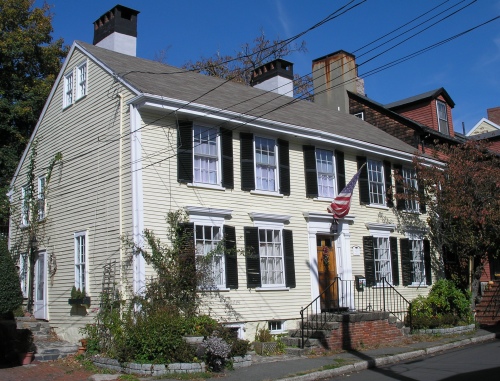
[The photo above shows the house in Marblehead where Samuel Russell Trevett was born in 1751, as photographed by Daniel Sterner of the Historic Buildings of Connecticut and Massachusetts blogs. Sterner has a new book out: A Guide to Historic Hartford, Connecticut.]

Saturday, July 07, 2012

The Gridley Legacy: From Louisburg to Cobble Hill

Continuing my quotation from Alexander H. Everett’s 1836 oration on the Battle of Bunker Hill, here’s how he described the action of Maj. Scarborough Gridley of the Massachusetts artillery:
Major Gridley had been ordered to proceed with his battalion from Cambridge to the lines; but had advanced only a few yards beyond the neck, when he made a halt, determined, as he said, to wait and cover the retreat which he considered inevitable.—At that moment Colonel [James] Frye [1709-1776], whose regiment was in the redoubt, but who, being on other duty, as I remarked before, had not yet joined it, was riding towards the hill, and found Major Gridley with his artillery in the position I have described. Frye galloped up to him and demanded what it meant.—

“We are waiting to cover the retreat.”—

“Retreat?”—replies the veteran, “who talks of retreating?—This day thirty years ago I was present at the taking of Louisburg, when your father with his own hand lodged a shell in the citadel. His son was not born to talk of retreating. Forward to the lines!”—

Gridley proceeded a short distance with his artillery, but, overcome with terror,—unequal to the horrors of the scene,—he ordered his men back upon Cobble Hill to fire with their three pounders upon the Glasgow and the floating batteries.

The order was so absurd that Captain [Samuel Russell] Trevett refused to obey it, and proceeded with his two pieces. He lost one of them by a cannon shot on Bunker Hill: the other he brought to the lines. This little fragment of Major Gridley’s battalion, was the only reinforcement of artillery that came into action.
At another point Everett explained, “In the war of 1745, when Massachusetts alone raised an army of three thousand two hundred men for the expedition against Cape Breton, he [Richard Gridley] commanded the artillery, and with scientific accuracy pointed the mortar which on the third fire threw into the citadel of Louisburg a shell that occasioned its surrender.”

Everett later incorporated his oration into the short biography of Dr. Joseph Warren published in Jared Sparks’s Library of American Biography. It’s the earliest mention I’ve found of either Richard Gridley’s mortar marksmanship at Louisburg or his son’s excuses at Bunker Hill. Everett didn’t state his sources, but from then on those statements were in the American historical record.

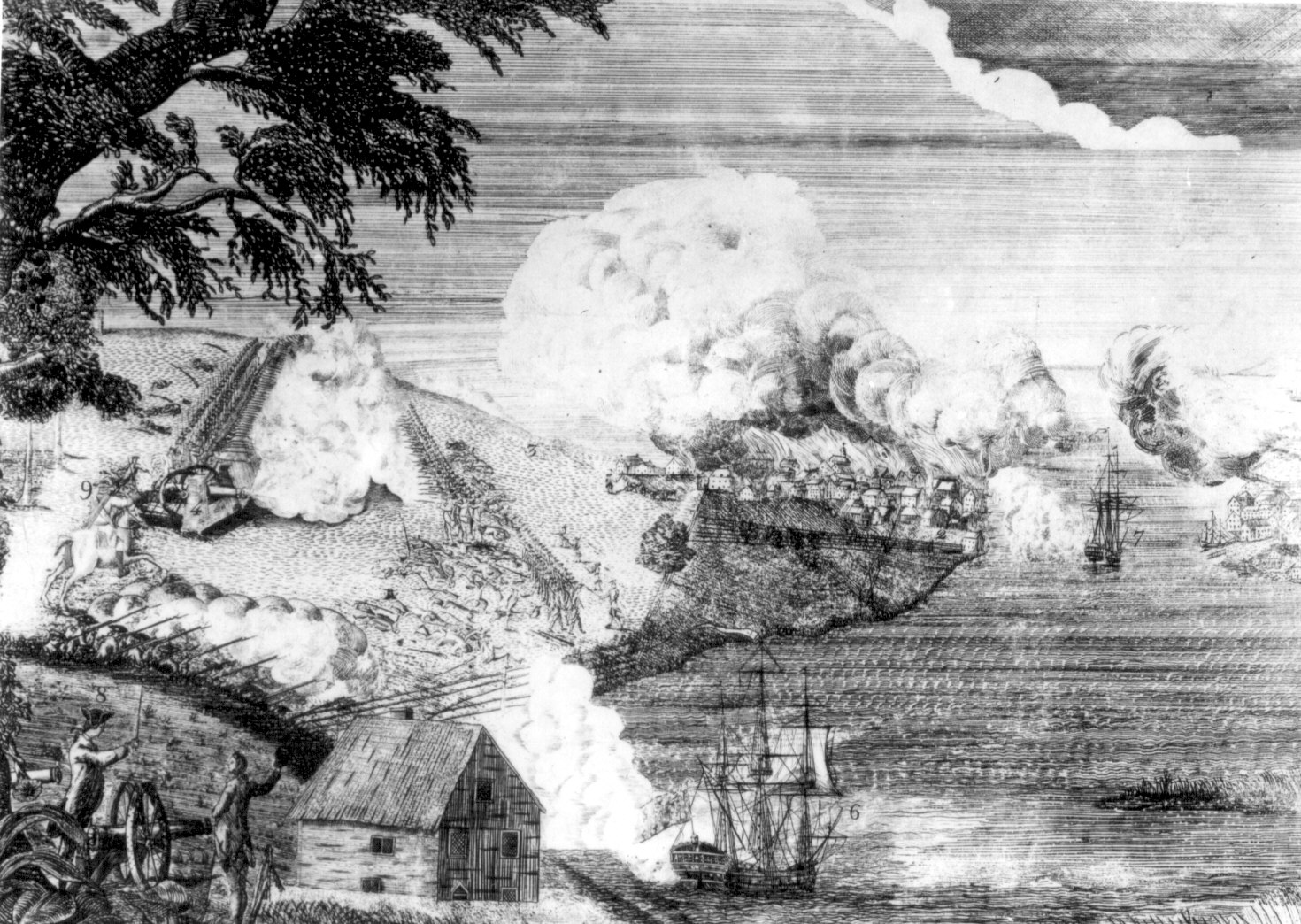
The picture above is Bernard Romans’s “Exact View of the Late Battle at Charlestown,” published in Philadelphia in September 1775 and provided by the National Archives. The artillery commander in the foreground shooting toward a warship, labeled “8,” is identified by the key atop the color version  (available at the John Carter Brown Library) as “Broken Officer.” However, Romans wasn’t on the scene, and that figure might be confused with a different American artillerist, not Scar Gridley.

The performance of the American artillery corps at Bunker Hill is a major part of my talk at Anderson House in Washington, D.C., next Tuesday: “Washington’s Artillery: Reengineering the Regiment Between Bunker Hill and Dorchester Heights.”

TOMORROW: Three artillery captains and one general on Bunker’s Hill.