J. L. BELL is a Massachusetts writer who specializes in (among other things) the start of the American Revolution in and around Boston. He is particularly interested in the experiences of children in 1765-75. He has published scholarly papers and popular articles for both children and adults. He was consultant for an episode of History Detectives, and contributed to a display at Minute Man National Historic Park.

Subscribe thru Follow.it


•••••••••••••••••


Showing posts with label Danvers. Show all posts

Sunday, February 01, 2026

Getting Warmer on the Origin of a Warming Pan
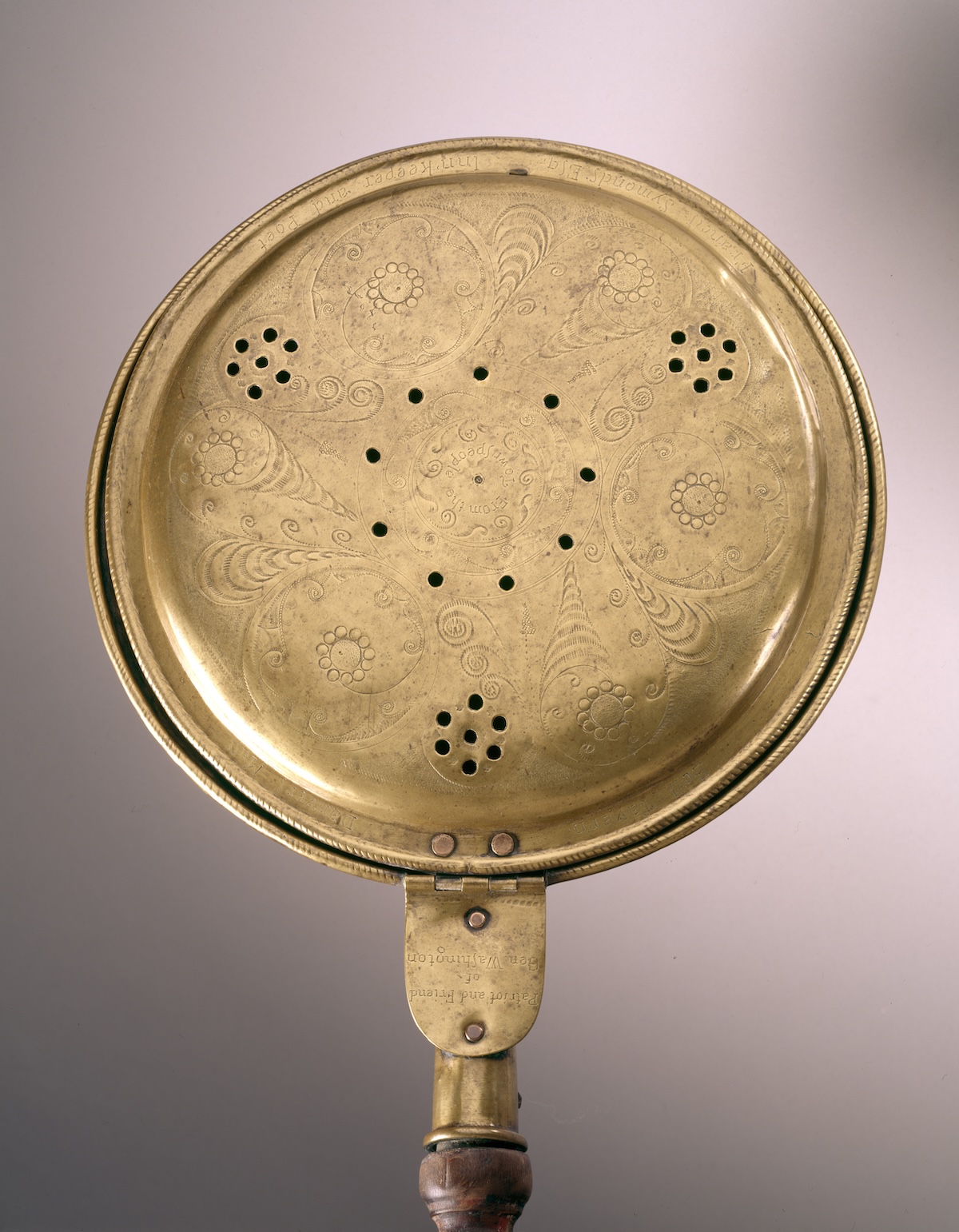
At Historic New England, Erica Lome, curator of collections, shared a behind-the-scenes essay about a warming pan with a Revolutionary heritage of sorts:
Tucked away in the parlor at Historic New England’s Cogswell’s Grant in Essex, Massachusetts, is a warming pan with a turned wooden handle and a brass container pierced with holes and engraved with scrolling vines and flowerheads. Also referred to as bed warmers, warming pans were a common household tool in colonial and post-revolutionary America, filled with embers and placed under the sheets of a bed to warm it before use.

This particular warming pan had more than just decorative motifs adorning its metallic surface. Engraved on its lid are the words:
From the Townspeople / Patriot and Friend of Gen. Washington / Bell Tavern, Danvers, Massachusetts / Francis Symonds Esq. Innkeeper and Poet.
On the pan’s sides, inside the incised outline of a bell:
I’ll toll you / if you have need / and feed you well / and bid you speed.
On the other side:
Francis Symonds / makes and sells / the best of chocolate / also shells.
John Warner Barber’s Historical Collections (1839) recorded that those verses hung on signs outside the Bell Tavern. In 1841 the Boston Cultivator stated that innkeeper Symonds’s “poetic genius caused [those lines] to be inscribed”; as Lome notes, he was known for adding bits of rhyme to his advertisements. (The Cultivator changed “also shells” to “and shells,” which scans better if you put three syllables into “chocolate.”)

The essay continues:
By its history, as recorded by Nina Fletcher Little, the warming pan was presented to Symonds around 1785: “After the war’s close, the citizens of Danvers evidently wished to present Symonds with a token of their esteem and decided on a warming pan as a practical gift.” The engraved inscription inside the bell matched the Bell Tavern’s signpost. The additional inscription praised Symonds as a patriot, friend of George Washington, and a poet, truly a prominent citizen and worthy of appreciation.

When researching this object for [the upcoming exhibit] Myth and Memory, one major detail of Symonds’s life challenged its story: Francis Symonds died on September 22, 1775. According to the Essex Gazette:
“On the 22nd Instant died at Danvers and on the 24th was very decently interred, Mr. Francis Symonds, Innholder, in the 5th Year of his Age. He was very just in his Dealings, and compassionate to the Poor as far as lay in his Power. In his last Sickness, especially towards the Close of Life, his Calmness and Resignation were very remarkable. He has left a sorrowful Widow and 6 Children, for whom we wish that the fame Compassion that he has shown to others may be shown to them.” . . .
Francis Symonds mustered for two days with Colonel [Timothy] Pickering’s regiment during the Battle of Lexington and Concord, and again on April 24, 1775, serving for a little over three months, until August 1, 1775. He was at home when he died of illness.

So, what about the warming pan? It seems very unlikely that the town of Danvers presented it to him on his deathbed, nor to his family immediately after, given the ongoing Siege of Boston. What is its true history?
Lome doesn’t offer a definite conclusion, but I like her hypothesis that the words were inscribed during a commemoration of the Revolution, such as Danvers’s dedication of a memorial obelisk near the Bell Tavern in 1835. Or later, when warming pans themselves were becoming relics of a quaint past. 

Sunday, December 21, 2025

The Burdicks after the Boston Massacre

In the year after the Boston Massacre, Benjamin Burdick became the proprietor of the Freemason’s Arms tavern—better known as the Green Dragon Tavern, owned by the St. Andrew’s lodge.

I imagine his wife Jane did a lot of the hosting since Benjamin remained Constable of the Town House Watch through 1774.

As the London government cracked down and war approached, the Burdicks moved out to Marblehead. Benjamin opened a “large, genteel, and commodious” inn opposite Jeremiah Lee’s mansion. Soon he was watching over auctions of captured goods and vessels. Later the inn hosted auctions of estates confiscated from absent Loyalists.

By 1786 Burdick had relocated to Danvers, at the Sign of the Flag, but that property was sold the next year. Jane was back in Boston when she died in 1791. I haven’t found a record of Benjamin’s death. (It doesn’t help that genealogists have intertwined him with a man of the same name from Westerly, Rhode Island.)

In 1778, the Boston merchant Samuel Phillips funded the opening of a new academy in Andover with Eliphalet Pearson as preceptor. The inaugural class of that school included Malcolm McNeil Burdick, born in Boston 1764—the Burdicks’ oldest son. (His first and middle name appeared with different spellings.) Malcolm was in his teens but for some reason listed as age ten in school records.

Later Malcolm M. Burdick went to sea, appearing in advertisements as master of the Minerva sailing from Baltimore to Liverpool in 1801 and of the John out of New York in 1807. By 1812 he had settled in Windham, Maine, where he advertised that someone else’s livestock had gotten onto his land.

Another of Benjamin and Jane Burdick’s sons, William, born in 1774, went into printing. In July 1795 he and Benjamin Sweetser cofounded a newspaper in Boston called the Courier. Soon that became The Courier, Boston Evening Gazette and Universal Advertiser. Burdick signed over his portion of the business to Sweetser in December, and it ceased publishing in March 1796 after a fire.

[ADDENDUM: From 1798 to 1800 William Burdick was the junior partner in publishing the Oriental Trumpet newspaper in Portland, Maine. He then returned to Boston.]

In 1809 William Burdick married Lucretia Sprague (1788–1849), daughter of Continental artillery veteran Samuel Sprague (1753–1844). According to her brother, the banker and poet Charles Sprague (1791–1895), their father was also part of the Boston Tea Party.

William Burdick reused the Boston Evening Gazette name for a new periodical in 1813. His printing office at Congress and State Streets was next to the Exchange Coffee House, and he bought stock in that jittery enterprise. The printer’s older brother Malcolm sold subscriptions up in Maine.

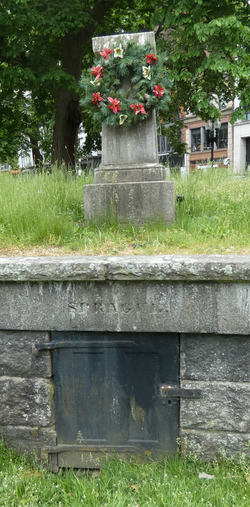
That Boston Evening Gazette evolved into the the Boston Intelligencer in August 1816. Burdick sold the business the following January and died on 30 May 1817, under Dr. John Collins Warren’s care. He was intestate but solvent, so his widow Lucretia could settle the estate and live for three more decades. She was interred in the Sprague family tomb in Boston’s Central Burying-Ground, shown above.

Monday, April 28, 2025

“Fidelity is not given to a single individual”

On Patriots’ Day the towns of Danvers and Peabody come together again to honor the men who marched from that area on 19 Apr 1775 to confront the British regulars.

Seven men in the Danvers company were killed in the fighting at Menotomy.

The Danvers town archivist, author Richard B. Trask (shown here), was among the speakers at this year’s ceremony. He said: “I cannot ignore, at today’s remembrance of the sacrifice for liberty made by our ancient brethren, the danger that I believe our nation now faces.”

Caroline Enos reported for the Salem News:
Their sacrifice led to the nation’s Declaration of Independence in 1776 and, in 1789, the creation of the Constitution, said Trask, one of the most respected historians of the Salem Witch Trials and North Shore colonial history who is a founding member of the Danvers Alarm List Co.

“Our form of government was codified by the ratification of the United States Constitution,” he said. “It included the establishment of co-equal branches of government, the judicial, executive and legislative. But our Constitution and our way of life can only be preserved by a vigilant citizenry who insists these branches perform as specified in this our founding document.”

Trask said the Executive branch has overstepped its power by disregarding the checks and balances enshrined in the Constitution. He criticized the Department of Government Efficiency, created under President Donald Trump upon taking office in January, for its mass firings of government employees and its steps to defund agencies and programs without the consent of Congress, which is responsible for appropriating the government’s funds.

The Trump administration’s mass deportations of undocumented migrants and, in a growing number of cases, immigrants who came into the country legally, has disregarded the Constitution’s right to due process before American courts, Trask said.

“Our Constitution and our way of life can only be preserved by a vigilant citizenry who insists these branches perform as specified in this our founding document,” he said.

“Fidelity is not given to a single individual, a group or a party, but to the adherence to the words and the meaning of our Constitution.”

Trask’s words of concern followed his detailed account of the events of April 19, 1775. “We must, at this time, be brave as those young men, who in ‘75 were willing to lay their lives on the altar of liberty for a cause bigger than themselves, when our country and its future seemed in peril.”

Much of the crowd cheered or clapped for Trask as he used his walker to step back from the podium. Some who were sitting gave him a standing ovation. Others were upset.
Loyalists were upset at criticism of their king in 1776, too.

Wednesday, September 25, 2024

Three Events on Saturday, 28 Sept.

This Saturday, 28 September, will see a number of local events linked to Revolutionary history.

10:00 to 11:00 A.M.
How We Remember
Massachusetts Avenue, Arlington

The Arlington Historical Society, Arlington 250, and Freedom’s Way National Heritage Area host a walking tour of Revolutionary sites in central Arlington, including a newly installed monument.
Historical references point to a mass grave of 40 British regulars who died on April 19, 1775 in the retreat from Lexington and Concord. A recent Ground Penetrating Radar study revealed disturbed soil in this location consistent with a mass grave. A permanent monument, dedicated September 7, 2024, now marks this historic site.

Our program will begin with a brief tour of the Jason Russell House where British bullet holes from April 19th, 1775 can still be seen. We will then walk a flat and easy 0.3 miles to the Old Burying Ground, passing Robbins Memorial Town Hall, a statue by Cyrus Dallin, the Winfield Robbins Memorial Gardens and the Whittemore-Robbins House.

Arriving at the Old Burying Ground, we will see the recently dedicated Monument to the Fallen Crown Soldiers who Died on April 19, 1775 and the 2023 Monument to Enslaved and Free Persons of Color in Menotomy who are buried in the same area. Before returning to the Jason Russell House, we will visit the 1848 Revolutionary War Monument that marks the burial site of Jason Russell and 11 of his fellow Patriots who fell on April 19th, 1775.
Space is limited to twelve people, so register in advance

10:00 A.M. to 4:00 P.M.
Sudbury Ancient Colonial Faire and Fife & Drum Muster
Longfellow’s Wayside Inn, Sudbury

The annual fair in Sudbury includes a colonial encampment, militia and crafts demonstrations, contradancing, and dozens of food and craft vendors. Twenty-five fife and drum corps from across the Northeast are scheduled to perform.

The Grand Parade of fifes and drums will begin at noon; this year there is a new route that starts in front of the camping area. After the groups reach the fair grounds, each performs in turn, providing music through the afternoon.

Admission is $3 cash at the gate. Nearby parking is free.

4:00 to 5:30 P.M.
Battle of Menotomy: Myth, Lore & History
Rebecca Nurse Homestead, Danvers

Prof. Donald Hayes, a longtime member of the Danvers Alarm List Company, will present his recent research on the role that the Danvers militias played in the fighting at Menotomy during the Battle of Lexington and Concord. Danvers lost seven men that day, second only to Lexington itself. He will highlight what is lore and what is documented fact. Reserve free tickets here.

Friday, June 28, 2024

“A ministerial member pleaded a call of nature”

The Massachusetts House started its session on Friday, 17 June 1774, at 9:00 A.M.

The first action was a committee report on a land grant, which the legislators read and accepted.

Then came the all-important “Committee appointed to consider the State of the Province.” The House approved a motion “The the Gallaries be clear’d and the Door be shut.”

Ordinarily this step was to keep spectators away from sensitive discussions before official votes, so legislators could speak freely and discuss compromises. In this case, however, House clerk Samuel Adams and his allies also wanted to keep people in.

The Rev. William Gordon recounted:
They had their whole plan compleated, prepared their resolves, and then determined upon bringing the business forward. But before they went upon it, the door-keeper was ordered to let no one whatsoever in, and no one was to go out:

however, when the business opened, a ministerial member pleaded a call of nature, which is always regarded, and was allowed to go out.

He then ran to give information of what was doing, and a messenger was dispatched to general [Thomas] Gage, who lived at some distance.
Inside the Salem courthouse, the committee laid out their recommendations. First, the General Court would appoint five men to represent Massachusetts at an upcoming “Meeting of Committees from the several Colonies on this Continent”—what became known as the Continental Congress.

The designated men were:
At that moment Adams and Cushing were leading the discussion in the chamber. Bowdoin was home sick, Adams was in Boston, and Paine on his way back to Salem from Taunton with fellow legislator Daniel Leonard.

The House then approved paying £500 for those five men’s expenses traveling and staying wherever the congress met. Finally, with a lot more verbiage than I’ll reproduce, the chamber resolved that this “Meeting of Committees” was so important that it urged towns to come up with that £500 outside of the regular tax system in case the Council didn’t get around to approving this bill or the governor vetoed it.

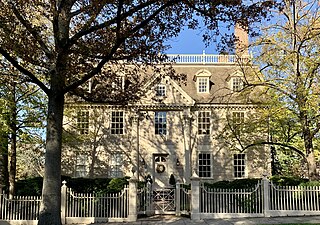
By this time word had reached Gage at the house he rented in Danvers (shown above at its new location). He knew what the General Court was up to.

TOMORROW: The key.

Tuesday, April 23, 2024

“When forty-two countrymen Sure bid their friends adieu.”

Ezra Lunt and Henry-Walter Tinges printed the Essex Journal in Newburyport with the financial backing of Isaiah Thomas, who made a hasty move from Boston to Worcester in April 1775.

On 26 May, the Essex Journal published this verse in a section of the back page titled “The Parnassian Packet”:
A Funeral ELEGY, to the Immortal Memory of those Worthies, who were slain in the Battle of CONCORD, April 19, 1775.

AID me ye nine! my muse assist,
A sad tale to relate,
When such a number of brave men
Met their unhappy fate.
At Lexington they met their foe
Completely all equip’d,
Their guns and swords made glitt’ring show,
But their base scheme was nipp’d.
Americans, go drop a tear
Where your slain brethren lay!
O! mourn and sympathize for them!
O! weep this very day!
What shall we say to this loud call
From the Almighty sent;
It surely bids both great and small
Seek GOD’s face and repent.
Words can’t express the ghastly scene
That here presents to view,
When forty-two brave countrymen
Sure bid their friends adieu.
To think how awful it must seem,
To hear widows relent
Their husbands and their children
Who to the grave was sent.
The tender babes, nay those unborn,
O! dismal cruel death!
To snatch their fondest parents dear,
And leave them thus bereft.
O! Lexington, your loss is great!
Alas! too great to tell,
But justice bids me to relate
What to you has befell.
Ten of your hardy, bravest sons,
Some in their prime did fall;
May we no more hear noise of guns
To terrify us all.
Let’s not forget the Danvers race
So late in battle slain,
Their courage and their valor shown
Upon the crimson’d plain.
Sev’n of your youthful sprightly sons
In the fierce fight were slain,
O! may your loss be all made up,
And prove a lasting gain.
Cambridge and Medford’s loss is great,
Though not like Acton’s town,
Where three fierce military sons
Met their untimely doom.
Menotomy and Charlestown met
A sore and heavy stroke,
In losing five young brave townsmen
Who fell by tyrant’s yoke.
Unhappy Lynn and Beverly,
Your loss I do bemoan,
Five of your brave sons in dust doth lye,
Who late were in their bloom.
Bedford, Woburn, Sudbury, all,
Have suffer’d most severe,
You miss five of your choicest chore,
On them let’s drop a tear.
Concord your Captain’s fate rehearse,
His loss is felt severe,
Come, brethren, join with me in verse,
His mem’ry hence revere.
O ’Squire Gardiner’s death we feel,
And sympathizing mourn,
Let’s drop a tear when it we tell,
And view his hapless urn.
We sore regret poor Pierce’s death,
A stroke to Salem’s town,
Where tears did flow from ev’ry brow,
When the sad tidings come.
The groans of wounded, dying men,
Would melt the stoutest soul,
O! how it strikes thro’ ev’ry vein.
My flesh and blood runs cold.
May all prepare to meet their fate
At GOD’s tribunal bar,
And may war’s terrible alarm
For death us now prepare.
Your country calls you far and near,
America’s sons ’wake,
Your helmet, buckler, and your spear,
The LORD’s own arm now take
His shield will keep us from all harm,
Tho’ thousands gainst us rise,
His buckler we must sure put on,
If we would win the prize.
This tribute to the local men killed the previous month started with the town of Lexington, not just because redcoats had fired the first fatal shots there but because that town lost more men than any other.

Seven Danvers men were killed in and around Jason Russell’s house in Menotomy, so that town got the next mention—which the newspaper’s Essex County audience probably appreciated.

Eventually the poet got to individuals, naming a couple of men at the top of society—Capt. James Miles of Concord and Isaac Gardiner, Esq., of Brookline—and Benjamin Pierce of Salem, also killed at the Russell House. Other dead officers went unnamed, however.

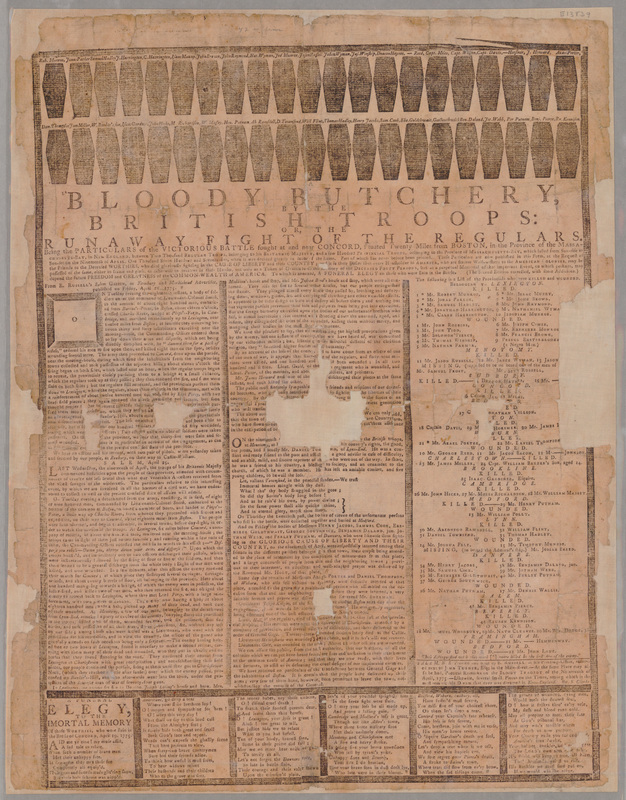
Ezekiel Russell printed this poem at the bottom of his “Bloody Butchery of the British Troops” broadside, shown above. You can peruse that page more closely through the American Antiquarian Society, founded by Thomas.

The Russell broadside contained some errors (a missing “brave,” “young” became “your,” another “your” dropped out), suggesting that shop hastily copied the text out of the newspaper. I would have expected the transmission to go the other way: from the Russell print shop, which was known for publishing a young woman’s elegiac verses, to the Essex Journal.

That in turn suggests that Russell didn’t issue the “Bloody Butchery” broadside until more than a month after the battle. Maybe he needed that time to engrave all those coffins.

Sunday, April 07, 2024

Heading into Patriot’s Day 2024

With yesterday’s posting, Boston 1775 has entered the Patriot’s Day season for 2024.

It’s hard to find a complete posting of Patriot’s Day events because so many towns and organizations have their own celebrations. But a good place to start is the calendar on the front page of Revolution 250.

Among the new commemorations this year is Tavern Week in Arlington, known as West Cambridge or Menotomy in 1775. The Massachusetts Provincial Congress’s committee on safety and supplies met in the Black Horse Tavern on what’s now Massachusetts Avenue on 18 April. Three members planned to spend the night but bolted out the back door when the redcoat column approached.

The Arlington Historical Society is also offering tours of the Jason Russell House, site of the bloodiest fighting of the day, on Saturday, 13 April, and Monday, 15 April, noon to 4 P.M.

Also on 13 April, Michael Lepage will portray Paul Revere at the Paul Revere House in Boston while the Minute Man National Historical Park hosts its annual big tactical demonstration and reenactment of events along the Battle Road.

Some of the towns planning local Patriot’s Day remembrance events include Billerica, Danvers, Somerville, Hanover, and Lynnfield. Others will send traditional contingents to the event in Minute Man Park.

All outdoor events of course depend on welcoming weather. We had snow last week, and flooding forced the cancellation of an event at James Barrett’s farm in Concord today. So let’s hope for sunshine and cool breezes for the next two weeks!

Monday, March 18, 2024

“Dill” Screenplay Reading in Old South, 19 Mar.

On Tuesday, 19 March, Revolutionary Spaces’s Old South Meeting House will host a live reading of a screenplay, performed by local actors and accompanied by music and sound effects.

The drama is called Dill, described as “inspired by real people and real events on the Cape Ann Shore in Massachusetts during a tumultuous time on the cusp of the American Revolutionary War.”

At the risk of spoilers, I’m guessing the central character, “an enslaved woman named Dill, short for Deliverance, who…finds herself in a love triangle between two men,” is based Deliverance Symonds. Abram English Brown wrote a chapter about Symonds in Beneath Old Hearth-Stones (1897).

After the reading, there will be a discussion of the screenplay’s historical context featuring these experts:
  • Lise Breen, author of “Hidden City: Slavery and Gloucester’s Quadricentennial” in Gloucester Encounters: Essays on the Cultural History of the City 1623-2023 and coauthor of Objects of Myth and Memory: American Indian Art at the Brooklyn Museum.
  • Nerissa Williams Scott, producer of Dill and other films, C.E.O. and Lead Creative Producer of That Child Got Talent Entertainment (TCGT), and an affiliated faculty member at Emerson College in the Business of Creative Economy and Visual Media Art departments.
  • Beth Bower, formerly staff archaeologist at the Museum of Afro American History and archaeological and historic resources program manager for the Central Artery project, now studying the 1750–1850 African American community in Salem.
  • Jeanne Pickering, an independent scholar of slavery in eighteenth-century Essex County who maintains the research databases of NorthShoreSlavery.org.
The event announcement does not name the author of the screenplay.

This is a free event, but registration is requested. Doors will open at 6:30 P.M., with light refreshments available, and the performance is scheduled for 7:00.

Wednesday, February 14, 2024

“Tea which Lot Cheever shook out of his shoe”

Here’s another in the seemingly endless tales of tea surviving from the Boston Tea Party.

The earliest sign of this tea I’ve found is an article in the 7 Nov 1864 Boston Evening Transcript:
Some of the Tea not Thrown Overboard. After the tea was thrown overboard in Boston harbor, Feb 10th, 1774 [sic], one of the party engaged in that movement, Lot Cheever, whose direct descendants now reside in Salem, stopped at the house of Col. Abner Cheever in Saugus to change his disguise. Some of the tea then in his shoes was saved by an old lady of the family, and has from that time until now been carefully preserved.

A lady of the highest respectability and a direct descendant of the Cheever here spoken of, has presented to the manager of the Salem Table at the Naval Fair at Boston a remaining portion of the tea, which will be offered for sale.
The Naval Fair was a fundraiser for sailors in the U.S. Navy, then engaged in quelling another rebellion.

The famous Boston Tea Party didn’t take place 250 years ago this February, and neither did the less famous second Boston Tea Party. No previous source links Lot Cheever to that action. (A Bostonian named Ezekiel Cheever was one of the volunteers patrolling the docks starting in late November.)

In fact, the only man named Lot Cheever I’ve found in the Revolutionary period lived in Danvers. It makes little sense for a man from that far away to take part in destroying the tea in Boston on 16 Dec 1773. It makes even less sense that such a man would travel all the way from Boston to Saugus before removing his disguise.

Incidentally, the man that newspaper story called “Col. Abner Cheever” was only eighteen years old in 1773. He family home was in Lynn, evidently the part of that town which became Saugus in 1815.

People must have realized that some details of that family lore made no sense because over the following decades it evolved to come closer to the standard story.

In 1878 Horace E. Scudder wrote in his novel/travelogue The Bodleys on Wheels about the main characters visiting the East India Marine Hall in Salem and seeing “a little packet of tea which Lot Cheever shook out of his shoe after he had been at the Boston Tea-party.”

A correspondent to St. Nicholas magazine in 1893 described seeing at the Essex Institute in Salem “two bottles of the tea that was thrown over board at the Boston tea-party,—it was found in the shoes of Lot Cheever after removing his disguise.”

That same year, at the 1893 Columbian Exposition in Chicago, the historical exhibits inside the U.S. pavilion included:
Tea in Bottle
Which was found in the boots of Col. Abner Cheever, of the Boston Tea Party, December 16, 1775 [sic], when changing his disguise after the affair was over. Loaned and collected by Dr. D. W. Cheever, Boston, Mass.
Lot Cheever was thus erased from the story. In 1888 the Essex Institute reported that it had received a “pocket-book of Col. Abner Cheever of the Boston Tea Party.”  

The longest presentation appeared in Lynn in the Revolution (1909), in the entry on Abner Cheever:
Family tradition says that he took part in the famous Boston Tea Party. His grand-niece, Miss Rachel Cheever, of Saugus, has still in her possession a small phial of tea which, it is said, he brought away from the party in his shoes.

Many of the older people remember the venerable patriot who was known as Colonel Cheever in his latter days. He was a tall man, rather thin in face, and smooth-shaven in accordance with the old-time custom. He was the last survivor but one in Saugus of the battle of Lexington. He died September 13, 1837, aged eighty-two, and was first interred in a private tomb which had been built upon his estate, but some few years ago his remains were transferred to the new Saugus cemetery and buried in the Perley lot. A marble stone and marker of the S.A.R. were erected at his grave in 1903.
Because one sample of tea can easily be divided, it’s possible there were multiple small containers of tea from the Cheever family on display in the late 1800s. These sources speak of “a little packet,” “two bottles,” one “Bottle,” and “a small phial.” These could all be separate items, or the family might have retrieved tea they loaned to various displays.

Might any of these tea samples survive today? The most likely depository would be the Peabody Essex Museum, successor of the East India Marine Hall and Essex Institute. But the last reports of the tea said samples were owned by “Dr. D. W. Cheever” and “Miss Rachel Cheever.”

(The photo of the Abner Cheever pocket-book above appeared in volume 5 of Elroy McKendree Avery’s A History of the United States and Its People [1908].)

Thursday, December 17, 2020

When John Piemont Set Up Shop in Danvers

At the website of the Danvers Archival Center, part of the town’s public library, Richard B. Trask shared his essay “Discovering Paul Revere in the Dried Prunes Box,” also published decades ago in Family Heritage.

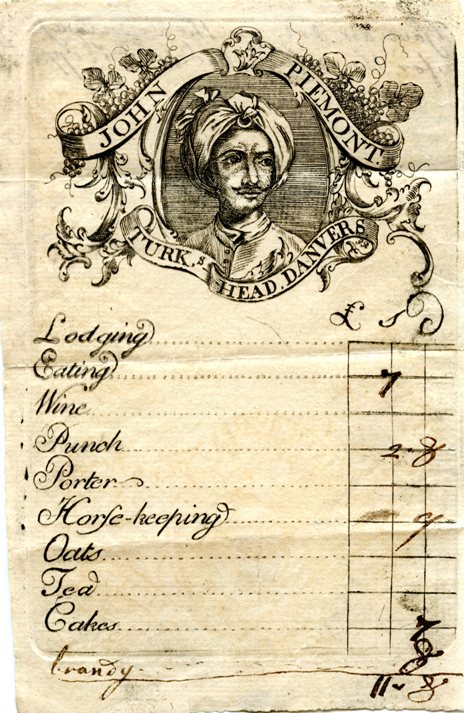
It involves the engraved billhead shown here.
It was the summer of 1969, and I was working for the local Historical Commission as a summer cataloguer and researcher, trying to put into order the thousands of town records. Most of the loose, individual town papers were enclosed in nailed wooden boxes as a result of a W.P.A. project in the 1930s when the records were roughly sorted into various departmental categories. The boxes had originally been used in food relief during the depression and were clearly, and to my eyes humorously, marked, “Dried Prunes–For Relief–Not to be Sold.” Unfortunately, the boxes were not good for storing manuscripts, and many of them had become nesting areas for all sorts of vermin. . . .

Among these handwritten slips of paper, I noticed a very handsome item containing a fine engraving of the shoulders and head of a turbaned and mustachioed man with banners about him proclaiming, “John Piemont. Turk’s Head, Danvers.” The item was a trade bill of John Piemont’s eighteenth-century Turk’s Head Tavern, which was located on the old post road near what is now the junction of Pine and Sylvan Streets in Danvers.

Subsequent to discovering the identity of the trade bill’s printer, I learned from Dr. Richard P. Zollo, who wrote an interesting study on the life of John Piemont titled, “Patriot in Exile,” that Piemont was a Frenchman who settled in Boston in about 1759 and took up the trade of peruke [wig] maker. While residing in Boston, Piemont apparently became enmeshed in the patriot cause. He was a member of St. Andrew’s Lodge of Masons and was actively involved in the events leading up to the Boston Massacre of 1770. In 1773, partly as a result of losing Tory patronage at his wig shop, Piemont moved to Danvers and took on the management of a tavern.
To be exact, apprentices from the shop Piemont shared with another barber and wigmaker were involved in the first violence on King Street on the evening of 5 Mar 1770. One of those teens, Edward Garrick, criticized a passing army officer, and Pvt. Hugh White called the boy over and clonked him on the head.

There’s also a complaint from Pvt. John Timmins about Piemont and some other barbers clonking him on the head, as I quoted way back here. I still can’t make sense of this unmotivated attack, especially since Piemont’s business catered to royal officials and army officers. He even employed a moonlighting private, Pvt. Patrick Dines. I suspect Timmins came up with the complaint after the Massacre when he knew his superiors were eager for complaints about the locals whose names had come up in that dispute.

As Trask writes, Piemont later left Boston and opened a tavern in Danvers. When the war broke out in 1775, some locals “called him a Tory,” and the local committee of correspondence had to vouch for him. But back to the essay.
Months later, while browsing in a local book store I was looking through a book titled Paul Revere’s Engravings by Clarence S. Brigham. A plate in the chapter on trade cards caught my eye. A bill from Joshua Brackett’s “O. Cromwell’s Head” tavern on School Street in Boston, was reproduced. The design, format and size of this Revere engraving was almost identical to the Piemont bill that I had found.

I quickly looked in the index for “Piemont” and was referred to page 175, which stated that Paul Revere’s day book included many charges for engraving advertising cards and bill heads, but that no specimen remains of many of them. In June 1774 Revere made two hundred prints for a charge of 8 shillings to Mr. John Piemont.
Check out Trask’s essay to see the clue that confirmed his suspicion that Paul Revere had engraved this image for the former barber from Boston.

Monday, November 23, 2020

The Disappearance of George Penn

After George Penn sat on the Salem gallows for an hour and was whipped twenty times, as described yesterday, the authorities sent him back to the Essex County jail to finish another part of his sentence for rioting: two years’ imprisonment.

At the time, Penn was “(a Mulatto) aged thirty, five Feet nine Inches, and remarkably stout for his Heighth.”

We have that description from the 18 Aug 1772 Essex Gazette. It appeared there because of an event reported in the same paper:
The several Prisoners confined in his Majesty’s Gaol in this Town made their Escape last Saturday Night [15 August].

They were all committed on criminal Actions, viz. Charles Lee, Francis Lewis, Samuel White, William Campbell, and George Mitchell, for Theft, and George Penn, a Mulatto, for being concerned in a Riot at Cape-Ann two or three years ago. For the better Security of them, Mr. Brown, the Prison-Keeper, had them all confined in the two lower Apartments, which were deemed the strongest of any in the Prison.

They however, by Means of a Gimblet and Chizel, made a Hole through the Partition, which divided the two Rooms, and thereby all got together: They then bored off a square Piece of Plank in the Floor, and with the Chizel cut it quite out. Having thus got through the Floor, they applied themselves to work out a Passage through the Stones and Earth, and finally forced their Way through the Underpinning of the Building, quite into the Yard, which is inclosed with a very high Fence; they however, with their united Strength, forced open the Gate, and went off entirely undiscovered.
County sheriff Richard Saltonstall ran an advertisement in that paper describing the six escapees and offering a reward of $10. Those men ranged from “a French Lad, (as will be discovered by his speech) aged twenty” to a man “about forty Years old.”

The same newspaper also reported that a married couple who had arrived in town with the suspected thief Mitchell, “with much pretended Innocence,” had departed town suddenly, leaving behind some scraps of cloth. Also, a Danvers man reported finding a pile of clothing “hid in the Corner of a Wall,…near where Mr. Putnam found the Goods supposed to be stolen by Campbell.” So those thieves were very much on the locals’ minds.

It’s notable that the newspaper referred to the man previously called “a Mulatto Servant [i.e., slave] of Samuel Plummer, Esq; of Gloucester, named George,” with a surname. Did the full name George Penn indicate that Dr. Plumer had freed him? Or simply disowned him?

In the eighteenth century the word “stout” referred to muscle, not fat, so for George Penn to be “remarkably stout for his Heighth” suggests he contributed a lot of the “united Strength” that forced open the prison gate.

Once outside, the men presumably scattered. The harbors of Salem and neighboring towns offered plenty of opportunities to move. Sheriff Saltonstall’s advertisement appeared in the newspaper for several more weeks, into September. But so far as I can tell, George Penn was never apprehended to serve out the rest of his sentence.

TOMORROW: Whatever happened to Jesse Saville?

ADDENDUM: The vital records of Ipswich report an intention of marriage on 16 July 1777 between George Penn and Flora Freewoman. There’s no racial label for either of those people, but this town may have used the appelations Freeman and Freewoman for former slaves. In the 1770s and 1780s listings are Prince, Cesar, and Titus Freeman, the latter marrying Katherine Freewoman. So George Penn may not have completely disappeared after the jailbreak, just laid low in a nearby town until the government changed.

Thursday, July 30, 2020

“America’s Summer Road Trip,” 1 Aug.

When History Camp Boston and then other History Camps had to be canceled this year because of the pandemic, the organizers of The Pursuit of History looked for another way to share historical information with the public.

Lee Wright and Carrie Lund have been conducting online interviews with authors every Thursday. I was the first interviewee as we all figured out what we were doing. (As a board member of The Pursuit of History, as well as a friend of Lee and Carrie, it felt fair for me to be a test pilot.)

Another new enterprise from The Pursuit of History is “America’s Summer Road Trip,” the first excursion scheduled for this Saturday, 1 August. You can watch preview videos and sign up for this streaming event here. It’s free.

For Saturday, twelve historic sites across the country have prepared longer video visits. Personnel at each site will speak live and answer questions. This should be a fun way for history fans not only to mentally get out of the house, but also to check out places and topics that you’ve never visited (yet).

Once again I’m involved, this time working with Ranger Jim Hollister at Minute Man National Historical Park to talk about the James Barrett farm in Concord. We talk about what the fighting on 19 Apr 1775 looked like from there. This property is a crucial part of that history, but it wasn’t part of the park until a few years ago and not many tours cover it. So even if you’ve been to Minute Man, this corner of the park might be new to you.

“America’s Summer Road Trip 2020” streams from 9:00 A.M. to 9:00 P.M. Eastern Time on Saturday at AmericasSummerRoadtrip.org and the Facebook page. The recorded content will also be archived on that Facebook page. Here’s the whole schedule.

9:00 A.M.: Historic New Bridge Landing, River Edge, New Jersey – The Bergen County Historical Society introduces this battleground, encampment, and intelligence outpost, with a building that served as Gen. George Washington’s headquarters in 1780.

10:00: Rebecca Nurse Homestead, Danvers, Massachusetts — The only home of a victim of the 1692 Salem Witch Hunt preserved and open to the public.

11:00: National Underground Railroad Freedom Center, Cincinnati, Ohio — Opened in 2002, its mission is to “reveal stories of freedom’s heroes, from the era of the Underground Railroad to contemporary times.”

12:00 noon: Minute Man National Historical Park, Lexington, Lincoln, and Concord, Massachusetts — Site of the first fatal battle of the Revolutionary War in April 1775.

1:00 P.M.: Faneuil Hall and the Printing Office of Edes & Gill, Boston, Massachusetts — Faneuil Hall has been the site of historic meetings, speeches, and debates for 275 years. At Edes and Gill, the documents that led to the origin of the nation are recreated on a colonial-era printing press.

2:00: Molly Brown House, Denver, Colorado — Margaret “Molly” Brown was a labor activist, suffragist, and advocate for social justice who survived the tragedy of the Titanic; her ornate Victorian-era mansion interprets her story.

3:00: Thomas Edison National Historical Park, West Orange, New Jersey — Thomas Edison’s Laboratory Complex shows the development of such innovations as the phonograph, incandescent lamps, and motion picture cameras while his home, Glenmont, is a 29-room estate with verdant grounds.

4:00: Chaco Culture National Historical Park, Nageezi, New Mexico — The ruins at Chaco Culture National Historical Park are more than 1,000 years old and offer insight into the largest and most advanced ancient Pueblo villages in the Southwest.

5:00: American Heritage Museum at the Collings Foundation, Stow, Massachusetts — This museum focuses on America’s military engagements from the Revolutionary Way to today, with an extensive collection of vehicles from the World Wars.

6:00: Heart Mountain Interpretive Center, Powell, Wyoming — More than 14,000 Japanese-Americans were confined here during World War II; this site both preserves the remains of the camp and tells the stories of the people forced to move there.

7:00: Wright Brothers National Memorial, Kill Devil Hills, North Carolina — The museum and grounds at this National Park Service site describe the Wrights’ methodical experimentation to achieve the first successful, sustained, powered flights.

8:00: Marshall Gold Discovery State Historic Park, Coloma, California — This California State Historic Park marks where James Marshall discovered gold in 1848, prompting the Gold Rush to California.

Wednesday, October 23, 2019

William Burnet Brown, Skinny Legs and All

Like his first cousin William Browne, William Burnet Brown was a wealthy man and therefore rather well documented in eighteenth-century sources and nineteenth-century accounts.

However, almost none of those accounts connect him to the fight between John Robinson and James Otis, Jr., in the British Coffee-House in September 1769. That’s because he wasn’t even living in Massachusetts at the time.

In fact, the longest modern profile of Brown was written for Princetonians, the reference series on all men who went to Princeton College. It doesn’t mention the Otis incident at all, instead saying Brown “sank almost without trace” from prominence after 1767. So let’s start filling some gaps.

William Burnet Brown was born on 7 Oct 1738 in Salem. (Brown spelled his name both “Brown” and “Browne” in newspaper advertisements, and later sources spelled his middle name as “Burnett.” I’m using the simplest form.) At the time middle names were rare in New England, but little William’s parents gave him one for two reasons:
  • To distinguish him from his first cousin, the future Massachusetts Justice William Browne, born the previous year.
  • To remind people of his illustrious maternal line, including his great-grandfather, His Grace Gilbert Burnet (1643-1715), bishop of Salisbury; and his grandfather, the Hon. William Burnet (1688-1729), governor of both New York and New Jersey (1720-1728), and then both Massachusetts and New Hampshire (1728-1729).
William Burnet Brown’s father was Col. William Browne (1709-1763), a wealthy man and officeholder in Essex County. His mother was born Mary Burnet in 1723, married at the age of fourteen, and died of consumption at twenty-two, when her eldest son was about seven. Col. Browne later remarried.

After his cousin William went to Harvard College, William Burnet Brown headed south to join the class of 1760 at the College of New Jersey. The Princetonians profile speculates that this was because Col. Browne “was much given to theological speculation and controversy” and disliked the orthodox Congregationalists of New England.

I think it’s more notable that William B. was old for a college student. His cousin graduated from Harvard at the age of eighteen a few weeks before William B., a few weeks shy of seventeen, entered the New Jersey college’s grammar school for remedial lessons before becoming a freshman. So it’s possible the family chose that young college because it was the only one that would take him.

In 1763 William B. Brown’s father died, and he came into a big inheritance. The colonel’s will, quoted by Ezra Dodge Hines in Browne Hill and What Has Happened There, with Some Account of the Browne Family, states these bequests to his eldest son:
All my farm and lands at Royall Side with my land at Porter’s Neck [in Danvers], with the farm house and out houseing, stock and utensils, and the house on said farm, which I have built and named “Browne Hall” after the place in Lancashire, England, from whence my ancestors originally came, to William and the heirs male of his body lawfully begotten, and for want of such issue, the remainder to my son Samuel, and heirs male of his body lawfully begotten, and for want of such issue male, remainder to son Benjamin and heirs male, of his body lawfully begotten, and for want of such issue male, remainder to son Thomas, and heirs male of his body lawfully begotten, and for want of such issue in him to revert to my proper heirs. And to prevent any doubt whom I mean by heirs male in this devise, and in other parts of this my last will, I do hereby declare them to be, what by the laws of England they would be understood to be, and are not to be construed otherwise by any colour of any particular law or laws of any of the Colonys of America.

To William all pictures Tapestry, Library and medals, the same to be deemed heirlooms, and to pass with my said house called “Browne Hall,” to the heirs males, to whom my said house is limited as aforesaid. But my other sons and all their issue male, are to have the perusal of any of the books, in the said Library and liberty of borrowing them from time to time, as they have occasion for them, giving receipts for them in a receipt book, fixed to the Catalogue of the said Library, and useing them carefully and returning them safely, after a reasonable time allowed them for the reading thereof, when the receipts given are to be cancelled.

To William, one gilt cup, embossed with silver which was my said wife’s and formerly belonged to her grand-mother, Bishop Burnet’s Lady, which grand-mother was descended of the Duke of Buccleugh’s family. This is to be deemed an heir loom, and to pass with my said house of “Browne Hall” to the heirs males, to whom my said house is limited, that so it may remain as a memorial of their noble extraction. . . .

To William, two dutch knives, in a sheath of velvet, powdered with pearl; being a marriage covenant of Apollonius Scott, and Maria Vanderhoog, the father and mother of the said Bishop’s Lady.
The mansion that Col. Browne proudly called “Browne Hall” was known to locals at least as early as 1796 as “Brown’s Folly.” It stood on what’s still called Folly Hill in Beverly. Nathaniel Hawthorne wrote about the mansion in 1860, but someday I’ll discuss the real story behind it. For now, I’ll just say that in 1763 William Burnet Brown inherited a very valuable property.

The “pictures” that came with the estate included “a copy of Holbein’s portrait of Sir Anthony Browne, Viscount Montacute,” “a fine [painting] of the Bishop,” and portraits of his parents, perhaps by John Smibert. The “Tapestry” consisted of “Gobelin tapestry hangings, the gift to Bishop Burnet of William of Orange.” And there was “an inlaid box, in which the episcopal sermons were kept.”

In sum, William Burnet Brown was about as close to a British aristocrat as one could find in Salem, Massachusetts. Which was advantageous for him, because he had been sent home from Princeton after less than two years.

TOMORROW: A true American aristocrat.

Tuesday, January 17, 2017

Picking Up Pottery Pieces in Peabody

At the Early American Ceramics site, Justin W. Thomas just wrote about what he found at a site in Peabody, which in the eighteenth century was part of Danvers.

That site, Thomas knew, was once owned by a family of potters called Osborn. The business was established by a Quaker named Joseph Osborn in the late 1730s and grew over time; “there used to be multiple kilns located in this neighborhood, which were operated by multiple generations of Osborn family potters.”

In the early 1800s the family opened similar workshops in several other New England towns, expanding from Rhode Island to Maine and westward to New York. The Osborns sold the Peabody site to another pottery firm which stayed in business into the early 1900s.

That property is now mostly taken up by a senior citizen community center. Driving by, Thomas saw that a portion of it, never built on in recent decades, had been excavated to expand a parking lot. He got permission from the authorities to walk over the ground and pick up any artifacts on the surface that might be remnants of the early pottery works.

Thomas reported:
We discovered hundreds of artifacts. We found found kiln furniture, kiln bricks, wasters and sherds. I believe all of these objects are related to the Osborn Pottery instead of the businesses that operated afterwards. Collectively, I would say that these artifacts date from the circa 1740-1860 period.

I was amazed at some of the evidence that we were able to gather, which has never been tied to the Osborns before:

1) The abundance of thickly potted black-glazed wares: There were a number of thickly potted black-glazed utilitarian sherds with walls that were over one-inch thick, which appeared very-similar to black-glazed pottery that was produced in Buckley, England in the eighteenth-century. Were the Osborns trying to imitate the Buckley wares that were imported into places like Boston and Salem, Massachusetts in the 1700s? Are products in New England made by the Osborns mistaken for wares made in Buckley today?

2) Slip Decoration: It has been published in the past that the potters in Essex County, Massachusetts did not utilize a lot of slip-decoration in the eighteenth-century. However, I have found evidence that suggests otherwise. I think it is more a matter of tying slip-techniques to Essex County today that have been left unattributed or even attributed elsewhere in the past. I do not believe the Osborns have ever previously been linked to slip-decoration; although, we found accurate evidence of it yesterday.

3) Glazed Base: It has been published in the past that utilitarian red earthenware potters did not glaze bases in New England; however, I have recently proven that they did occasionally glaze bases in North Yarmouth, Maine. North Yarmouth was also a potter’s industry that was directly tied to Essex County. Yesterday, we found evidence of a black-glazed jug that was intentionally entirely glazed on the base by the Osborns. I have seen similar black-glazed bases in North Yarmouth.

4) A Fluid Glaze: We found evidence yesterday of a fluid glaze that was applied at the Osborn Pottery in Peabody. I have not seen this type of glaze previously associated with utilitarian potters in Essex County.

5) Glazes: We found an abundance of glazes yesterday that would not traditionally be tied to Essex County, Massachusetts today; although, Lura Woodside Watkins also confirms these type of Peabody (or South Danvers) glazes in Early England Potters and Their Wares. We found glazes that would normally be tied to Pennsylvania or elsewhere in New England (i.e., New Hampshire, Maine, etc.).
Thomas’s posting includes many photographs. The one above shows what he suspects might be the Osborns’ attempt to replicate thick black-glazed pottery from Britain.

Tuesday, February 11, 2014

The Mysteries of Ezekiel Russell’s Wife

I’ve been writing about printer Ezekiel Russell’s wife, who, according to Isaiah Thomas’s History of Printing, was a great help to him in his business. Indeed, as I quoted yesterday, the first edition of that book said she learned the printing business and wrote memorial verses for broadsides.

Since 2009 I’ve been calling that woman Penelope Russell because that’s what later printing historian Josiah Snow called her in 1847. But over the past few days I’ve realized that her name was Sarah Russell.

That’s clear from a series of documents:
  • The record of the marriage of Ezekiel Russell and Sarah Hood in Hampton, New Hampshire, on 7 Oct 1773.
  • Biographies of their oldest (surviving) child, Nathaniel Pope Russell, born in Danvers in 1779.
  • The births of two younger children in Boston in 1785 and 1787.
  • The baptisms of four younger children at Ezekiel Russell’s house by the minister of the Hollis Street Meetinghouse, all on one day in May 1787.
  • Real estate records from Boston in the 1780s and 1790s.
  • Ezekiel’s death notice in the 12 Sept 1796 Federal Orrery, and Sarah’s notice for administering his estate in the 7 Oct 1796 Massachusetts Mercury.
  • Sarah’s unusual listing as a printer in the 1798 Directory of Boston.
  • Sarah’s death notices in the 16 Oct 1806 Boston Gazette and 24 Oct 1806 Farmer’s Museum.
And then there’s this letter that a descendant has shared online, sent by Sarah’s mother from besieged Boston in January 1776 when the Russells were living in Salem.

So where did the name Penelope Russell come from? Was she just an error by Snow, repeated by later authors through to me? Or, since Waters linked her to the Censor, published in 1771-72, perhaps she was Russell’s first wife (though I haven’t found any other trace of her). If the latter, that could mean both of Russell’s wives were active in the printing house.

Another question: Bostonians didn’t go up to Hampton, New Hampshire, to be married by a Presbyterian minister unless they were eloping. What was the story behind the Russells’ marriage in 1773? Did they have any children in the mid-1770s? Why did they have four children baptized by a Congregationalist minister at their home in 1787, but not the oldest, Nathaniel Pope Russell? (If there was illness in the family, the baby survived, but I don’t know about the middle children.)

Friday, May 11, 2012

Gen. Gage Slept Here

As part of the London government’s program to punish Boston for the Tea Party, Gen. Thomas Gage used his prerogative as new governor in the spring of 1774 to move the Massachusetts General Court to Salem.

The legislature protested, but it was protesting everything those days. The body met in Salem for less than two weeks, from 7 to 17 June. As soon as Gage heard that the lower house was voting to send delegates to the First Continental Congress, he declared the session adjourned.

Samuel Adams as Clerk had arranged to have the chamber locked, so Secretary Thomas Flucker had to read the governor’s proclamation to the closed doors until the legislators had finished their business. (There’s a little more intrigue to that story.)

Gage remained in Salem through the nearly the end of August. Last month, Boston 1775 reader P. J. Curran asked me where exactly he lived during that time. I did some digging, and found that the governor borrowed a mansion built in Danvers around 1754 for Robert “King” Hooper (1709-1790). That Loyalist merchant dominated the trade in Essex County’s fishing catch. His Danvers estate became known as “the Lindens.”

The good news is that the Lindens house has largely been preserved. The bad news, at least for folks touring Massachusetts, is that it was preserved by being dismantled and reassembled on Kalorama Road in Washington, D.C., in 1935. Here’s a Washington Post article about the house, and here’s a Library of Congress collection of photographs taken shortly before the move. In addition, one room’s paneling went to the Nelson-Atkins Museum of Art in Kansas City.

Thursday, April 21, 2011

“With two balls each time, and with well directed aim”

J. W. Hanson’s History of the Town of Danvers (1848) prints part of a speech that that veteran Gideon Foster delivered when laying the cornerstone of that town’s Revolutionary War monument (shown at right) in 1835. Foster described how his militia company had marched on 19 Apr 1775:

I was then 26 years of age. About ten days before, I had been chosen to command a company of minute-men, who were at all times to be in readiness at a moment’s warning. They were so ready. They all assembled on the very spot where we are this day assembled:—they all went; and in about four hours from the time of meeting, they travelled on foot (full half the way upon the run) sixteen miles, and saluted the enemy. This they did most effectually,—as the records of that day most clearly prove.

I discharged my musket at the enemy a number of times (I think eleven,) with two balls each time, and with well directed aim. My comrade (Mr. Cleaves of Beverly) who was then standing by my side, had his finger and ramrod cut away by a shot from the enemy.

Whether my shots took effect, I cannot say; but this I can say, if they did not, it was not for the want of determined purpose, in him who sent them.
I first took note of this passage as yet another example of someone shooting two balls at once, as likely happened at the Boston Massacre. Some folks have said it would be foolish to try to shoot two balls from a flintlock musket; all I can say is that men of the eighteenth century did it.

After the British evacuation, Dr. Edward Augustus Holyoke billed Massachusetts for treating:
Nathaniel Cleaves of Beverly
wounded in Lexington Battle
To Amputating his finger, sutures &c
To 5 dressings Do.
Holyoke’s treatment lasted from 20 April to 24 May, and cost 12 shillings.

While the Danvers men traveled on foot, Cleaves rode from Beverly. We know that because he asked to be reimbursed £12 for his lost horse, saddle, and bridle. He got £2.12s.

And speaking of Beverly, I’ll repeat the announcement that on Monday, 25 April, at 9:30 A.M., I’ll speak at that town’s library on “The Lost and Legendary Riders of April 19th.” I’m afraid that Cleaves doesn’t make the list.

Sunday, November 07, 2010

Salem Revisits Colonial Witchcraft, 18 Nov. and 16 Dec.

Now that Hallowe’en is past, Salem can turn to its real history of witchcraft—or, rather, to the real history of the witchcraft hysteria that began in Salem Village, now Danvers, and spread through Massachusetts.

The Old Town Hall Lectures in Salem series has two upcoming presentations related to that 1692 scare and its repercussions.

Judge Sewall’s Apology
Thursday, November 18, 2010
Illustrated lecture and book signing with Richard Francis

The Salem witch hunt has entered our vocabulary as the very essence of injustice. Judge Samuel Sewall presided at these trials, passing harsh judgment on the condemned. But five years later, he publicly recanted his guilty verdicts and begged for forgiveness. This extraordinary act was a turning point not only for Sewall but also for America’s nascent values and mores.

Witchcraft and Conflict in Early New England
Thursday, December 16, 2010
Illustrated lecture and book signing with Emerson (“Tad”) Baker

In 1682, ten years before the infamous Salem witch trials, the town of Great Island, New Hampshire, was plagued by mysterious events: strange, demonic noises; unexplainable movement of objects; and hundreds of stones that rained upon a local tavern and appeared at random inside its walls. Town residents blamed what they called “Lithobolia” or “the stone-throwing devil.” In this lively account, Emerson Baker shows how witchcraft hysteria overtook one town and spawned copycat incidents elsewhere in New England, prefiguring the horrors of Salem. In the process, he illuminates a cross-section of colonial society and overturns many popular assumptions about witchcraft in the seventeenth century.
America’s Revolutionary unrest started over seventy years after the Salem witch scare, about as long as it’s been for us since the Great Depression. But the specter of those events still lingered, as I discussed back here and here. And now it’s the basis of a tourist economy!