J. L. BELL is a Massachusetts writer who specializes in (among other things) the start of the American Revolution in and around Boston. He is particularly interested in the experiences of children in 1765-75. He has published scholarly papers and popular articles for both children and adults. He was consultant for an episode of History Detectives, and contributed to a display at Minute Man National Historic Park.

Subscribe thru Follow.it


•••••••••••••••••


Showing posts with label Massachusetts Council. Show all posts

Friday, October 23, 2026

“He declin’d taking a Seat at the honorable Board”

Yesterday I described how in May 1772 Gov. Thomas Hutchinson reversed the pattern of previous years and accepted John Hancock’s election to the Council, the upper house of the Massachusetts General Court.

The governor hoped that would help to pull Hancock away from the influence of Samuel Adams, a fellow member and clerk of the lower house.

On 28 May provincial secretary Thomas Flucker delivered Gov. Hutchinson’s approval of the list of Council members and a message

desiring that the House would send up John Hancock and Samuel Phillips, Esq’rs; Members of this House, and chosen Yesterday to the Members of his Majesty’s Council, that they may take their Seats at the Board.
Hancock’s response appears in the record of the Massachusetts House:
John Hancock, Esq; acquainted the House that he declin’d taking a Seat at the honorable Board to which he was elected, and gave his Reasons in the House.
Unfortunately, the record doesn’t preserve those reasons, and I haven’t seen any source that states them. Quite possibly Hancock never wanted to be on the Council—he just wanted to be asked.

Hutchinson was still optimistic about converting Hancock to the side of the Crown, or at least convincing him not to fund the Whigs, with such signs of favor. In response to what he perceived as cooperation, the governor brought the General Court back to Boston’s Town House later in 1772.

Gov. Hutchinson’s reports about wooing Hancock reached London. In early 1773 John Wilkes reportedly said he’d heard that “Mr. H. had deserted the Cause of Liberty.” As quoted back here, Adams sent corrective letters to Arthur Lee, declaring such reports were “a scurvy Trick of lying.” As Adams framed it, Colonial Secretary Lord Hillsborough had told Hutchinson to “to promote Mr. H. …But he had Spirit enough to refuse a Seat at the Board, & continue a Member of the House.” (In fact, that strategy was always Hutchinson’s idea.)

I doubt Hancock ever turned against Samuel Adams in the pre-war period. I think he just sensed that with most of the Townshend duties repealed, no troops patrolling the streets, and no new measures from Parliament, Bostonians were ready for a less confrontational political approach. Hancock followed the public mood while Adams continued to push.

Hancock’s real allegiance was to the voters and his reelection prospects. He continued to spend his money in ways that conspicuously benefited Boston: cloth for Dr. Joseph Warren’s suit at that year’s Massacre memorial oration, cloth to drape on the pulpit, a new fire engine. He continued to serve as both a selectman and a representative. And now he was “Colonel Hancock.”

On imperial politics, Hancock continued to side with the Whigs. Though in the next year and a half he wouldn’t take part in Adams’s most radical measures, such as joining the new standing committee of correspondence, he also didn’t block those.

Then came the tea crisis. Both the public mood and Hancock shifted. The merchant joined Boston’s radical leaders at the front of the crowd in the protest meetings in Old South. He delivered the Massacre oration himself in 1774. That fall, he chaired the Massachusetts Provincial Congress. In 1775 he joined the Continental Congress and soon became its president—rising higher in politics than Adams.

TOMORROW: Tensions in the Congress.

(Photo above by Axel R-D, courtesy of Flickr.))

Thursday, October 22, 2026

“I had settled it some months ago to accept Hancock”

John Hancock was elected to three important positions in the spring of 1772.

In April, fellow members of the Company of Cadets unanimously chose Hancock to lead that upper-class militia company, which served as the governor’s honor guard.

Though the top officer in ordinary companies was a captain, the Cadets commander had the rank of colonel. Because they were fancy, and rich, and well connected.

Knowing Hancock would like that status, Gov. Thomas Hutchinson approved the company’s choice. 

In May 1772, Boston held a town meeting to choose the town’s four representatives in the lower house of the Massachusetts General Court.

Back in May 1771, the four men elected had been:
(Adams was listed in the town records as “Mr. Samuel Adams” while the other three men were given the honorifics “Honorable” and “Esquire.” All four had been elected to the house before, so those designations must have been based on perceived wealth, not formal rank in government.)

In May 1772, many more voters came to Faneuil Hall for the representatives’ election. This time the results were:
Town clerk William Cooper didn’t list any other candidates, but there probably were some.

Adams won reelection with support from about 70% of the voters, but that was still a marked tumble from previous years. The March meeting highlighting his deficits as a tax collector might have hurt him. It’s also seems likely that the electorate had cooled on Adams’s militancy given that the Crown hadn’t forced any new measures for many months.

Those four representatives went out to Cambridge for the General Court session starting on 27 May. On the first day, Cushing was reelected as speaker of the assembly, Adams as its clerk. Then came the choice of the Council for the new legislative year.

The legislators produced a list of twenty-six men, including Hancock. That choice wasn’t a surprise. He had been named every year since 1768. And every year the royal governors exercised their prerogative to veto his selection.

This spring, however, Gov. Hutchinson had a new idea. He accepted all the proposed Councilors except Jerathmeel Bowers of Swansea. (Privately, Hutchinson wrote that the legislators had nearly chosen Phillips and Adams for the Council, and he would have vetoed them, too.)

As the governor told his predecessor, Sir Francis Bernard, in a letter the next day:
I had settled it some months ago to accept Hancock & have seen the good effects of it not that I can depend upon his being for any time of the same mind but it breaks the connexion & they are all jealous of him and in the greatest part of their measures he forsakes them. . . .

Han. carries Ad. in his chariot but when they come to Court they seldom vote the same way. If the former exerts himself as he promised me will do I think it not improbable that before the end of the year if not before the end of the Session they will apply to me in such a manner as that I may bring [the General Court] to Boston consistent with my Instruction. I wish to do it chiefly that I may have the Members every day at my table and provide an Antidote for the poison of that white liverd fellow that you usd so much to detest.
Convinced that Hancock wished to distance himself from Adams, and felt grateful about his colonelcy and rising onto the Council, Hutchinson was optimistic he could break up the political partnership that had roiled Boston for years.

TOMORROW: Hancock’s choice.

Wednesday, October 14, 2026

“They Assured me he wished to be seperated from Mr Adams”

I dug into the early-1770s rift between John Hancock on Samuel Adams the old-fashioned way: By pulling books about those men off my shelves, looking in their indexes, reading the relevant passages, and tracking down the citations.

The earliest signs of trouble appear in the letters of acting governor Thomas Hutchinson, which the Colonial Society of Massachusetts is publishing in a series edited by John W. Tyler.

On 5 June 1771, Hutchinson wrote to a correspondent in Britain, probably John Pownall in the Colonial Office:
I can mention to you what will appear improper in a publick Letter. I was much pressed by many persons well affected in general to consent to the Election of Mr Hancock [to the Council] his connections being large which are strongly prejudiced against me for the frequent refusal to accept of him in Office. They Assured me he wished to be seperated from Mr Adams another Representative of the Town an Incendiary equal to any at present in London and, if I would admit him to the Council, they had no doubt there would be an end to the Influence he now has, by means of his property, in the Town of Boston.

As there had been no advances on his part I could not think it proper for me to follow their advice. I have now reason to think that before another Election he will alter his conduct so far as to justify my acceptance of him which certainly will take off that sowerness of temper from many People which his negatives occasion and unless you think it a step not advisable I believe I shall accept of him.
Hutchinson didn’t state why he believed Hancock would change his behavior. The merchant hadn’t spoken to the acting governor himself. Some men friendly to the royal government (“persons well affected”) had.

Months later, Hutchinson was more confident. On 1 December, he told Gen. Thomas Gage in New York:
The pretenders to Patriotism [in] this Province have always followed the Example of those who make the like pretences in England. They are now quarrelling among themselves. Hancock has declared he will never again connect himself with Adams. They both have their Partizans & like [John] Wilkes & [Richard] Oliver they both declare they will never give up any part of the Cause of Liberty.
Two days later, Hutchinson told his predecessor, Sir Frances Bernard: “At present H & A are at great variance. Some of my friends blow the coals & I hope to see a good effect.”

He wrote to Bernard again on 29 Jan 1772:
If it was not for the Faction in this Town I think the Province would be easy with one Session in a year & it would be enough for the necessary business. This Faction seems to be breaking. The Doctor [Benjamin] Church who wrote the Times is now a writer on the side of Government. Hancock has not been with their club for two months past & seems to have a new set of acquaintance. By means of [Timothy] Folger there have been some overtures. I remember what passed between him & you & therefore shall act with greater caution. His coming over will be a great loss to them as they support themselves with his money.
And finally Hutchinson ventured to describe the situation in an official letter to the Secretary of State for North America, Lord Hillsborough, on 31 January, albeit in veiled fashion: “A Gentleman who has assisted them much by his money and by the reputation which his fortune gives him among the people seems weary of them and I have reason to think is determined to leave them.”

Meanwhile, Adams had sensed some trouble and tried to mend the relationship.

TOMORROW: All a misunderstanding?

Tuesday, September 29, 2026

“To be a liege subject of the State of Massachusetts Bay”

In May 1778, the Massachusetts General Court began a new legislative year.

On 17 September, Council member John Pitts brought the lower house “a Petition of Hopestill Capen, a Prisoner in Boston Goal, praying that he may not any longer be confined.”

This was a breakthrough. For the first time, Capen was addressing the General Court as a legitimate government. Previously he had insisted that doing so would violate his religious scruples.

Once again, the legislators formed a joint committee to consider Capen’s petition, along with a similar plea for release from the shorthand expert John Hodgson.

On 19 September, the Council approved a resolution “liberting them on certain Conditions.” This time, the House fully concurred. The official resolve stated:
that the prayer of Hopestill Capen’s petition be so far granted, that he be liberated from his confinement upon his giving bond to the Treasurer of this State for the sum of Two thousand pounds, with sufficient sureties that he will subscribe and closely adhere to the following declaration by him proposed in his petition, vizt. “I, the subscriber, acknowledge myself to be a liege subject of the State of Massachusetts Bay, and hold myself obliged to assist in supporting peace and good order in this State and when called on by lawfull authority I am ready so to do.”
Back in February 1778, the legislature had stipulated this oath of allegiance:
I, A.B., do swear (or affirm as the case may be) that I will bear faith and allegance to the state of Massachusetts Bay, and will faithfully support and maintain and defend the same against George the Third, king of Great Britain, his abettors and all other enemies and opposers whatsoever, and will discover all plots and conspiraces that shall come to knowledge, against said state or any other of the United States of America. So help me God.
Hodgson was ready to take that oath, but Capen still shied from explicitly renouncing his loyalty to George III. After all, what if the tide of war turned, and the Crown prevailed? According to his faith, he would have to be a Loyalist again. But for now, Capen would acknowledge the state of Massachusetts as his sovereign. (It’s notable he used the term “subject,” not “citizen.”)

In the fall of 1778, after twenty-five months of confinement, Hopestill Capen got out of jail.

TOMORROW: The last years.

Monday, September 28, 2026

Hopestill Capen Still in the Boston Jail

We left the Boston merchant Hopestill Capen locked up in the Boston jail in mid-1777.

As a Sandemanian, Capen had stayed loyal to the British Crown—but then he’d stayed in Boston after the British military left. He refused to pledge allegiance to the colonies declaring independence in July 1776, rendering himself suspicious.

As I previously quoted, Capen tried a public plea for his release. His wife Patience petitioned the state government. His friends in the merchant community vouched for him.

On 20 June 1777, the Massachusetts Council approved a petition from merchant Robert Pierpont and others for Capen’s release. The lower house of the General Court “concurr’d as taken into a new Draught.”

A resolution is printed in Massachusetts Acts and Resolves, stipulating that Pierpont and friends would give “Give bond to the Treasurr. of This State in the sum of five hundred Pounds” that Capen would “appear before any Court in the County of Suffolk.”

But apparently the House never agreed to that wording, or those terms. Capen remained in jail.

On 24 Feb 1778, the Council took up a new petition from Patience Capen. That board named Benjamin Austin to a committee to consider it along with whatever members the House named.

On 3 March, the Council accepted that committee’s recommendation. Moses Gill (shown above) delivered the news to the House. And the House disagreed, telling the committee instead to “enquire of the Committee of Correspondence, &c. of the Town of Boston, respecting Mr. Capen.”

A week later, there was a new report. The Council again agreed with the committee, Jabez Fisher reported. The House again disagreed, and voted to set the petition aside.

The Council, made up of richer men, was apparently inclined to be more lenient, but the House, dominated by rural delegates, was still not in a forgiving mood.

The Massachusetts government had exchanged some of its Loyalist prisoners to bring captives back from New York. That wasn’t an option for Capen since he didn’t want to go over to the enemy.

And thus the legislative term ended in the spring of 1778 with Hopestill Capen still in the Boston jail.

TOMORROW: Change of heart.

Saturday, September 12, 2026

“the long Confinement of her said Husband in close Goal”

Yesterday’s post recounted Hopestill Capen’s plea to be let out of jail, where he was locked up on suspicion of being inimical to the newly independent Massachusetts in August 1776.

That long, religiously based argument, printed as a broadside, didn’t work. So on 22 October his wife Patience took over the case.

It’s possible that, like Benjamin Davis, Hopestill refused to petition the Massachusetts legislature because that would mean recognizing that as a legitimate government authority.

It’s also possible that Patience Capen was willing to argue a position that her husband would not. Or she expected that as a woman she could garner more sympathy than he did.

The Massachusetts Archives displays a digital copy of Patience Capen’s petition to the Council in this online exhibit, albeit captioned with her husband’s name.

Patience Capen acknowledged that her husband handbill hadn’t gone over well:
That altho your Pet[itione]r’s said Husband signed certain Obnoxious Papers, in which he declares he acted from the Principles of his Religion and the Dictates of Conscience, by “Submitting to the Powers that be,” yet he never had in his Heart the least intention of taking up Arms against his country but on the contrary exerted himself and was actually the means of securing and saving the Property and Interest, to a very considerable Value of several of the Inhabitants of Boston, who removed out of Town, and left their Interest & Property exposed to the Ravage and Plunder of our Enemies.

That by means of the long Confinement of her said Husband in close Goal, she and her Children have suffered great Distress
She asked that the authorities release Hopestill so he could get busy “obtaining a support for them”—with the implied threat that the family might soon need public charity. That sort of plea was designed to catch officials’ attention.

On 24 October, Council member Caleb Cushing shared Patience Capen’s petition with the Massachusetts House. Which of course referred the matter to a committee.

American Archives included the transcription of a document datelined “In the House of Representatives, November 25, 1776.” It laid out a plan for Hopestill Capen to be released once he arranged for a bond of £100. However, there’s no sign of that proposal in the official records of the House. I suspect this was a draft that went nowhere.

Hopestill Capen remained in jail.

TOMORROW: Hearing from Hopestill again.

Friday, September 11, 2026

“I am to be confined in Prison for that I cannot in Confidence do”

A month ago, Boston 1775 followed Hopestill Capen (1731–1807) to the Boston jail, suspected of being disloyal to the new U.S. of A. And left him there.

Postings veered off onto the trail of Benjamin Davis, already in the jail after being captured while sailing from Haliax to New York.

Both Capen and Davis were Sandemanians. They grounded their attitude to the new independent state on their religion. They felt bound to remain loyal to King George III, they said, until events showed that this new republican government had God’s approval. 

When the Massachusetts Council ordered that Capen and dozens of other suspected men be detained, it named seven Suffolk County magistrates to question them: Joseph Palmer, Benjamin White, Joseph Greenleaf, Samuel Niles, Thomas Penniman, Theophilus Cushing, and Thomas Crafts.

Capen wrote an address to that “Court of Enquiry” dated 29 August. It doesn’t look like he had a chance to deliver it, at least as he had imagined, because he later wrote this preface:
The following was written with an expectation that I should have the Liberty to lay the same before the Court of Enquiry, before whom I was impeached as an Enemy to my country and cast into Prison, (in Boston 6th August 1776) but it has been said by some I was not rightly understood, and if opportunity be given to me to open my simple meaning to the Court, and I am restored to my just right of Liberty, cause of Complaint will end; and if not, this will serve to inform all whom it may concern, the Principles I acted upon, and if I am to be confined in Prison for that I cannot in Confidence do, it will be happy for me if I am indeed taught to suffer with Patience.
Several copies of that text survive because Capen had his address printed—an act that probably reinforced militant Patriots’ fear that he was a troublemaker.

On the copy of that handbill offered by Sotheby’s in 2013, Capen also wrote a note to Sheriff William Greenleaf:
You have never yet shewed me by what authority you have kept me thus in prison which you ought to have dun & now demand of you a coppey of my commitment and I likewise demand of you my just liberty as I look on you answerable for all the consequences of unjust imprisonment.
Again, perhaps not the most politic way of winning over the authorities.

Capen kept a copy of his handbill sold by Heritage Auctions in 2006 with Biblical citations for his argument and notes about exactly how long he was in jail. That copy appears above.

While Boston 1775 may have just left Capen in the Boston jail for a month, 250 years ago the Massachusetts authorities kept him locked up for much longer.

TOMORROW: Another sort of plea.

Wednesday, August 19, 2026

“Leave for his brother Benjamin, his son and servant, to depart this State”

As the year 1777 began, the Loyalist Benjamin Davis remained in the Boston jail along with his son and an enslaved servant.

Davis refused to petition the Massachusetts General Court for his release since he didn’t want to recognize the independent state government. But his religious scruples didn’t stop his brother Edward.

On 4 February, Massachusetts Council member Benjamin Austin came into the assembly chamber with
a petition of Edward Davis, of Boston, in behalf of his brother, Benjamin Davis, and son, prisoners in Boston Goal, praying that they may be permitted to go with a cartel to Newport
A “cartel” was the mechanism for a prisoner exchange.

The legislature named a joint committee of Austin and two House members to consider the request. The next day, that committee recommended “That the petitioner have leave to withdraw the same.” The General Court approved. That was a polite way of saying no.

On 18 February, jailer Joseph Otis listed his prisoners. Among the men noted as “being Enemical to the States” was Benjamin Davis but not his son. Benjamin, Jr., might have been paroled into the town, or at twenty years old he might still have been too young to merit his own listing.

On 6 March, the House noted
A petition of Edward Davis, praying leave for his brother Benjamin, his son and servant, to depart this State, in a cartel vessel bound for Halifax.
This time the response was “Read and dismissed.” That was a blunt way of saying no.

A newly elected legislature took their seats in May. Even as the House was getting itself in order
Nathan Cushing, Esq; brought down a Petition of James Richards, of Norwalk, praying that Mr. Benjamin Davis, a Prisoner in Boston, may be exchanged for his Brother Capt. Samuel Richards, a close Prisoner in New York Goal.
Again, the lawmakers referred this to a committee.

On 2 June, the Massachusetts House and Council reached this agreement:
Resolved that the prayer of the within petition be granted, & that Benjamin Davis now a Prisoner in the Goal in the town of Boston, be exchanged for Capt. Samuel Richards a prisoner in New York, provided that proper care be taken that sd Davis does not carry any papers with him & is cautiously sarched when deliver’d up. And it is also

Resolved that Benjamin Davis junr. Son of the aforesaid Davis, now a Prisoner in Boston Goal be exchanged for Mr John Callender a Prisoner in New York, provided due caution be taken that he does not carry any papers with him & is properly sarched when deliver’d up. But if said Callender or some person of equal rank should not be procured in Exchange for said Davis that said Davis be returned to this State.
Two days later, according to what Davis later told the British government, he was let out of the Boston jail. By the end of the year, it appears, the Davises were established in New York.

TOMORROW: The other side of those exchanges.

Tuesday, August 18, 2026

“‘Subject’ to an authority founded on the late Declaration of Independence”

During the siege of Boston, Benjamin Davis, Sr., signed up for the Loyal American Association, which appears to have been a pro-Crown militia.

We have these companies’ rolls but little other information on what they actually did, if anything. But membership is a useful yardstick for Loyalism.

According to Todd Braisted’s On-Line Institute for Advanced Loyalist Studies website, Davis was listed as a sergeant in the Third Company, headed by Adino Paddock. Hopestill Capen, a fellow Sandemanian, was also a fellow sergeant.

Benjamin Davis, Jr., joined the Second Company under Capt. Abijah Willard at the rank of private. He was around nineteen years old, thus of prime military age.

In 1776 both father and son evacuated Boston with the British military. Then they headed back to New York to be part of the British military’s return to the newly-declared independent U.S. of A. After their ship was captured, both were locked up in the Boston jail starting in July.

In the Massachusetts state archives, and published in Peter Force’s American Archives, is a long letter dated 10 Oct 1776 to James Bowdoin, who happened to be a senior member of the Massachusetts Council. The signature as transcribed was “Benj’a Davis, Jun.” However, the writer refers to “my son” and “the property which I left in my store in Boston, in March past, worth about a thousand pounds sterling,” so it must have come from Benjamin, Sr.

This letter lays out Benjamin Davis’s religious motivation for remaining loyal to the royal government, to the extent that he refused to recognize the authority of his captors, even to ask for his release:
There is a proverb that it will be well for me to attend to, as it is applicable to one in my present situation: “The fear of man bringeth a snare.” [Proverbs, 29:25] I consider myself now to be wholly in the power of the people, and that there is no legal authority for me to apply to for relief. The present distressed situation I am in, and the method pointed out to me in order to get relieved, are such as makes it necessary for me to be much on my guard, lest I get ensnared.

I am bound by God’s law to “be subject to the higher power;” [Romans 13:1] and I have much more to dread from the disobedience of his commands than I can have to fear from those who may be offended at me because I cannot in conscience be “subject” to an authority founded on the late Declaration of Independence. I am very sorry I am placed in such a situation, as though designed to compel me to take such a step for my enlargement as would be in me a breach of God’s law.

To compel me to act or do, contrary to the dictates of my conscience, any one thing that shall carry with it any authority founded on the Declaration of Independence, until the same be recognized and fully settled so as to become my duty to be “subject,” would be the same, and I see no odds, as if I was in Spain or Portugal and committed to the Inquisition as a heretick, and they were to inflict on me the most cruel tortures in order to compel me to deny the faith.
I’m sure Bowdoin didn’t expect that!

Davis pointed out that he wasn’t demanding his confiscated property since doing so would be another form of recognizing the local courts. He probably knew that also meant fewer locals would see him as an enemy.

The letter continued:
I profess myself a liege subject of his Majesty King George III, founded on this principle, that all who are born within his dominions or realm he has a claim upon as his rightful and lawful subjects; that the Provinces and Colonies in North America make a part of his realm.

I was born in this Province; of course allegiance is due from me to him, nor can it be dissolved but by his consent, or by a revolution taking place within the Kingdom, or the Government fixed and established, in which case it would be dissolved. I am bound by God’s law to “honour the King,” and to be subject to the legislative authority of Great Britain as “the higher power.”

I cannot, in any way, be aiding or assisting in any plan or scheme for bringing about any revolution in the Empire upon any pretence whatsoever, without breaking a positive law of God. But whenever any revolution does take place within the Kingdom, and the Government becomes fixed and established, be the cause that brings it about what it may, I shall then be bound in conscience to be “subject” to its authority, for they will then become the “higher power” in the Apostle’s sense.
That’s Sandemanian doctrine.

Davis said he didn’t desire “being abroad” in Boston, lest people think he was trying to convert them or spy on them; that “would be as unbecoming as to be an informer against my neighbour, who may be concerned in an illicit trade.” But he also said he hoped to “take lodgings in town.”

Finally, Davis suggested that “my son, together with myself and servant, could be exchanged for any prisoners in the hands of his Excellency General [William] Howe, at New-York.”

TOMORROW: Petitions.

Tuesday, August 11, 2026

“We went to see Mr. Davis in Jail”

As I wrote back here, the lore in Benjamin Davis’s family was that his third wife, Alice, left him soon after their marriage in 1768 because she couldn’t stand how he worshipped with the Sandemanians.

Reportedly the men of the sect agreed that Davis could remarry if he chose. In a profile of Davis written for the Colonial Society of Massachusetts, Henry H. Edes said:
If Mr. Davis married a fourth wife, it is probable that she was Katharine Overlick, whose Intention of Marriage with Benjamin Davis was entered 24 April, 1773, but as we find no record of a marriage, and do find that Catharine Overlick,—presumably the same woman—entered her Intention of Marriage with John Clows 10 November, 1774, it is doubtful if Mr. Davis made another matrimonial alliance.
Alice (Whipple) Davis died in Cranston, Rhode Island, in 1795.

When captured on the Peggy sailing from Halifax to New York in July 1776, Benjamin Davis was accompanied only by his son and an enslaved man. In contrast, a couple of other merchants on the same ship were traveling with their wives, most notably Robert and Mary Semple, formerly Mary Wheat of Lincoln.

In her journal, published by the Essex Institute in 1868, Mary Holyoke (1737–1802, shown above) of Salem wrote:
July 28. Mr. Ben. Davis taken and put into Jail at Boston, and on the 31st Mrs. Davis spent the day with us at Mrs. Minott’s; we went to see Mr. Davis in Jail.
It appears that this “Mrs. Davis” wasn’t Benjamin Davis’s wife but a friend and/or relative of Mary Holyoke whom she mentioned many other times. But this Mrs. Davis could also have been related to Benjamin, giving him a courtesy call.

Life in the Boston jail wasn’t easy. The mates on the British transport ship Anne, James Young and John M’Kurdy, escaped from custody in Massachusetts and provided this intelligence on 24 August:
That Mr. Benjamin Davis, and several others were passengers, and that they treated Mr. Davis very ill. That they do not give the prisoners sufficient provisions, but offer them good wages to enter on board their privateers, and that many do enter.
The captain of the Peggy, James Kennedy, even petitioned the Massachusetts Council on 13 August for release on the grounds that he didn’t deserve to be associated with his passenger:
As your Petitioner had a Man on Board by the Name of Davis whose Character he did not know till he was brought into this Place, he beleives is the Occasion of his receiving different punishment from other Masters of Vessells.
Kennedy was indeed let out of the jail. According to the Naval Documents of the American Revolution editors, four other men gained release through “similar petitions.”

TOMORROW: Junior.

Thursday, August 06, 2026

Hopestill Capen from the Cornfields to the Jail

On 6 Aug 1776, 250 years ago today, authorities in Boston locked merchant Hopestill Capen (1731–1807) in jail for “aiding and abetting those called enemies to the Colonies.”

For decades Capen had run his dry goods business at the sign of the Cornfields in a building he owned, now known as the Union Oyster House. He served as a militia officer and held minor town offices.

Late in 1769 Capen took on Benjamin Thompson as an apprentice, but that arrangement didn’t last long. The merchant later reportedly told the teenager’s mother “he oftener found her son under the counter, with gimblets, knife, and saw, constructing some little machine, or looking over some book of science, than behind it, arranging the cloths or waiting upon customers.”

From 1771 until just before the war, one of Capen’s tenants in the building was the Whig printer Isaiah Thomas.

During that time, Capen had become known as a mild Loyalist. He signed the complimentary addresses to Gov. Thomas Hutchinson and Gen. Thomas Gage, and he joined the protest against the Solemn League and Covenant.

Capen chose not to evacuate with the British military in 1776, however. Unlike many Loyalists, he had deep family roots in Massachusetts, and all his property was there.

In April 1776 the Massachusetts House directed the Suffolk County justices and sheriff to detain and question dozens of individuals suspected of disloyalty. Capen was fifth on that list, showing his prominence in town.

But it wasn’t until the summer, after Massachusetts had declared independence from the Crown, that the Council ordered those authorities to lock Capen up. No one ever appears to have ever produced evidence of him “aiding and abetting” Crown forces, but he did refuse to pledge allegiance to the new state.

Capen presented himself as a conscientious objector, motivated by religion. In the 1760s he had joined Boston’s small Sandemanian sect, and he said that his faith required him to stay out of the war.

Some analysts have described the Sandemanians as pacifist because of statements like Capen’s. But he wasn’t opposed to military action in principle. He’d been an active member of the Ancient and Honorable Artillery Company as well as the colonial militia, and during the siege he became a sergeant in a Loyal Associated Volunteers under Capt. Adino Paddock.

Rather, the Sandemanian creed said believers should be loyal to the government in control on the grounds that it must be divinely ordained. With the war still going on, and thus divine will not yet clear, Capen insisted that he couldn’t promise his allegiance to the U.S. of A.

COMING UP: Capen’s release.

Saturday, July 18, 2026

“To hear the proclamation for independance read and proclamed”

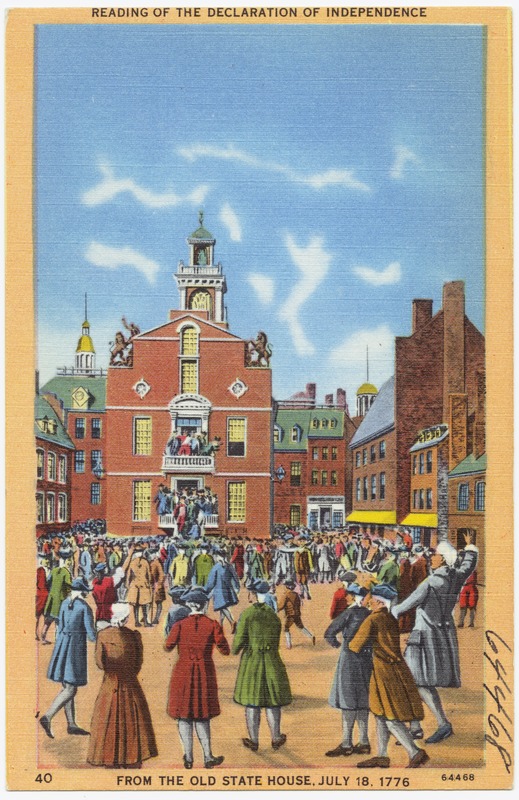
On 18 July 1776, 250 years ago today, the Declaration of Independence was officially proclaimed in Massachusetts.

People had already heard about the Continental Congress’s vote, and many had probably read the Declaration in newspapers. But this was a governmental ceremony. It happened in two places, and on two levels.

With no governor, the highest executive authority in Massachusetts was the Council. Most of its members were meeting in the Edmund Fowle house in Watertown.

Therefore, one part of the official reading was performed by Council secretary Perez Morton, reading the Declaration to the Council and to a crowd gathered outside. Also present were delegates from the Mi’kmaq and St. John’s/Maliseet communities, ready to sign a treaty of friendship with this new United States.

In Boston, there was a parallel, larger ceremony. Inside the Council’s chamber in what was now the State House, Suffolk County sheriff William Greenleaf read the Declaration to some Council members and other officials.

Col. Thomas Crafts of the Massachusetts artillery regiment, who had a bellowing voice, then “deaconed” or repeated the text phrase by phrase from the balcony of the Council chamber to the crowd gathered on the street below.

Thus, most Bostonians at the event heard Col. Crafts’s reading, but the official proclamation in Boston came from Sheriff Greenleaf. The ceremony was meant for both government officials and the “people out of doors.”

On 21 July, Abigail Adams reported to her husband:
Last Thursday after hearing a very Good Sermon I went with the Multitude into Kings Street to hear the proclamation for independance read and proclamed. Some Field peices with the Train were brought there, the troops appeard under Arms and all the inhabitants assembled there (the small pox prevented many thousand from the Country).

When Col. Crafts read from the Belcona of the State House the Proclamation, great attention was given to every word. As soon as he ended, the cry from the Belcona, was God Save our American States and then 3 cheers which rended the air, the Bells rang, the privateers fired, the forts and Batteries, the cannon were discharged, the platoons followed and every face appeard joyfull.

Mr. [James] Bowdoin [a senior member of the Council] then gave a Sentiment, Stability and perpetuity to American independance.

After dinner the kings arms were taken down from the State House and every vestage of him from every place in which it appeard and burnt in King Street. Thus ends royall Authority in this State, and all the people shall say Amen.
Not everyone was entirely pleased. Merchant John Rowe characterized the celebration as “a Great Confusion in Town.”

Pulling the royal emblems of the lion and unicorn down from the State House roof was probably inspired by reports of New Yorkers toppling the statue of King George III after that city’s reading of the Declaration on 9 July. But the street was still called King Street until 1784.

Monday, May 11, 2026

“Not playing cards but fondling and kissing each other”

In preparation for tomorrow’s talk about Benjamin Thompson’s early years, I’ve been reviewing the evidence of his affair with Mary (Dill) Thomas, wife of printer Isaiah Thomas.

When Isaiah moved to divorce Mary in 1777 by petitioning the Massachusetts Council, he submitted testimony from several people who had seen his wife traveling with the militia major from New Hampshire in February 1775, behaving like man and wife.

The printer’s file also offered an affidavit from Mary Fowle of Londonderry, New Hampshire, who had stayed with the Thomases in Boston from 20 Sept 1774 to 16 April 1775.

In Sex and the Scientist, Jane Merrill quotes Fowle describing how “Major Thompson [was] then a refugee in Boston who borded in a house opposite.” Mary Thomas started visiting him several times a day even though (or because) she had two children under the age of three.

One Saturday the printer’s wife “dressed herself, shifting her Linen, which I knew was not her custom,” said her house guest. Mary Thomas came home with “a small piece of parchment, on which a Lady’s face had been drawn with a black lead pencil. . . . the Major had taken much pains with it.”

Soon Mary Thomas visited Thompson’s ”bed-chamber, where they staid the whole afternoon and part of the evening.” Fowle stated, “I could not but think there was more intimacy between them than I before tho’t of.” She observed the couple “kissing each other, laying in each others laps, speaking fondly of each without regarding me.”

One day Isaiah came home from business after his wife had gone to play cards with Maj. Thompson. Mary Fowle and a household servant went across to fetch her. They found the couple “not playing cards but fondling and kissing each other, she often laying her head on the Major’s shoulder, and their arms round each other.”

As if that wasn’t clear enough, in February 1775 Mary Thomas insisted on taking that trip to Newbury with Maj. Thompson, first having her hair “in the greatest taste much powdered.” Later the printer gathered testimony from several innkeepers about that journey. At the time, however, he just seems to have felt trapped.

On one Sunday, Isaiah Thomas and Mary Fowle went to church. When they came home, his daughter Mary Ann, who turned three years old that March, showed them a “copper” that Maj. Thompson had given her to go into another room. Fowle stated the little girl said, “The major kissed her Mama and felt her bosom.” In response, little Mary Ann’s mother told her she was lying and threatened to whip her.

Isaiah finally demanded that Mary admit to what was going on. She acknowledged having a sexual affair. And when did it start? True to Benjamin Thompson’s character, he first got into Mary Thomas’s bed right after writing a letter to his own wife back in Concord, New Hampshire.

I won’t bother asking if these marriages can be saved.

TOMORROW: Who was Mary Fowle?

Saturday, April 25, 2026

“That the said Hill be immediately apprehended”

John Hill was yet another of the Loyalists captured aboard the brig Elizabeth.

[I feel like I’m never getting away! Then again, that’s probably how those passengers felt when they were brought back to New England after trying to evacuate.]

According to recent research shared in the Loyalist Directory, John Hill was born in Ireland about 1737. He moved to New York City in the early 1770s and ran an inn.

In March 1775, Hill came to the aid of William Cunningham during a fight near New York’s Liberty Pole (shown here). Hill later told the Loyalists Commission that “a Mob…beat us with Clubs, and stoned us.” The two men were thrown into prison and put on trial in April. But the foreman of the jury, John Wetherhead (another future Loyalist), kept them from being convicted and punished.

Cunningham and Hill “escaped to Boston,” reaching the besieged town by 5 May. They enlisted in the militia company of James Forrest, another man from Ireland. Hill said he was “appointed Quarter Master to the same Company.”

In March 1776, Gen. William Howe decided to evacuate the town. He ordered Crean Brush to confiscate all cloth that could be useful to the Continental Army. Brush enlisted Richard Hill, formerly sheriff in his county of northeastern New York (which would become Vermont), as an assistant. Richard presumably brought his younger brother, John Hill, onto that team.

As ships pushed off from Boston’s wharves, John Hill and his family squeezed onto the Elizabeth along with Brush, most of the confiscated goods, a squad of British soldiers, and other Loyalists. In Hill’s words, “on the 17th of March 1776, he left Boston, with the Royal Army; but was taken at Sea, by the Rebels.”

The brig, its property, and its wealthiest passengers were sent to Portsmouth, New Hampshire. The Hill family and several others were landed on Cape Ann by 7 April. The Massachusetts authorities summoned John Hill to Watertown for questioning.

On 19 April, the Massachusetts Council reported:
The Committee appointed to examine sundry Persons taken on board the Brigt Sally [sic] bound to Hallifax, & sent to the Council by the Committee of Marblehead…examined [John] Hill who informs your Committee that he is a native of Ireland that he came to New York three or four years since that he came to Boston about ten months ago on the removal of the troops from New York to Boston for the recovery of monies due to him from them and that for the same purpose he was going to Hallifax having acted as a Sutler among the troops.
Sailing off to Canada out of political loyalty was suspect. Sailing there just to collect debts from soldiers seemed more reasonable to these office-holders.

The Council agreed that Hill should be allowed to go free after providing a “written parole not to bear arms against the United Colonies, nor in any way aid or assist the Enemies of the said Colonies.” He probably headed back to Cape Ann to find his wife and at least one child.

In Boston, however, some merchants were still seething at how Brush and his assistants had taken their property. That property itself was up in Portsmouth, being sorted by Continental agent Joshua Wentworth. More information filtered back to Watertown.

On 25 April, 250 years ago today, the whole Massachusetts General Court passed a new resolve:
WHEREAS a certain John Hill, lately taken Prisoner by Commodore [John] Manly, in a Vessell bound from Boston to Hallifax, and brought into Portsmouth, was examined before the Council; and no Evidence then appearing against him, he was discharged & set at Liberty;

And whereas it hath since been made to appear to this Court; that the said Hill, at the time he was taken, as aforesaid, had in his possession Chests, Trunks & Packages of Goods and Merchandizes to the value of three hundred pounds Sterlg. supposed to have been stolen from the distressed Inhabitants of the Town of Boston; and was an Assistant to Crean Brush in his late unwarrantable and highhanded Thefts & Robberies
Therefore

Resolved, That the said Hill be immediately apprehended, wherever to be found, & brought before this Court for Examination, touching the Premises, and all Sheriffs, Constables & other executive Officers, and all the good People of this Colony, are hereby directed & impowered to apprehend the said Hill, wherever he may be found, and bring him forthwith before this Court, in order that he may be dealt with for his aforesaid highhanded Crimes, as to Law & Justice appertains.
TOMORROW: The manhunt was on!

[Boston also had a justice of the peace named John Hill, very involved in events surrounding the Boston Massacre. Unfortunately, the same tag applies to both men, but I think context will make it easy to sort out their stories.]

Friday, April 24, 2026

William Jackson in and out of the Boston Jail

One month after he’d decided to sail out of Boston with his goods, the brazier William Jackson was locked up in the town jail, suspected of stealing from his fellow merchants.

Cdre. John Manley had captured him on the Elizabeth. Crowds in Newburyport, Salem, and Boston had jeered him. The Massachusetts Council had ordered him into prison.

Bostonians already had some reasons to dislike Jackson. The great fire of 1760 started in his shop. He defied the non-importation movement in 1770, and on top of that he hosted Capt. Thomas Preston before the Massacre.

Then in 1774 Jackson signed the complimentary Addresses to Govs. Thomas Hutchinson and Thomas Gage. He stayed in town when war broke out. He joined the Associators, the Loyalist militia formed in Boston during the siege, though he tried to explain that away:
General [William] How…isued a Proclamation for the Inhabitants to Associate themselves and bear Arm’s in defence of the Town, being what I did not thing [think] was my duty I did not sing [sign],

sometime After he Isued another recommending to the Inhabitants to Associate themselves for preserving the peace and good Order of the Town by preventing any Riotous doings by the Soldier’s or other’s which I thought Incumbent with every good Citizen to comply
The Patriot government naturally looked askance at any “associators” who fell into its hands.

At the same time, William Jackson had some local support. Unlike Crean Brush and the other merchants locked up alongside him, Jackson had grown up in Boston. His mother Mary and older brother James still lived there. His shop sign, the Brazen Head, was a long-time landmark for locals and visitors.

The jailers had been ordered not to let Jackson have pen and paper, but he could ask his family for help. He stated, “after my Committment my brother wrote Mr [Joshua] Wentworth for my Baggage.”

More surprisingly, other members of Boston’s business community spoke up for him. I already quoted Isaac Smith, Sr.’s comment that he hadn’t really done anything bad. A few years back, Chris Hurley told me that Jackson garnered letters of support from selectmen John Scollay and Samuel Austin, printer John Gill, and other Patriots. (Among those names is John Peters, who could be the future husband of Phillis Wheatley.)

Later William Jackson would tell the Loyalists Commission that he was let out of jail after 126 days, or in August 1776. Some of his fellow prisoners would be locked up for much longer.

TOMORROW: Back to Cape Ann.

Thursday, April 23, 2026

“Without the Privelege of Pen, Ink, Paper or Candle”

In April 1776, Watertown was the seat of Massachusetts’s government.

Though people could now go into Boston, that town was still reeling from the siege. Plus, there was smallpox.

So the Massachusetts General Court stayed in Watertown—the assembly in the town’s meeting-house and the Council in an upper chamber of Edmund Fowle’s house (now headquarters of the Historical Society of Watertown, shown here).

Under the provincial charter, because the governor and lieutenant governor were absent (both driven away by the war), the Council exercised executive power.

That’s why, on 12 April, James Otis, Sr., as senior member of the Massachusetts Council, signed this order to imprison five genteel Loyalists captured aboard the brig Elizabeth:
To the Keeper of the Goal at Boston, in the County of Suffolk—Greeting—

You are hereby directed and commanded to take into your Custody Crean Brush, William Jackson, Peter Ramsey, Edward [K]eighley, and Richard Newton, lately taken in their flight from Boston in attempting to carry away from thence under the protection of the British fleet, large Quantities of Goods Wares & Merchandizes, the Rightful Property of the Inhabitants of that town, and having joined themselves with the Fleet & army employed against the united Colonies of America—

and you are commanded to confine the said Crean Brush William Jackson & Peter Ramsen [sic], each in an apartment by himself, without the Privelege of Pen, Ink, Paper or Candle, and not suffer them, or either of them to converse with any person whatever, unless in your hearing, and for the better Security of the said Crean Brush you are further ordered & commanded to put him into Handcufts immediately—

And them and each of them safely keep, ’till the further Order of the Major part of the Council, or they be otherwise discharged by due Course of Law—Hereof fail not at your Peril.
Two days later, Maj. John Grizzage Frazer, as assistant quartermaster for the Continental Army, wrote to Gen. George Washington to say that those men were now locked up. Brush was “in Irons.”

Frazer also passed on the news that on 12 April “8 british seamen” had made off with the cutter from H.M.S. Renown, one of the Royal Navy ships still hovering in the outer harbor, and got into Boston. Those defectors were much more welcome than the Loyalists who had tried to leave.

TOMORROW: Free William Jackson!

Wednesday, April 22, 2026

“They were much insulted by the people”

Yesterday we left William Jackson on the road from Portsmouth, New Hampshire, to Boston, having reached the town of Newburyport on 11 April 1776.

Jackson and dozens of fellow Loyalists had been captured aboard the brig Elizabeth while trying to sail to Halifax with the rest of the British evacuation fleet.

Most of the king’s army, and most of the Loyalists inside Boston, had managed to get away. Which meant popular anger about those people focused on the prominent few remaining—like Jackson.

In Newburyport, an angry crowd surrounded the tavern where the captives were eating, objecting to how they were riding in carriages. Carriages that Jackson, ship captain Peter Ramsey, and the others had hired.

Jackson later recounted:
we sent for the Committe of safety to Appease them, but all to no purpose, finding our selves in such a situation we comply’d, the Committe not thinking it safe they Appointed a Guard of five Men and Obliged us to pay the Expence the rest of the Journey,

as soon as we came out of the Inn we received Blow’s, mud, stones, Eggs, and every other abuse and proceeded to Boston being 40 miles on foot
In Salem, the lawyer William Pynchon (1723–1789) wrote in his diary:
Wm. Jackson, merchant, and others, with some regular soldiers, went thro’ Salem on foot for Boston, under guard; ’t is said they were much insulted by the people (it must be presumed to be the rabble) at Newburyport, in their way hither; that Jackson was stopped and obliged to leave his carriage, and walk on foot from Newbury to Salem, and thence to Boston
Pynchon then said: “in Newbury street he was stopped again and obliged, after his hat was knocked off, to fall on his knees and beg pardon of the mob and of the Country, and to say whatever was required of him.” At first I thought that might be a reference back to the streets of Newbury, but the placement suggests this story described when Jackson reached Newbury Street in Boston’s South End. Jackson himself didn’t specify such an incident.

Fellow gentlemen—merchants, professionals, landowners—sympathized with Jackson for coming under fire from crowds of poorer citizens. On 16 April, Isaac Smith, Sr., wrote to John Adams from Salem:
You have heard of Bill Jackson’s being taken. He received some Insult on the road which am sorry for and lamented by all, persons of any consequence. He is in Boston goal, but I dont learn he has behavd any way Ill att Boston dureing the seige.
Indeed, Jackson’s letter complained that after reaching Boston:
we was again carried to Wartertown 9 miles before the late Councill and being each seperately ask’d a few Question’s and not properly Examined was sent back to Boston and committed on a supposed Crime of being concern’d with Crean Brush denied the Use of pen Ink and paper and Candle light not suffer’d to speak to any one but in presence of the keeper whare we have been ever since 13th April
That accusation must have been especially galling to Jackson since one month before he’d been trying to stop Crean Brush from taking away Cyrus Baldwin’s goods.

TOMORROW: In the Boston jail.

Monday, April 20, 2026

“Such Cost and Charge as hath arisen by their being brought before the General Court”

On 13 Apr 1776, the Massachusetts General Court decided that “Caleb Wheaton and others [well, other men], who were taken aboard the brig,” should be brought to its meeting-place in Watertown ”for Examination.”

Four days later, as quoted yesterday, the Marblehead committee of correspondence wrote to say they now thought two of Wheaton’s sons—Joseph and Caleb, Jr.—had stolen a local man’s boat about six weeks before. That apparently focused the legislators’ attention on the family.

On 19 April the Council and the House named members to a joint committee to question the Wheatons.

Four days later, those members determined that Caleb Wheaton, Sr., had been “an Associator”—a member of the Loyalist militia—inside besieged Boston. Furthermore, he had been “in other Instances unfriendly to American Liberty,” perhaps a reference to his work as a Customs officer in Maine, or his statements supporting Parliament back in early 1775.

But the two legislative houses disagreed about what to do with the Wheatons. The published record of the Massachusetts House, readable here, says simply that the Council approved the first recommendation from the committee and the assembly didn’t concur.

Peter Force’s American Archives, evidently based on more complete manuscript records from the Council, revealed more details. The committee recommended
that the said Caleb Wheaton give bond to the Treasurer of this Colony for the sum of three hundred Pounds, with sufficient surety for his future good behaviour, or be confined in some Jail within this Colony until he shall find such surety; or if the said Wheaton shall think proper, and shall procure his passage for himself and family to Nova-Scotia, he may have liberty to remove there on his own expense, provided he will give his promise in writing, not to bear arms against the United Colonies.

And that the said Caleb Wheaton, Jun., and Joseph Wheaton, upon their giving their written paroles not to bear arms against the United Colonies, nor any way to aid or assist the enemies of said Colonies, and they paying the expense of being brought before this Court, may be discharged.
After the lower house said that wasn’t good enough, two more legislators were added to the joint committee, and they went back to rethink their recommendation.

The next day the Council approved a revised proposal:
  • All three Wheatons would be responsible for a £500 bond.
  • They not only had to promise not to fight the colonies, but also “not correspond with any of the Enemies of America.”
  • They had to “pay such Cost and Charge as hath arisen by their being brought before the General Court.” 
  • If any of those conditions weren’t met, they would be “committed to close confinement.”
There was no more mention of letting the Wheaton family resume their trip to Nova Scotia.

On 25 April the House considered those strictures and agreed. (Its journal says “close Imprisonment” instead of “close confinement,” if that matters.)

The committee report on that measure, signed off by Caleb Cushing of Salisbury for the Council, Perez Morton as Council secretary, and James Warren as speaker of the house, went up for auction last year.

Caleb Wheaton came back on 4 May with a petition to the House
setting forth that he has been apprehended as inimical to his Country, that he is released by giving Bonds, and is now in low Circumstance; and praying therefore that he may be enabled to recover his Household Furniture, Provisions, &c. on board the Brig Elizabeth, at Portsmouth; whereby he may support himself and Family.
The assembly gave Wheaton “Leave to withdraw his Petition.” In other words, it said no.

The Massachusetts legislature, especially the lower house, was in no mood to do any favors to Loyalists. In fact, the Wheatons even had to pay the costs of being transported to the General Court. And it appears Caleb, Sr., later told the British government that he was locked up for three months. The Wheatons’ case reflects a popular mood in the spring of 1776 that affected other Loyalists as well.

TOMORROW: William Jackson returns to Boston.

Sunday, April 12, 2026

“What I am to dow whith the Prisoners for I have Thirtey hear now upon Expences”

A lot of the correspondence that followed the Continental capture of the Elizabeth in April 1776 involved money.

First, there was the cost of housing the prisoners taken on that brig.

Eleven men were sent to Gloucester, including four British soldiers and Caleb Wheaton, the Customs officer from Maine. Their families came along.

Winthrop Sargent, Sr. (1727–1793), the Continental Army’s agent at that port, wrote to Gen. George Washington on 7 April:
The Bayer [bearer] of this has under his Gard a Number of Prisoners & Toreys tachen by Comodor [John] Manley & Capt. [Daniel] Warters the Prise is sent to Portsmouth I mack Know doubt you have had Acount of before this Reaches your Excellence thar nams you have below

thare is two Women & Sum Children Left hear which is not Abel to Travel Should be glad your Excellence would Send me Answor to what I Roat you Last about Capt. Watt:s Goods and what I am to dow whith the Prisoners for I have Thirtey hear now upon Expences.

I Rem[ai]n You[r] Hume Sarv.
Winthrop Sargent, Agent

P.S. Sence I rote the above Capt. [Samuel] Tucker here Carres the Prisners to Marvelhead ware thay well be sent to head Quartr will not Carrey the women & Children for fear of the Small Pox so I am fors to porvide for them hear Should be glad of your Order in Regard to the afore
Capt. Tucker on the armed schooner Franklin carried twenty-two people, including the Wheatons, to Marblehead on 9 April. That town’s committee of correspondence sent Azor Orne to ask the Massachusetts Council what to do with them.

On 13 April, the legislature “Resolved that the Soldiers belonging to the British Army, with their Wives and Children, be sent to General [Artemas] Ward.” Apparently they would be treated like other prisoners of war.

The Marblehead committee would be responsible for maintaining all the civilian women and children, tracking the expenses so the town could “endeavour to have the same discharged out of the Monies arising on the Sales of the Cargo and effects found on Board the said Vessel.”

And that was where the big money was. John Rowe heard that the Elizabeth had “Twenty five Thousand pound Sterling On board—in English Goods & Other Merchandise.” The Boston Gazette reported, “she is estimated to be worth about 35,000l. sterling.”

Cdre. Manley had sent the brig into Portsmouth, New Hampshire, where Continental agent Joshua Wentworth would go through the legal process of ”condemning” the ship and its contents and putting them up for auction. Manley, his captains, and his crews were no doubt anticipating a good payday.

TOMORROW: What to do with the Wheatons.