J. L. BELL is a Massachusetts writer who specializes in (among other things) the start of the American Revolution in and around Boston. He is particularly interested in the experiences of children in 1765-75. He has published scholarly papers and popular articles for both children and adults. He was consultant for an episode of History Detectives, and contributed to a display at Minute Man National Historic Park.

Subscribe thru Follow.it


•••••••••••••••••


Showing posts with label Thomas Cowdin. Show all posts

Monday, May 05, 2014

The Man with Two Monuments

Yesterday Bob O’Hara described the transformation of Thomas Cowdin from his central Massachusetts town’s most notorious opponent of military action against the Crown to the same town’s American militia leader and legislative representative. Here’s the end of that story.

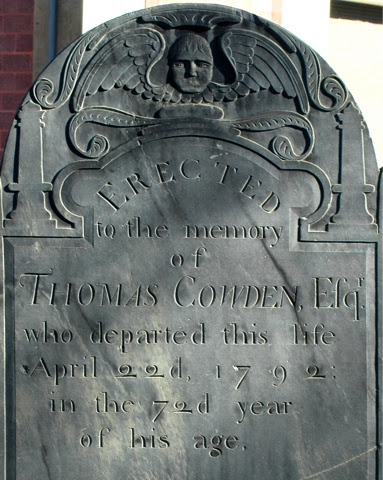
Thomas Cowdin, Esq., died in Fitchburg on 22 Apr 1792. He turned out to be as notable in death as he was in life because by an accident of history he is the only person in the town with two gravestones.

If you stand today at Fitchburg’s minuteman monument and look off to the southwest, you can just make out Thomas Cowdin’s great granite obelisk on the crest of the Laurel Hill Cemetery. But if you turn and look to the south, behind a row of trees and some rundown buildings, you may be able to spot Fitchburg’s original village burying ground, the tiny and almost forgotten South Street Cemetery. There you will find Thomas Cowdin’s actual grave, in company with the graves of several of the Fitchburg minutemen who were quicker to respond to the Lexington alarm than he was.

In 1884 one of Thomas Cowdin’s grandsons, John Cowdin of Boston, decided that the tiny colonial burying ground was not a suitably prominent place of rest for his prominent ancestor. He made arrangements for a granite obelisk to be erected at the top of Laurel Hill, overlooking the whole of downtown Fitchburg, and to have Thomas’s remains, along with the remains of his wife second Hannah, reinterred at the new location. The granite obelisk was put in place, but John Cowdin died before his grandparents’ graves could be moved.

The Laurel Hill obelisk thus stands as an accidental cenotaph. No casual visitor passing it today would ever know that Thomas Cowdin, Esq., the reluctant revolutionary, isn’t even there.

For more on Thomas Cowdin’s life and times, try these references, all of which are available online:
  • Fosdick, Charles. 1895. Captain Thomas Cowdin’s journal. Proceedings of the Fitchburg Historical Society, 1: 135-146. (Transcribing Cowdin's diary from 25 May to 2 June 1784 during one of his periods of service on “the Grate & General Coart.“)
  • Garfield, James F.D. 1908. Fitchburg soldiers of the Revolution. Proceedings of the Fitchburg Historical Society, 4: 172-232. (The standard reference on Fitchburg during the Revolution.)
  • Howard, Ada L. 1902. Captain Thomas Cowdin. Proceedings of the Fitchburg Historical Society, 3: 19-38. (A somewhat romanticized family portrait, by a descendant.)
  • Stearns, Ezra S. 1914. Capt. Thomas Cowdin in the Revolution. Proceedings of the Fitchburg Historical Society, 5: 270-277. (Transcribing the records of Cowdin’s arrest and trial in August 1775.)

Thanks for the story, Bob! Those references are a good reminder of how many smaller historical societies used to have publishing programs sharing local resources and lore. The volumes those societies created, often little known outside the area, have lots of Revolutionary stories to rediscover and expand on.

Sunday, May 04, 2014

The Transformation of Thomas Cowdin

Today Bob O’Hara continues his story of Thomas Cowdin, an Irish-born farmer who became a prominent landowner in central Massachusetts.

In the weeks that followed the battle of Lexington and Concord, it’s tempting to think that all the residents of Massachusetts sorted themselves neatly into Patriot and Tory camps, with one side laying siege to Boston and the other side coming under siege in their homes and villages all across the countryside. But the career of Thomas Cowdin of Fitchburg reminds us that revolutions are rarely neat—for Thomas Cowdin was indeed a soldier of the Revolution, but not at first.

As described yesterday, when news of the fatal shots at Lexington and Concord reached Fitchburg, Cowdin resisted the call to join the militia alarm. But in August 1775, he traveled to the siege lines to ask Continental authorities for a commission as an army officer.

Cowdin’s reputation for reluctance had preceded him, however. Reporting for duty four months after the war had begun looked suspicious to some of his fellow townsmen. When Cowdin arrived in Cambridge, he was promptly arrested by Gen. Nathanael Greene for having “invariably opposed every Measure pursued for the Restoration of our violated Previlages,” and he was sent to Gen. George Washington’s headquarters on 6 Aug 1775 for examination. Washington, skillful politician that he was, declined to involve himself in a local matter and referred the Cowdin case to the newly-reconstituted Massachusetts legislature, then sitting at Watertown.

Before that assembly two days later, Cowdin acknowledged that he had been “Backward In town Affairs with Regard to the Liberties of the Country.” He begged “the forgiveness of the honourable Board & hous of Representatives & all the good People of this Country,” declaring that he was “Now Ready to Convince the World of this Solemn Declaration not only by Word Interest—but even by exposing my life itself if my Country Calls me there to.”

After due consideration of his public apology, the General Court politely declined to recommend Cowdin for the commission he was seeking. But because they did apprehend in him “evidence of a Reformation,” they agreed to send him home to Fitchburg with a certificate “for his own security against the further resentment of the Publick for his past offences.”

But Thomas Cowdin was never one to sit still, and over the coming two years he worked assiduously to regain the trust of his Fitchburg neighbors. By 1777 he was again accepted into the town’s militia company and served in New York. By 1779 he was that company’s captain. The next year, his townsmen elected him as their first representative to the Massachusetts General Court under the new state constitution drafted by John Adams. The General Court was the same body that had denied him a commission in 1775, so he surely must have considered his rehabilitation complete.

TOMORROW: The man with two monuments.

Saturday, May 03, 2014

Thomas Cowdin of Fitchburg, Reluctant Revolutionary

While I’m out of town this weekend at a conference, I’m gratefully taking the opportunity to run some guest postings from Bob O’Hara, sharing the story of a prominent man from central Massachusetts.

This year is the 250th anniversary of the founding of Fitchburg, which was set off from its parent town of Lunenburg in 1764. In honor of that anniversary it’s worth remembering “Squire Cowdin,” who was for many years one of the young town’s biggest men.

If you stand today at Fitchburg’s minuteman monument, on the banks of the Nashua River in the heart of the city, and look to the southwest, you can just make out on the crest of the nearby Laurel Hill Cemetery one of the largest obelisks on the grounds: the memorial to Thomas Cowdin, Esquire.

Cowdin was born on Christmas Day in 1720 in the north of Ireland, the first son of James Cowdin and his wife Janet (Craige) Cowdin, who emigrated to New England about 1728 and who settled, along with many other Scots-Irish migrants of the time, near Worcester.

Thomas grew up and in 1748 married, in Worcester, Experience Grey or Gray, with whom he had four children. Experience died in 1760, and in Rutland the next year Thomas married Hannah Craige, with whom he had nine more children, for a total of thirteen in all. Thomas himself always wrote his surname “Cowdin,” but it often appears as “Cowden” in the documents of the time.

As a young man Thomas Cowdin served king and country at the first siege of Louisbourg during King George’s War in 1745, and then later as captain of a company of foot at Crown Point during the French and Indian War in 1762.

Soon after Fitchburg was incorporated, Thomas and his second wife removed to the new town, perhaps sensing opportunity. By the time of the 1771 tax census Thomas was by far the wealthiest man in the community, owning forty acres of mowing land and fifty acres of pasture, as well as one of the two taverns in the town. He also had two “servants for life,” as the tax valuation called them.

When Massachusetts broke out in open armed rebellion in the spring of 1775, Thomas Cowdin was fifty-four years old, so he might have been excused from marching to confront the redcoats. But when the alarm guns were fired on the morning of the Lexington Alarm, he tried to prevent two of his hired hands from setting aside their work and going to the militia assembly point.

TOMORROW: The transformation of Thomas Cowdin.