J. L. BELL is a Massachusetts writer who specializes in (among other things) the start of the American Revolution in and around Boston. He is particularly interested in the experiences of children in 1765-75. He has published scholarly papers and popular articles for both children and adults. He was consultant for an episode of History Detectives, and contributed to a display at Minute Man National Historic Park.

Subscribe thru Follow.it


•••••••••••••••••


Showing posts with label Owen Richards. Show all posts

Tuesday, October 26, 2021

“A large Collection of interesting Papers”

In 1843, the London bookselling firm of Thomas Thorpe issued its catalogue of manuscripts for sale, “Upon Papyrus, Vellum, and Paper, in Various Languages.”

Among those items was “A large Collection of interesting Papers, formed by the late George Chalmers, Esq., relating to New England, from 1635 to 1780, in 4 vols. folio, neatly bound in calf, £21.”

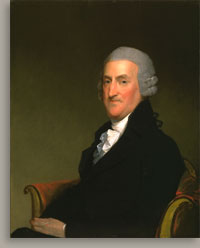
Chalmers (1742-1825, shown here) was born in Scotland and at age twenty-one settled in Maryland as a young lawyer. In early 1776 he published Plain Truth, a point-by-point riposte to Thomas Paine’s Common Sense. That went over so well that Chalmers soon moved back to Britain.

In 1780 Chalmers published Political Annals of the Present United Colonies from Their Settlement to the Peace of 1763. Or rather, he published the first volume of documents about the colonial governments, tracing the history up to 1688, but never produced the second.

In 1786 Chalmers became a secretary to Britain’s privy council, and he kept that postion for decades. It provided him with the income and access he needed to collect manuscripts and write books and pamphlets about the history of Scotland, Shakespeare, other authors, controversial issues of the day, and much more.

In 1796, as Britain fought Revolutionary France, the government paid Chalmers to write a critical biography of Paine. He issued that under the pseudonym of Francis Oldys, supposedly a graduate of the University of Pennsylvania. Otherwise, he focused mainly on British topics, particularly the long history of Scotland.

Nevertheless, Chalmers’s manuscript collection shows that he never gave up on accumulating material about the old North American colonies. After his death, his papers went to a nephew, and two years after that man died in 1841, they were on the market.

Here’s a sample of what the collection included from the Revolutionary years, according to the bookseller’s catalogue:
  • Various papers relating to the paper currency in the colonies, 1740-60.
  • Account of the dispute at New London, at the burial of a corpse, 1764.
  • List of graduates in Harvard College, who have made any figure in the world.
  • Part of Mr. Otes’s speech in the general assembly at Boston, in 1768.
  • Autograph letter from W. Molineux, relating to the riots at Boston, 1768.
  • Letters relating to the seizure of the sloop Liberty, 1768, very curious.
  • Information of Richard Silvester, of the speeches of the Boston leaders, 1769.
  • Declaration of Nathaniel Coffin to Governor J. [sic] Bernard, on the designs to drive off the Governor and Lieutenant Governor, 1769.
  • Key to the characters published in the Boston Chronicle of Oct. 26, 1769, (The Boston patriots characterized.)
  • Autograph letter from George Mason, containing an account of the riot and attack of Mr. Mein’s house, 1769.
  • Copy of a curious letter from Boston, relating to Franklin’s duplicity, &c. 1769.
  • Autograph letters from John Mein and George Mason to Joseph Harrison, concerning the riot at Boston, 1769.
  • Papers relating to the outrage on Owen Richards, an officer of the customs at Boston, 1770.
  • Copy of a letter from Lord Dartmouth to Dr. Benjamin Franklin, about presenting a remonstrance of the court to the king, 1773.
  • Account of the proceedings of Governor Hutchinson, relating to Massachusetts, &c., 52 pages, 1774.
  • Account of an attack that happened on His Majesty’s troops, by a number of the people of the province of Massachusetts Bay, 1775.
It looks like Chalmers obtained many of those documents from Joseph Harrison, a Boston-based Customs official, or his estate.

Prof. Jared Sparks (1799-1866) of Harvard College must have seen the bookseller’s listing. He apparently arranged for the college library to buy some of Chalmers’s papers in 1847 while he bought others for himself, leaving them to the library on his death. Thus, the papers listed above are now at the Houghton Library and digitized as part of the university’s Colonial North America project.

Tuesday, August 17, 2021

“Informed against for his participation in the destruction of the tea”

In the late nineteenth century, the Boston historian Francis S. Drake collected lore about the Boston Tea Party from lots of families.

Drake published those stories, along with many documents, in the book Tea Leaves (1884). One entry read:
——— ECKLEY,

A barber, was informed against for his participation in the destruction of the tea, and committed to prison. The Sons of Liberty supported him while in confinement, and also provided for his family. He was finally liberated, and the person who informed against him was tarred and feathered, and paraded through the town with labels on his breast and back bearing his name, and the word “informer” in large letters.
Some books on the Tea Party repeated this information without adding to it. No one has brought forward more evidence to corroborate this oral tradition, even from places we should expect to find it.

People don’t get “committed to prison” for long enough to need outside support without getting put on records. We know royal authorities in both Boston and London were very eager to find out who organized the destruction of the tea. Gen. Thomas Gage and Adm. John Montagu even secretly transported Samuel Dyer across the Atlantic because they thought he had useful information. But no source at the time mentioned this barber or the dismissal of his case.

To tar and feather someone and parade him through town was also a highly public act. When a Boston mob abused John Malcolm that way in January 1774, it was widely discussed in both New England and Britain. That same period offers no record of a tarring and feathering connected to the Tea Party like this.

Here’s my theory: This is a distorted memory of Joseph Akley’s dispute with Owen Richards in 1770-71, attached to the Tea Party because by the mid-1800s that was Boston’s most famous and respectable Revolutionary protest, the one families wanted to have an ancestor participating in.

This lore reversed the order of events, and probably exaggerated Joseph Akley’s tribulations, but we can recognize those events from the story of the mobbing of Owen Richards.

First, we know Richards was tarred, feathered, and paraded around town. People called him an ”informer.“ He recalled, “they also fix’d a paper on my breast, with Capital Letters thereon, but [I] cannot Recollect what it contained.”

The tradition referred to “ECKLEY…A barber.” Joseph Akley, whose name was spelled many different ways, was a barber later in life, after the peruke wigs he was first trained to make went out of style.

There’s no evidence Akley was accused of helping to destroy the tea or locked up, but Owen Richards did accuse him of a crime and haul him into court in 1771. Boston’s Whig leaders, including John Adams, John Hancock, and newspaper writers, did get involved in fighting against Richards’s accusations.

I suspect that some stories about that documented dispute, overshadowed by bigger Revolutionary events, got passed down in the Akley family or circle. Over time they faded until people in the late 1800s didn’t even remember the barber’s name precisely. But they remembered something about tarring and feathering, and legal jeopardy, and help from the Sons of Liberty. They hung those baubles of memory off the larger story of the Tea Party, and Francis S. Drake conglomerated the “Eckley” story with the rest.

TOMORROW: Joseph Akley in the war.

Monday, August 16, 2021

When Owen Richards Sued Joseph Akley for Assault

My last posting about Joseph Akley argued that despite being indentured away from his impoverished family at the age of ten and seeing his master die five years later, Akley turned out okay.

But, Boston 1775 readers might ask, we started looking into young Joseph only because Owen Richards sued him for being part of a tar-and-feathers attack in May 1770. Might that suggest the teenager ran wild and got into trouble?

That’s still a possibility, but today I’ll argue that Akley’s relationship to his master’s family played into both how he got sued and how he got out of that jam.

To start with, let’s go back to the attack on Owen Richards. He was a tide waiter for the Customs service, involved in that department’s disputes with John Hancock in 1768. On 18 May 1770, Richards confiscated a Connecticut ship for smuggling, and that evening a mob came to his house.

It makes sense to assume that most of the people in that mob were sailors, waterfront workers, and others with a grudge against the Customs service. The most prominent person Richards sued for assaulting him was Joseph Doble, a sea captain and son of a sea captain.

A teen-aged wigmaker like Joseph Akley could have joined that crowd, but he wouldn’t have led it. Why, then, did Owen Richards single out Joseph as another of only three people he sued for assault?

My answer starts in 1758 when peruke-maker Timothy Winship’s daughter Margaret, aged twenty-three, married John Gregory at King’s Chapel. Nine months later the couple returned to that church for the baptism of their first child, John.

There were three sponsors at that baptism. One was the mother’s older sister, Sarah. Back here I guessed that she was helping to manage the Winship household and her younger siblings after her mother’s death.

Another sponsor was Owen Richards.

Thus, Richards was close to members of the Winship family. He may well have met the indentured boy who arrived in the peruke-maker’s house in 1762, seen him grow up at church, and even attended the master’s funeral.

I theorize that Richards sued Joseph Akley not because that teenager was a leader of the tar-and-feathers mob but because he recognized the kid’s face.

We don’t have many records of that lawsuit, but we know who represented Akley and his fellow defendants in court: John Adams. He collected fees of 12s. and 48s. for defending the teen, more than twice what he charged Joseph Doble.

Beside the second payment Adams wrote: “at Elizabeth Winship’s Instance.” That was Timothy Winship’s widow, who had raised Joseph Akley since 1762 and was evidently still looking after him.

TOMORROW: A barber at the Tea Party?

Friday, April 09, 2021

Profiling Owen Richards’s Attackers

Last night as I finished the posting about Owen Richards taking his attackers to court, I thought, “Who are those men he accused? Who would have more to say about them?”

And then I realized that researching bit players in Revolutionary Boston is what I do. It’s one of my signature moves. So I had to get cracking on that task.

The easiest accused man to find is Joseph Doble or Dobel. He was born about 1739, according to his reported age at death, and was one of the many children of John and Abigail Doble. John was born about 1703, reportedly in Somerset, England. Abigail was a Boston native. They married at the Presbyterian Meetinghouse in 1732.

John Doble was a sea captain who at some point retired from seafaring to become a merchant, selling Pennsylvania pork, pottery, glassware, wood, and other goods. He accumulated a wharf, at least three houses, and a shop on King Street—the Sign of Two Sugar-Loaves. Abigail Doble died in 1769. John Doble died, variously reported “in an advanced Age” and “very suddenly,” four years later. They were both buried on Copp’s Hill. Their son Joseph was the captain’s executor, and settling the estate took well over a decade.

Back on 8 Jan 1761, Joseph Doble and Mary Williams were married by the Rev. Andrew Eliot. Joseph was following his father’s career course, which is why he was legally labeled as a “mariner” in Richards’s writ. In the early 1760s, the Boston newspapers often reported on a captain named Doble sailing to or from Newfoundland and the cod fisheries. However, it’s usually impossible to know whether this was John Doble; an older son such as John, Jr., or William; or Joseph. The first definite sign of Joseph having his own command is a listing in the 18 July 1768 Boston Chronicle that he had cleared out the snow St. Joseph for Newfoundland. In August 1769 he was in charge of the brig Peggy.

None of the Dobles shows up on lists of politically active men in Boston, on either side. But John Doble’s status as a native of Britain makes it plausible that in late 1770 the Boston Gazette would sneer that Joseph’s “family Connections are among the better sort of folks, the friends of Government.” I therefore suspect he was the target of Owen Richards’s first reported writ that year, as well as the one dated January 1771 and preserved in the John Adams Papers.

Likely being involved in the attack on Richards wasn’t Joseph Doble’s only excitement in the year 1770. The 22 November Boston News-Letter reported:
Sunday Evening last about 6 o’clock, a Brig, Capt. Joseph Doble, from Newfoundland, ran on Egg-Rock near the Light-House, a Hole was beat in her Bottom, and she sunk: The Peoples Lives were saved, and the Rigging of the Vessell.
However, the 26 November Boston Evening-Post added that there were “about fourteen Hundred Quintals of Fish entirely lost.”

TOMORROW: Capt. Joseph Doble goes to war.

Thursday, April 08, 2021

Owen Richards’s Lawsuits for Assault

When we left Owen Richards in May 1770, the magistrates of Boston were completely stymied in their inquiry into who had tarred and feathered him that month.

Richards, a Customs officer who had also been part of the disputes that led up to the Liberty riot of 1768, probably suspected those local officials weren’t really trying.

Eventually Richards took legal action himself. In On 24 Dec 1770 the Boston Gazette reported that he had
commenced an Action of Damage for Three Hundred Pounds lawful Money, against a young Gentleman of this Town, whose family Connections are among the better sort of folks, the friends of Government.

This Lad was taken by a single Writ and held to Bail—Upon his application to several of his near relations who are persons of fortune, to become sureties for him, we are told, they absolutely refus’d. But others had compassion upon him; for two Gentlemen were bound for his Appearance at Court.
The following 7 January an attorney—probably Samuel Fitch—wrote out a writ on Richards’s behalf, apparently aimed at another attacker:
Attach &c. Joseph Doble of Boston &c. Mariner, to answer unto Owen Richards of said Boston Yeoman, in a Plea of Trespass, for that the said Joseph, on the Eighteenth day of May last, 1770, Boston aforesaid, with Force and Arms an Assault on the Body of him the said Owen made and him did then and there violently beat, wound, bruise, and evil entreat, so that his Life was thereby put in great Danger, and He the said Joseph did then and there take and imprison him the said Owen, and him in Prison for a long Time, vizt. for the space of six hours, detained against Law, and the Custom of our Realm, and he the said Joseph then and there, did also grievously abuse the said Owen; forcibly took and placed him in a Cart, and stripped him naked to his Skin, and with Force as aforesaid, did tear off, from his Body, and take from him, his Hatt, Wigg, Coat, Waistcoat, and Shirt, and also a gold Sleeve Button, two Handkerchiefs, his Pocket Book, with sundrie Papers therein of the Value of [blank] vizt. an original Note of Hand, for seven Pounds, Ten Shillings, and Sundrie, original Receipts for Moneys paid, and other Papers of Value, also one Piece of Gold Money, called a Johannes, and two Spanish milled Dollars in Silver, being all of the Value of Thirty Pounds lawfull Money, none of which Things so taken from him the said Owen, have ever been returned to him again and He the said Joseph did then and there also cover and besmear the said Owen, Head, Face, and naked Body, with Tar and cover him over with Feathers, upon said Tar, and cruelly and inhumanly set fire to said Feathers; and then and there dragged said Owen in said Cart, through diverse Streets of said Town of Boston, and from one End of said Town to the other, for the Space of Six Hours, as aforesaid, and fixed a Label to his the said Owens Breast, with Writing thereon importing that he the said Owen was a common Informer, and in that Condition exposed him the said Owen to the Contempt and Resentment of our liege Subjects, and as a public Spectacle, thro said Town, and other Outrages and Enormities, on him the said Owen, He the said Joseph then and there committed, against our Peace, To the Damage &c. £1000.
Fitch filed that writ in April 1771, almost a year after the attack and 250 years ago this month. Richards sued two more men named Benjamin Jones and Joseph Akley (Aikley, Heakley) for assault. (That makes three or four suits, depending on whether either Doble, Jones, or Akley was the “young Gentleman” sued in December.)

Meanwhile, in February 1771 the Crown brought criminal charges for the same riot against a man named George Hamblin.

If that seems confusing, all I can say is that I’m not really clear on the whole situation myself. The colonial legal system is hard enough to understand already, few cases like these have left complete records, and I’m relying on mentions in the Legal Papers of John Adams.

TOMORROW: Tracking down the defendants?

Wednesday, April 07, 2021

“Strict Examination into the Affair of taring, feathering & carting Owen Richards”

Yesterday’s posting quoted two accounts of the assault on Customs employee Owen Richards on 18 May 1770.

Richards and a colleague had caught a ship’s captain from Connecticut trying to sneak in undeclared barrels of sugar. They refused a bribe and used their legal powers to confiscate the cargo and the ship.

That evening, a waterfront mob grabbed Richards, tarred and feathered him, paraded him through town, and threatened to do the same to the other Customs men.

This was a couple of months after the royal government had pulled soldiers from the center of town following the Boston Massacre. The first tar-and-feathers attack in Boston had occurred in October 1769, when the troops were still there, so there’s no guarantee a larger military presence would have protected Richards. But Customs officials certainly argued that withdrawing the regiments had turned the town over to the mob.

On 21 May, two of those officials—William Sheaffe, Deputy Collector, and Robert Hallowell, Deputy Comptroller—prepared a report on the incident for their superiors, the Commissioners of Customs. They gathered three accounts from lower-level officers called tidesmen:
  • John Woart, also attacked but more mildly.
  • Josiah King and Joshua Dutton, who had hidden from the mob in the captain’s cabin of the ship they were supposed to be patrolling.
The Customs service didn’t have the power to arrest anyone for assault; it could only seize property. So Sheaffe and Hallowell set about doing that. King and Dutton testified about hearing “a great noise of People on the Deck, Knocking with Sticks, or Clubs.” Sheaffe and Hallowell interpreted that as
such hideous noises & thumping of Clubs and handspikes that they durst not venture out for a great part of the night during which time it is violently suspected, that part of the sugars, with other goods were taken out, which is very much confirmed, by our going Early the next morning into the Hold, and finding a great Vacancy on the starboard side of the Vessell the Ceiling of the Hold maked with the drainings of the Sugar Casks and but one or two of those Casks marked with —> the day before by Mr. Richards. . . .

We found in the Vessell seventeen hogsheads four teirces & two barrells Sugar, which are in the Store at the Custom house, which with the Vessell will be Immediately prosecuted [i.e., seized].
I saw those documents in the Treasury Papers at the National Archives in London. In the long run they might have helped to influence royal policy in Boston, but they didn’t do much for Owen Richards. The only officials who could indict the rioters who assaulted him were the town’s justices of the peace.

The Massachusetts Council was scheduled to meet on 23 May, but acting governor Thomas Hutchinson called those gentlemen together on the same day Sheaffe and Hallowell made their report. They agreed that “it does not appear that the Justices of the Peace within the Town of Boston have made any enquiry, or taken any notice of such disorder.”

The Council therefore advised Hutchinson to send for the justices. The Boston Post-Boy reported how the governor
enjoined them to meet, and make strict Examination into the Affair of taring, feathering & carting Owen Richards, as mentioned in our last, and to bind over such Persons, as shall appear to have been active in it, to answer the same in due Course of Law; and that in all Respects they pursue the Steps of the Law, in order to bring the Offenders to Justice.
But the result?
The Same Day and the Day following His Majesty’s Justices met at the County Court-House, and sent for several Persons as Evidences, but could obtain no Intelligence of any one that was concerned.
Even though parts of the attack on Owen Richards had taken place on King Street in the center of town, no one would identify any of the men involved.

TOMORROW: Owen Richards goes to court.

Tuesday, April 06, 2021

Looking Back on the Owen Richards Attack

Last December, starting here, I wrote about the tar-and-feathers attack on a Customs employee named Owen Richards in May 1770.

The fallout from that event lasted for years, so I’m going to resume the story.

But first, for review, here’s the merchant John Rowe’s summary of the attack in his diary for 18 May:
Just as I was going to bed there was a very great Hallooing in the street & a mob of upwards a thousand people—it seems they had got an informer & put him in a Cart, covered with Tar & Feathers & so exhibited him thro’ the Streets.
For a more detailed description, we can turn to Esther Forbes’s Paul Revere and the World He Lived In, quoting the merchant Samuel Salisbury (shown above, decades later):
I perceived candles in a number of windows,

what, thinks I, is there an illumination tonight?

Getting home I was informed that an Informer had been carted through the streets, Tarred and feathered.

After I had been to the Barber’s my Curiosity led me to the point at New Boston [the western tip of the peninsula] where I found the Informer in a Cart before Capt [John] Homer’s door surrounded with a great number of People

he had his shirt taken off & his bare skin tarred & Feathered. Sometimes they would make him say one thing sometimes another. Sometimes he must hold the Lanthorn this way, sometimes that, then he must hold up a glass Bottle & Swear he would never do so agin & let the bottle fall down & break & then Huzzah—

from thence they carried him into King Street Let him get out of the Cart made a lane down the street where 3 or 4 carried him off from the multitude in safety, being about nine o’clock.
The mob that attacked George Gailer, another man accused of helping the Customs service, in October 1769 also made him “carry the lantren in his hand & calling to all the inhabitince to put Candles in their Windoes.”

I can’t find a precedent for making Richards swear an oath and drop a bottle, though. It looks like a folk ritual of some sort, with the extra appeal of breaking stuff.

As Salisbury reported, the crowd eventually let Richards’s friends pull him away and get him home safely.

TOMORROW: Going to court.

Thursday, December 24, 2020

Press Coverage of the Owen Richards Riot

On 21 May 1770, Green and Russell’s Boston Post-Boy reported:
Last Friday Night Owen Richards, one of the Tidesmen belonging to the Custom-House, was Tarred, Feathered and Carted thro’ the Town for several hours, for having as ’tis said, given Information against a Connecticut Sloop which was Seized.
In contrast, the same day’s Boston Gazette from Edes and Gill said:
Last Friday Night one Richards, a Tide-Waiter, having ’tis said informed against a Connecticut Sloop, was tarred, feathered and carted thro’ the Town for two or three Hours.
No full name for the victim, no acknowledgement that the ship had actually been judged to be smuggling, and an ordeal of “two or three Hours” instead of “several.” 

Here are three more items from the newspapers reporting on different legal fallout from the 18 May 1770 attack on Richards.

In the Boston Post-Boy, 28 May:
At a Council held at the Council-Chamber on Monday last, His Honor the Lieutenant-Governor [Thomas Hutchinson], with the Advice of His Majesty’s Council, sent for His Majesty’s Justices of the Peace of in the Town of Boston, and enjoined them to meet, and make strict Examination into the Affair of taring, feathering & carting Owen Richards, as mentioned in our last, and to bind over such Persons, as shall appear to have been active in it, to answer the same in due Course of Law; and that in all Respects they pursue the Steps of the Law, in order to bring the Offenders to Justice.

The Same Day and the Day following His Majesty’s Justices met at the County Court-House, and sent for several Persons as Evidences, but could obtain no Intellgence of any one that was concerned.
In the Boston Post-Boy, 11 June:
Court of Vice-Admiralty
at Boston, June 2, 1770.

ALL Persons claiming Property in the Schooner Martin, and 17 Hogsheads, 4 Tierces and 2 Barrels of Brown Sugar, seized for Breach of the Acts of Trade, are hereby notified to appear at a Court of Vice-Admiralty to be held at Boston, on the 13th Day of June instant, at Ten o’Clock beforenoon, to shew cause, (if any they have) why the said Schooner and Sugar should not be decreed to remain forfeit pursuant to an Information filed in said Court for that purpose.

By Order of Court, Ezekiel Price, D. Reg’r.
That was the ship Richards had seized for the Customs office.

Finally, the Boston Gazette on 24 December (250 years ago today):
One Owen Richards, a petty Officer in the Customs, who was tarred and feather’d some Months ago, we hear has commenced an Action of Damage for Three Hundred Pounds lawful Money, against a young Gentleman of this Town, whose family Connections are among the better sort of folks, the friends of Government.

This Lad was taken by a single Writ and held to Bail—Upon his application to several of his near relations who are persons of fortune, to become sureties for him, we are told, they absolutely refus’d. But others had compassion upon him; for two Gentlemen were bound for his Appearance at Court.
I haven’t yet figured out who this young man might be. It’s striking how Edes and Gill criticized his relations for not bailing him out for an assault they presumably disapproved of on both personal and political grounds.

COMING UP: The court cases.

Wednesday, December 23, 2020

“Found me in the Hold of the Vessel where I had hid”

As recounted yesterday, shortly after nine o’clock on the evening of 18 May 1770, a crowd seized Customs land waiter Owen Richards as he was returning to a schooner he had seized for smuggling that afternoon.

The attackers ripped off Richards’s hat, wig, and at least most of his clothing and covered him with tar and feathers. The Customs man’s report continued:
in this barborous, Cruel & Inhuman manner they carted me thro’ all the Streets in Boston. they also fix’d a paper on my breast, with Capital Letters thereon, but cannot Recollect what it contained—

so after, so much cruel usage. and being so Long naked, it being to the best of my Knowledge, from 10 OClock in the Evening, till Two in the Morning. I gott away at last by the Help of some friends, from my merciless, and bitter Enemies, which happned before Capt. John Homers door, at Bartons point; whilst that another party of the same mob were contending what they should with John Woart; whom they had, in a Riotous manner, brought there, in order to serve him as I had been served as I had been served—

in fine [i.e., finally] I gott to my house, by the Assistance of God, and some friends, where my Wife and Children with unspeakable Grief, and astonishment, beheld me in that Horrible Condition—
Again, Richards later described this attack with more dire details. A court filing in January 1771 stated he “lost his Cloaths, Money, and Papers to the Amount of near £20 st[erling]. And in order to satiate their abandoned Brutality, they set fire to the Feathers as they stuck in the Tar, upon his naked back.”

Richards’s petition to the Loyalists Commission in 1782 said the crowd “set the Feathers on Fire on his Back, and fixed a Rope round his Neck. In this Position they Exposed him around the Town for seven Hours untill he was just expiring.” Back in the month it happened, he estimated the ordeal as four hours long.

Meanwhile, Richards’s original statement said, parts of the crowd went after his partner in the Customs service the same way. John Woart stated:
Soon after Dark Seven or Eight People with Clubs came alongside the Schooner & enquired for Mr. Richards & me, they were told by the Master & mate that Mr. Richards was dismist from that Vessel, & put on board another & that I was not on board, they went away, & about half an hour after, about a Dozen came, & made the same Enquiry, they were told as before, that Mr. Richards was dismist from that Vessel soon after Dinner, & that I was not on board

about 12 or 1 oClock, there came a great number of People & demanded me from on board, the Captain still telling them I was not there, they swore I was on board & were determined to have me, Mr. Richards (they said) having told them that I was on board & durst not leave the Vessel; they immediately got a Candle & came on board to search for me, & found me in the Hold of the Vessel where I had hid myself.

They then took me & carried me up to New Boston where there was a Cart with Mr. Richards in it. they asked Mr. Richards if I was the Man, he told that I was his Partner, & a Partner concerned, they were then going to hoist me into the Cart, but by my strugling & the Assistance of some of the Standers by I got away from them, & went to my own house & received no further Molestation
Barton’s Point, as shown in the map detail above, was a sparsely populated part of the Boston peninsula in West (or New) Boston that stuck out into the Charles River. It didn’t have the political significance as Liberty Tree or the government buildings near the center of town. That seclusion, plus the interference of passersby, suggests that this mob wasn’t exercising as much popular will as some other mobs had.

Two other Customs men were back on the confiscated schooner Martin, Josiah King and Joshua Dutton. They reported the same story to their superiors. This is Dutton’s wording:
I was ordered by Mr. [William] Sheaffe on board the Schooner Martin Silvanus Higgins Master from New London & continued walking on Deck of said Vessel untill 11 oClock at Night when a great number of People came on board said Schooner.

Capt. Higgins on seeing the People collecting, advised Mr. King and myself to go down into the Cabbin, and as we apprehended it not safe for us to tarry there, We accordingly went down accompanied by him soon after we got down, the Companion Doors was shutt by the People above, & we heard a great noise of People on the Deck, Knocking with Sticks, or Clubs.

We tarried shutt up in the Cabbin untill about three oClock in the morning when the Noise in some measure ceased & several People came in the Cabbin & satt Drinking there for about half an hour when they went away & all was quiet.
Back in 1768, Customs employee Thomas Kirk testified that a captain and crew locked him below decks and then emptied out their ship. That doesn’t seem to have happened with the Martin, however. It’s possible the Customs office had already hauled its undeclared sugar away.

TOMORROW: The legal fallout.

Tuesday, December 22, 2020

“I also Seized the schooner, and her appertunances”

As recounted yesterday, on the afternoon of 18 May 1770, Customs service land waiters Owen Richards and John Woart spotted a schooner being unloaded on Greene’s Wharf. They went over to that ship, the Martin, and found Capt. Silvanus Higgins in charge.

Inviting the Customs men into his cabin, Higgins showed them his official papers. Richards, the more experienced of the Customs men, said he suspected the ship was carrying more cargo than that. Higgins offered punch and a friendly bribe. Refusing, Richards and Woart searched the forehold and discovered many containers of undeclared sugar.

“Mr. Richards then asked me for a piece of Chalk,” Woart stated. Richards started marking the barrels and kegs with an upward-pointing arrow—the sign of royal property. “I seized as many Casks as I could come att,” he wrote; “then we both went on Deck, and I also Seized the schooner, and her appertunances, for a breach of the Acts of Trade.”

Leaving Woart on board, Richards reported everything to William Sheaffe, Deputy Collector of the Port of Boston. Sheaffe went through the legal ritual of seizing the Martin again, then “ordered Mr. Woart to go to the tide Surveyor, and desire him to send Two more tidesmen onboard.” Josiah King and Joshua Dutton arrived. That evening, between 6:00 and 7:00, “the schooner was transported to Mr. [James] Pitts Wharf at the town dock.”

The Customs office now had the Martin both legally and physically. Capt. Higgins and his crew were about to lose all their goods and their vessel. Those men hailed from New London, Connecticut, but they turned out to have support on the Boston waterfront—particularly now that there were no soldiers patrolling the town.

Richards described what happened next:
between seven & Eight OClock I went to my house to bring my great Coat—a little after Nine as I was Returning onboard, near the draw Bridge I was Violently assaulted in the Street by a great Number of disorderly men & Boys & Negroes, also, with Clubs & Sticks, Crying out, and Informer, an Informer; Repeating the word Informer continually.
That was the same term Bostonians used for Ebenezer Richardson, convicted the month before of murdering a child. Richardson had actually started out as a secret informer, but Richards had been working openly for the royal government.

I must note that thirteen years later, when applying for compensation from the Loyalists Commission, Richards testified that “a Tumultuous Mob of near 2000…came to your Petitioners House, Broke his Windows, and distroyed his Furniture.” That wasn’t how he described the attack immediately afterwards—but the British government was compensating Loyalists for lost property, and it was easier to put a money figure on that than on suffering.

Richards’s 1770 account continued:
they set upon me furiously, and I defended myself, as long as I could, with my Stick, but being at last overpower’d, by numbers of murdering Villains, they beat me out of measure, and Halled and Dragged me thro’ the Streets, and being intirely overcome, and faint, thro’ loss of blood, and my Sense quite gone, I could make no more resistance.

they then gott a Cart and dragged me into it, in a barbarous manner, and Carried me into King’s Street, and there right against the Custom House, in a Most Cruel & Violent manner, they Robb’d me of my Hatt, Wigg & Coat, waistcoat & Shirt, and stripped me naked down to my breeches, they poured Tarr on my head, and tarr’d my body all over, and then putt feathers thereon, repeating an Informer:
This was the second tar-and-feathers attack in Boston, following the October 1769 assault on George Gailer, another man who worked for the Customs service. And it wasn’t over yet.

TOMORROW: Coming for the rest.

Monday, December 21, 2020

“I believe they are a smuggling”

With less than two weeks left in 2020, there are still some significant events in 1770 that I missed discussing on their Sestercentennials, so I’m trying to catch up.

The first of those events took place on 18 May and centered on Owen Richards, a Customs service tide waiter. I traced Richards’s arrival in Boston from Wales, work as a ship’s rigger and auctioneer, and entrance into the Customs service in this post.

That set the stage for his role in the tussle over John Hancock’s ships Lydia and Liberty in 1768. Bostonians didn’t forget Customs men whom they perceived as having overstepped their authority.

On 7 Apr 1770, Richards had to put up a £100 bond to be released from magistrates’ custody. That was the same day that Edward Manwaring, John Munro, and Hammond Green put up much larger bonds after being indicted for participating in the Boston Massacre. I don’t know if the cases were linked, but many locals saw all Customs men as conspiring against the town.

Here is Richards’s own description of what happened on 18 May, from a collection at Harvard’s Houghton Library. At about 1:00 P.M., Richards and another Customs man named John Woart were standing on the deck of the schooner Success, making sure nothing was secretly unloaded from it.
John Woart being on Deck,…he did say to me, Richards look over to Greens Wharf, there is a Schooner hoisting out goods: I believe they are a smuggling;

I desired that we would go over, and see what they are about: he answered I will go over, come along with me. I followed him, stepping over the two Vessels that lay in the dosk, which brought us on Greens Wharf—
The Customs men moved from one ship to another by walking across other ships moored between them. That was how close the wharves were in that central area near Long Wharf, and how many ships were in the harbor at the height of the year.

Woart had turned thirty the year before while Richards was probably in his late forties and didn’t move so fast. According to Woart, he reached the schooner being unloaded and asked for the master. A man “sitting on a Sparr by a Store alongside the Vessel” stood up and said, “I suppose you are a Custom house Officer.” This was the captain, Silvanus Higgins.

Back to Richards:
John Woart was alongside the schooner before me, and Inquired where they came from, and if they had a permit to unload:

the master answered, that he came from New London, and that he had a permit.

Woart desired to see it, the master said Gentlemen, Walk down to the Cabbin, and I will shew it to you—

We went into his Cabbin, and read the permit, found her the schooner Martin, from New London, loaded with Corn Wheat Pork, Pottashes &c. and one barrell of Sugar—

I said to the master, [“]Sir, I believe you have more goods onboard your Vessel than are mentioned in your permit”

he answered Sir, only a triffle, that was put onboard without my Knowledge; he then called for some Water, to make Punch, and said “pray don’t ruin me, I will give you any thing your shall ask:[”]

I answered, I was under oath, and Could not over look it.

he then said Two or three half Joannes [£4-6] will make all things Easy—

I said, it was not in my power to take anything, from him; that I must do my Duty.

I then with Mr. Woart went down into the Hold and found the fore Hold full of Hogsheads, Tierces, & barrells, of brown Sugar
Busted.

TOMORROW: Crowd action.

Monday, November 25, 2019

The Devil and George Gailer

Here’s a final note on the riotous events of 28 Oct 1769—the merchants’ confrontation with printer John Mein and the tarring and feathering of sailor George Gailer.

In 2011 Dr. Caitlin G. D. Hopkins shared a passage from a letter by Elizabeth Cumings, a shopkeeper who witnessed both events from inside nearby buildings. Cumings, from a Concord family, hadn’t had much formal education, so her spelling offers a fun challenge.

Here’s what Cumings had to say about the attack on Gailer:
it was Dark our house shut up & we alon trimbling lick Courds [“trembling like curds,” I think], when a larg Mob of ful a thousand Man & boys aranged themselves befor our Dorr & on a Kart a Man was Exibited as we thought in a Gore of Blod; & poor meen [John Mein] we was shure was the sufrer but we was happyly mistaken it was an informer they had caught the moment Meen found Shalter, & instintly posted him on a kart tard him all over the town then fathered him all under our windo thin carid him threu the town obliging him to carry the lantren in his hand & calling to all the inhabitince to put Candles in their Windoes
Elizabeth Cumings and her older sister Ame were becoming unpopular for defying the non-importation movement. Hopkins has also shared her analysis of the Cumings sisters’ situation in “Enemies to Their Country”:
After Mein’s escape, the crowd had caught a suspected customs informer, George Gailer, who was beaten, tossed into a cart, and jostled through the streets. At strategic points along the route, men poured buckets of tar over Gailer’s bare skin, scalding his flesh and filling his wounds with hot, gummy resin. When the torturers “aranged themselves befor [the Cumings’] Dorr,” they applied this treatment once more, this time finishing it off with feathers. As they moved away, down Cornhill, someone thrust a lantern into Gailer’s hand, obliging him to stay conscious, lest he drop the flame and set himself afire.
In his legal filing, Gailer didn’t mention the lantern or any fear of being set on fire. Instead, he emphasized how the crowd beat him. And I’m not convinced that the purpose of the lantern was to threaten Gailer with being burned.

Indeed, the crowd could simply have held a flame to the feathers. The Customs officer Owen Richards later testified that in 1770 a mob “put him into a Cart, Tarr’d and Feathered him, then set the Feathers on Fire on his Back.”

Richards’s account was probably the source for the “Recipe” for tar and feathers in Peter Oliver’s Origin and Progress of the American Rebellion including the lines: “Then hold a lighted Candle to the Feathers, & try to set it all on Fire; if it will burn so much the better. But as the Experiment is often made in cold Weather; it will not then succeed.”

My immediate thought of seeing Cumings’s description of Gailer being made to hold a lantern was the Pope Night wagons. In 1767 Pierre Eugène du Simitière sketched three wagons in Boston. In the back of all three was an oversized effigy of the devil, and all three devils held lanterns out in one hand. Du Simitière’s image of the North End gang’s devil appears above, dangling his lantern off the back of the wagon.

Judge Oliver, Isaiah Thomas, and other witnesses also wrote of those devil figures being covered with tar and feathers. In other words, the 29 October mob turned George Gailer into a living preview of one of the effigies that would roll around town on 6 November, a little over a week away.

[Incidentally, this month I got to see Caitlin Hopkins speak about the extended Vassall family and their slaveholding at Longfellow House–Washington’s Headquarters in Cambridge. She has also turned in a report to the Harvard University administration about the college’s links to slavery, which seems like it should be issued as part of the newly announced initiative.]

Saturday, June 09, 2018

Lydia—Have You Searched Lydia?

On Friday, 8 Apr 1768, as I mentioned yesterday, Owen Richards received an “Appointment & Deputation” as a tide waiter for His Majesty’s Customs Service in Boston. He later said that “His Sallary was £25 pr. an. & 1sh. 6d. when employed,” for a total of about £45 a year.

Richards may already have been working for the Customs department, which would make this a new assignment, a promotion, or a commission under a new legal authority. Under the Townshend Act, the Customs service in North America had a new structure, topped by a five-man commission headquartered in Boston. It had the added responsibilities of collecting new tariffs for the Crown, and it had additional resources from those tariffs, so the Commissioners were probably on a hiring spree.

On the very same day that Richards received his new paperwork, a cargo ship arrived from London: the Lydia, under the command of Capt. James Scott. The owner of the Lydia and of the wharf where it docked was John Hancock, a Boston selectman and representative to the Massachusetts General Court.

Hancock had already attracted the attention of the Customs Commissioners, they later wrote: “early in the Winter he declared in the General Assembly that he would not suffer our officers to go even on board any of his London Ships.” But Customs officers were supposed to go aboard a ship when it arrived to watch over the cargo.

The two tide waiters assigned to the Lydia were Owen Richards and Robert Jackson. According to a summary of events written by Massachusetts attorney general Jonathan Sewall, they boarded the ship about 1:00 P.M. and confirmed the cargo included “Tea, Paper, and other Customable Goods.” The tide waiters’ job was to watch until all those goods were unloaded and counted.

At 4:00, Hancock himself came on board and asked to see the Customs men’s paperwork. He also told Capt. Scott and the ship’s mate not to let Richards and Jackson “go under Deck.” The tide waiters remained on the ship Friday night and all Saturday. Sewall wrote:
About seven o’clock on Saturday Evening, the said Owen Richards went down into the Steerage; and in about ten minutes the Master came and laid his Hand upon their Shoulders and told them they must go out of the Steerage or he should lose his Bread and they accordingly went out:

and about eight o’clock the said Owen went down into the Steerage again and continued there until about eleven o’clock when Mr. Hancock came on board again, attended by eight or ten people, all unarmed, and after demanding of the said Owen what Business he had below deck and to come up, upon his refusal, he demanded sight of their orders, which were shown him, he also demanded a sight of their Commissions and the said Owen showed his; to which he objected that it had no Date;

he [Hancock] then demanded to know if they had any Write of Assistants; and being answered in the Negative, he ordered the Mate and Boatswain to turn him out of the Steerage; who accordingly took hold of him under the Arms and Thighs and forced him upon Deck, after which the Companionway being fastened, Mr. Hancock demanded of him whether he wanted to search the Vessel; to which he answered that he did not. Mr. Hancock then told him that he might search the Vessel but should not tarry below.
One of the people who came on board with Hancock was Capt. Daniel Malcom. He had had his own confrontation with the Customs service in 1766, and the Customs Commissioners were certain he had snuck “about Sixty pipes of Wine” into Boston just a few weeks earlier. As Richards was removed, witnesses reported Malcom helpfully saying things like, “damn him hand him up, if it was my Vessel I would knock him down.”

It’s not clear to me what exactly was going on here—why Richards went below, or why Hancock had him physically removed but then said “he might search the Vessel.” The historian Oliver M. Dickerson believed that the Boston Customs office operated as a “racket” and was out to penalize Hancock because of his defiant words that winter. He suggested Richards was acting on orders from his supervisors to provoke Hancock or catch him doing something illegal. Alternatively, Richards might have snooped around on his own; if he had detected smuggled goods, he would have shared in any fines the Customs service levied. As for Hancock’s statement that Richards might search the ship, that might have been contingent on him producing a legal writ, which Hancock knew he didn’t have.

On 15 April, the Customs service asked attorney general Sewall to prosecute Hancock and his employees for interfering with their enforcement of the law. After examining the testimony for a week, Sewall declined. No statute specified that tide waiters had the power to go below deck, he wrote, even “in extreme cold and stormy seasons.” Hancock and his men had therefore done nothing illegal in manhandling Owen Richards.

TOMORROW: The arrival of the Liberty.

Friday, June 08, 2018

The Life of Owen Richards, Customs Man

Owen Richards was born in Wales, according to what he testified to the Loyalists Commission in 1784. Two years earlier he had told the royal government he was “now near Sixty Years of Age,” meaning he was born in the mid-1720s.

In 1744, again by his own account, Richards came to Boston. He had been “bred a Seaman” and made his living as a mariner of some sort. On 14 Dec 1745 the Rev. Timothy Cutler of Christ Church, the Anglican congregation the North End, married Richards and Rebecca Sampson.

Owen and Rebecca Richards had three children baptized at Christ Church, as preserved in its records:

  • Elizabeth on 26 Apr 1752.
  • James on 15 Feb 1756.
  • Joseph Prince on 26 Feb 1758.
In addition, there were two older sons in the family: William and John Lloyd.

Owen Richards became a steady part of Boston’s Anglican community. At some point he bought pew #75 in Christ Church. He sponsored four baptisms at King’s Chapel between 1750 and 1769 and stood godfather to three babies at Christ Church in 1766 and 1767. (Notably, the third of those North End babies appears to have been the son of John Manley, America’s first naval hero.)

In 1759, Richards bought a house on North Street, showing that he had earned some money at sea—and in his thirties he was getting ready to settle down. That deed listed his profession as “rigger,” someone expert in rigging the ropes and sails of ships. In February 1761 Richards was one of two executors for the estate of another rigger named William Prince, whom Joseph Prince Richards might have been named after.

In early 1764, the Boston News-Letter ran a series of ads in which Owen Richards promoted his services as an auctioneer. At the “North End New-Auction Room” he offered “Sundry sort of Goods”: new and secondhand clothing, cloth, a mahogany table, tobacco, and so on. He promised people with goods to sell, especially in-demand “Checks and Linens of all Sorts,” that he would get them the best possible prices and prompt payment.

It wasn’t a good time to enter business. There was a postwar recession. By February, Richards had to assure customers, “The Small-Pox is not anywhere nigh to the North End New Auction-Room.” In January 1765 Nathaniel Wheelwright’s bankruptcy shocked the Boston business community.

At some point, Owen Richards gave up his own business and took a steady, if unpopular, government job: he went to work for the royal Customs service. Exactly when he became a Customs man isn’t clear in the sources.
  • In 1782 Richards wrote that he had “been in the Service of his Majesty by Sea and Land near Thirty Years, the greatest part of that Time in his Majestys Customs at Boston.” That might have included some naval or privateering service during the 1750s, and he probably counted the Revolutionary War years when he wasn’t really able to do the job.
  • Customs Commissioner Henry Hulton wrote that Richards “had been many years Tidesman in this Port” before 1770.
  • However, in 1784 the earliest documentation for his Customs work that Richards could supply was an “Appointment & Deputation dated 8th of April 1768.” Now that might have been after a promotion or a new appointment under the Commissioners, who arrived in 1767.
As a Customs officer, Owen Richards became significant in the development of the American Revolution, as I’ll start to discuss tomorrow.

Returning to Richards’s personal story, his wife Rebecca died on 1 Sept 1758, leaving an infant and a two-year-old. Less than three months later, Owen remarried to Elizabeth Tucker at the Brattle Street Meetinghouse.

In February 1771, Richards, now listing himself as a “gentleman,” deeded the house he was still administering for the estate of William Prince to his sons William, John Lloyd, and James, the last then fifteen years old.

(As for daughter Elizabeth, she had married a man named Charles Perrin at King’s Chapel in August 1768, when she was sixteen. Their first child, George, was born the following June but died at four weeks. Their daughter Mary was baptized in 1771.)

On the list of Loyalists departing Boston in 1776, Richards appeared among other Customs employees as a “coxswain.” No family members were listed as leaving with him. However, in 1782 he told the government he had “a helpless Wife & four Children” to look out for.

The Loyalists Commission awarded Richards £120 in compensation for his property lost in Boston, plus a pension of £30 per year. He collected that until 1800, when he presumably died.

TOMORROW: Owen Richards and the Lydia.

Wednesday, December 13, 2006

Keeping the Boston Tea Party Under Control

Whatever we call the Boston Tea Party—civil disobedience, political protest, destruction of private property, vigilante politics, terroristic intimidation—it was not a riot. Boston had several of those in the years from 1765 to 1777 (and others before and afterward). In riots, crowds spontaneously rampaged against individual people and buildings; the genteel political leadership sometimes tried to stop the violence and always disavowed it.

In contrast, the Tea Party was one of the most carefully controlled public activities of pre-Revolutionary Boston: planned in advance, carried out with efficiency, and directed exactly at its target. Naturally, the political class celebrated afterwards. When John Adams heard the news in Braintree, he wrote in his diary:

This is the most magnificent Movement of all. There is a Dignity, a Majesty, a Sublimity, in this last Effort of the Patriots, that I greatly admire.
The men out to destroy the East India Company tea took great care not to injure any people along the way. By law, Customs officials had to watch over ships until they were unloaded to prevent smuggling. One official on the boats that night was tide waiter Owen Richards. This Welshman was well known to Bostonians: he had participated in controversial searches of John Hancock's ships in 1768, was detained for trumped-up reasons after the Massacre in 1770, and was tarred and feathered later that same year after he condemned a ship from New London for smuggling. But on 16 Dec 1773, the crowd simply asked Richards to go below deck and not peek. (Which he did.)

To get to the tea chests on one ship, the men had to break a lock. So scrupulous were the organizers that the next day someone anonymously supplied the ship’s captain with a replacement lock. The only property they wanted to destroy, they thus signaled, was the dutied tea.

The tea destroyers also made sure people understood they were not out for personal advantage. Merchant John Andrews wrote to a friend in Philadelphia about
Captain Conner, a letter of horses in this place, not many years since remov’d from dear Ireland, who ript up the lining of his coat and waistcoat under the arms, and watching his opportunity had nearly fill’d ’em with tea, but being detected, was handled pretty roughly.

They not only stripp’d him of his cloaths, but gave him a coat of mud, with a severe bruising into the bargain; and nothing but their utter aversion to make any disturbance prevented his being tar’d and feather’d.
Even sixty years later, when speaking to James Hawkes in 1834, George R. T. Hewes recalled detecting “Captain O’Connor” in the act of theft. (I’m collecting more information about Conner for a future posting. Note the typical eighteenth-century Bostonian attempt to blame the foreigner and, even better, the Irishman.)

Despite the organizers’ best efforts, however, at least one man at the Tea Party brought a little tea home with him. The Bostonian Society exhibits a small vial of leaves that Thomas Melvill (grandfather of novelist Herman Melville) reportedly shook out of his boots and the wrinkles in his clothing when he went home that night. The Massachusetts Historical Society owns a similar jar of leaves, shown above when it was on display at the Herbert Hoover Presidential Library, but those were collected from the seawater at Dorchester. Hewes recalled men rowing around the harbor on 17 Dec, pounding floating masses of tea into the water to ensure that none remained drinkable.

(Folks might remember fictional versions of two Tea Party anecdotes above. In Johnny Tremain, Esther Forbes makes Johnny’s old bedmate Dove into the person who tries to steal tea. In Mr. Revere and I, Robert Lawson describes Paul Revere’s mother gleefully gleaning tea leaves from the wrinkles of his clothing.)