J. L. BELL is a Massachusetts writer who specializes in (among other things) the start of the American Revolution in and around Boston. He is particularly interested in the experiences of children in 1765-75. He has published scholarly papers and popular articles for both children and adults. He was consultant for an episode of History Detectives, and contributed to a display at Minute Man National Historic Park.

Subscribe thru Follow.it


•••••••••••••••••


Showing posts with label Lincoln. Show all posts

Thursday, February 19, 2026

The “Noble Train” at Hartwell Tavern, 21 Feb.

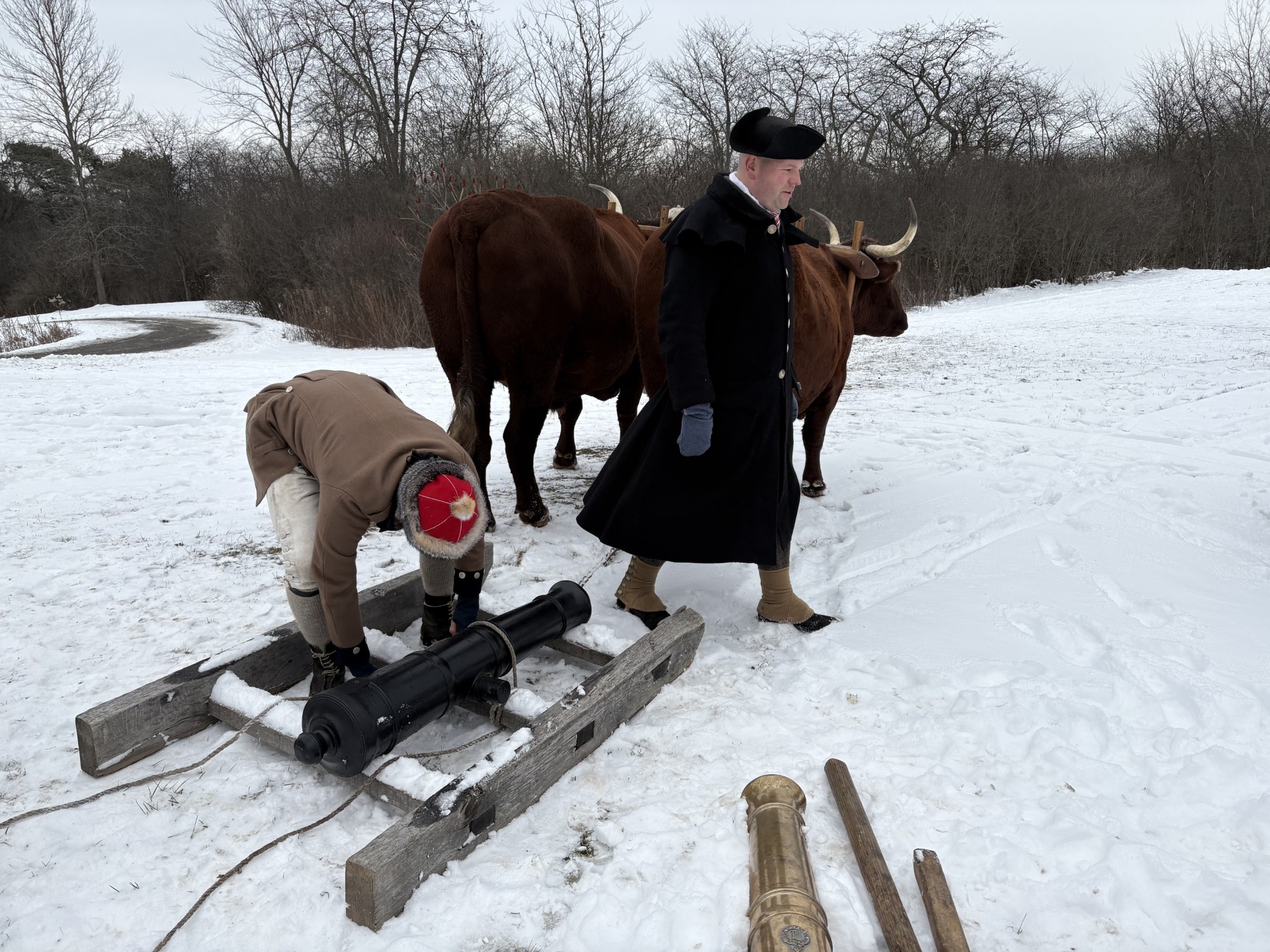
On Saturday, 21 February, Minute Man National Historical Park and Fort Ticonderoga will present a special event titled “To Win The Siege: The Noble Train Arrives.”

The park says:

We invite you to join us…at the Hartwell Tavern to commemorate the 250th anniversary of Knox’s Noble Train of Artillery arriving and outfitting for battle. Witness history come to life as the artillerists of Washington's army haul cannon via oxen, prepare supplies, and conduct artillery firing demonstrations.

Inside Hartwell Tavern we welcome you to enjoy the warmth and learn about the ways everyday people confronted the immense difficulties of surviving a siege of their own.
The living history encampment at the Hartwell Tavern site will be open from 10 A.M. to 4:30 P.M. During that time there will be demonstrations of:
  • Moving cannon with oxen, 11 A.M. and 3 P.M.
  • Firing artillery, 2 and 4 P.M.

Saturday, April 12, 2025

Making Plans for Battle Road 250

If you hope to visit the reenactments on Lexington common or Minute Man National Historical Park on Saturday, 19 April, it’s not too early to make plans about how to get there.

Between the local parades and the out-of-town crowds, moving around will be a challenge.

Here are three overlapping websites with transport information:
Basically, unless you live nearby or drive in well before dawn, you should expect to park at a distance from the events and then catch one of the many shuttle buses to within walking distance of the action you want to see.

The M.B.T.A. will run extra commuter trains on the Boston-Fitchburg line, but it won’t let passengers bring bicycles on board. 

There’s no food service inside Minute Man National Historical Park, and for security reasons visitors shouldn’t bring coolers. There are drinking fountains at the visitor centers, Hartwell Tavern, and the Nathan Meriam House. In addition to those sites’ usual restrooms, there will be portable toilets at Lexington’s satellite parking lots.

I recommend choosing which events you want to enjoy, heading for those, and enjoying the details rather than trying to see everything everywhere. The Battle Road 250 event inside Minute Man Park promises to be the largest, most accurate historical portrayal yet! And of course, we should hope for good weather.

Wednesday, March 26, 2025

Planning for the Sestercentennial of Battle of Lexington and Concord

As the 250th anniversary of the Battle of Lexington and Concord approaches, I’ve gotten requests for information about where the commemorations will happen.

The answer is that they’ll happen all over because that battle didn’t take place on one field, but spread out over twenty miles.

Furthermore, we New Englanders like our traditions. Many towns and organizations have their own time-honored ways of celebrating the anniversary: local parades, marches, pancake breakfasts, and the like. We’re not going to cancel those just because this anniversary ends in 50.

That said, because of the Sestercentennial many of our commemorations this year will be much bigger than usual: more participants, more spectators, more traffic. And that’s not counting the potential complications from the weather and from Washington, D.C.

Therefore, my only recommendation is to choose a couple of events to enjoy from the many on the schedule. But don’t assume that when I say “schedule,” there is one master schedule. Oh, no, that’s not how we operate here. Here are multiple sources to consult, and I don’t claim this list is exhaustive.

Battleroad.org is a venerable website [check out that coding!] which is updated each year with the latest details about events in Middlesex County. These include celebrations on the weekend before the big anniversary, such as Bedford’s pole-capping and Lincoln’s Paul Revere Capture ceremony. More events in early April appear on Minute Man National Historical Park’s page.

On Friday, 18 April, the National Parks of Boston, the Paul Revere House, and the Old North Church all have events linked to the start of Paul Revere’s ride to Lexington. Those three links go to overlapping lists of offerings, which include a reading of the play Revolution’s Edge, a reenactment of Revere’s movements, the lighting of two lanterns in the steeple, a talk by Prof. Heather Cox Richardson, and a talk by me. It’s impossible to see all those since the whole point is that they’re on opposite sides of the Charles River.

Saturday, 19 April, will start with the confrontation on Lexington common; see the Lexington 250 events calendar. Then the action moves into Minute Man Park for the clash at Concord’s North Bridge, followed by what promises to be the largest, most authentic reenactment ever of the fighting along the Battle Road. The best information on those happenings and how to enjoy them safely comes from the park.

This year the reenacting continues on Sunday afternoon with the Battle of Menotomy along Massachusetts Avenue in Arlington. The setting looks modern, but it’s the actual ground of the bloodiest fighting in April 1775.

Monday is of course Patriots’ Day, the state holiday best known for the Boston Marathon. And the celebrations aren’t over yet. It looks like the Lincoln Salute for fife and drum corps has been pushed to 27 April, for example. So choose your fighters.

Saturday, February 01, 2025

Join Us for “The Outbreak of War,” 3–6 Apr.

Last spring I worked with the Pursuit of History, the nonprofit founded by Lee Wright to organize History Camp, to produce a weekend of talks and tours about the New England rebellion of 1774.

This spring we’re offering a new program. On 3–6 April, we’ll gather in Concord and visit nearby towns to explore “The Outbreak of War.”

Once again, there are a limited number of seats available for this event, and I understand most have already been reserved. People are coming from as far away as California, Texas, Arizona, and New Mexico.

The event will start with dinner on Thursday, 3 April, at the eighteenth-century Wayside Inn in Sudbury. Over dessert I’ll review what led up to April 1775 and look ahead to the next three days.

On Friday, 4 April, we’ll meet inside the Wright Tavern in the center of Concord. Massachusetts Provincial Congress delegates met in committee in this building in the spring of 1775, and on April 19 the British commanders used it as their headquarters. We’ll hear presentations from these experts:
  • Jayne Triber, Ph.D., author of A True Republican: The Life of Paul Revere.
  • Don N. Hagist, author of Noble Volunteers: The British Soldiers Who Fought the American Revolution and editor of The Journal of the American Revolution.
  • Alexander Cain, author of We Stood Our Ground: Lexington in the First Year of the American Revolution.
  • Joel Bohy, expert in historic arms who appears regularly on Antiques Roadshow, sharing findings from recent battlefield archeology.
On that day we’ll also visit Concord’s Old Hill Burying Ground and North Bridge.

That evening, we’ll have dinner at the Colonial Inn, which dates to 1716. I’ll speak afterwards about how the royal government and the Massachusetts Patriots competed to control information before and after the battle.

On Saturday, 5 April, we’ll visit Lexington Common, viewing the historic buildings and monuments nearby and watching the rehearsal for the 250th-anniversary reenactment of the first shots of the Revolutionary War. (We have a contingency plan if bad weather postpones that rehearsal.) We’ll also stop at the Hartwell Tavern site, the Parker’s Revenge site, and the Jason Russell House in Arlington.

On Sunday, 6 April, attendees can sign up for an optional tour of colonial Marblehead architecture with Judy Anderson for an additional cost.

Some meals are included, and some will be up to the attendees. Lodging isn’t included in the cost, but there are rooms available for reserving at the Colonial Inn and other hotel possibilities nearby.

The Pursuit of History has a webpage with lots more details about the event. That page also includes a couple of videos of me out in Concord on a winter day, looking ahead to spring.

Thursday, January 30, 2025

Lincoln’s Sestercentennial Series

The town of Lincoln is observing the Sestercentennial with a series of exhibits at the library and a series of events.

The January exhibit was about Lincoln’s vote to send delegates to the Massachusetts Provincial Congress 250 years ago this month. The February exhibit will be on the theme “Enslaved in the American Revolution.”

Here are the presentations and other events announced so far.

Thursday, 30 January, 7:00 P.M., online
Causes of the American Revolution
Dane Morrison

Increasing taxation created dissent in Massachusetts. In 1774, Great Britain issued more punitive measures to suppress dissent and restore order, such as the revocation of the Massachusetts Bay Colony Charter of 1691. Former Salem State Professor Dane Morrison will discuss Lincoln at the beginning of the Revolution, exploring why an inland agricultural village would feel threatened by the new royal and Parliamentary initiatives. Register here.

Sunday, 2 February, 12:30–4:00 P.M., in and around Bemis Hall
The Lincoln of 1775
Co-hosted by the Bemis Free Lecture Series, the Lincoln Historical Society, the Lincoln Minute Men, the Middlesex County 4-H Fife & Drum, and Lincoln250

What was life like for families 250 years ago in Lincoln? Talk with reenactors about the attire, the food, and the amusements of family life of the day. The event will include musket demonstrations and music. At 2:00 P.M., a dance party will begin with instruction for all who wish to join. Refreshments will be served.

Thursday, 27 February, 7:00 P.M., online
Entangled Lives, Black and White in Lincoln, Mass.
Don Hafner

In the 18th century, the town of Lincoln had dozens of Black residents, enslaved and free, who helped the town thrive. They plowed the fields, hoed the gardens, and harvested the food. They did the cooking, they did the laundry, they cared for the children, they tended the sick and the elderly. They worked the blacksmith shops and the sawmills, made the nails and cut the boards for Lincoln’s first meeting house and houses that still stand. More than a hundred white residents of Lincoln lived in a household with an enslaved person. Come hear what we know about their entangled lives with historian Don Hafner. Register here.

Saturday, 8 March, 2:00 P.M., at the library
Meet Abigail Adams
Sheryl Faye

Lincoln250 celebrates Women's History Month! All ages are invited to Sheryl Faye’s engaging portrayal of Abigail Adams, wife of second President John Adams and sister of Lincoln Minute Men captain William Smith. Ms. Faye will portray Abigail as an adult and a child as she navigates life in colonial New England and stands up for the rights of women during the turbulence of War for Independence. All ages welcome. No registration necessary.

Thursday, 13 March, 7:00 P.M., at the library
Women in the American Revolution
Audrey Stuck-Girard

While the experiences of individual women during the American War of Independence have been largely left out of the historical record, they were nonetheless active participants of the cultural shift known as the American Revolution. Rural Massachusetts women in 1775 managed household budgets and property while being legally barred from owning any of that property. As the primary influence and educators of young children, they instilled moral and cultural values and ethics to the first generation of independent Americans. And when many of the men in their lives were away serving or killed in the war, women endeavored (with varying levels of success) to fulfill both male and female roles in their absence. Register here.

Monday, January 27, 2025

“In the afternoon there was a sham fight”

Back in 2011, guest blogger Roger Fuller quoted Albert W. Bryant’s recollection of watching a reenactment of the 1775 fighting on Lexington common that took place “on the 19th of April, 1822.”

Since Bryant shared that recollection at an 1890 meeting of the Lexington Historical Society, well over half a century after the event, I thought it was worth looking for evidence he got the date right.

And indeed, the 23 Apr 1822 Salem Gazette carried this item:
The 19th of April was noticed at Lexington by a military parade. In the afternoon there was a sham fight between the inhabitants of Lexington and its vicinity and the military corps, in imitation of the important event, which took place on the same day, in 1775.

An address on the occasion was delivered by the Rev Dr Stearns, of Lincoln.
That matches exactly with Bryant’s memory except he mistakenly recalled the minister coming from Bedford.

The Rev. Dr. Charles Stearns was sixty-eight years old when he delivered this address. According to a family history, he “preached his last sermon the first Sunday in July, 1826,” which was the 2nd. Living through the fiftieth anniversary of American independence, he died on the 26th.

Dr. Oliver Wendell Holmes (1809–1894) recalled being told as a boy that the “bulky” Stearns had published a poem in 1797 called “The Ladies’ Philosophy of Love.” Holmes wrote: “How I stared at him! He was the first living person ever pointed out to me as a poet!” Holmes wrote his own first poem at age thirteen, the same year as the commemoration in Lexington.

Saturday, January 25, 2025

Hiring Freeze in National Parks May Curb 250th Events

Yesterday National Parks Traveler reported that the new administration has ordered the National Park Service to rescind seasonal job offers made to up to 1,400 people.

Per the Washington Post, the new administration’s hiring freeze was explicitly not supposed to include “seasonal employees and short-term temporary employees necessary to meet traditionally recurring seasonal workloads.”

The Park Service has long depended on seasonals and interns, as everyone in the federal government knows. Every year the agency hires more people to cover the busiest months. Even so, its staffing level is pretty skeletal.

The Post story, filed by an environmental reporter, focuses on the big nature parks like Yellowstone and Yosemite. But a hiring freeze will also affect the historic parks, which get less attention.

Here in Massachusetts, we have several Sestercentennial anniversaries coming up. Local governments and organizations are planning events for their communities and expecting large influxes of tourists. In most cases, those events involve or require fully staffed national parks.

The Salem Maritime National Historic Site will have an exhibit on “Leslie’s Retreat,” due to open on 15 February, to complement events around the city.

Minute Man National Historic Park offers a full slate of events about the Battle of Lexington and Concord, running from presentations on spies on 22 March through a Battle Road Anniversary Hike on 21 April—with the big military reenactment in between on 19 April, of course.

The weeklong series of events in Charlestown to celebrate the 250th anniversary of the Battle of Bunker Hill on 17 June will of course be centered around the Monument, under the care of the National Parks of Boston. Even before then, the parks are sharing events like this 27 February talk on how Boston harbor helped to shape that battle.

Longfellow House–Washington’s Headquarters National Historic Site in Cambridge is preparing to commemorate the anniversary of the arrival of Gen. George Washington in July.

Looking further ahead, we’re all eagerly awaiting the reopening of the Dorchester Heights Monument to people visiting that crucial site in the siege of Boston.

I don’t know how much each of those initiatives depends on seasonal hires. But I know some parks absolutely need augmented staffing to handle their ordinary schedules, much less special events for larger crowds in an anniversary year.

Nobody in Washington is saying how long this hiring freeze will last. Hopeful N.P.S. managers have told people who’d received offers for seasonal jobs only to see those yanked away that the positions might open up again. But of course those managers thought they’d finally gotten through the federal hiring process and found qualified and eager staffers, only to have to pull back. As of this evening, the only N.P.S. job openings at USAJobs.gov are in security, firefighting, and other public-safety departments.

Monday, January 20, 2025

John Pope “removed from his late habitation”

It’s possible to follow cancer specialist John Pope’s travels during the Revolutionary War through his advertisements in newspapers.

There was a class of itinerant healers in early America, particularly dentists like John Baker. But Pope had lived in Boston before the war. Not only did he have a family and a Quaker faith community in Boston, but his reputation was strong enough that he didn’t have to go looking for patients; hopeful people came to him.

The siege of Boston disrupted that, sending Pope out to Mendon in the middle of 1775, as mentioned yesterday.

After the British military evacuated Boston in March 1776, Dr. Pope might have returned there, but he didn’t stay. Instead, on 6 July he ran this ad in the Providence Gazette:
The Public are hereby informed, that JOHN POPE who of late Years hath been much noted in curing malignant ULCERS, and inveterate CANCERS, having by Reason of the distressed Situation of the Town of Boston, his native Home, removed into the Country, now resides at Smithfield, near Woonsoket Falls, Rhode-Island Government.
On 22 July Dr. Pope made the same announcement in the Boston Gazette, adding “scrofulous Tumours” to the list of things he was known to cure. Those were swelling in the neck produced by an infection of the lymph nodes, often involving tuberculosis. Since Americans no longer had access to the king’s touch, they need a domestic scrofula cure.

Two years later, on 7 May 1778, Pope told readers of the Independent Chronicle that he had “removed from his late habitation, into Lincoln, at Humphry Farrar’s and expects soon to fix himself in the south of Concord.” Farrar (1741–1816) had mustered in his militia company during the Lexington Alarm and the push onto the Dorchester peninsula. He later moved to Hanover, New Hampshire.

Five more years, and on 22 May 1783 Dr. Pope returned to the Independent Chronicle to announce his new home as “Lynn, Essex County, Massachusetts State, near the Friends Meeting-House.” This ad then added:
He has for sale, at a small Price for the Cash, in the South corner of Concord, about two acres of excellent Land; with some fruit Trees, a well of Water, a small upright House and two other small Buildings; situate very suitable for a Blacksmith, or a good Shoe-Maker.
Folks interested in the property could inquire of a neighbor, Amos Hosmer (1734–1810). Having experience from the previous war, Hosmer had been made a sergeant and then lieutenant in the Middlesex County militia.

Pope’s stay in Lynn wasn’t long, either. On 17 Sept 1785 the Massachusetts Centinel told readers:
John Pope,
Who for 18 years past has been noted for curing Cancers, scrophulous Tumors, fetid and phagedonic Ulcers, &c. has removed into a house, the North corner of Orange and Hollis Street, south end, Boston, Where he proposes to open a school for Reading, Writing, Arithmetick, Surveying, Navigation, Mensuration of superfices and solids, practical Gauging, &c, and an Evening School the 19th inst. [i.e., of this month]
Dr. Pope had finally returned to “his native Home,” and he stayed there until his death in 1796.

[The picture above shows a section on “Mensuration of Superficies” from Nicolas Pike’s A New and Complete System of Arithmetic, Composed for the Use of the Citizens of the United States, published out of Newburyport in 1788.]

Saturday, September 07, 2024

Gunshots in the Countryside

On 7 Sept 1774, 250 years ago today, Henry Vassall was riding in Lincoln when he heard a gunshot.

The only Henry Vassall I was able to find on the family tree at this time was a nineteen-year-old son of William Vassall, discussed yesterday.

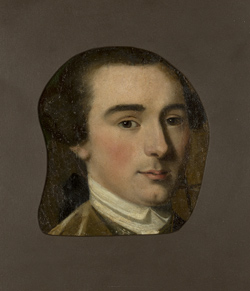
Henry was either visiting or staying with his cousin Elizabeth, wife of Dr. Charles Russell (1739–1780, shown here). I wonder if he was studying medicine.

Later that month Henry Vassall told the Charlestown committee of correspondence about his experience. He then wrote out an account for two Middlesex County magistrates, Henry Gardner of Stow and Dr. John Cuming of Concord:
Passing between the House of Mrs. Rebecca Barons [?] & Doct. Russell’s between the Hours of 7 & 9 in the Evening of the 7 instant [i.e., this month] & to the best of my Knowledge as I rose [?] a little Hill a little a past the first Canopy [?] I heard the report of a Gun saw the light and a Ball Enter’d the Carriage which I was in being Doct. Russells.

I immediately step’d out of the Carriage & stood about five or six Minutes & then stepp’d into the Carriage Again & road in haste to the Doctor when I had gone a small Distance from the Place where the Gun was discharged I met a person on Horse back

when I had past a small Distance further I met several Persons riding on two Horses,

whether the Ball was aim’d at the Carriage I can’t say I further declare I do not know or even suspect who the Person was that Discharg’d the Gun as above mentioned . . .

NB. The above affair I declar’d to no person in Lincoln but the Revd. Mr. [William] Lawrence & desired him to keep it secret—Till the Friday Following.
Gardner and Cuming also gathered statements from a local man named Joseph Peirce and Luck, enslaved to Dr. Russell. Both declared that they had been traveling near young Vassall and had heard no gunshot.

Three members of the Lincoln committee of correspondence then wrote back to Charlestown agreeing that they detested “the Crime of Assassination” but casting doubt on Vassall’s complaint:
We shall only add that as the evening on which this event was said to have happened was very calm it is the general opinion here that it is very improbable if not utterly impossible that a gun should be Discharged at that time & place without being heard by many persons, you have Doubtless seen the impression in the Carriage & are able to judge & Declare whether it is the efect of a Bullet Discharged from a Gun or Not as well as any person in this town
This incident provided yet another reason for members of the Vassall family to seek safety surrounded by the king’s soldiers. (And on the same day that the magistrates wrapped up their investigation, people in Bristol, Rhode Island, threw stones at the chaise of Henry’s father and stepmother, William and Margaret Vassall. Newspapers reported that “next morning [they] set out for Boston.”)

This shot in Lincoln is only the second example I’ve found of someone in Massachusetts firing a gun at a supporter of the royal government. The first had occurred a couple of weeks earlier in Taunton.

According to Daniel Leonard, a veteran of the last war named Job Williams came to his house with a warning that “the People were to assemble” to protest how he had joined the mandamus Council. Leonard left, thinking that would head off the problem. Instead, on 22 August , or perhaps make it clear he wouldn’t be welcomed back. That crowd did arrive. Leonard wrote:
about five hundred persons assembled, many of them Freeholders and some of them Officers in the Militia, and formed themselves into a Battalion before my house; they had then no Fire-arms, but generally had clubs. . . .

My Family supposing all would remain quiet, went to bed at their usual hour; at 11 o’Clock in the evening a Party fixed upon the house with small arms and run off; how many they consisted of is uncertain, I suppose not many; four bullets and some Swan-shot entered the house at the windows, part in a lower room and part in the chamber above, where one Capt. Job Williams lodged. The balls that were fired into the lower room were in a direction to his bed, but were obstructed by the Chamber floor. . . . I conclude it possible that the attack upon the house was principally designed for him.
Back in 1769–1770, there had been three increasingly notorious incidents of government supporters shooting at crowds of protestors: the “Neck Riot,” Ebenezer Richardson killing Christopher Seider, and of course the Boston Massacre. But even in that period Massachusetts protestors had never shot at royal officials or their supporters.

These untraceable gunshots in the late summer of 1774 show that some people in Massachusetts were starting to think it was acceptable to use that level of violence against Loyalists.

Thursday, May 09, 2024

How Many British Soldiers Are Buried beside the North Bridge?

How many British soldiers are buried beside the North Bridge in Concord?

On some night late in 1891, George R. Brooks and other local worthies took a cranium given up by the Worcester Society of Antiquity and interred it in the patch of ground beside the bridge long marked as the grave of two redcoats.

In doing so, they believed they were restoring one of two skulls that had been removed from that grave decades before.

That would have left slightly less than two British soldiers buried there.

Those men were convinced that the phrenologist Walton Felch had dug up those skulls with the permission of the Concord selectmen back around 1840, shortly after the town had erected its obelisk monument to the fighting on 19 Apr 1775.

They were also convinced that the skull they had failed to return was damaged, based on a series of musts:
  • If the two skulls were unearthed in Concord, they must have come from the grave beside the North Bridge because that was the only grave of British soldiers in town with two bodies.
  • If the skulls came from the grave at the North Bridge, they must have belonged to the soldiers killed at that bridge, including the one Ammi White hit in the head with a hatchet.
  • If one of those skulls came from a man killed by a hatchet blow to the head, that skull must have shown severe damage.
And thus, even though no one reported actually seeing a damaged second skull in the latter half of the 1800s, people became convinced that it was “demoralized.”

But what if the initial premise of that logical chain was wrong? Because that’s what the evidence from ante-bellum Concord says.

First of all, in 1840 schoolboy Edmund Quincy Sewall, Jr., went to hear the phrenologist Walton Felch at the Concord Lyceum. Right afterward, Edmund wrote in his diary that the man had the top part of the skull of a British soldier with a bullet hole through it, and that cranium had been “dug up in Lincoln,” not Concord.

Second, in 1850 Henry David Thoreau spoke with William Wheeler, who described seeing Felch dig up two skulls years before in an “almost unused graveyard in Lincoln.” Wheeler’s description of a bullet hole through one cranium matched young Edmund’s.

Third, in 1836 the town of Concord chose to erect its monument near where two soldiers had been shot and buried. Lots of people paid attention to that spot, including the Rev. Dr. Ezra Ripley, Ralph Waldo Emerson, and other town leaders. There was also a contingent in Concord who had wanted the monument built elsewhere. The selectmen couldn’t have authorized opening the soldiers’ graves without people in town knowing, and at least some of them criticizing the idea. There would have been no secrets.

In contrast, Lincoln had had a lot more British soldiers to bury back in April 1775. So many that local men simply carted those bodies to the town burying-ground and placed them in a single grave in the paupers’ section. By the 1830s that old cemetery was largely ignored. Lincoln didn’t put up any marker for those bodies until 1884. In sum, few people in Lincoln probably cared whether those bodies were disturbed.

I wouldn’t be surprised if Lincoln’s town records from the late 1830s show the selectmen granting Felch permission to explore the cemetery. And I wouldn’t be surprised if those records say nothing about Felch’s request; the selectmen may not have cared enough to take formal action. Unlike in Concord, how to treat the remains of British soldiers in Lincoln wasn’t a monumental decision.

In the following years Felch described his skulls as those of soldiers killed in the “Battle of Concord.” Some listeners heard, or remembered, that as meaning the soldiers had died in the town of Concord. By the time Albert Tyler and Daniel Seagrave were asking his widow about the skulls, Felch wasn’t around to correct that idea. So those men and their Worcester Society of Antiquity colleagues understood the skulls as having come from Concord.

That mistaken belief led to museum labels and newspaper articles about the remaining skull from Concord—reportedly unearthed with the selectmen’s approval. Men from Concord started to whisper about how that reflected on them and their forefathers. They constructed the logical chain above. And ultimately we reach the moment in 1891 when Concord antiquarians were secretly digging in the dirt beside the North Bridge, not to investigate but to partially rectify a breach of etiquette from fifty years before.

But that wasn’t really necessary. The last time that skull had been in Concord, it was still healthy, even if its owner might have come under fire. That soldier didn’t die until a bullet pierced his brain in Lincoln. In 1891 the rest of that man’s body was still in Lincoln, and whatever remains of it is there now.

Buried in the grave beside Concord’s North Bridge are slightly more than two British soldiers.

Saturday, May 04, 2024

G. F. Hoar and “stories of the Battle of Concord”

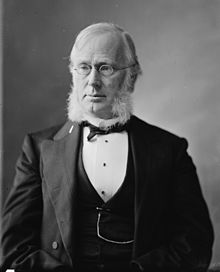
George Frisbie Hoar (1826–1904, shown here) was born in Concord. His father, Samuel Hoar, represented the area in the U.S. Congress and contributed to the wording of the town’s monument at the North Bridge.

In his autobiography Hoar wrote fondly about growing up in Concord, and particularly about living reminders of the Revolutionary War:
Scattered about the church were the good gray heads of many survivors of the Revolution—the men who had been at the bridge on the 19th of April, and who made the first armed resistance to the British power. They were very striking and venerable figures, with their queues and knee-breeches and shoes with shining buckles. Men were more particular about their apparel in those days than we are now. They had great stateliness of behavior, and admitted of little familiarity.

They had heard John Buttrick’s order to fire, which marked the moment when our country was born. The order was given to British subjects. It was obeyed by American citizens. Among them was old Master [Thaddeus] Blood, who saw a ball strike the water when the British fired their first volley. I heard many of the old men tell their stories of the Battle of Concord, and of the capture of Burgoyne.

I lay down on the grass one summer afternoon, when old Amos Baker of Lincoln, who was in the Lincoln Company on the 19th of April, told me the whole story. He was very indignant at the claim that the Acton men marched first to attack the British because the others hesitated. He said, “It was because they had bagnets [bayonets]. The rest of us hadn’t no bagnets.”

One day a few years later, when I was in college, I walked up from Cambridge to Concord, through Lexington, and had a chat with old Jonathan Harrington by the roadside. He told me he was on the Common when the British Regulars fired upon the Lexington men.

He did not tell me then the story which he told afterward at the great celebration at Concord in 1850. He and Amos Baker were the only survivors who were there that day. He said he was a boy about fifteen years old on April 19, 1775. He was a fifer in the company. He had been up the greater part of the night helping get the stores out of the way of the British, who were expected, and went to bed about three o’clock, very tired and sleepy. His mother came and pounded with her fist on the door of his chamber, and said, “Git up, Jonathan! The Reg’lars are comin’ and somethin’ must be done!” . . .

A very curious and amusing incident is said, and I have no doubt truly, to have happened at this celebration. It shows how carefully the great orator, Edward Everett, looked out for the striking effects in his speech. He turned in the midst of his speech to the seat where Amos Baker and Jonathan Harrington sat, and addressed them. At once they both stood up, and Mr. Everett said, with fine dramatic effect, “Sit, venerable friends. It is for us to stand in your presence.”

After the proceedings were over, old Amos Baker was heard to say to somebody, “What do you suppose Squire Everett meant? He came to us before his speech and told us to stand up when he spoke to us, and when we stood up he told us to sit down.”
In Concord, George F. Hoar became lifelong friends with Henry David Thoreau. They met as schoolboys at different grades, and George later attended the Thoreau brothers’ Concord Academy for a while. It’s unclear whether he overlapped with Edmund Quincy Sewall, Jr.

However, in an 1891 letter Hoar wrote that as a boy he attended a lecture in Concord where the speaker exhibited the skull of a British soldier killed in 1775. That could only have been Walton Felch at the town’s lyceum in the spring of 1840.

After the obligatory years at Harvard, George F. Hoar went into the law, establishing his practice in Worcester. Then he went into politics. He served in the Massachusetts General Court, then the U.S. Congress after the Civil War, and finally the U.S. Senate from 1877 to 1904.

Back home, Hoar helped found what became the Worcester Polytechnic Institute and served as president of the American Antiquarian Society. He also sat on boards of the Smithsonian Institute and the Peabody Museum of Archaeology and Ethnology, so he didn’t have a complete aversion to museums holding human remains.

But Sen. Hoar didn’t like the idea of the Worcester Society of Antiquity holding that skull of a British soldier killed on 19 Apr 1775.

TOMORROW: A private arrangement.

Friday, May 03, 2024

“The most prominent addition made to the cabinet”

On 2 Feb 1877, the Boston Daily Advertiser took note of “an exhibition of antiquarian relics” temporarily open “in the rooms of the National History Society of Worcester.”

The article didn’t provide the name of the group that had organized the exhibit, the Worcester Society of Antiquity, which received its state charter that year.

All the objects on display were probably owned by members. Most were items on paper, including books, deeds, commissions, newspapers, and autographs unfortunately clipped out of documents of greater interest. 

The exhibit did include “Spurs worn by General [Artemas] Ward in the Revolutionary war.” And:
the skull of a British soldier from Concord, April 19, 1775.
The Worcester Natural History Society, founded in 1825 as the Worcester Lyceum of Natural History, went on to open the New England Science Center, now called the EcoTarium.

Meanwhile, the Worcester Society of Antiquity started renting its own space in the building of the Worcester National Bank for its meetings and growing collection. On 6 Apr 1881 the Worcester Evening Gazette reported on the group’s monthly gathering, saying:
The most prominent addition made to the cabinet was the skull of a British soldier, shot at Concord Bridge in the first fight of the Revolution. Two were killed and buried where they fell. In 1844 [sic], by permission of the Selectmen, the bodies were exhumed by a resident, whose widow, who is in reduced circumstances transferred the relic to the Society. The members made up quite a collection of money for the donor. The other skull is in possession of Dr. J. N. Bates of this city.
The soldier’s skull had actually been dug up before 1840 because Edmund Quincy Sewall, Jr., saw Walton Felch display it that year. Sewall also heard that the skull had been dug up in Lincoln, not Concord, and Henry David Thoreau recorded the circumstances later in his journal.

The 1881 article suggests that Daniel Seagraves had just formally donated the skull to the society. As discussed yesterday, Dr. Joseph N. Bates died in 1883, and no one could find the second skull among his effects.

Folks might uncover other newspaper mentions of the British soldier’s skull on display in Worcester in the late 1800s. These are the only two I came across. Notably, they show no squeamishness about displaying human remains.

After a generous gift from a member and some fundraising, the Worcester Society of Antiquity opened its own building on Salisbury Street in 1892. The organization became the Worcester Historical Society in 1919 and the Worcester Historical Museum in 1978. Ten years after that, it moved into its present building on Elm Street.

But the British soldier’s skull was never exhibited in those museums.

Some people didn’t like the thought of that British soldier’s skull being separated from his body.

TOMORROW: Back to Concord.

Sunday, April 28, 2024

“Mr Felch is delivering a course of Phrenological Lectures”

Walton Felch was born in Royalston, Massachusetts, in 1790, youngest in a large family. Eventually his parents and some siblings moved to Vermont, forming the village of Felchville in Reading.

Walton Felch appears to have gone to work in one of Rhode Island’s early industrial mills as a teenager. Ambitious and eager for knowledge, he rose to management ranks. He then did something even more unusual, turning his experience into poetry.

In 1816 Felch published The Manufacturer’s Pocket-Piece, or, The Cotton-Mill Moralized: A Poem, with Illustrative Notes. The notes about how mills of this time really operated appear to have had more lasting value than the poetry.

Felch continued to write poetry his whole life. He composed verses on fire, the stars, his ancestors, and other topics. When he died, a big part of his legacy to his family was hundreds of unpublished poems.

The year before The Manufacturer’s Pocket-Piece appeared, Felch married Lydia Inman of Smithfield, Rhode Island. He was then listed as living in Attleboro, and the couple may soon have moved to Medway. Walton and Lydia had at least three children: Hiram (house builder and assessor who stayed in Massachusetts), Walton Cheever (trained as a printer, moved to California in the Gold Rush), and Sarah (married a man named Dunbar).

Walton Felch was living in Hubbardston in 1831 when he married again, to Mrs. Nancy Sullivan. By 1840 he was in the area of Oakham called Coldbrook Springs, and he was living there at the end of his life—but didn’t necessarily remain there the whole time.

Felch was certainly intellectually restive. He enjoyed the lyceum movement of the time, particularly the Barre Lyceum, right over the town line. He spoke there in 1834 on the subject of geology. The next year, he participated in a debate: “Does the strength of temptation lessen the turpitude of crime?” In 1837 he spoke on the costs and benefits of government-sponsored South Sea exploration.

One of Felch’s most consuming interests was grammar. In December 1834 he lectured on his “Architectural System of the English Grammar.” He then published A Comprehensive Grammar, Presenting Some New Views of the Structure of Language (1837) and Grammatical Primer: Comprising the Outlines of the Compositive System (1841). The Norfolk Democrat credited Felch with “a very amusing and instructive Lecture” on the topic in January 1840.

The Barre Gazette of 23 Feb 1838 signaled a new interest:
Oakham Lyceum Meets on Monday evening, the 26th inst. Lecture by Mr Felch on Phrenology.
Phrenology was a relatively new scientific pursuit—diagnosing people’s personalities, strengths, and deficits from the bumps on their skulls, usually as felt through through hair and skin. By the next year, Felch felt he had mastered it enough to publish A Phrenological Chart: And Table of Combinations.

On 15 Nov 1839 the Christian Freeman and Family Visitor of Waltham published this item:
Phrenological Lectures.

Mr Felch is delivering a course of Phrenological Lectures in Rumford Hall [shown above]. We perceive from letters in his possession, that he shares the confidence of Mr [George] Combe, and has given great satisfaction where he has lectured. He has not only read extensively on the science upon which he lectures, but is a close observer of mankind, and an original thinker. We were pleased and instructed by his lecture last Tuesday evening, which was the first of a course of six, to be delivered on Tuesday and Thursday evenings. Admission 12 1-2 cents each evening.
That expertise seems to have been enough to persuade the selectmen of Lincoln to let Felch take the skulls of two British soldiers killed on 19 Apr 1775 from the town’s old burying-ground. Indeed, according to Henry David Thoreau’s understanding, Felch actually had those skulls “dug up” particularly for his phrenological investigation.

TOMORROW: When Felch took his skulls to Concord.

Saturday, April 27, 2024

“Dug up–and took away two skulls”

In the summer of 1840, shortly after twelve-year-old Edmund Quincy Sewall, Jr., got to see part of a British soldier’s skull with a bullet hole through it, his teacher John Thoreau proposed marriage to his sister, Ellen Sewall.

The Rev. Edmund Quincy Sewall, Sr., opposed that union. Then Edmund’s other teacher, Henry David Thoreau, proposed marriage to Ellen as well. And the Thoreau family drama built from there.

In the decade that followed, John Thoreau died of tetanus. Henry moved in with the family of Ralph Waldo Emerson, then moved out to a cabin in Walden Woods, then moved back in. He became a published author. He spent time in jail for protesting the Fugitive Slave Act by refusing to pay his taxes.

During those years, Henry David Thoreau kept a diary. In the late spring of 1850 he wrote this entry:
I visited a retired–now almost unused graveyard in Lincoln to-day where (5) British soldiers lie buried who fell on the 19th April ’75. Edmund Wheeler—grandfather of William—who lived in the old house now pulled down near the present—went over the next day & carted them to this ground—

A few years ago one Felch a Phrenologist by leave of the select men dug up–and took away two skulls

The skeletons were very large—probably those of grenadiers. Wm Wheeler who was present–told me this—He said that he had heard old Mr. Child, who lived opposite–say that when one soldier was shot he leaped right up his full length out of the ranks & fell dead. & he Wm Wheeler–saw a bullet hole through & through one of the skulls.
There were multiple families named Child in Lincoln around 1775, so it’s hard to identify which one gave that description of the dying redcoat to Wheeler.

The skull with the bullet hole was undoubtedly the same one that young Edmund Quincy Sewall had seen at the Concord Lyceum in 1840. The schoolboy had even recorded that it had come from Lincoln. Perhaps another of the skulls put out for the phrenologist was also from a regular’s body.

Concord had built a large monument near the gravesite of the first two British soldiers killed on 19 Apr 1775. Those weren’t the only redcoats buried in that town, but those two bodies were the most significant because they showed the Americans effectively fighting back.

In contrast, more regulars had died on 19 April in Lincoln, but that town was less concerned about memorializing them. Some soldiers were buried near where they fell, or near the houses where they died days later. Those graves weren’t marked, even with “rough stones” as originally in Concord. It was up to men like William Wheeler to pass on the increasingly vague knowledge of where those bodies lay.

As for the British soldiers in the town burying-ground, Abram English Brown’s Beneath Old Roof-Trees (1896) would quote Mary Hartwell of Lincoln about the aftermath of the battle:
I could not sleep that night, for I knew there were British soldiers lying dead by the roadside; and when, on the following morning, we were somewhat calmed and rested, we gave attention to the burial of those whom their comrades had failed to take away.

The men hitched the oxen to the cart, and went down below the house, and gathered up the dead. As they returned with the team and the dead soldiers, my thoughts went out for the wives, parents, and children away across the Atlantic, who would never again see their loved ones; and I left the house, and taking my little children by the hand, I followed the rude hearse to the grave hastily made in the burial-ground.

I remember how cruel it seemed to put them into one large trench without any coffins. There was one in a brilliant uniform, whom I supposed to have been an officer. His hair was tied up in a cue.
In 1884 the town of Lincoln installed a marker in that cemetery stating simply:
FIVE
BRITISH SOLDIERS
SLAIN APRIL 19, 1775
WERE BURIED HERE
The approximate locations of other soldiers’ graves along the Battle Road in Lincoln have also been marked now.

But the diaries of Edmund Quincy Sewall, Jr., and Henry David Thoreau tell us that parts of the soldiers’ bodies were removed from the Lincoln burying-ground over forty years before the town marked the remains.

TOMORROW: To advance the cause of science.

Sunday, April 21, 2024

The Death of Daniel Thompson

Yesterday I quoted Maj. Loammi Baldwin’s diary noting the death of Woburn militiaman Daniel Thompson on 19 Apr 1775.

The published Woburn vital records say Daniel Thompson was born on 9 Mar 1734, making him forty-one years old at the Battle of Lexington and Concord (unless that’s an unlabeled Old Style date). He and his wife Phebe had three children, born 1761–1765.

According to a family history, The Memorial of James Thompson, of Charlestown, Mass., 1630-1642, and Woburn (1887), this was the story of Thompson’s death:
He was a man of ardent temperament, full of activity and enterprise. Previous to the Revolutionary war he was one of the guards of the royal governor [most likely the horse guard], and yet, in the troubles which preceded that event, he ever zealously espoused the cause of his native country.

On the morning of the 19th of April, 1775, hearing of the march of the British toward Concord, he mounted his horse and hurried to the north village, a mile distant, for the purpose of rousing his friends to oppose the march of the enemy. There is a tradition that of all the men he met only one hesitated, and when that one asked him if he were not too hasty and likely to expose himself to great danger, he instantly replied, “No! I tell you our tyrants are on their march to destroy our stores, and if no one else opposes them to-day, I will!” Immediately hurrying away to the scene of action, he boldly took his position and poured his fire into the ranks of the British.

On the retreat of the enemy, he took a station near the road. Stepping behind a barn to load, and then advancing round the corner of the building, he fired diagonally through the platoons of the enemy, so as to make every shot effectual.

A grenadier, who watched his movements, was so enraged that he ran around the corner of the barn and shot him dead on the spot, while he was in the act of reloading his gun. Tradition says that a well directed ball from another Woburn gun prevented the grenadier from ever rejoining his comrades.
I’m skeptical about that quotation, though the aggressive attitude seems to fit with going too close to the road and being cut down by a flanker. Abram English Brown’s Beneath Old Roof Trees (1896) added the comforting claim that one of Daniel Thompson’s own brothers killed that grenadier and brought his firelock back home to Woburn.

More certainly, we know that Thompson died within the borders of Lincoln. His body was brought back to Woburn. On 21 April there was a joint funeral with Asahel Porter, detained by the regulars in the early hours of the 19th and killed in the shooting on Lexington common.

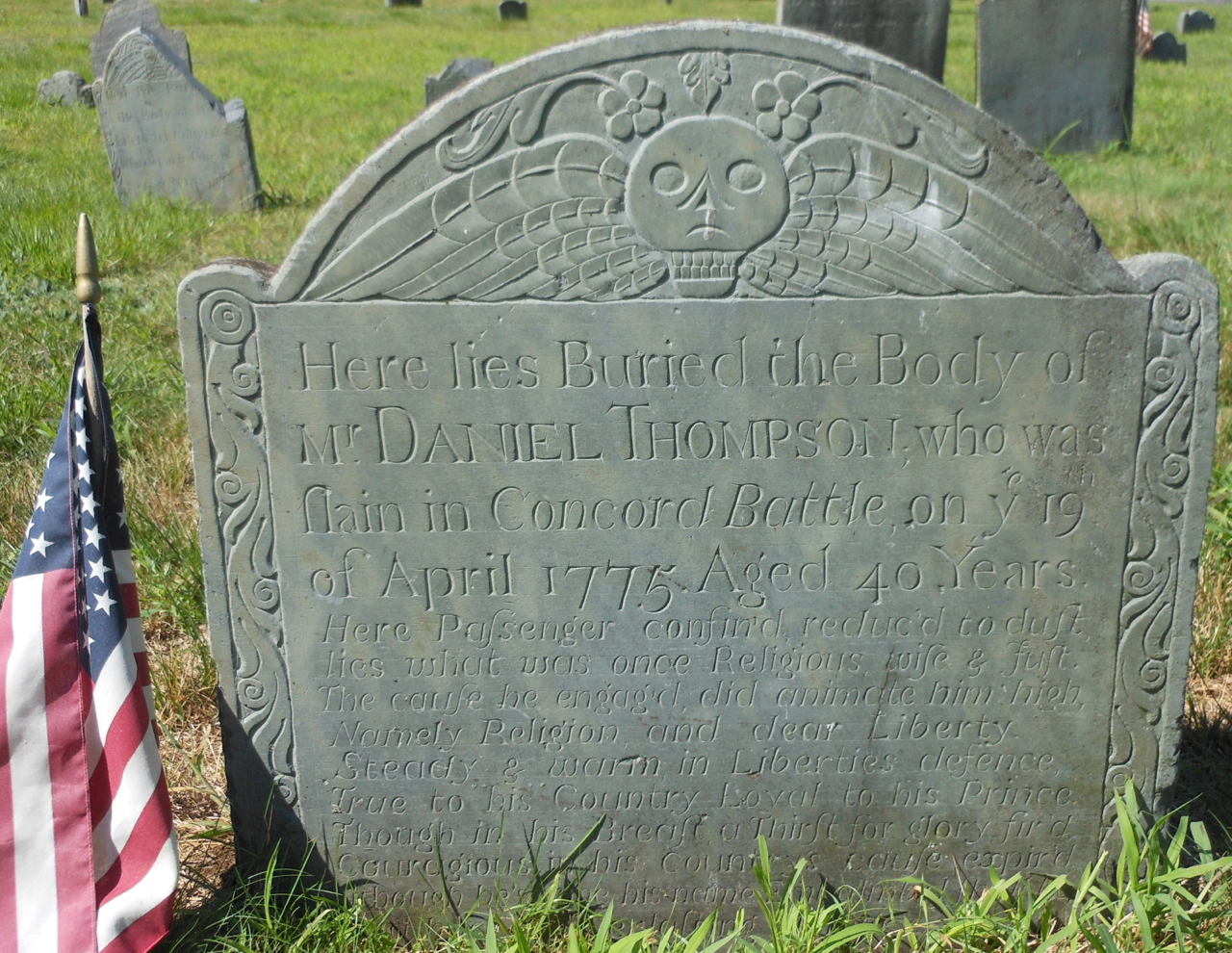
Thompson’s gravestone appears above, courtesy of Find a Grave. It says:
Here lies Buried the Body of
Mr. DANIEL THOMPSON who was
slain in Concord Battle on ye. 19th.
of April 1775. Aged 40 Years.

Here Passenger confin’d reduc’d to dust,
lies what was once Religious wise & Just.
The cause he engaged did animate him high,
Namely Religion and dear Liberty.
Steady and warm in Liberties defence,
True to his Country, Loyal to his Prince.
Though in his Breast a Thirst for glory fir’d,
Courageous in his country’s cause expired.
Although he’s gone his name Embalmed shall be,
and had in Everlasting Memory.
The phrase about “Loyal to his Prince” suggests the Thompson family erected this stone in 1775 when most Americans still professed allegiance to King George III and saw themselves as fighting corrupt British ministers rather than the whole British constitutional system. If the Thompson family had had to wait another year for the stonecarving, the elegy would surely have praised Thompson’s loyalty to his country but not to his “Prince.”

Daniel and Phebe Thompson’s daughter, born in 1762 and also named Phebe, married Josiah Pierce in 1787 and settled in Maine. Josiah was a younger half-brother of Benjamin Thompson, who by then had moved from Woburn to Europe on his way to becoming Count Rumford.

Saturday, April 20, 2024

“A ball came thru the Meeting house near my head”

Yesterday we left Maj. Loammi Baldwin and his Woburn militiamen skedaddling east from Brooks Hill in Concord with the withdrawing British column on their tail.

Baldwin’s account in his diary, as transcribed in this copy with line breaks for easier reading, continues:
we came to Tanner Brooks at Lincoln Bridge & then we concluded to scatter & make use of the trees & walls for to defend us & attack them—We did so & pursued on flanking them—(Mr Daniel Thompson was killed & others[)]. till we came to Lexington. I had several good shots—
“Tanner Brooks” referred to the tannery owned by the Brooks family. Analysts of the battle say the Woburn companies engaged the British troops somewhere around the Hartwell Tavern within the borders of Lincoln.
The Enemy marched very fast & left many dead & wounded and a few tired I proceeded on till coming between the meeting house and Mr Buckmans Tavern with a Prisoner before me when the Cannon begun to play the Balls flew near me I judged not more than 2 yards off.

I immediately retreated back behind the Meeting house and had not been there 10 seconds before a ball came thru the Meeting house near my head.

I retreated back towards the meadow North of the Meeting house & lay & heard the ball in the air & saw them strike the ground I judged about 15 or 20 was fired but not one man killed with them. They were fired from the crook in the road by Easterbrooks—
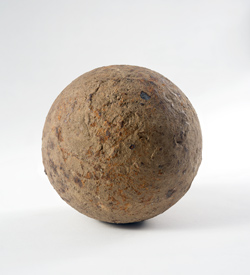
The picture above, courtesy of the Massachusetts Historical Society, shows a “small cannon ball, said to have been found on the side of the road near Lexington” at some point. The webpage for this artifact says: “It is made of lead and was the type of projectile fired from a smooth-bored cannon.”

In The Road to Concord I argue that the presence of cannon in Concord, and particularly the brass cannon of the Boston militia train, was crucial to Gen. Thomas Gage’s decision to order an expedition there.

But the provincials moved most of those cannon further west in the days before that march. They probably weren’t all equipped for use, anyway. On the British side, the expedition under Lt. Col. Francis Smith marched with no artillery for maximum speed.

But Col. Percy’s reinforcement column did come out with field-pieces, and those were the cannon that Loammi Baldwin and his Woburnites ran into. By deploying heavy weapons for the first time that day, Percy was able to make time for the combined British forces to regroup in Lexington, tend their wounded, and set off for Boston.

As for Maj. Baldwin, his diary stops as quoted above. The transcripts don’t resume until May, when he was an officer in the provincial army. Baldwin probably decided that having marched into Concord and back, fired “several good shots,” and taken a prisoner, his unit had done their dangerous duty for the day. He and his men may have followed the British column east for some more miles, but they stayed out of cannon range.

Friday, April 19, 2024

“Soon heard that the regulars had fired upon Lexington People”

For Loammi Baldwin of Woburn, 18 Apr 1775 was not a good day.

As he wrote in his diary, “My Brother Ruel departed this life after a short illness of 5 or 6 days, Pleurisy fever.” Loammi was there, along with his parents.

Reuel Baldwin was twenty-seven years old. He left his wife Keziah and three young children—Reuel, Ruth, and James—with another child on the way, eventually named Josiah.

The next day, Loammi Baldwin had to muster as a major in the Middlesex County militia. An officer in a horse troop, Baldwin rode instead of marched.

I don’t know if Loammi Baldwin’s diary still exists, but there are two handwritten transcripts of select dates in the Harvard libraries, and much of his entry on 19 Apr 1775 was published in the first volume of D. Hamilton Hurd’s History of Middlesex County in 1890.

There’s an old joke that a man with a watch always knows what time it is, but a man with two watches never does. Likewise, with one transcript we’d feel confident about what Baldwin originally wrote, but with three there are some reasons for doubt about the details.

Here’s how Maj. Baldwin described his experience of the start of the war according to this transcript, with line breaks added to make reading a little easier:

April 19. Wednesday

This morning a little before break of day we was allarmed by Mr. Ledman [probably Ebenezer Stedman] Express from Cambridge—Informd us that the Regulars were upon the move for Concord

we musterd as fast as possible—The Town turned out extraordinary & proceeded towards Lexington & Rode along a little before main body and when I was nigh Jacob Reeds I heard a great firing proceeded on soon heard that the regulars had fired upon Lexington People & killed a large Number of them

we proceeded on as fast as possible and came to Lexington and saw about 8 or 10 dead & Numbers wounded was informed that the Regulars rushed upon our Lexington men and hollowed damn you Disperse Rebels & fired upon the Lexington Company

we proceeded to Concord by way of Lincoln meeting house come to Concord ascended the hill & pitched & refreshed ourselves a little

about [blank] o’clock the People under my command & also some others came running of the East end of the hill while I was at a house refreshing myself & we proceeded down the road & could see behind us the regulars following
A transcript with a more modern handwriting but more alternative spellings and the name “Stedman” starts at seq. 15 in this document. I can’t tell if this is more accurate to what Baldwin originally wrote. Fortunately, none of the discrepancies so far seriously affect his meaning.

TOMORROW: Cannon fire.

Wednesday, April 10, 2024

Elijah Sanderson of Lexington and Salem

Elijah Sanderson has appeared on Boston 1775 several times, but usually as a source on other people’s experiences of the April 19 battle.

Several years back, Donna Seger highlighted Sanderson’s memories of that day and his subsequent career on her Streets of Salem site.

In 1775 Sanderson signed off on a brief account of his experience for the Massachusetts Provincial Congress. But he had much more to say in Elias Phinney’s History of the Battle of Lexington, on the Morning of the 19th of April, 1775, published in 1825.

Seger wrote:
Phinney took oral histories from participants who were still alive, published in the form of sworn affidavits in the book’s appendix, and the very first account was that of Elijah Sanderson, who was at the end of a long career as one of Salem’s most successful cabinetmakers. Sanderson’s testimony was given just weeks before his death in early 1825, and published not only in Phinney’s account but also in the regional newspapers that year, when historical consciousness of the importance of the Battles of Lexington and Concord seems quite well-developed.

Elijah Sanderson and his younger brother Jacob were among the most prolific and consequential cabinetmakers of Salem, who spread the city’s craftsmanship and style far beyond New England through an expansive export trade in alliance with their partner Josiah Austin and several prominent merchants and shipowners.
That’s the same Josiah Austin quoted in this document describing how he moved ammunition out of Concord. Since that account seems incredible, perhaps Austin was spurred to invent his tale after hearing his partners talk about their presence at Lexington. Or perhaps someone else thought that if one Salem cabinetmaker was in the thick of the fight, another could be inserted into that action as well.
…in 1775 the Sanderson brothers were living in Lexington, in the home of their elder brother Samuel…on the main road from Boston. . . . relatively late on the evening of the 18th Elijah noted the passing of a party of British officers “all dressed in blue wrappers”. He decided to discern what was up, so made his way to John Buckman’s tavern where an older gentleman encouraged him to “ascertain the object” of these officers, so he did so, on a borrowed horse in the company of two other comrades. . . .

Elijah’s party was stopped by nine British officers a few miles down the road in Lincoln, and they were detained and examined, along with two other “prisoners”, a one-handed pedlar named Allen and Col. Paul Revere. After “as many question as a Yankee could” ask, the entire party mounted and made their way to Lexington, where [fellow detainee John] Loring observed “The bell’s a ringing, and the town’s alarmed, and you’re all dead men” but [the officers] let them go, after cutting the bridle and girth of Elijah’s horse.

We hear no more of Revere, but Elijah made his way to the tavern in Lexington and there promptly fell asleep! Yes, he fell asleep in the middle of the opening act of the American Revolution.
But then came the drums signalling that the British column was in sight. To follow Sanderson through what happened next, visit Streets of Salem.

(The picture above is a secretary bookcase from the Sanderson brothers’ shop, now the property of the U.S. Department of State.)

Sunday, April 07, 2024

Heading into Patriot’s Day 2024

With yesterday’s posting, Boston 1775 has entered the Patriot’s Day season for 2024.

It’s hard to find a complete posting of Patriot’s Day events because so many towns and organizations have their own celebrations. But a good place to start is the calendar on the front page of Revolution 250.

Among the new commemorations this year is Tavern Week in Arlington, known as West Cambridge or Menotomy in 1775. The Massachusetts Provincial Congress’s committee on safety and supplies met in the Black Horse Tavern on what’s now Massachusetts Avenue on 18 April. Three members planned to spend the night but bolted out the back door when the redcoat column approached.

The Arlington Historical Society is also offering tours of the Jason Russell House, site of the bloodiest fighting of the day, on Saturday, 13 April, and Monday, 15 April, noon to 4 P.M.

Also on 13 April, Michael Lepage will portray Paul Revere at the Paul Revere House in Boston while the Minute Man National Historical Park hosts its annual big tactical demonstration and reenactment of events along the Battle Road.

Some of the towns planning local Patriot’s Day remembrance events include Billerica, Danvers, Somerville, Hanover, and Lynnfield. Others will send traditional contingents to the event in Minute Man Park.

All outdoor events of course depend on welcoming weather. We had snow last week, and flooding forced the cancellation of an event at James Barrett’s farm in Concord today. So let’s hope for sunshine and cool breezes for the next two weeks!

Monday, February 05, 2024

The Hive Symposium, 17–18 Feb.

On the weekend of 17–18 February, Minute Man National Historical Park will host its annual symposium for living history interpreters, The Hive.

Cosponsoring organizations include the Friends of Minute Man, Revolution 250, Freedom’s Way National Heritage Area, and the Massachusetts Army National Guard, which will host the gathering.

Though this series of presentations and workshops is designed primarily for people who participate in the park’s colonial reenactments, including the Battle of Lexington and Concord, they offer valuable information for anyone interested in local Revolutionary history.

The schedule of presentations includes:

Overview of the Minute Man 250 Thematic Framework with Park Rangers Jim Hollister and Jarrad Fuoss: The 250th anniversary of the American Revolution is well underway! The staff at Minute Man have developed an interpretive framework that carry our program through the next several years.

1774: The Empire Strikes Back, and Resistance Becomes Revolution with Prof. Bob Allison of Suffolk University: Parliament responded to Boston’s destroying the tea by closing the port and suspending the 1691 charter. The people of Massachusetts would no longer have control over their municipal governments. Instead of silencing the local resistance, these moves brought the other colonies into an alliance with Massachusetts to begin a revolution against Parliament's authority. Find out what went wrong for the Empire in 1774.

By His Excellency’s Command: General Gage, the British Army and the People of Salem in 1774 with Dr. Emily Murphy: In June of 1774 the newly appointed royal governor of Massachusetts, Gen. Thomas Gage, was eager to escape the political turbulence of Boston. Therefore, he took the drastic step of removing himself and the provincial legislature to the seemingly calmer waters of Salem. Two regiments of British regulars came with him. That summer the people of Salem came into direct contact with a display of royal power on a scale they had never before experienced. What was the social and political landscape of the town like in 1774? How did the people deal with their new neighbors?

Lives of the Embattled Farmers: The Towns of Lexington, Lincoln and Concord in 1775, a panel discussion with Alex Cain, Don Hafner, and Bob Gross: The towns of Lexington, Lincoln and Concord were farming communities. Many of the families who called these towns home had been there for multiple generations. In this panel discussion we will look at the social and economic dynamics of these three towns, their similarities and their differences.

Practical, often hands-on workshops will cover these topics:
  • “Techniques for Informal Visitor Engagement” with Park Ranger Jarrad Fuoss
  • “Too Clean!: Incorporating Appropriate Levels of Garment Distress into Your Historical Impression” with Adam Hodges-LeCaire
  • “A Pressing Matter: Media Literacy & 18th Century Newspapers” with Michele Gabrielson
  • “Women’s Hair Styles and Cosmetics” with Renee Walker-Tuttle
  • “Men’s Hair Styles” with Neils Hobbs and Sean Considine
  • “‘Fitted with the Greatest Exactness’: The Material Culture of Appearance of the 18th-Century British Soldier” with Sean Considine and Niels Hobbs
  • “Pinning Gowns & Filling Pockets: How to Wear Women’s Clothing Well & Have Fun Pulling from Your Pockets!” with Ruth Hodges
Plus, the program includes time for sewing circles, infantry drill, consultation on kit, and lunchtime conversations.

The 2024 spring season at Minute Man will includes some events about the crucial year of 1774 in addition to the traditional Patriots Day battle reenactment. That event will be practice for the Sestercentennial in 2025, which may very well be insane.

Register to attend the 2024 Hive symposium through the Friends of Minute Man Park.