J. L. BELL is a Massachusetts writer who specializes in (among other things) the start of the American Revolution in and around Boston. He is particularly interested in the experiences of children in 1765-75. He has published scholarly papers and popular articles for both children and adults. He was consultant for an episode of History Detectives, and contributed to a display at Minute Man National Historic Park.

Subscribe thru Follow.it


•••••••••••••••••


Showing posts with label Cambridge. Show all posts

Monday, July 13, 2026

“Headquarters of a Revolution” in Cambridge, 19 July
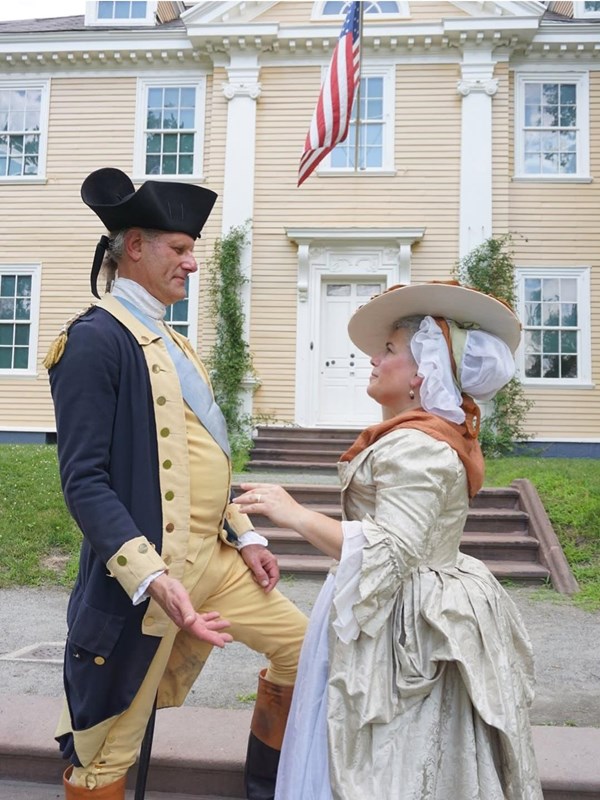
On Sunday, 19 July, the Longfellow House–Washington’s Headquarters National Historic Site in Cambridge will host a commemoration called “Headquarters of a Revolution: Washington’s Arrival in Cambridge,” coinciding with the 251st anniversary of the new commander-in-chief’s first week living in that mansion.

Here are the events scheduled for that day, including two from me.

10 A.M. to 3 P.M.
Living History
On the Lawn

Interact with living historians John Koopman (as George Washington) and Sandy Spector (as Martha Washington), including a noontime Q&A with Mrs. Washington. Free family activities and a story walk available all day.

10 and 11:30 A.M., 2:30 P.M.
House Tour: Headquarters of a Revolution
Starting in the Visitor Center

General George Washington’s Cambridge headquarters was a testing ground for many of the ideals, institutions, and questions that still define our nation. This conversational tour with an N.P.S. ranger explores Cambridge Headquarters as a hub of revolutionary activity, where generals, enslaved people, paid laborers, poets, Indigenous diplomats, politicians, and soldiers shaped history—and how later generations would shape its memory.

10:15 A.M.
Get Ready with Martha
Carriage House

Learn all about the clothing of 1775 as Mrs. Washington finishes dressing for her day. There will be some stories and some gossip, too! Sandy Spector is a Boston-based historian, researcher, and interpreter, and has been a Revolutionary War reenactor since 2000. She spends most of her time researching and interpreting Mrs. Washington and has been portraying Martha—alone or with George—in numerous states and venues for the past 10 years.

11:30 A.M. to 12:15 P.M.
The Last British Army to Come Through Cambridge
Carriage House

In November 1777, nearly 6,000 soldiers of the king arrived in Cambridge. With them came about a thousand women and children. These weren’t invaders but prisoners of war, British and German, captured at Saratoga. Top officers were housed in mansions along “Tory Row” while enlisted men went into the leftover barracks on Prospect and Winter Hills. Over the next few months Cambridge, Charlestown, and neighboring towns had to adjust to a new population under guard. J. L. Bell explores what we should remember about this “Convention Army” as we approach the 250th anniversary of its arrival.

12:30 to 1:15 P.M.
“Though Dwelling in a Land of Freedom”
Carriage House

Join poet, educator, and Darby Vassall descendant Denise Washington for an exploration of Revolutionary-era freedom struggles surrounding Washington’s Headquarters through the lens of Anthony, Cuba, and Darby Vassall, as well as Phillis Wheatley Peters.

1:30 to 3 P.M.
The Black Patriots of Lexington – Silas Burdoo
Carriage House

This film explores the role that third-generation Lexington resident Silas Burdoo played in the Revolutionary War, starting with the battle on 19 Apr 1775. Burdoo was a grandson of Ann and Philip Burdoo, who married in Medford in 1704 and then purchased 40 acres in Cambridge Farms, which became Lexington. This film screening will be followed by a discussion with Zine Magubane, professor of historical sociology at Boston College, and Sean D. Osborne, producer of the Black Patriots of Lexington YouTube series.

3 P.M.
What Washington Saw on Cambridge Common
Walking Tour starting at the gate at the southern tip of the common

What did the center of Cambridge look like in July 1775? Since April, the town had been the base of the New England army besieging Boston, with war transforming the community. On this walking tour J. L. Bell looks at sites in and around the common, including the first headquarters, buildings turned into barracks, and the Continental artillery’s lost laboratory. How well do the Washington Elm and the Revolutionary monuments that dot the common memorialize the men who were actually there?

All of these events are free, as organized by the National Park Service.

Sunday, March 15, 2026

“After Evacuation” in Cambridge, 19 Mar.

On Thursday, 19 March, I’ll speak at Longfellow House–Washington’s Headquarters National Historic Site on the topic “After Evacuation: What Came Next for General Washington and the American Colonies.”

Back in January I spoke in that same space about Col. Henry Knox’s “Fine Train of Artillery” and the end of the siege of Boston. Here’s the video of that presentation. This talk will pick up when that left off.

Here’s our event description:
On March 17, 1776, the British military pulled out of Boston, giving General George Washington his first victory of the Revolutionary War. Already, however, he was positioning the Continental Army for the redcoats to return. Meanwhile, the political atmosphere had changed, sending the thirteen colonies in a new direction. This year’s annual Evacuation Day talk explores how much changed during the siege and what lay ahead as the Washingtons left Cambridge.
One detail I haven’t decided whether to include is the honorary doctorate that Harvard College conferred on Washington on 3 Apr 1775, as discussed back here. This was the first time the college gave an LL.D. degree.

The Rev. Dr. Samuel Cooper wrote in his diary about signing the handwritten diploma on 4 April. Then Cooper went to Cambridge to say farewell to the general and presumably help to deliver that document, only to find that Washington was already on his way south. No word about how the diploma eventually made its way to the man.

To reserve a seat at my talk on Thursday, or learn about how to look in online, go to this page.

Thursday, February 26, 2026

“It was not the Butler who fell in Battle”

I just finished quoting a letter that Jonathan Hastings, Jr., of Cambridge addressed to “Friend Jacob” on 11 June 1775. The letter probably never reached that friend because it’s in the files of Gen. Thomas Gage, the British commander besieged inside Boston at the time.

Hastings started by referring to “Your Brother’s Letter of 18th. May.” Later he wrote, “John intends to write to your Brother.” The writer had a younger brother named John, born in 1754 and graduating from Harvard College in 1772. Heitman’s Historical Register of Officers of the Continental Army says John Hastings “Served in the Army in 1775” but doesn’t specify a unit until 1777. Massachusetts Soldiers and Sailors of the Revolutionary War likewise documents his service from 1777 on, rising to brevet major.

It looks like the Hastings brothers, Jacob, and Jacob’s unnamed brother were all part of the same crowd in Cambridge, probably connected with Harvard. Jonathan expected Jacob to know where “the Red House leading to Charlestown” was. Jacob and the Hastings family had financial dealings.

That link offers an explanation for Jonathan Hastings’s line “It was not the Butler who fell in Battle, but a Samuel Cooke from Danvers.” Harvard had a staff position called the butler. This man oversaw the buttery, which sold snacks and other little items to undergraduates. Unfortunately, the Harvard archives says, “there is no complete list of all of the Harvard Butlers.” It looks like the college reserved the job for master’s students to hold for two or three years before moving on.

Harvard’s class of 1772 included Samuel Cooke, Jr. (1752–1795), son of the minister in Cambridge’s Menotomy precinct. Some college documents say Cooke filled in as librarian while reading for his master’s degree. I suspect that he was the college butler in that period, thus known to his classmates and those who came after as well as to the administration.

After Samuel Cook of Danvers was widely reported as killed in the fighting at the Jason Russell House, Jonathan Hastings assured his friend Jacob that this wasn’t the fellow they knew from the buttery. The Menotomy Samuel Cooke, Jr.’s most significant action on 19 Apr 1775 was dragging his father away from the fighting.

TOMORROW: A man on the move and on the make.

Wednesday, February 25, 2026

“Boston is environed on all sides”

Having shared his version of the Battle of Lexington and Concord, as quoted over the last two days, the new Cambridge postmaster Jonathan Hastings, Jr., turned to the current situation.

His 11 June 1775 letter described the siege this way:
Boston is environed on all sides. 7000 Men at Camb. 6000 at Roxbury, exclusive of smaller Numbers wch. guard the Coasts both Eastward & Southward. [Thomas] Gage acknowleges our Superiority in Number, but says we have neither Government, Discipline nor Powder. The two first Charges are false; and I hope the other Colonies will not be backward to Supply us with the last, to let him see he is mistaken in that likewise.—

Indeed we are determined to defend ourselves in the best manner at all Events, rather than submit to Slavery.—Our Motto is the same which Caesar engraved on his Breast Plate—“Nil actum reputans si quid superesset agendum.”
That was a standard eighteenth-century British rendering of a line from Lucan’s Civil War, appearing in the Spectator and Lord Chesterfield’s letters. It translates more or less as “As long as there’s anything left to do, we don’t consider anything done.” Curiously, that Latin line appears differently in modern editions of Lucan. I can’t explain the discrepancy.
Should Massachusetts be conquered, your Halcyon Days will soon be at an end. God grant our union may be like that of a Band of Brothers, wch. can never be broken. The Light Troops in Boston we are informed have not done Duty for 4 Days. An Attack is expected soon, for every Delay on their part is a Strengthening to us.

It was not the Butler who fell in Battle, but a Samuel Cooke from Danvers the largest Man in the Colony, I suppose
A Danvers man named Samuel Cook, Jr., was indeed among the provincial casualties on 19 April, killed at the Jason Russell House. I haven’t found any other reference to his size. I’ll discuss why Hastings mentioned him tomorrow.
You must excuse my not being more particular, as John intends to write to your Brother, and my Business call me away: therefore would just acquaint you that an half a whole Sheet with your Name alone will afford a particular Pleasure to your sincere Friend & very humble Servant

Jonathan Hastings Junr.

P.S.—My Father & mother desire to be remembered to you & your Friends, & would inform you that our Papers are removed into the Country, & we know not where to look for any Receipts, therefore beg you will make yourself easy with regard to us—&c
JH
That looks like a very familiar closing for an eighteenth-century letter, begging more time to pay bills. Or maybe Hastings was replying to a correspondent who had begged more time.

Of course, there was a war on. The Hastings house had become the headquarters of both the Massachusetts committee of safety and Gen. Artemas Ward, so it’s understandable that the family had moved their records out.

TOMORROW: Clues to the crowd.

Tuesday, February 24, 2026

“As ever the two Armies met”

Yesterday we left schoolteacher Jonathan Hastings, Jr., and the rest of Col. Thomas Gardner’s Cambridge militia contingent caught near the Lexington meetinghouse on 19 Apr 1775.

Lt. Col. Francis Smith’s expedition to Concord (which Hastings called “the Detachment”) was headed back their way from the west, harried by other militia companies.

Col. Hugh Percy’s reinforcement column (“the Brigade”) was approaching from the east. Percy had more soldiers. And he had cannon.

We return to Hastings’s 11 June letter, now in the Thomas Gage Papers:
We were commanded to retreat into a thick Grove of Oaks over a Meadow, up to our Knees in water, wch. saved us. The Brigade turned their Artillery immediately upon us.—Their Cannon Balls cut down the Branches of the Trees merrily but none of us were killed.

As ever the two Armies met, it being about 3 Quarters after one OClock, they begun a precepitate Retreat for Bunkers Hill in Charlestown under the Protection of the navy. There were not above 400 that attacked them, being 1850 at once that day. Lord Peircy put the Cannon in Front, himself in the Centre, & the Marines were formed in the Rear. The Grenadiers & Marines were nobly peppered. Peircy had a Ball shot thro’ the Bosom of his shirt.

Two Officers were treppaned in the Red House leading to Charlestown. Quarters were offered them, they refused, replying their Orders were neither to give nor take any Favour. They met Death bravely.—

It is easier for you to imagine, than for me to describe the Horrid Barbarity & savage Cruelty of the British Troops in their Retreat. Houses plundered & burnt, wounded Men begging for mercy, had Bayonets struck into their Heads, & the Piece discharged, Women in Child Bed commanded into the Streets with a Gun at their Breasts, Old Men unarmed thrust thro’ their Bodies. Harmless young Fellows shot dead, such was the horrid Scene.

But on our side no such Vestiges of Cruelty were seen or exercised on any who chose to live: the wounded taken the utmost Care of, & when exchanged for our Men who were taken Prisoners, & have been treated most inhumanly: they cryed like Children to tarry among us.—
Of course, the redcoats had their own tales of atrocities by the enemy, starting with the “scalping” at Concord’s North Bridge.

I can think of one example of a woman who had recently given birth ordered out of her house (Hannah Adams of Menotomy) and one of a young teenager shot when he peeked out a window (Edward Barber of Charlestown). But Hastings’s letter rendered those examples as plural. And I’m not sure what he referred to with the bayonets.

Likewise, Hastings’s numbers of the troops engaged—400 militiamen chasing off 1,850 regulars—are skewed to make his side look good. Many groups of 400 provincials attacked the British column in turn. The Massachusetts force had a clear advantage in numbers.

Hastings wrote of emergency surgeries in “the Red House leading to Charlestown” as if his correspondent knew that location. Indeed, there appears to have been a brick house fitting that description. I haven’t been able to identify who owned or lived there, but sources do refer to its appearance and location.

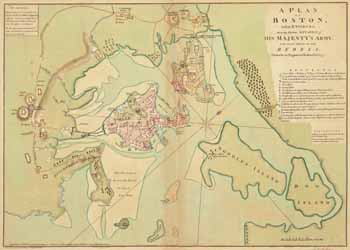
On 12 May the Massachusetts committee of safety mentioned “the red house at the head of the creek near the road from Cambridge to Charlestown.” Soon provincials built the “Red House Fort,” more commonly called Fort No. 3, to guard a nearby crossroads, as shown in the detail of Henry Pelham’s map above. Today the site is just south of Union Square in Somerville.

TOMORROW: Finishing the letter.

Monday, February 23, 2026

“At length we have had the Commencement of Hostilities begun”

Here’s an account of the start of the Revolutionary War that I don’t believe has been published before.

It’s a letter dated 11 June 1775 from Jonathan Hastings, Jr. (1751–1831), son of the steward of Harvard College, to a friend named Jacob.

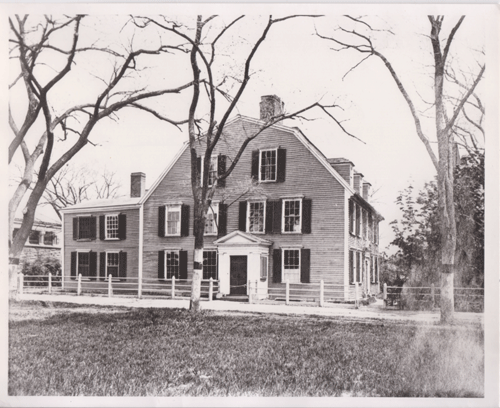
Hastings graduated from Harvard in 1768 and a few years later become one of Cambridge’s school teachers. He was living in his father’s house beside the common, shown here. On 8 June, three days before writing this letter, the young man took the job of town postmaster.

Ironically, his letter appears to have been intercepted by the Crown forces because it’s filed among Gov. Thomas Gage’s papers at the Clements Library. The library offers scans and an imperfect transcription.

Hastings wrote:
Your Brother’s Letter of 18th. May we received the 9 of June. Notwithstanding my many Avocations (our House being made Head Quarters) I cannot miss an Opportunity of sending you a Letter. Am happy you had so safe a Passage & found your Friends well.

At length we have had the Commencement of Hostilities begun by Gage’s Troops, at the Battle of Lexington, where 8 of our Men were killed, there being about 50 assembled on a Green.—

The Evening preceeding the 19 of April, I was met by 11 Officers equipt with Pistols & Cutlasses; when I got Home I acquainted several Gentlemen therewith; but they thought it was like to prove nothing but a false Alarm. They were mistaken. About 2 OClock the next Morning, we were roused out of Bed to pursue 1100 Grendadiers & Light Infantry being a Detachment from all the Regiments in Boston.—

They made their way to our Magazines at Concord, but affected nothing more than destroying 80 Barrels Flour, knocking of [sic] the Ears of 3 twenty four pounders & burning the Carriages. A Quantity of Bullets they threw into a pond, but have been got out since.

Coll. [Thomas] Gardner ordered our Regiment to parade at Watertown, not knowing but that Gage’s Reinforcement would take that Course. He was mistataken [sic], they marched thro’ Cambridge, wch. being known our Regiment took the nearest Way to meet the Detachment. Unluckily for us we had no sooner placed ourselves in an advantageous Post near Lexington Meeting House to give Battle to the Detachment, than we perceived the Brigade in the other Side of us. Our Situation was bad, being between both Armies.
Well, that seems like an exciting place to break, doesn’t it?

TOMORROW: Under fire.

Friday, January 23, 2026

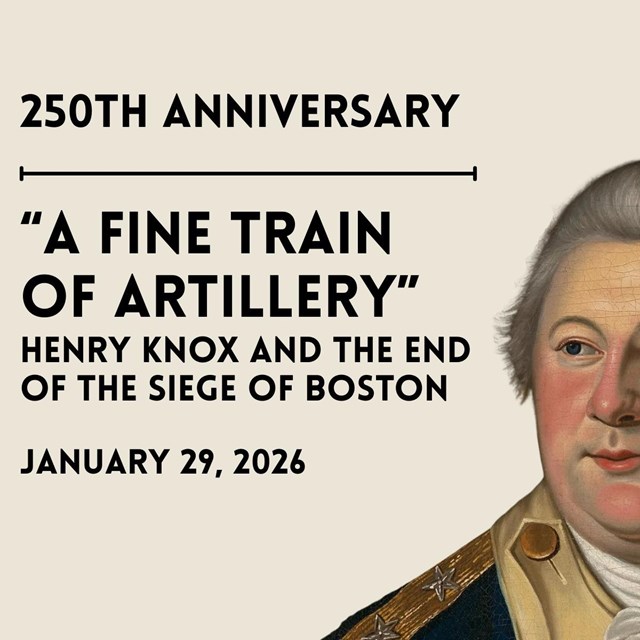
“A Fine Train of Artillery” Talk in Cambridge, 29 Jan.

On Thursday, 29 January, I’ll contribute to the discourse about Col. Henry Knox’s artillery trek with the talk on “‘A Fine Train of Artillery’: Henry Knox and the End of the Siege of Boston” at the Longfellow House–Washington’s Headquarters National Historic Site in Cambridge.

In the past few months I’ve already shared my take on the myths and realities of the Knox saga, and on Knox’s political profile before the war and how that might have contributed to his rise to command the artillery regiment.

For this new talk, therefore, I’m focusing on what Knox accomplished on his first military mission and how that affected the siege of Boston. Here’s our event description:
On January 18, 1776, Gen. William Heath wrote, “Col. Knox, of the artillery, came to camp. He brought from Ticonderoga a fine train of artillery.” Those 58 guns would nearly double the size of the Continental artillery force. But Gen. George Washington and his commanders still had to figure out the best way to use their new ordnance before they could drive the British military out of Boston.
Gen. Washington’s first proposal appears in his 18 February letter to John Hancock as chairman of the Continental Congress:
The late freezing Weather having formed some pretty strong Ice from Dorchester point to Boston Neck and from Roxbury to the Common, therby affording a more expanded and consequently a less dangerous Approach to the Town, I could not help thinking, notwithstanding the Militia were not all come In, and we had little or no Powder to begin our Operation by a regular Cannonade & Bombardment, that a bold & resolute Assault upon the Troops in Boston with such Men as we had (for it could not take Many Men to guard our own Lines at a time when the Enemy were attackd in all Quarters) might be crown’d with success . . .

from a thorough conviction of the necessity of attempting something against the Ministerial Troops before a Re-inforcement should arrive, and while we were favour’d with the Ice, I was not only ready, but willing and desirous of making the Assault; under a firm hope, if the Men would have stood by me, of a favourable Issue; notwithstanding the Enemy’s advantage of Ground—Artillery—&ca.
An infantry charge across the flat ice of the inner harbor against the British army’s fortified batteries on the Common and in the South End. What could go wrong?

This talk is due to start at 6 P.M. It’s free and open to the public, but because of limited seating the site asks people to register in advance. We’re working on how to record and/or livestream the talk as well.

Wednesday, December 10, 2025

Recording of “The First Commander Remembered” Panel

The Cambridge Room at the Cambridge Public Library has shared the video recording of last week’s panel discussion on “The First Commander Remembered: Washington’s Legacy in Cambridge.”

This event was organized by a group of local historical organizations and moderated by Christopher Beagan, site manager of the Longfellow House–Washington’s Headquarters National Historic Site.

The first part of the event is my fast analysis of why George Washington was in Cambridge from different perspectives: how that town became the headquarters of the provincial and then Continental army, why the Continental Congress chose Washington to lead that army, what he thought his mission was, what he really learned during his months in Cambridge, and how historians of the nineteenth century portrayed his work.

Then Charles Sullivan, executive director of the Cambridge Historical Commission, discussed how the city has commemorated Washington, particularly the long life, death, and latter-day commemoration of the Washington Elm.

We then discussed themes of memory and answered questions from the audience. Though this event happened on a night with a somewhat gloomy weather forecast, there was a robust and curious crowd.

I think my favorite part was getting the inside story of how William Dawes’s ride through Cambridge came to be commemorated through the unique bronze horseshoes in the sidewalk at Harvard Square rather than a conventional equestrian statue.

Though I suppose an equestrian statue might have been unconventional, too, if it were really modeled after the description traced back to Dawes’s cousin Josiah Waters, Jr.: “mounted on a slow jogging horse, with saddle bags behind him, and a large flapped hat upon his head, to resemble a countryman on a journey.”

The recording of the series’s first event, “From Revolution to Remembrance: Memory of the American Revolution” with Michael Hattem, Nikki Stewart, and Beth Folsom is also available for viewing.

Sunday, November 30, 2025

“Like a shock of electricity upon a morbid system”

Yesterday I discussed how An Authentic Narrative of the Life of Joshua Slocum was anything but an authentic memoir of a Revolutionary War soldier.

Joshua Slocum had spent time in the Continental Army, to be sure, but the book his son John published in 1844 went into great detail about events his father had nothing to do with, producing bogus stories based on preceding books and popular lore.

When the war began, Joshua Slocum was about fifteen years old, probably living in the part of Wrentham that became Franklin. Although there are cases of boys that young serving in the siege of Boston—as musicians, servants, clerks, substitutes for older brothers—there’s no documentation that Joshua did. He probably stayed in the countryside and worked on the farm. Four years later, when he reached the typical age for military service, he enlisted for one of the Rhode Island campaigns.

Because John Slocum wanted to connect his father to the famous events of the Revolutionary War, he wrote about 1775: the Lexington alarm, the siege of Boston, the capture of Fort Ticonderoga. When he created the book, in the middle of the nineteenth century, one of the most celebrated events from that year was Gen. George Washington taking command of the Continental Army.

This is how the Authentic Narrative treats that moment:

When this heart-cheering intelligence [of George Washington’s appointment] reached Cambridge, my father informed me that one long, loud and joyful acclamation rent the skies—each successive post catching the sound, till it was wafted through the entire line of the arm, operating upon it like a shock of electricity upon a morbid system.

If, continues he, the mere announcement of his appointment could create so much enthusiasm and awaken such joyous sensations through our ranks, what must have been the feelings inspired when, on the 2d of July, fifteen days from the date of his commission, Washington, in company with Gen. [Charles] Lee, arrived at Head Quarters in Cambridge—when, for the first time, we were permitted to see, face to face, the great man who, under God, was destined to achieve the Independence of his country, and to lay broad and deep the foundation of this stupendous republic? For myself I shall not attempt to describe it—language would fail in the attempt.
As eyewitness testimony, this is worthless. Indeed, Slocum didn’t even try to provide details of the generalissimo’s arrival.

As a reflection of how Americans of 1844 wanted to think about Washington, however, it’s very interesting. Since John Slocum was writing without any reliable input from his father, this passage is entirely untainted by what the fighting men of 1775 actually thought. It’s a pure expression of myth.

Slocum depicted the provincial troops around Boston as “a morbid system” needing a jolt of power. Ordinary men were excited to learn about the new commander-in-chief, not because he represented support from colonies outside New England but because they somehow sensed he was the “great man who, under God, was destined to achieve the Independence of his country.”

Actual diaries from July 1775 show much less emotion. Some barely mention Washington. Most of the soldiers had probably never heard of the man. Few entertained thoughts of independence yet.

Those newly dubbed Continental soldiers probably did share the nineteenth-century Americans’ wish to believe their success was destined and protected by God, but so have many other groups in history. Stories like this are one way to reinforce that belief.

John Slocum might come up in Tuesday’s panel discussion at the Cambridge Public Library about “The First Commander Remembered.”

Friday, November 28, 2025

“The First Commander Remembered” Panel in Cambridge, 2 Dec.

On Tuesday, 2 December, I’ll take part in a panel discussion on “The First Commander Remembered: Washington’s Legacy in Cambridge.”

This is the second in a series of Sestercentennial events on “Washington in American Memory” to be held at the Cambridge Public Library through April 2026.

The panel will include:
  • Charles Sullivan, executive director of the Cambridge Historical Commission and coauthor of Building Old Cambridge: Architecture and Development.
  • Christopher Beagan, site manager at the Longfellow House–Washington’s Headquarters National Historic Site, moderator.
  • me, drawing from a study of the commander-in-chief’s months in Cambridge in 1775–76 and any thoughts that have occurred to me since. 
We’ll talk about how Gen. Washington came to Cambridge, how authors have portrayed his time there, and how he’s been commemorated in Cambridge by, among other things, a tree, a park, a monumental gate, a hotel (shown above), and a National Park Service site. What do all those landmarks tell us about how we like to think of Washington? And could we remember and teach that period of history more accurately?

This event is scheduled from 6 to 7:30 P.M. in the Cambridge Public Library’s Lecture Hall. It will also be livestreamed and recorded for online viewing.

This program and all the series will be free and open to the public. Follow this link to register.

The main supporter of this series is Eastern National, a nonprofit partner of the National Park Service. It has been organized by the National Park Service/Longfellow House–Washington’s Headquarters National Historic Site, History Cambridge, Cambridge Public Library, Cambridge Historical Commission, and Cambridge MA250.

Thursday, November 13, 2025

The Vanishing of Mary Wenwood?

As recounted earlier, Gen. George Washington had Mary Wenwood brought his headquarters to answer questions about a ciphered letter she had given to her former husband to pass on.

The woman held out against the general’s questioning for hours. But still under guard the morning after she arrived, she gave up the name of the cipherer: her lover, Dr. Benjamin Church.

After that, Mary Wenwood fades from the historical record. She had every reason to adopt a low profile. Gen. Washington kept her name out of his official report and paperwork. No surviving informal comment on the episode mentions her name. 

But men had a lot to say about her character. Indeed, just as she vanished as a person, she started to appear as a character in a moral fable—the downfall of a doctor.

James Warren, speaker of the Massachusetts house, called her “a suttle, shrewd Jade” and “an Infamous Hussey.” The Rev. Ezra Stiles of Newport said she was “a Girl of Pleasure,” and had carried the ciphered letter “in her stocking on her Leg.” How did he know?

Lt. Ebenezer Huntington of Norwich, Connecticut, told his brother: “the Plot was discoverd by his [Church’s] Miss who is now with Child by him and he owns himself the father (for he has Dismissed his Wife).” Huntington was stationed in Roxbury, far from Washington’s headquarters, and had no link to people in the case. No one closer to the investigation said the woman was pregnant. Some other details in Huntington’s account are wrong. Therefore, unless other evidence turns up, I think this was probably baseless gossip.

Here are further facts possibly about Mary Wenwood.

The 14 December 1775 New-England Chronicle reported that the Cambridge post office was holding mail for a woman named Mary Butler—which was Mary Wenwood’s maiden name.

Mary was the most common given name for women, and Butler a fairly common surname. Wainwood/Wenwood/Wanewood was much less common. Indeed, all mentions of “Wenwood” and its variants in late-1700s New England newspapers lead back to Godfrey Wenwood, Mary’s former husband.

That said, Newport vital records show that another Mary Wenwood, wife of Frederick Wenwood, gave birth to a baby girl named Mary in December 1785, and that couple baptized a baby girl named Mary (perhaps a new one) in June 1787. Even an uncommon name isn’t necessarily unique.

The most tantalizing clues are that a Mary Wainwood/Wanewood was in and out of the Boston almshouse after the war:
  • Admitted 6 May 1785, left 30 May 1786.
  • Admitted 29 Feb 1792.
  • Admitted 12 Jan 1793.
  • Admitted 25 Apr 1797, died 23 May 1797.
And that last entry stated that the woman was from Rhode Island.

Wednesday, November 12, 2025

“Tradition gives us a graphic scene connected with her arrest”

In his biography of George Washington, published in the late 1850s, Washington Irving included a vivid description of how Mary (Butler) Wenwood was brought to the commander-in-chief’s headquarters.

Irving wrote:
Tradition gives us a graphic scene connected with her arrest. Washington was in his chamber at head-quarters, when he beheld from his window, General [Israel] Putnam approaching on horseback, with a stout woman en croupe behind him. He had pounced upon the culprit.

The group presented by the old general and his prize, overpowered even Washington’s gravity. It was the only occasion throughout the whole campaign on which he was known to laugh heartily.

He had recovered his gravity by the time the delinquent was brought to the foot of the broad staircase in head-quarters, and assured her in a severe tone from the head of it, that, unless she confessed everything before the next morning, a halter would be in readiness for her.

So far the tradition;…
This anecdote is consistent with other stories about Putnam.

However, there’s no contemporaneous support for this tale, nor did Irving explain how he came by all those details, especially the picture of the general laughing in his own bedroom.

In fact, even Irving seemed dubious, twice labeling this story “tradition.” But he couldn’t resist including it.

And some other authors, including George Washington Greene, repeated it in their books.

It can serve to signal how Mary Wenwood was about to be transmuted from a real woman into the embodiment of all female dangers.

Tuesday, November 11, 2025

“i expeted you would have arote to me be for this”

Several of the questions after my talk in Watertown about Dr. Benjamin Church, Jr., involved his lover Mary (Butler) Wenwood.

Unfortunately, we have lots of rumors and little hard evidence about this woman, and I’m wary of overstating what we know. But I can share some more information and leads for further research.

We have a note in Mary Wenwood’s own handwriting, preserved in the George Washington Papers at the Library of Congress.

This note is undated, but it appears to have prodded her former husband, Godfrey Wenwood, into showing a ciphered letter she’d previously left with him to the Patriot authorities in Rhode Island. That happened in September 1775, so it’s likely Mary Wenwood wrote this note that month.

She addressed it “To Mr. godfrey wenwood / Baker / in Newport” but added no signature. Neither the handwriting nor spelling is clear:
Dear sir—

i now Sett Down to right a fue Lines hoping thay will find [you] in good helth as thay Leave me

i expeted you would have arote to me be for this But now i expet to Sea you hear every Day i much wonder you never Sent wot you promest to send if you Did i never reseve it so pray Lett me know By the furst orpurtnuty wen you expet to be hear & at the Same time whether you ever Sent me that & wether you ever got a answer from my sister i am a litle unesey that you never rote

thar is a serten person hear wants to Sea you verey much So pray com as Swon as posebell if you righ[t] Direct your Lettr to mr Ewerd Harton Living on Mr t apthorps farm in Little Cambrig
It’s tempting to treat personal details in the letter—the “sister,” “the serten person hear [who] wants to Sea you verey much”—as clues. But those could just as well have been parts of a cover story, to fool Godfrey or someone else who might see the note into thinking it’s all about a family matter.

The real tenor of this note is anxiety about having received no answer to the earlier, ciphered letter. Mary was even suspicious that Godfrey hadn’t sent it on (which he hadn’t). She wanted to know what was happening. Dr. Church was probably hoping some money was on its way to him.

The information about how to send a reply to Mary Wenwood must therefore have been sincere. “Little Cambridge” was the portion of that town on the south side of the Charles River which we now call Brighton. The local historian Lucius Paige found an Edward/Edmund Horton living there in 1776.

The note suggests Horton was living on the estate of Thomas Apthorp (1741–1818), one of several younger sons of Charles and Grizzell Apthorp. In 1858 the Rev. Nicholas Hoppin wrote, “James and Thomas Apthorp Esqrs., brothers of the missionary [Rev. East Apthorp], also had houses…in what is now Brighton, then called Little Cambridge,” but James (1731–1799) moved to Braintree in 1768.

That same year, Thomas lobbied to become a deputy paymaster for the army, as his father had been. With that affiliation, he would have been inside Boston when the war broke out, and he would leave with the British troops in March 1776. Horton might have been looking after Apthorp’s country estate.

Mary Wenwood could have been living on that estate, or she could have been living nearby. Godfrey showed up at her home toward the end of September, asking about the ciphered letter. Mary refused to answer his questions. So Gen. George Washington ordered her brought to his headquarters.

TOMORROW: Rumors and unanswered questions.

Saturday, November 08, 2025

“A proper Method for bringing Dr. Church before the House”

As described yesterday, on 17 Oct 1775 the Massachusetts General Court decided to summon Dr. Benjamin Church to Watertown to explain why he’d sent a ciphered letter into British-occupied Boston.

Dr. Church’s first response to that action arrived on 23 October, as reported by James Warren: “The Speaker communicated to the House a Letter received from Dr. Church, wherein he expresses a Desire to resign his Seat in the House of Representatives.”

The previous month, Church had also tried to resign as Surgeon-General of the Continental Army, following a month of turf disputes with regimental surgeons. Gen. George Washington and his aides had urged him to stay, only to be blindsided by that ciphered letter. Those two resignations suggest that Church was realizing what a hole he’d dug for himself and just wanted to go away.

The legislators didn’t want to let Church go, though. Particularly Speaker Warren. He’d been immersed in this case since Washington had called him to Cambridge to share the first hints of the doctor’s dealings.

Back on 1 October, Warren had written to his friend John Adams:
Dr. C——h has been detected in a Correspondence with the Enemy at least so far that a Letter wrote by him in Curious Cypher . . .

We all thought the Suspicion quite sufficient to Justify an Arrest of him and his Papers, which was done, and he is now under a Guard. He owns the writeing and sending the Letter. Says it was for [John] Fleeming in Answer to one he wrote to him, and is Calculated, by Magnifying the Numbers of the Army, their regularity, their provisions and Ammunition &c, to do great Service to us. He declares his Conduct tho’ Indiscreet was not wicked.
Something had to be done. The legislature therefore voted on 23 October to let Church’s resignation letter “lay on the Table, till the Committee who are directed to consider a proper Method for bringing Dr. Church before the House shall report.”

As Warren and others understood by this time, the Continental Army rules and regulations didn’t allow a court-martial to sentence a spy to death. Gen. Washington was therefore holding off on formal proceedings. His most recent council had decided “to refer Doctor Church for Tryal & Punishment to the General Court of Massachusetts Bay.”

On 26 October the house committee came back with their recommendation. They started by stating that Church “has been convicted by the Judgment of a Council of War, at which his Excellency [Gen. Washington] presided, of having carried on a criminal Correspondence with the Enemy.”

In fact, Washington’s councils weren’t courts and had no power to convict anyone. But neither did the legislature have the power to try and punish Church as the last council suggested—all the General Court could do was expel the doctor. Each body was pushing for the other to take on the authority of judging Dr. Church. And everyone was still waiting for guidance from the Continental Congress.

The General Court voted:
…whereas the said Benjamin Church is also a Member of this House, and the Charge brought against him is of so criminal a Nature, that it is the Duty of the House to make strict Enquiry into the Fact, and upon Proof of the same to manifest their utter Abhorrence thereof:

Therefore, Resolved, That Mr. William Howe, the Messenger of this House, be and he hereby is directed on Friday the 27th of October Instant [i.e., this month], to apply to his Excellency George Washington, Esq; for a sufficient Guard, safely to conduct the said Benjamin Church to and from the Barr of this House, and being furnished therewith, to take the Body of the said Church and bring him to the Barr of the House accordingly, at Ten o’Clock in the Forenoon of the same Day.
On that Friday morning, there was a motion “That there be fixed in the Alley [i.e., aisle] a Bar, at which Dr. Church will be brought.” The stage was set.

I’ll speak about what happened next in Watertown on Sunday afternoon, as detailed here.

TOMORROW: Records of the case.

Sunday, November 02, 2025

“Washington in American Memory” Series in Cambridge, Starting 10 Nov.

The Longfellow House–Washington’s Headquarters National Historic Site, working with History Cambridge, the Cambridge Historical Commission, and Cambridge MA250, has organized a series of Sestercentennial panel discussions and talks at the Cambridge Public Library on the theme of “Washington in American Memory.”

This series runs through April 2026. Here are the events scheduled for this calendar year.

Monday, 10 November, 6 to 7:30 P.M.
From Revolution to Remembrance: Memory of the American Revolution
Cambridge Public Library and online

Explore how Americans have remembered, reinterpreted, and reshaped the meaning of the American Revolution from 1776 to today, featuring:
  • Michael Hattem, author of Past and Prologue: Politics and Memory in the American Revolution and Associate Director of the Yale-New Haven Teachers Institute
  • Nikki Stewart, Executive Director of Old North Illuminated
Register here.

Tuesday, 2 December, 6 to 7:30 P.M.
The First Commander Remembered: Washington’s Legacy in Cambridge
Cambridge Public Library and online

Debunk myths and trace the evolution of the public memory of George Washington in Cambridge, Massachusetts, featuring:
  • J. L. Bell, author of The Road to Concord: How Four Stolen Cannon Ignited the Revolutionary War and proprietor of Boston 1775
  • Charles Sullivan, co-author of Building Old Cambridge: Architecture and Development and Executive Director of the Cambridge Historical Commission
Register here.

All these events will be free thanks to funding from Eastern National.

Unfortunately, some of the people who worked hard to organize this series are now not being paid and legally barred from their jobs in the National Park Service because of the federal government shutdown. Because these panel discussions will be at the city library, they will go on, unlike events scheduled at parks themselves. But it’s a hell of a way for the U.S. government to celebrate the 250th.

Wednesday, October 08, 2025

Teachers’ Tour of the Siege of Boston, 4 Nov.

The Massachusetts Council for the Social Studies is offering a Sestercentennial tour of sites in the siege of Boston for teachers. I’ll be one of the folks riding along to talk about that history.

This tour will happen on Tuesday, 4 November, from 7:30 A.M. (when the bus is scheduled to pick up the first batch of participants) to about 4:30 P.M. That’s Election Day, when many schools close for staff training because the buildings are being used for voting.

Through site tours and rides, we aim to provide an overview of the siege from April 1775 to March 1776 that includes the perspectives of rank and file soldiers, free and enslaved Africans, Loyalists, and women.

After gathering at Castle Island, we plan to visit:
Three of those sites are part of the National Park Service, so access will be limited if the federal government is still shut down at that time. The grounds will probably be open but the buildings closed. We’re developing contingency plans to cover those sites or perhaps substitute others.

Registration cost is $30 for an individual, $100 for a team of four educators. Lunch will be provided. See this page for more information. Use this form to register.

Saturday, September 20, 2025

New Research on the Vassall Mansion in Cambridge

The Longfellow House–Washington’s Headquarters National Historic Site is unveiling a special history study researched over many years and in multiple countries. It adds tremendous detail to a dimension of that Cambridge mansion that people have long known about more generally.

That mansion in Cambridge was built in 1759 for John Vassall, heir to wealthy slave-labor plantations on Jamaica. It was not only erected with the profits of slavery, but it was staffed by enslaved workers for two decades.

While John Vassall took his family to England in the first year of the Revolutionary War, at least one family he had enslaved, led by Tony and Cuba Vassall, stayed behind to gain their freedom and found an African-American community nearby.

Black History at the Vassall Estate by Caitlin DeAngelis, Carla D. Martin, Rayshauna C. Gray, Aabid Allibhai, and Eshe Sherley digs into that story from every possible angle, using archives in the U.S. of A., Jamaica, Antigua, and Britain. The story it tells extends from the origins of the (white) Vassall family fortune through the political activity of the (black) Vassall family in the ante-bellum republic.

Two events in the next month will illuminate those findings for the public.

Thursday, 25 September, 6 to 7 P.M.
Black History at the Vassall Estate
Caitlin DeAngelis, Carla Martin, Rayshauna Gray, Aabid Allibhai, and Eshe Sherley
Online, free with registration

A new landmark study documents and analyzes the Black experience at 105 Brattle Street and in the wider Cambridge community from the mid-1700s to the mid-1800s. The authors will introduce the project, share key findings, and take you behind the scenes of their research and writing process.

This study is remarkable not only for the history it documents—much of it appearing in print for the first time—but also for the breadth of research behind it. In partnership with lineal descendants of the Black Vassalls, the authors consulted sources spanning New England, the United Kingdom, and the Caribbean over the course of more than three years. Research of this scale is rare, and even more rarely presented in a format accessible to all readers.

Everyone who registers for that event will receive a digital copy of the study, which is also available for downloading here.

Sunday, 12 October, 1 to 3 P.M.
In Search of Darby Vassall: Tour of Cambridge & Beyond
Denise Washington and Joel Mackall
Free with registration

Starting at Longfellow House–Washington’s Headquarters, travel by trolley in greater Cambridge between seven stops with a Vassall descendant and an educator. Each stop reflects a key location in the life of Darby Vassall (1769-1861), a lifelong community activist who endured slavery and seized freedom with his family in Revolutionary Cambridge. Early dinner provided after the tour.

Monday, September 01, 2025

Colonel Louis, Caesar Marion, and More

Here are a couple of new online resources exploring aspects of the first months of the Revolutionary War in New England.

The Longfellow House–Washington’s Headquarters National Historic Site has posted Dr. Benjamin Pokross’s article “General Washington in the Native Northeast.” It begins:
It had been ten days since the Caughnawaga Mohawk men had arrived at the camp in Cambridge with their wives and families, and George Washington was still not sure what he was going to do. This was the second time that one of their leaders, Atiatoharongwen (also known as Col. Louis Cook), had come to Cambridge, and he had again made it known that he could raise four or five hundred men to fight for the colonists if he was given a commission in the Continental Army. But Washington was unsure how he would pay for all these additional soldiers if Atiatoharongwen did what he said, and even more apprehensive about the idea of engaging Indigenous allies at all. At least it had stopped snowing on the clear, cold, morning of January 31, 1776; this was the day Washington had promised to meet the Mohawk delegation outside.

Washington’s “Out-Door’s Talk”, as he called the subsequent conversation in a letter to General Phillip Schuyler, would be the most extensive of several interactions with Indigenous people he had had while he lived in the Vassall House. These visits did not result in decisive alliances or enduring treaties. They matter, however, for two reasons. The first is that they emphasize how the Revolution—normally thought of as a conflict between American colonists and the British—occurred on Native land, in areas that had long been stewarded by Indigenous communities and where Native people continued to find ways to survive in spite of colonial upheaval. Secondly, these visits highlight the unsettled and transitional character of the very early days of the Revolution. For both Washington and the Native diplomats who came to visit him, this was a moment of experimentation, of exploring what a possible relationship between the Continental Army and Indigenous Nations could look like.
At the HUB History podcast, Jake Sconyers shared an episode on “The Well Known Caesar Marion.”
In this somewhat brief episode, we’re going to look at why Mr. Marion was thrown into Boston’s notorious jail 250 years ago this week, and then we’ll compare his treatment inside British-occupied Boston with the experience of Black volunteers in the Continental Army outside Boston, once Virginia enslaver George Washington took command.
Both Pokross and Sconyers explore moments when Washington was pushed out of his comfort zone by encounters with men of color. And in both cases, while he never stopped being a planter with aristocratic ambitions, Washington was able to shift his habits and show respect for allies.

(Hearing the podcast also reminded me that I broke off a short series about Marion, promising more was “COMING UP,” nine years ago. I won’t get back to that story this week, but it’s back on my to-do list.)

Monday, July 21, 2025

“The Past and Present Here Unite” and “Who Are My Ancestors?”

If you’re interested in seeing and hearing me as a talking head in a documentary film, check out “The Past and Present Here Unite,” a video introducing the Longfellow House–Washington’s Headquarters National Historic Site created by Argentine Productions.

A decade ago, I wrote a study for the National Park Service about Gen. George Washington’s use of that house in 1775–76, and most of my commentary for this movie pertains to that period. But I also shared some observations on Henry Wadsworth Longfellow and how he shaped American memory.

Alongside that video, the same filmmakers produced “Who Are My Ancestors?: The Descendants of Cuba Vassall,” which you can watch at this page. It explores the family of Cuba Vassall, a woman enslaved by the Royall and Vassall families until the Revolutionary War. She had a longer connection to that site than Washington did, and her son Darby was prominent in Boston’s antebellum campaigns for human rights.

Monday, July 07, 2025

“The Colony of Connecticut must raise 6,000”

As I quoted last week, on 23 Apr 1775 the Massachusetts Provincial Congress resolved to raise an army of 30,000 men, 16,400 of them coming from outside the province.

In this Journal of the American Revolution article from last year, I discussed how early in 1775 the congress had set up liaisons with the governments of Connecticut, Rhode Island, and New Hampshire in case war broke out.

The Massachusetts Patriots had alerted their colleagues in those colonies about the fighting on 19 April. And now they asked for troops.

In Connecticut, Gov. Jonathan Trumbull supported the Patriots. As soon as he heard the news from Lexington, he agreed to call the legislature into session to take official action. On 21 April, William Williams, the Connecticut assembly speaker and Trumbull’s son-in-law, wrote with two other politicians to the Massachusetts congress:
Every preparation is making to Support your Province— . . . the Ardour of Our People is such that they can’t be kept back;—The Colonels are to forward part of the best men & most Ready, as fast as possible; the remainder to be ready at a Moments warning
Some militia officers were already on the move. Israel Putnam was in Concord on 21 April as the Massachusetts congress met. He wrote back:
I have waited on the Committee of the Provincial Congress, and it is their Determination to have a standing Army of 22,000 men from the New-England Colonies, of which, it is supposed, the Colony of Connecticut must raise 6,000, and begs they would be at Cambridge as speedily as possible, with Conveniences; together with Provisions, and a Sufficiency of Ammunition for their own Use.
Col. Benedict Arnold and his volunteers left New Haven on 22 April and arrived in Cambridge one week later. On 23 April a letter from Wethersfield to New York said:
We are all in motion here, and equipt from the Town, yesterday, one hundred young men, who cheerfully offered their service; twenty days provision, and sixty-four rounds, per man. They are all well armed, and in high spirits. . . . Our neighbouring Towns are all aiming and moving. Men of the first character and property shoulder their arms and march off for the field of action. We shall, by night, have several thousands from this Colony on their march. . . .

We fix on our Standards and Drums, the Colony Arms, with the motto, “qui transtulit sustinet,” round it in letters of gold, which we construe thus: “God, who transplanted us hither, will support us.”
On 27 April the Connecticut legislature voted to enlist 6,000 soldiers—six regiments of about a thousand men each. Joseph Spencer was appointed general of this army with Putnam next in seniority. (David Wooster remained in Connecticut to oversee defending its coast or New York as needed.)

Notably, Connecticut asked men to enlist in its army only until 10 December, not the end of the year as other New England colonies did. That became a problem when December rolled around and lots of Connecticut companies wanted to leave early (as Gen. George Washington viewed it) or on time (as their enlistment papers said). I discussed that conflict back here.

TOMORROW: Rhode Island’s observers.