


J. L. BELL is a Massachusetts writer who specializes in (among other things) the start of the American Revolution in and around Boston. He is particularly interested in the experiences of children in 1765-75. He has published scholarly papers and popular articles for both children and adults. He was consultant for an episode of History Detectives, and contributed to a display at Minute Man National Historic Park.

Subscribe thru Follow.it


•••••••••••••••••


Showing posts with label Sally Paine. Show all posts

Monday, June 24, 2024

“It was known to all but Mr. Leonard”
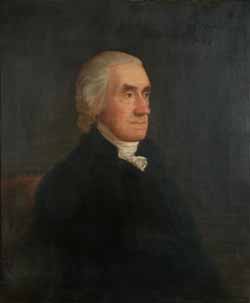
Robert Treat Paine and Daniel Leonard were Taunton’s two representatives to the Massachusetts General Court in the spring of 1774.

Both Paine and Leonard were Harvard graduates and well regarded lawyers. Both men had, as I mentioned yesterday, courted Sarah White, with Leonard being successful and marrying her.

(Paine finally married Sally Cobb of Taunton in 1770, when he turned thirty-nine and she twenty-six. Losing no time, they had their first child two months later.)

On 9 June 1774, both Paine and Leonard were named to the assembly’s committee of nine members to consider how Massachusetts should respond to the Boston Port Bill.

Looking back after two decades, Paine described that period this way:
Mr. Leonard was a Gentleman of natural good Sence & Eloquence, polite & of engaging Adress & had been Chosen Several Years as member for the Town of Taunton, on the Idea of his being a firm & able freind to the Opposition in wch. his Town was so determined; but on the prevailing Address & Sollicitation of Govr. [Thomas] Hutchinson he had changed his principles, & considered himself now at Market to make the best of them;

all this was well known to the members of the Court & the rest of the Committee more especially to his Colleague the writer hereof; it was therefore considered unsafe for that committee to enter into the consideration of the State of the Province on principles of Opposition while he was present, & as it appeared by the Port bill that the only releif from the Continual Exn. of it was the payment for the Tea that was destroy’d, the Committee turn’d their whole Attention to that;

& as it was known to all but Mr. Leonard, that Another Committee of vastly more importance, form’d from Members of the house of Representatives by their own inclinations was beginning to operate in secret the committee of nine talkd very favourably of paying for the Tea, as a thing not to be compar’d with the Sufferings from the Port Bill:

it would be hard to discribe the Smooth & placid Observations made by Mr. S[amuel]. Adams, Saying that it was an irritating affair, & must be handled Cautiously; that the people must have time to think & form their minds, & that hurrying the matter would certainly create such an Opposition as would defeat the matter;

& many Observations of this kind, all tending to induce Mr. Leonard the Oblique Member of that Committee to think that matters would work terminate in Obedience to the Port Bill were made by Several other Members of the Committee, & then it was Observ’d that it was very hot, & that they had been engag’d in Court all day, & that it was unprofitable to set any longer at that time for the people must have time to bring their minds to a Compromise;

Proceedings of this kind took place on the PM & Evning of three days; as soon as the Committee on the State of the Province was adjournd, all the Members except Mr. Leonard immediately repaird to a retired room where the Self Created Committee before mention’d mett, & being cornpos’d of Such members only as had Signalized themselves in their Opposition to the British Aggressions of Tyrannick Govt., they Shut their Doors & entered freely & fully on all the Subjects of Grievances;…
Meanwhile, back in Boston some leading merchants were also arguing that the town should pay for the East India Company tea.

TOMORROW: Dr. Warren’s diagnosis.

Friday, October 16, 2020

Bachelors in Braintree

When Anthony Wibird came to Braintree to be the minister of the north parish in 1755, the congregation offered him £80 a year and £120 as a lump sum in “settlement money” when he married.

Wibird held out instead for £100 a year with no extra help in setting up a household.

We can do the calculation and see that after six years as a bachelor Parson Wibird would be ahead.

Which is not to say the minister didn’t talk about marriage. In fact, that seems to have been a major topic in his conversations when the young lawyer John Adams slept over one Tuesday in January 1759. Adams wrote in his diary:
Met Mr. Wibirt at the Coll’s door, went with him to his Lodgings, slept with him and spent all the next day with him, reading the Reflections on Courtship and Marriage, . . .

In P[arson] Wib[ird] s Company, Something is to be learned, of human Nature, human Life, Love, Court Ship, Marriage. He has spent much of his Life, from his Youth, in Conversation with young and old Persons of both sexes, maried and unmaried, and therefore has his Mind stuffed with Remarks and stories of human Virtues, and Vices, Wisdom and folly, &c. But his Opinion, out of Poetry, Love, Court ship, Mariage, Politicks, War, Beauty, Grace, Decency &c. is not very valuable. His Soul is lost, in a dronish effeminacy. Ide rather be lost in a Whirlwind of Activity, Study, Business, great and good Designs of promoting the Honour, Grandeur, Wealth, Happiness of Mankind.

He says he has not Resolution enough to court a Woman. He wants to find one that will charm, conquer him and rouse his spirit. He is like a Turkey, retiring to Roost. . . .

Wib[ir]t exposes very freely to me his Disposition, the past and present state of his mind, his susceptibility of Impressions from Beauty &c., his Being amourous, and inclined to love, his Want of Resolution to Court, his Regard, fondness, for O., his Intimacy and dalliance with her &c. He has if I mistake not a good many half born Thoughts, of courting O.
“O.” was Adams’s code for the young lady he called “Orlinda”: Hannah Quincy (1736-1826), eldest daughter of Col. Josiah Quincy. [The house the colonel built in 1770 appears above as a stand-in for the family’s previous house.]

Adams himself was beguiled by Hannah Quincy, filling his diary with their dialogues and analyzing how she treated young gentlemen.
She lets us see a face of Ridicule, and Spying, sometimes, inadvertently, tho she looks familiarly, and pleasantly for the most part. She is apparently frank, but really reserved, seemingly pleased, and almost charmed, when she is really laughing with Contempt. Her face and Hart have no Correspondence.

Hannah checks Parson Wibirt with Irony.—It was very sawcy to disturb you, very sawcy Im sure &c.

I am very thankful for these Checks. Good Treatment makes me think I am admired, beloved, and [my] own Vanity will be indulged in me. So I dismiss my Gard and grow weak, silly, vain, conceited, ostentatious. But a Check, a frown, a sneer, a Sarcasm rouses my Spirits, makes me more careful and considerate. . . .

Mr. Wibirt has not an unsuspicious openness of face. You may see in his face, a silly Pain when he hears the Girls, a whispering, and snickering.
For his part, in the summer the parson declared, “Out of H[annah] and E[sther Quincy, her cousin] might be made a very personable Woman but not a great soul.”

Adams likewise began to resent Hannah Quincy’s behavior:
Should have said, H. you was dissatisfied with your situation and desirous of a Husband. In order to get one, you Wheedled Wibirt; you wheedled Lincoln. You gave each of them hints and Encouragement to Court you. But especially you wheedled me. For 6 months past you and I have never been alone together but you have given me broad Hints, that you desired I should court you, &c. &c.
Adams once came close to proposing to “Orlinda,” but he never did. The rival he called “Lincoln”—Dr. Bela Lincoln (1734–1773) of Hingham, brother of Benjamin Lincoln—proposed first. He and Hannah Quincy wed on 1 May 1760.

In his diary Adams assured himself that he’d made a narrow escape, that he didn’t really want to marry “Orlinda” anyhow:
[Jonathan] Sewal and Esther [Quincy] broke in upon H. and me and interrupted a Conversation that would have terminated in a Courtship, which would in spight of the Dr. have terminated in a Marriage, which Marriage might have depressed me to absolute Poverty and obscurity, to the End of my Life. But the Accident seperated us, and gave room for Lincolns addresses, which have delivered me from very dangerous shackles, and left me at Liberty, if I will but mind my studies, of making a Character and a fortune.
A couple of years later, Adams met young Abigail Smith of Weymouth, and they married in 1764. That same year, Adams’s friend Jonathan Sewall married Esther Quincy after a long engagement. Another of their circle, Robert Treat Paine, finally married Sally Cobb in 1770, two months before their first child was born.

TOMORROW: And Parson Wibird?

Sunday, October 10, 2010

Intelligence from Taunton

Last month the Taunton Daily Gazette reported on an effort by the city’s mayor to have the city—or at least its central area—be designated as some sort of National Park Service site:

Mayor Charles Crowley…said that Taunton is qualified because it has a “rich history” in its role as a bellwether for rebellion leading up to the Revolutionary War. He also discussed how Taunton’s industrial development was remarkable, especially when it came to silver.

Crowley started by detailing the totality of events that occurred in what he called the “theater” of downtown Taunton, including Church Green and the Taunton Green, where the Liberty and Union flag was raised. The flag was raised in 1774 by the revolutionary group the Sons of Liberty in the lead-up to the war against the British, according to historians.

Crowley said that the original pole that to hold up the flag in Taunton is missing, but the the Taunton green nonetheless served as a theater that hosted many of Americans founding fathers, including Benjamin Franklin. . . .

Crowley noted the Sons of Liberty of Taunton embodied American values by going against the grain, refusing to act like cowards like most of the subjects in the colonies. He said they displayed their bravery by raising the Liberty and Union flag, impressing their fellow revolutionaries in Boston.
So take that, all those cowards everyone else in the colonies—only Taunton raised the flag!

Except it wasn’t only Taunton. Towns everywhere in New England were hoisting flags on Liberty Poles that season. It was the thing to do in the fall of 1774.

A report about Taunton did indeed get noticed in Boston, in the 24 Oct 1774 Boston Evening-Post:
We have just received the following intelligence from Taunton—that on Friday last [i.e., 21 October] a Liberty Pole 112 feet long was raised there on which a vane, and a Union flag flying with the words Liberty and Union thereon.
That motto was unusual, but a Union flag on a tall pole was not. When Isaiah Thomas took note of Taunton’s Liberty Pole in the Massachusetts Spy, he also reported on poles erected in Concord, Middleborough, Barnstable, Granville, Vineyard Haven, and Hanover, Massachusetts. Already the 3 October Newport Mercury had reported that “most of the towns” in Connecticut had erected Liberty Poles, with heights ranging from 100 to 170 feet.

And how did the town’s “theater” host Benjamin Franklin? On 10 Nov 1775, Sally Paine wrote to her husband, the Taunton lawyer and Continental Congress delegate Robert Treat Paine:
I had the happiness of seeing Doctor Franklin on his return to Philadelphia. He was so kind as to call at our house for letters or anything else that I wanted to send you. He made but a short stay with us and we would have been glad for more of his company.
Franklin was simply doing a favor to a colleague (and taking the opportunity to visit a pleasant woman—always a favorite activity). “He made but a short stay” in Taunton.

As the article explains, to support a new park the N.P.S. wants a site to be of national influence and not to duplicate the stories told in other parks. (There are also important factors of feasibility, budgets, and congressional support.) Clearly Taunton’s citizens took part in the regional Revolutionary movement, but I don’t see it standing out greatly from other New England towns.

(The conjectural recreation of Taunton “Liberty and Union” flag above is available from Flags Unlimited. Thanks to Rob Velella at the American Literary Blog for his tip about this news story.)

Monday, September 29, 2008

“Very much pleas’d with thoughts of having the Small pox”

Last week while I was at the Massachusetts Historical Society, I continued perusing of the third volume of The Papers of Robert Treat Paine, which the society published in 2005. Here’s a bit from a letter that Sally Paine sent to her husband from Taunton on 18 Aug 1776, while he was away at the Second Continental Congress in Philadelphia:

You desire’d me to write what my destines ware about the Small pox. Our Justices are to meet this week to determine Where the Hospital Shall be

if it Should be in a pleasant place & the docter think proper for me to have it I Shall go & three of the Children. I Should not think of having it ware it not for the Children but I Chuse to be with them. . . .

Bobe [i.e., Bobby] & Sally Send duty & are very much pleas’d with thoughts of having the Small pox & Tommy promises to be very good if he may goe.
I had to read that over two or three times to be sure. The Paines were discussing smallpox inoculation, of course, but at the time the treatment really did involve deliberately contracting the disease and hoping it was a mild case, not causing permanent disfigurement or death. But I guess the kids thought that would be exciting. Bobby Paine was born in 1770, Sally in 1772, and Tommy in 1773. All lived to adulthood.

Thursday, February 07, 2008

“Such Is Her Regard for You”

This afternoon I was at the Massachusetts Historical Society, studying the print edition of its Robert Treat Paine Papers. A couple of letters from the second volume struck me as shedding unusual light on Paine’s marriage to Sally Cobb.

Bob and Sally married on 15 Mar 1770. He was a lawyer in his late thirties, prominent enough for the town of Boston to hire him the next month to be a special prosecutor in the trials of Ebenezer Richardson and the Boston Massacre defendants. She was about thirty, daughter of a Taunton iron manufacturer and tavern owner.

Bob Paine wrote to his sister from Plymouth on 17 May of the same year (yes, the same year):

Dear Eunice,

I have just time to inform you that last Monday [14 May] 5 oClock P.M. my Sally brought forth a remarkable fine Boy having Endured a natural Regular uncommonly tedious & painful Travail for 21 hours. The poor Girl endured beyond description.

I left her very comfortable being obliged to come here to Court, & yesterday heard she was well, but I have not yet recovered from the distress of my Anxiety. The Boy weigh’d between 12 & 14 lbs.

Pray give my Love to Mrs. Cranch & Mrs. Adams & inform ’em of this matter. Hoping yr. Welfare I am yr. married father Brother

R. T. Paine
“Mrs. Adams” was Abigail Adams, and “Mrs. Cranch” was her older sister Mary. The big new baby, named Robert, grew up to become a lawyer like his father, but he died at twenty-eight of yellow fever. (His younger brother Thomas then took the name “Robert Treat Paine. Jr.”)

A young lady from Boston named Abigail Tailor was visiting Sally Paine in Taunton on 5 Sept 1770, while Bob Paine was in Boston on legal business. She wrote to ask him to stop by her mother’s house and pick up a cloak “in case it should be Cold when she returns to Boston.” Tailor then added:
Mrs. Paine was so disconsolate in your absence she was Determin’d to have something that belong’d to you so got your plad Gownd & laid it as Close to her as she possible could, such is her regard for you, I think she justly Merits yours
The Paines were married for forty-four years, until Bob’s death in 1814. Sally died two years later.

Saturday, March 10, 2007

Robert Treat Paine's New Clothes

Last November I quoted a letter from Robert Treat Paine’s sister Abigail reminding him to send his laundry home from college. Paine went on to try schoolteaching and merchant sailing before he became one of the province’s leading lawyers. He married at age thirty-nine to Sally Cobb, a young woman from a prominent Taunton family.

The Papers of Robert Treat Paine, published by the Massachusetts Historical Society, offers a few more glimpses of their family life. Here’s a letter that Sally wrote to Robert on 9 Apr 1775. He was then at the Massachusetts Provincial Congress meeting in Concord, looking ahead to returning to the Second Continental Congress in Philadelphia after a stop in Taunton. Sally contacted Robert with a familiar spousal reminder: errands he shouldn’t forget on his way home.

Dear Husband,

I have Sent your Breeches to be Colour:d. I am in hopes they will be done for you to Bring home. You must Call upon Allen Crocker for them and pay him for the Colouring. If your Cloaths should be wove befor your return I Shall Send it to Liscumb to be Colour:d pea Green unless I hear from you.

I am in Great want of that Cambrick if you have an opportunity due Send it up.

I want to know when you expect to come home, I hope I Shall See you with your head on your Shoulders once more but my Stout heart begins to quiver for fear of blood Shed. I hear their is a great number going to see Col G—— to night with a Desire to carry him to providence but what the event of this will be I do not know.

Our family are well at present. Give my Love to your Sisters. I am in haste your Loving wife,

Sally Paine