J. L. BELL is a Massachusetts writer who specializes in (among other things) the start of the American Revolution in and around Boston. He is particularly interested in the experiences of children in 1765-75. He has published scholarly papers and popular articles for both children and adults. He was consultant for an episode of History Detectives, and contributed to a display at Minute Man National Historic Park.

Subscribe thru Follow.it


•••••••••••••••••


Showing posts with label Henry Wells. Show all posts

Sunday, April 06, 2025

From “Loyall Nine” to “Sons of Liberty”
We have a reasonably good idea of who eight of Boston’s “Loyall Nine” were:
In addition, the ship masters Henry Wells and Joseph Field were also lumped in with this group by different contemporaries.

Within months after they started organizing anti–Stamp Act protests, the group appears to have adopted another name. Back during Parliament’s debate over that law, opponent Isaac Barré called American colonists “Sons of Liberty,” as reported to this side of the Atlantic by Jared Ingersoll. By the fall the “Loyall Nine” started using that phrase.

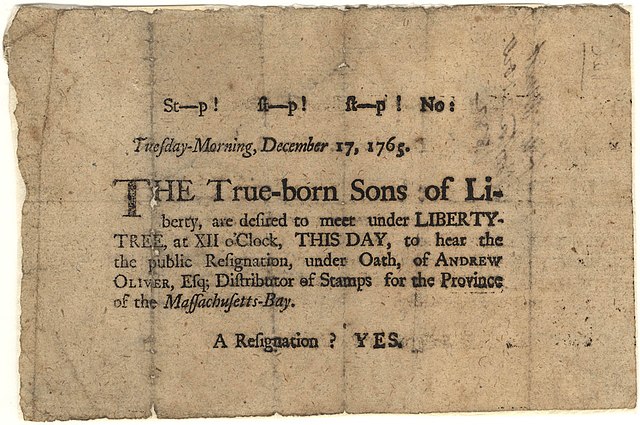
The handbills that Bass described the group printing in his December 1765 letter said: ”The True-born Sons of Liberty, are desired to meet under LIBERTY-TREE, at XII o’Clock, THIS DAY…” Evidently any man could merit that label by coming out to resist the new tax from London. In early 1766 the phrase also started to appear in newspapers in other ports.

But the group also used that term for themselves. In January 1766 John Adams called them “the Sons of Liberty.” On 15 February, Crafts wrote to Adams that “the Sons of Liberty Desired your Company at Boston Next Wensday.” Those are clearly references to a specific group, not to everyone taking a certain political stand.

It looks like the more general use won out. By August 1769, “An Alphabetical List of the Sons of Liberty who din’d at Liberty Tree [Tavern], Dorchester” included 300 names. Clearly those Sons of Liberty weren’t just the “Loyall Nine”—though all eight men listed above were there.

Nonetheless, because of some unsubstantiated claims and portrayals in popular culture, the belief persists that the Sons of Liberty was an identifiable group of activists, not a mass movement, as I’ve written before. Because of that squishiness, I tend not to use the term. But of course it’s strongly associated with the Revolution.

TOMORROW: Back to the bowl.

Saturday, April 05, 2025

Counting the “Loyall Nine”

In a 19 Dec 1765 letter divulging details about Boston’s latest Stamp Act protest, and earlier ones, Henry Bass wrote of the organizers as “the Loyall Nine.” He added:
And upon the Occasion we that Evg. had a very Genteel Supper provided to which we invited your very good friends Mr. S[amuel] A[dams] and E[des] & G[ill] and three or four others and spent the Evening in a very agreable manner Drinkg Healths etc.
On 15 Jan 1766 John Adams wrote in his diary:
Spent the Evening with the Sons of Liberty, at their own Apartment in Hanover Square, near the Tree of Liberty. It is a Compting Room in Chase & Speakmans Distillery. A very small Room it is.

John Avery Distiller or Merchant, of a liberal Education, John Smith the Brazier, Thomas Crafts the Painter, Edes the Printer, Stephen Cleverly the Brazier, [Thomas] Chase the Distiller, Joseph Field Master of a Vessell, Henry Bass, George Trott Jeweller, were present.

I was invited by Crafts and Trott, to go and spend an Evening with them and some others, Avery was mentioned to me as one.
Finally, in 1788 the Rev. William Gordon wrote in his history of the Revolution about the first anti-Stamp protest, back in August 1765:
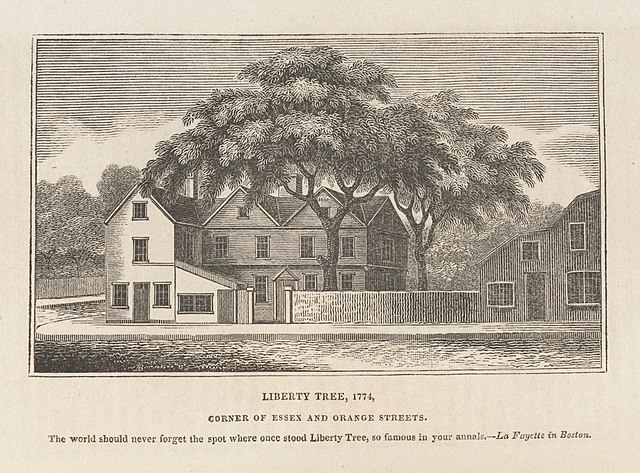
Messrs. John Avery, jun. Thomas Crafts, John Smith, Henry Welles, Thomas Chace, Stephen Cleverly, Henry Bass, and Benjamin Edes…provide and hang out early in the morning of August the fourteenth, upon the limb of a large old elm, toward the entrance of Boston, over the most public street, two effigies,…
Those sources, which were published in reverse chronological order, all seem to refer to the same group of men. The lists of names overlap—but not exactly.

Bass said there were nine men, and seemed to treat Samuel Adams, Edes, and Gill all as guests. Gordon named eight men, including Edes among them. John Adams also listed Edes in the group, and he treated George Trott, not on Gordon’s list, as in the group.

John Adams didn’t list Henry Wells from Gordon’s list (though Tea Leaves and some subsequent books misquote him as doing so). Instead, Adams named Joseph Field, saying he was a ship captain. According to mentions in the Boston press before he died in 1768, Henry Wells was also a ship captain. Would either of them have been in town long enough to help plan protests? 

It’s therefore difficult to say exactly who the “Loyall Nine” were, but there was definitely a political club supping at the Chase distillery near Liberty Tree and organizing the protests under that tree.

TOMORROW: A change of names?