J. L. BELL is a Massachusetts writer who specializes in (among other things) the start of the American Revolution in and around Boston. He is particularly interested in the experiences of children in 1765-75. He has published scholarly papers and popular articles for both children and adults. He was consultant for an episode of History Detectives, and contributed to a display at Minute Man National Historic Park.

Subscribe thru Follow.it


•••••••••••••••••


Showing posts with label Richard Prescott. Show all posts

Wednesday, January 21, 2026

“Also embarked Colonel Richard Prescott”

In late 1774 the British 7th Regiment, known as the Royal Fusiliers, was stationed southwest of Montréal, guarding the frontier of the British Empire.

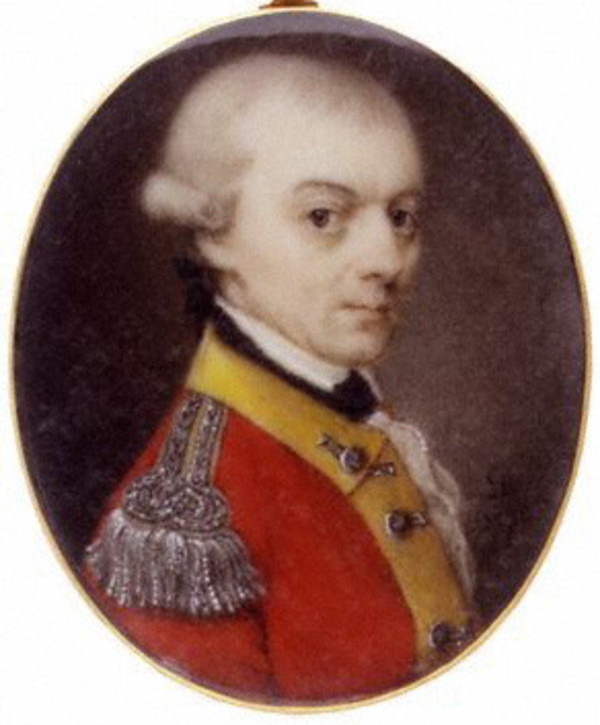
But its commanding officer, Col. Richard Prescott (shown here), wasn’t with them.

The 17 October New-York Gazette reported:
On Thursday Morning last Major General [Frederick] Haldimand embarked on board the Transport named the Countess of Darlington, attended by Major of Brigade [Thomas] Moncrieff, Capt. Thomas Gamble, Assistant Quarter-Master General, Captain [Dietrich] Brehm, Aid de Camp, and Captain [Francis] Hutcheson;

with General Haldimand also embarked Colonel Richard Prescott of his Majesty’s Royal Fusileers, a Company of the Royal Artillery, with a large Quantity of Ordnance Stores for Castle-William.
Also headed to Boston were the 47th Regiment, three companies of “the Royal Regiment of Ireland” (18th), an artillery company, and artificers to build barracks.

Those transport ships arrived on Sunday, 23 October, as reported four days later in the Boston News-Letter. This was part of Gen. Thomas Gage’s military build-up after the “Powder Alarm.” Indeed, by the end of the year the 7th would be one of the few regiments in North America not stationed inside Boston.

Col. Prescott was still in Boston when the war began because on 12 June 1775 Gen. Gage wrote to the Secretary of War, Viscount Barrington, that “Colonel Prescot, now declared Brigadier,…is going to Canada to Assist General [Guy] Carleton.”

In addition, this 1905 publication by the Canadian Archives stated that Gage sent the same news that day to Lord Dartmouth, the Secretary of State: “The Colonel Prescott goes immediately to Canada to assist General Carleton, for I hear the Rebels, after surprising Ticonderoga, made Incursions, and committed Hostilities upon the Frontiers of the Province of Quebec…” I haven’t found a copy of that letter in Gage’s papers at the Clements Library, but its online database and transcriptions are still a work in progress.

Thus, through the first half of October 1774 Col. (later Gen.) Richard Prescott was in New York, where Hugh Gaine printed A Letter from a Veteran, to the Officers of the Army Encamped at Boston, as discussed here.

Prescott then sailed north. Eight days after he arrived, booksellers Cox and Berry advertised that pamphlet for sale in Boston.

As a senior officer in Gage’s force, particularly one not engrossed in the daily duty of his regiment, Prescott had the motive and opportunity to pen advice from a “Veteran” to younger officers. He was much closer to the situation in Boston than his younger brother Robert.

When William Tudor, Jr., recorded that people said A Letter from a Veteran was written by “General Prescott,” he most likely meant Richard Prescott.

Thank you for your attention to this matter.

Tuesday, January 20, 2026

The Younger General Prescott

Bibliography abhors a vacuum.

Once William Tudor, Jr., suggested in print that “General Prescott” deserved credit for writing the 1774 pamphlet A Letter from a Veteran, to the Officers of the Army Encamped at Boston, cataloguers didn’t want to ignore that suggestion. It was better to share some possibly correct information than to leave a blank, right?

No matter that Tudor didn’t seem certain, or offer a reason to believe that attribution. He was a solid researcher, for the early nineteenth century. His parents had been in Boston before the war. His mother, Delia Jarvis, was from a Loyalist family who knew British army officers. So his info might have been accurate.

In the early twentieth century, bibliographers started to surmise that “General Prescott” might mean Robert Prescott (1726?–1815, shown above), a veteran of the Seven Years’ War who eventually became governor general of the Canadas. Most of those attributions remained tentative, but his was the only name put forward, so gradually it came to seem more solid.

I’m skeptical. In 1774, when A Letter from a Veteran appeared in New York, Robert Prescott was almost certainly in Britain, living on his half-pay pension as a lieutenant colonel mustered out of the 72nd Regiment. He hadn’t served on the North American mainland since 1760.

While it’s conceivable that Lt. Col. Prescott followed the political debates over America closely, wrote an essay responding to American Whig arguments and analyzing the cultures of different colonies, and sent it across the Atlantic to be published, that seems unlikely.

On 8 Sept 1775 Robert Prescott was called back into service, now lieutenant colonel in the 28th Regiment. He reached New York with the 1776 invasion force. After fighting on the mainland and in the Caribbean, he gained the rank of general in 1781. And his military and administrative career would continue. He never appears to have claimed A Letter from a Veteran as his own, or to have published other political essays. 

Is there any better candidate for “General Prescott”?

Robert’s older brother Richard Prescott (1725–1788) gained the rank of general a few years before him, early in the Revolutionary War. Richard’s regiment, the 7th or King’s Fusiliers, was in North America in 1774. So is Richard more likely to have been the author of A Letter from a Veteran?

The main problem with that hypothesis is that in 1774 the 7th Regiment was stationed in western Canada, practically as distant from New York as London was.

TOMORROW: A paper trail.

Wednesday, December 18, 2024

“Perfectly Loyal, no one more so & very active”

As recounted yesterday, as of May 1777 John Cochran was on British-held Long Island in New York while his wife Sarah was still back home in Londonderry, New Hampshire.

(We know that because the Patriot authorities who intercepted a letter from John to Sarah were gracious enough to print it in the New-Hampshire Gazette that month for everyone to read.)

Documents published in the Parliamentary Papers show that John Cochran was continuing to collect ten shillings per day as captain of Fort William and Mary, plus “rations of provisions and fuel.”

In return, Cochran did various tasks for the king’s military. Sarah later told the Loyalists Commission:
He was occasionally employed in the Navy. Went on a Voyage as Pilot on Board the Lively. He Continued with the Army; always ready to give them his assistance by Land or Sea.

He was employed by Genl. [Richard] Prescot [shown above] on Rhode Island to attack an Enemies out Post, which he performed & took ye Picket. He was on a Cruise with Mr. [George] Leonard. Went with Dispatches from Rhode Island to New York, and was employed on various occasions.
Abijah Willard confirmed this service, telling the commission that Cochran “was very forward in giving Intelligence. Joined the Brit. very early.” The Loyalist colonel said he considered the man “perfectly Loyal, no one more so & very active.”

Cochran was also a lieutenant in a Loyalist militia company.

In June 1779, the state of New Hampshire moved to confiscate John Cochran’s property. If Sarah had been staying on the farm to forestall that move, it hadn’t worked. Maybe that’s what finally drove her away. By 1783, the whole Cochran family was in New York.

Sometime that year John suffered “a paralytic stroke.” Sarah described him as “not capable of doing any Business,” with “no more strength or understanding than a Child.”

When the order came to evacuate New York City, John’s militia company was assigned to the ship Bridgewater. Sarah got her husband and their four children aboard along with three dependents, including an eleven-year-old black boy named Adam who was indentured until he turned twenty-one, according to this article from Loyalist Trails.

That fleet left New York in June and arrived at Saint John, New Brunswick, on 5 July. John was still “not capable of doing any Business,” and then suffered another stroke about two months later.

TOMORROW: Life in a new province.

Saturday, January 18, 2020

Capt. Samuel Lockwood at War

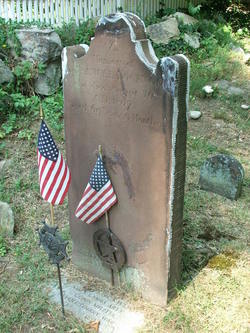
Samuel Lockwood (1737–1807, gravestone shown here courtesy of Find a Grave) of Greenwich, Connecticut, became a second lieutenant in the Continental Army in April 1775.

That fall, he joined Gen. Richard Montgomery’s invasion of Canada. On 5 November Lockwood’s commanders made him an assistant engineer with the rank of captain. The Continental Congress never recognized that rank but later voted to pay Lockwood a year’s salary as an engineer.

Lt. Lockwood’s specialty was really maneuvers on the water. He reconnoitered ahead of the army by boat during the march north and helped to capture eleven Crown vessels and Gen. Richard Prescott at Sorel.

The Battle of Québec didn’t work out so well for Lockwood, however. He was wounded, captured, and not released on parole until late in 1776.

As soon as Lockwood was formally exchanged in early 1777, the Congress commissioned him as a captain in Col. John Lamb’s artillery regiment. He served two years, resigning in 1779.

Capt. Lockwood was then done with the Continental Army, but he wasn’t done with the war. He remained active in his state’s military. In 1779 he commanded an armed vessel on Long Island Sound, attacking British ships in the Oyster Bay harbor in November.

On 17 Jan 1780, Capt. Samuel Lockwood led “forty volunteers from Greenwich” alongside Capt. Samuel Keeler and an equal number of Connecticut militiamen on a raid into New York. Their target was the home in Morrisania of Lt. Col. Isaac Hetfield, Loyalist commander of the Westchester County militia.

Gen. William Heath reported to New York’s Gov. (and Gen.) George Clinton about the Lockwood and Keeler raid a few days later:
they arrived at the place a little after one the next morning, attacked the picket, killed 3 and drove the others in, march’d to the House where Hatfield was, who, with his men took to the chambers [i.e., bedrooms] and kept up a fire down stairs and out at the windows; the militia behaved with great Bravery, call’d to Hatfield to Surrender or they would Set fire to the House…
TOMORROW: The view from inside Hatfield’s house.

Sunday, November 11, 2018

Redcoats Return to Newport, 17 Nov.

On Saturday, 17 November, the Newport Historical Society, the Redwood Library & Athenæum, and two dozen of the region’s top-notch Revolutionary War reenactors will present a program titled “Redcoats at the Redwood: A 1778 Living History Event.”

The British military occupied Newport, Rhode Island, for years during the Revolutionary War, fending off threats from land and sea. This event focuses on the year 1778. Here’s the event description:
The Redwood Library’s Harrison Room will be transformed into an officer’s club as men from the British army and Royal Navy discuss the latest news and intelligence about the war efforts, in-between relaxing, playing cards and enjoying a few drinks.

Chat with reenactors portraying key figures such as General [Richard] Prescott, Mary Almy, Joseph Wanton Jr. and the newly wed Henrietta Overing Bruce. Other personas will include a printer, a minister, a merchant, officer’s wives, and a local woman who’s courted by a British officer.

Hourly activities range from toasts to games and will include a skit inspired by the Redwood’s history from this time. Visitors can learn about 18th-century newspapers, letters, artwork and military passes, including the pass that was required to leave the island, along with life during the Revolutionary era in Newport.
Spectators can also try a Spy Challenge, collecting intelligence as they chat with the reenactors to learn about the British military plans.

This event is scheduled for 2:00 to 7:00 P.M. at the Redwood Library, 50 Bellevue Avenue in Newport. There is a parking lot beside the building. Admission is free, though donations are welcome.

Saturday, August 19, 2017

“British Occupation of Newport,” 26 Aug.

On Saturday, 26 August, the Newport Historical Society will host another of its highly regarded living history events, this one depicting “The British Occupation of Newport’s Old Quarter.”  

The overview:
During the Revolutionary War, the British occupied Newport, Rhode Island, for nearly three years—a time that dramatically changed the city. Prior to the war, Newport was the fifth-largest city in the American colonies and was experiencing a Golden Age of wealth. But beginning in December 1776, British troops arrived, and the course of Newport’s future was dramatically altered. Much of the population left, and those who remained struggled; tensions between local Loyalists and British troops grew during each year of the three-year occupation.

The afternoon program will open with a heated argument between two gentlemen who favor the Crown, and will close with the capture of General Richard Prescott.
The activity takes place from 12:00 noon to 5:00 P.M. The main action in the public areas is free. It looks like these include:
  • Eighteenth-century auction beside the Museum of Newport History at the Brick Market.
  • Preparations for a wedding between a British solider and a local woman in the yard of the Wanton-Lyman-Hazard House.
  • Sentry box with British soldiers outside the Colony House, a fine opportunity for selfies.
  • In Washington Square, visitors can mingle with such residents as an apothecary, a printer, merchants, food sutlers, and owners of a boarding-house and tavern.
The Newport Historical Society takes advantage of the space around its colonial buildings and attracts some of the country’s best historical reenactors as enthusiastic volunteers. If all goes according to plan, this will be the society’s largest living-history event yet.

In addition, there are special events for additional fees.

The Spy Challenge: “For a $3 fee per family, purchase a handout at the Brick Market Museum Shop that offers clues guiding visitors to collect important intelligence information at select interpretative stations. Participants must then figure out how to transport the intelligence off of the island to help General Washington win the War for Independence. Upon successfully completing the Spy Challenge, participants can collect a small prize. Proceeds help offset event operation costs.”

American Revolution in Newport Walking Tour: This tour will wind its way through the action in Washington Square and end with a “tot of rum” in a reproduction eighteenth-century Royal Navy cup, a silver and brass souvenir included in the tour price. Starting from the Brick Market Museum at 2:00, this tour is for people aged 21 or older with photo identification. It costs $35 per person, $30 for society members and active-duty military personnel. Limited to twenty participants, so reserve a space by calling 401-841-8770.

Thursday, December 05, 2013

“Kidnapping the Enemy” in Newport, 12 Dec.

Next Thursday, 12 December, the Newport Historical Society will host author Christian McBurney’s first lecture about his new book Kidnapping the Enemy: The Special Operations to Capture General Charles Lee and Richard Prescott. The society describes the event this way:
On December 13, 1776, at an isolated New Jersey tavern, George Washington’s second-in-command, Major-General Charles Lee, was captured by a party of British dragoons. The American army needed a British captive who was the same rank as General Lee.

Rhode Island’s William Barton planned and executed the cross-bay capture of Major-General Richard Prescott at the Overing house in Middletown, where Prescott commanded the British garrison occupying Newport and the rest of Aquidneck Island. Barton’s raid was the outstanding special operation of the Revolutionary War and still ranks as one of the greatest in American military history. But did the pride he earned from this mission ruin thirteen years of his life?
McBurney is a graduate of Brown University and partner in a Washington, D.C., law firm. He is the author of other books on early Rhode Island history, including The Rhode Island Campaign: The First French and American Operation of the Revolutionary War and British Treatment of Prisoners During the Occupation of Newport, 1776–1779.

Admission to this event is $5 per person, or just $1 for Newport Historical Society members. It will take place in the Newport Colony House, Washington Square, starting at 5:30 P.M. To reserve a space, call 401-841-8770.

Friday, February 29, 2008

“Alarming Apprehensions” and the Mysterious Dr. Gilson

Boston selectman Timothy Newell must have been nervous when he started his last diary entry for February 1776 with “Thursday 25th.” As the person who transcribed this document for the Massachusetts Historical Society’s Collections series noted, the 25th was a Sunday. Context indicates that Newell probably wrote this entry on Thursday the 29th:

From the accounts of Dr. Gilson, and some others Deserters from the Continental army, great preparations were making to attack the Town,—caused very alarming apprehensions and distress of the Inhabitants.
Newell had stayed in Boston not because he supported the Crown but because he felt a responsibility to guard the town from the damages of war. Now the Continental artillery was preparing to bombard Boston, as Gen. George Washington had described days before.

After reading this diary entry, I wondered who “Dr. Gilson” was. Newell called him a deserter, and deserters are always interesting. But it took a lot of digging to find even a little about the man. His name doesn’t appear on the list of colonial Boston’s physicians published by the Colonial Society of Massachusetts, for example. Fortunately, we now have Google.

On 19 Apr 1764, while Boston was under threat from a smallpox epidemic, the selectmen summoned every physician in the area to discuss how they were treating patients and inoculating people safely. “Dr. Samuel Gilston” was one of the doctors who did not attend that meeting.

Jacob Rader Marcus’s compilation of documents from the eighteenth century on the topic of American Jewry offers a very good clue about the man. (Only Google Books allowed me to find this.) In 1770 Aaron Isaacs of East Hampton, Long Island, wrote to a Newport businessman that “Docter Gilston” owed him money. He added, “He is a docter and neavel offesur at Nantucket.” Gilson might therefore have been working as a ship’s doctor for the Royal Navy.

Isaacs (1724-1798) was born in Hamburg, moved to Long Island, and eventually converted from Judaism to Presbyterianism. His daughter Sarah married a Cape Cod man named William Payne, and their son John Howard Payne wrote “Home, Sweet Home.” But I digress.

Then the war broke out. If Dr. Gilston had ties to the navy and to Nantucket, which was known for its Loyalism, the Whig authorities in Massachusetts might well have seen him as an enemy. So they locked him up. William Pynchon of Salem wrote in his diary on 29 Feb 1776, the same day Newell heard the upsetting rumors:
News came that Dr. Gilson and others broke out of Plymouth jail and got into Boston; and by advices from Dr. Eliot and Mr. Payson that the Regulars at B[oston]. are preparing to quit the town; and from others that the Provincials are busy in preparing to bombard the town, and to erect works for that end on the hill at Dorchester, near the Neck.
Dr. Eliot was probably the Rev. Dr. Andrew Eliot, one of the Congregationalist ministers who had stayed in occupied Boston. Mr. Payson was probably the Rev. Phillips Payson of Chelsea.

Dr. Gilston was not on the list of civilians evacuated from Boston in 1776, nor was he listed as an absentee by the state in 1778. Instead of leaving, he appears to have returned to Nantucket and become part of that community’s struggle to stay out of the fighting that followed.

I found two more glimpses of the doctor during the war. In 1779, a Nantucket man named Thomas Jenkins complained to the Massachusetts Council about five islanders trying to aid the British military and summoning their “predatory fleet” to the island. Jenkins wrote, “Dr. Samuel Gilston will prove this confession.” Gilston signed this complaint as a witness.

In addition, Dr. James Thacher’s Military Journal recorded some gossip about the British general Richard Prescott, who had been captured and exchanged:
After the general was exchanged, and he resumed his command on the island, the inhabitants of Nantucket deputed Dr. Gilston to negotiate some concerns with General Prescott, in behalf of the town. Prescott treated the Doctor very cavalierly, and gave as the cause, that the Doctor looked so like that d—d landlord, who horsewhipped him in Connecticut, that he could not treat him with civility.
The islanders might have chosen Dr. Gilston to be their liaison with Gen. Prescott because he had old ties with the British military.

I’ve also found indications that a boy named “Gilson” entered Boston’s South Latin School in July 1773, as noted by assistant teacher James Lovell, and that Roland Gilson was later a physician on Nantucket. Was this Dr. Samuel Gilston’s son, sent to Boston for a classical education and then taking over his father’s practice?

(Thumbnail map of Nantucket above, actually drawn in the 1940s, courtesy of Rev. A. K. M. Adam’s blog.)

ADDENDUM: Thanks to reader Tom Macy, I’ve found much more about this doctor. It turns out he preferred to spell his last name “Gelston.”