J. L. BELL is a Massachusetts writer who specializes in (among other things) the start of the American Revolution in and around Boston. He is particularly interested in the experiences of children in 1765-75. He has published scholarly papers and popular articles for both children and adults. He was consultant for an episode of History Detectives, and contributed to a display at Minute Man National Historic Park.

Subscribe thru Follow.it


•••••••••••••••••


Showing posts with label Edmund Burke. Show all posts

Friday, November 10, 2023

“The Imp at the Cardinal’s bolster”

Sir Joshua Reynolds completed his painting of “The Death of Cardinal Beaufort,” based on a scene from Henry IV, Part 2, in 1789.

The Shakespeare Gallery in London had commissioned this canvas for 500 guineas (£525).

Immediately some colleagues criticized the canvas for including the face of a demon.

In Shakespeare’s play the king says: “O! beat away the busy, meddling fiend that lays siege unto this wretch’s soul.” But people said that was just a metaphor; no real fiend appeared on stage, much less at the historical event.

A correspondent wrote in The Times of London on 7 May:
The Imp at the Cardinal’s bolster cannot spoil the Picture, but it does no credit to the judgement of the Painter. We rather apprehend that some Fiend had been laying siege to Sir Joshua’s taste, when he determined to literalise the idea. The license of Poetry is very different from that of Painting; but the present subject itself is complete in itself, and wants not the aid of machinery from Heaven or Hell. In this enlightened period astonishment and pity wait upon it.
The landscape designer Humphry Repton said that if Shakespeare had listed an evil spirit as one of his characters, then it might deserve a place in the painting. But otherwise not.

After Reynolds’s death another Royal Academy instructor, Edward Edwards, declared:
The Death of Cardinal Beaufort is an admirable specimen of colouring, but the introduction of the little Imp or Devil on the pillow of the Cardinal, as tormenting the wretched sinner in his last moments, is too ludicrous and puerile to escape censure; and it has been matter of great surprize, that a man of Sir Joshua’s understanding could persevere in the admission of such an object, even against the advice of his friend Mr. Burke, to whose judgment he ever paid great deference.
The portraitist William Beechey told a story of hearing Edmund Burke tell Reynolds that the devil’s face was “an absurd and ridiculous incident, and a disgrace to the artist.” After some exchange about Burke’s ability to argue either side of an issue (if paid, implicitly), Reynolds said that the fiendish face “was a thought he had conceived and executed to the satisfaction of himself and many others; and having placed the devil there, there he should remain.”

One observer who agreed with that choice was Dr. Erasmus Darwin, writing in 1791:
…why should not painting as well as poetry express itself in a metaphor, or in indistinct allegory? A truly great modern painter lately endeavoured to enlarge the sphere of pictorial language, by putting a demon behind the pillow of a wicked man on his death bed. Which unfortunately for the scientific part of painting, the cold criticism of the present day has depreciated.
Soon after “The Death of Cardinal Beaufort” debuted, Caroline Watson produced an engraving of the picture. However, within a year, apparently to meet public desire, the controversial demon’s face was rubbed out of the copper plate, leaving just a few light squiggles on later prints, such as this one from the Royal Collection (shown above).

I linked to an ArtNetUK image of “The Death of Cardinal Beaufort” yesterday. Looking at it, you might ask: What demon? Where is this imp? What were people so upset about?

That’s because, although Reynolds never altered his painting to please its critics, over the years other people’s layers of varnish and paint did. The face of the fiend disappeared.

This year the National Trust had the painting restored, and the fiend is back, as shown in the detail below.

Saturday, March 04, 2023

John Sawbridge, M.P.

John Sawbridge (1732–1795) was of the radical Whigs who joined the Rev. John Horne in supporting John Wilkes during the 1760s, forming the Society of Gentlemen Supporters of the Bill of Rights, and then leaving that group to form the Constitutional Society instead, as discussed yesterday.

Sawbridge first tried to run for Parliament in 1763, but bowed out when a more prominent Kentish gentleman wanted the seat. Reportedly, Tories tried to keep him in the race in hopes he’d split the Whig vote—the first time he had to deal with the rough and tumble of genteel Georgian politics.

Five years later, Sawbridge entered Parliament as a member for the town of Hythe, succeeding Lord George Sackville (Germain). At first he appeared to be one of the Duke of Grafton’s men, but he started to push Wilkes’s cause. As a result, Lord Grafton dropped Sawbridge, but the city of London adopted him, making him a sheriff and an alderman.

Then came the split with Wilkes. In 1771 Sawbridge was up for the post of Lord Mayor of London, but Wilkes threw his weight behind the incumbent instead. That year, the ministry’s preferred candidate won the office—Wilkes and Sawbridge had split the Whig vote.

Wilkes became increasingly vituperative, saying that “in politics [Sawbridge], poor man,…[could] see no farther than his nose.” Sawbridge had a big nose, but the cross-eyed Wilkes was hardly the one to criticize someone else’s vision. When that didn’t work, Wilkes complained that Sawbridge was a “proud Colossus of pretended public virtue.”

In response, Sawbridge kept talking about the importance of remaining politically independent of parties and, more radically, serving the people by voting the way they wanted. Most politicians preferred the approach Edmund Burke argued for, voting the way that you knew was best for them.

In the spring of 1774 Sawbridge and Wilkes reconciled. Sawbridge bowed out of the race for Lord Mayor in favor of Wilkes, who promised support in the fall’s parliamentary election. Sawbridge lost his seat in Hythe but won one in London. The next year, he also succeeded Wilkes as Lord Mayor.

Both men opposed Lord North’s policy toward the American colonies, but they were part of a small minority in Parliament. Over the next few years, Sawbridge allied with the Marquess of Rockingham and the Earls of Shelburne and Chatham rather than the more radical opposition. As Charles James Fox rose to lead the Whigs in the House of Commons, Sawbridge deferred to him.

In 1780, Sawbridge supported the Roman Catholic Relief Act. That proved to be wildly unpopular; the Gordon Riots paralyzed the city. Sawbridge lost support among Londoners, apologized humbly for taking a position that they didn’t like, and still came in fifth in a race for four seats.

However, one of the four frontrunners, John Kirkman, died on the day the polls closed. There was a special by-election, and this time Sawbridge won with no contest.

Four years later, the new prime minister, William Pitt, spent £2,000 supporting his own candidate in London. His party called Sawbridge a “republican” and “an avowed enemy to the constitution, to monarchy.” It didn’t help that Sawbridge’s older sister was the celebrated republican historian (and now married widow) Catharine Macaulay Graham.

Sawbridge insisted he wanted only reform in the Commons and protection for “the Rights of the People.” He pulled out a win in 1784 by only nine votes. He promptly resumed pushing for parliamentary reforms, which still went nowhere.

In 1790, Sawbridge sought reelection mainly for old times’ sake, even asking for the privilege to die in political service to the city of London. Voters chose him overwhelmingly. But then he suffered a stroke, so while he remained an M.P. until his death he was at least partially paralyzed.

Though contemporaries and historians agree that John Sawbridge was an ambitious man, he also stuck to his principles, which were ahead of his time.

Sunday, December 18, 2022

“Not only relishing the sociable but actively contriving it”

Like the Georgian Papers Programme, Digit.En.S is a study of eighteenth-century Britain funded by the E.U. and based at a continental university.

Digit.En.S hosts the Digital Encyclopedia of British Sociability in the Long Eighteenth Century, designed to “Explore the wide range of topics related to British Sociability from 1650 to 1850 and learn about the circulation of models of sociability that shaped European and colonial societies.”

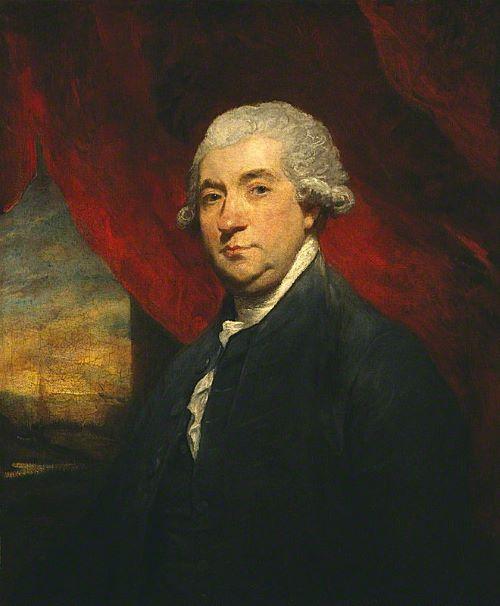
Be that as it may, I enjoyed Allen Ingram’s profile of James Boswell:
…he was, quite simply, good company – attentive, amusing, intelligent and above all lively. [Samuel] Johnson, most clearly, and [Pasquale] Paoli, once exiled in England, became lifelong friends and were pleased to see him often during his annual spring visits to London from Edinburgh. Through Johnson in particular, Boswell became friends with a set of men he might not otherwise have met, or met so soon and so favourably. These included Edmund Burke, David Garrick, Joshua Reynolds and Oliver Goldsmith; but other friends, like John Wilkes, and various members of the Scottish nobility, were already part of Boswell’s circle, and would remain so – indeed, he even contrived a dinner in London in May 1776 that brought Johnson and Wilkes, the bitterest of political rivals, together in an atmosphere of sociability and mutual good humour, though the good humour found its focus in making jokes at Boswell’s expense.

But this was part of Boswell’s talent, not only relishing the sociable but actively contriving it. He could be immensely self-promoting, often in a highly embarrassing way, as at the annual dinner of the Company of Grocers in London in November 1790, in the presence of Prime Minister William Pitt, an honorary member of the Company, when Boswell sang the semi-satirical ballad, ‘William Pitt, The Grocer of London’, six times, apparently by popular acclaim, in a misguided attempt to curry favour from Pitt in his political ambitions. But Boswell seems to have been utterly beyond embarrassment, especially at large social occasions, and especially after consuming alcohol. . . .

Drinking for Boswell almost always took place within a social context. He was not particularly choosey, though, about the nature of that context, or about the location of his drinking. As long as there was company, he would drink: with lords and ladies, as at Northumberland House, where Trafalgar Square now is, where the set surrounding the Duke and Duchess of Northumberland congregated, as he did in London during his visit of 1762-1763; or with politicians and genteel tradesmen, as at the Grocers’ dinner cited above; or with his legal friends and acquaintances back in Edinburgh, as he did all his life; or with prostitutes in London, or Edinburgh, or anywhere, as he also did all his life; or, as he did returning to Edinburgh from Auchinleck in March 1777 with an old friend, Richard Montgomery, ‘at some low ale-house’, where ‘I drank outrageously’ and ‘arrived at Edinburgh very drunk’.

Boswell’s taste in women and in female society was if anything even wider than his taste in alcohol and his expectations of the kind of sociability that was possible from it changed the further down the social scale he went. Few if any of his sexual relationships were with women of the highest social class. With such women his expectations were similar to the sociability he enjoyed with men, with the bonus of their being female: he enjoyed their company and was able to flirt as an amusement rather than as a preliminary to anything. . . . [In contrast,] His relationship with the actress ‘Louisa’ (Anne Lewis) in London in 1762-1763…observes all the polite social niceties, with a mix of gallantry, wit and deference:
‘Madam, I was very happy to find you. From the first time that I saw you, I admired you.’ ‘O, Sir.’ ‘I did, indeed. What I like beyond everything is an agreeable female companion, where I can be at home and have tea and genteel conversation. I was quite happy to be here. ‘Sir, you are welcome here as often as you please.’ (London Journal 115)
The pay-off, however, when it comes is a level of physical reality far beyond ‘tea and genteel conversation’: ‘A more voluptuous night I never enjoyed. Five times was I fairly lost in supreme rapture. Louisa was madly fond of me; she declared I was a prodigy.’
Boswell published essays, travel accounts, and his biography of Johnson in his lifetime, but he came back to life only in the 1900s when his private diaries were discovered and put into print.

Monday, August 22, 2022

“Opposition to established error must needs be opposition to authority”

In May, prompted by the Boston Museum of Fine Arts’s new acquisition of a double portrait by Joseph Wright of Derby, I started writing about the life and public image of historian Catharine Macaulay.

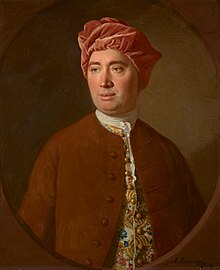
Then I broke off to address other matters, but at last I’m getting back to her. But first a running start with another historian, David Hume (1711–1776, shown here).

Hume began publishing philosophical essays with his Treatise on Human Nature in 1738, earning about as much as philosophers have usually earned. But in 1754 he published the first volume of his History of England. In eight years he wrote six volumes covering time from Julius Caesar to the Glorious Revolution of 1688. That series was popular enough to make Hume moderately rich and famous.

As a national history, Hume’s work was notable for a couple of themes that might seem contradictory:
  • He was skeptical or critical about religion, casting it as an impediment to progress.
  • He was favorable about England’s monarchs, even the Stuarts.
Hume thought of himself as an independent Whig or standing politically between the Whigs and Tories, but the Whigs of the 1750s felt he had created a Tory history of their country.

In 1763 Catharine Macaulay published the first volume of her History of England from the Accession of James I to that of the Brunswick Line. She and her readership saw her as providing a truly Whiggish response to Hume. For her the Stuarts were bad kings, and the uprising against them a Good Thing.

The two authors exchanged letters in 1764. Hume stated, “I look upon all kinds of subdivision of power, from the monarchy of France to the freest democracy of some Swiss cantons, to be equally legal, if established by custom and authority.” Macaulay disagreed:
Your position, that all governments established by custom and authority carry with them obligations to submission and allegiance, does, I am afraid, involve all reformers in unavoidable guilt, since opposition to established error must needs be opposition to authority.
Whigs extolled Macaulay in the mid-1760s. Artists issued portraits of her as a Roman matron “lamenting the lost liberties.”

In 1768 Macaulay, recently widowed, published the fourth volume of her history, covering the trial and execution of Charles I. Even that event she portrayed as a Good Thing, arguing that “Kings, the servants of the State, when they degenerated into tyrants, forfeited their right to government.” Though she criticized Oliver Cromwell, she praised the Commonwealth of the 1650s.

That went too far for the British political establishment. People began to view Macaulay as a “republican,” someone who didn’t think any monarchy was necessary in Britain—and perhaps no social hierarchy, either. The Earl of Rockingham, his Whig faction, and his mouthpiece Edmund Burke distanced themselves from her. Having been celebrated, she was becoming controversial.

Macaulay herself had no formal role in politics, but in 1769 her brother John Sawbridge, a Member of Parliament and London alderman, helped to found the Society of the Gentleman Supporters of the Bill of Rights with the Rev. John Horne. Their original goal was to support John Wilkes in his battles with the government, but within a couple of years Sawbridge and Horne thought the group had become too focused on that one man. They wanted broader reforms, and Macaulay was part of the same circle.

Catharine Macaulay published the fifth volume of her history in 1771. And then she appears to have hit a wall. No sixth volume appeared for a decade.

To be sure, Macaulay did issue shorter works, such as her Address to the People of England, Scotland, and Ireland, on the Present Important Crisis of Affairs in 1775. That crisis was of course the outbreak of war in America, and Macaulay made clear which side she was on:
With an entire supineness, England, Scotland, and Ireland, have seen the Americans, year by year, stripped of the most valuable of their rights; and, to the eternal shame of this country, the stamp act, by which they were to be taxed in an arbitrary manner, met with no opposition, except from those who are particularly concerned, that the commercial intercourse between Great-Britain and her Colonies should meet with no interruption.

With the same guilty acquiescence, my countrymen, you have seen the late Parliament finish their venal course, with passing two acts for shutting up the Port of Boston, for indemnifying the murderers of the inhabitants of Massachusets-Bay, and changing their chartered constitution of government:
Macaulay also jumped ahead of her big history to publish the first volume of a History of England from the Revolution to the Present Time in 1778, but she adopted the less demanding form of “a Series of Letters to a Friend.” In those pages she went so far as to criticize the Glorious Revolution of 1688 for not putting enough curbs on the powers of monarchy.

TOMORROW: Moving to Bath, traveling to France.

Tuesday, April 05, 2022

Frith as “Madman” and “unfortunate stone-thrower”

Although John Frith expressed his grievance against the British government using the language of rights and social contracts, his cause was personal, not political.

That didn’t stop his case from being mixed into the factional politics of 1790, however.

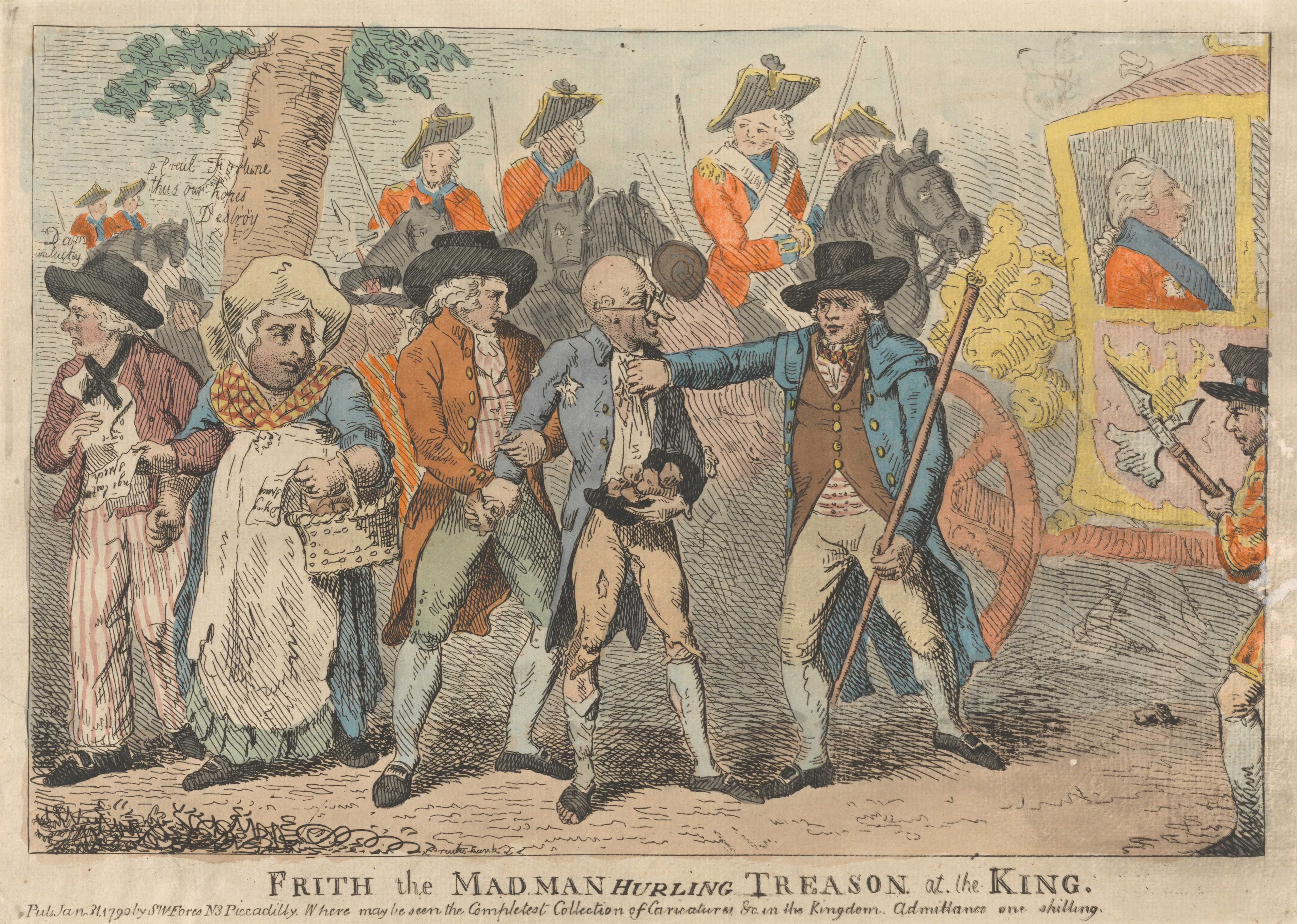
Ten days after Frith threw a stone at King George III’s gilded carriage, the caricaturist Isaac Cruikshank issued the print shown above, titled “Frith the Madman Hurling Treason at the King,” shown courtesy of the Yale Centre for British Art.

King George is at the right, riding by obliviously. A small fiddle-playing demon rides on his carriage and mounted guards follow.

In the middle of the picture, two men are seizing a third who holds a hatful of rocks. That central figure doesn’t look like Firth, however. Instead, it’s a caricature of the elderly Edmund Burke, bald, bespectacled, and ragged from being out of power. One of the men stopping him is dressed as a Bow Street Runner. The other looks like George, the Prince of Wales, as the British Museum expounds.

At the left are figures of a sailor and a woman carrying a basket, dismayed at the arrest. The woman’s five-o’clock shadow reveals her to be a lampoon of Charles James Fox, another opposition leader. The sailor looks like Fox’s ally Richard Brinsley Sheridan.

The message of this image is therefore that the opposition Whigs in Parliament metaphorically throwing rocks at the king.

Another, cruder image came from William Dent, shown here through the British Museum. It contrasted Frith “the unfortunate stone-thrower,” making “a follish throw for full pay” as an army officer, with the impeached India administrator Warren Hastings. As a “fortunate stone thrower,” Hastings is tossing diamonds as bribes “for a full P-rd-n.”

In this print Frith labeled is “Gulliver the little in Brob-dignag,” confronting the giants of the king and his bodyguards. In contrast, Hastings is “Gulliver the great in Lilliput,” lording over the grasping king and queen and Baron Thurlow, the former attorney general and lord high chancellor. George III and Thurlow were supporting Hastings in his ongoing impeachment trial.

The Member of Parliament who led the case against Hastings was Edmund Burke—the same man Cruikshank depicted as Frith in his print. Thus, artists on opposite sides of the political debate used Frith’s attack on the king’s carriage to convey contradictory messages.

Thursday, January 06, 2022

“Burke surely rolls over in his discreetly marked grave”

Back in December 2020, after the election and before the insurrection, the L.A. Review of Books published an op-ed essay by Jessica Riskin, a professor of history at Stanford University.

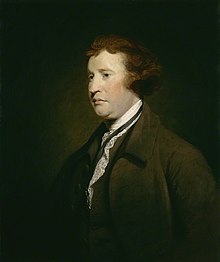
Riskin’s started with the way Edmund Burke (1729–1797) defined conservative politics in the 1790s.

Burke had been an ally of the American Whigs. In 1765 he was private secretary to the Marquess of Rockingham, who led one opposition Whig faction in Parliament. Toward the end of that year, the marquess became prime minister. His team found a pocket borough to send Burke to Parliament, where his oratory made a quick impression.

Rockingham was soon out of power, but Burke continued to be his faction’s most eloquent voice, in both speeches and print. In 1774 he won a seat from Bristol and promptly told his constituents that he would vote as he saw best, not as they told him; he didn’t win reelection from that district six years later.

When Rockingham returned to power after the British defeat at Yorktown, he made Burke Paymaster of the Forces. Rather than maintain the job as a lucrative sinecure, Burke introduced a law to reduce its financial latitude. He wrote other reform bills as well, though some stuck only after other people introduced them.

After Rockingham died, Burke allied with Charles James Fox. That worked out during the brief Fox-North coalition government, but then William Pitt the Younger became prime minister and stayed in the job for the rest of the century. Because of faction rather than strong ideological reasons, Burke was stuck in the opposition during his final years.

Those were also the years of the French Revolution, which inspired Burke’s statements on conservatism. In her op-ed, Prof. Riskin drew a hard line between that ideology and the political methods of Donald Trump and his followers:
Each time a commentator refers to Trumpism as “conservative” — probably hundreds of times a day — Edmund Burke surely rolls over in his discreetly marked grave in Buckinghamshire.

Burke, the Irish political philosopher and Whig MP who originated Anglo–American conservatism, supported the rebellion of the British colonies in North America but hated the revolutionaries in France, and there you have conservatism in a nutshell. The American rebellion, Burke judged, was not a revolution but a movement to conserve an ancient principle of the British constitution, the people’s power of “granting their own money” to the government. Also in keeping with Burke’s “principle of conservation” was the colonists’ preservation of other longstanding institutions such as slavery, which Burke favored eliminating, but only “gradually.”

In France, on the other hand, people went rushing around hurling kings from their thrones, abolishing feudalism, summarily eliminating aristocratic and clerical exemptions and privileges, and making a lot of vulgar noise about equality. That sort of revolution was anathema to Burke. The discreet marker on his grave was a compromise: he had asked that it be altogether unmarked, sure that the Jacobins would arrive in droves to desecrate his final resting place, if they could find it, as they had desecrated the institutions of the Old Regime.

His abhorrence of the French Revolution led Burke to define the political philosophy that would come to be known as conservatism. His central principle was that abstract political ideals, such as the ideal of absolute equality, were dangerous because they led people to destroy longstanding traditions in their name. A society could not rest upon airy abstractions, Burke argued, but only upon solid things: traditional institutions, such as the institutions of property and inheritance. Burke’s “principle of conservation” held that any reform must be undertaken gradually, keeping always in mind that traditions were the bedrock of society, and that to eliminate them was to invite mayhem. . . .

“Conservative” in reference to Trumpism is dangerously misleading. If you’re a conservative, you’ll think the word denotes wisdom and judiciousness, two things Trumpians don’t even pretend to embrace, but make a show of flouting. If you disagree with conservatism as a political philosophy, you might think it sounds stodgy, benighted, even oppressive, but in a static or at least a slow-moving way, not in a way that poses an immediate threat of civil war. No one associates an attempted coup, even an inept one such as we’ve been witnessing, with the word “conservative.”
Note that Riskin wrote thirteen months ago, before 6 Jan 2021.

On that day Trump told thousands of followers, “we’re going to walk down, and I’ll be there with you,…we’re going to walk down Pennsylvania Avenue. . . . And we’re going to the Capitol.” And then he went home to watch the resulting violence on television. That habitual deceit isn’t even “Trumpism”; it was just trumpery.

Monday, March 22, 2021

A Pyrrhic Victory in the Printers’ Case

In Parliament, 250 years ago this season, there was a big step forward in press freedom to report about how English-speaking governments worked.

Back in 1731, Edward Cave launched the Gentleman’s Magazine, which among its features included detailed reporting on the debates in Parliament, going beyond the official House Journals record of motions and whether or not they were adopted. Cave had actually been jailed a few years earlier for publishing such reports. This time he issued his proceedings only during parliamentary recesses, which provided legal cover.

According to James Boswell, Cave passed “scanty notes” on the debates to a young writer named Samuel Johnson to turn into oratorical arguments. It’s not that surprising, therefore, that these reports were often distorted—or so the prime minister, Sir Robert Walpole, complained.

In 1738, the House of Commons resolved:
That it is a high indignity to, and a notorious breach of the privilege of, this House for any news-writer in letters or other papers…to give therein any account of the doings or other proceedings of this House, or any Committee thereof, as well during the recess as the sitting of Parliament, and this House will proceed with the utmost severity against such offenders.
The London Magazine and Gentleman’s Magazine then started to report on the debates as if they had taken place in ancient Rome, Lilliput, or the Robin Hood Society, thinly disguising legislators’ names. Another trick was to replace some letters of the Members’ names with asterisks or dashes. Because of the magazines’ slow publishing schedule and upper-class audience, it appears, the government didn’t press its objections.

In the 1760s, however, John Wilkes brought more populist politics to London, with the business community and big crowds behind him. The capital’s newspapers increased their coverage of Parliament’s debates. That meant quicker reporting to a larger and closer readership.

The Houses responded by clearing all spectators out during debates, sometimes by force. At the end of 1770 the Whig M.P. Isaac Barré complained about how he’d been pushed out of the House of Lords as if by “a very extraordinary mob” headed by two earls.

On 5 Feb 1771, a Member named George Onslow asked for Parliament’s old rule against printing the proceedings to be read again. Onslow had started in Parliament as a Rockingham Whig, opposing the prosecution of Wilkes and the Stamp Act, but he’d become a strong supporter of Lord North’s government, and he didn’t like how printers were representing it.

Opposition members of the House disagreed with Onslow’s proposal. Charles Turner argued that “not only the debates ought to be printed, but a list of the divisions [i.e., votes] likewise.” Edmund Burke said he wished all debates were fully recorded in the House Journals.

Naturally, the press reported on that debate. John Horne, a radical clergyman, prefaced the coverage in the Middlesex Journal for 7 February with this line:
It was reported, that a scheme was at last hit upon by the ministry to prevent the public from being informed of their iniquity; accordingly, on Tuesday last, little cocking George Onslow made a motion, that an order against printing debates should be read.
Onslow took the bait on 8 February, rising solemnly to complain that the Middlesex Journal and another paper, the London Gazetteer, had misrepresented Parliament and brought it into poor repute. He demanded that the printers Roger Thompson and John Wheble be summoned to explain themselves. By a vote of 90 to 50, the House adopted Onslow’s resolution.

But those printers didn’t show up. They didn’t come to their front doors to accept warrants. On 8 March the Crown issued a proclamation offering £50 for apprehending the two men. Meanwhile, newspapers heaped more criticism on Onslow: “That little insignificant insect, George Onslow, was the first mover of all this mighty disturbance.”

On 12 March, Onslow demanded to hear from six more publishers who continued to run parliamentary reports. On the first vote the House supported him, 140 to 43. Another member suggested summoning not only the proprietor of each newspaper but “all his compositors, pressmen, correctors, blackers and devils,” which produced more argument over both legalities and language. The Whigs kept moving to cancel the discussion and adjourn; the majority kept voting to proceed.

One account said, “There were so many divisions, and such strong and personally offensive expressions used during the course of this debate, that the Speaker [Fletcher Norton, shown above] said, ‘This motion will go into the Journals—what will posterity say?’” After more votes Norton declared, “I am heartily tired of this business.” Barré spoke up: “I will have compassion on you, sir; I will move the adjournment of the House.” That motion produced another round of debate.

Of all the printers Onslow had named, two appeared in the House, ritually knelt in penance, and paid fines. The rest made excuses to stay away or just lay low. Some replied that they would come when the legal situation was resolved.

Wilkes orchestrated the next move. Wheble and Thompson let themselves be apprehended by fellow printers and brought before the aldermen of London—namely Wilkes and his political allies. Those officials demanded to know under what authority the printers had been seized. When the captors pointed to the proclamation, Wilkes declared such an order “contrary to the chartered rights of this city, and of Englishmen.”

The conflict between levels of government grew. The Crown arrested Alderman Richard Oliver and the Lord Mayor, Brass Crosby, for defying parliamentary authority. They remained in the Tower of London until the end of the legislative session, then came out to a twenty-one gun salute and a parade of carriages. Crowds hanged Onslow and Norton in effigy on Tower Hill.

Legally the “printers’ case” of 1771, as it was called, ended in a victory for the House of Commons. Courts upheld its authority to determine how its proceedings would be published. But politically everyone realized that the press and society were operating under new rules. British citizens now expected to read full reports of what their legislators were saying. Parliament never tried to exercise its authority so strictly again.

The only way legislative houses could regain control of the reporting process was to issue their own official or semi-official transcriptions of debates. John Almon and John Debrett launched the Parliamentary Register in 1775. William Cobbett began publishing more detailed Parliamentary Debates in 1802, and that became the modern standard Hansard Debates. That tradition transferred over to the U.S. of A., with the Congressional Record, the Capitol press galleries, and C-SPAN as the offshoots.

Friday, March 19, 2021

“What natural right, whether that of smuggling, or of throwing tea overboard?”

The second Boston Tea Party on 7 March 1774 made a smaller splash than the first on the preceding 16 December.

There was much less tea involved—fewer than thirty chests as opposed to more than three hundred.

The tea was much less valuable. It was the Bohea variety, an everyday black tea rather than a more expensive blend or a green tea.

The destroyed tea wasn’t owned by the highly connected East India Company but by the private firm of Davison & Newman, consigned to the Boston merchant Henry Lloyd. It had less financial importance for the Crown.

In response to the first Tea Party, Parliament passed the Boston Port Bill, declaring it illegal for Boston to receive goods (with a few exceptions, like firewood) from any other colony. It took only a few days in mid-March for that bill to become law. News of the second action was still making its away across the Atlantic.

Once news of the second Tea Party arrived in London in April, Davison & Newman and their insurers sent a petition to Parliament, reproduced on this website and on tins of “Boston Harbour Tea,” asking that they, too, be compensated for their lost property just as the East India Company would be. (Of course, Boston never paid back the East India Company.)

But the second Boston Tea Party still had an impact in London. On 28 March, prime minister Lord North (shown above) opened formal discussion in Parliament about a plan to change the constitution of the Massachusetts province. He advocated three changes:
  • giving the governor more power so he didn’t depend so much on support from the Council.
  • limiting town meetings to once each year to elect town officials unless the governor allowed otherwise.
  • an unspecified way of regulating the choice of jurymen.
Some Members of Parliament advocated stronger measures. Lord George Germain immediately raised the idea of making the Massachusetts Council an appointed body, as in most other North American colonies, rather than elected.

A smaller number of M.P.’s argued to preserve Massachusetts’s system. Former governor John Pownall described Americans as “a conscientious, good, religious, peaceable set of people.”

Lord North brought in his bill on 15 April, now including the appointed or “mandamus” Council. Soon he added the Administration of Justice Act, empowering the governor to send people charged for actions they had taken to enforce the laws away to another colony or Britain if he felt they couldn’t receive a fair trial in Massachusetts.

Strong Whigs like Isaac Barré and Charles Fox spoke against those bills. They complained about Gov. Thomas Hutchinson, who was being replaced (he didn’t know it yet). They moved to repeal the entire Tea Act. Edmund Burke made a very long speech that went all the way back to the first Navigation Acts and the Stamp Tax. Generally these members argued that while the destruction of the tea in December was wrong, the Crown had to give time for the Boston Port Bill to work before making permanent changes to the Massachusetts government.

On 21 April, Lord North opened another day of debate with a speech that included:
Sir, there is a ship arrived, I think her name is the Fortune, captain Goreham; she arrived in Boston harbour the latter end of February, or beginning of March 1774, I cannot say which; she was loaded with tea; the inhabitants came immediately and unloaded her, and emptied the contents of her cargo into the sea.

Is this, Sir, seeing their error? Is this, Sir, reforming? Is this making restitution to the East India Company?
Sir Thomas Frankland rose to confirm Lord North’s news based on a letter from Boston. Word of the second Boston Tea Party thus arrived just in time to confirm the worst impressions of the first.

Debate continued, but Massachusetts looked harder to defend. On 2 May, Lord North declared:
I am sorry to hear a charge thrown out, that these proceedings are to deprive persons of their natural right. Let me ask, of what natural right, whether that of smuggling, or of throwing tea overboard? Or of another natural right, which is not paying their debts?
He lamented the province “being in a distempered state of disturbance and opposition to the laws of the mother country.”

The Massachusetts Government Act went to a vote that day. The Commons divided 239 in favor of the law, only 64 against. Four days later, there was a vote on the Administration of Justice Act: 127 for, 24 against.

TOMORROW: What happened to the merchants who imported this cargo of tea?

Friday, January 10, 2020

“The notion of Vampyres” in Early America

The 1784 Connecticut Courant report about Isaac Johnson having the bodies of his children dug up, hoping to save other members of his family from consumption, didn’t use the word “vampire.”

Two years before, the Connecticut poet John Trumbull had used that word in the fourth canto of M’Fingal while discussing British prison commissary Joshua Loring:
Aloft the mighty Loring stood,
And thriv’d like Vampyre on their blood.
But Trumbull also included a footnoted explanation for his readers:
The notion of Vampyres is a superstition, that has greatly prevailed in many parts of Europe. They pretend it is a dead body, which rises out of its grave in the night, and sucks the blood of the living.
Clearly the concept of vampires wasn’t yet common knowledge for Americans, even those who read satirical poetry.

The word “vampire” appeared more often in American newspapers during the following decades. One source was European literature. In 1786, for example, the French author Louis-Sébastien Mercier published a collection titled Mon Bonnet de nuit, soon translated into English as The Nightcap.

On 24 Nov 1787 the Pennsylvania Evening-Post published one piece by Mercier called “Opulence: A Vision.” Its narrator described obtaining the philosopher’s stone, which leads to wealth and a pretty young wife. Then, when everything seems to be going well—
a crowd of Vampires entered the room, and began to unfurnish my apartment. In vain did I make signs to them to desist; they carried every thing away, making many low bows. . . .

Then I turned to my dearly beloved, and, in the effusion of my soul, said to her, “The Vampires have stripped me of all I had; but still I have thee.” She wept—I thought it proceeded from tenderness; but my wife so mild, so open, sprang from my arms, ran over the apartment with the looks and gesture of a fury, and, seeing it was stript, seized on a purse the Vampires had forgot in one of my waistcoat pockets, came to me, and, applying a vigorous stroke to my cheek, disappeared.

Stunned with this scene, I got up in bed, in order to run after my wife, for I loved her. I had grown fat from living well; but a little Vampire, thinner still than the others, sprang upon me, and began to suck me alive. He swelled on my body as I grew lank; he dried me up from head to foot, gorging himself with my blood, and I became so light, that the wind carried me off my magnificent bed with rich curtains through the window.
(Spoiler: It was all a dream.)

American newspapers also printed extracts from Dr. Erasmus Darwin’s Botanic Garden (composed 1789-1793), which made a poetic hero of Benjamin Franklin and included such lines as this:
So, born on sounding pinions to the West,
When Tyrant-Power had built his eagle nest;
While from his eyry shriek’d the famish’d brood,
Clenched their sharp claws, and champ’d their beaks for blood,
Immortal FRANKLIN watch’d the callow crew,
And stabb’d the struggling Vampires, ere they flew.
Darwin used vampires, sucking blood from innocents, as a political metaphor. American authors couldn’t resist doing the same:
  • Joel Barlow: “Courts and Kings, / These are the vampires nurs’d on nature’s spoils” (Gazette of the United States, 14 July 1792)
  • “The Versifier”: “You’ll foil that Treasury Vampire who from spite, / Sucks from our coin its blood night after night” (Connecticut Courant, 4 Feb 1793)
The word appeared in prose as well, such as this line from the 7 Mar 1800 Salem Gazette: “AMERICANS—Will you permit a few Democratic Vampires, which infect the United States, to lull you into a state of slumbering security, that they may suck the dearest blood of your country?”

In fact, one of the earliest uses of ”vampires” as a political metaphor in English had a link to the American Revolution. It appeared during debate over how Parliament should respond to the Boston Tea Party in April 1774, as reported in London newspapers and eventually the 9 June 1774 Massachusetts Spy:
Mr. [Edmund] Burke rose to explain, that he did not mean to cast the least slur upon the character of Mr. [George] Grenville; and concluded with saying, he would not raise the bodies of the dead, to make them vampires to suck out the virtues of the living.
That line isn’t as well remembered as the two-hour speech Burke had given earlier that day, usually titled “On American Taxation.” But it shows how the idea of vampires had penetrated British culture on its way to America.

Of course, poets and propagandists could write about vampires without believing that they actually existed. And New England farmers didn’t need to know the word “vampire” to hold out hope that digging up bodies and burning those that seemed too well preserved might cure the dying. But as the word became more common in the 1800s, the belief might have spread along with it.

Tuesday, September 05, 2017

“He was the delight and ornament of this House”

Yesterday I quoted Horace Walpole’s immediate response to the death of Charles Townshend in September 1767. Townshend had a big personality full of contradictions, and he seems to have both fascinated and exasperated his political peers—who expressed themselves so handsomely.

Walpole had more to say about Townshend later in his Memoirs of the Reign of King George III:
On the 4th of September, 1767, died Charles Townshend, of a neglected fever, in, I think, the forty-second year of his age. He met his approaching fate with a good humour that never forsook him, and with an equanimity that he had never shown on the most trifling occasions. Though cut off so immaturely, it is a question whether he had not lived long enough for his character. His genius could have received no accession of brightness; his faults only promised multiplication. He had almost every great talent, and every little quality. His vanity exceeded even his abilities, and his suspicions seemed to make him doubt whether he had any. With such a capacity he must have been the greatest man of this age, and perhaps inferior to no man in any age, had his faults been only in a moderate proportion—in short, if he had had but common truth, common sincerity, common honesty, common modesty, common steadiness, common courage, and common sense. . . .

Charles Townshend, who had studied nothing accurately or with attention, had parts that embraced all knowledge with such quickness, that he seemed to create knowledge instead of searching for it; and, ready as [Edmund] Burke’s wit was, it appeared artificial when set by that of Charles Townshend, which was so abundant, that in him it seemed a loss of time to think. He had but to speak, and all he said was new, natural, and yet uncommon. If Burke replied extempore, his very answers, that sprang from what had been said by others, were so painted and artfully arranged, that they wore the appearance of study and preparation: like beautiful translations, they seemed to want the soul of the original author. Townshend's speeches, like the Satires of Pope, had a thousand times more sense and meaning than the majestic blank verse of Pitt; and yet, the latter, like Milton, stalked with a conscious dignity of pre-eminence, and fascinated his audience with that respect which always attends the pompous but often shallow idea of the sublime.
Edmund Burke himself, in his 1774 speech on American taxation, recalled his political colleague and frequent adversary this way:
In truth, Sir, he was the delight and ornament of this House, and the charm of every private society which he honoured with his presence. Perhaps there never arose in this country, nor in any country, a man of a more pointed and finished wit, and (where his passions were not concerned) of a more refined, exquisite, and penetrating judgment. If he had not so great a stock, as some have had who flourished formerly, of knowledge long treasured up, he knew better by far than any man I was ever acquainted with how to bring together within a short time all that was necessary to establish, to illustrate, and to decorate that side of the question he supported. He stated his matter skilfully and powerfully. He particularly excelled in a most luminous explanation and display of his subject. His style of argument was neither trite nor vulgar, nor subtle and abstruse. He hit the House between wind and water; and, not being troubled with too anxious a zeal for any matter in question, he was never more tedious nor more earnest than the preconceived opinions and present temper of his hearers required, with whom he was always in perfect unison. He conformed exactly to the temper of the House; and he seemed to lead because he was always sure to follow it.
For Burke always knowing the pulse of Parliament was, to be sure, somewhat faint praise, but praise nonetheless.

Tuesday, August 22, 2017

A Trial and Execution in India

What was happening in India while the siege of Boston got under way on the far side of the world? The Executed Today blog describes a controversial court case:
On [5 Aug] 1775, inconvenient Indian official Nandakumar (or Nand Kumar, or Nuncomar) was hanged on a forgery charge — all too conveniently inflicted at the very time he was accusing British Governor-General Warren Hastings [shown here] of corruption.

Nandakumar and Hastings decidedly did not get along; the Indian believed he had been unfairly denied a plum career assignment. He leveled in response an accusation that Hastings was taking payola in exchange for his appointments.

English pols involved in the administration of India, such as Philip Francis, John Clavering and George Monson, had their own rivalries with Hastings and wanted to pursue these charges. Instead, within weeks, Nandakumar was facing years-old forgery charges, and two months after his trial, he was at the end of a rope. . . .

(He forged part of a will to recover a bad loan. All concerned appear to agree that this charge is factually accurate, which is, of course, a long way from explaining why the matter required immediate adjudication at this juncture. Incidentally, while forgery could get you hanged in England, it was a much less serious offense under Hindu law.) . . .

Parliamentarian heavyweight Edmund Burke would eventually weigh in on the hanged man’s side, charging that Hastings had “murdered this man, by the hands of [Chief Justice] Sir Elijah Impey.” In a report to the select committee established by the Amending Act (cited in this tome), Burke noted
that this Trial and Execution was looked upon by many of the Natives as political; nor does the Committee conceive it possible, that, combining all the Circumstances together, they should look upon it in the Light of a common judicial Proceeding; but must regard it as a political Measure, the Tendency of which is, to make the Natives feel the extreme Hazard of accusing, or even giving Evidence of corrupt Practices against any British Subject in Station, even though supported by other British Subjects of equal Rank and Authority. It will be rather a Mockery, than a Relief to the Natives, to see Channels of Justice opened to them, at their great Charge, both in the Institution and in the Use, and then Appeals, still more expensive, carefully provided for them, when, at the same Time, Practices are countenanced, which render the Resort to those Remedies far more dangerous than a patient Endurance of Oppression, under which they may labour.
Hastings was impeached for corruption in 1787 — it took Burke, who served as one of the prosecutors, two full days to read the 20-count indictment against him, though Burke’s own attempt to add judicial murder to the bill of particulars was jettisoned.
The House of Lords finally acquitted Hastings in 1795. Britain continued to enjoy the new empire he had assembled in India, even richer than the colonies lost in North America.

Executed Today points to three sources on this case: Henry Beveridge’s The Trial of Maharaja Nanda Kumar (1886); J. Duncan M. Derrett’s article “Nandakumar’s Forgery” in The English Historical Review (April 1960); and Nicholas B. Dirks’s The Scandal of Empire (2008).

Wednesday, January 27, 2016

“The right of representation and taxation always went together”

Having spent a week on the U.S. Constitution and Bill of Rights, I’m going to jump back to 250 years ago and Parliament’s debate over what to do about the Stamp Act.

That law was clearly unenforceable in North America. The Marquess of Rockingham’s government was already working with Barlow Trecothick, spokesman for London’s merchants doing business with North America, to revise it. (The Journal of the American Revolution recently published an article with more about Trecothick’s role.)

But simply repealing the tax might suggest that the ministry thought it was as unconstitutional as Americans had complained. And Parliament could not countenance some of the colonists’ irregular methods of protest. Like the riots. And the unauthorized assemblies.

On 27 Jan 1766, according to Horace Walpole’s Memoirs of the Reign of King George the Third, an M.P. submitted the Stamp Act Congress’s petition against the law to the House of Commons. The Chancellor of the Exchequer asked for the petition to be withdrawn as coming from a body with no standing.
Mr. [William] Pitt warmly undertook the protection of the petition, which he affirmed was innocent, dutiful, and respectful. . . . He painted the Americans as people who, in an ill-fated hour, had left this country to fly from the Star Chamber and High Commission Courts. The desert smiled upon them in comparison of this country. It was the evil genius of this country that had riveted amongst them this union, now called dangerous and federal. . . . This country upon occasion has its meetings, and nobody objects to them; but the names of six or eight Americans are to be big with danger.

He could not guess by the turn of the debate, whether the Administration intended lenity or not. To him lenity was recommended by every argument. He would emphatically hear the Colonies upon this their petition. The right of representation and taxation always went together, and should never be separated. Except for the principles of Government, records were out of the question. “You have broken,” continued he, “the original compact if you have not a right of taxation.” The repeal of the Stamp Act was an inferior consideration to receiving this petition.

Sir Fletcher Norton [shown above] rose with great heat, and said, He could hardly keep his temper at some words that had fallen from the right honourable gentleman. He had said, that the original compact had been broken between us and America, if the House had not the right of taxation. Pitt rose to explain—Norton continued: “The gentleman now says, I mistook his words; I do not now understand them.”

Pitt interrupted him angrily, and said, “I did say the Colony compact would be broken—and what then?”

Norton replied, “The gentleman speaks out now, and I understand him; and if the House go along with me, the gentleman will go to another place.”
Walpole’s footnote explained that Norton meant, “To the bar of the House, whither members are ordered when they violate the rules or privileges of Parliament.” However, Maj. Thomas James, observing his first parliamentary session, thought he meant that Pitt “ought to have been sent to the Tower.”
Pitt at this looked with the utmost contempt, tossed up his chin, and cried, “Oh! oh!—oh! oh!”

“I will bear that from no man,” said Norton; “changing their place did not make Englishmen change their allegiance. I say the gentleman sounds the trumpet to rebellion; or would he have strangers in the gallery go away with these his opinions? He has chilled my blood at the idea.”

“The gentleman,” rejoined Pitt, “says I have chilled his blood: I shall be glad to meet him in any place with the same opinions, when his blood is warmer.”
In the end, Pitt’s approach gained only a handful of supporters, including Col. Isaac Barré and a new M.P. named Edmund Burke. The House set aside the Americans’ petition and moved on to other matters.

Meanwhile, behind the scenes, the government continued to look for a way out of the Stamp Act.

Thursday, August 20, 2015

The Rise and Fall of Thomas Wooldridge

Thomas Wooldridge (often called Woolridge) returned to London by September 1773, having cultivated a relationship with Secretary of State Dartmouth and made contact with merchants in multiple North American ports. Through his father-in-law, William Kelly, he already had excellent connections among the London merchants investing in the American trade.

Kelly took ill and died in 1774, and Wooldridge, still in his mid-thirties, stepped up to become a spokesman for London’s American traders. In the months when Parliament voted on its Coercive Acts, that interest group was lobbying hard for a peaceful end to the American crisis.

The merchants’ strategy seems to have been to argue that a rupture with the colonies would be bad for their nation’s economy and their own—but that they shouldn’t have to reveal how much loss they were personally exposed to, lest their creditors lose faith in them. Wooldridge met with Edmund Burke in January 1775 and with Josiah Quincy, Jr., the next month. In 1778 he testified to Parliament about losses to American privateers.

By then Wooldridge was an alderman of the City of London, elected in 1776 for the district called the Bridge Ward Within (shown above in 1720). He remained in that post until February 1783, though not always comfortably.

In 1777 Wooldridge was chosen sheriff of London and Middlesex, but that September he declined the office because of financial reverses. That same year, he declared bankruptcy. Wooldridge found a sympathetic audience in London. The same issue of the London Magazine that reported his resignation and the ensuing debate went on to say:
Last Thursday at a meeting of the creditors of a North American merchant, the state of his affairs was laid before them, by which it appeared, that his present situation could not in the least degree be imputed to any misconduct of his own, but totally owing to the present unhappy state of affairs in America. It appeared there is now due to the house 70,000l. from that quarter, and that the demand upon the house is no more than about 27,000l. It was agreed that a letter of credit be given to the said gentleman for three years; that his affairs should be put under the inspection of five trustees, and that he should assist in getting in his effects, allowing him a stipend of 500l. per ann. for his time, trouble, and the maintenance of his family, house rent, &c.
That merchant may well have been Wooldridge himself.

That same year, Wooldridge spoke out against the prosecution of the Rev. William Dodd for forgery. Later he signed one of the petitions Lord George Gordon circulated protesting the granting of political rights to Catholics. When in 1780 that movement provoked anti-Catholic riots in London, however, Alderman Wooldridge sent letters to Lord Jeffery Amherst requesting troops to keep peace in his district.

Britain lost the war, of course, and that result sunk Wooldridge’s prospects, whether because his firm’s debts became uncollectible or because the peace revealed that his finances were far worse than he’d represented. Wooldridge was imprisoned for debt in 1783 and had to declare bankruptcy again the next year.

This time, the City wasn’t forgiving. To lose one fortune was a misfortune; to lose it again looked like mere carelessness, or worse. Furthermore, according to Ben Saunders’s article “The Swindler Detected,” the city government determined that Wooldridge had been maintaining himself by submitting false expenses, skimming fines, and forcing defendants into military service, pocketing recruiting fees.

After a raucous meeting of the aldermen, Wooldridge’s voters stripped him of his post, an unprecedented step that prompted him to sue to get it back. That effort failed, though his wife Susanna continued to receive substantial sums from the aldermen’s budget for years afterward, “independent of her husband, for the support of herself and her children.”

Wooldridge’s reputation was ruined from then on. The City Biography of 1799, which was full of unabashed gossip about London politicians, stated of Wooldridge:
He was at one period regarded as a mouth-piece to the City, and if he had possessed capacity equal to his effrontery, it is probable he would have made a considerable figure. Impudence made him, and caused him to be unmade, an Alderman; but he had no talents beyond those that commonly fall to the lot of Aldermen.
In the new U.S. of A., lawsuits over the property and debts of William Kelly, his sons, and Thomas Wooldridge continued for years, such as this 1795 case in Pennsylvania. As for Wooldridge himself, at some point he went back to America. He was in Boston by late 1793, when a couple named a child after him. And he died in Boston by 4 Jan 1794, as reported in the Columbian Centinel, and was buried out of King’s Chapel. The 6 January Boston Gazette reported the death “In this town, Thomas Wooldridge, Esq. aged 54, late an Alderman of the city of London.”

Sunday, February 08, 2015

Finally, the Debate Over the Stamp Act

So did Isaac Barré speak against the Stamp Act in the House of Commons on 6 Feb 1765? Edmund Burke recalled that debate as unexciting, but on 12 February Horace Walpole wrote that Barré had delivered “a pretty heavy thump” to bill advocate Charles Townshend.

On 4 May the Providence Gazette cited “several Letters from London” to Newport that characterized Barré’s remarks this way:
Col. B—, confirmed the Equity of the Taxation, but doubted whether the Colonies were in a Capacity to pay it, and seemed inclinable to favor them.
Not very stirring.

But Jared Ingersoll (1722-1781), outgoing agent (lobbyist) for Connecticut, sent a much more dramatic account to Gov. Thomas Fitch. That manuscript, dated 11 Feb 1765, was transcribed and published in 1918.

Part of that letter was also published in America in 1765, including the 27 May Boston Post-Boy:
Mr Charles Townshend spoke in favour of the Bill, (Stamp Duty), and concluded his Speech by saying to the following Effect:

“These Children of our own Planting, (speaking of Americans), nourished by our Indulgence, until they are grown to a good Degree of Strength and Opulence, and protected by our Arms, will they grudge to contribute their Mite to relieve us from the heavy load of national Expence which we lie under?[”…]

Which having said and sat down, Mr. Barre arose, and, with Eyes darting Fire [he was in fact blind in one eye] and an outstretched Arm, spoke as follows, with a voice somewhat elevated, and with a Sternness in his Countenance, which express’d in a most lively Manner, the feelings of his Heart:

“Children planted by your Care? No! Your Oppression planted them in America; they fled from your Tyranny, into a then uncultivated Land, where they were exposed to almost a1l the Hardships, to which humane Nature is liable; and among others, to the Savage Cruelty of the Enemy of the Country; a People the most subtile, and, I take upon me to say, the most truly terrible of any People that ever inhabited any Part of GOD’s EARTH, and yet actuated by Principles of true English Liberty; they met all these Hardships with Pleasure, compared with those they suffered in their own Country, from the Hands of those that should have been their Friends.

“They nourished up by your Indulgence? They grew by your Neglect of them: As soon as you began to care about them, that Care was exercised in sending Persons to Rule over them, in one Department and another; who were, perhaps, the Deputies of some Deputy, of Members of this House, sent to spy out their Liberty, to misrepresent their Actions, and to prey upon them; Men, whose Behaviour, on many Occasions, has caused the Blood of those Sons of LIBERTY, to recoil within them; Men promoted to the highest Seats of Justice: some to my Knowledge, were glad by going to foreign Countries, to Escape being bro’t to a Bar of Justice, in their own.

“They protected by your Arms? They have nobly taken up Arms in your Defence, have exerted their Valour, amidst their constant and laborious Industry, for the Defence of a Country whose Frontier, while drench’d in Blood, its interior Parts have yielded all its little Savings to your Enlargement: and BELIEVE ME, REMEMBER I THIS DAY TOLD YOU SO, That the same Spirit which actuated that People at first, will continue with them still: But Prudence forbids me to explain my self any further. GOD KNOWS, I do not at this Time speak from Motives of Party Heat; What I deliver, are the genuine Sentiments of my Heart: However superior to me in general Knowledge and Experience, the respectable Body of this House may be, yet I claim to know more of America than most of you, having seen and been conversant in that Country. The People there are as truly Loyal, I believe, as any Subjects the King has; But a People jealous of their Liberties, and who will vindicate them, if they should be violated; but the Subject is too delicate, I will say no more.”
That speech inspired American opponents to the Stamp Act to call themselves “Sons of Liberty,” a phrase with deeper roots in British culture that lasted into other political battles as well.

Barré remained one of Parliament’s most vocal opponents of new taxes on the American colonies. Not that his oratory convinced many of his colleagues. His motion to adjourn without approving the bill, which was a form of up-or-down vote, failed by 245 votes to 49.

As for Jared Ingersoll, he decided the fight against the Stamp Act was lost, applied successfully for the position of stamp agent in Connecticut, and became a target of the Sons of Liberty—the very political movement his reporting had helped to inspire.

Saturday, September 14, 2013

The Revolutions of Sir Robert Smyth

In 1774, Thomas Paine emigrated to Pennsylvania with a letter of recommendation from Benjamin Franklin and a fervent wish to help the American colonists resist the royal government.

That same year, Sir Robert Smyth (1744-1802) was first elected to Parliament, representing the boroughs of Cardigan. Sir Robert had inherited a baronetcy (a hereditary knighthood), but we all remember that knights and baronets are technically commoners and therefore eligible for election to the House of Commons, right?

In Parliament, Smyth “generally voted with the court,” or the Tory government, according to Horace Walpole. He supported Lord North’s American policy, speaking in favor of the Quebec Act and delivering “a reply to [opposition member Edmund] Burke…laughing at his metaphors.” His opponent challenged the results of Smyth’s election, however, and he lost his seat at the end of 1775.

In 1780, Sir Robert returned to Parliament as the member from Colchester, a seat he held for ten years. He had shifted from voting with Lord North to being a strong opponent of him and the American war. Smyth instead appears to have aligned himself with the younger William Pitt.

As shown above, Sir Joshua Reynolds painted Smyth’s wife Charlotte and children in 1787, a portrait now at the Metropolitan Museum. The children were:
  • Louisa, born 1782, according to Debrett’s Baronetage.
  • Charlotte, born 1783.
  • George-Henry, born 1784, and heir to the baronetcy, which is why he gets the top position among the children and all the attention.
In 1790 Smyth stepped away from Parliament. He moved even further to the left and moved his family to Paris, going into business there. Smyth was part of a small community of British gentlemen who were big fans of the French Revolution.

Another of those men was Thomas Paine. He’d left the U.S. of A. in 1787 with big plans for building an iron bridge in England, but then got inspired by the events in France. When Burke criticized the French Revolution, Paine replied with his Rights of Man, moving back and forth between London and Paris as British government agents threatened him. On one of those trips, Lafayette entrusted Paine with the key to the Bastille, which the marquis wanted to go to George Washington.

In 1792, Paine moved to France one step ahead of an indictment for seditious libel. Britain convicted him in absentia while France elected him to four seats in its new National Convention—even though at the time he didn’t speak French.

The Convention was the legislative successor to the Assembly, part of the French constitutional monarchy that fell apart in late 1792. The country was then at war with Austria and Prussia. Louis XVI was arrested. Lafayette fled the country. In September the Convention declared France to be a republic.

On 18 Nov 1792, according to a story that appeared in London newspapers, “the English arrived in Paris [i.e., the British expatriate community] assembled at White’s Hotel, to celebrate the triumph of victories gained over their late invaders by the armies of France.” Paine was staying in that mansion, also known as the Hotel d’Angleterre, and attended the dinner.

The other diners included Sir Robert Smyth and Lord Edward Fitzgerald, younger son of an Irish duke and a former British army officer who had been wounded at Eutaw Springs, South Carolina. The newspaper report credited them with a couple of actions:
Among several toasts proposed by the citizens, Sir R. Smith and Lord E. Fitzgerald, was the following: “May the patriotic airs of the German Legion (Ça ira, the Carmagnole, Marseillaise March, etc.) soon become the favourite music of every army, and may the soldier and the citizen join in the chorus.” . . .

Sir Robert Smith and Lord E. Fitzgerald renounced their titles; and a toast proposed by the former was drank:—“The speedy abolition of all hereditary titles and feudal distinctions.”
Thus, the baronet Sir Robert Smyth was now, he declared, simply Citizen Smyth.

TOMORROW: Imprisonment, flirtation, and young Charles Este.

Saturday, December 25, 2010

“He Would Much Rather Sit on Christmas-Day...”

On Monday, 19 Dec 1774, the British Parliament debated “raising the Supply granted to his Majesty”—i.e., enacting taxes, in this case a land tax. The country’s landowners were, understandably, against raising this charge, so the House of Commons agreed to Lord North’s proposal to keep it at “three Shillings in the Pound.”

Then a member named David Hartley (1732-1813) rose to speak. Representing Kingston upon Hull, he was one of the radical Whigs opposed to the government’s American policy, meaning the Boston Port Bill, Massachusetts Government Act, and duties enacted since 1767. He insisted that Parliament had to deal with the crisis in the Massachusetts Bay colony, where nearly all the army troops on the continent were holed up in Boston.

This description of Hartley’s speech comes from a record of Parliamentary activity published in 1775 (which leaned toward the Whigs):

Mr. Hartley rose, and in a mild, sensible speech, enlarged upon the very extraordinary conduct of Administration concerning American affairs.

He said the accounts from that country were truly alarming; that the Resolutions of the Continental Congress evidently proved that the people were determined not to submit to the late Acts passed in relation to America, nor to any other of a like complexion; that the Troops now stationed at Boston, and the inhabitants of that Town, had no means of procuring subsistence but by Sea, or from the country; that either method was now equally difficult, as the Harbour would be frozen up, and the land carriage, even if subsistence was to be had, rendered impracticable, as the country would be covered with snow; and that, under such circumstances, the situation of the Troops would be no less deplorable than that of the miserable inhabitants.

He continued to say, that he was not well versed in sieges; but if he understood right, he took it that the Town of Boston was surrounded by General [Thomas] Gage with lines of circumvallation, and that such being the very critical state of things, respecting both the situation, the temper, and disposition of the military and the natives, he submitted it to the gentlemen on the other side how they could reconcile it to the duty they owed to the Nation in their publick, or to their constituents in their private capacity, to agree to a long adjournment, while things remained in so dangerous and alarming a state, without taking any one step to avert the numerous and fatal mischiefs which they portended.

For his part, he affirmed solemnly, he would much rather sit on Christmas-day, and continue to do so, de die in diem [from day to day], than go to the country [i.e., adjourn] in so critical a season, without at least agreeing to some measures, though they should extend no further than prevention.
According to Nathaniel Wraxall, who entered Parliament in 1780, Hartley was by no means a stirring orator:
The Rockingham Party had not among them a more zealous adherent; but in Parliament, the intolerable length, when increased by the dullness of his Speeches, rendered him an absolute nuisance, even to his own friends. His rising always operated like a dinner bell.

One day, that he had thus wearied out the patience of his audience; having nearly cleared a very full House, which was reduced from three hundred, to about eighty persons, half asleep; just at a time when he was expected to close, he unexpectedly moved that the Riot Act should be read, as a document necessary to elucidate, or to prove, some of his foregoing assertions.

[Edmund] Burke, who sat close by him, and who wishing to speak to the Question under discussion, had been bursting with impatience for more than an hour and a half; finding himself so cruelly disappointed, bounced up, exclaiming, “The Riot Act! my dear friend, the Riot Act! to what purpose! don’t you see that the mob is already completely dispersed?”

The sarcastic wit of this remark, in the state of the House, which presented only empty Benches; encreased by the manner and tone of despair, in which Burke uttered it; convulsed every person present except Hartley, who never changed countenance, and insisted on the Riot Act being read by one of the Clerks.
Be that as it may, I found that Hartley’s argument had a certain resonance this month, when American legislators also argued about whether to stay in session, not on Christmas but in the days after Christmas. And ended up finishing before the holiday after all.

Back in 1774, the House of Commons “adjourned for Christmas recess” on Friday, 23 December, after the king approved the renewed act “granting to his majesty certain duties upon malt, mum, cyder and perry” as before. The land tax was completed in February. Lord North and his ministers maintained their American policy, and war began in April.

During the war, North’s government had to raise the land tax, which cost it support. After years of fighting and the defeat at Yorktown, a new ministry in London changed policy and started to negotiate a withdrawal from those thirteen colonies. That government appointed David Hartley to represent Britain at the signing of the Treaty of Paris.

Wednesday, April 08, 2009

The Only Thing Necessary for the Triumph of False Quotations

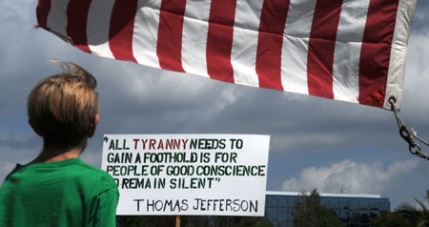
Dave Noon at the Edge of the American West noted the photo above, showing one of the modern “Tea Party” demonstrations which have nothing to do with the issues of the actual Boston Tea Party. And the quotation on that sign has nothing to do with the actual Thomas Jefferson.

In fact, that quotation, or one of its many variations, has usually been attributed to the British politician Edmund Burke, as Martin Porter examined in these online essays. He found many, many versions of this statement. He didn’t find any versions in Burke’s actual writings.

The most common version, “The only thing necessary for the triumph of evil is for good men to do nothing,” appears in the 1968 edition of Bartlett’s Familiar Quotations, attributed to a letter from Burke that doesn’t exist. The editor of the next edition guessed that it might be a corruption of a separate statement from Burke that says something quite different—leading one to wonder what “quotation” is supposed to mean.

I checked on Google Books and found an example of the Bartlett’s wording from 1920, here in Boston. It’s in an address titled “Some Present Features of the Temperance Crusade” by Sir R. Murray Hyslop at the Fourth International Congregational Council:

Burke once said: “The only thing necessary for the triumph of evil is that good men should do nothing.” Leave the Drink Trade alone and it will throttle all that is good in a nation’s life. Let it alone, that is all that is required. Cowardice will suffice for its triumph. Courage will suffice for its overthrow. The patriotism of the good citizen must be as sleepless as the selfishness of the Liquor Trade. Eternal vigilance is the price of liberty.
Moving a little earlier, the Archive of Americana tossed out an article in the San Jose Mercury Herald for 31 Oct 1916: “It has been said that for evil men to accomplish their purpose it is only necessary that good men should do nothing.” The man who delivered that line was another Prohibition advocate, Dr. Charles F. Aked.

It’s curious that, for a quotation that supposedly goes back to the eighteenth century, there’s no earlier example in either database. And it’s ironic that the same quotation which Prohibition advocates spread almost a century ago appeals to today’s “tea party” protesters; I think nearly the only thing those groups have in common is the belief that their opponents are “evil.”

And what about Sir R. Murray’s last sentence, which has also been attributed to Jefferson, along with Thomas Paine, Patrick Henry, and others? It actually comes from an 1852 speech (once again in Boston) by Abolitionist Wendell Phillips. He had forgotten the source, but was probably paraphrasing the Irish orator John Philpot Curran in 1790:
It is the common fate of the indolent to see their rights become a prey to the active.—The condition upon which God hath given liberty to man is eternal vigilance; which condition if he break, servitude is at once the consequence of his crime and the punishment of his guilt.
This is standard eighteenth-century Whig thinking, a big reason why politicized Americans came to see Parliament’s small tea tax as a serious encroachment on their liberties. Any sort of taxation without representation, they came to believe after the Stamp Act of 1765, threatened to put their society on a slippery slope to tyranny. (Today’s issue is taxation with representation, which is fundamentally different.)