






“Escaped from New Gate Prison at Simsbury, one John Hinson”
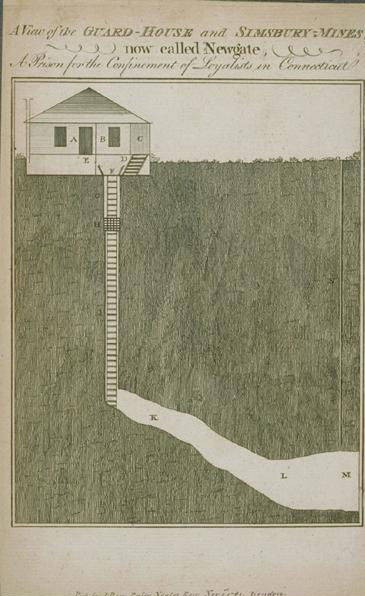
On 10 Jan 1774, John Viets, keeper of that New-Gate Prison, wrote out an advertisement for the New Haven newspaper. Here’s the text of the ad as it appeared in the 1 February Connecticut Courant, out of Hartford:
Ten Dollars Reward.Seven decades later, in 1845, Noah A. Phelps published A History of the Copper Mines and Newgate Prison, at Granby, Conn.. It was based on interviews with Viets’ descendants, so it used his spelling of the escapee’s name (Hinson) rather than what appeared in the newspaper reports of his trial (Ensign).
LAST Night escaped from New Gate Prison at Simsbury, one John Hinson, lately committed for Burglary, who is about 5 Feet 8 Inches high, has black Eyes, dark Hair, of a fair Complexion, and about twenty Years of Age—(he was helped out by some evil minded Persons from without).
Whoever will take up said Fellow, and return him to the Subscriber Master of said Prison, or shall discover those that aided him in his said Escape, so that they may be brought to conviction, shall have TEN DOLLARS reward, paid by
JOHN VIETS.
January 10, 1774.
Phelps wrote:
The first convict received into the prison was John Hinson. He was committed Dec, 22, 1773, and escaped on the 9th of January following, by being drawn up through the eastern shaft by a rope, assisted, it is said, by a woman, to whom he was paying his addresses.How did the Viets family know this? How confident was Phelps about this information, which he qualified by adding “it is said”?
Despite reasons for less than full certainty, subsequent histories of the Old New-Gate Prison repeat that 1845 account in a definite tone. And it may even be accurate. But in this Boston 1775 series, I’ll emphasize contemporaneous accounts.
Whether or not Viets was right in guessing the escape method, the Connecticut legislature acted quickly to prevent future departures through that shaft. By the end of the month it voted:
Upon the representation of the overseers of Newgate Prison: It is resolved by this Assembly, that said overseers be and they are hereby directed and impowered to cause the east shaft of said prison to be effectually secured with stone or iron, at their discretion, and to cause a log-house to be built and to consist of two or three rooms, one of which to be directly over the west shaft of said prison; taking care to preserve a free communication of air.Young Ensign was gone, those officeholders might have told themselves, but he’d benefited the colony by providing a useful test of the New-Gate Prison. Now they were making that place stronger. Soon it was ready to receive more convicts.
TOMORROW: Two sets of arrivals.

