






State Flags and the Questions of Loyalty
Four of those flags contain symbols that invoke the colonial or Revolutionary periods. So how could they have roots in the era of the U.S. Civil War?
Back in January I looked at another article by Brockell, one about Robert R. Livingston, and concluded that she had been misled by what appear to be authoritative online sources. So, I wondered, what evidence was behind this one?
The key to the conundrum is that most states didn’t have flags before the Civil War. Flags were national emblems, required by law for warfare at sea. States that had at one point been independent nations, particularly with naval ships or privateers, may have established flags before 1860. But once the U.S. of A. was established, those banners lost their official status. The very idea of a state flag was a sign of national disloyalty.
In the months leading up to the Civil War, several southern states seceded from the U.S. of A. They were briefly independent nations before helping to form the Confederate States of America. And in those months South Carolina, Virginia, and North Carolina adopted the flags they still basically use.
Notably, all three of those flags incorporated details associated with the Revolutionary War:
- South Carolina adopted the gorget (often taken to be a crescent moon) and palmetto tree from the Battle of Sullivan’s Island in 1776.
- Virginia slapped its state seal, designed principally by George Wythe and showing Liberty killing a tyrant with the motto “Sic Semper Tyrannus,” onto a blue background.
- North Carolina created a flag highlighting the dates May 20, 1775 (the mythical Mecklenburg Declaration), and April 16, 1776 (the genuine Halifax Resolves), as important moments when the state made steps toward independence.
In Virginia, that claim didn’t go uncontested. Men in the western portion who didn’t want to break away (or who broke away from the breaking away) took the same seal-based flag design and changed the motto to “Liberty and Union.”
I was surprised to learn that there was a similar but smaller dispute over California’s bear flag. It was designed in some version back in 1846, but flew only a short time before the U.S. Army arrived. (Incidentally, the federal officer who pulled down the bear flag and replaced it with the U.S. flag was Lt. Joseph W. Revere, descendant of Paul Revere named after Dr. Joseph Warren.)
California didn’t have a state flag for more than a decade after that. Again, flags were seen as national symbols. But in 1861, in the “several months before the firing on Fort Sumpter,” some southern Californians flew the bear flag to show their opposition to the U.S. government, according to George H. Tinkham’s California: Men and Events (1915).
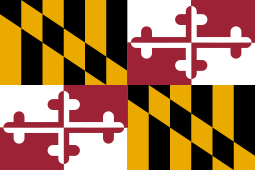
Maryland’s official flag dates from 1904, decades after the Civil War. It reflects the heraldic arms of Cecil Calvert, the second Baron Baltimore, proprietor of the colony in the seventeenth century. Maryland never seceded. So what ties to the Confederacy might its flag have?
According to Brockell, back in the early 1860s:
Union Marylanders flew the black-and-gold Calvert flag, the heraldry of the Calvert family that founded the Maryland colony. Confederate Marylanders flew the white-and-red Crossland flag, believed to be the heraldry of the Crossland family, from which George [actually Cecil] Calvert’s mother descended.Marylanders and eventually their state legislature adopted a flag that incorporated both those patterns as a symbol of reconciliation. Of course, that was reconciliation among white men. Black Marylanders were subject to the Jim Crow laws of that time.
Brockell’s article is arranged from least to most obvious links to the Confederacy. The last two state flags it discusses are those of Arkansas, which includes a star explicitly added to commemorate the Confederacy, and Georgia, which is based on the Confederate national emblem. So those ties aren’t really debatable.
In contrast, we can ponder whether the actions of the South Carolina slaveholders of 1861 taint the symbols they adopted from the South Carolina slaveholders of 1776. Or whether the same combination of patterns as on Lord Baltimore’s seventeenth-century coat of arms can acquire a new meaning as the post-Reconstruction settlement among whites swept injustice under the national rug. But we’re mistaken to assume those state flags actually go back to the Revolution or before.
Brockell’s article starts by quoting Jason Patterson, interim deputy director of Washington College’s Starr Center for the Study of the American Experience. He wants more people to understand the meaning of the Maryland flag. However, Patterson “doesn’t want to change the flag, which is particularly beloved by Marylanders. But he doesn’t think its Confederate ties should be ignored either.” Are people willing to do that?
This article told me stuff I didn’t know, and prompted me to look up more, so I’m grateful for it.
TOMORROW: Massachusetts’s seal.

