J. L. BELL is a Massachusetts writer who specializes in (among other things) the start of the American Revolution in and around Boston. He is particularly interested in the experiences of children in 1765-75. He has published scholarly papers and popular articles for both children and adults. He was consultant for an episode of History Detectives, and contributed to a display at Minute Man National Historic Park.

Subscribe thru Follow.it


•••••••••••••••••


Showing posts with label museums. Show all posts

Thursday, July 16, 2026

New Signage Installed at the President’s House During the Night

Since September 2025 I’ve been following the dispute over displays at the President’s House, part of Independence National Historical Park in Philadelphia.

Reflecting its overall ideology, the Trump White House ordered the National Park Service to replace signs discussing how that site had been a site of enslavement when George and Martha Washington lived there in the 1790s.

Because the city of Philadelphia had participated in creating the exhibit, it claimed legal standing to sue for the signs to be restored. A district judge agreed. A higher judge stopped the restoration process. Over the last month the full circuit ruled that the federal government could control the site and remake the signage.

Yesterday WHYY reported: “Workers replaced the remaining exhibits overnight Tuesday.”
The new exhibit retains references to slavery and those enslaved by Washington while serving as president in Philadelphia, but it devotes significantly more space to the history of the executive mansion and the early presidency. A panel that had been titled “The Dirty Business of Slavery,” for example, has now been replaced by signage that reads, “Celebrating Independence Throughout the Years.”

It also softens Washington’s views on slavery compared to the previous display.

“In 1774, Washington helped draft the Fairfax Resolves at Mount Vernon,” one panel reads. “These condemned the slave trade as ‘wicked,’ ‘cruel,’ and ‘unnatural’ and called for putting ‘an entire Stop’ to it. Over time, he became increasingly committed to the gradual abolition of slavery.” . . .

on Wednesday, several armed members of the National Park Service Police were seen vigilantly watching over the site.

Park service officials stopped one activist, Dr. Sandra Shachar-Krasnoff of Philadelphia, after she briefly taped a piece of paper with “the excavation revealed a kitchen and a slave quarters below the president’s house site” to one of the walls.

She was fined $310.
The photo above, taken by Abraham Gutman for the Philadelphia Inquirer, shows a federal officer writing a citation for Dr. Shachar-Krasnoff. The Inquirer also reported that the N.P.S. installed security cameras at the outdoor site last week, ostensibly because the All-Star Game was about to be played in the city. So there’s no doubt the government will surveil the walls more tightly.

The park website displays eleven large new panels, but the Inquirer states there are also “more than a dozen smaller panels that detail governmental processes, the lives of various historical figures, and a panel dedicated to the escape of Ona Judge and Hercules [Posey], two people enslaved by Washington who fled to freedom.”

All told, says the Inquirer, “the new exhibits mostly offer a broad timeline of U.S. history that significantly strays from the original intent of the President’s House as outlined in the park’s foundation document in 2017: ‘It would explore the historic context of the site in the context of its ties to slavery and the lives of the enslaved who lived at the site.’”

There’s already an effort to have Philadelphia erect a historic marker about Hercules Posey outside of federal control, like one already up for Ona Judge.

Saturday, June 27, 2026

New Boston Museum Exhibits to Visit During the Sestercentennial

Two venerable Boston museums are unveiling big reworked exhibit spaces for the Sestercentennial.

At Revolutionary Spaces’ Old South Meeting House, “Ruckus!” opens formally on 2 July. This is a 25-minute “immersive” show that
drops you right into the heart of the debate and defiance that once filled this iconic space, where ordinary people set extraordinary change in motion.

From the floorboards to the balconies, you will be surrounded by dynamic sound, lighting, and projected animations of fiery revolutionaries, determined citizens, and some unlikely troublemakers whose courage shook these walls.
Revolutionary Spaces encourages people to buy tickets in advance since space at each showing is limited. Arrive around the top of the hour, and the show begins at fifteen minutes past. Tickets include admission to all of Old South’s exhibits and the Old State House.

“Ruckus!” includes loud noises and dynamic lighting to reflect the intensity of the story it tells. It therefore might not be comfortable all visitors. Revolutionary Spaces also offers “Sensory-Friendly Mornings” at the Old State House each month.

The Museum of Fine Arts has reopened its “Art of the Americas: 1700–1800” galleries with a new, hemispheric approach. Thomas Sully’s massive painting of Washington crossing the Delaware stayed where it is, but lots of other iconic artworks are arranged in a new way.

The museum says:
The MFA’s reimagined galleries of 18th-century Art of the Americas bring together works from across North, Central, and South America, and the Caribbean—including works by Native American and Indigenous makers. Together, the eight spaces in this suite, organized by theme, explore how artists have contributed to, or in some cases resisted, ideas of nationhood and identity. Visitors can immerse themselves in expansive versions of familiar stories, discovering the interconnectedness of the Americas and its history, institutions, and people.
The galleries have the themes of “Power and Resistance,” “History and Mythmaking,” “Asian Styles in the Americas,” “Boston’s World,” “Something’s Brewing” (not revolutions but caffeinated beverages), “Communities of Makers,” “Families at Home,” and “Copley’s Ambition.”

Thursday, June 11, 2026

Remembering the Battle of Bunker Hill This Week

Next week brings the 251st anniversary of the Battle of Bunker Hill, and the Charlestown Historical Society and partner organizations have planned several events to commemorate it.

On Saturday, 13 June, there will be an Author & Historian Symposium in the lodge beside the Bunker Hill Monument. Among the scheduled speakers from 10 A.M. to 4:30 P.M. are:
  • Timothy Reardon on the Brothers of the Battle of Bunker Hill descendants group 
  • James Philbrick on his ancestor, David Howe
  • Joni and Christine Parker on their ancestor, Benjamin Parker
  • Christian Di Spigna on Dr. Joseph Warren
  • J. L. Bell on the “whites of their eyes” quotation
  • Joe Bagley on archeology in Charlestown, including the dig completed the day before
  • Julie Hall on how public relations shaped the American Revolution
Throughout the day family artifacts, letters, journals, ephemera, and other historic items will be on display for visitors. A musket demonstration by the National Park Service is scheduled for 4:30.

Charlestown’s annual Bunker Hill Day Parade will be on Sunday, 14 June, from 12:30 to 4:30 P.M. I understand through other sources that there will also be a sidewalk demonstration against White House censorship of signs quoting later generations on the monument inside the lodge, as discussed here.

On Tuesday, 16 June, the society, the city of Boston, and GBH will cohost a community viewing of the Bunker Hill portion of Ken Burns, Sarah Botstein, and David Schmidt’s documentary series The American Revolution. Some of the historians, archeologists, and descendants from Saturday will be on hand, as well as Donald R. Ryan, biographer of William Prescott. That discussion will take place from 6 to 8 P.M. in the street-level meeting room of the Bunker Hill Museum.

On Wednesday, 17 June, the Bunker Hill Monument Association will have its annual meeting at 11 A.M. in the museum. Prof. Robert Allison from Suffolk University will speak on “The Importance of the Left Flank and the Rail Fence.” This event is open to B.H.M.A. members and invited guests only.

Finally, from 3:30 to 5 P.M. that Wednesday, the annual Remembrance Ceremony on the monument grounds will be open to the public.

Sunday, May 17, 2026

“There is something off about this sword”

Earlier this year the Sandwich Enterprise shared a story by Cearra O’Hern about the identification of an artifact at the Pilgrim Hall Museum.

The article focuses on Michael L. Welch, Jr., who uses first-person interpretation of Revolutionary figures in teaching history at the Sandwich Middle School.

The article explains:
Welch primarily portrays Major General James Warren, a leading revolutionary in Massachusetts who also served as president of the Massachusetts Provincial Congress during the American Revolution. Welch heard that the Pilgrim Hall Museum in Plymouth had Warren’s sword

“I connected with the curator, who was very helpful in lining up a time to go in and look at the sword,” Welch said. “I was given the attribution of the sword, how the sword was passed down through the Warren family and donated. I photographed it extensively, I scanned it, I made a 3D rendering of it, and the whole time I am looking at this sword, I am like, ‘There is something off about this sword.’”

Welch had seen a sword like Warren’s before, which was believed to date back to 1764-1765. As he continued to examine its pommel, guard and counter-guard, Welch determined the sword was not a general’s sword; it was a mass-produced sword made much later, after the American Revolution.

Welch identified the sword as a Model 1796 Hanger carried by British sergeants, a discovery that “broke his heart,” as he did not want to say anything to the Pilgrim Hall Museum.
The photo above, which the museum shared on social media a few weeks before this article appeared, may show one of those awkward moments when Welch looked at the sword and wondered about sharing doubts with curator Anne Mason.

After confirming his assessment with an expert, Welch did indeed discuss those findings with Mason and her colleagues. The museum will add that information to its files and assess how it displays the hanger. As Welch points out in the article, the fact that this sword was made in 1796 doesn’t mean it wasn’t owned by James Warren; his son James, Jr. (1757–1821), a Continental Marine officer who lost a limb in 1781; or another member of the family. It just doesn’t go back as far as the Revolution.

Saturday, May 09, 2026

Declarations of Independence around Boston—Collect Them All!

To commemorate the 250th anniversary of the Declaration of Independence, multiple institutions in greater Boston have collaborated to lay out a Declarations Trail—exhibits of different significant copies of that document.

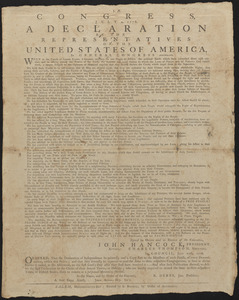
The Leventhal Map Center at the Boston Public Library has opened “Declarations: Printing a New Nation” with eight printings from broadsides and newspapers, along with maps showing the spread of that news. It will be up through 13 September. Shown here is the library’s copy of the Declaration as printed by Ezekiel Russell for the newly independent Massachusetts government.

The Boston Athenaeum exhibit “Imagined Nation” displays early printings in the context of such items as George Washington’s copy of Thomas Paine’s Common Sense, maps of the young republic, and World War II–era posters. That runs through November.

The Massachusetts Historical Society’s “1776: Declaring Independence” display, up through December, includes “handwritten copies of the Declaration by John Adams and Thomas Jefferson as well as multiple early printings, including a rare Dunlap broadside.” That was the first official presentation of the text, commissioned from printer John Dunlap by the Continental Congress in July 1776.

In Cambridge, three parts of the Harvard University library system are creating linked displays. The university archives is offering “Harvard and the American Revolution.” Next week the Harvard Map Collection will open “Charting Independence.” And starting on 18 May the Houghton Library will host “War of Words,” a display assembled by curator John Overholt to feature “the posters, pamphlets, newspapers, and images that brought news of the American Revolution to those who lived through it.”

In addition to the sites on the Declarations Trail, the Commonwealth Museum regularly displays Mary Katherine Goddard’s official reprinting of the Declaration signed by John Hancock and sent to the state in 1777.

And the “The Road to Revolution: Massachusetts and the Independence Movement” exhibit in Revolutionary Spaces’s Old State House, drawing on material from the M.H.S., includes a “rare 1776 Boston broadside printing of the Declaration of Independence.”

Most of those exhibits are free to the public. Many have special tours, talks, and workshops scheduled as well.

In a parallel initiative, five Revoloutionary-era institutions with admission fees—the Paul Revere House, Old State House, Old North Church, Old South Meeting-House, and King’s Chapel—have combined to offer visitors the Boston 250 Pass with a 10% on regular adult admission.

Tuesday, March 03, 2026

“Touch-screen displays, Revolutionary War artifacts, and A.I. slop”

Among the Trump administration’s Sestercentennial initiatives are modern gladiatorial games outside the White House on the President’s birthday. Less decadently imperial are the Freedom Trucks mentioned yesterday.

These trucks were clearly inspired by the Freedom Train that traveled the country in 1947–49, giving citizens a look at 127 documents from the National Archives and other artifacts.

The most detailed list of those documents that I found is a Huntington Library catalogue description of “Heritage of Freedom,” the booklet given out to explain those items to visitors. The selection didn’t include the handwritten Declaration of Independence, Articles of Confederation, or Constitution, but it did have the Congress-approved Bill of Rights, George Washington’s copy of the printed Constitution, and various letters and pamphlets from the Founding era. The display went back as far as the Magna Carta and Christopher Columbus, and as recently as the surrender of Germany and Japan.

The 1940s Freedom Train previously inspired the American Freedom Train of the Bicentennial period, 1975–76. This one carried Washington’s copy of the Constitution again, the original Louisiana Purchase, and other documents, but also one of Judy Garland’s dresses from The Wizard of Oz, Martin Luther King Jr.’s pulpit, and a Moon rock. It was like a rolling Smithsonian.

What will be in the Freedom Trucks? The New York Times reported:
The truck exhibits were designed in collaboration with Hillsdale College, a conservative school in Michigan, and PragerU, a company that makes conservative educational materials. . . . The trucks prominently feature quotes from Mr. Trump and a video he filmed inside the Oval Office.
On 27 February, the New Yorker offered a story by Jessica Winter about PragerU’s projects:
Last year, PragerU unveiled the Founders Museum, a “partnership” with the White House and the U.S. Department of Education featuring A.I.-generated video testimonials from luminaries of the American Revolution. These include a digitized John Adams who ventriloquizes the words of the right-wing influencer Ben Shapiro, almost verbatim: “Facts do not care about our feelings.”

PragerU is also supplying the multimedia content for the Freedom Truck Mobile Museums, a travelling exhibition of touch-screen displays, Revolutionary War artifacts, and A.I. slop that will chug across the country on tractor-trailers throughout 2026, in celebration of the two-hundred-and-fiftieth anniversary of the Declaration of Independence. It seems that the battle over who defines good and evil—or, at least, over who defines American history—will be waged, in part, from the helm of an eighteen-wheeler. . . .

Prager’s nonprofit is just one of dozens of conservative organizations, many of them Christian, that are named as “partners” in the America 250 Civics Education Coalition, which is overseen by Linda McMahon, the Education Secretary. The coalition has the secular task of developing programming for America’s birthday, such as PragerU’s Founders Museum and the Freedom Trucks, the latter of which received a fourteen-million-dollar grant from the federal Institute of Museum and Library Services. (In March, President Trump signed executive orders to dismantle both the I.M.L.S. and the D.O.E.; they remain alive, albeit in shrunken, ideologized versions of their former selves.)

Other America 250 partners include both of the major pro-Trump think tanks (the America First Policy Institute and the Heritage Foundation), a Christian liberal-arts school (Hillsdale College), the Supreme Court’s favorite conservative-Christian legal-advocacy group (the Alliance Defending Freedom), the Christian-right-aligned church of Charlie Kirk (Turning Point USA), and something called Priests for Life.
Another notable detail from the New York Times: “Both institutions [Hillsdale and Prager U] said that they had not received any of the $10 million in taxpayer money and that they had funded their work with private donations.” That $10 million, you may remember from yesterday, was shifted by the White House from the Institute of Museum and Library Services to America250 and then to Freedom 250, ostensibly for these very trucks. What pocket is that money sitting in now?

TOMORROW: Up in the air.

Sunday, February 08, 2026

Museum of African American History Events on the Revolution

The Museum of African American History in Boston has opened a new exhibit called “Black Voices of the Revolution: Liberty, Emancipation, and the Struggle for Independence.”

The museum website says:
What do you do when a country cries out for liberty—but won’t offer it to you? In the shadowed alleys and crowded docks of Revolutionary-era Boston, Black men and women—enslaved and free—listened as white colonists thundered about freedom. They heard the speeches. They read the broadsides. But they knew: the liberty being shouted from the rooftops was not meant for them. Still, they stepped forward.

Interact with AI-driven, holographic images of primary sources, and the men and women who represented the African American community in Massachusetts during the period from the 1620s to 1800. Ask questions of the interactive using a voice activated program or by simply typing your queries on a touchscreen.
Those personages include Lucy Terry Prince, Phillis Wheatley Peters, Chloe Spear, and more.

On Tuesday, 17 February, the museum will host an event called “Digging Deeper into Black Voices of the Revolution.” Chief Curator and Director of Collections Angela Tate and Prof. Nedra Lee will discuss the process of assembling that exhibit. That free event is due to run from 5 to 7 P.M. at the museum on 46 Joy Street. Register to attend here.

On Wednesday, 18 February, the Massachusetts Historical Society will host a panel discussion on the topic “Whose Independence: Black Experiences During the American Revolution.” The panelists will be:
  • Dr. Noelle Trent, Museum of African American History | Boston & Nantucket
  • Dr. Benjamin Remillard, Providence College
  • Dr. Chernoh Sesay Jr., DePaul University
  • Dr. Kyera Singleton, Royall House and Slave Quarters
The panel description says:
As cries for liberty and clashes with the British broke out in the American colonies, enslaved and free Black people fought for independence on the battlefield, in courtrooms, and their communities. In petitions and writings, they argued that there were contradictions in a fight for freedom that didn’t include a full abolishment of slavery. Following the promise of freedom advertised, many enslaved men enlisted as soldiers. Many joined the Patriot cause while others volunteered with British forces. Throughout the war and in the years following, free Black leaders built the African Lodge and African Meeting House and established spaces for religion and education in their communities.
That event will run 6 to 7 P.M. Register to attend in person or online starting at this page.

Back at the Museum of African American History, on Thursday, 26 February, it will host the first U.S. showing of “In Search of Phillis Wheatley Peters,” Leslie Askew’s thirty-five-minute documentary about the poet, her work, new discoveries about her life after marriage, and her cultural legacy. That event is scheduled from 6 to 8 P.M. It is free, with donations welcome. Reserve a space here.

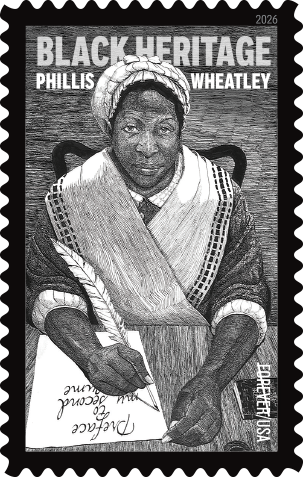
Shown above is the first-class stamp featuring Phillis Wheatley, just issued by the U.S. Postal Service.

Sunday, February 01, 2026

Getting Warmer on the Origin of a Warming Pan

At Historic New England, Erica Lome, curator of collections, shared a behind-the-scenes essay about a warming pan with a Revolutionary heritage of sorts:
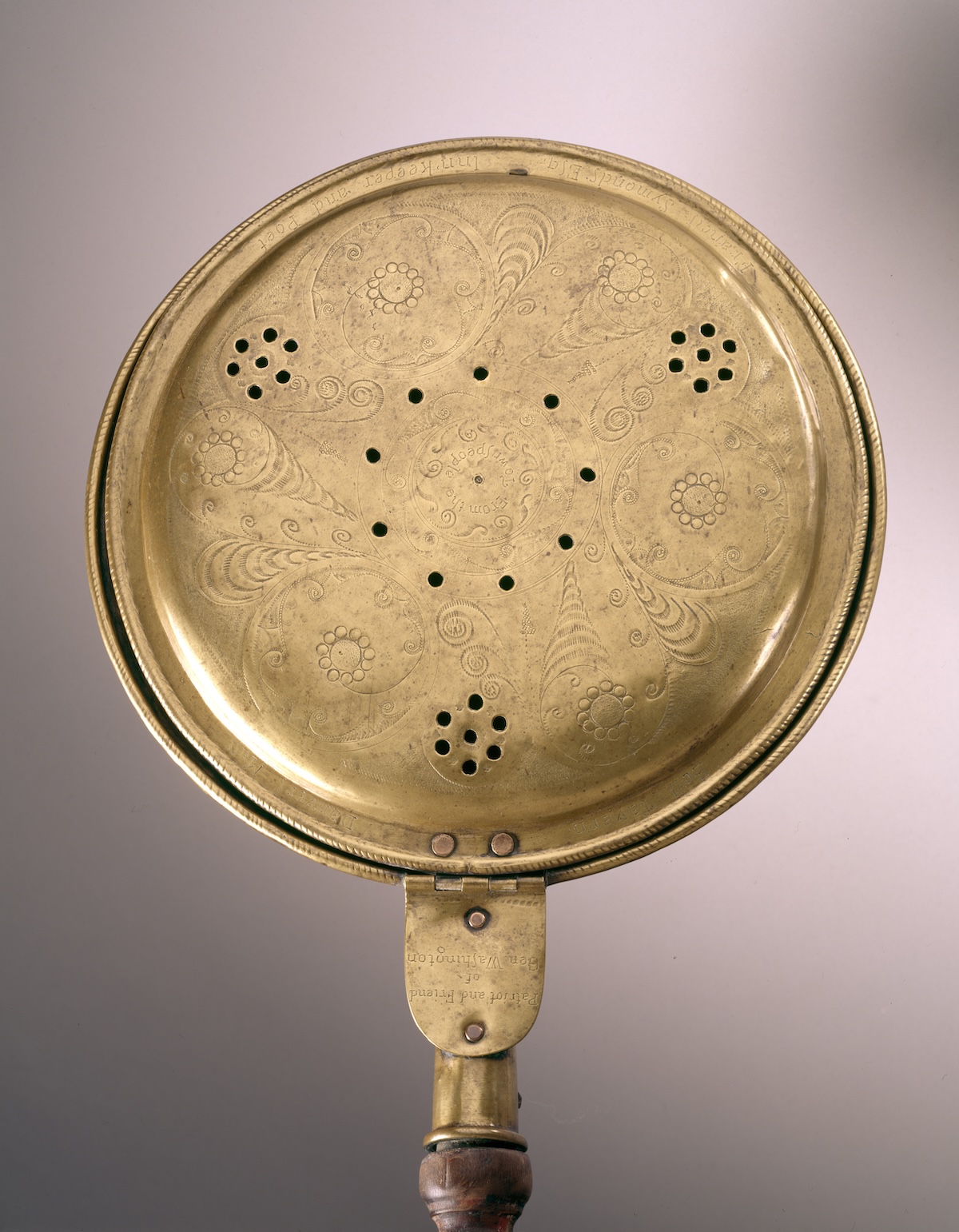
Tucked away in the parlor at Historic New England’s Cogswell’s Grant in Essex, Massachusetts, is a warming pan with a turned wooden handle and a brass container pierced with holes and engraved with scrolling vines and flowerheads. Also referred to as bed warmers, warming pans were a common household tool in colonial and post-revolutionary America, filled with embers and placed under the sheets of a bed to warm it before use.

This particular warming pan had more than just decorative motifs adorning its metallic surface. Engraved on its lid are the words:
From the Townspeople / Patriot and Friend of Gen. Washington / Bell Tavern, Danvers, Massachusetts / Francis Symonds Esq. Innkeeper and Poet.
On the pan’s sides, inside the incised outline of a bell:
I’ll toll you / if you have need / and feed you well / and bid you speed.
On the other side:
Francis Symonds / makes and sells / the best of chocolate / also shells.
John Warner Barber’s Historical Collections (1839) recorded that those verses hung on signs outside the Bell Tavern. In 1841 the Boston Cultivator stated that innkeeper Symonds’s “poetic genius caused [those lines] to be inscribed”; as Lome notes, he was known for adding bits of rhyme to his advertisements. (The Cultivator changed “also shells” to “and shells,” which scans better if you put three syllables into “chocolate.”)

The essay continues:
By its history, as recorded by Nina Fletcher Little, the warming pan was presented to Symonds around 1785: “After the war’s close, the citizens of Danvers evidently wished to present Symonds with a token of their esteem and decided on a warming pan as a practical gift.” The engraved inscription inside the bell matched the Bell Tavern’s signpost. The additional inscription praised Symonds as a patriot, friend of George Washington, and a poet, truly a prominent citizen and worthy of appreciation.

When researching this object for [the upcoming exhibit] Myth and Memory, one major detail of Symonds’s life challenged its story: Francis Symonds died on September 22, 1775. According to the Essex Gazette:
“On the 22nd Instant died at Danvers and on the 24th was very decently interred, Mr. Francis Symonds, Innholder, in the 5th Year of his Age. He was very just in his Dealings, and compassionate to the Poor as far as lay in his Power. In his last Sickness, especially towards the Close of Life, his Calmness and Resignation were very remarkable. He has left a sorrowful Widow and 6 Children, for whom we wish that the fame Compassion that he has shown to others may be shown to them.” . . .
Francis Symonds mustered for two days with Colonel [Timothy] Pickering’s regiment during the Battle of Lexington and Concord, and again on April 24, 1775, serving for a little over three months, until August 1, 1775. He was at home when he died of illness.

So, what about the warming pan? It seems very unlikely that the town of Danvers presented it to him on his deathbed, nor to his family immediately after, given the ongoing Siege of Boston. What is its true history?
Lome doesn’t offer a definite conclusion, but I like her hypothesis that the words were inscribed during a commemoration of the Revolution, such as Danvers’s dedication of a memorial obelisk near the Bell Tavern in 1835. Or later, when warming pans themselves were becoming relics of a quaint past. 

Wednesday, January 14, 2026

Knox Trail Commemorations on 15–18 Jan.

Sestercentennial commemorations of the progress of Col. Henry Knox’s artillery convoys across western Massachusetts continue this weekend.

(I’m trying to list all of these events, but there are so many that I might miss some being promoted locally.)

Thursday, 15 January, 6:30 to 7:30 P.M.
The Most Proper Spot in America: The Continental Arsenal at Springfield
Alex MacKenzie
Captain Charles Leonard House, 663 Main Street, Agawam

The winter meeting of the Agawam Historical Association will hear from Alex MacKenzie, curator of collections at the Springfield Armory National Historic Site. Having visited the region in 1776, Col. Knox chose Springfield to be the site of the Continental Army’s laboratory, or depot for building and repairing ordnance and other military supplies. Starting in 1777, that operation eventually grew into the Springfield National Armory, now a national park. This event is free and open to the public.

Friday, 16 January, 6 to 8 P.M.
250th Anniversary of Henry Knox in Monterey
Monterey Library, 452 Main Road

A new exhibit opens at the town library with a reception and remarks by Mark Makuc, Heather Kowalski, Rob Hoogs, and Jonathan Barkan, including presentations on the Bicentennial and current reenactments of Knox’s trek. These presentations will be repeated at the library on Saturday morning.

Saturday, 17 January, 2 to 3 P.M.
250th Anniversary Commemoration of the Henry Knox Trail
Springfield Armory National Historic Site

Revolution 250, Boston Celebrations, the Springfield Armory National Historic Site, and citizens of the towns of Westfield, West Springfield, Springfield, Wilbraham, Palmer, and Warren join to commemorate the “Noble Train of Artillery” on its way to Boston. Attendees can take in the site’s exhibit “The Continental Arsenal at Springfield During the Revolution” and ongoing display of weaponry through the decades.

Saturday, 17 January, 2 to 4 P.M.
Walk the Old Knox Trail
Bidwell House Museum, Monterey

After an outdoor gathering with a bonfire and hot mulled cider, Rob Hoogs will lead attendees along a segment of old road that Knox’s teamsters used, about half a mile each way.

Saturday, 17 January, 7 to 8:30 P.M.
Panel Discussion on Ye Trodden Path
Monterey Library, 452 Main Road

As the Berkshire County Historical Society publishes a new booklet on the trails through the region in 1775, titled Ye Trodden Path, local historians Rob Hoogs, Bernie Drew, Gary Leveille, Ron Bernard, and Tom Ragusa discuss the research going into that publication.

Sunday, 18 January, shows at 1:30 and 4 P.M.
For Love! For Liberty!
Springfield Performing Arts Venture

This new musical theater production by Vana Nespor and Clifton (Jerry) Noble tells the story of Henry Knox, his young wife Lucy Knox, and his mission to bring cannon to the Continental forces around Boston. Middle school history students help the U.S. Park Service, teachers, and grandparents explore this tale. Tickets available through this webpage.

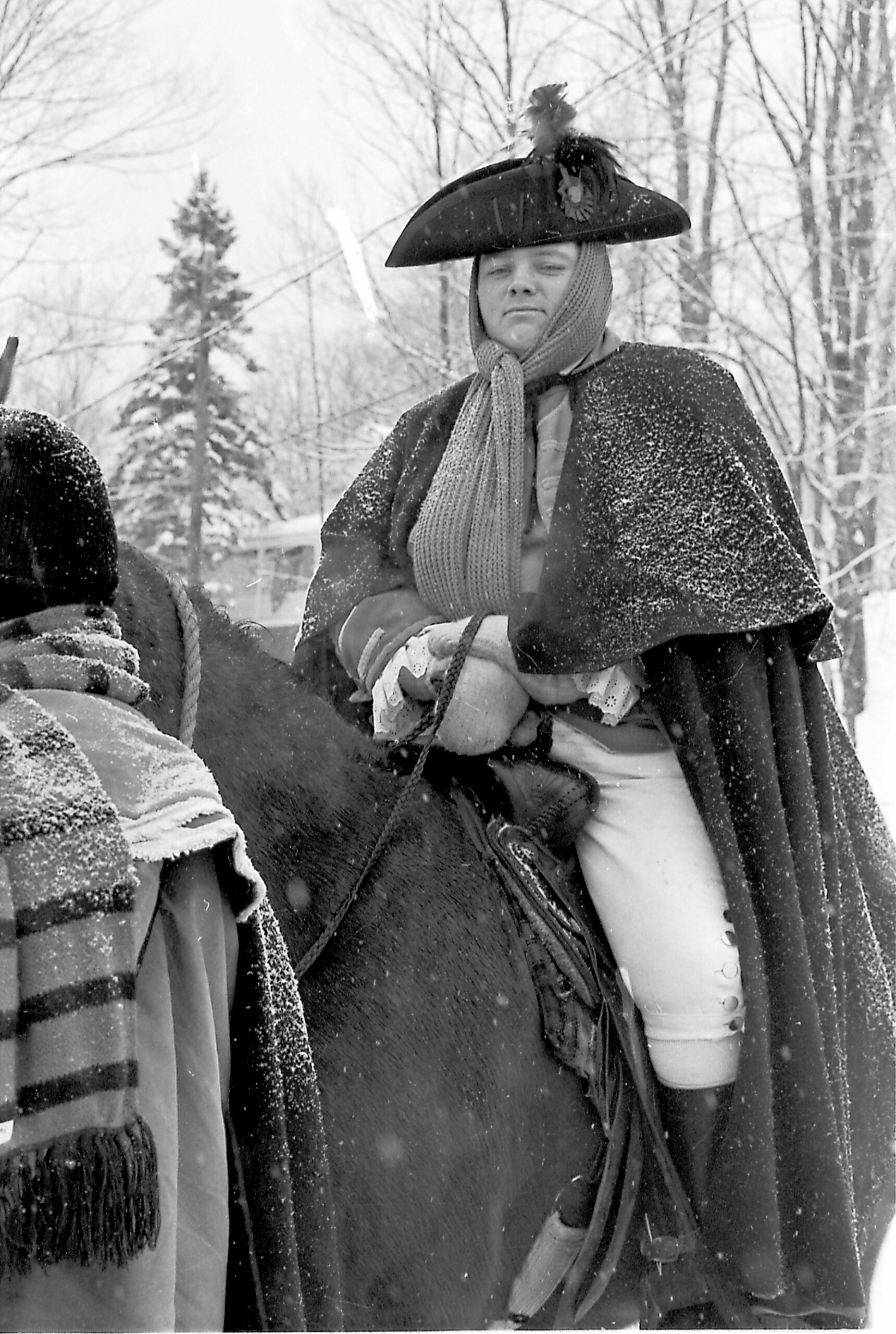
(The photograph above shows William Wilber portraying Henry Knox during the 1976 reenactment, courtesy of Gerry Francis and the Berkshire Edge.)

Tuesday, December 16, 2025

Call for Papers on Eyewitness Accounts of the Revolution in the Mid-Atlantic

To mark the 250th anniversary of the Declaration of Independence, Historic Trappe, the McNeil Center for Early American Studies, and Ursinus College will convene a symposium about “Experiencing Independence: Eyewitness Accounts of the American Revolution” on October 2–3, 2026.

This symposium will explore the diaries, journals, letters, and material culture of people in the mid-Atlantic region of America from 1760–1790.

The organizers say:
We seek to convene panels that explore family dynamics in the midst of political upheaval, wartime experiences of soldiers and civilians, accounts from different religious perspectives, and new approaches to non-English sources on the American Revolution.

We invite papers from historians, museum curators, educators, conservators, tour guides, reenactors, and other experts who rely on these sources to interpret military engagements, domestic life, and political and cultural changes of this period. Scholars of all backgrounds, disciplines, and career stages are encouraged to submit proposals.
Participants in “Experiencing Independence” will be able to tour Historic Trappe’s sites, including:
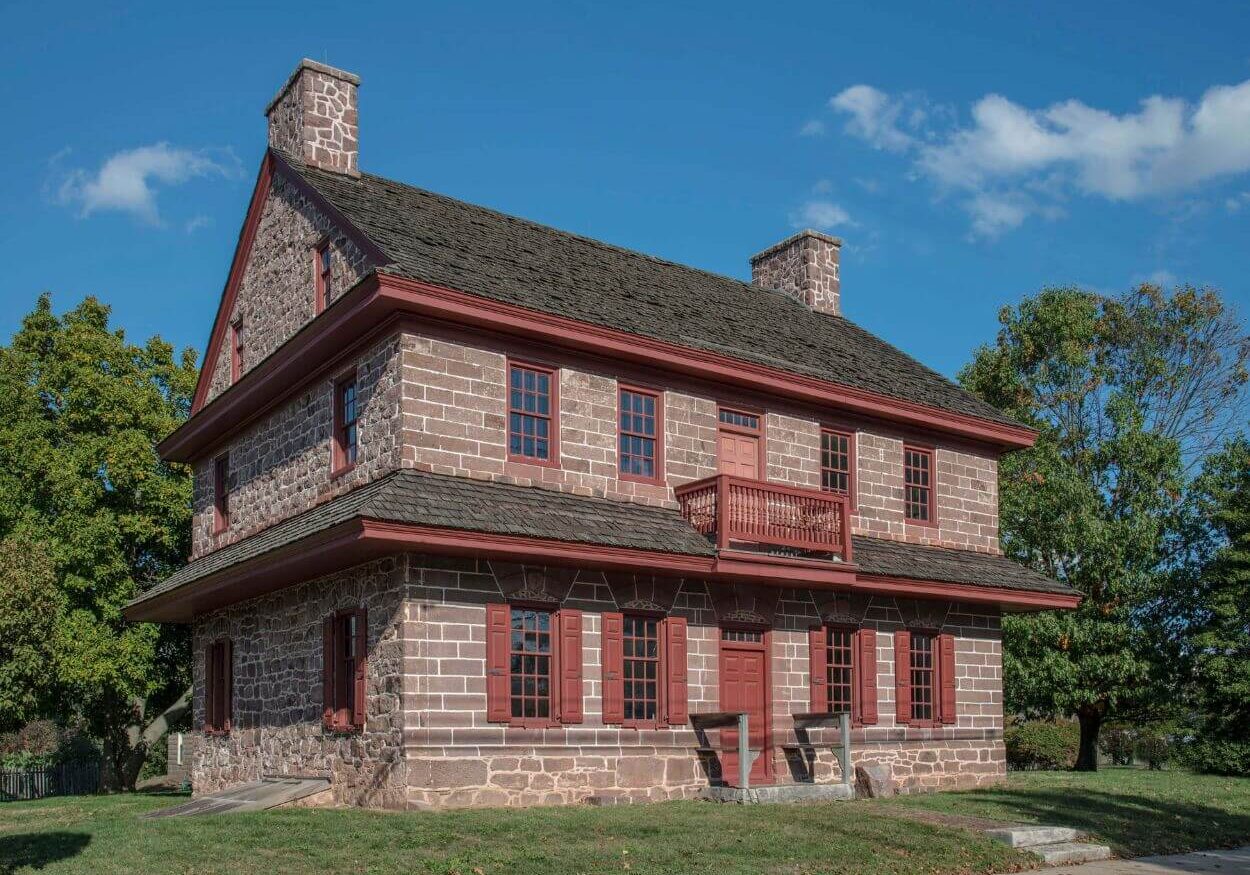
  • the home of Henry Melchior Muhlenberg and his wife Mary (shown above), who moved in the week following the Declaration of Independence 
  • the home of his son, Frederick Muhlenberg, which will open to the public in 2026 after a twenty-five-year restoration 
  • the special exhibition “Window to Revolution: Pennsylvania Germans and the War for Independence” in the Center for Pennsylvania German Studies at the Dewees Tavern
Prospective presenters can submit a title and 250-word abstract along with a one-page C.V. by 9 Jan 2026 through this online form. Direct questions about the symposium to Emily Sneff, Historian and Consulting Curator at Historic Trappe, at emily@historictrappe.org.

Monday, October 27, 2025

“Great Trade to Bilbao” Symposium in Salem, 8 Nov.

On Saturday, 8 November, Salem State University will host a symposium titled “’To Drive a Great Trade to Bilbao’: Rediscovering New England’s Iberian Ties, 1640s–c.1830.”

This scholarly event coincides with the Marblehead Museum’s ongoing exhibition “Bilbao Bound,” created with the Itsasmuseum Bilbao (Bilbao Maritime Museum).

The symposium brings together an international group of historians and curators to examine a largely forgotten aspect of early New England history: the trading connections between Boston’s North Shore and the Spanish Basque port of Bilbao. Those commercial ties played a part in securing Spanish Crown support for the American Revolution.

10 to 11:30 A.M.
“Bilbao Bound” exhibit tour
Donald C. Carleton, Jr., guest curator
Marblehead Museum

All the symposium presentations will take place in the Petrowski Room of Marsh Hall at Salem State University.

1:30 to 1:45 P.M.
Greetings and Welcome
Brad Austin, Chairman, History Department, Salem State University
Rafael Orbegozo Guzmán, Advisor to the Chairman, Iberdrola

1:45 to 2:05 P.M.
“James G. Lydon and the Rediscovery of New England’s Iberian Trade(s)”
Donald C. Carleton, Jr., exhibit curator

2:15 to 3:45 P.M.
New England and Iberia: Peoples, Ports, Perspectives
  • “Dowries of Cod and Prayers against Shipwreck: Women and Their Atlantic World in the Early Modern Basque Country” by Amanda L. Scott, Associate Professor of History and Women’s, Gender, and Sexuality Studies, The Pennsylvania State University
  • “El papel de cádiz en las primeras redes comerciales atlántico-mediterráneas de nueva inglaterra (1770–1820)” [“The Role of Cádiz in the early Atlantic-Mediterranean Commercial Networks of New England (1770–1820)”] by Guadalupe Carrasco-Gonzalez, Profesora Titular, Universidad de Cádiz via Zoom
  • “Fish for Faience: Archaeological Evidence of Early New England’s Trade with Portugal” by Emerson Baker, Professor of History, Salem State University
Moderator: Donald C. Carleton, Jr.

4:00 to 5:15 P.M.
Yankees, Cod, Spain, and Revolution
  • “Spain and the American Revolution: The View from Madrid” by Larrie D. Ferreiro, George Mason University
  • “Fish to Firearms: How Lee, Gerry, and Gardoqui Helped Arm a Revolution” by José Manuel Guerrero Acosta, Project Director and Curator, Spain and the Support for the American Revolution, a Project by Iberdrola
Moderator: Dane Morrison, Professor Emeritus of Early American History, Salem State University

5:15 to 5:30 P.M.
Concluding Remarks
Brad Austin

The symposium is free, but attendees must register in advance. For in-person seats, sign up here. To watch the presentations online, use this link.

Saturday, October 11, 2025

Two Talks on Thursday, 16 Oct.

It used to be that when two historical organizations scheduled talks on the same night you had to choose between them.

Now, thanks to live-streaming, it’s may be possible to catch both events and not even leave the house to watch them.

Here are two interesting talks scheduled for this upcoming Thursday.

Thursday, 16 October, 6 P.M.
“Within the compass of good citizens”: Paul Revere’s Masonic Journey
Steven C. Bullock
Scottish Rite Masonic Museum, Lexington

From the son of an immigrant to speaking beside the governor on Beacon Hill, Paul Revere traveled far in his extraordinary life. His membership in the Freemasons played an important role in that journey. This talk will consider how the fraternal order fit into Revere’s life—and into the development of Boston and the new nation of which they were a part.

Bullock is a Professor of History at Worcester Polytechnic Institute and author of Revolutionary Brotherhood: Freemasonry and the Transformation of the American Social Order, 1730–1840. This lecture is produced in partnership with the Paul Revere House. It will take place in person at the museum and be livestreamed on YouTube by LexMedia.

Thursday, 16 October, 7 P.M.
I Am So Tired of Waiting, Aren’t You?: Revisiting Black Majority
Peter H. Wood
American Antiquarian Society, Worcester

Black Majority: Race, Rice, and Rebellion in South Carolina, 1670-1740, first published in 1974, marked a breakthrough in understanding of early American history. This landmark book chronicles the crucial formative years of North America’s wealthiest and most tormented British colony. It explores how West African familiarity with rice determined the Lowcountry economy and how a skilled but enslaved labor force formed its own distinctive language and culture.

In this annual Robert C. Baron Lecture, an A.A.S. member who has written a seminal work of history reflects on its impact since publication. The series was endowed to honor Robert C. Baron, founder of Fulcrum Publishing and chairman of the A.A.S. council for a decade. Wood will speak in person at the A.A.S., and people can register to watch online.

Friday, October 10, 2025

Call for Proposals on “The Work of Revolution”

The National Council on Public History and the American Association for State and Local History will hold a joint conference in Providence, Rhode Island, on 16–19 Sept 2026.

The theme will be “The Work of Revolution,” and here is the call for papers:
Revolution is at the center of every remarkable societal change. Through formal politics, grassroots organizing, boycott, protest, litigation, war, and a wide range of other mass and individual actions, behind every revolutionary moment are the people working to bring revolutionary ideas into reality.

In the face of rapid cultural, social, political, and technological change, history’s importance as a guide for our future has become clearer than ever. Documenting during crises, archiving our collective past, supporting researchers and revolutionaries alike, public historians are part of the landscape of revolution. We bring history to the public because it matters.

The ongoing work of revolution is front and center in Rhode Island’s story, past and present. Rhode Islanders have always prided themselves on their independent spirit. To wit, 125 years after the Declaration of Independence, state leaders placed a statue called The Independent Man atop the grandest state house in the nation. Scholars, public historians, educators, and avocational historians interpret Rhode Island’s revolutionary roots and legacies as embedded in self-determination and self-rule, traits with often contradictory legacies and implications. On these lands of early contact and conflict, interpretive sites and educational institutions share the stories of vibrant Indigenous communities, African heritage legacies, as well as histories of immigration, industrialization, political tumult, and religious freedom.

As we close out the US Semiquincentennial year in this historically significant city, we are called to a moment of reflection on the work of revolutions past and the work that lies ahead. AASLH and NCPH members come together at this moment to take stock of our field and ask each other important questions. How do the events of the past 50 years shape how we do the work of public history in the next 50 years? How do we effectively respond to the challenges of our world while strengthening the field? What work will drive our revolutions? What revolutionary work needs to be done to forge the future of the field? And how do we as history practitioners continue to create fulfilling careers in the ever-evolving landscape of our field?
The conference organizers welcome proposals for sessions, workshops, and working groups. The deadline is 1 December of this year, and proposals should be submitted through this webpage.

Monday, October 06, 2025

“Patriot, Hero, Distracted Person” Online

At the end of the summer Revolutionary Spaces and the National Museum of Mental Health Project debuted an online exhibit titled “Patriot, Hero, Distracted Person: James Otis, Jr. and Mental Health in the Eighteenth Century.” It’s well worth a visit.

For decades the standard American story of James Otis was shaped by the Massachusetts Whigs, particularly his sister Mercy Warren and his admirer John Adams.

That narrative had Otis staunchly leading the political resistance to the British ministry’s corrupt laws until Customs Commissioner John Robinson assaulted him in the British Coffee-House. That severe head injury tipped Otis into bouts of insanity.

In the twentieth century historians noted that Otis’s family had noticed him behaving erratically earlier in life. Adams’s diary and newspapers show that Otis was especially verbose and bellicose in the days leading up to his confrontation with Robinson. The fight in the British Coffee-House might thus have been the result of mental difficulties, not just the cause.

This web exhibit shares all that evidence as well a note from a psychiatrist saying that Otis’s head injury could have brought on or severely exacerbated his manic episodes. It also explores his treatment and family life in more detail than I’ve seen elsewhere.

Without completely neglecting politics, the exhibit thus reframes Otis’s life “from an epic tragedy to a much more familiar story of loss and sacrifice.” It puts particular emphasis on his later years when he was unable to work and often separated from his wife and children. The final page shares artistic responses to his story.

Kate LaPine, Lucy Pollock, Paul Piwko, and their colleagues at Revolutionary Boston and the National Museum of Mental Health Project have produced a website evoking sympathy for Otis as an individual facing human difficulties, not a distant historical figure. It provides a different dimension to our grand Sestercentennial narrative.

Thursday, September 18, 2025

“Officials plan to substantially alter an exhibit that memorializes nine people enslaved”

Back in July, the Philadelphia Inquirer reported on how pressure from the Trump White House was affecting signage at Independent National Historical Park.

Its article said:
More than a dozen displays at Independence National Historical Park that share historical information about slavery during the founding of United States have been flagged for a content review in connection with an executive order from President Donald Trump. . . .

The President’s House Site, where Presidents George Washington and John Adams once lived, came under particular scrutiny with six exhibits flagged for review. The exhibit focuses on the contradictory coexistence of liberty and slavery during the founding of America and memorializes the people Washington enslaved.
White House staff had written an executive order for Donald Trump to sign with his distinctive signature that singled out the Independence park for training interpretive rangers to be sensitive to racial issues.

This Wednesday was the administration’s initial deadline for removing content it might deem “inappropriate.” Early in the week more articles appeared. The New York Times reported: “At Independence National Historical Park in Philadelphia, officials plan to substantially alter an exhibit that memorializes nine people enslaved by George Washington.”

A day before, the Washington Post said:
That park includes the President’s House Site, where George Washington served as president before the capital moved to Washington, D.C. The house was demolished in the 1800s, but an exhibit opened there in 2010 based on archaeological excavations.

Local advocates had pushed for the exhibit to provide in-depth information on the lives of nine people who were enslaved by George Washington while he lived in the house as president. The exhibit includes their names carved into a granite wall.

“This is not just a handful of signs that tell the story of slavery,” said Ed Stierli, senior Mid-Atlantic regional director at the advocacy group National Parks Conservation Association. “This is a place that tells the complete story not just of slavery in America, but what it was like for those who were enslaved by George Washington.”

Trying to extricate slavery from the President’s House exhibit would fundamentally change the nature of the site, said Cindy MacLeod, who was superintendent of Independence National Historical Park for 15 years until 2023.

“This is just one of many exhibits at Independence National Historical Park,” MacLeod said. “And to me, it’s a vital one.”
Alerting the news media to this pressure from above is the first step to resisting it. Philadelphians quickly protested the prospect of erasing information about slavery in the park, the Inquirer reported on Tuesday.

Independence National Historical Park commemorates how Americans sought their liberties and political rights in the late 1700s. The lives and struggles of Americans born into literal slavery, some of whom managed to secure their freedom on that very site, fit right into that theme. The stories of Oney Judge, Hercules Posey, and others can be enlightening, even inspiring, for people who recognize them as fellow humans. But champions of trumpery would prefer to suppress that history.

Tuesday, September 16, 2025

Commemorating the 1775 Expedition to Québec in Newburyport

This weekend the town of Newburyport will commemorate the 250th anniversary of when Col. Benedict Arnold and his Continental volunteers passed through the town on their way to Québec.

There are multiple events on the schedule. It looks like the Custom House Maritime Museum at 25 Water Street is the main base, open 10 A.M. to 4 P.M. all three days, but the Museum of Old Newbury and several churches are involved.

Friday, 19 September, 12 noon
Newburyport’s Bells Ring Out!

Three of the town’s oldest churches will ring their bells to herald the coming of the Continental troops.

Friday, 19 September, 7 to 8:30 P.M.
Through a Howling Wilderness: 1775 March to Quebec
Tom Desjardin
St. Paul’s Church, Newburyport

In September 1775, Arnold commanded eleven hundred Colonial soldiers on a daring, top-secret mission: to march and paddle nearly 200 miles through the untamed wilderness of Maine and Quebec to seize British-held Quebec City. It was a journey marked by hypothermia, disease, starvation, hurricanes, and blizzards. Dozens perished; survivors endured eating everything from dogs to lip salve before reaching their target. Though the attack ultimately failed, Arnold’s expedition helped pave the way for America’s eventual victory. Through a Howling Wilderness tells this gripping story of endurance, sacrifice, and leadership before Arnold’s name became synonymous with treason.

Tom Desjardin holds a Ph.D. in U.S. History and is the author of multiple acclaimed books. A former archivist and historian at Gettysburg National Military Park, he has taught at Bowdoin College, advised film and television productions (including Gettysburg and Gods and Generals), and appeared on the History Channel, A&E, Discovery, PBS, and CSPAN. He is a former Commissioner of Education for Maine and director of the Maine Bureau of Parks and Lands.

Saturday, 20 September, 10 A.M. to 4 P.M.
Revolutionary Living History Experience: Bringing 1775 to Life
Downtown Newburyport

A special one-day living history event featuring reenactors, tactical demonstrations, and engaging historical interpretation, this immersive celebration brings 1775 to life and honors the city’s pivotal role in America’s fight for independence. The day’s schedule will begin with Col. Arnold reviewing his troops. He will address them about their orders at around 3:30 P.M.

Saturday, 20 September, 10:30 A.M.
A Moment of Resolve: Reenactment of the Dedication Service
First Parish Church, 20 High Road

Commemorate the 250th anniversary of the Quebec Expedition with a powerful reenactment of the 1775 dedication service for departing troops. Reverend Samuel Spring, portrayed by Edward Speck, delivers the historic sermon that inspired courage and faith, honoring the spiritual strength that sustained Newburyport’s patriots on their journey to liberty.

Saturday, 20 September, 11 A.M. to 4 P.M.
Revolutionary Newburyport
Museum of Old Newbury, 98 High Street

Tours starting every hour highlight objects linked with the American Revolution not usually on display. Buy tickets and reserve spaces through this page.

Saturday, 20 September, 1:00 P.M.
DAR America 250 Patriots Marker Dedication
Old South Presbyterian Church, 29 Federal Street

The Brigadier General James Brickett–Old Newbury Chapter, N.S.D.A.R., will dedicate an America 250 Patriots Marker in Newburyport. This ceremony honors Revolutionary War patriots with reflections from civic leaders and descendants, preserving their legacy for generations to come.

Saturday, 20 September, 1:30 P.M.
Walk to the River: A Tribute to Newburyport’s Revolutionary Departure
Federal Street to Water Street

Following the dedication of the America 250 Patriots Marker, attendees are invited to join a commemorative walk through downtown Newburyport to the riverfront. The walk will conclude near the original embarkation site with brief remarks honoring the 1775 departure of local patriots on their daring expedition to Quebec.

Saturday, 20 September, 2 to 4 P.M.
Discover Your Family’s Story: Genealogy Drop-in Clinic
Museum of Old Newbury, 98 High Street

Discover your roots and deepen your community connection at this engaging genealogy workshop. Participants will learn how to trace family history, uncover ancestral ties to early settlers and patriots, and explore Newburyport’s revolutionary and colonial past. Trained genealogists will be available to assist with family history research.

Sunday, 21 September, 10:00 A.M.
Burying Ground Tour: Old Hill and Newburyport’s Road to Revolution
Old Hill Burying Ground, 25 Greenleaf Street

Join Newburyport historian Ghlee Woodworth on a captivating cemetery tour honoring Revolutionary War patriots. Explore gravestones, hear stories of bravery and sacrifice, and discover how these local heroes shaped America’s fight for independence. A fascinating journey connecting past to present through tales of courage, resilience, and Newburyport’s rich revolutionary heritage.

Sunday, 21 September, 11 A.M. to 4 P.M.
Revolutionary Newburyport
Museum of Old Newbury, 98 High Street

Tours starting every hour highlight objects linked with the American Revolution not usually on display. Buy tickets and reserve spaces through this page.

Sunday, 21 September, 1 P.M.
Faith and Freedom: Old South Presbyterian Church and the Revolution
Old South Presbyterian Church, 29 Federal Street

Explore Old South Presbyterian Church and uncover its rich Revolutionary War history on this guided tour. Learn about its role in 1775 as a gathering place for patriots, hear stories of prominent figures connected to the church, and discover how faith and freedom intertwined in Newburyport’s fight for independence.

Sunday, 21 September, 3 P.M.
The 1775 Quebec Expedition from Newburyport: Following Their Footsteps
Central Congregation Church, 14 Titcomb Street

On September 19, 1775, over 1,100 men departed Newburyport on a secret mission to capture Quebec—led by Benedict Arnold and planned with George Washington. Join Jack Santos as he recounts the stories of Newburyport’s patriots on this daring expedition through the wilderness as we celebrate its 250th anniversary.

Monday, September 15, 2025

Revolutionary Talks This Week in Dedham and Westford

Here are a couple more Revolutionary lectures coming up this week.

Wednesday, 17 September, 7:00 P.M.
Bullet Strikes from the First Day of the American Revolution
Joel Bohy
Dedham Museum, 612 High Street

In 2013, Joel Bohy began a collaboration with conflict archaeologist Dr. Douglas Scott to better understand the ammunition found during archaeological investigations on former battlegrounds. This morphed into live-fire research and the study of the extant battle-damaged structures and objects from April 19, 1775.

From the Elisha Jones house in Concord, through Lexington and the Jason Russell house in Arlington, Massachusetts—where Dedham soldiers fought—the two carefully studied all the surviving bullet strikes and bullet-struck objects. Using modern forensic techniques adapted to historical studies and live-fire validation, Bohy and Scott tell the story of the brutality of the fighting on the first day of the American Revolution as British forces retreated to Boston.

Joel Bohy is the owner of J.Bohy Historical Consulting. He is an arms & militaria specialist at Blackstone Valley Auctions and an appraiser on the PBS TV series Antiques Roadshow.

Admission is $10, free to museum members. This event will be recorded by C-SPAN for its America 250 series and by DedhamTV.

Thursday, 18 September, 7:00 P.M.
The Plight of the Loyalist in Massachusetts
Larry Kerpelman
Westford Museum, 2 Boston Road

It’s been said that history is written by the victors, so it’s not surprising that the story of Loyalists to the Crown who lived in the American colonies is not as widely known as that of the Revolutionary War’s victors, the Patriots. As the drumbeat to independence grew louder, Loyalists faced their Patriot neighbors’ scorn and the agonizing decision of whether or not to flee their towns and homes. Various historians have estimated that between 60,000 and 100,000 people fled the colonies by the time “America’s first civil war” ended. Dr. Kerpelman will present a picture of how ordinary Massachusetts Loyalists and their Patriot neighbors interacted with one another during the fraught period between the 1750s and the 1790s.

Larry C. Kerpelman, Ph.D., is a freelance writer and communications professional from Acton, Massachusetts. Upon retiring as Vice president and Director of Corporate Communications after 30 years with the Cambridge public policy research and consulting firm Abt Global, he turned to researching, writing, and speaking on singular moments in American history. His work has appeared in American History, American Heritage, The Boston Globe, The Rochester Review, and The Chronicle of Higher Education, among other publications. He holds a B.A. from the Johns Hopkins University and a Ph.D. from the University of Rochester.

Suggested Donation for this lecture of $10 per person.

Sunday, August 24, 2025

“A beautiful tribute to so many American heroes”

After the White House issued its letter illegally demanding control over the Smithsonian Institution, Donald Trump weighed in through his preferred method of communication: a rant on his Truth Social microblogging network.

As usual, Trump’s presentation of the situation was more bombastic and expansive than actual policy, or actual facts:
The Museums throughout Washington, but all over the Country are, essentially, the last remaining segment of “WOKE.” The Smithsonian is OUT OF CONTROL, where everything discussed is how horrible our Country is, how bad Slavery was, and how unaccomplished the downtrodden have been — Nothing about Success, nothing about Brightness, nothing about the Future. We are not going to allow this to happen, and I have instructed my attorneys to go through the Museums, and start the exact same process that has been done with Colleges and Universities where tremendous progress has been made. This Country cannot be WOKE, because WOKE IS BROKE. We have the "HOTTEST" Country in the World, and we want people to talk about it, including in our Museums.
This produced a lot of responses, many pointing out how the complaint about museums portraying “how bad Slavery was” matches the Trump administration’s moves to honor Confederates, remove African-Americans from positions of authority, and roll back programs to remedy the effects of historic racism.

Others noted the ridiculousness of complaining that history museums should be more focused on “the Future” and less on the past.

Politifact rated Trump’s claim that the Smithsonian Institution museums include “nothing about success, nothing about brightness, nothing about the future” [capitalization corrected] as “Pants on Fire.” Its analysis said in part:
A walk through the [African-American history] museum’s six levels reveals its overwhelming focus on Black Americans’ resilience, strength and success. . . .

Smithsonian museums are also chock full of patriotic items and exhibits celebrating American culture. . . .

As for "brightness," it’s hard to ignore the nonpartisan pop culture icons at the American history museum, from Kermit the Frog to "Star Wars" droids and basketball legend Michael Jordan.
Author Jonathan M. Katz wrote on Bluesky:
The funny thing about this is that the Smithsonian African American History Museum is built around the exact "Success" narrative Trump claims to want. You climb through the Middle Passage, slave cabin, Jim Crow train, etc, and come out into Oprah's studio and Obama.
But we have to wonder if success for African-Americans counts as success for Trump.

The Civil War historian Kevin M. Levin offered further analysis on Substack:
The Smithsonian and National Park Service are not leaders in the direction of historical interpretation and trends in public history. They largely reflect changes that have already taken place. More broadly, these institutions reflect cultural and societal shifts that have already been established.

Another way to make this point is to say that if you are a young activist, committed to instilling Americans with radical leftist ideas, the last place you will want to work is at the Smithsonian or National Park Service. Such a career move promises a lifetime of disappointment and frustration.
Levin also noted that Trump visited the National African American History Museum around the time he first entered public office in 2017 and came out saying, “This museum is a beautiful tribute to so many American heroes.”

According to a Washington Post article from 2019, based on Smithsonian director Lonnie Bunch’s memoir, that visit was more fraught behind the scenes.
The incoming president wanted to come on the holiday commemorating the Rev. Martin Luther King Jr., according to the memoir. The administration also asked that the museum be closed to the public during the visit. “The notion that we could shut out visitors on the first King holiday since the opening of the museum was not something I could accept,” Bunch writes. Another day was chosen. . . .

Before the president-elect arrived, his aides told Bunch that Trump “was in a foul mood and that he did not want to see anything ‘difficult,’ ” Bunch writes. Nevertheless, Bunch started the tour in the history galleries, which begin with the global slave trade.

“It was not my job to make the rough edges of history smooth, even for the president,” he writes. . . .

“The president paused in front of the exhibit that discussed the role of the Dutch in the slave trade,” Bunch writes. “As he pondered the label I felt that maybe he was paying attention to the work of the museum. He quickly proved me wrong. As he turned from the display he said to me, ‘You know, they love me in the Netherlands.’ All I could say was let’s continue walking.”

“There is little I remember about the rest of the hour we spent together. I was so disappointed in his response to one of the greatest crimes against humanity in history,” he continues. “Here was a chance to broaden the views and the understanding of the incoming president and I had been less successful than I had expected.”
It looks like Trump now has no memory of that visit.

Also, for the record, the Dutch, like most people around the world, had a negative view of Donald Trump. In 2017 the Pew Research Group reported that Dutch confidence that the U.S. President would do the right thing had gone down 75 percentile points in the shift from Barack Obama (92%) to Trump (17%). As of June 2025, the same global survey reported that 63% of the people in the Netherlands have no confidence at all that Trump will do the right thing as President.

Saturday, August 23, 2025

“The right of all Americans to learn about our history and culture”

The American Council of Learned Societies is a federation of more than eighty scholarly organizations in the humanities and related social sciences, founded in 1919.

This week it issued a statement about the Trump White House’s attempt to dictate the work of the Smithsonian Institution:
The American Council of Learned Societies (ACLS) stands in firm opposition to the latest directive by the White House forcing Smithsonian Institution museums to subject their presentation of American history to government review. This supersedes the oversight of professional scholars and makes the museums tools of the presidential administration. . . .

The Smithsonian was established in 1846 to advance knowledge through research and to make knowledge accessible to all through museums, education programs, and public outreach. Many steps are required to make knowledge part of public understanding. Scholars and scientists start with evidence—a worm-eaten page in an archive, an artifact found in an archaeological dig, a book written in a rarely studied language, and all sorts of familiar objects and texts—and only after careful study, writing, editing, informal and often formal peer review do we make the results public. These steps are where expertise is tested and where academic freedom is expressed in real time.

The historical materials at the Smithsonian Institution museums are intended to paint a full and accurate picture of the American experience; by forcing them to edit their exhibits at the administration’s command, the White House is engaging in authoritarian censorship. It is taking another step toward divesting in professional expertise and dismantling principles of academic freedom.

The genuinely patriotic thing we can all do in this moment is to speak out on behalf of the scholars who have dedicated their lives to helping us understand our nation, and for the right of all Americans to learn about our history and culture free from government intrusion.
On the one side, we have this long collective effort to develop, explore, and share knowledge. On the other hand, we have an executive branch in thrall to a man whose conviction for fraud was just upheld, reaching past what the law allows.

Sunday, August 17, 2025

Opposing “authoritarian control over the national narrative”

The Organization of American Historians has issued a statement on the White House attempt, discussed yesterday, to dictate the operation of the Smithsonian Institution:
No president has the legitimate authority to impose such a review. Established by Congress in 1846 as a unique and independent agency, the Smithsonian Institution is not, and has never been, under the authority of the Executive Branch. It is an independent statutory agency, led by the Secretary and governed by a bipartisan Board of Regents as established by law. This legal structure is ignored by the letter, as the stated goals of the review are to “ensure alignment with the President’s directive to celebrate American exceptionalism, remove divisive or partisan narratives, and restore confidence in our shared cultural institutions.”

The White House’s effort to assert control over the Smithsonian’s staff, archives, donors, public-facing content, curatorial processes, exhibition planning, and collection use constitutes an alarming infringement on the autonomy and integrity of this 179-year old distinguished institution. Moreover, it asks the hundreds of professionals who work at the Smithsonian to violate their ethics and their dedication to free and open historical inquiry.

The effort as outlined is divorced from the realities of an evidence-based, comprehensive telling of the U.S. past, and is part of an aggressive push to flatten American history into a narrowly conceived, unrepresentative, and simplified story. Historians, scholars, or subject-area experts will not be conducting this mandated review—and certainly not those whose exhaustive research, reviews, and consultations preceded the public staging of exhibits—but rather it will be undertaken by presidential appointees aligned with a specific political agenda. This is exactly what the architects of Smithsonian independence sought to avoid.

The end result of this process will be the opposite of a fulsome presentation of the history of the United States that reflects the Smithsonian’s mission for “the increase and diffusion of knowledge.” Instead, the review and the method used to compel it, will undoubtedly be in service of authoritarian control over the national narrative, collective memory, and national collections.

It is particularly distressing to see this effort of historical censorship and sanitizing tied to the 250th anniversary of the nation’s founding—what should be a moment for thoughtful reflection about and celebration of the American experiment with all its tragedies and triumphs. Together, these moves threaten to weaponize our shared past to serve political imperatives of the present and an imagined future. They politicize the artifacts, recorded stories, and historical experiences that belong to the American people and that help to bring a full, unvarnished picture of our democracy into public view not for indoctrination, but for education.
Full statement here.

(James Smithson, founding donor of the Smithsonian Institution, was a younger half-brother, born out of wedlock, of Col. Earl Percy.)