J. L. BELL is a Massachusetts writer who specializes in (among other things) the start of the American Revolution in and around Boston. He is particularly interested in the experiences of children in 1765-75. He has published scholarly papers and popular articles for both children and adults. He was consultant for an episode of History Detectives, and contributed to a display at Minute Man National Historic Park.

Subscribe thru Follow.it


•••••••••••••••••


Showing posts with label Daniel Leonard. Show all posts

Thursday, April 24, 2025

Esther Sewall and “the female Connections”

In the fall of 1774 and winter of 1775, Massachusetts attorney general Jonathan Sewall appears to have worked as an advisor to the royal governor, Thomas Gage.

With the courts closed by crowds and Gage’s authority confined to Boston, there wasn’t much else for Sewall to do.

There’s a renewed debate about whether Sewall wrote the “Massachusettensis” essays published in those months. Patriots of the time believed he did, but his former law trainee Ward Chipman described copying them out for another Loyalist lawyer, Daniel Leonard. In 2018 a team led by Colin Nicolson reported in the New England Quarterly that their linguistic analysis pointed the finger back at Sewall.

In early April 1775, a dispatch from Lord Dartmouth brought instructions to arrest the leaders of the Massachusetts Provincial Congress. Gen. Gage might well have discussed the legalities of such arrests with his attorney general.

The president of that congress was John Hancock. His fiancée, Dorothy Quincy, was the sister of Esther Sewall, the attorney general’s wife. On 7 April, James Warren wrote to his own wife:
The Inhabitants of Boston are on the move. H[ancock] and A[dams] go no more into that Garrison, the female Connections of the first come out early this morning and measures are taken relative to those of the last.
Dorothy Quincy was soon staying with Hancock and Samuel Adams at the parsonage in Lexington.

As discussed yesterday, though Esther Sewall was married to a leading Massachusetts Loyalist, she was still emotionally attached to her family, friends, and neighbors on the Patriot side. She might have heard her husband talk of Hancock and Adams being arrested. Any military operation to do that could put her sister in danger.

Esther Sewall therefore had a motive and possible means to be the “daughter of liberty, unequally yoked in point of politics,” who sent a warning that British soldiers might arrest Hancock and Adams, as the Rev. William Gordon later wrote. When I first discussed that question, I didn’t see how Esther would have had access to inside information. Jonathan’s work with Gov. Gage offers a possible answer. (And, we must remember, this “daughter of liberty” did not have information on Concord as Gage’s real target.)

A few months into the siege of Boston, Jonathan and Esther Sewall sailed for London. They remained yoked together for the rest of his life. But neither of them was happy. For most of those years Jonathan was seriously depressed, often confined to his bedroom. Esther was terribly homesick. Jonathan blamed Esther for his difficulties. Yet she stayed with him.

Esther Sewall made two trips back to Massachusetts, first in 1789 and then in 1797, the year after she became a widow. Her grown sons Jonathan and Stephen became important lawyers in Canada, and she settled in Montreal.

In 1809, Esther sued in Massachusetts court for her dower property, confiscated thirty years before as part of Jonathan’s assets. Though she didn’t live to hear about it, the state’s highest judges decided in her favor. Then the Massachusetts General Court passed a special law to compensate the man who’d bought that property for what he had to pay her estate. So the Massachusetts government ended up paying Esther Sewall money.

Saturday, September 07, 2024

Gunshots in the Countryside

On 7 Sept 1774, 250 years ago today, Henry Vassall was riding in Lincoln when he heard a gunshot.

The only Henry Vassall I was able to find on the family tree at this time was a nineteen-year-old son of William Vassall, discussed yesterday.

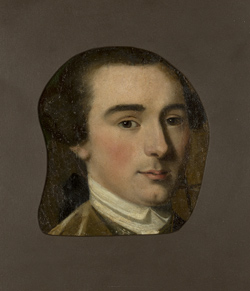
Henry was either visiting or staying with his cousin Elizabeth, wife of Dr. Charles Russell (1739–1780, shown here). I wonder if he was studying medicine.

Later that month Henry Vassall told the Charlestown committee of correspondence about his experience. He then wrote out an account for two Middlesex County magistrates, Henry Gardner of Stow and Dr. John Cuming of Concord:
Passing between the House of Mrs. Rebecca Barons [?] & Doct. Russell’s between the Hours of 7 & 9 in the Evening of the 7 instant [i.e., this month] & to the best of my Knowledge as I rose [?] a little Hill a little a past the first Canopy [?] I heard the report of a Gun saw the light and a Ball Enter’d the Carriage which I was in being Doct. Russells.

I immediately step’d out of the Carriage & stood about five or six Minutes & then stepp’d into the Carriage Again & road in haste to the Doctor when I had gone a small Distance from the Place where the Gun was discharged I met a person on Horse back

when I had past a small Distance further I met several Persons riding on two Horses,

whether the Ball was aim’d at the Carriage I can’t say I further declare I do not know or even suspect who the Person was that Discharg’d the Gun as above mentioned . . .

NB. The above affair I declar’d to no person in Lincoln but the Revd. Mr. [William] Lawrence & desired him to keep it secret—Till the Friday Following.
Gardner and Cuming also gathered statements from a local man named Joseph Peirce and Luck, enslaved to Dr. Russell. Both declared that they had been traveling near young Vassall and had heard no gunshot.

Three members of the Lincoln committee of correspondence then wrote back to Charlestown agreeing that they detested “the Crime of Assassination” but casting doubt on Vassall’s complaint:
We shall only add that as the evening on which this event was said to have happened was very calm it is the general opinion here that it is very improbable if not utterly impossible that a gun should be Discharged at that time & place without being heard by many persons, you have Doubtless seen the impression in the Carriage & are able to judge & Declare whether it is the efect of a Bullet Discharged from a Gun or Not as well as any person in this town
This incident provided yet another reason for members of the Vassall family to seek safety surrounded by the king’s soldiers. (And on the same day that the magistrates wrapped up their investigation, people in Bristol, Rhode Island, threw stones at the chaise of Henry’s father and stepmother, William and Margaret Vassall. Newspapers reported that “next morning [they] set out for Boston.”)

This shot in Lincoln is only the second example I’ve found of someone in Massachusetts firing a gun at a supporter of the royal government. The first had occurred a couple of weeks earlier in Taunton.

According to Daniel Leonard, a veteran of the last war named Job Williams came to his house with a warning that “the People were to assemble” to protest how he had joined the mandamus Council. Leonard left, thinking that would head off the problem. Instead, on 22 August , or perhaps make it clear he wouldn’t be welcomed back. That crowd did arrive. Leonard wrote:
about five hundred persons assembled, many of them Freeholders and some of them Officers in the Militia, and formed themselves into a Battalion before my house; they had then no Fire-arms, but generally had clubs. . . .

My Family supposing all would remain quiet, went to bed at their usual hour; at 11 o’Clock in the evening a Party fixed upon the house with small arms and run off; how many they consisted of is uncertain, I suppose not many; four bullets and some Swan-shot entered the house at the windows, part in a lower room and part in the chamber above, where one Capt. Job Williams lodged. The balls that were fired into the lower room were in a direction to his bed, but were obstructed by the Chamber floor. . . . I conclude it possible that the attack upon the house was principally designed for him.
Back in 1769–1770, there had been three increasingly notorious incidents of government supporters shooting at crowds of protestors: the “Neck Riot,” Ebenezer Richardson killing Christopher Seider, and of course the Boston Massacre. But even in that period Massachusetts protestors had never shot at royal officials or their supporters.

These untraceable gunshots in the late summer of 1774 show that some people in Massachusetts were starting to think it was acceptable to use that level of violence against Loyalists.

Thursday, June 27, 2024

“Undertook to carry off Mr. Leonard”

As I’ve been discussing, in the middle of June 1774 Samuel Adams and his Whig colleagues had come up with a plan to have their colony represented at what would be the First Continental Congress.

But to give the Massachusetts General Court time to approve that plan before Gov. Thomas Gage learned about it and shut down the legislature, they needed to get around committee member Daniel Leonard. He had recently moved to the Loyalist side of the political divide.

Besides Leonard, the other representative from Taunton was Robert Treat Paine, one of Adams’s allies. Both Leonard and Paine were lawyers, and on Tuesday, 14 June, the Bristol County court of common pleas was due to sit in their town. The courthouse was quite close to Leonard’s house, in fact.

As Paine described his actions decades later, he told Leonard that

it had been usual for Years past, to adjourn the Common Pleas Court at Taunton which was to set the then next Tuesday in Order that the Members of the General Court from that County might attend the General Court; but that the Neglect of it always gave uneasiness to many persons; especially the Tavern keepers, who from the great Concourse of people Collected there (the days being long & the Season pleasant) reaped great profits &c., &c., & that we might agree to Shorten the Court by Demurrers & Continuances & get back to [the Massachusetts General] Court in Season to attend to all important business
It was important for politicians to keep local tavern-keepers happy, after all. They were influential men at election times.

But Paine revealed his real motivation when he wrote: “the writer hereof Undertook to carry off Mr. Leonard.”

This maneuver is sometimes described as Paine inducing Leonard to leave Salem just before the crucial legislative vote. But in fact the two men left the previous Saturday, attended the county court for a few days, and even agreed to sit on a county committee to write an address to Gov. Gage.

At the end of the week, Paine and Leonard headed back to the legislature in Salem—“in Season to attend to all important business,” Paine had promised. But Adams’s resolutions were already moving.

TOMORROW: Behind closed doors.

Wednesday, June 26, 2024

“Keep the committee in play, and I will go and make a caucus”

In addition to Robert Treat Paine’s recollection quoted here, the Rev. William Gordon’s early history of the American Revolution offers another peek at the delicate political maneuverings in Salem in June 1774.

Gordon wrote:
Mr. Samuel Adams observed, that some of the committee were for mild measures, which he judged no way suited to the present emergency. He conferred with Mr. [James] Warren of Plymouth upon the necessity of giving into spirited measures, and then said, “Do you keep the committee in play, and I will go and make a caucus against the evening; and do you meet me.”

Mr. Samuel Adams secured a meeting of about five principal members of the house, at the time specified; and repeated his endeavours against the next night; and so as to the third, when they were more than thirty; the friends of administration knew nothing of the matter. The popular leaders took the sense of the members in a private way, and found that they should be able to carry their scheme by a sufficient majority.
Adams and his team came up with a two-step plan.

First, the Massachusetts House would appoint delegates to a Continental Congress, an idea raised by the Providence town meeting, the Virginia House of Burgesses, and other political allies outside of the colony. The House would also alert all its counterparts of that step and urge them to participate as well.

But then there was the age-old question of how to pay for this. Sending five gentlemen to Philadelphia would cost upwards of £500. Any legislative action involving money, even if it passed the Council, could be vetoed by Gov. Thomas Gage.

The solution was to write a bill authorizing that expenditure of £500 and then adding this clause:
Wherefore this House would recommend, and they do accordingly hereby recommend to the several Towns and Districts within this Province, that each Town and District, raise, collect and pay, to the Honorable THOMAS CUSHING, Esq; of Boston, the Sum of FIVE HUNDRED POUNDS by the Fifteenth Day of August next, agreeable to a List herewith exhibited, being each Town and District’s proportion of said Sum, according to the last Province Tax, to enable them to discharge the important Trust to which they are appointed; they upon their Return to be accountable for the same.
Adams’s unofficial caucus managed to formulate that plan without official committee member Daniel Leonard or other Loyalists catching on.

The next problem was how to pass those resolutions through the House. As Paine wrote:
it was Considered that the regular Method was for the Committee on the State of the Province to make report of these doings as their Report; eight of that Committee were then present, but the ninth [Leonard] was known to be adverse to any Such measure & therefore could not be trusted, least the whole should be defeated by the Governor;…
If Gov. Gage learned about the measures that the House was discussing, he could use his constitutional authority to shut down the legislature entirely.

TOMORROW: The Bristol feint.

Monday, June 24, 2024

“It was known to all but Mr. Leonard”

Robert Treat Paine and Daniel Leonard were Taunton’s two representatives to the Massachusetts General Court in the spring of 1774.

Both Paine and Leonard were Harvard graduates and well regarded lawyers. Both men had, as I mentioned yesterday, courted Sarah White, with Leonard being successful and marrying her.

(Paine finally married Sally Cobb of Taunton in 1770, when he turned thirty-nine and she twenty-six. Losing no time, they had their first child two months later.)

On 9 June 1774, both Paine and Leonard were named to the assembly’s committee of nine members to consider how Massachusetts should respond to the Boston Port Bill.

Looking back after two decades, Paine described that period this way:
Mr. Leonard was a Gentleman of natural good Sence & Eloquence, polite & of engaging Adress & had been Chosen Several Years as member for the Town of Taunton, on the Idea of his being a firm & able freind to the Opposition in wch. his Town was so determined; but on the prevailing Address & Sollicitation of Govr. [Thomas] Hutchinson he had changed his principles, & considered himself now at Market to make the best of them;

all this was well known to the members of the Court & the rest of the Committee more especially to his Colleague the writer hereof; it was therefore considered unsafe for that committee to enter into the consideration of the State of the Province on principles of Opposition while he was present, & as it appeared by the Port bill that the only releif from the Continual Exn. of it was the payment for the Tea that was destroy’d, the Committee turn’d their whole Attention to that;

& as it was known to all but Mr. Leonard, that Another Committee of vastly more importance, form’d from Members of the house of Representatives by their own inclinations was beginning to operate in secret the committee of nine talkd very favourably of paying for the Tea, as a thing not to be compar’d with the Sufferings from the Port Bill:

it would be hard to discribe the Smooth & placid Observations made by Mr. S[amuel]. Adams, Saying that it was an irritating affair, & must be handled Cautiously; that the people must have time to think & form their minds, & that hurrying the matter would certainly create such an Opposition as would defeat the matter;

& many Observations of this kind, all tending to induce Mr. Leonard the Oblique Member of that Committee to think that matters would work terminate in Obedience to the Port Bill were made by Several other Members of the Committee, & then it was Observ’d that it was very hot, & that they had been engag’d in Court all day, & that it was unprofitable to set any longer at that time for the people must have time to bring their minds to a Compromise;

Proceedings of this kind took place on the PM & Evning of three days; as soon as the Committee on the State of the Province was adjournd, all the Members except Mr. Leonard immediately repaird to a retired room where the Self Created Committee before mention’d mett, & being cornpos’d of Such members only as had Signalized themselves in their Opposition to the British Aggressions of Tyrannick Govt., they Shut their Doors & entered freely & fully on all the Subjects of Grievances;…
Meanwhile, back in Boston some leading merchants were also arguing that the town should pay for the East India Company tea.

TOMORROW: Dr. Warren’s diagnosis.

Sunday, June 23, 2024

Daniel Leonard on the Move

Daniel Leonard (1740–1829) was born into a wealthy family in Norton. He went to Harvard College, where he ranked third in the class of 1760 in social prestige, captained a militia company, and was elected valedictorian.

After graduating, Leonard earned his master’s degree and then went into the law. He was a leader among other bright young attorneys like Josiah Quincy, Jr., Francis Dana, and John Trumbull.

In 1767 Leonard married Sarah White, daughter of his legal mentor. Her other suitors had included Robert Treat Paine. Sarah Leonard died young, however, and in 1770 Leonard remarried to Sarah Hamock, daughter of a wealthy Boston merchant, in Trinity Church.

Inheriting his first father-in-law’s legal practice and his second father-in-law’s money, Leonard settled in Taunton. He quickly gained a royal appointment as the King’s Attorney for Bristol County and a seat in the Massachusetts General Court.

In that legislature Leonard worked with the province’s most fervent Whigs. He was on the committee of correspondence and a committee that called for the removal of Gov. Thomas Hutchinson and Chief Justice Peter Oliver.

Around the time of the Boston Tea Party, however, Leonard moved toward the side of the royal government. He said he’d come to distrust the motives of men like Samuel Adams. In February 1774 Leonard voted against impeaching Oliver.

People said Gov. Hutchinson had lured Leonard over to the Crown. Taunton locals reportedly watched him standing under a pear tree, speaking at length with the governor as he sat in his carriage. (I don’t know of any time the governor actually visited that town.) In 1815 John Adams put his own spin on the younger man’s progress:
As a Member of the House of Representatives, even down to the year 1770 he made the most ardent Speeches which were delivered in that House against Great Britain and in favour of the Colonies. His Popularity became allarming. The two Sagacious Spirits Hutchinson and [Jonathan] Sewall Soon penetrated his Character of which indeed he had exhibited very visible proofs.

He had married a daughter of Mr Hammock, who had left her a Portion, as it was thought in that day. He wore a broad Gold Lace round the rim of his Hatt. He had made his Cloak glitter with laces Still broader. He had sett up his Charriot and Pair and constantly travelled in it from Taunton to Boston. This made the World Stare. It was a Novelty. Not another Lawyer in the Province, Attorney or Barrister, of whatever Age Reputation Rank or Station presumed to ride in a Coach or a Charriot.

The discerning ones Soon perceived that Wealth and Power must have charms to a heart that delighted in So much finery and indulged in such unusual Expence. Such Marks could not escape the vigilant Eyes of the two Arch Tempters Hutchinson and Sewall, who had more Art, Insinuation and Adress than all the rest of their Party.

Poor Daniel was beset, with great Zeal for his Conversion. Hutchinson sent for him, courted him with the Ardor of a Lover, reasoned with him flattered him, overawed him frightened him, invited him to come frequently to his House.

As I was Intimate with Mr Leonard during the whole of this process I had the Substance of this Information from his own Mouth, was a Witness to the progress of the Impression made upon him, and to many of the Labours and Struggles of his Mind between his Interest or his Vanity and his Duty.
Whatever had motivated Daniel Leonard’s political shift, in June 1774 he still had enough of a history of standing up to the royal governors that several colleagues recommended him for the assembly’s committee to respond to the Boston Port Act. But Whig leaders didn’t trust him. He would, they suspected, tell Gov. Thomas Gage everything that committee was talking about.

So Adams and friends came up with a plan.

TOMORROW: An old rival returns.

Saturday, June 22, 2024

The Sestercentennial of Salem as the Seat of Government

Gov. Thomas Hutchinson prorogued the Massachusetts General Court on 8 Mar 1774, stating:
I have passed over without notice the groundless, unkind, and illiberal charges and insinuations made by each of the other branches against the Governor…
So those insinuations didn’t bother him, not at all.

Two months later, Gen. Thomas Gage arrived as the new governor, and the legislature didn’t have Thomas Hutchinson to kick around anymore.

A newly elected General Court convened in Boston on 25 May. By the end of the day, the legislatures had elected twenty-eight gentlemen to sit on the new Council.

The next morning, Gov. Gage vetoed thirteen of those men. So things were off to a smooth start.

The House started to address the petitions, bills, and other business before it. On Saturday, 28 May, the governor sent a message that he was adjourning the legislature, and the term would start up again on 7 June in the courthouse at Salem (shown above).

That action was part of the British government’s policy of isolating and punishing Boston until the town repaid the cost of the tea destroyed the previous December. Gage acted on instructions from London. Deciding when and where the legislature would meet had long been a Massachusetts governor’s power.

Naturally, the House’s first business when it reconvened was to complain about having to be in Salem. Its resolution argued that since Gage had acted “unnecessarily, or merely in Obedience to an Instruction, and without exercising that Judgment and Discretion of his own,” he wasn’t properly exercising the governor’s prerogative.

A day after that, the House members responded to Gage’s speech opening the session with more complaints about being in Salem.

Late on the morning of 9 June, the House made itself “a Committee to consider the State of the Province” after the Boston Port Bill. After some private and unrecorded debate, the lawmakers appointed a committee to recommend responses to that situation. Its members were:
(Some sources say the “Col. Tyng” appointed to this committee was William Tyng of Falmouth, but he had served in the previous General Court and the House journal referred to him as “Mr. Tyng.” The only Tyng in this session was John Tyng of Dunstable, and the Rev. Dr. Samuel Cooper’s diary confirms his title of colonel.)

That committee thus included three of Boston’s four representatives to the General Court. The remaining member was John Hancock, who’s not mentioned in the record of the Salem session, suggesting he wasn’t even there.

Paine later wrote that eight of those men “were considered as firm in the Opposition to British measures.” The exception?
by the mixture of nominations from both parties in the House the Name of Daniel Leonard was so repeated, that the Speaker found himself Obliged to nominate him & he was chosen.
TOMORROW: Who was Daniel Leonard?

Sunday, April 05, 2020

The Disappearance of Jonathan Sewall

In the mid-1760s, Jonathan Sewall allied with Gov. Francis Bernard, writing pseudonymous newspaper essays lampooning James Otis and favoring the Crown. The governor appointed Sewall to be attorney general of Massachusetts in 1767.

Sometime in March 1770, Attorney General Sewall wrote out the indictment of Capt. Thomas Preston and eight soldiers for multiple counts of murder—the Boston Massacre. This document used old British legal formulas: “not having the Fear of God before their eyes, but being moved and seduced by the Instigation of the devil and their own wicked Hearts…”

After 27 March, Sewall expanded that indictment to include three Customs service employees and notary John Munro, caught up in young Charles Bourgate’s accusations. It’s highly unlikely he believed in those charges, but he didn’t fight them.

Ordinarily Sewall would have prosecuted all those defendants, as well as the murder charges against Ebenezer Richardson and George Wilmot. He had personally argued all previous criminal cases since his appointment. Because people knew Sewall was a friend of the royal government, on 13 March the town of Boston voted to hire an attorney to assist him—an unusual move to ensure there was an aggressive prosecution.

Instead, the indictment turned out to be Sewall’s last official act in the Massacre trials. He never appeared in the Boston courthouse again that term. In 1816 defense counsel John Adams recalled: “Mr. Sewall, the Attorney General, who ought, at the hazard of his existence, to have conducted those prosecutions, disappeared.” Solicitor general Samuel Quincy wrote that Sewall couldn’t appear “by reason of Ill health.”

According to Thomas Hutchinson, the problem was the Boston Whigs’ visit to the court on 22 March to demand that the judges proceed to those murder trials. The acting governor wrote, “Sewall tells me he never will appear at any other court in that town, after the present, as Attorney General, and the whole court say they do not sit there with freedom.”

Yet the judges continued to sit. To prosecute the big murder cases, they appointed Robert Treat Paine, a private lawyer in Taunton, and Samuel Quincy. Adams wondered if Sewall was involved in those choices, but there’s no surviving evidence that he was.

Samuel Phillips Savage of Weston complained that Sewall didn’t stop all legal work. In his almanac diary Savage wrote that the attorney general continued to appear “with the jurys of the Inferior Courts at Charlston and Ipswich in the petty Concerns cognizable before the General Sessions of the Peace.” But he never went into Boston.

I suspect there was another factor in Sewall’s action, or lack of it: he was prone to depression. During the war he had a breakdown and spent more than a year in his bedroom. He had other spells of depression later in life, and his son suffered from the same spells while serving as chief justice of Upper Canada.

Even before the war, I think Sewall’s public writing shows a pattern of bursts of energy and silence. He published series of lively and often verbose essays from February to June 1763 (as “J,” “Jehosaphat Smoothingplain,” and “J. Philanthrop”), December 1766 to August 1767 (“Philanthrop”), December 1770 to February 1771 (Philanthrop” reviewing the Massacre trials he’d stayed away from), and June to August 1773 (“Philalethes”).

But in late 1774, after the Powder Alarm drove him into Boston, Sewall went silent. To argue for the Crown, “several of the principal gentlemen” turned to Daniel Leonard and Sewall’s law clerk Ward Chipman to deliver the “Massachusettensis” essays. Sewall may have supported the project, but he couldn’t do the work.

Historians are reluctant to apply psychiatric diagnoses like bipolar disorder to figures of the past. They’re beyond the reach of psychologists. And more than anyone historians know how concepts of mental illness change over time.

But in Sewall’s case, I think attributing his refusal after March 1770 to try the Massacre cases solely to his politics or to Whig pressure might miss a crucial internal force. The attorney general couldn’t bring himself to prosecute the big cases, nor to refuse to prosecute. He just stayed away.

Thursday, February 22, 2018

The “Swan Shot” that Killed Christopher Seider

On 22 February 1770, Customs service employee Ebenezer Richardson killed a young boy named Christopher Seider.

Christopher was part of a crowd of boys mobbing Richardson’s house. Indeed, he had just stooped to pick up a stone when he was hit by the discharge from Richardson’s gun.

Richardson had not shot a musket ball. Instead, he had loaded his musket with “Swan shot.” What that meant is clear from the Whig newspapers’ report on the boy’s injuries:

soon after the child’s decease his body was opened by Dr. [Joseph] Warren and others and in it were found eleven shot or plugs, about the bigness of large peas; one of which pierced his breast about an inch and one-half above the midriff and passing clear through the lobe of the lungs, lodged in his back.

This, three of the surgeons deposed before the Jury of Inquest, was the cause of his death; on which they brought in their verdict, wilful murder by Richardson. The right hand of the boy was cruelly torn, whence it seems to have been across his breast and to have deadened the force of the shot, which might otherwise have pierced the stomach.
“Swan shot” was a common term at the time. For example, in the 6 Nov 1729 Pennsylvania Gazette Benjamin Franklin reported:
We are inform’d that the following Accident lately happen’d at Merion, viz. A Man had order’d his Servant to take some Fowls in from Roost every Night for fear of the Fox: But one Evening hearing them cry, he look’d out and saw, as he thought, a Fox among them; accordingly he took his Gun, charg’d with Swan Shot, and fir’d at him; when to his Surprize it prov’d to be the Servant’s Arm, which taking down the Fowls he had mistaken for a Fox. The Man receiv’d several Shot, some thro’ his Arm, but none of them are thought to be dangerous.
In 1751, reporting on how he had knocked himself out with an electric shock, Franklin wrote, “I afterwards found it had rais’d a Swelling there the bigness of half a Swan Shot or pistol Bullet.” Likewise, in Robinson Crusoe, Daniel Defoe had his hero speak of “swan-shot, or small pistol bullets.”

On 22 Aug 1774, a crowd surrounded the house of Daniel Leonard of Taunton, protesting his appointment to the Council under Parliament’s new Massachusetts Government Act. According to Leonard, most people went home but “at 11 o’Clock in the evening a Party fixed upon the house with small arms and run off;...four bullets and some Swan-shot entered the house at the windows.” This is the earliest incident I’ve found of Massachusetts Patriots firing guns in their long political dispute with the royal government and its supporters.

Back in 1770, Richardson’s gun might have contained even smaller pellets than swan shot. During his trial, prosecuting attorney Robert Treat Paine took notes on testimony about George Wilmot, who had helped Richardson defend his house (and was acquitted of murder). If we can read Paine’s handwriting accurately, a witness said: “I took from W[ilmot]. a Gun loaded with 179 Shots. 17. Swan Shot. The rest Goose and Duck.” “Goose shot” and “duck shot” were evidently smaller pellets. Nowadays we’d lump them all together as “birdshot” and assign them numbers.

Wednesday, January 21, 2009

Gossip from Daniel Leonard, part 2

Yesterday I quoted from John Adams’s diary entry from 20 Jan 1766, as he gossiped with Daniel Leonard. But enough, those men apparently decided, about what Boston lawyers think about each other! What do other people think about Boston lawyers?

Here’s the rest of Adams’s notes, as Leonard described his recent visit to Rhode Island:

Leonard gave me also a Relation of his going to Providence Court and Spending an Evening with the Political Clubb there. The Clubb consists of Governor [Stephen] Hopkins, Judge [Daniel] Jenks, [Silas] Downer, [John] Cole and others. They were impatient to have the Courts opened in this Province not choosing to proceed in Business alone.
As in Boston, the big legal issue of early 1766 in Providence was the Stamp Act. That tax law required all legal proceedings to be submitted on stamped paper. Colonists responded by closing their courts until judges agreed not to enforce that part of the law. These Rhode Island attorneys and judges wanted to start holding court sessions again, without stamped paper, but wished to do so alongside the jurists in the bigger colony to their north rather than stick their necks out alone.
Were very inquisitive concerning all our Affairs. Had much to say of [Lt. Gov. Thomas] Hutchinson, [James] Otis, &c. Admired the answer to the Governors [Francis Bernard’s] Speech. Admired the Massachusetts Resolves. Hopkins said that nothing had been so much admired there through the whole Course of the Controversy, as the Answer to the Speech, tho the Massachusetts Resolves were the best digested and the best of any on the Continent. Enquired who was the Author of them.
The man who wrote the Massachusetts legislature’s resolves against the Stamp tax was Samuel Adams—the first time his political activity attracted notice outside the province.

Then the Rhode Islanders’ talk turned to less elevated forms of argument: satirical poems published in the newspapers.
Enquired also who it was that burlesqued the Governors Speeches? Who wrote jemmybullero [about Otis], &c. Thought Hutchinsons History [of Massachusetts] did not shine. Said his House was pulled down [on 26 Aug 1765], to prevent his writing any more by destroying his Materials. Thought Otis was not an original Genius, nor a good Writer, but a Person who had done, and would continue to do much good service.

Were very inquisitive about [Ebenezer] McIntosh [the shoemaker who led Boston’s public protests against the Stamp Act]. Whether he was a Man of Abilities, or not? Whether he would probably rise, in Case this Contest should be carried into any Length.

Jo[seph]. Green, [Samuel] Waterhouse and [Benjamin] Church were talk’d of as capable of Bullero and the Burlesques.
So gentlemen in Rhode Island had a good idea of which Bostonians were in the habit of writing satirical verse. Local consensus settled on Waterhouse as the author of the “Jemmibullero” attack on Otis, with Church responsible for “These Times,” attacking Bernard.

Tuesday, January 20, 2009

Gossip from Daniel Leonard, part 1

Prof. Ben Carp at Tufts pointed me to this gossipy scene from John Adams’s diary on 20 Jan 1766. Adams recorded a talk with a man he called “Leonard,” probably Daniel Leonard (1740-1829) of Taunton:

Leonard gave me an Account of a Clubb that he belongs to, in Boston. It consists of John Lowell, Elisha Hutchinson, Frank Dana, Josiah Quincy, and two other young Fellows, Strangers to me.
Most of these young men were studying the law on their way of becoming attorneys. Adams was five to ten years older than all of them, but was about to move from Braintree to Boston and try to grow his practice in a bigger town. So he was eager to learn about the legal scene in the capital.

These are the club members Adams named:
  • John Lowell (1743-1802) had come from Newbury to Boston to study under the attorney Oxenbridge Thacher—who died suddenly in 1765. Lowell would go back to Newbury and practice there until the war had started, then return to Boston and become one of the town’s richest attorneys and founder of the town’s famously upper-crust Lowell family. (The portrait of him above comes courtesy of Wikipedia.)
  • Elisha Hutchinson (1745-1824) was Lt. Gov. Thomas Hutchinson’s younger son. He never practiced law, but with his older brother Tommy would become one of the East India Company’s designated tea consignees in 1773.
  • Francis Dana (1743-1811), son of one of Boston’s leading justices of the peace. As the U.S. of A.’s first minister to Russia, he would take young John Quincy Adams to St. Petersburg as secretary and French translator.
  • Josiah Quincy, Jr. (1744-1775), son of a leading Braintree property-owner, would become Adams’s colleague in the Boston Massacre trial and in Revolutionary politics. He would die of tuberculosis on the eve of the Revolutionary War.
Leonard and his friends were debating the issues of the day—which in early 1766 meant the Stamp Act. Adams described the talk:
Leonard had prepared a Collection of the Arguments, for and against the Right of Parliament to tax the Colonies, for said Clubb. His first Inquiry was whether the subject could be taxed without his Consent in Person or by his Representative? 2d. Whether We Americans are represented in Parliament or not?

Leonard says that Lowell is a Courtier, that he ripps about all who stand foremost in their opposition to the Stamp Act, at your [James] Otis’s and [Samuel] Adams’s &c. and says that no Man can scribble about Politicks without bedaubing his fingers, and every one who does is a dirty fellow. He expresses great Resentment against that Line in Edes & Gill[’s Boston Gazette], ”Retreat or you are ruined,” and says they ought to be committed for that single stroke.—

Thus it seems that the Air of Newbury, and the Vicinage of Farnham, Chipman &c. have obliterated all the Precepts, Admonitions, Instructions and Example of his Master Thatcher, and have made him in Thatchers Phrase a shoe licker and an A—se Kisser of Elisha Hutchinson. Lowel is however very warm, sudden, quick, and impetuous and all such People are unsteady. Too much Fire. Experientia docet [experience teaches].
When Charles Francis Adams published his grandfather’s diaries in the 1860s, he left out the phrase “and have made him in Thatchers Phrase a shoe licker and an A—se Kisser of Elisha Hutchinson.” Pity.

Adams’s remark about “the Vicinage of Farnham, Chipman &c.” refers to leaders of the Essex County bar, where young Lowell would practice: Daniel Farnham (1719-1776) and John Chipman (1722-1768, died from a seizure he suffered while arguing a case in Maine). For some reason, Adams was always suspicious of attorneys from that part of Massachusetts. Years later he would elevate such a group into the “Essex Junto,” a label that took the men themselves by surprise.

Back in 1766, I suspect that Adams was a little jealous of those young men’s connections in Boston. They came from rich, established families. Despite his seniority, they threatened to become his professional rivals. Plus, despite his protests against wishing popularity, Adams disliked being left out of anything.

As the political turmoil heated up in the following decade, two of the young men in that club became firm Loyalists: Leonard and Hutchinson. In fact, Leonard would debate Adams in the newspapers in 1774-75—the widely reprinted Novanglus-Massachusettensis exchange. Two of the young men became Patriots: Dana and Quincy. The fifth, Lowell, first proclaimed his loyalty to the Crown and then repudiated it. Curiously, his career worked out best of all.

TOMORROW: Leonard’s stories about another club Adams probably wished he were in.