J. L. BELL is a Massachusetts writer who specializes in (among other things) the start of the American Revolution in and around Boston. He is particularly interested in the experiences of children in 1765-75. He has published scholarly papers and popular articles for both children and adults. He was consultant for an episode of History Detectives, and contributed to a display at Minute Man National Historic Park.

Subscribe thru Follow.it


•••••••••••••••••


Showing posts with label Grizzell Apthorp. Show all posts

Friday, June 16, 2023

“Slavery in Boston” Exhibit Now Open in Faneuil Hall

Today the city of Boston’s Department of Archaeology officially opens its new exhibit in Faneuil Hall, titled “Slavery in Boston.”

The display panels are already up, so I swung by to see them yesterday. The exhibit is in two parts, with an online component as well.

One part is on the ground floor of Faneuil Hall, among the shops selling books, souvenirs, and candy. This consists mostly of vertical panels set up around the building’s structural pillars. Some of the panels have basic introductory material, and some look at the legacy of race-based slavery in the area.

Most of the pillars, however, profile individual enslaved people, using all the sources available to show even a sense of their lives. That sees like a powerful way to communicate the experience of slavery on a one-to-one level to visitors who think they have just a minute or two to spare.

Those visitors who want to learn more (or use the restrooms) can go downstairs, where there’s a larger space and the rest of the exhibit. This area includes benches, a television monitor (now showing a video about abolitionist Lewis Hayden), and an activity table for kids.

Here the walls are lined with panels providing a more general introduction to the laws, economics, and demographics of slavery in Boston. Some of this repeats information upstairs, and sometimes it builds on that. One major message is that in the mid-1700s slavery affected all Bostonians’ daily lives and produced benefits for most free people, not just slaveowners.

At times, the presentation might even be too Boston-centered. One panel describes Charles Apthorp becoming the town’s richest merchant by trading with the Caribbean islands, Britain, and Africa. His business included buying and selling people. That panel could add that Apthorp’s ties to the slavery economy included marrying an heiress, Grizzell Eastwick, born on Jamaica.

A few of the “Slavery in Boston” panels display archeological finds related to households that included enslaved people, but most of the information behind this exhibit comes from documentary sources: legal and church records, newspapers, letters, and so on.

So why is this an Archaeology Department display? I suspect it’s because that’s the branch of local government most concerned with Boston’s past rather than its present and future.

Monday, February 24, 2020

The Life and Death of Christopher Seider

The younger boy hit by “Swan shot” from Ebenezer Richardson’s musket on 22 Feb 1770 was named Christopher Seider (although that last name also showed up as Snider and in other forms).

Christopher’s story starts with an effort to settle Maine. Around 1740, Massachusetts land speculators recruited German-speaking immigrants to live in the area around Broad Bay now called Waldoboro. At first this community was very small, but immigrant-laden ships arrived in Boston harbor beginning in November 1751.

The 25 Sept 1752 Boston Evening-Post reported:
a ship arrived from Holland with about 300 Germans, men, women and children, some of whom are going to settle at Germantown [in Braintree] and the others in the Eastern parts of the Province [i.e., Maine]. . . . a number of very likely Men and Women, Boys and Girls, from Twelve to twenty-five years old, will be disposed of for some Years according to their Ages and the different Sums they owe for their Passage.
In other words, some of the younger immigrants were to be indentured servants.

On that ship, the St. Andrew, came Heinrich Seiter, a farmer from Langensteinbach, and his family. Their home country was ruled by Charles Frederick, Margrave of Baden-Durlach. He was among the more enlightened of Europe’s noble despots, but Seiter was “very poor” and sought better opportunities. In that family, it appears, was a young man named Georg Frederich Seiter, born in 1727.

Around the same time, a woman named Christine Salome Hartwick, born about 1723, arrived with several of her relatives. That family’s name showed up in New England records as Hardwick, Hartig, and other forms.

Heinrich Seiter settled in the Waldoboro area. George Seiter may have lived with him for a while or gone directly to Braintree, where locals were trying to develop a little manufacturing center. Some of the new Germans were said to be glassmakers, and Joseph Palmer and Richard Cranch were building a glass factory.

We know that Georg Frederich Seiter married Christine Salome (soon Sarah) Hartwick on 20 Mar 1753 at Germantown. They had three children in Braintree:
  • Christina Elizabeth, born 26 Dec 1754.
  • Sophia, born 29 June 1756.
  • Christopher, baptized 18 Mar 1759.
By then the family name was written as “Sider.” If Christopher was baptized a week or two after birth, like his sisters, then he was born in early March 1759.

In 1755, the glass factory was struck by lightning and burned. Palmer and Cranch tried to keep the venture going, but in 1760 they gave up and mortgaged the land to Thomas Flucker. Some of the German workers went to Maine, some to a new town soon called Ashburnham—and George and Sarah Seider moved their family to Boston, where their daughter Mary was baptized at King’s Chapel on 10 June 1761.

The Seiders lived in a little house at the bottom of Boston Common on Frog Lane, later gentrified to Boylston Street. On the other side of the street was the giant elm that in 1765 the Sons of Liberty dubbed “Liberty Tree.”

As the 1760s came to a close, Christopher was no longer living with his family, however. He was in the household of the very wealthy widow Grizzell Apthorp, working as a servant. Apthorp was a pillar of the King’s Chapel congregation, which was probably how she came to know the Seiders.

There’s evidence that Christopher also attended a school of some sort. In the 1840s a woman named “Mrs. Preston” told a writer that she had gone to school with him, probably a reading school when they were younger. The Boston News-Letter reported that Christopher “was going from School” on 22 Feb 1770.

It’s quite clear that Christopher Seider was a reader. The Boston Evening-Post reported that he carried “several heroic pieces” or broadsides “in his pocket, particularly Wolfe’s Summit of human glory.” A broadside titled Major-General James Wolfe, who reach’d the summit of human glory, September 13th, 1759 is now on display at the Massachusetts Historical Society. The 17" by 24" sheet describes the taking of Québec in 1759, illustrated with a large colored woodcut of the general.

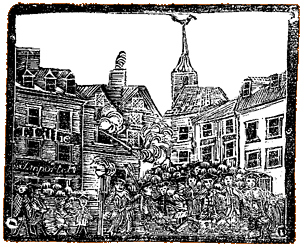
On the morning of 22 February, Christopher was among the boys outside Ebenezer Richardson’s house. It’s not clear how much he participated in the young mob’s attack on that house. Prosecutor Robert Treat Paine took notes that a witness named Jonathan Kenny said, “Syder threw nothing stood looking,” and “I was by Syder 5. minutes. Saw him throw nothing.” But Charles Atkins testified, “Syder was stooping to take up a Stone as I thought.”

Christopher must have been toward the front of the crowd when Richardson pulled his trigger because his torso was hit by eleven lead pellets. In addition, said the Boston Evening-Post, “The right hand of the boy was cruelly torn, whence it seems to have been across his breast.” Christopher fell and was carried into a nearby house.

The Evening-Post reported, “all the surgeons, within call, were assembled and speedily determined the wounds mortal.” Among the doctors we know examined the boy were the radical Dr. Thomas Young, the apothecary Dr. John Loring, and Dr. Joseph Warren, who afterward conducted an autopsy.

In addition, there were “clergyman who prayed with” Christopher. The newspaper praised “the firmness of mind he showed when he first saw his parents, and while he underwent the great distress of bodily pain, and with which he met the king of terrors.”

Christopher Seider died “about nine o’clock that evening.” Some reckonings say he was the first person killed in the American Revolution. He was probably just a few days short of his eleventh birthday.

TOMORROW: The older boy.

Thursday, October 12, 2017

“A Monument over the grave of young SEIDER”?

On 5 Mar 1770, the Boston Gazette reported on the grand funeral for little Christopher Seider, shot by Ebenezer Richardson on 22 February, and added:
We can assure the Publick, that a Monument will be erected over the Grave of young Snider, with an Inscription, to perpetuate his Memory; A Number of patriotic Gentlemen having generously subscrib’d for that Purpose——It is said it will be done in an elegant Simplicity, and that the Overplus Money, if any, will be given to the Parents.
However, over a year later the 21 Mar 1771 Massachusetts Spy ran this item on the same matter:
For the MASSACHUSETTS SPY.
Mr. [Isaiah] THOMAS,

As there was a collection made some time ago by a Gentleman who had a considerable share in the popular transactions of the year past, for the professed purpose of erecting a Monument over the grave of young SEIDER; if the above Gentleman will condescend to inform the Public, why the Money so collected, has not been approproiate to the avowed design, he will oblige a number of your readers, as well as your humble servant,

The TRIFLER.
The Spy had published another item signed “The TRIFLER” on 10 January. It was a snide attack on Jonathan Sewall, identified by his own newspaper pseudonym “Philanthrop.” It said he should be “satisfied with his 600l. sterling per annum, and no longer prostitute his pen.”

That presents a political mystery. The “Gentleman who had a considerable share in the popular transactions of the year past” had to be one of Boston’s Whigs. But Sewall was a friend and vocal supporter of the royal government. Would the same newspaper writer attack both sides?

One possible explanation is that the Trifler supported the Crown but resented how Sewall was hogging two lucrative government appointments: Massachusetts Attorney General and Judge of the Vice Admiralty Court. Several letters and even newspaper reports from that period show how royal officials wanted Sewall to hand over the judgeship to Customs Commissioner John Robinson. (In the end, Sewall clung to both jobs.)

So who was the “Gentleman who had a considerable share in the popular transactions of the year past”?  I think the most likely candidate is William Molineux. He was definitely the Whigs’ leader in street demonstrations. He was close to Madam Grizzell Apthorp, who had employed Christopher Seider as a house servant, and he was on the scene when people arrested Richardson.

Molineux was also in need of money. On 1 May 1771 he was supposed to repay the town of Boston £300 it had loaned him to kickstart a cloth-weaving enterprise that would employ the poor. He never did pay that back. By 1774 Molineux had probably applied money he was supposed to manage for Charles Ward Apthorp of New York to the weaving scheme. So it’s not hard to imagine that the funds collected for a monument to Christopher Seider went into the same hole.

Then again, the first report from 1770 said merely that some gentlemen had “generously subscrib’d” or promised money for a monument. The Trifler may have been wrong to say that funds had actually been collected. After all, in the evening after the Gazette reported on the possibility of a monument, the Boston Massacre took place. Suddenly everyone had something new to focus on and argue about.

Friday, September 09, 2016

Thomas Apthorp’s Whizzer

Speaking of Boston archeology and Joseph M. Bagley (who’ll be speaking at Old South on 13 September), I recently enjoyed looking through his A History of Boston in 50 Objects.

That book highlights fifty artifacts found during digs in greater Boston, ranging from pre-Columbian stone tools to twentieth-century household items.

My favorite object is shown above: a metal “whizzer” inscribed with the name of Thomas Apthorp, found near Faneuil Hall.

This is a child’s toy. A loop of string goes through the holes. By twisting the loop and then pulling it taut, a child can cause the metal disk to spin around and make noise. (Simpler times.)

The archeologists surmised that this whizzer was made by hammering a lead musket ball flat and then clipping its edge all around. I’m intrigued by the question of why it was made so elaborately. Why did someone go to the trouble of customizing this toy, stamping Thomas Apthorp’s name on the metal letter by letter? This is not a silversmith stamping his mark on the bottom of an expensive teapot. Thomas Apthorp wasn’t a toymaker advertising his craft, and he almost certainly didn’t make this whizzer. Rather, it was made for him.

Bagley links this whizzer to Thomas Apthorp, born in 1741 to the wealthy merchant Charles Apthorp (1698-1758). Charles’s wife Grizzell inherited Caribbean sugar plantations, and he had a major transatlantic trading business (including slaves), but his real fortune came from military contracts during the mid-century wars.

Apthorp was a commissary, supplying goods for the British army. Later he handled the money to pay the king’s soldiers in North America, keeping a share of all the specie he transported from Europe. That wasn’t actually coining money, but in terms of steady income it came close.

Apthorp’s status as an important contractor may explain this elaborate whizzer: a smith might have made it for young Thomas as a way to curry favor with his father, or show off his craftsmanship.

Another possible reason for the name-stamping: Charles and Grizzell Apthorp had a large, healthy family. Thomas was their twelfth child and eighth son. There might have been a lot of arguing over toys in the Apthorp home. If a smith stamped each boy’s name on a whizzer, that might have cut down the quarrels about which one belonged to whom, and who had lost his near Faneuil Hall.

Saturday, February 23, 2013

Grizzell Apthorp: Widow, Employer, Property Owner

This is an image of Robert Feke’s portrait of Grizzell Apthorp (1709-1796), made in the late 1740s. The original now belongs to the De Young Museum in San Francisco.

The sitter was born Grizzell Eastwick in Jamaica. Her maternal grandfather was Sir John Lloyd, a baronet. Grizzell’s family moved to Boston in 1716, and ten years later she married Charles Apthorp (1698-1758) at King’s Chapel. They were part of a class of wealthy Anglicans who had a lot of money from Caribbean sugar plantations and slave labor.

Charles Apthorp earned even more money as a merchant and supplier of specie to the British army during the imperial wars of the mid-1700s. As a measure of how rich he became, his junior partner was Thomas Hancock, the rich uncle who left his fortune to John Hancock. In other words, the Apthorps had even more money than the Hancocks. In 1758 the New-Hampshire Gazette called Charles Apthorp “the greatest merchant on this continent.”

Having married in her teens, Grizzell Apthorp had the good health to bear eighteen children, over a dozen surviving to adulthood. Grizzell’s namesake daughter married Barlow Trecothick, who became a London alderman and briefly lord mayor. Her daughter Susan married Dr. Thomas Bulfinch, father of the architect, and her daughter Ann married Nathaniel Wheelwright, a linchpin of Boston finance until 1765.

Charles died in 1758, and his eldest son Charles Ward Apthorp took over most of his business, moving to New York when the army command located there. Another son, Thomas, succeeded his father as paymaster to the British troops. Other sons remained in Boston. East Apthorp was the first minister of Christ Church in Cambridge, but the provincial reaction to him was so hostile that he moved to England; the mansion he commissioned, still called Apthorp House, is now part of Harvard.

After her husband’s death Grizzell was usually called “Madam Apthorp,” the title of respect for a rich widow as opposed to an ordinary one. She was a devout supporter of King’s Chapel. A 1771 letter to Robert Treat Paine shows she was also active in looking after her real estate outside town.

Grizzell Apthorp became connected to the political violence of early 1770 in at least two ways:
  • Young Christopher Seider was “living” at her house when he died on 22 February, meaning that he was working there at least part-time as a domestic servant.
  • She owned the house on King Street that the Customs service rented as an office. The Boston Massacre occurred outside that building on 5 March.
In addition, in 1821 octogenarian Mary Turell recalled that some of the British army officers of the time boarded in another house Madam Apthorp owned.

Though most of her family were Loyalists, Grizzell Apthorp never left Massachusetts and thus never lost her property during the war. She remained in Boston and in the King’s Chapel congregation through the changes of the 1780s, still “Madam Apthorp” to her neighbors. A death notice declared: “So unexceptionable was her deportment in every relation of life, though she remained near a century upon its theatre, and passed through successive empires of beauty and fortune, envy never dared to utter a lisp, or slander to forge a dart against her fame.”