J. L. BELL is a Massachusetts writer who specializes in (among other things) the start of the American Revolution in and around Boston. He is particularly interested in the experiences of children in 1765-75. He has published scholarly papers and popular articles for both children and adults. He was consultant for an episode of History Detectives, and contributed to a display at Minute Man National Historic Park.

Subscribe thru Follow.it


•••••••••••••••••


Showing posts with label Benjamin White. Show all posts

Sunday, November 26, 2023

Summing Up the Evidence on the Marshfield Tea Burning

Last week, inspired by today’s reenactment of the tea burning in Marshfield, I traced all the sources I could find about that event.

I found no contemporaneous or first-person account. The earliest description appeared in an 1854, and more details dribbled out over the next century and beyond, based on either family lore or no stated authority at all.

Hazy as that local tradition is, I nonetheless believe that people in Marshfield did burn tea in the wake of the Boston Tea Party.

The 1854 story echoes what happened in other Massachusetts communities, such as Salem, Lexington, and Newburyport.

First, the community agreed unofficially not to drink or sell tea to show their opposition to the Tea Act (not because the retail price of tea was too high). Local Whig leaders confiscated that form of property from shops and locked it up. Then something spurred younger, more radical Whigs to take the tea and make a show of burning it.

The 1854 report said Nehemiah Thomas confiscated the tea, and contemporaneous documents show he was indeed the town’s senior Whig, clerk, treasurer, and deacon. But that report also said he wasn’t in town for the burning.

Instead, late in the nineteenth century authors attached two brothers-in-law to the story: Jeremiah Low, who would have descendants in Marshfield, and Benjamin White, also documented as a Whig activist in this period. Plus other, unnamed citizens.

In the twentieth century local historians pointed to a very old building as one of the places the tea was stored. That’s plausible; in the 1770s the building was an ordinary, or tavern, and towns did use public houses for public business. That said, there might have been appeal in linking this rare surviving building to a historic event, providing a focus for commemoration. So I’m a little less convinced about that claim.

I’m still left puzzling about some details of this event, however. Here are my unanswered questions.

A. Starting with a history of the White family in 1895, authors describe Marshfield’s Tea Rock as “flat on ye top,” “flatt on ye top,” and “upon a stone quite flat on top”—all of those phrases within quotation marks. That implies they were quoting from a source. But none of those authors explains where those words come from, and a Google Books search turns up nothing. Is there a missing source?

B. In 1929 the Boston Herald said that after setting fire to the tea Jeremiah Low “was later forced to flee to New York with his family.” While not making an explicit connection, that article and local authors who repeated the information implied that the Lows had to leave town because of their Whig activity.

Whoever wrote that article certainly got some information from Low’s descendants. The reporter also wrote that “a fourth generation descendant of Jeremiah” was Seth Low [1850–1916], president of Columbia University and a reform mayor of New York.

However, L. E. Fredman’s article on Mayor Low in the Journal of American Studies in 1972 and online genealogies say the man was descended from a Low family in Ipswich and Salem, not Marshfield.

Furthermore, for most of the decade after 1773 Marshfield was a safe place for Whigs while New York was where Loyalists found refuge. So what was the real basis of this family lore? What had been lost or added?

C. What was the source for Cynthia Hagar Krusell’s statement in Of Tea and Tories (1976) that the Marshfield tea-burning occurred on the night of 19 Dec 1773? Was that just the first Sunday after the Boston Tea Party? If the event occurred when Nehemiah Thomas was out of town on some legislative business, as late-1800s sources suggest, that would have been late 1774 or afterward.

Monday, November 20, 2023

“We have a rock that is a relic of the Revolution”

The wonderfully named Lysander Salmon Richards (1835–1926, shown here) published a two-volume History of Marshfield in 1901 and 1905.

In the first volume he summed up what authors of the previous century had written about how locals had burned tea during the fraught last weeks of 1773:
We do not have in Marshfield an historic rock, like Plymouth Rock, a relic of the Pilgrims, but we have a rock that is a relic of the Revolution. When the Boston Tea Party threw overboard in the Boston Harbor all the tea on the ships in the harbor, the patriots of Marshfield learned there was a large quantity of tea secreted by some authorities in the cellar of a house on the site now occupied by Mr. Seaverns, two or three hundred feet from the street leading from the First Congregational church to the Marshfield station.

The Marshfield patriots, not to be outdone by the Boston tea sinkers, marched to the said house and demanded the tea. Resistance being useless, it was given up and carried to a rock on a hill directly opposite Dr. Stephen Henry’s residence, not far from the First Congregational church, and there heaped upon this huge rock, it was set afire and burned to ashes. This rock (what there is remaining of it) has since been called “Tea Rock.”
In the second volume Richards included a close rewrite of what members of the White family had written about their ancestor ten years before:
Mr. [Benjamin] White was commissioned to collect the tea after it was voted not to drink it. They stored it in the house of Nehemiah Thomas. Saving the tea at that time did not satisfy those earnest, honest whigs, so they took this confiscated article and carried it into a nearby field, where there was a large rock, “flatt on ye top,” pouring it thereon, and then Mr. White and his brother-in-law, Jeremiah Low, (two staunch old whigs,) applied the torch amid rejoicings.
To compare those paragraphs with the passages I quoted yesterday, it looks like Richards didn’t add any facts to the story besides who lived in the houses in his time.

By that point, the landscape of Revolutionary Marshfield had changed—literally. To the dismay of the town’s first chronicler, Marcia A. Thomas, Tea Rock had been blasted into pieces, some of them used for the foundations of nearby houses. That’s why Richards wrote, “what there is remaining of it.” Nehemiah Thomas’s house was also gone.

Some Marshfield residents were determined to keep that story alive, though. In 1916 the town some local women established the Tea Rock Chapter of the Daughters of the American Revolution. On 5 Aug 1929 they unveiled a historic marker on Tea Rock Hill.

The next day’s Boston Herald laid out that generation’s understanding of the historic event:
…the men of Marshfield…in December, 1773, burned tea brought here by the British after the latter had failed to sell it to the public at a high price.

So much of the tea remained unsold that the British stored it in various parts of the village. Then, one night, patriots raided these places, loaded the tea onto an ox cart, hauled it to the top of the elevation known as Tea Rock hill, on which the residence of Elijah Ames now stands, and burned it.

The torch was applied by Jeremiah Lowe, who was later forced to flee to New York with his family. . . . John and Mary Ford, children of Edward Ford of Marshfield, direct descendants of Jeremiah Lowe, assisted in unveiling the tablet, which is affixed to a large granite boulder.

The memorial is inscribed as follows:
“On this hill, in December, 1773, the staunch Whig, Jeremiah Lowe, applied the torch which burned the tea confiscated by the patriots from the public and private stores of the town of Marshfield. Erected by Tea Rock Chapter, D.A.R. of Marshfield, 1929.” . . .

Miss Louise Wardsworth, regent of Tea Rock Chapter, read the history of the burning of the tea, and vocal solos were given by Miss Elsie Sennott.
The story had changed in the quarter-century since Richards’s writing. For some reason, the problem with the tea was that it was too expensive, not that it was taxed. An ox cart made its first appearance in the story, though it would have been a logical assumption before. The tea came from several unstated locations, not just Nehemiah Thomas’s house. Indeed, there was no mention of Thomas or Benjamin White, another documented political leader of the time. Only Jeremiah Low’s name was molded into the tablet.

TOMORROW: Objections and details.

Sunday, November 19, 2023

Bad Day at Tea Rock

As I recounted back in 2016, Marshfield was unusually split in the last years before the war. Some influential men supported the Crown, and some opposed it.

Control of town meetings went back and forth, and the faction that was outvoted in the official meeting would gather and grumble about the results.

One documented leader of the local resistance was Nehemiah Thomas (1712–1782), both treasurer and clerk for the town as well as a deacon at the meetinghouse.

Another was Benjamin White (1725–1783), who sometimes filled in as clerk and would also represent the town in the Massachusetts Provincial Congress.

In late 1773 Marshfield got into a tussle over tea. The official side of that dispute is documented in the record of a town meeting on 31 Jan 1774 that protested the Boston Tea Party, and then a protest against that protest, both published in the Boston newspapers.

However, there appears to have been more direct action in December, not described in writing until decades later.

The first mention of this incident I’ve found was in Marcia A. Thomas’s Memorials of Marshfield (1854):
While [Nehemiah Thomas was] absent, on one of these occasions, the whigs of the vicinity, in the ardor of their patriotism, took from his house, contrary to his intention, a quantity which had been seized by them and deposited there. This was burnt on a rock, near the meetinghouse, with much eclat. This was known afterwards as Tea Rock.
In the 13 Sept 1869 Springfield Republican I found this:
A few rods from the Marshfield post-office is “Tea-rock hill.” During the revolutionary period all the tea was secreted in the entry of one of the colonists. While he was at Boston, attending the Continental Congress [sic], a few ardent whigs, who did not believe in the soothing qualities of tea bearing a British tax, seized and burned it upon the hill’s summit.
L. Vernon Briggs’s History of Shipbuilding on North River (1889) devoted a footnote to the memories of Isaac Thomas (1765–1859), including:
He saw the burning of the obnoxious tea on the height which yet bears its name, and saw the torch touched to the fire fated pile by that devoted Whig, Jeremiah Low.
Thomas and Samuel White’s family history published in 1895 stated:
Benjamin White was one of the committee to collect the tea after it was voted not to use it, and it was stored in Nehemiah Thomas’s house. He did not feel satisfied with this, it looked as if saved for future use. When the Whigs of the vicinity, in the ardor of their patriotism, seized this tea, carrying it into a field near by, where there was a large rock which was “flat on ye top,” poured the tea thereon, when Benjamin White and his brother-in-law, Jeremiah Low, two staunch old Whigs, God bless them! applied the torch with much rejoicing. This was known ever afterwards as “Tea Rock.”
The following year, Caleb A. Wall borrowed much of that language for The Historic Boston Tea Party of December 16, 1773.

TOMORROW: Traditions in the twentieth century.

[The photograph of the marker on Marshfield’s Tea Rock Hill comes from Patrick Browne, who in his Historical Digression blog synthesized the accounts of the town’s tea-burning.]

Tuesday, August 01, 2023

“With respect to the liberation of our friends in Boston”

Last month I left off a discussion of Boston’s first town meetings during the war with the agreement that Bostonians reached with Gen. Thomas Gage.

In exchange for lodging all privately owned firearms with the selectmen, the military authorities promised to let people leave the besieged town with their other goods.

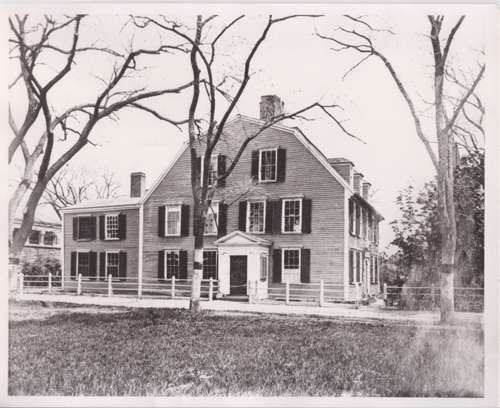
Henderson Inches, a merchant and former selectman who had helped to negotiate that pact, brought news of the general’s approval to the Patriot committee of safety on 28 April. That group, chaired by Dr. Joseph Warren, was headquartered in Jonathan Hastings’s house in Cambridge (shown above).

That committee answered to the Massachusetts Provincial Congress, which was out in the Watertown meetinghouse. Its president, John Hancock, was away at the Second Continental Congress, and other men were serving as president pro tempore. On 24 April that job had fallen on the Rev. John Murray (1742–1793) of Townsend/Boothbay, Maine, who had previously filled in as secretary.

The congress responded to the news out of Boston that afternoon with this resolve:
Ordered, That the committee appointed to introduce the honorable delegates from the convention at Exeter, in New Hampshire, to the committee of safety, apply to said committee for an authentic account of what transactions have certainly taken place, with respect to the liberation of our friends in Boston, and report as soon as may be.
The next morning, the committee reported they had delivered the message and “brought from the committee of safety a number of papers, which contain the proceedings of the town of Boston with general Gage, in respect to moving the inhabitants and their effects.” The committee asked that the larger legislature not take any action until they had come up with a recommendation.

On 29 April, the committee of safety appointed a subcommittee to draft that recommendation. The delegates named were Azor Orne of Marblehead, Richard Devens of Charlestown, and Benjamin White of Brookline—men from two communities neighboring Boston and the province’s second-largest port. Their towns would be among the first to receive refugees.

However, the committee of safety was managing many martial and political efforts, such as reorganizing the militia companies that had turned out on 19 April into an army enlisted till the end of the year and propagating the Patriot version of the fighting so far. Those subcommittee members were handling other tasks. They didn’t produce a quick plan.

The provincial congress in Watertown got antsy. On the morning of 30 April that body sent delegate John Grout of Petersham to ask for the committee of safety’s result. Delegates also discussed “an addition to the committee of safety”—i.e., adding more members so as to spread out the work.

There was still no response from Cambridge after the midday dinner break. The congress then sent John Mosely of Westfield “to procure their result with respect to moving out the inhabitants of Boston” with a letter that demanded a response:
IN PROVINCIAL CONGRESS, April 30, 1775.

SIR— I am directed to inform you, that it is with regret, this Congress find themselves obliged to send to the committee of safety a third messenger, to request their immediate report on the subject of the removal of the poor inhabitants of Boston.

To wait for that report, the Congress have suspended all proceedings on that matter, and sat in almost impatient expectation, by several adjournments, since seven o’clock this morning. I am obliged to request your answer by this express, without loss of time, that the Congress may then see what it is their duty to conclude on.

I have the honor to be, with great respect, Sir,
Your most obedient humble servant,
JOHN MURRAY.
TOMORROW: Resolutions at last.

Tuesday, July 12, 2016

The Mystery of Marshfield’s “many ill disposed people”

I’ve been tracing the political back-and-forth in Marshfield, Massachusetts, often labeled a “Tory town” but more clearly a split town.

When the story left off, the Patriot faction was in the ascendancy. Loyalist leader Nathaniel Ray Thomas had been chased out of Marshfield by crowds from the neighboring communities. As its legislative representative the town had replaced Loyalist Abijah White with a moderate Whig, town clerk and treasurer Nehemiah Thomas. A public meeting had then approved sending him to the extralegal Massachusetts Provincial Congress.

But that wasn’t the end of the seesawing. In January 1775 Abijah White and four other citizens of Marshfield, all also named White, plus five men from neighboring Scituate “In behalf of ourselves and our Associates” wrote to the royal governor, Gen. Thomas Gage:
We the Subscribers Inhabitants of Scituate and Marshfield, being loyall Subjects of his Majesty King George the Third, desireous of Supporting his Crown, & dignity and the Laws of Great Brittain, But being insulted, our persons and property’s threatned by many ill disposed people, who declare their intention of Assembling in great numbers to Attack & destroy us and many others among us who are determined as far as in us lies to Support the Laws of the Realm, and repel by force every unlawfull Attempt to destroy his Majestys good Government over us, Desire we may be Assisted with One Hundred of his Majestys troops to repair to Marshfield as Soon as conveniently may (or such number as may be thought proper) by whose Assistance we will to the Utmost of our power repel and resist any violent or rebellious attempt that may be made against us, or any other of his Majesty’s loyall & peaceable Subjects whom we can protect there are about two Hundred & forty in Marshfield & Scituate who are loyally disposed & who we have good reason to believe will stand forth in Support of his Majestys Government:
That brings us back to the moment when I started this series of posts, the arrival of Capt. Nisbet Balfour and one hundred soldiers, two drummers, four corporals, four sergeants, and three subaltern officers in Marshfield on 23 Jan 1775.

It’s unclear to me whether Nathaniel Ray Thomas was back on his large farm by that time or came back with the troops. In any event, he hosted most of the hundred soldiers while others lived at a nearby tavern belonging to a man the Boston Evening-Post called “Tory White.”

And that tilted the political seesaw once again. As I quoted back here, in February the Loyalists had the numbers to control the town meeting, and they voted official thanks to Gage and Adm. Samuel Graves for providing military support. Sixty-four men left in the minority could do no more than issue a public protest. That’s how the situation remained when the war began.

What were the tensions underlying Marshfield’s split? As of October 1765, the town had appeared united against the Stamp Act, calling it “so terrible a calamity as threatens this Province” and urging its representative to respect the Stamp Act Congress in New York. (Marshfield also condemned “the late riotous proceedings in the town of Boston,” but even Boston was embarrassed about those.) The committee who drew up that anti-Crown message included future Loyalists Abijah White and Nathaniel Ray Thomas as well as future Whig Nehemiah Thomas. So whatever divided the town so deeply and evenly appears to have happened in the next eight years.

Unlike in some other communities I’ve seen, this conflict wasn’t between people whose ancestors had joined the Puritan migration of the early 1600s and other families who had arrived more recently and thus felt a tighter tie to Britain. All the men involved had ancestors among the town’s earliest English settlers.

Nor did this political divide seem to reflect old feuds between families. Certainly family networks were involved in each side’s organizing—as in, for instance, all those Whites asking for troops. But other members of that family were Patriots, such as Benjamin White, who took the responsibility of hiding the town militia company’s gunpowder away from those regulars at his house near the town border.

Likewise, the old Little and Winslow families had politically active members on both sides of the conflict. Nathaniel Ray Thomas and Nehemiah Thomas actually descended from two different early settlers surnamed Thomas, but all the families had intermarried, so it looks very hard to draw lines between them.

Geography played some role in the disagreements. Like a lot of old Massachusetts towns, Marshfield had more than one village by this point, and people living in one spot clamored not to have to go all the way to the old town center for worship, town meetings, and school. A second Congregational meeting had been established in the northern part of town in 1738, called the “Chapel of Ease.”

I mentioned how a proposal to annex part of Scituate, to the west, had become an area of contention between almost evenly matched parties in the early 1770s. Sometime in 1774 the town voted that “one-half of the annual town meeting for the future shall be held & kept at the North meeting house.” In contrast, when Marshfield voted to participate in the Provincial Congress, the body met “at the South meeting house.” And the people who protested the town’s thank-you message to Gen. Gage complained that meeting had been “held in a part of the Town where a Town Meeting was never before had.”

Yet there doesn’t seem to have been one neighborhood where all the Loyalists lived. Crown supporters Nathaniel Ray Thomas and Dr. Isaac Winslow lived in the south part of town, as did Whig Nehemiah Thomas and radical young men like Benjamin White.

The weather may have been a factor in which party won votes at town meetings, especially if that factor was combined with having to travel longer. Generally the pro-Crown party prevailed at meetings held in January through March while the pro-Whig party won votes from June through October. But that might be just an artifact of incomplete records and turbulent years.

TOMORROW: Was the Rev. Ebenezer Thompson a factor in Marshfield’s split?

Friday, April 17, 2015

John Goddard Carts Supplies to Concord

On 24 Febr 1775, the Massachusetts Provincial Congress’s Committee of Safety and Committee on Supplies voted to procure these items and store them in Concord:
1000 candles; 100 hhds. [hogsheads] salt; a suitable supply of wooden spoons; 20 casks of raisins; 20 bushels of oatmeal; 1500 yards Russia linen; also 2 barrels Lisbon oil; 6 casks of Malaga wine, and 9 casks of Lisbon wine, to be lodged at Stow.
The committees had already started to amass other supplies, including some with no other purpose but to wage war. The congress needed someone to move all that stuff around, so on that same day the committees
Voted, unanimously, that Mr. John Goddard, of Brookline, be waggon master for the army, and that Capt. [Benjamin] White inform him of his choice by the province.
Goddard (1730-1816) had been one of Brookline’s three representatives to the first Massachusetts Provincial Congress, convening in October 1774, but for the February session the town had sent only White.

In 1898 the Brookline Historical Society printed John Goddard’s expense book, listing these entries for the beginning of the year 1775:
The Committee for Supplies to John Goddard of Brookline Dr. for his Expense of Time —

March 4th 1775 to one day going to Boston & engaging Team £0.. 5 .. 4
[etc. etc.]

March 8th 1775.
The Committee for Supplies to Sundry Persons under ye Direction of John Goddard Dr. —
To carting fifty five Barrels of Beef from Boston to Concord @5/ Pr Barrel £3..15..0

18th
to carting two Hogsheads of Flints & other articles from Boston to Brookline 0..6..6

20th to carting 74 C:3/4 of Rice from Boston to Concord @1/2d pr C 4..19..8

22. to carting 15 C:1/4 of weights 1..0..2
to carting sheet Lead and three Barrels of Linen 0..8..0

24. To carting 2 casks of Leaden Balls 0..2..8

April 10th 1775. to carting two Ox Cart & two horse cart loads of canteens to Concord £3..6..8
to ye assistance of 3 Men in removing canteens 0..3..0

14th to carting 1 ox cart & 1 horse cart load of Canteens to Concord 1..13..4
In Nathaniel Goddard: A Boston Merchant, 1767-1853 (1906), Henry G. Pickering wrote that on the trips to Concord, “One of these teams was driven by John Goddard himself, and another by his son Joseph, then a lad of fourteen.”

Wednesday, June 15, 2011

“To take immediate Possession of Bunker’s Hill, and Dorchester Neck”

A couple of days ago, I quoted a warning from New Hampshire to Massachusetts about the British army planning to seize the Charlestown and Dorchester peninsulas.

In response to that and other warnings, the Massachusetts Committee of Safety met on 15 June at the house of Harvard steward Jonathan Hastings and came to this conclusion:
Whereas, it appears of Importance to the Safety of this Colony, that possession of the Hill, called Bunker’s Hill, in Charlestown, be securely kept and defended; and also some one hill or hills on Dorchester Neck [i.e., peninsula] be likewise Secured. Therefore, Resolved, Unanimously, that it be recommended to the Council of War, that the abovementioned Bunker’s Hill be maintained, by sufficient force being posted there; and as the particular situation of Dorchester Neck is unknown to this Committee, they advise that the Council of War take and pursue such steps respecting the Same, as to them shall appear to be for the Security of this Colony.
As Charles Martyn interpreted the documentary evidence in his biography of Gen. Artemas Ward, that commander convened his council of war, also in the Hastings house, and decided:
Resolved in Council of War to take immediate Possession of Bunker’s Hill, and Dorchester Neck.
But Gen. John Thomas wasn’t at Ward’s council of war in Cambridge. In fact, I’m not sure whether he was at any of Ward’s councils of war. And Thomas had responsibility for Dorchester and the southern wing of the siege.

So the Committee of Safety sent two members, Joseph Palmer and Benjamin White, to meet with Thomas. And Ward’s council of war sent Gen. Israel Putnam, Col. Joseph Ward (the commander’s secretary), and Col. Samuel Gerrish to relay its resolve. They were all “to consult with the Commanding Officers at Roxbury respecting the expediency of carrying the above Resolutions into Execution.”

Thomas didn’t take the decision of Ward’s council as an order. He evidently convened his own council of war, and they concluded that they didn’t have the resources to hold the Dorchester peninsula against a likely British countermove. As a result, that area remained a no-man’s land until the following March.

Would the siege of Boston have been different if Gen. Thomas’s troops had taken possession of the Dorchester peninsula at the same time that Ward’s wing marched into Charlestown? Well, sure. But different in what way is hard to figure.

Would Gen. Thomas Gage have split his forces to attack both peninsulas, and not been able to capture either? Or would sending men into Dorchester have weakened Thomas’s defenses in Roxbury, opening the door for a British charge down the Boston Neck?

Given the topography of the Dorchester peninsula, would its hills’ defenders have been cut off? (Most of the provincials who went into Charlestown got out.) Would holding the heights of either peninsula have mattered for the New England forces when they had little to no heavy artillery? We’ll never know.

Meanwhile, in Philadelphia, on 15 June 1775, the Continental Congress appointed George Washington as commander-in-chief of the army it had just created on paper.

(Above is Thomas’s headquarters in Roxbury, now known as the Dillaway-Thomas House. The photograph is by Tim Sackton via Flickr through a Creative Commons license.)