J. L. BELL is a Massachusetts writer who specializes in (among other things) the start of the American Revolution in and around Boston. He is particularly interested in the experiences of children in 1765-75. He has published scholarly papers and popular articles for both children and adults. He was consultant for an episode of History Detectives, and contributed to a display at Minute Man National Historic Park.

Subscribe thru Follow.it


•••••••••••••••••


Showing posts with label Charlotte of Mecklenburg-Strelitz. Show all posts

Thursday, October 17, 2024

“Selwyn, whose constant flow of exquisite wit made him generally acceptable”

As described yesterday, on Christmas Eve in 1769 the brothers Patrick and Matthew Kennedy got drunk and stomped around the neighborhood of Westminter Bridge in London, clubbing people.

One of those people died: watchman George Bigby.

Within weeks, the Kennedys were tried, convicted, and sentenced to death. Matthew was about to step on the cart that would take him to the gallows when a reprieve arrived.

The brothers had a sister, Catherine or Kitty, who was one of London’s leading courtesans. (Many discussions of this case amalgamate Kitty Kennedy with another courtesan named Polly Kennedy, née Jones. There are some nice pictures of that woman, but I’m convinced by the historian Horace Bleackley that I shouldn’t use them because they show a different person.)

Kitty Kennedy’s closest gentleman friends were Lord Robert Spencer, brother of the Duke of Marlborough, and the Hon. John St. John, brother of Viscount Bolingbroke. Both men were members of Parliament. St. John, a barrister, actually testified at the brothers’ trial, claiming a prosecution witness had offered not to testify in exchange for £10; by implication, all the witnesses were dubious.

But Kitty had some prominent ex-lovers as well. And even more men who were won over by entreaties from her and her admirers. Among the aristocrats who publicly supported leniency for the Kennedys were the Duke of Manchester, until recently lord of the bedchamber to George III; the Earl of Carlisle; Viscount Palmerston; the Earl of Fife, who was in the British House of Commons because his peerage was Irish; and Sir George Savile, M.P.

But the Kennedy family’s most active champion was George Selwyn (1719–1791, shown above), yet another member of Parliament. Not because Selwyn was enamoured of Kitty Kennedy—he was gay. And not because he was against hanging—Selwyn was notorious for his fetish for watching people die. Rather, Kitty Kennedy’s admirers seem to have convinced Selwyn that her brothers were not the sort of young men who should be hanged.

There was an obvious class prejudice behind the campaign to keep the Kennedys from being executed. They weren’t street thugs, people said; they worked in an auction house, and had a sister who was a social celebrity. And hadn’t Matthew suffered enough in thinking he was about to be hanged?

Of course, other people thought the Kennedys had been drunk, cruel, and violent, and under the law of the day deserved their death sentence, even if only one could have struck the fatal blow.

Horace Walpole was among those who helped push for leniency while reveling in the insider nature of the campaign. For instance, sometime in 1770 Walpole wrote to Selwyn:
After you was gone last night, I heard it whispered about the room that a bad representation had been made at the Queen’s house against the unhappy young man. Do not mention this, as it might do hurt; but try privately, without talking of it, if you cannot get some of the ladies to mention the cruelty of the case; or what do you think of a hint by the German women [i.e., certain ladies in waiting], if you can get at them?
In his memoirs Walpole later described the case this way:
Two Kennedys, young Irishmen, had been charged with, and one of them had been condemned for, the murder of a watchman in a drunken riot. They had a handsome sister, who was kept by two young men of quality.

Out of friendship to them, Mr. George Selwyn had prevailed on six or seven of the jury to make an affidavit that, if some circumstances, which had really been neglected by the counsel for the prisoners, had appeared on the trial, they would not have brought in their verdict murder.

Mr. Selwyn applied for mercy, and the young convict was reprieved; but when the report was made in Council, Lord Mansfield prevailed to have him ordered for execution.

Mr. Selwyn, whose constant flow of exquisite wit made him generally acceptable, applied in person to the King, and represented that Lord Rochford, the Secretary of State, had under his hand assured the pardon; that such an act had always been deemed pardon, and that the prisoner had been made acquainted with it. The King immediately renewed his promise, the criminal was ordered for transportation…
That commutation was made on 17 April. Matthew Kennedy was put on a ship bound for America.

TOMORROW: Shipboard conditions.

Friday, October 11, 2024

Searching for Revolutionary Charlotte

Large tree knocked onto graves in the Settler’s Cemetery in Charlotte, North Carolina, after Hurricane Helene
I was in western North Carolina when Hurriance Helene blew through at the end of September.

Fortunately for me, I was in Charlotte, away from the worst damage by wind and flooding.

After speaking at a convention, I’d planned to spend another day and a half in the Asheville area, just relaxing. Well, that became impossible.

I made new arrangements and saw more of Charlotte. In particular, I checked out the markers along what the city calls its Liberty Walk, obviously inspired by Boston’s Freedom Trail.

Sidewalk marker for the Liberty Walk in Charlotte, North Carolina
Signs, linked by tablets in the sidewalk, mark the locations of long-gone buildings and events. The walk doesn’t pass the sort of historic houses, churches, or civic structures that Boston has preserved. Instead, the city is quite new, with lots of construction and recent skyscrapers styled to recall earlier decades. To be sure, the Settler’s Cemetery, where I took the photo above, dates back to the eighteenth century.

About half of the markers along the Liberty Walk refer to one of two events:
In the battle, the markers say, the militia succeeded in delaying Cornwallis’s advance guard. However, there appears to have been no larger effect of such a delay. The Crown forces took the town, camped there, and left after learning that another part of the army had lost at Kings Mountain.

As for the Mecklenburg Declaration, that’s a myth that only people from North Carolina speak up for. Since it’s referred to on the state flag, though, everyone is brought up believing in it.

The strong historical consensus outside of North Carolina is that a Mecklenburg County convention on 31 May 1775 issued twenty radical resolutions, printed in newspapers that same year. There’s no historical dispute about that event, but it gets only one marker on the trail instead of several.

Imperfect memories of that gathering, tinged by later events, grew into a claim in 1819 that locals had made a full-throated declaration of independence from British government on 20 May 1775. There’s no contemporaneous documentation of that putative event. The reconstructed “Declaration” actually provides evidence that it was composed later.

The Liberty Walk has some other miscellaneous markers, such as one for a soldier of African ancestry named Ishmael Titus. However, I couldn’t find that marker, and the audio tour gave no details about what it called Titus’s “remarkable life” after he was born enslaved in 1759.

I therefore looked up information about Ishmael Titus after getting home. That webpage gives an earlier birth year and states that he lived to be about 112. In later life Titus lived in Savoy and Williamstown, Massachusetts. William Cooper Nell described him in The Colored Patriots of the American Revolution. That passage and an application for a Revolutionary War pension (rejected) are the two big sources on Titus’s life, and they don’t always mesh.

Statue of Queen Charlotte of Great Britain and her two dogs in Charlotte, North Carolina
Most of the stops on the Liberty Walk are just metal or stone signs, such as one reporting that Gen. Nathanael Greene took command of the Continental Army’s southern forces in Charlotte.

But there is a fully modeled, though less than full-sized, statue of Queen Charlotte with two little dogs. A main avenue through the city still bears the name of Gov. William Tryon, who moved on to New York in 1771. So the royal government still has a presence in the “Queen City.”

Also in Charlotte, the university library where I spoke displays N. C. Wyeth’s painting of Patrick Henry bathed in heavenly inspiration.
N. C. Wyeth painting of Patrick Henry orating on display in the library of the University of North Carolina at Charlotte

Sunday, January 23, 2022

Two Attacks on George III’s Coach

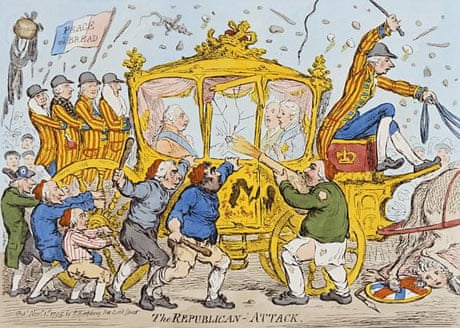
Last week I wrote about George III’s gilded coach, and how some Londoners stoned it in October 1795.

It turns out this wasn’t the first time a crowd had attacked that royal coach. Or was it?

The Georgian Lords Twitter account led me to this passage from the diary of Queen Charlotte on 21 Jan 1794:
To Day the Kg. went to Open the Parliament about 3 a Clock. in going there were two attempts made at throwing a Stone at the Kg. the first broke the Side Glass of the Coach, & the Second was thrown from behind & fell over the Coachmans Head.
You can view the actual diary page here.

On 24 January the Oracle newspaper, also called Bell’s New World, stated:
some daring ruffian threw a stone at his Majesty…which broke the coach window. We have not yet had the pleasure to hear of the villain’s apprehension.
However, the Times of London had reported on 23 January:
Tuesday, as his Majesty was going in state to the House of Peers, one of the halberts of the Yeomen struck against the window of the King’s coach and smashed it. Happily no mischief was occasioned, but the circumstances gave rise to a report of some madman having thrown a stone at the window, which we are happy to contradict.
Was the queen correct in recording an attack on the royal coach? It looks like she wasn’t there, but of course she would have heard from the king. It certainly looks like he was convinced people had attacked him with stones.

And yet a leading establishment newspaper assured the public that the “report” circulating was mistaken, that there was no “madman” or “ruffian” to hunt down—let alone two. Publicizing an assault when there was no way to find the criminal would probably have only made the authorities look ineffectual.

In contrast, the government took quite public action when people threw stones at the king’s coach toward the end of the following year, on 29 Oct 1795. Parliament undertook an immediate investigation. The questioning of witnesses was transcribed and later published. Two men were charged:
  • Edward Collins, “Keeper of an Eating-house,” accused by an eyewitness of throwing a stone at the king, a crime of high treason.
  • Kidd Wake, journeyman printer, heard to shout “No war!” but not seen to throw anything, and thus charged with “a misdemeanor in hissing and hooting the king in a riotous manner.”
The authorities also offered a £1000 reward for information about any other rioters, but it doesn’t look like anyone came forward.

The ministry under William Pitt took advantage of the moment to press two bills, one “for the Safety and Preservation of His Majesty’s Person and Government” and the other “for the More Effectually Preventing Seditious Meetings and Assemblies.” Those laws let the British government crack down on opponents of its war policy.

Kidd Wake went on trial in February 1796, and his fate can be seen in the title of a publication he offered for sixpence in 1801: The Case of Kidd Wake: Being a Narrative of His Sufferings, During Five Years Confinement!!! In Glocester Penitentiary House: for Hooting, Hissing, and Calling Out No War! as His Majesty was Passing in State. Among Wake’s reported sufferings was contracting tapeworms. He died in a wagon accident in 1807.

As for Edward Collins, he was eventually released without trial, but I’ve found no report on that development in the mainstream British news media. It’s tempting to say he had served his purpose for the ministry.