J. L. BELL is a Massachusetts writer who specializes in (among other things) the start of the American Revolution in and around Boston. He is particularly interested in the experiences of children in 1765-75. He has published scholarly papers and popular articles for both children and adults. He was consultant for an episode of History Detectives, and contributed to a display at Minute Man National Historic Park.

Subscribe thru Follow.it


•••••••••••••••••


Showing posts with label slavery/emancipation. Show all posts

Friday, July 17, 2026

A Boston Stone

This month the city of Boston announced a new finding about a stone in the Granary Burying Ground that reads:
HERE LYES Ye.
BODY OF BOSTON
AGED 70 YEARS
DECd. FEBy. Ye. 28
1 7 2 8
Kelly Thomas, director of the Historic Burying Grounds Initiative for the Boston Parks and Recreation Department, told WBZ: “I was reviewing the photos of headstones, and then I noticed that the stone only had one name.” A geographic name, at that. That hinted the person buried there had been an enslaved man.

Some documentary research turned up records of such a man. Indeed, Gloria McCahon Whiting discussed Sebastian’s marriage to Jane Lake at length in her 2024 book, Belonging: An Intimate History of Slavery and Family in Early New England. Judge Samuel Sewall helped to negotiate the terms of that union at the same time he was writing The Selling of Joseph, his pioneering but self-suppressed anti-slavery pamphlet.

On 13 Feb 1701, after protracted discussions between the couple’s two owners, the judge married the couple. Sebastian’s owner, John Waite, died the next year. Six years after that, when the Boston selectmen listed free black men in town they put to work mending roads (since those men were free/barred from militia training), one of those men was identified as “Bastion Waite.”

Interestingly, Sebastian’s wife came to be known as Jane Basteen and then Jane Boston, taking (or being assigned) her husband’s name while he was assigned his late owner’s surname. As Whiting pointed out, Sabastian would name his second son Joseph, echoing Sewall’s pamphlet. Meanwhile, Sebastian’s name evolved into “Boston.”

The issue of the New-England Weekly Journal dated 24 Feb 1729 included this death notice:
On the 14th. Instant [i.e., of this month] died here a Negro Freeman named Boston, in an advanced Age, and on the 17th, was very decently Buried. A long Train follow’d him to the Grave; it’s said about 150 Blacks, and about 50 Whites, several Magistrates, Ministers, Gentlemen, &c.——

He having borne the Character of a sober Virtuous Liver, and of a very trusty honest and faithful Servant to all that employ’d him, and having acquir’d to himself the general Love and Esteem of his Neighbours by a Readiness to do any good Offices in his power for every one; his Funeral was attended with uncommon Respects, and his Death much lamented.
The carved gravestone, whether paid for by Boston’s estate or by his friends, was another sign of his standing in the community. It is, Mayor Michelle Wu now notes, “one of the oldest gravestones of a free Black person in America.”

At first I was confused by the different death dates stated in the newspaper and on the gravestone. But then I realized the stone was written in the Old Style, Julian date system while the newspaper followed New Style, Gregorian dating decades before the British Empire adopted it officially.

Thursday, July 16, 2026

New Signage Installed at the President’s House During the Night

Since September 2025 I’ve been following the dispute over displays at the President’s House, part of Independence National Historical Park in Philadelphia.

Reflecting its overall ideology, the Trump White House ordered the National Park Service to replace signs discussing how that site had been a site of enslavement when George and Martha Washington lived there in the 1790s.

Because the city of Philadelphia had participated in creating the exhibit, it claimed legal standing to sue for the signs to be restored. A district judge agreed. A higher judge stopped the restoration process. Over the last month the full circuit ruled that the federal government could control the site and remake the signage.

Yesterday WHYY reported: “Workers replaced the remaining exhibits overnight Tuesday.”
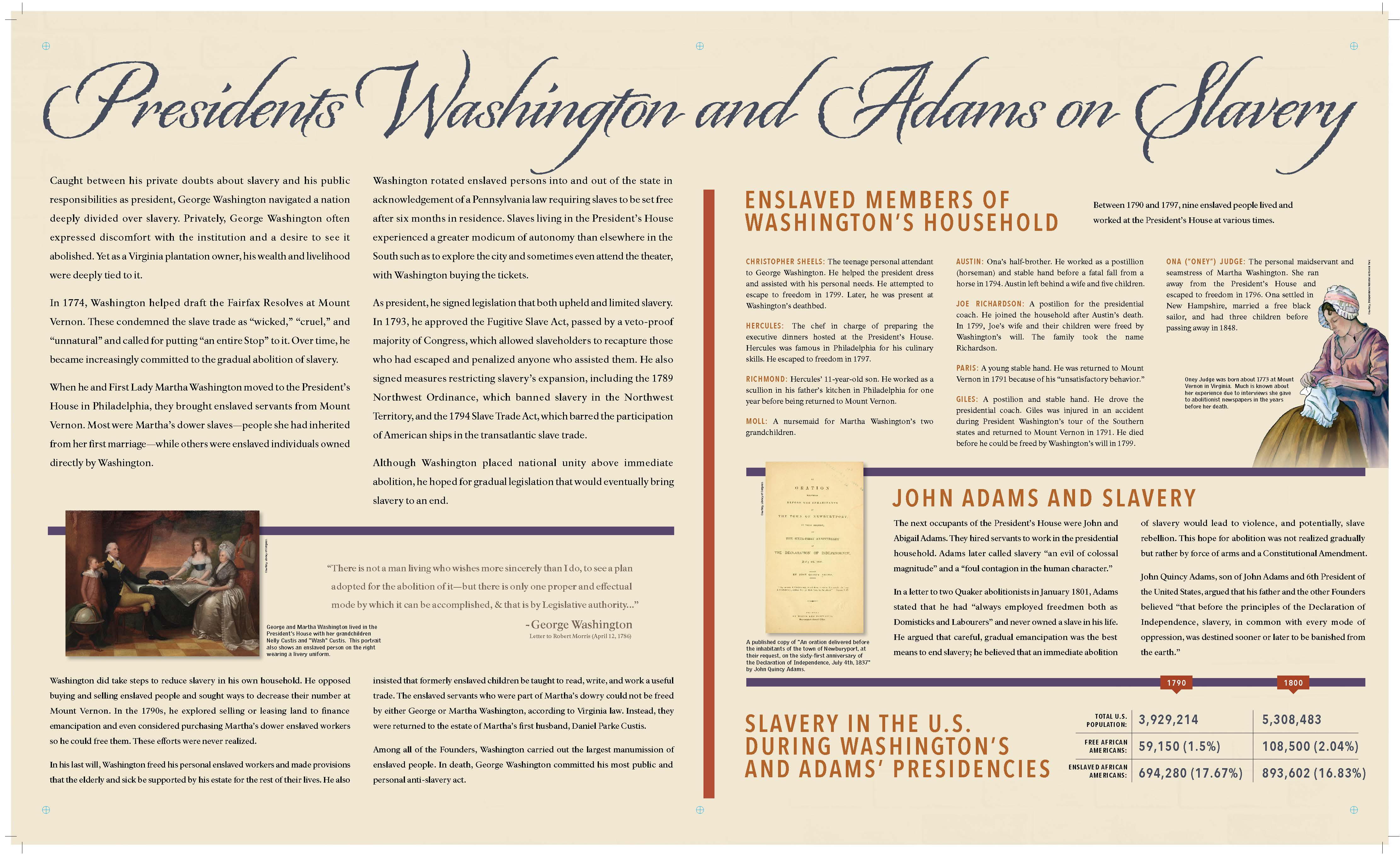
The new exhibit retains references to slavery and those enslaved by Washington while serving as president in Philadelphia, but it devotes significantly more space to the history of the executive mansion and the early presidency. A panel that had been titled “The Dirty Business of Slavery,” for example, has now been replaced by signage that reads, “Celebrating Independence Throughout the Years.”

It also softens Washington’s views on slavery compared to the previous display.

“In 1774, Washington helped draft the Fairfax Resolves at Mount Vernon,” one panel reads. “These condemned the slave trade as ‘wicked,’ ‘cruel,’ and ‘unnatural’ and called for putting ‘an entire Stop’ to it. Over time, he became increasingly committed to the gradual abolition of slavery.” . . .

on Wednesday, several armed members of the National Park Service Police were seen vigilantly watching over the site.

Park service officials stopped one activist, Dr. Sandra Shachar-Krasnoff of Philadelphia, after she briefly taped a piece of paper with “the excavation revealed a kitchen and a slave quarters below the president’s house site” to one of the walls.

She was fined $310.
The photo above, taken by Abraham Gutman for the Philadelphia Inquirer, shows a federal officer writing a citation for Dr. Shachar-Krasnoff. The Inquirer also reported that the N.P.S. installed security cameras at the outdoor site last week, ostensibly because the All-Star Game was about to be played in the city. So there’s no doubt the government will surveil the walls more tightly.

The park website displays eleven large new panels, but the Inquirer states there are also “more than a dozen smaller panels that detail governmental processes, the lives of various historical figures, and a panel dedicated to the escape of Ona Judge and Hercules [Posey], two people enslaved by Washington who fled to freedom.”

All told, says the Inquirer, “the new exhibits mostly offer a broad timeline of U.S. history that significantly strays from the original intent of the President’s House as outlined in the park’s foundation document in 2017: ‘It would explore the historic context of the site in the context of its ties to slavery and the lives of the enslaved who lived at the site.’”

There’s already an effort to have Philadelphia erect a historic marker about Hercules Posey outside of federal control, like one already up for Ona Judge.

Monday, July 13, 2026

“Headquarters of a Revolution” in Cambridge, 19 July

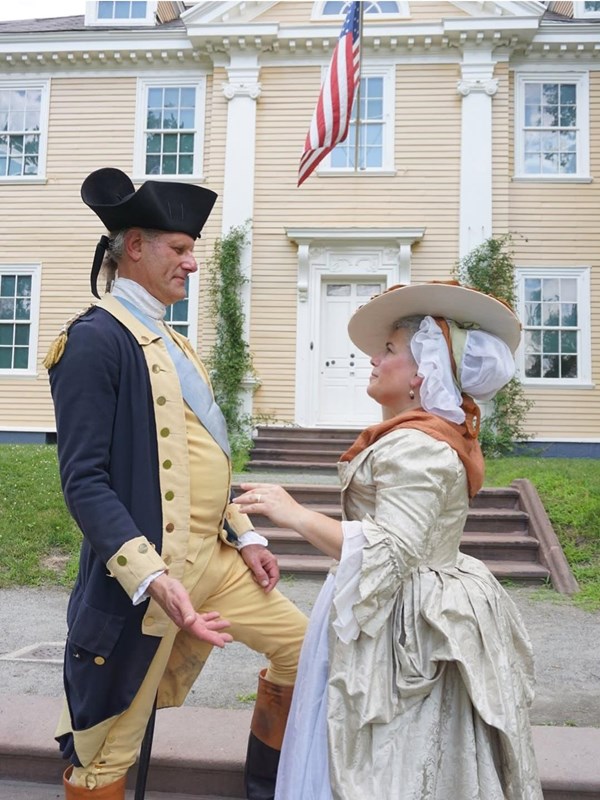
On Sunday, 19 July, the Longfellow House–Washington’s Headquarters National Historic Site in Cambridge will host a commemoration called “Headquarters of a Revolution: Washington’s Arrival in Cambridge,” coinciding with the 251st anniversary of the new commander-in-chief’s first week living in that mansion.

Here are the events scheduled for that day, including two from me.

10 A.M. to 3 P.M.
Living History
On the Lawn

Interact with living historians John Koopman (as George Washington) and Sandy Spector (as Martha Washington), including a noontime Q&A with Mrs. Washington. Free family activities and a story walk available all day.

10 and 11:30 A.M., 2:30 P.M.
House Tour: Headquarters of a Revolution
Starting in the Visitor Center

General George Washington’s Cambridge headquarters was a testing ground for many of the ideals, institutions, and questions that still define our nation. This conversational tour with an N.P.S. ranger explores Cambridge Headquarters as a hub of revolutionary activity, where generals, enslaved people, paid laborers, poets, Indigenous diplomats, politicians, and soldiers shaped history—and how later generations would shape its memory.

10:15 A.M.
Get Ready with Martha
Carriage House

Learn all about the clothing of 1775 as Mrs. Washington finishes dressing for her day. There will be some stories and some gossip, too! Sandy Spector is a Boston-based historian, researcher, and interpreter, and has been a Revolutionary War reenactor since 2000. She spends most of her time researching and interpreting Mrs. Washington and has been portraying Martha—alone or with George—in numerous states and venues for the past 10 years.

11:30 A.M. to 12:15 P.M.
The Last British Army to Come Through Cambridge
Carriage House

In November 1777, nearly 6,000 soldiers of the king arrived in Cambridge. With them came about a thousand women and children. These weren’t invaders but prisoners of war, British and German, captured at Saratoga. Top officers were housed in mansions along “Tory Row” while enlisted men went into the leftover barracks on Prospect and Winter Hills. Over the next few months Cambridge, Charlestown, and neighboring towns had to adjust to a new population under guard. J. L. Bell explores what we should remember about this “Convention Army” as we approach the 250th anniversary of its arrival.

12:30 to 1:15 P.M.
“Though Dwelling in a Land of Freedom”
Carriage House

Join poet, educator, and Darby Vassall descendant Denise Washington for an exploration of Revolutionary-era freedom struggles surrounding Washington’s Headquarters through the lens of Anthony, Cuba, and Darby Vassall, as well as Phillis Wheatley Peters.

1:30 to 3 P.M.
The Black Patriots of Lexington – Silas Burdoo
Carriage House

This film explores the role that third-generation Lexington resident Silas Burdoo played in the Revolutionary War, starting with the battle on 19 Apr 1775. Burdoo was a grandson of Ann and Philip Burdoo, who married in Medford in 1704 and then purchased 40 acres in Cambridge Farms, which became Lexington. This film screening will be followed by a discussion with Zine Magubane, professor of historical sociology at Boston College, and Sean D. Osborne, producer of the Black Patriots of Lexington YouTube series.

3 P.M.
What Washington Saw on Cambridge Common
Walking Tour starting at the gate at the southern tip of the common

What did the center of Cambridge look like in July 1775? Since April, the town had been the base of the New England army besieging Boston, with war transforming the community. On this walking tour J. L. Bell looks at sites in and around the common, including the first headquarters, buildings turned into barracks, and the Continental artillery’s lost laboratory. How well do the Washington Elm and the Revolutionary monuments that dot the common memorialize the men who were actually there?

All of these events are free, as organized by the National Park Service.

Saturday, July 11, 2026

New Dramas at Old Places in Newport, Deerfield, and East Granby

This is a very busy summer for Plays in Place, which works with historic sites to create new plays built on their past, informed by their archives, and designed for their spaces.

At the Hunter House in Newport, Rhode Island, Newport Mansions presents Loyalty or Liberty, a trio of short plays set between 1778 and 1781 as control of that port changed hands.

“Dinah” by Ken Green follows an enslaved woman in a Loyalist household whose husband plans to enlist in the Continental Army, seeking freedom for the family. “For Love and Glory” by Patrick Gabridge dramatizes the conference between Axel von Fersen, aide-de-camp to Gen. Rochambeau, and Adm. de Barras, who has to be convinced to sail his fleet to Yorktown. “Where We Once” by Lily Mathews picks up the story of Dinah’s enslaver, Sarah Wanton, as she faces life in an independent republic. These plays are directed by Rachel Walshe and produced by Jessica Chace.

Loyalty or Liberty will run Tuesday and Saturday evenings through 1 September. Normally the plays will be staged outdoors, overlooking Narragansett Bay, but in bad weather the production will move into the Guild Hall at St. John’s Church. Buy tickets here.

Historic Deerfield is hosting A Stake in the Ground: 1774, three short plays about conflicts in that Loyalist-leaning town as Massachusetts slid out of royal control.

In the summer of 1774, Patriots brought a Liberty Pole into Deerfield. “The Liberty Lark” by Talya Kingston, “Jinny and Cato” by Valyn Lyric Turner, and “Sparks on Dry Tinder” by Patrick Gabridge explore the political divisions, tangled family relations, and complexities of enslavement stirred up by that political act and the protest against it. These dramas are directed by Brianna Sloane and produced by Talya Kingston.

Performances will take place on Friday and Saturday evenings and Sunday afternoons through 16 August. A Stake in the Ground will be staged outside, with the audience walking to each location and sitting on folding chairs. On 31 July–2 August, and in very bad weather, the same plays will be performed inside the Deerfield Community Center for a more traditional and accessible theatrical experience. Tickets available here.

At the Old New-Gate Prison & Copper Mine in East Granby, Connecticut, visitors can take in The Slippery Truth: Prisonbreak at New Gate by Patrick Gabridge, directed by Zoë Golub-Sass and produced by Nicole Young-Martin.

On 18 May 1781, a group of captive Loyalists rushed up a 35-foot ladder and overpowered their guards, killing one man before escaping into the night. Was this brave resistance by political prisoners or a desperate blow by criminals? Did they have inside help? Prison trustee John Forward interrogates guards and recaptured prisoners to find the truth.

The Slippery Truth will be produced indoors—to be precise, inside the mine. The audience will enter via 33 steps and a 100-yard loop starting at 35 feet below ground and descending to 75 feet below. The shortest tunnel is 4 feet. The mine is always 52 degrees and wet. Strollers, wheelchairs, walkers, and similar devices are not permitted, and visitors should consider their medical history and physical limitations before attending.

Performances will happen on Friday, Saturday, and Sunday evenings through 30 August. Tickets at this page.

Thursday, July 02, 2026

“Jefferson proposed to me to make the draught”

At last we come to John Adams’s dramatic description of how he—and he alone—convinced Thomas Jefferson to draft the Declaration of Independence, in his August 1822 letter to Timothy Pickering.
You enquire why so young a man as Jefferson was placed at the head of the Committee for preparing a declaration of Independence? I answer, it was the Frankfort advice, to place Virginia at the head of everything.

Mr: Richard Henry Lee, might be gone to Virginia, to his sick family, for aught I know, but that was not the reason of Mr: Jefferson’s appointment. There were three Committees appointed at the same time. One for the declaration of Independence; another for preparing Articles of Confederation; and another for preparing a Treaty to be proposed to France. Mr Lee was chosen for the Committee of confederation, and it was not thought convenient that the same person should be upon both.
In fact, Lee wasn’t named to any of those three committees. Roger Sherman and Robert R. Livingston were placed on the Declaration committee on 11 June and the Articles committee on 12 June.
Mr Jefferson came into Congress in June 1775. and brought with him a reputation for literature, science, and a happy talent at composition. Writings of his were handed about remarkable for the peculiar felicity of expression. Though a silent member in Congress, he was so prompt, frank, explicit and decisive upon Committees, not even Saml Adams was more so, that he soon seized upon my heart, and upon this occasion I gave him my vote and did all in my power to procure the votes of others. I think he had one more vote than any other, and that placed him at the head of the Committee. I had the next highest number and that placed me the second.

The Committee met, discussed the subject, and then appointed Mr: Jefferson & me to make the draught; I suppose, because we were the two highest on the list.

The Sub-Committee met; Jefferson proposed to me to make the draught.

I said I will not; You shall do it.

Oh No!

Why will you not?

You ought to do it.

I will not.

Why?

Reasons enough.

What can be your reasons?

Reason 1st. You are a Virginian, and Virginia ought to appear at the head of this business. Reason 2d. I am obnoxious, suspected and unpopular; You are very much otherwise. Reason 3d: You can write ten times better than I can.

“Well,” said Jefferson, “if you are decided I will do as well as I can.”

Very well, when you have drawn it up we will have a meeting.

A meeting we accordingly had and conn’d the paper over. I was delighted with its high tone, and the flights of Oratory with which it abounded, especially that concerning Negro Slavery, which though I knew his Southern Bretheren would never suffer to pass in Congress, I certainly never would oppose.

There were other expressions, which I would not have inserted if I had drawn it up; particularly that which called the King a Tyrant. I thought this too personal, for I never believed George to be a tyrant in disposition and in nature; I always believed him to be deceived by his Courtiers on both sides the Atlantic, and in his Official capacity only, Cruel.

I thought the expression too passionate and too much like scolding for so grave and solemn a document; but as [Benjamin] Franklin and Sherman were to inspect it afterwards, I thought it would not become me to strike it out. I consented to report it and do not now remember that I made or suggested a single alteration.

We reported it to the Committee of Five. It was read and I do not remember that Franklin or Sherman criticized any thing. We were all in haste; Congress was impatient and the Instrument was reported, as I believe in Jefferson’s hand writing as he first drew it.
Adams made a copy of Jefferson’s draft before it was complete, and Jefferson kept another draft with marks on it. The latter shows that Franklin did make substantive contributions.

On Independence Day in 1823, Pickering quoted liberally from Adams’s letter in an oration, which he then published.

TOMORROW: What did Jefferson think of that?

Thursday, June 25, 2026

“From which patterns of everyday life and social change would emerge”

Back in April the Concord Bridge published a nice retrospective profile of Robert Gross, author of The Minutemen and Their World.

Published in 1976 and recently updated, that book has proved the most lasting of the New England community studies that came out in the middle of the twentieth century.

No doubt Minutemen gets a boost from its connection to the nation’s origin story, but it’s a really good book that offers both an early example of computer-aided data analysis and interesting new ideas about how generations interact.

Plus individual stories, as the article says:
Gross wanted to write about “men, women, free and slave, native and newcomer, patriot, neutral, and loyalist” — all of those who had been excluded from conventional accounts — recovering their voices. His approach would reflect his interest in social history, a method that was growing in popularity. It involved tapping overlooked sources such as tax lists, censuses, vital records, genealogies, and town meeting minutes, from which patterns of everyday life and social change would emerge, he says.

Among those who people “Minutemen” is John Jack, an enslaved man who worked for a cobbler, bought his freedom, built a cabin in Great Meadows, and paid his taxes, but was never allowed to vote. At the time of Jack’s death, he owned eight acres, a pair of oxen, and seven barrels of cider. “His was a marginal place in the community, but it was nonetheless a real place,” Gross writes.

And there is Lucy Barnes Hosmer, daughter of a prosperous farmer and town clerk. When Joseph Hosmer, a cabinet maker, asked for permission to marry 16-year-old Lucy, her father refused, wanting her to wed someone wealthy and important.

Though a father could not dictate his daughter’s choice of spouse, he could try to arrange unions and pressure her to agree, Gross says. Lucy rebelled, denying her father’s choice of a cousin for her, and acted on her own. When she married Hosmer at 19, she was two months pregnant.
Highlighting people like that reflects the appeal of such human detail in a study of a society, a balance that The Minutemen and Their World achieved.

Monday, June 08, 2026

“Washington and slavery have always been particularly instructive”

At Commonplace, Karin Wulf of the John Carter Brown Library interviewed John Garrison Marks about his new book, Thy Will Be Done: George Washington’s Legacy of Slavery and the Fight for American Memory.

Wulf started with an introduction reiterating that talking about the Washingtons’ slaveholding is far from new in American culture:
As anyone reading this will likely know, and as John Marks notes below, a remarkable volume of important research detailing George Washington’s (and Martha Dandridge Custis Washington’s, and their family’s) investment in slavery has been published over the last two decades. In conjunction with critical work on other “founders,” namely Thomas Jefferson, this work has helped usher in a shift in public perspective that has been greeted with angst by those who either didn’t know or don’t want to know about the foundational role of slavery at the founding, but also by relief among the many who did and do.

This book is different. It takes up the question of how this very specific issue about the first president—his role as an enslaver—was debated over centuries. In other words, this was not a phenomenon that leapt upon a settled historical narrative unbidden from the culture wars or the specific spate of racial violence that called forth the Black Lives Matter movement. For me, there was another dimension.

As soon as I heard about John’s project some time ago, I was intrigued in part because at one point I checked out a number of copies of Washington’s will printed in the 19th and 20th centuries. Why, I wondered, were so many people keen to have to hand a copy of what Washington willed? In part it has to do with the vexed issue of manumission. John shows, in this book that helps us to see historical memory in motion, Washington and slavery have always been particularly instructive.
In the interview, Marks noted three ways Americans have discussed George Washington’s connection to slavery. Some complain about exploitation and hypocrisy, some insist on reverence for the other things he did, and some argue we should focus on how he moved away from slavery over his lifetime. “What was really fascinating in researching the book was how early and consistently all three of these perspectives appeared in the record,” Marks added, finding examples of each approach in the period of his death.

Sunday, June 07, 2026

A New Fight at Bunker Hill

With the anniversary of the Battle of Bunker Hill coming up on 17 June, the central office of the National Park Service has ordered Boston National Historical Park to remove much of a display of quotations of Americans commenting on the battle in the context of their times.

This incident began with the Trump administration ordering parks to post Q.R. codes to collect feedback from visitors in a new channel. This was clearly an attempt to trawl for political objections, but I heard that most of the comments were positive.

As reported by the Washington Post, “A visitor at the [Bunker Hill] site complained to park staff about a quote related to women’s suffrage as being ‘woke’ feminist ideology, the people familiar said, and the visitor later sent an email complaint.”

There appear to be two quotations on display that address the situation of American women in the late 1800s:
“The battle is celebrated for the justice of the cause, which, because it was just, was triumphant. The woman sufferance battle is like that of Bunker Hill—not won today, but sure to be later. Meantime, Bunker Hill Monument is our monument.”
—Lucy Stone, The Woman’s Journal, 22 June 1889

“Once, as we were passing by in the train, we saw the lofty shaft on Bunker Hill outlined against the sunset glow. [Lucy Stone] spoke eloquently of all it commemorates, and said in substance: ‘We are still battling for the principle it stands for. My spirit kindles whenever I see that monument. It is our monument.‘”
—Florence M. Adkinson, The Woman’s Journal, 1893
Stone’s claim on the monument probably derived from how women had been crucial to raising the funds to complete it in the early 1800s.

One might think that American women having the right to vote is no longer the sort of “corrosive ideology” that Trump’s appointees claim to oppose in federal historic sites and museums. They could read the U.S. Constitution and find it’s been part of our electoral system for over a century now.

Nevertheless, that visitor’s complaint cued “a wider review of material at the site.” N.P.S. officials in Washington ordered the removal of three quotations—though, ironically, not any about women.

The quotations in jeopardy are likewise all over fifty years old:
“As we drew near to Boston, there stood Bunker Hill Monument, towering up towards the heavens, as if in silent, bitter mockery of the millions of slaves guarded by the professed lovers of Liberty, who reared its lofty column.”
—G. F. Stebbins to William Lloyd Garrison, published in The Liberator, 22 May 1846

“Now that a public orator has declared that foreign-born men have no association with the men of the Revolution, it is our duty to show that in love of freedom and loyalty to the republic, the citizens of foreign birth take no second place…”
—“To Our Irish Societies,” The Pilot (published by Boston’s Roman Catholic archdiocese), 8 May 1875

“We find, upon reflection, that our duty to our country has not ended... We as Vietnam Veterans, strongly feel that the United States should cease to build memorials to death and begin to glorify life.”
—Arthur Johnson and Bestor Cram, Vietnam Veterans Against the War, published in the Boston Globe, 23 May 1971
Again, it’s hard to see what’s “corrosive” about supporting emancipation, immigrants showing loyalty to their new country, and life itself. But this is an administration now focused on observing the President’s birthday with gladiatorial games next to the ruins of the East Wing. They think in strange ways.

Wednesday, May 27, 2026

Uncovering Boston Jersey

Earlier this month the Guardian reported on how researchers had unearthed new information about a figure in this portrait.
For hundreds of years, he was known only as “Jersey”, an enslaved boy of about 11 rendered in oil on canvas by the great 18th-century portrait painter Sir Joshua Reynolds. . . .

The painting, thought to have been completed around 1748, shows the boy and his “master”, the naval officer and MP Paul Henry Ourry. While Ourry looks out into the distance authoritatively, the enslaved child gazes up at the officer tentatively. . . .

Scouring admiralty records, letters, muster books (ships’ registers) and captains’ logs, [Mark] Brayshay and Katherine Gazzard, a curator at Royal Museums Greenwich, found him named as “Boston Jersey” on ships that Ourry was attached to.

They believe he may have been given the surname Jersey because Ourry was born in the Channel Islands. It is possible he had his first name because he once lived in Boston, Massachusetts.

The researchers discovered Jersey was baptised as George Walker (possibly a name he had been known by earlier in his life) on 30 July 1752, probably in a chapel in Westminster.
The article has a little more to say about George Walker and much more about the restoration of the painting.

This discovery led to the quick creation of a Wikipedia page about Boston Jersey/George Walker.

Friday, May 08, 2026

“The only ‘emancipation’ relevant to this site was Ona Judge’s own”

On 21 April, the Philadelphia Inquirer shared an opinion piece about the President’s House exhibit by Sharon Ann Holt, a public historian recently retired from Penn State Abington.

Holt was previously director of education and interpretation at the Historical Society of Pennsylvania and director at the Sandy Spring Museum in Maryland. She’s the author of Freedom Pay: North Carolina Freedpeople Working for Themselves, 1865–1900.

The web headline for Holt’s essay is “We can’t give in to the Trump administration’s attempts to make the history of slavery invisible in Philadelphia.” I don’t know if it appeared in the newspaper’s print edition, and the webpage now behind a paywall unless one has a guest link. So here’s an extended extract:
The digital images posted on the Park Service’s website make it clear that, under Donald Trump, the first priority of the Park Service seems to be to make enslaved people and slavery itself as invisible as possible. Panels that discussed the lives of urban enslaved people, Philadelphia’s free Black community, the Washingtons’ enslaved “family,” fugitives from enslavement (and the laws Washington signed to reclaim them) have all disappeared. The rich biographies of Christopher Sheels, Hercules, Richmond, Austin, Giles, Ona Judge, Joe Richardson, Moll, and Paris have shrunk to single sentences. . . .

So what stories are they telling? George and Martha’s determination to flout Pennsylvania’s six-month limit on holding people in slavery is reframed as a lovely gift of theatre tickets rather than their cynical move to get enslaved people across the river to New Jersey, thus restarting the six-month residential countdown. I’m surprised the Park Service left out the Washingtons’ “kind” willingness to let enslaved workers visit their families left behind in Virginia, which worked the same trick.

If Park Service bureaucrats value relevance, I challenge them to explain the transformation of the story about 18th-century slavery at the President’s House into a puzzling evocation of the Emancipation Proclamation of the 19th century and the Civil Rights Movement of the 20th century. Is it that, to them, all stories having to do with African Americans belong in the same place? They must think so, because they have randomly added completely irrelevant references to Frederick Douglass, the Civil War, the Rev. Dr. Martin Luther King Jr., the Underground Railroad, and Abraham Lincoln to the history of the President’s House.

Worse, the Park Service has embraced sentimental claims that Washington, Thomas Jefferson, and James Madison all “had their doubts” about slavery from the beginning.

None of those “doubts” persuaded the Founders to end slavery when they could have, either in our founding documents or in their own personal lives. None of the 19th- and 20th-century stories that the Park Service has shoehorned into their new panels ever involved the President’s House at all. The only “emancipation” relevant to this site was Ona Judge’s own self-liberation — the very story the Park Service has all but erased.

Speaking of irrelevance, the opening panels are even more laughable. Park Service interpreters have decided to feature discussions of the 1876 Centennial, the 1926 Sesquicentennial, and the 1976 Bicentennial, all of which happened long after the President’s House had been remodeled into oblivion or entirely demolished. . . .

If the judges choose these new panels to replace the ones taken down earlier this year, they will disparage millions of Americans who have struggled since 1776 to improve on the shaky foundations the founders laid. The President’s House should honor those struggles, alongside the nine people enslaved there by George and Martha Washington.
While Holt directs her critique at the National Park Service, which produced this revised signage, it’s clear that agency was working under directives from the White House. Based on what sort of historical presentations the White House has produced on its own, N.P.S. historians undoubtedly worked hard to drag this material into the realm of historical fact, even if it’s far from complete and relevant.

Thursday, May 07, 2026

A Closeup Look at the President’s House in Philadelphia

I’ve been following the story of the President’s House site within Independence National Historical Park.

That structure marks the residence of George Washington and John Adams before the District of Columbia was built and also memorializes the people enslaved to the Washingtons who lived and worked there.

In September, we first learned that White House policy was putting pressure on the park to change the signage on that site. In January, the signs were taken down.

In February, after the city of Philadelphia filed a lawsuit, a judge ordered the signs be put back up. But then a higher judge halted that process while also requiring those signs already restored to remain. The U.S. Circuit Court has upheld that stasis.

Last month I traveled to Philadelphia for the Pursuit of History’s weekend examining the creation of the Declaration of Independence. One morning I walked through the President’s House.

Most of the frames for signs are empty; the few panels that have been restored appear to be almost random. In some of the blank spaces people had posted small images of the missing signs. While I was there, a local taped a large sheet of paper in another space along with two markers, inviting people to share their own thoughts on the controversy. I presume those unofficial displays are taken down each evening and replaced each day.

In April the National Park Service unveiled new draft signage, created (by people unknown) to please the White House. Those panels now appear on the webpage for the President’s House Site. WHYY reported:
The new panels include references to slavery, the Underground Railroad and figures like Frederick Douglass. Like the previous panels, they also make mention of the nine enslaved people held by Washington while he was president and living in Philadelphia.

However, they would have changed the overall tone of the site, softening and significantly reducing references to slavery, and shifting the focus toward the “anti-slavery sentiments” of the slave-owning Founding Fathers. For example, text on one notes that the U.S. Constitution did not contain the word “slavery,” and another one argues that Washington had “doubts” about the institution.
Local critics called that revision “whitewashing” and “maliciously outrageous.”

TOMORROW: A historian’s take.

Saturday, April 11, 2026

“Itt’s said she has a large quantity of the Stolen goods”

It didn’t take long for New England Patriots to realize that Cdre. John Manley’s capture of the Elizabeth on 2 April 1776 was a big deal.

On 6 April, Isaac Smith, Sr. (1719–1787, shown here courtesy of the Yale University Art Gallery), wrote to his niece Abigail’s husband, John Adams, from Salem:
Commodore Manleys fleet has taken a brigantine bound to Halifax on board of which is Bill Jackson and all his Effects and itt’s said she has a large quantity of the Stolen goods—

and there is on board likewise One Greenbrush, receiver general of the stolen goods and has distinguisht himself in that way by demanding People’s propaty from them. Itts said he came from York and itts said those Carpenters and runagarders from that way has behaved worse than any Others.—

A sloop is on shore at the Cape, beleive nothing very Valuable on board but itt Appears they (the inhabitants) went away in a most dismal Cituation, not haveing even Water sufficient and crowded and some sick with the small pox.
That sloop was the Sally, commissioned by Jolley Allen and captained by no one who knew what he was doing, as described back here.

As a merchant in Boston before the siege, Isaac Smith knew William Jackson and his troubles well. But Smith wasn’t familiar with Crean Brush, who had arrived from New York after the siege began—hence his reference to the man as “One Greenbrush.”

John Rowe was all too familiar with Brush, having watched that royal appointee confiscate some of his property. On 8 April he wrote in his diary with surprising calm:
Capt. Manly is come to Town & brings the Accot. of his Taking Crian Brush Wm. Jackson & Twenty other passengers in A Brigg bound with The Fleet—

This Vessell tis Said has Twenty five Thousand pound Sterling On board—in English Goods & Other Merchandise—

among the Prisoners is A Sergiant & 12 Men of the Kings Troops
On 8 April Rowe added:
There is a Confirmation of Crean Brush & Wm. Jackson being taken & also My Negro Fellow Adam
Adam was one of the four enslaved people found aboard the Elizabeth. Remarkably, this is the only time in his published diary that Rowe mentioned the man. We therefore have no clue about how he came to be on the brig. Had Adam asked to evacuate the town, or had Rowe sent him away?

TOMORROW: Following the money.

Friday, April 03, 2026

All Aboard the Elizabeth

When Cdre. John Manley captured the brigantine Elizabeth, evacuating from Boston, in April 1776, he saw that he’d hooked an important—and potentially lucrative—prize.

Manley sent some of the people aboard that ship to Gloucester on the Lee under Capt. Daniel Waters. He kept the rest on the Elizabeth and escorted that ship to Portsmouth, New Hampshire.  

That harbor was appropriate since it was the Elizabeth’s home port. Back in October 1775 H.M.S. George had captured that brig on its way back from Montserrat. The local merchant Richard Hart (c.1744–1820) was glad to see his ship return.

The Elizabeth was still carrying the seventeen hogsheads of rum and four hogsheads of sugar that it had picked up in the West Indies. And it was loaded with other cargo. There were household and mercantile goods that passengers were taking with them from Boston and, most valuably, a large quantity of linen and woolen cloth.

Sadly, the property on board the ship also included four enslaved people, listed in a public document a couple of months later as:
A negro man named Adam, John Rowe, Esq owner.
A negro man named Scip, Harrison Gray Esq: owner.
A negro woman named Belinder, Benjamin Austin Esq: owner.
A negro woman named Brada, a widow Kitpath, owner.
Rowe, Gray, and Austin were all rich Boston merchants, but they were in different political situations. Gray, also royal treasurer of Massachusetts, had left with the fleet. Austin was on the Patriot side. And Rowe was trying to find his usual place in the middle, having stayed in Boston through the siege but then stayed in town after the siege as well. (I can’t identify the widow.)

The Elizabeth was also carrying “a Serjeant & twelve privates of the 4th or Kings own Regiment,” who were now prisoners of war. At least some of those soldiers had wives and children with them.

In all, there were forty-six civilians on board the Elizabeth, including the ship’s captain, Peter Ramsey, and the crew. The most prominent of the Loyalist passengers were:
And Brush had made himself notorious inside besieged Boston.

TOMORROW: Where those woolens came from.

Saturday, February 21, 2026

An Update from the President’s House in Philadelphia

Last month I noted the news reports that White House policy had pushed the National Park Service into removing signage in Independence National Historical Park which discussed people enslaved there in the 1790s.

Earlier this week the signs were restored under a court order while a lawsuit over them proceeds. The Trump administration is appealing that order and contesting the suit.

The lawsuit was filed by the city of Philadelphia, which participated in the creation of the President’s House Site and the signs, spending money on them. The city is therefore in the position to argue that it had a contract with the federal government. (The head of this administration is, of course, notorious for disregarding contracts.)

The administration has likewise pushed the removal of signage, books, photographs, flags, inconvenient scientific information, and other material from other national parks, as the press has documented. There’s even a grass-roots effort called “Save Our Signs,” aimed at collecting photographs of signage that might be affected by such trumpery. The legal situation in Philadelphia probably doesn’t apply in all those cases, meaning the damage will be harder to fix. 

The restoration at the President’s House was also made possible by the National Park Service’s careful storage of the signs. While they were gone, someone used a marker to improvise a replacement, as shown in the photo above. The cartoon President says:
I cannot tell a lie.
I, George Washington, “owned” human slaves on this very spot.
President Trump doesn’t want you to think about that.
Isn’t that great?!
A FURTHER UPDATE: On Friday another judge, acting on an appeal from the Trump administration, stayed the first judge’s order requiring all the signage to be restored. However, that order also stated that all the signage that had been restored so far must stay. So the site now has some of its dozens of signs visible and others back in storage.

Sunday, February 08, 2026

Museum of African American History Events on the Revolution

The Museum of African American History in Boston has opened a new exhibit called “Black Voices of the Revolution: Liberty, Emancipation, and the Struggle for Independence.”

The museum website says:
What do you do when a country cries out for liberty—but won’t offer it to you? In the shadowed alleys and crowded docks of Revolutionary-era Boston, Black men and women—enslaved and free—listened as white colonists thundered about freedom. They heard the speeches. They read the broadsides. But they knew: the liberty being shouted from the rooftops was not meant for them. Still, they stepped forward.

Interact with AI-driven, holographic images of primary sources, and the men and women who represented the African American community in Massachusetts during the period from the 1620s to 1800. Ask questions of the interactive using a voice activated program or by simply typing your queries on a touchscreen.
Those personages include Lucy Terry Prince, Phillis Wheatley Peters, Chloe Spear, and more.

On Tuesday, 17 February, the museum will host an event called “Digging Deeper into Black Voices of the Revolution.” Chief Curator and Director of Collections Angela Tate and Prof. Nedra Lee will discuss the process of assembling that exhibit. That free event is due to run from 5 to 7 P.M. at the museum on 46 Joy Street. Register to attend here.

On Wednesday, 18 February, the Massachusetts Historical Society will host a panel discussion on the topic “Whose Independence: Black Experiences During the American Revolution.” The panelists will be:
  • Dr. Noelle Trent, Museum of African American History | Boston & Nantucket
  • Dr. Benjamin Remillard, Providence College
  • Dr. Chernoh Sesay Jr., DePaul University
  • Dr. Kyera Singleton, Royall House and Slave Quarters
The panel description says:
As cries for liberty and clashes with the British broke out in the American colonies, enslaved and free Black people fought for independence on the battlefield, in courtrooms, and their communities. In petitions and writings, they argued that there were contradictions in a fight for freedom that didn’t include a full abolishment of slavery. Following the promise of freedom advertised, many enslaved men enlisted as soldiers. Many joined the Patriot cause while others volunteered with British forces. Throughout the war and in the years following, free Black leaders built the African Lodge and African Meeting House and established spaces for religion and education in their communities.
That event will run 6 to 7 P.M. Register to attend in person or online starting at this page.

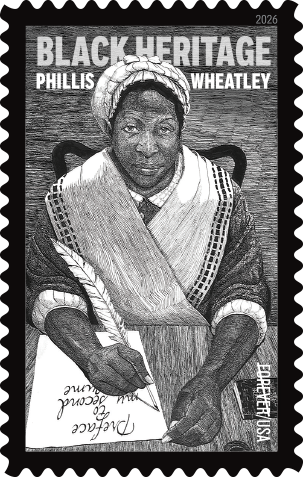
Back at the Museum of African American History, on Thursday, 26 February, it will host the first U.S. showing of “In Search of Phillis Wheatley Peters,” Leslie Askew’s thirty-five-minute documentary about the poet, her work, new discoveries about her life after marriage, and her cultural legacy. That event is scheduled from 6 to 8 P.M. It is free, with donations welcome. Reserve a space here.

Shown above is the first-class stamp featuring Phillis Wheatley, just issued by the U.S. Postal Service.

Monday, January 26, 2026

Historical Signage Removed at Independence National Park

Back in September, I shared news reports of the Trump White House complaining about signs at the President’s House Site in Independence National Historical Park.

That mansion, now gone, was the home of Presidents George Washington and John Adams in the 1790s. During Washington’s time, it was a site of enslavement—and of self-liberation.

Two of the Washington’s staff, Oney Judge and Hercules Posey, escaped from bondage at that house and made their way to free lives in New Hampshire and New York, respectively. (Boston 1775 readers might recall this blog played a tiny part in documenting Posey’s presence in New York.)

In erecting brick walls to show the outline of the mansion, the National Park Service also developed detailed signage to interpret the history of that site for visitors. That’s standard N.P.S. procedure, with the material going through many reviews for accuracy.

Last week, the Philadelphia Inquirer reported that N.P.S. workers had acted under orders to remove all those signs. All that remains now is a list of the people documented as enslaved in President Washington’s household, etched in cement. (And I have no idea how long that list will remain visible.)

I first read complaints about commemorating slavery at Independence N.H.P. over twenty years ago on the Revlist discussion group. I pointed out that this was also a story of people gaining their liberty and independence, so what park could be more fitting?

The objector was unwilling to recognize that freedom for black Americans was more significant than comfort for white Americans. That same attitude is evident in the current trumpery from the White House.

This President’s respect for historical fact is evident in his June 2024 comment on Washington owning slaves: “Actually I think he probably didn’t.” Likewise his 4 July 2019 statement about how the Continental “Army manned the air, it rammed the ramparts, it took over the airports,…”

After years of complaints that any community’s removal or alteration of a statue or monument was tantamount to erasing history, this administration is literally erasing history from a public site. But only a particular sort of history. 

Monday, January 12, 2026

Online Lectures from the National Parks of Boston

The National Parks of Boston and the Boston Public Library are teaming up to offer some online lectures for the Sestercentennial.

The announcements of these events don’t names the speakers, but they’re usually N.P.S. rangers and other experts who have researched the topics thoroughly.

Wednesday, 14 January, 6 to 7:30 P.M.
Benedict Arnold: The Trials and Contributions of an Early Patriot
Register here

Before his name is booed across the land, Benedict Arnold was an avid supporter in the Patriot cause. In order for his name to be so reviled he first had to make an impact to the cause. This program will explore the contributions made by Benedict Arnold in the early stages of the Revolutionary War and shed light on the complexities of a man who has become synonymous with betrayal.

Wednesday, 28 January, 6 to 7:30 P.M.
In the Shadow of the Declaration: Boston’s Hidden Architects of American Freedom
Register here

Explore how the Declaration of Independence reshaped Boston by examining the experiences of communities often excluded from its promises. Look at how Black Bostonians organized and petitioned for freedom while women questioned their exclusion from political and social rights. Together, these perspectives reveal how independence sparked debates over who truly benefited from the Revolution, showing 1776 Boston as a place where the ideals of freedom were contested, expanded, and reimagined.

Wednesday, 25 February, 6 to 7:30 P.M.
“Donation People”: Refugees from the Siege of Boston
Register here

The talk will examine the experience of the poor and ill forced out of Boston during the 1775-1776 siege. The refugees, known as donation people, bore the brunt of the American Revolutionary war in Boston, yet their treatment by the people of Massachusetts represented a spirit of welfare in the new nation.

Wednesday, 11 March, 6 to 7:30 P.M.
The Siege of Boston: An Ending and Beginning
Register here

This talk will explore the Siege of Boston – its origins, impacts, and conclusion – and how the departure of the British Military from Boston would influence the pivotal year of 1776 and what became the Revolutionary War.

Wednesday, 25 March, 6 to 7:30 P.M.
Remembering Revolution: Protest and Celebration of the Bicentennial
Register here

This talk will explore how the Bicentennial was celebrated in Boston. Learn how through protest, reenactments, and celebrations, Bostonians claimed the legacy of the Revolution for themselves 50 years ago.

In addition, the central library’s exhibit “Revolution!: 250 Years of Art & Activism in Boston” is open to all in-person visitors through 21 April. “Featuring over 100 artworks and documentary materials from the Boston Public Library’s Special Collections…this exhibition brings to light both familiar and lesser-known stories about America’s ongoing struggle for freedom, civil rights, and belonging for all.”

Sunday, December 14, 2025

“I Enquired for the waggon master”

On 16 May 1776, Gen. John Sullivan was at Albany, New York, trying to organize the remnants of the Continental Army’s invasion of Canada.

He sent a letter to Gen. George Washington complaining of the Northern Department’s wagon master, among other things:

Early on the 15 Inst. to my Surprize I found three hundred Barrels (which I had Sent forward) Lying on the Beach without any teams to Carry them to Still water about twelve miles further

I Enquired for the waggon master & was Informed he was at his own House About Six miles off

I Immediately wrote him of the Necessity of his Exerting himself at this time
Two days later Sullivan sent off another complaint about the wagon drivers:
I found at Still water a Number of Barrells of Pork that the Waggoners had Tap[p]ed & Drawn off the pickle to Lighten their Teams. This pork must Enevetably be Ruin’d before it can reach Canada,

as Genl [Philip] Schuyler was Absent I Order’d the Commissary not to Receive any Such from the Waggoners & the Commissary at half moon not to receive out of the Boats any or Deliver out such to the Waggoners.

I order’d the Waggoners not to Receive any such as it would Eventually be thrown on their hands I then Directed the Commissary here not to Send any Barrels forwards that had lost the Pickle which would be only taking up Batteaus & Waggons to Cary Provisions which when brought to Canada Could not be Eaten.

By this Step I hope to prevent any further fraud in the Waggoners who (it is said) Learnt this piece of Skill in the Last War, for which Some of them were well flogged, and I hope Some of them may Share the Same fate—again.
Washington passed on word of those complaints to Schuyler, who responded a month later:
As to the Waggon master he is an Industrious Active and I believe an honest Man, But It is not in his Power, nor any Mans whatsoever to procure Waggons at all Times & at that Time It was peculiarly difficult both on Account of the Scarcity of Forrage the Badness of the Roads and the extravagant Abuses the Waggoners had met with from some of the Troops that preceded General Sullivan’s Brigade.
Neither general named the wagon master, which might reflect how he wielded authority over the teamsters but wasn’t at the level of a gentlemen. Their letters do offer some clues about the man: He had his own house about six miles from where Sullivan was in Albany. He was literate. He was independent.

Now that man in May 1776 wasn’t necessarily the same official whom Schuyler oversaw in December 1775. Nonetheless, he was clearly not one of Schuyler’s slaves.

TOMORROW: Names at last.

Saturday, December 13, 2025

Was Gen. Schuyler’s Wagon Master One of His Enslaved Workers?

As quoted yesterday, on 29 Dec 1775 Col. Henry Knox wrote that Gen. Philip Schuyler “sent out his Waggon Master & other people to all parts of the Country” to hire teams of horses for transporting heavy ordnance to Springfield.

Back in 2016 Ian Mumpton at the Schuyler Mansion wrote:
It is unclear who the “Waggon Master” refers to, but as mentioned in a previous article, many of the men enslaved by the Schuyler family were skilled at driving carts and sleds. As there is no surviving record of Schuyler hiring a wagon master, it is likely that this person was one of the enslaved servants, possibly Lisbon or a man named Lewis who, five months later, was lent to Benjamin Franklin as a driver for a trip from the Schuyler’s home to New York City.
That previous article, also posted by Mumpton, analyzed a 1771 document which mentioned enslaved workers and said:
Lisbon and Dick are both mentioned in other Schuyler documents as carters or wagoners, conveying goods and people for the Schuyler family. Lisbon in particular is mentioned in at least four other sources, always in regards to his driving goods back and forth between Albany and Saratoga. These men’s ability to drive carts and sleds was a large part of their value to the Schuylers, as this was a specialized skill-set that involved being able to work with draft animals, manage tack and harness, and maintain the carts and sleds in their charge.
A comment noted another wagon driver named Anthony, Tony, or Tone.

I wouldn’t be surprised if Gen. Schuyler assigned some of his enslaved wagon drivers to the operation moving cannon toward Boston (and collected the same pay he was offering to other farmers for himself).

However, I’m not convinced that one of those men could have been Schuyler’s “Waggon Master.” That was an official designation within the Continental Army’s quartermaster department. On 9 August, Gen. George Washington appointed John Goddard of Brookline “Waggon Master General to the Army of the Twelve United Colonies.” (That count included Georgia but not Delaware, still officially a subset of Pennsylvania.)

In the fall of 1775 Schuyler had overseen preparations for Gen. Richard Montgomery’s invasion of Canada, an operation that probably required a convoy of wagons and thus an official to oversee them.

And that’s a crucial aspect of the job of wagon master. It required more than driving a wagon—indeed, the wagon master might not do any actual driving at all. The job involved making deals on behalf of the Continental Army with a large number of independent contractors and then overseeing a force of teamsters. The word “master” was even in the name. Did any enslaved man, however skilled, have the legal standing and social authority to do that job in 1775?

TOMORROW: Glimpses of Schuyler’s wagon master in spring 1776.

Friday, November 14, 2025

Call for Proposals for “Rebellion, Resistance & Refuge” Symposium

Slavery North has issued a call for proposals for a scholarly conference to be held at the University of Massachusetts, Amherst, on 8-12 July 2026 on the topic “Rebellion, Resistance, and Refuge: Slavery and Border-Crossing during the American Revolution.”

The call says:
Like all conflicts, the Revolutionary War (1775–1783) brought disruption, violence, and uncertainty. However, because it unfolded at a moment when Transatlantic Slavery was yet to be abolished in the regions that were to become Canada and the USA, for the enslaved, the war also brought large-scale upheaval of forced inland and maritime migration which opened opportunities for escape and emancipation. On the 250th anniversary of the signing of the Declaration of Independence, Slavery North invites proposals for papers that rethink the cultures, events, and experiences of the war across the liminal borders (regional and proto-national) of British North America.

While scholars of early America have centered studies on the political motivations and military maneuvers that influenced the rebels, the grassroots impact of sedition, and the interpretation of constitutional debates, most scholarship on the Canadian side of the border has been regionally and thematically biased towards a celebratory focus on White Loyalists in the Maritimes.

Meanwhile, little scholarship – Canadian or American – has been devoted to recuperating and understanding the experiences of the enslaved across regions, origins, identities, climates, geographies, and circumstances. Nor has attention been paid to the turmoil that ensued when White Loyalist enslavers, those they enslaved, and newly freed Black Loyalists were all evacuated into northern (Canadian) territories which had already been shaped by Transatlantic Slavery.

Slavery North invites abstracts for 20-minute papers in Humanities and Fine Arts disciplines that engage new approaches and perspectives, interrogate un(der)studied archives, and tackle original topics and themes on the art, cultural, material, and traditional histories of the Revolutionary War on both sides of the 49th parallel. We especially encourage contributions that recuperate and center the aspirations, resistance, perspectives, and experiences of enslaved people and communities.
Slavery North therefore “invites proposals for 20-minute papers from graduate students, scholars, professors, and cultural and heritage workers.” Those proposals must include:
  • Name, title, affiliation/institution, and location (city, province/state, country)
  • Paper title
  • Abstract (200-300 words)
  • Two-page c.v. (featuring research highlights)
The submission deadline is Friday, 19 December. Proposals should be sent via email as P.D.F. files to Emily Davidson.

Scholars whose proposals are accepted in January will be expected to participate fully in the in-person symposium program in Amherst. The organizers will cover the costs of travel, accommodation, and some meals.